

EN 13295:2004
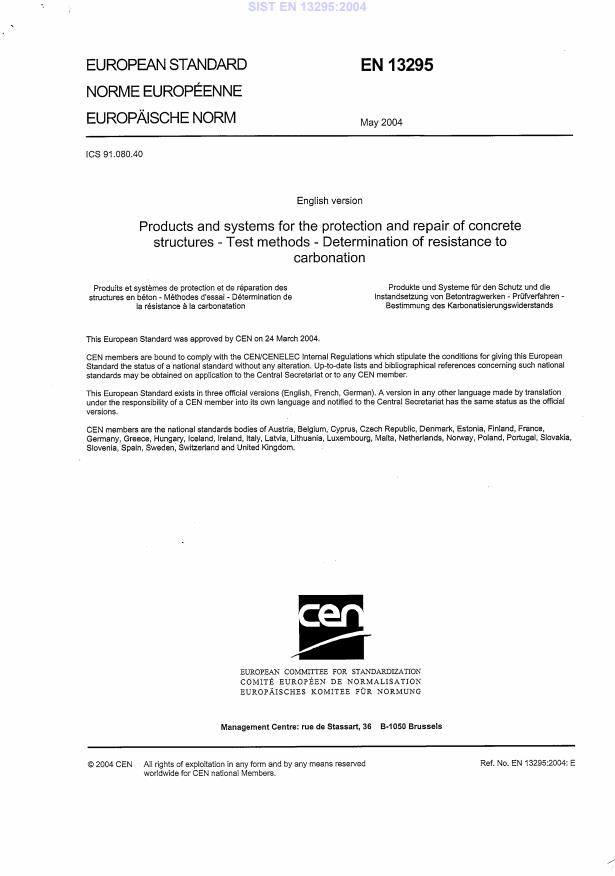
(Main)Products and systems for the protection and repair of concrete structures - Test methods - Determination of resistance to carbonation
- Abstract
This European Standard specifies an accelerated laboratory method for measuring the resistance against carbon dioxide penetration through repair products and systems, as defined in EN 1504-3 1). The method is suitable for assessing the performance of repair grouts, mortars and concretes without a protective coating system applied. The method does not measure the resistance to reduction in pH-value that may occur by absorption of other acidic gases (e.g. SO2, HCl etc.).
- Status
- Published
- Publication Date
- 18-May-2004
- Withdrawal Date
- 29-Nov-2004
- Technical Committee
- CEN/TC 104 - Concrete ( performance, production, placing and compliance criteria )
- Drafting Committee
- CEN/TC 104/SC 8/WG 2 - Repair
- Current Stage
- 9092 - Decision on results of review/2YR ENQ - revise - Review Enquiry
- Start Date
- 29-Jun-2020
- Completion Date
- 21-Oct-2026

Overview - EN 13295:2004 (Resistance to Carbonation)
EN 13295:2004 is a European Standard (CEN) that specifies an accelerated laboratory method to determine the resistance of repair products and systems to carbonation (carbon dioxide penetration). It applies to repair grouts, mortars and concretes used for protection and repair of concrete structures as defined in EN 1504-3. The method is intended for assessing performance when no protective coating system is applied. It does not measure resistance to reductions in pH caused by other acidic gases (for example SO2 or HCl).
Key topics and technical requirements
- Scope: Focused on repair products and systems (grouts, mortars, concretes) used in structural repair and protection.
- Test approach: An accelerated laboratory test to quantify resistance to carbonation (CO2 penetration) of repair materials.
- Applicability limits: Suitable only for materials without an applied protective coating; excludes measurement of pH changes from other acidic gas absorption.
- Standard reference: Linked to definitions and product categories in EN 1504-3 (repair products and systems).
- Intended outcome: Provides comparative, reproducible data to evaluate how well a repair material resists CO2 ingress under accelerated conditions.
Practical applications and who uses EN 13295:2004
- Materials manufacturers use the standard for product development, performance claims, and technical datasheets for repair mortars, grouts and concretes.
- Testing laboratories apply the method to generate standardized carbonation-resistance data for third‑party verification and quality control.
- Structural and materials engineers include results from EN 13295 tests when specifying repair systems to ensure long-term durability against carbonation.
- Contractors and specifiers reference the standard when selecting repair products for concrete rehabilitation projects where carbonation resistance is a concern.
- Research organizations use the accelerated method to compare formulations and to study durability performance of repair materials.
Related standards
- EN 1504-3 - Defines repair products and systems categories referenced by EN 13295.
- Other standards in the EN 1504 series (concrete repair and protection) are relevant when creating a comprehensive specification for repair systems.
Keywords: EN 13295:2004, resistance to carbonation, carbonation testing, concrete repair, repair mortars, repair grouts, repair concretes, EN 1504-3, accelerated laboratory method.
Relations
- Effective Date
- 28-Jan-2026
- Effective Date
- 28-Jan-2026
- Effective Date
- 28-Jan-2026
- Effective Date
- 28-Jan-2026
- Effective Date
- 28-Jan-2026
- Effective Date
- 28-Jan-2026
Get Certified
Connect with accredited certification bodies for this standard

DIBt (Deutsches Institut für Bautechnik)
German Institute for Building Technology.
DIN CERTCO
DIN Group product certification.

Aboma Certification B.V.
Specialized in construction, metal, and transport sectors.
Sponsored listings
Frequently Asked Questions
EN 13295:2004 is a standard published by the European Committee for Standardization (CEN). Its full title is "Products and systems for the protection and repair of concrete structures - Test methods - Determination of resistance to carbonation". This standard covers: This European Standard specifies an accelerated laboratory method for measuring the resistance against carbon dioxide penetration through repair products and systems, as defined in EN 1504-3 1). The method is suitable for assessing the performance of repair grouts, mortars and concretes without a protective coating system applied. The method does not measure the resistance to reduction in pH-value that may occur by absorption of other acidic gases (e.g. SO2, HCl etc.).
This European Standard specifies an accelerated laboratory method for measuring the resistance against carbon dioxide penetration through repair products and systems, as defined in EN 1504-3 1). The method is suitable for assessing the performance of repair grouts, mortars and concretes without a protective coating system applied. The method does not measure the resistance to reduction in pH-value that may occur by absorption of other acidic gases (e.g. SO2, HCl etc.).
EN 13295:2004 is classified under the following ICS (International Classification for Standards) categories: 91.080.40 - Concrete structures. The ICS classification helps identify the subject area and facilitates finding related standards.
EN 13295:2004 has the following relationships with other standards: It is inter standard links to EN 1015-2:1998, EN 1504-1:1998, EN 196-1:2016, EN 1766:2017, CEN/TR 16563:2013, EN 1504-3:2005. Understanding these relationships helps ensure you are using the most current and applicable version of the standard.
EN 13295:2004 is associated with the following European legislation: EU Directives/Regulations: 305/2011, 89/106/EEC; Standardization Mandates: M/128. When a standard is cited in the Official Journal of the European Union, products manufactured in conformity with it benefit from a presumption of conformity with the essential requirements of the corresponding EU directive or regulation.
EN 13295:2004 is available in PDF format for immediate download after purchase. The document can be added to your cart and obtained through the secure checkout process. Digital delivery ensures instant access to the complete standard document.
Standards Content (Sample)
2003-01.Slovenski inštitut za standardizacijo. Razmnoževanje celote ali delov tega standarda ni dovoljeno.Produkte und Systeme für den Schutz und die Instandsetzung von Betontragwerken - Prüfverfahren - Bestimmung des KarbonatisierungswiderstandsProduits et systemes pour la protection et la réparation des structures en béton - Méthodes d'essai - Détermination de la résistance a la carbonatationProducts and systems for the protection and repair of concrete structures - Test methods - Determination of resistance to carbona
...