

EN 16750:2017+A1:2020
(Main + Amendment)Fixed firefighting systems - Oxygen reduction systems - Design, installation, planning and maintenance
General Information
- Abstract
This European standard specifies oxygen reduction systems that are used as fire prevention systems by creating an atmosphere in an area which is having a lower permanent oxygen concentration as in ambient conditions. The level of oxygen reduction is defined by the individual risks of these areas (see Annex A). Oxygen reduction is achieved by technical systems which are providing a flux of air containing a reduced concentration of oxygen.
This European standard specifies minimum requirements and defines the specifications governing the design, installation and maintenance of fixed oxygen reduction systems with oxygen reduced air in buildings and industrial production plants. The standard also applies to the extension and modification of existing systems.
This European standard applies to oxygen reduction systems using nitrogen which are designed for continual oxygen reduction in enclosed spaces.
NOTE Nitrogen is today the most suitable gas to be used for oxygen reduction. For other gases this European standard can be used as basis.
This European standard does not apply to oxygen reduction systems that use water mist or combustion gases.
The European standard does not apply to:
- explosion suppression systems;
- explosion prevention systems;
- fire extinguishing systems using gaseous extinguishing agents;
- inertization of portable containers;
- systems in which oxygen levels are reduced for reasons other than fire prevention (e.g. steel processing in the presence of inert gas to avoid the formation of oxide film);
- inerting required during repair work on systems or equipment (e.g. welding) in order to eliminate the risk of fire or explosion.
In addition to the conditions for the actual oxygen reduction system and its individual components this European standard also covers certain structural specifications for the protected area.
The space protected by an oxygen reduction system is a controlled and continuously monitored indoor climate for extended occupation. This standard does not cover unventilated confined spaces that may contain hazardous gases.
- Status
- Published
- Publication Date
- 18-Aug-2020
- Withdrawal Date
- 27-Feb-2021
- Technical Committee
- CEN/TC 191 - Fixed firefighting systems
- Drafting Committee
- CEN/TC 191/WG 6 - Gas extinguishing Systems and components
- Current Stage
- 9093 - Decision to confirm - Review Enquiry
- Start Date
- 06-Apr-2023
- Completion Date
- 23-Sep-2026



Overview
EN 16750:2017+A1:2020 is a CEN European standard for fixed firefighting systems - oxygen reduction systems. It defines minimum requirements for the design, installation, planning and maintenance of systems that prevent fire by creating and maintaining a permanently oxygen‑reduced atmosphere in enclosed spaces. The standard applies primarily to systems using nitrogen to supply oxygen‑reduced air and covers continuous inerting solutions in buildings and industrial plants. It does not apply to water‑mist or combustion‑gas systems, gaseous extinguishing agents, explosion‑suppression systems or inerting for non‑fire‑prevention processes.
Key topics and technical requirements
EN 16750 lays out technical and organizational requirements including:
- System requirements and effectiveness - criteria for achieving target oxygen concentration based on assessed ignition thresholds (see Annex A).
- Design - qualification of designers, fire protection concepts, structural specifications for the protected area, safety margins and calculation of oxygen‑reduced air quantities.
- Distribution pipework - installation, components and support requirements for delivery of reduced‑oxygen air.
- Monitoring and controls - continuous oxygen concentration monitoring, alarms (local and external), fault signalling and data recording.
- Control equipment and power - functional and electrical requirements for control panels and supply reliability.
- Operation, maintenance and documentation - inspection, maintenance schedules, training, operations logs and system documentation.
- Health & safety (Annex B) - guidance on occupational safety, risk classification and measures for working in reduced‑oxygen atmospheres.
- National regulatory considerations (Annex C) - awareness that national rules for access and work in low‑oxygen areas vary across EU members.
Applications and who uses this standard
EN 16750 is intended for stakeholders involved in fire prevention by atmospheric control:
- Fire safety engineers and consultants designing oxygen reduction solutions.
- System manufacturers and installers responsible for equipment selection and installation.
- Facility and plant managers deploying continuous nitrogen inerting for archives, data centers, museums, warehouses, chemical or pharmaceutical production areas.
- Maintenance contractors performing inspections, testing and servicing.
- Regulators and safety officers assessing compliance and occupational health impacts.
Practical benefits include reduced ignition risk for stored materials, tailored fire prevention strategies, and clear operational and safety procedures for continuously occupied, controlled atmospheres.
Related standards
EN 16750 references and complements other standards, notably:
- EN 54 (Fire detection and alarm systems)
- EN 50104 (Oxygen measuring apparatus)
- EN 12094‑1 (Components for gas extinguishing systems)
Keywords: EN 16750, oxygen reduction systems, fixed firefighting systems, nitrogen inerting, oxygen‑reduced air, design, installation, maintenance, fire prevention.
Relations
- Effective Date
- 18-Jan-2023
- Effective Date
- 01-Jul-2020
- Effective Date
- 09-Feb-2026
- Effective Date
- 28-Jan-2026
- Effective Date
- 28-Jan-2026
- Effective Date
- 28-Jan-2026
- Effective Date
- 28-Jan-2026
- Effective Date
- 28-Jan-2026
- Effective Date
- 28-Jan-2026
- Effective Date
- 28-Jan-2026
- Effective Date
- 28-Jan-2026
- Effective Date
- 28-Jan-2026
- Effective Date
- 28-Jan-2026
- Effective Date
- 28-Jan-2026
- Effective Date
- 28-Jan-2026
Get Certified
Connect with accredited certification bodies for this standard

CIS Institut d.o.o.
Personal Protective Equipment (PPE) certification body. Notified Body NB-2890 for EU Regulation 2016/425 PPE.

Kiwa BDA Testing
Building and construction product certification.
Kmetijski inštitut Slovenije
Agricultural Institute of Slovenia. Soil testing, plant health, agricultural product analysis.
Sponsored listings
Frequently Asked Questions
EN 16750:2017+A1:2020 is a standard published by the European Committee for Standardization (CEN). Its full title is "Fixed firefighting systems - Oxygen reduction systems - Design, installation, planning and maintenance". This standard covers: This European standard specifies oxygen reduction systems that are used as fire prevention systems by creating an atmosphere in an area which is having a lower permanent oxygen concentration as in ambient conditions. The level of oxygen reduction is defined by the individual risks of these areas (see Annex A). Oxygen reduction is achieved by technical systems which are providing a flux of air containing a reduced concentration of oxygen. This European standard specifies minimum requirements and defines the specifications governing the design, installation and maintenance of fixed oxygen reduction systems with oxygen reduced air in buildings and industrial production plants. The standard also applies to the extension and modification of existing systems. This European standard applies to oxygen reduction systems using nitrogen which are designed for continual oxygen reduction in enclosed spaces. NOTE Nitrogen is today the most suitable gas to be used for oxygen reduction. For other gases this European standard can be used as basis. This European standard does not apply to oxygen reduction systems that use water mist or combustion gases. The European standard does not apply to: - explosion suppression systems; - explosion prevention systems; - fire extinguishing systems using gaseous extinguishing agents; - inertization of portable containers; - systems in which oxygen levels are reduced for reasons other than fire prevention (e.g. steel processing in the presence of inert gas to avoid the formation of oxide film); - inerting required during repair work on systems or equipment (e.g. welding) in order to eliminate the risk of fire or explosion. In addition to the conditions for the actual oxygen reduction system and its individual components this European standard also covers certain structural specifications for the protected area. The space protected by an oxygen reduction system is a controlled and continuously monitored indoor climate for extended occupation. This standard does not cover unventilated confined spaces that may contain hazardous gases.
This European standard specifies oxygen reduction systems that are used as fire prevention systems by creating an atmosphere in an area which is having a lower permanent oxygen concentration as in ambient conditions. The level of oxygen reduction is defined by the individual risks of these areas (see Annex A). Oxygen reduction is achieved by technical systems which are providing a flux of air containing a reduced concentration of oxygen. This European standard specifies minimum requirements and defines the specifications governing the design, installation and maintenance of fixed oxygen reduction systems with oxygen reduced air in buildings and industrial production plants. The standard also applies to the extension and modification of existing systems. This European standard applies to oxygen reduction systems using nitrogen which are designed for continual oxygen reduction in enclosed spaces. NOTE Nitrogen is today the most suitable gas to be used for oxygen reduction. For other gases this European standard can be used as basis. This European standard does not apply to oxygen reduction systems that use water mist or combustion gases. The European standard does not apply to: - explosion suppression systems; - explosion prevention systems; - fire extinguishing systems using gaseous extinguishing agents; - inertization of portable containers; - systems in which oxygen levels are reduced for reasons other than fire prevention (e.g. steel processing in the presence of inert gas to avoid the formation of oxide film); - inerting required during repair work on systems or equipment (e.g. welding) in order to eliminate the risk of fire or explosion. In addition to the conditions for the actual oxygen reduction system and its individual components this European standard also covers certain structural specifications for the protected area. The space protected by an oxygen reduction system is a controlled and continuously monitored indoor climate for extended occupation. This standard does not cover unventilated confined spaces that may contain hazardous gases.
EN 16750:2017+A1:2020 is classified under the following ICS (International Classification for Standards) categories: 13.220.20 - Fire protection. The ICS classification helps identify the subject area and facilitates finding related standards.
EN 16750:2017+A1:2020 has the following relationships with other standards: It is inter standard links to EN 16750:2017, EN 16750:2017/FprA1, EN IEC 60079-29-0:2026, EN 54-16:2008, EN 54-12:2015, EN 12094-1:2003, EN 54-28:2016, EN 54-5:2017+A1:2018, EN 54-4:1997, EN 54-4:1997/A1:2002, EN 54-1:2021, EN 54-30:2015, EN 54-25:2008, EN 54-21:2006, EN 54-24:2008. Understanding these relationships helps ensure you are using the most current and applicable version of the standard.
EN 16750:2017+A1:2020 is available in PDF format for immediate download after purchase. The document can be added to your cart and obtained through the secure checkout process. Digital delivery ensures instant access to the complete standard document.
Standards Content (Sample)
SLOVENSKI STANDARD
01-november-2020
Nadomešča:
SIST EN 16750:2017
Vgrajeni gasilni sistemi - Sistemi z zmanjšano koncentracijo kisika - Projektiranje,
vgradnja, načrtovanje in vzdrževanje
Fixed firefighting systems - Oxygen reduction systems - Design, installation, planning
and maintenance
Ortsfeste Löschanlagen - Sauerstoffreduktionsanlagen - Auslegung, Einbau, Planung
und Instandhaltung
Installations fixes de lutte contre l'incendie - Systèmes d'appauvrissement en oxygène -
Conception, installation, planification et maintenance
Ta slovenski standard je istoveten z: EN 16750:2017+A1:2020
ICS:
13.220.10 Gašenje požara Fire-fighting
2003-01.Slovenski inštitut za standardizacijo. Razmnoževanje celote ali delov tega standarda ni dovoljeno.
EN 16750:2017+A1
EUROPEAN STANDARD
NORME EUROPÉENNE
August 2020
EUROPÄISCHE NORM
ICS 13.220.20 Supersedes EN 16750:2017
English Version
Fixed firefighting systems - Oxygen reduction systems -
Design, installation, planning and maintenance
Installations fixes de lutte contre l'incendie - Systèmes Ortsfeste Löschanlagen - Sauerstoffreduktionsanlagen -
d'appauvrissement en oxygène - Conception, Auslegung, Einbau, Planung und Instandhaltung
installation, planification et maintenance
This European Standard was approved by CEN on 9 July 2017 and includes Amendment 1 approved by CEN on 12 July 2020.
CEN members are bound to comply with the CEN/CENELEC Internal Regulations which stipulate the conditions for giving this
European Standard the status of a national standard without any alteration. Up-to-date lists and bibliographical references
concerning such national standards may be obtained on application to the CEN-CENELEC Management Centre or to any CEN
member.
This European Standard exists in three official versions (English, French, German). A version in any other language made by
translation under the responsibility of a CEN member into its own language and notified to the CEN-CENELEC Management
Centre has the same status as the official versions.
CEN members are the national standards bodies of Austria, Belgium, Bulgaria, Croatia, Cyprus, Czech Republic, Denmark, Estonia,
Finland, France, Germany, Greece, Hungary, Iceland, Ireland, Italy, Latvia, Lithuania, Luxembourg, Malta, Netherlands, Norway,
Poland, Portugal, Republic of North Macedonia, Romania, Serbia, Slovakia, Slovenia, Spain, Sweden, Switzerland, Turkey and
United Kingdom.
EUROPEAN COMMITTEE FOR STANDARDIZATION
COMITÉ EUROPÉEN DE NORMALISATION
EUROPÄISCHES KOMITEE FÜR NORMUNG
CEN-CENELEC Management Centre: Rue de la Science 23, B-1040 Brussels
© 2020 CEN All rights of exploitation in any form and by any means reserved Ref. No. EN 16750:2017+A1:2020 E
worldwide for CEN national Members.
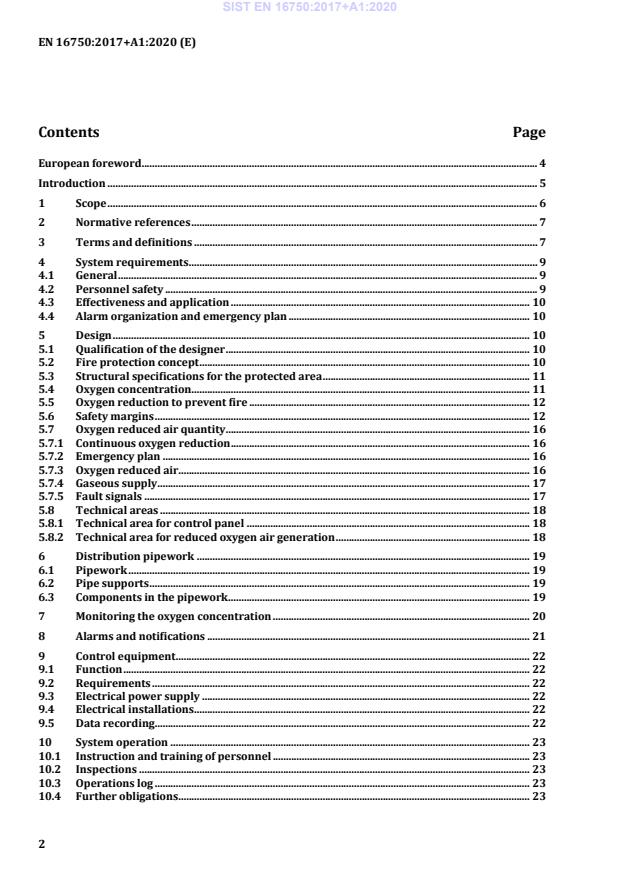
Contents Page
European foreword . 4
Introduction . 5
1 Scope . 6
2 Normative references . 7
3 Terms and definitions . 7
4 System requirements . 9
4.1 General . 9
4.2 Personnel safety . 9
4.3 Effectiveness and application . 10
4.4 Alarm organization and emergency plan . 10
5 Design . 10
5.1 Qualification of the designer . 10
5.2 Fire protection concept . 10
5.3 Structural specifications for the protected area . 11
5.4 Oxygen concentration . 11
5.5 Oxygen reduction to prevent fire . 12
5.6 Safety margins . 12
5.7 Oxygen reduced air quantity . 16
5.7.1 Continuous oxygen reduction . 16
5.7.2 Emergency plan . 16
5.7.3 Oxygen reduced air . 16
5.7.4 Gaseous supply . 17
5.7.5 Fault signals . 17
5.8 Technical areas . 18
5.8.1 Technical area for control panel . 18
5.8.2 Technical area for reduced oxygen air generation . 18
6 Distribution pipework . 19
6.1 Pipework . 19
6.2 Pipe supports . 19
6.3 Components in the pipework . 19
7 Monitoring the oxygen concentration . 20
8 Alarms and notifications . 21
9 Control equipment . 22
9.1 Function . 22
9.2 Requirements . 22
9.3 Electrical power supply . 22
9.4 Electrical installations . 22
9.5 Data recording . 22
10 System operation . 23
10.1 Instruction and training of personnel . 23
10.2 Inspections . 23
10.3 Operations log . 23
10.4 Further obligations . 23
11 Maintenance . 24
12 Documentation . 24
13 Installation . 25
13.1 Qualification of the installer . 25
13.2 General specifications, installation . 25
Annex A (normative) Ignition thresholds for oxygen reduction using nitrogen in fire
prevention . 26
A.1 Ignition thresholds . 26
A.2 Tests to ascertain ignition thresholds of unfamiliar materials . 27
A.2.1 Cup burner tests . 27
A.2.2 Ignition threshold tests . 28
A.2.2.1 General . 28
A.2.2.2 Test criteria . 29
A.2.2.3 Test documentation . 29
Annex B (informative) Information for health and safety – Working in oxygen-reduction
atmospheres for reasons of fire prevention . 31
B.1 General . 31
B.2 Principles of occupational health . 31
B.3 Risk classes . 31
B.4 Basic requirements, planning and installation . 32
B.5 Protective measures for all areas with oxygen-reduced atmospheres . 33
B.5.1 Structural and technical measures. 33
B.5.2 Organizational measures . 34
B.6 Risk classes and safety measures . 35
Annex C (informative) Existing national regulations for access and working in areas with
lower oxygen concentration . 36
Bibliography . 37
European foreword
This document (EN 16750:2017+A1:2020) has been prepared by Technical Committee CEN/TC 191
“Fixed firefighting systems”, the secretariat of which is held by BSI.
This European Standard shall be given the status of a national standard, either by publication of an
identical text or by endorsement, at the latest by February 2021, and conflicting national standards
shall be withdrawn at the latest by February 2021.
Attention is drawn to the possibility that some of the elements of this document may be the subject of
patent rights. CEN shall not be held responsible for identifying any or all such patent rights.
This document supersedes !EN 16750:2017".
This document includes Amendment 1 approved by CEN on 12 July 2020.
The start and finish of text introduced or altered by amendment is indicated in the text by tags !".
According to the CEN-CENELEC Internal Regulations, the national standards organisations of the
following countries are bound to implement this European Standard: Austria, Belgium, Bulgaria,
Croatia, Cyprus, Czech Republic, Denmark, Estonia, Finland, France, Germany, Greece, Hungary, Iceland,
Ireland, Italy, Latvia, Lithuania, Luxembourg, Malta, Netherlands, Norway, Poland, Portugal, Republic of
North Macedonia, Romania, Serbia, Slovakia, Slovenia, Spain, Sweden, Switzerland, Turkey and the
United Kingdom.
Introduction
Oxygen reduction systems are designed to prevent fires from starting or spreading, by means of the
introduction of oxygen reduced air. Oxygen reduction systems are not designed to extinguish fires. The
design and installation shall be based on detailed knowledge of the protected area, its occupancy and
the materials in question. It is important to suit the fire protection measures to the hazard as a whole.
It is important to emphasize that across the European Union there are several regulatory and legislative
limitations for access and working in areas with lower oxygen concentration, so it is important to take
these limitations into account. Use of this European Standard can vary based on the national legislation
in each country of the European Union.
1 Scope
This European standard specifies oxygen reduction systems that are used as fire prevention systems by
creating an atmosphere in an area which is having a lower permanent oxygen concentration as in
ambient conditions. The level of oxygen reduction is defined by the individual risks of these areas (see
Annex A). Oxygen reduction is achieved by technical systems which are providing a flux of air
containing a reduced concentration of oxygen.
This European standard specifies minimum requirements and defines the specifications governing the
design, installation and maintenance of fixed oxygen reduction systems with oxygen reduced air in
buildings and industrial production plants. The standard also applies to the extension and modification
of existing systems.
This European standard applies to oxygen reduction systems using nitrogen which are designed for
continual oxygen reduction in enclosed spaces.
NOTE Nitrogen is today the most suitable gas to be used for oxygen reduction. For other gases this European
standard can be used as basis.
This European standard does not apply to oxygen reduction systems that use water mist or combustion
gases.
The European standard does not apply to:
— explosion suppression systems;
— explosion prevention systems;
— fire extinguishing systems using gaseous extinguishing agents;
— inertization of portable containers;
— systems in which oxygen levels are reduced for reasons other than fire prevention (e.g. steel
processing in the presence of inert gas to avoid the formation of oxide film);
— inerting required during repair work on systems or equipment (e.g. welding) in order to eliminate
the risk of fire or explosion.
In addition to the conditions for the actual oxygen reduction system and its individual components this
European standard also covers certain structural specifications for the protected area.
The space protected by an oxygen reduction system is a controlled and continuously monitored indoor
climate for extended occupation. This standard does not cover unventilated confined spaces that may
contain hazardous gases.
2 Normative references
The following documents, in whole or in part, are normatively referenced in this document and are
indispensable for its application. For dated references, only the edition cited applies. For undated
references, the latest edition of the referenced document (including any amendments) applies.
EN 54 (all parts), Fire detection and fire alarm systems
EN 12094-1, Fixed firefighting systems — Components for gas extinguishing systems — Part 1:
Requirements and test methods for electrical automatic control and delay devices
EN 50104, Electrical apparatus for the detection and measurement of oxygen — Performance
requirements and test methods
3 Terms and definitions
For the purposes of this document, the following terms and definitions apply.
3.1
Alarms
3.1.1
external alarm
alarm to emergency services such as fire brigade or permanently attended location
3.1.2
local alarm
acoustic and possibly additional visual alarm in protected areas or their immediate surroundings
3.1.3
internal alarm
acoustic and visual displays at the detection panel, possibly with additional displays at other signalling
equipment
3.1.4
alarm threshold
value of a process parameter which, when reached, triggers an alarm and, where necessary, initiates
automatic protection measures
3.1.5
alarm signal
signal to warn people at risk and/or to summon help from the emergency services and/or to provide
information about automatic response measures
3.2
design concentration
ingnition threshold including a safety margin
Note 1 to entry: See also Figure 1.
Note 2 to entry: The design concentration represents the maximum oxygen concentration which cannot be
exceeded in any time.
3.3
emergency situation
deviation from normal operation
EXAMPLE For example a significant deviation from the threshold value (scale of risk).
3.4
operating pressure
pressure of a system under normal operating conditions
3.5
combustible material
A material capable of combustion or being ignited
Note 1 to entry: For the purposes of this standard, whether the quantity of a combustible material is to be
regarded as significant or not can be determined by means of a risk analysis as part of the fire protection design.
3.6
ignition threshold
maximum oxygen concentration in a mixture of a combustible material with air and inert gas, in which
there can be no ignition, determined under established test conditions
Note 1 to entry: This is a specific characteristic of combustible material and inert gas (see A.1).
3.7
detection and alarm installation
remote detection system for the reliable detection of risk to people and property
Note 1 to entry: It creates alarm reports from automatic or manually input information, issues these and detects
any faults. The transmission channels for information and alarms are monitored. Special measures are in place to
prevent any malfunction as far as possible, which may be powered electrically or otherwise. Detection and alarm
systems cover facilities for the input, transmission (through wires or wirelessly), processing and issuing of alarms,
including the necessary power supply. This standard applies to detection and alarm systems which detect and
report the scale of the risk at an early stage.
3.8
measuring zones
virtual separation of the protected volume for oxygen measuring
3.9
normal operation
situation in which the equipment, protection systems and components are able to carry out their
designated functions within their design parameters
3.10
oxygen reduced air
ambient air with an oxygen concentration lower than natural air
3.11
oxygen reduced air supply
nitrogen enriched air stream with an oxygen concentration of less than natural air ready to be
introduced into a protected volume
3.12
oxygen reduction
reduction of oxygen which increases the nitrogen concentration to prevent the ignition or spread of fire
3.13
protected volume
effective volume of the space to be protected
3.14
system
combination of components whose function and compatibility guarantees the safety of the installation
3.15
technical areas
areas where either or the control panel, nitrogen production unit and other relevant system
components are placed
3.16
control panel
electrical device for monitoring, controlling and alarm of the oxygen reduction system
4 System requirements
4.1 General
An oxygen reduction system shall consist basically of:
a) a supply of oxygen reduced air;
b) a fixed pipework system with fittings, valves, nozzles, outlets;
c) oxygen sensors and control panel;
d) alarms.
Oxygen reduced air is produced by air separation or by injecting inert gas or gas mixture into the
protected area.
The oxygen concentration in the protected area shall be monitored by means of measuring equipment.
During operation, the supply of nitrogen shall be controlled automatically according to demand. Where
necessary as a result of a risk analysis additional means shall be provided to operate the supply
manually or an additional supply operated manually or automatically.
The oxygen reduction system can be equipped with automatic equipment designed to shut down
machinery and to close fire doors and other equipment, with the aim of creating and maintaining the
required oxygen concentration.
4.2 Personnel safety
Oxygen reduced air can be dangerous for personnel.
Adherence to this European Standard does not remove the user's statutory responsibility to comply
with the relevant national bodies and laws. In case no national laws exist, further information can be
found in Annex B.
Code requirements for unventilated confined spaces do not apply to space protected by oxygen
reduction system that control and continuously monitor indoor climate for extended occupation.
Personnel safety measures shall be made for the fact that neighbouring volumes can have a reduced
oxygen concentration. These areas may also need to be monitored and/or personnel safety measures
may need to be taken.
Technical or organizational measures shall be taken to prevent unauthorized people from entering
protected areas with permanently reduced oxygen levels.
The measurement system shall be designed in such a way that a loss of function or a measurement
error can in no event lead to the minimum oxygen threshold not being detected.
The spreading of the oxygen-reduced atmosphere to other areas not intended for this (e.g. through wall
openings, cable ducts, floor drainages, leaking doors, conveyor belts, etc.) shall be prevented.
4.3 Effectiveness and application
A fire risk assessment detailing the key fire protection factors shall be done. The important aspects are:
— the type and quantity of material/materials requiring protection;
— the area(s) requiring protection;
— the right dimension of the oxygen reduced air supply to maintain the reduced oxygen concentration
on its design value;
— a back-up oxygen reduced air supply, if provided;
— alarm equipment.
Oxygen reduction systems provide preventive fire protection. The introduction of nitrogen reduces the
oxygen concentration of the air, thereby preventing the ignition or spread of fire except for the
following:
— chemicals containing their own supply of oxygen, such as cellulose nitrate;
— mixtures containing oxidizing materials, such as sodium chlorate or sodium nitrate;
— chemicals cable of undergoing auto-thermal decomposition, such as some organic peroxides;
— reactive metals (such as sodium, potassium, magnesium, titanium and zirconium), reactive
hydrides or metal amides, some of which may react violently.
4.4 Alarm organization and emergency plan
An alarm organization is required for the following purposes:
— to alert affected and responsible persons;
— to alert the permanently attended location;
— to initiate other necessary protective measures.
The responsibilities for the alarm organization shall be defined.
The emergency plan should cover keywords to designate the basic measures that need to be taken in
case of emergency, too low oxygen level or fire signal.
5 Design
5.1 Qualification of the designer
The designer shall be sufficiently technically qualified to ensure effective protection.
5.2 Fire protection concept
The system design shall be part of the fire safety concept of the building.
As part of the system design a fire risk assessment might lead to further fire protection measures.
EXAMPLE Since the oxygen reduction system cannot prevent or detect smouldering or pyrolizing processes
(e.g. overheated cables) suitable smoke detection systems for the protected volume e.g. high sensitive smoke
detection systems according to EN 54–20 class A, are recommended and should be part of the main fire alarm
system of the facility.
Where special circumstances deviate from what is covered in this standard, for example spatial
configuration, structure, installations, combustible materials, altitude different from sea level,
temperature different from normal, fumes or gases, require special measures, the designer shall take
these into account. In these cases the appropriate authorities shall be consulted.
5.3 Structural specifications for the protected area
Structural partitions shall comply with the criteria governing the protection target, as shown in Table 1.
Building regulation specifications are unaffected by these measures.
Table 1 — Structural partitions
Level Protection target Protected Specification Achieved by
volume
Enclosing elements (walls,
floor and roof) shall be
The contents of a room
a
1 shall be protected Room —
sufficiently air tight over the
from internal fires.
life time to protect from
internal fires.
Enclosing elements (walls,
The contents of a room The construction
floor and roof) shall be
shall be protected of fire
a
sufficiently air tight over the
from internal fires and compartments
2 Room
life time and provide
from fires spreading according to the
protection against the spread
from an external relevant
of fire from the surrounding
source. guidelines.
area.
a
Openings shall be constantly sealed or sealable; otherwise the openings shall be reflected in the
calculation of the nitrogen production.
The user should be aware of the relationship between leakage, reduced oxygen air supply and the
system duty cycle.
In the case of oxygen reduction systems all operational openings that are not included in the calculation
of the required levels of oxygen shall be provided with closing mechanisms or monitored via limit
switches. These operational openings include emergency exit doors and other doors, gates etc.
5.4 Oxygen concentration
The following information should be used (where relevant) to determine the design concentration:
— combustible material present (in normal operation and in the case of maintenance work or faults);
— geometry of the combustible materials (e.g. hollow items, thin walls etc.);
— volume of gas contained in combustible materials (e.g. hollow parts, densely packed storage items);
— temperatures and pressures in the protected area;
— safety margin between oxygen concentrations established experimentally and the oxygen
concentrations required for the design of the oxygen reduction system.
5.5 Oxygen reduction to prevent fire
NOTE Ignition can only be prevented in protected areas if the oxygen concentration within the protected area
does not exceed the design concentration. If this level is exceeded, the protection objective of “fire prevention” can
no longer be guaranteed.
If different combustible materials are present in the protected area the lowest ignition threshold (i.e.
the most ignitable material in its most ignitable geometry) shall be taken as the basis for determining
the design concentration. In individual cases additional tests can be carried out to establish ignition
thresholds for combustible materials in the forms and geometry in which the materials are actually
present.
Ignition thresholds for oxygen reduction using nitrogen for various applications are given in A.1. Values
obtained with mixtures of other gas components can differ from these figures. These concentrations are
determined under the specific test conditions described in A.2.
Concentrations other than those shown in Table A.1 can be achieved and allowed when national
legislation (if applicable) are met and the test is validated by test reports in accordance with A.2.
Materials not listed in Table A.1 should be tested in accordance with the test in A.2 and validated by test
reports. Users of this European Standard are advised to inform themselves of the applicability or non-
applicability for this European Standard by their national responsible authorities. If the procedures
described in A.2 is not applicable the ignition threshold shall be determined by the national responsible
authorities. The design of oxygen reduction systems shall take into account the ignition levels and the
safety margins described in 5.6. This design concentration shall not be exceeded anywhere in the
protected area. In case of any fault arising action shall be taken according to the emergency plan (see
5.7.2).
WARNING — Where stored goods may allow a large amount of oxygen to enter the warehouse, the test
structure and the test described in A.2 may not be sufficient. In such cases an appropriate design
concentration shall be agreed with the national responsible authorities. Such cases might include e.g.
warehouses containing toilet paper or clothing in bales.
5.6 Safety margins
The safety margin for oxygen reduction systems shall be set at 0,75 % oxygen by volume.
The difference between the design concentration and the warning threshold or warning threshold and
operating range is established according to the combustible materials, operation and fault related
fluctuations in time and place of the inert gas concentration, the time needed for protection measures
and emergency action to take effect and the tolerance of the oxygen monitoring facilities.
Definitions of concentration levels shown in Figure 1:
a) Ignition threshold
Safety margin, 0,75 % oxygen by vol.
b) Design concentration
Oxygen sensor tolerance: This margin covers the technical measuring errors.
c) Warning threshold for maximum oxygen concentration
Operating margin 1: this margin takes into account the operational fluctuations in time and place of
the oxygen concentration to avoid false warnings, related to the warning threshold for maximum
oxygen concentration (see Clause 4).
Operating margin 2: this margin takes into account the delay before protective measures take effect
and alarm delays of the measuring device monitoring the oxygen concentration. Operation margin
2 is dependent on the system configuration, the emergency concept and the expected hold time.
d) Oxygen reduced air ON
Working range high: this margin ensures a sufficient cycle time for the operation of the oxygen
reduced air supply.
e) Target value for the oxygen concentration
Working range low: this margin ensures a sufficient cycle time for the operation of the oxygen
reduced air supply.
f) Oxygen reduced air OFF
Operating margin 3: this margin takes into account the delay before protective measures take effect
and alarm delays of the device monitoring the oxygen concentration. Operation margin 3 is
dependent on the system configuration and the emergency concept.
g) Pre-alarm threshold for minimum oxygen concentration
Operating margin 4: this margin determines the alarm value for the minimum oxygen
concentration to avoid false alarms.
h) Alarm threshold for minimum oxygen concentration.
NOTE The alarm threshold for minimum oxygen concentration is defined by national regulations and laws.
For further information see Annex B.
Key
X time Y O concentration
1 design values a safety margin
2 ignition threshold b oxygen sensor tolerance
3 maximum design concentration c design operation range
4 minimum design concentration d oxygen sensor tolerance
5 risk classification for human beings e altitude correction
6 alarm and warning levels f supply on
7 O max warning g supply off
a
8 optional O max pre-warning
a
9 optional O min pre-alarm
10 O min alarm
a
required, if distribution valves are not monitored, see 5.7.3
Figure 1 — Control diagram for oxygen reduction
Table 2 provides an example for the calculation of the oxygen concentration with different design
values at an altitude of 300 m.
Table 2 — Example for the calculation of the oxygen concentration
O -
Design values Margin Remarks
Concentration
Vol.-% Vol.-%
Ignition threshold 16,0
Safety margin - 0,75
Design concentration 15,25
Oxygen sensor tolerance - 0,2
Maximum O concentration 15,05 O max warning
2 2
Operating Margin 1warning - 0,2
Pre-warning O 14,85 O max pre warning (optional)
2 2
concentration
Operating margin 2 pre- - 0,2 (optional)
warning
Oxygen reduced air supply 14,65
ON
Working range high - 0,2
Target value 14,45
Working range low - 0,2
Oxygen reduced air supply 14,25
OFF
Operating Margin 3 pre-alarm - 0,2 (optional)
Pre-alarm O concentration 14,05 O min pre alarm (optional)
2 2
Operating margin 4 alarm - 0,2
Minimum O concentration 13,85 O min alarm
2 2
Oxygen sensor tolerance −0,2
Altitude correction None Altitude 300 m (less than
700 m)
Risk classification 13,65 a
Risk class 2
a
See Annex B.
5.7 Oxygen reduced air quantity
5.7.1 Continuous oxygen reduction
When determining the oxygen reduced air flow required for continuous oxygen reduction the following
factors shall be taken into account:
— the target design concentration;
— the leak rate under normal operating conditions (including door openings, air locks and sluices and
frequency of the operation of those openings per day);
— the concentration of the oxygen reduced air;
— the period of operation.
To determine the necessary capacity for the protected volume (under normal operating conditions) an
additional 25 % shall be added to the calculated flow rate.
The basis for determining the leak rate of the protected volume can be for example a Door Fan Test
according to EN 15004-1:2008, Annex E, the fan pressurization method according to EN ISO 9972 or a
test for determination of local mean ages of air in buildings for characterizing ventilation conditions
according to ISO 16000-8. In addition air leakage due to normal operation (e.g. through airlock
entrances) shall be taken into account.
5.7.2 Emergency plan
An emergency plan shall be formulated that describes the progress of the oxygen concentration in the
event of a failure of the oxygen reduced air. If there is a risk that after activation of the O max warnings
the design concentration is reached and a danger situation in the protected area cannot be ruled out,
contingency measures shall be taken. Contingency measures can be either technical or organizational
measures.
The emergency plan shall be discussed with all those responsible for fire protection and, where
applicable, personnel safety.
5.7.3 Oxygen reduced air
!The oxygen reduced air shall be free of dangerous impurities and have a minimum concentration of
nitrogen that is necessary to ensure that the necessary injected volume to reduce the oxygen
concentration from 0,5 Vol.% above the target concentration down to the target concentration does not
exceed 20 % of the protected room volume. The pressure and temperature in the protected room needs
to be considered.
The maximum oxygen concentration is to be calculated as follows:
cc+−0,5 %
O O
22,Target Residual
ln > 20 %
cc−
O O
2,Target 2Residual
0,5 %
cc< +
O O
20 %
2Residual 2,Target
1− e
cc< − 23, %
O Residual O
2 2,Target
where
c
is the target oxygen concentration;
O
2,Target
c
is the residual oxygen concentration.
O
2Residual
"
The system and if applicable the reserve supply of oxygen reduced air shall be monitored, see also
Clause 7. Measures to be taken in the event of a fault shall be detailed in the emergency plan.
NOTE The reliability can be achieved for example by:
— monitoring the operating position of the manual stop valves located in the gas flow;
— monitoring the function of the oxygen reduced air production system and/or supply;
— monitoring the oxygen reduced air flow by means of flow monitors.
The oxygen reduced air shall be free of dangerous impurities and have a minimum volumetric
concentration of 90 % of nitrogen.
5.7.4 Gaseous supply
5.7.4.1 In containers
If the oxygen reduced air is stored in containers the reliable quantity of oxygen reduced air shall be
available for the required demand.
A fault alarm shall be issued as soon as this quantity is no longer sufficient to maintain the design
concentration for the period required for refill.
5.7.4.2 Vaporizer
The necessary oxygen reduced air shall be available at all times and if it is a stand-alone system no
other uses shall be allowed for the vaporizer and the supply. If it is a back-up system, additional uses for
the supply can be allowed.
The oxygen reduced air supply shall be monitored for faults. Should there be a problem with the oxygen
reduced air supply a fault alarm shall be displayed on the control panel.
5.7.4.3 Oxygen reduced air production equipment
The necessary oxygen reduced air production equipment shall be available at all times and shall be
dedicated only to the fire prevention purpose.
If back-up solutions (e.g. liquid nitrogen) are used, they shall ensure at all time to have the necessary
availability of oxygen reduced air.
The oxygen reduced air production equipment shall be monitored for faults.
5.7.5 Fault signals
All relevant deviations from the normal operation of the oxygen reduced air system shall trigger a fault
signal on the control panel. These include:
— failure of the oxygen reduced air supply;
— measured oxygen concentration in the protected volume out of design operating range;
— the possible misalignment of section valves from their operating positions or as an alternative the
oxygen concentration in the protected zone could be used. In this case a pre-warning and pre-alarm
level shall be implemented;
— abnormal operating range of the generator (e.g. by low or too high pressure, concentration below
10 % of the normal operating range, high temperatures);
— short-circuit or open-circuit of all operation and alarm lines;
— failure of any oxygen sensor;
— breakdown of power supply.
5.8 Technical areas
5.8.1 Technical area for control panel
The control panel should be located in a designated area, which is not subject to major fire risk and
should not be set up in the protected volume itself. If the control panel is located inside the protected
volume, a display for the actual oxygen concentration shall be visible from outside close to the entrance
of the protected volume and it shall be possible to switch off the oxygen reduced air supply from the
outside.
The location of the control panel shall comply with the following minimum requirements:
— be easily accessible;
— be protected against unauthorized access;
— maintain a minimum temperature range between 0 °C and +50 °C or specified by the manufacturer;
— be designed such that maintenance work and inspections can be carried out easily;
— have electrical lighting.
The operating instructions shall always be displayed in a prominent position.
5.8.2 Technical area for reduced oxygen air generation
The technical area for reduced oxygen air generation shall:
— have ventilation or in the case of closed volumes, the technical area should be equipped with an
oxygen sensor;
— be easily accessible;
— be protected against unauthorized access;
— maintain a minimum temperature range between 0 °C and +35 °C or specified by the manufacturer;
— be designed such that maintenance work and inspections can be carried out easily;
— have electrical lighting.
Components installed in the technical area shall be protected against excessively high temperatures
caused by exposure to the sun or other heat sources.
The technical area shall be separated from neighbouring volumes such that any components of the
oxygen reduction system located in that space are protected against mechanical and chemical
influences.
The following information about the oxygen reduction system shall be provided by the installer:
— name of the installer, where applicable the name of the maintenance company;
— year of installation or of any significant changes;
— operating and main
...