


EN 13842:2004
(Main)Oil fired forced convection air heaters - Stationary and transportable for space heating
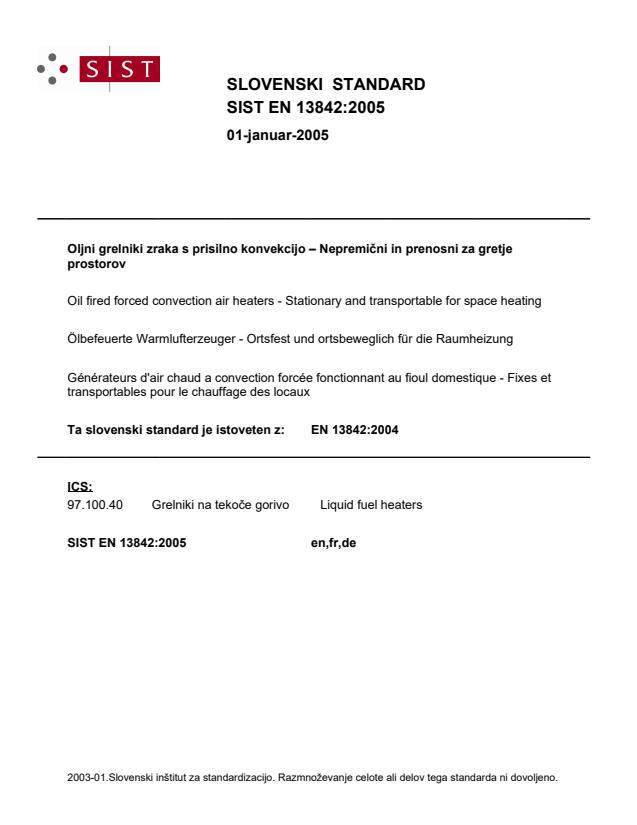
Oil fired forced convection air heaters - Stationary and transportable for space heating
This European Standard specifies the requirements and test methods for the safety and efficiency of oil-fired air heaters using only forced draught oil burners, hereafter referred to as "appliances".
This European Standard applies to stationary and portable appliances. It also applies to appliances intended for outdoor installation. Provision of the heated air may be by means of ducting or may be directly into the heated space.
For the purpose of this standard the heat generation is by the combustion of liquid fuel oils as defined in EN 267 (gas oil with a viscosity at the burner inlet of 1,6 mm²/s (cSt) up to 6 mm²/s (cSt) at 20 °C). Alternatively, if the manufacturer requests, the fuel of kerosene may be used as defined in EN 304:1992. Kerosene with a viscosity at the burner of 1,3 mm2/s (cSt) to 2,9 mm2/s (cSt) at 20 °C) or other suitable liquid fuel oils may also be used.
This standard does not apply to:
- appliances intended for use in a single unit residential dwelling;
- appliances of the condensing type;
- appliances with atmospheric burners without a fan to assist the transportation of combustion air;
- dual purpose air conditioning appliances (heating and cooling);
- appliances where the air is heated by an intermediate fluid;
- appliances fitted with manual or automatic flue dampers;
- appliances having multiple heating units with a single flue;
- appliances fitted with more than one flue outlet.
This European Standard is applicable to appliances which are intended to be type tested.
NOTE Requirements for appliances which are not type tested would need to be subject to further consideration.
Ölbefeuerte Warmlufterzeuger - Ortsfest und ortsbeweglich für die Raumheizung
Diese Europäische Norm legt die Anforderungen und Prüfverfahren für die Sicherheit und den Wirkungsgrad ölbefeuerter Warmlufterzeuger unter ausschließlicher Verwendung von Ölbrennern mit Gebläse, nachfolgend kurz als �Geräte" bezeichnet, fest.
Diese Europäische Norm gilt für ortsfeste und tragbare Geräte. Sie bezieht sich auch auf Geräte, die zur Installation im Freien vorgesehen sind. Die Zufuhr der Heizluft kann entweder mittels Leitungen oder direkt in den zu beheizenden Raum erfolgen.
Für die Anwendung dieser Norm wird die Wärme durch die Verbrennung von flüssigem Öl nach EN 267 (Gasöl mit einer Viskosität am Brenner von 1,6 mm2/s (cSt) bis zu 6 mm2/s (cSt) bei 20 °C) erzeugt. Falls der Hersteller dies fordert, darf alternativ Kerosinöl nach EN 304:1992 verwendet werden. Es dürfen auch Kerosin mit einer Viskosität am Brenner von 1,3 mm2/s (cSt) bis 2,9 mm2/s (cSt) bei 20 °C oder weitere geeignete Arten flüssigen Öls verwendet werden.
Diese Norm gilt nicht für:
- Geräte, die für den Gebrauch in nur aus einer Einheit bestehenden Wohnungen ausgelegt sind;
- Geräte mit Brennwertnutzung;
- Geräte mit atmosphärischen Brennern ohne Gebläse zur Beförderung der Verbrennungsluft;
- Doppelzweck-Klimaanlagen (zum Heizen und Kühlen);
- Geräte, bei denen die Luft mittels einer Zwischenflüssigkeit erwärmt wird;
- Geräte mit handbetätigten oder automatischen Abgasklappen;
- Geräte mit mehreren Heizelementen mit nur einer Strömungssicherung;
- Geräte mit mehr als einem Abgasstutzen.
Diese Europäische Norm gilt für Geräte, die einer Typprüfung unterzogen werden sollen.
ANMERKUNG Hinsichtlich der Anforderungen an Geräte, die keiner Typprüfung unterzogen werden, sollten weitere Überlegungen angestellt werden.
Générateurs d'air chaud à convection forcée fonctionnant au fioul domestique - Fixes et transportables pour le chauffage des locaux
La présente norme européenne spécifie les exigences et les méthodes d'essai relatives à la sécurité et au rendement des générateurs d'air chaud fonctionnant au fuel utilisant uniquement des brûleurs à fioul à tirage forcé, désignés ci-après par "appareils". La présente norme européenne s'applique aux appareils fixes et portatifs. Elle s'applique également aux appareils destinés à l'installation à l'extérieur.
Oljni grelniki zraka s prisilno konvekcijo – Nepremični in prenosni za gretje prostorov
General Information
Overview
EN 13842:2004 is a CEN (European) standard that specifies safety and efficiency requirements and test methods for oil‑fired forced convection air heaters that use forced‑draught oil burners. It covers both stationary and transportable (portable) appliances intended for space heating, including units installed outdoors and units that deliver heated air directly or via ducting. Fuels are primarily liquid fuel oils defined in EN 267 (gas oil) with optional use of kerosene per EN 304 when requested by the manufacturer. EN 13842 is intended primarily for appliances that are type tested.
Key topics and requirements
- Scope and exclusions: Applies to forced‑draught oil burner heaters but excludes single‑unit residential heaters, condensing units, atmospheric burners without a fan, dual heating/cooling units, appliances heated by an intermediate fluid, units with manual/automatic flue dampers, multi‑unit single‑flue systems, and appliances with more than one flue outlet.
- Construction requirements: Mechanical, chemical and thermal robustness of components (heat exchanger, combustion chamber, casing), non‑use of asbestos or cadmium‑bearing solder, and non‑combustible materials where required.
- Combustion air and flue connections: Adequate combustion air supply across operating range; fixed combustion product outlet geometry and rules for flue connection depth and diameter to ensure safe evacuation of combustion products.
- Controls and safety devices: Requirements for automatic burner control systems, automatic shut‑off valves, overheat cut‑offs (manual reset), fan delay controls, thermostats, and lock‑out behavior after faults or power interruption.
- Electrical and EMC requirements: Compliance with prEN 50156‑1, EN 60335‑1, EN 60730 series, EN 60529 for IP ratings, and provisions for leakage current, wiring diagrams and protection.
- Accessibility & maintenance: Removable parts must be accessible and designed to avoid hazardous incorrect reassembly; user access panels must not allow combustion products into air distribution.
- Test methods, marking and instructions: Standard includes prescribed tests, measurements and mandatory documentation for safe commissioning and type testing.
Applications and users
Who uses EN 13842:
- Manufacturers and product designers of oil‑fired forced convection air heaters for ensuring compliance and preparing type tests.
- Test laboratories and certification bodies conducting safety and performance tests.
- Regulatory and compliance managers in HVAC, industrial heating and mobile/temporary heating sectors.
- Installers and system integrators who need to understand connection, flue and installation constraints.
- Procurement and safety engineers specifying equipment for warehouses, workshops, outdoor temporary sites and large non‑residential spaces.
Related standards
Relevant referenced documents include: EN 267, EN 304, EN 230, prEN 50156‑1, EN 60335‑1, EN 60529, EN 60730 series and EN ISO 1182 (non‑combustibility). These provide burner definitions, fuel specifications, electrical and safety requirements that complement EN 13842.
EN 13842 is the go‑to standard for certifying and safely deploying oil‑fired forced convection heaters in non‑residential and portable heating applications across Europe.

Standards Content (Sample)
2003-01.Slovenski inštitut za standardizacijo. Razmnoževanje celote ali delov tega standarda ni dovoljeno.SURVWRURYÖlbefeuerte Warmlufterzeuger - Ortsfest und ortsbeweglich für die RaumheizungGénérateurs d'air chaud a convection forcée fonctionnant au fioul domestique - Fixes et transportables pour le chauffage des locauxOil fired forced convection air heaters - Stationary and transportable for space heating97.100.40Liquid fuel heatersICS:Ta slovenski standard je istoveten z:EN 13842:2004SIST EN 13842:2005en,fr,de01-januar-2005SIST EN 13842:2005SLOVENSKI
STANDARD
EUROPEAN STANDARDNORME EUROPÉENNEEUROPÄISCHE NORMEN 13842July 2004ICS 97.100.40English versionOil fired forced convection air heaters - Stationary andtransportable for space heatingGénérateurs d'air chaud à convection forcée fonctionnantau fioul domestique - Fixes et transportables pour lechauffage des locauxÖlbefeuerte Warmlufterzeuger - Ortsfest und ortsbeweglichfür die RaumheizungThis European Standard was approved by CEN on 13 May 2004.CEN members are bound to comply with the CEN/CENELEC Internal Regulations which stipulate the conditions for giving this EuropeanStandard the status of a national standard without any alteration. Up-to-date lists and bibliographical references concerning such nationalstandards may be obtained on application to the Central Secretariat or to any CEN member.This European Standard exists in three official versions (English, French, German). A version in any other language made by translationunder the responsibility of a CEN member into its own language and notified to the Central Secretariat has the same status as the officialversions.CEN members are the national standards bodies of Austria, Belgium, Cyprus, Czech Republic, Denmark, Estonia, Finland, France,Germany, Greece, Hungary, Iceland, Ireland, Italy, Latvia, Lithuania, Luxembourg, Malta, Netherlands, Norway, Poland, Portugal, Slovakia,Slovenia, Spain, Sweden, Switzerland and United Kingdom.EUROPEAN COMMITTEE FOR STANDARDIZATIONCOMITÉ EUROPÉEN DE NORMALISATIONEUROPÄISCHES KOMITEE FÜR NORMUNGManagement Centre: rue de Stassart, 36
B-1050 Brussels© 2004 CENAll rights of exploitation in any form and by any means reservedworldwide for CEN national Members.Ref. No. EN 13842:2004: ESIST EN 13842:2005
Flue connections.31 Annex B (normative)
Classification according to the evacuation of the combustion products.32 Annex C (normative)
Measurements.33 Bibliography.40 SIST EN 13842:2005
EN 230, Monobloc oil burners — Safety, control and regulation devices and safety times. EN 267, Forced draught oil burners — Definitions, requirements, testing, marking. EN 304:1992, Heating boilers — Test code for heating boilers for atomizing oil burners. prEN 50156-1, Electrical equipment for furnaces and ancillary equipment — Part 1: Requirements for application design and installation. EN 60335-1:2002, Household and similar electrical appliances — Safety — Part 1: General requirements (IEC 60335-1:2001, modified). EN 60529, Degrees of protection provided by enclosures (IP code) (IEC 60529:1989). SIST EN 13842:2005
1 013,25 mbar and temperature of 15 °C NOTE Cubic metres per second (m3/s) or cubic metres per hour (m3/h). 3.3.7 delivered air pressure static pressure available within the duct system provided by the appliance fan related to the delivered air volume NOTE Pascal's (Pa) or millibar (mbar); 1 Pa = 1 N/m2; 1 mbar = 100 N/m2. 3.3.8 controlled shut-down process where the power to the fuel shut off valves and/or the burner motor is removed immediately, e.g. as a result of the action of a controlling function 3.3.9 safety shut-down process which is effected immediately following the response of a safety limiter or sensor or detection of a fault in the burner control system and which puts the burner out of operation by immediately removing the power to the fuel shut-off valves, the ignition device and/or the burner motor SIST EN 13842:2005
mg/kWh mg/kWh 1 250 110 2 185 110 3 120 60 5.8 Combustion under normal fluctuation of auxiliary energy The CO-concentration in the dry air-free combustion products shall not exceed 0,2 % when the appliance is supplied with reference fuel under the conditions defined in 6.8; in addition, the appliance shall ignite and continue to operate safely. SIST EN 13842:2005
0,85 kg/dm3. If the density and sulphur content is known (e.g. by analysis) the calorific value can be calculated as follows: ()()sHi×−×−=3,093,1192,5215ρ in MJ/kg (6) where ρ15 = density of the fuel at 15 °C in kg/dm3; s = Sulphur content in kg/kg. 6.3.2.4 Calorific value of kerosene fuel oil If the calorific value is not determined calorimetrically and in the absence of a complete analysis, the value for kerosene can with sufficient accuracy be assumed as follows: Hi = 43,300 MJ/kg SIST EN 13842:2005
= 0,141 kg/kg; Sulphur content s = 0,004 kg/kg; density at 15 °C:
0,79 kg/dm3. If the density and sulphur content is known the calorific value can be calculated as in the formula in 6.3.2.3. 6.4 Temperature of parts of the appliance which have to be touched during normal use 6.4.1 General The temperatures of the parts specified in 5.2 shall be measured at thermal equilibrium using an instrument with an accuracy of ±2 K, for example using contact thermocouples, and compliance with the requirements of 5.2 is verified. 6.4.2 Temperatures of the side walls, front and top of the appliance The test is carried out when the appliance has reached thermal equilibrium. The temperatures of the hottest parts of the side walls, front and top of the appliance are measured by a suitable means having an accuracy of ±2 K, for example using contact thermocouples, and compliance with the requirements of 5.2.1.2 is verified. 6.4.3 Component temperatures Component temperatures are measured when thermal equilibrium has been reached and after the appliance has been turned off at the end of the test, and compliance with the requirements of 5.2.1.3 is verified. The component temperatures are measured by means of attached thermocouples having thermoelectric junctions with an accuracy of ±2 K. Alternative devices of equivalent accuracy may by used. However, if an electrical component is itself likely to cause a rise in temperature (e.g. automatic shut-off valves) the temperature of the component is not measured. In this case, thermocouples or alternative devices, are placed so as to measure the air temperature around the device. The temperature measurements of the components are deemed to be satisfactory if: ()Ctttasm025−+≤ (7) where tm is the maximum temperature measured in the test in degrees Celsius (°C); ts is the maximum temperature specified by the component manufacturer in degrees Celsius (°C); ta is the ambient room temperature in degrees Celsius (°C). NOTE If the maximum temperature of the component was specified for an ambient temperature other than 25 °C, this should be used. SIST EN 13842:2005
is the temperature rise in Kelvin (K); R1
is the resistance at the beginning of the test in ohms (Ω);
R2
is the maximum resistance at the end of the test in ohms (Ω);
t1
is the room temperature at the beginning of the test in °C; t2
is the room temperature at the end of the test in °C; C
is a constant equal to 234,5 °C for copper. 6.5 Efficiency 6.5.1 Principle of method The thermal efficiency is determined by the flue loss method from measurements of CO2 or O2 concentration and the temperature of the products of combustion. Where the appliance is intended for use within the heating space then the surface loss of the case may be ignored. 6.5.2 Preparation of appliance The appliance is installed in accordance with 6.2 and operated, in accordance with the manufacturer’s instructions, with the appropriate fuel oil. 6.5.3 Test conditions The appliance is supplied with the reference fuel and operated within ±2,5 % of the specified heat input(s) using the minimum delivered air flow declared by the manufacturer. The CO2 or O2 concentration and the temperature of the combustion products are measured by means of a suitable probe, incorporating a temperature-measuring device, located in the flue system. The sampling rate of combustion products for the measurement of temperature is approximately 100 l/h. SIST EN 13842:2005
in m3/kg (11) 2min Atr,AtrO76,4100100VV×−×= (12) where VCO2
is the volume of carbon dioxide CO2 in m3/kg; VSO2
is the volume of sulphur dioxide SO2 in m3/kg; VN2
is the volume of nitrogen N2 in m3/kg; (CO2 + SO2)measured
is the measured proportion of (CO2 + SO2) in the flue gases in m3/kg; O2
is the measured proportion of O2 in the flue gases in m3/kg; VAtr, min
is determined from equation (A.3), see EN 304:1992, Annex A. b) the volume of water vapour VW resulting from water content and the combustion of the water forming components of the fuel in m3/kg or m3/m3 (the water content of the combustion air may be ignored). When the volume of water vapour is separated from the volume of dry products of combustion, the equation becomes: iLAOH pm,WAtr pm,AtrAH1)tt()CVCV(q2×−××+×= (13) where Cpm, Atr is the mean specific heat of the dry flue gas in the temperature range tL to tA, in J/(m3 · K); Cpm, H2O is the mean
...
Frequently Asked Questions
EN 13842:2004 is a standard published by the European Committee for Standardization (CEN). Its full title is "Oil fired forced convection air heaters - Stationary and transportable for space heating". This standard covers: This European Standard specifies the requirements and test methods for the safety and efficiency of oil-fired air heaters using only forced draught oil burners, hereafter referred to as "appliances". This European Standard applies to stationary and portable appliances. It also applies to appliances intended for outdoor installation. Provision of the heated air may be by means of ducting or may be directly into the heated space. For the purpose of this standard the heat generation is by the combustion of liquid fuel oils as defined in EN 267 (gas oil with a viscosity at the burner inlet of 1,6 mm²/s (cSt) up to 6 mm²/s (cSt) at 20 °C). Alternatively, if the manufacturer requests, the fuel of kerosene may be used as defined in EN 304:1992. Kerosene with a viscosity at the burner of 1,3 mm2/s (cSt) to 2,9 mm2/s (cSt) at 20 °C) or other suitable liquid fuel oils may also be used. This standard does not apply to: - appliances intended for use in a single unit residential dwelling; - appliances of the condensing type; - appliances with atmospheric burners without a fan to assist the transportation of combustion air; - dual purpose air conditioning appliances (heating and cooling); - appliances where the air is heated by an intermediate fluid; - appliances fitted with manual or automatic flue dampers; - appliances having multiple heating units with a single flue; - appliances fitted with more than one flue outlet. This European Standard is applicable to appliances which are intended to be type tested. NOTE Requirements for appliances which are not type tested would need to be subject to further consideration.
This European Standard specifies the requirements and test methods for the safety and efficiency of oil-fired air heaters using only forced draught oil burners, hereafter referred to as "appliances". This European Standard applies to stationary and portable appliances. It also applies to appliances intended for outdoor installation. Provision of the heated air may be by means of ducting or may be directly into the heated space. For the purpose of this standard the heat generation is by the combustion of liquid fuel oils as defined in EN 267 (gas oil with a viscosity at the burner inlet of 1,6 mm²/s (cSt) up to 6 mm²/s (cSt) at 20 °C). Alternatively, if the manufacturer requests, the fuel of kerosene may be used as defined in EN 304:1992. Kerosene with a viscosity at the burner of 1,3 mm2/s (cSt) to 2,9 mm2/s (cSt) at 20 °C) or other suitable liquid fuel oils may also be used. This standard does not apply to: - appliances intended for use in a single unit residential dwelling; - appliances of the condensing type; - appliances with atmospheric burners without a fan to assist the transportation of combustion air; - dual purpose air conditioning appliances (heating and cooling); - appliances where the air is heated by an intermediate fluid; - appliances fitted with manual or automatic flue dampers; - appliances having multiple heating units with a single flue; - appliances fitted with more than one flue outlet. This European Standard is applicable to appliances which are intended to be type tested. NOTE Requirements for appliances which are not type tested would need to be subject to further consideration.
EN 13842:2004 is classified under the following ICS (International Classification for Standards) categories: 97.100.40 - Liquid fuel heaters. The ICS classification helps identify the subject area and facilitates finding related standards.
You can purchase EN 13842:2004 directly from iTeh Standards. The document is available in PDF format and is delivered instantly after payment. Add the standard to your cart and complete the secure checkout process. iTeh Standards is an authorized distributor of CEN standards.
이 기사는 유럽 표준 EN 13842:2004에 대해 다룹니다. 이 표준은 "기기"라고 불리는 강제 유동 오일 버너만을 사용하는 오일 히터의 안전 및 효율성에 대한 요구 사항과 시험 방법을 명시합니다. 이 표준은 정지 및 휴대용 기기에 적용됩니다. 또한, 야외 설치를 위해 고안된 기기에도 적용됩니다. 난방 공기는 덕트를 통해 공급될 수도 있으며 직접 가열 공간으로 공급될 수도 있습니다. 이 표준을 위해 열 생성은 EN 267에서 정의한 액체 연료 오일을 통해 연소하는 것을 전제로 합니다 (연소기 입구에서 20°C에서 1.6 mm²/s (cSt)에서 6 mm²/s (cSt)의 점도를 가지는 가솔린). 또는 제조업체의 요청에 따라 EN 304:1992에서 정의한 케로시나와 같은 연비를 가진 연료를 사용할 수도 있습니다. 이 표준은 다음에 해당하지 않습니다: - 단일 유닛 주거용으로 쓰이는 기기 - 응축형 기기 - 선회없는 대기 연소기를 가진 기기 - 이중 목적 에어컨 기기 (난방 및 냉방) - 공기가 중간 유체를 통해 가열되는 기기 - 수동 또는 자동 배기 다목적 기기 - 하나의 배기구를 가진 다중 가열 기기 - 두 개 이상의 배기구 콘센트를 가진 기기 이 유럽 표준은 유형 시험을 받을 예정인 기기에 적용됩니다. 참고: 유형 시험을 받지 않는 기기의 요구 사항은 추가적인 고려가 필요합니다.
The article discusses the European Standard EN 13842:2004, which outlines the requirements and test methods for the safety and efficiency of oil-fired air heaters. These heaters use forced draught oil burners and can be either stationary or portable, including those intended for outdoor installation. The standard specifies that the heat generation should be from the combustion of liquid fuel oils, such as gas oil or kerosene. However, it does not apply to certain types of appliances, such as those intended for use in single unit residential dwellings, condensing appliances, and appliances with atmospheric burners without a fan. It also does not apply to appliances with manual or automatic flue dampers and those with multiple flue outlets. The standard is applicable to appliances that undergo type testing, and additional consideration is needed for appliances that are not type tested.
The article discusses the requirements and test methods for oil-fired air heaters, specifically those that use forced draught oil burners. The European Standard applies to both stationary and portable appliances, including those intended for outdoor installation. The heat generation is achieved by burning liquid fuel oils or kerosene. The standard does not apply to certain types of appliances, such as those used in single-unit residential dwellings, condensing appliances, those with atmospheric burners, dual purpose air conditioning appliances, and others listed in the article. The standard is applicable to appliances that undergo type testing, but requirements for appliances not subjected to type testing would need further consideration.
기사 제목: EN 13842: 2004 - 공간 난방을 위한 정지형 및 이동 형 유류 동력 강제 대류식 공기 가열기 기사 내용: 이 유럽 표준은 "기기"라고 지칭되는 강제 공기 유류 버너만을 사용하는 유류 동력 공기 가열기의 안전성과 효율성에 대한 요구사항 및 시험 방법을 규정한다. 이 유럽 표준은 정지형 및 휴대용 기기에 적용된다. 야외 설치용 기기에도 적용된다. 가열된 공기는 배관을 통해 제공되거나 직접 가열 공간으로 공급될 수 있다. 이 표준의 목적을 위해 열생성은 EN 267에 정의된 액체 연료 오일의 연소로 이루어진다(버너 입구에서의 가스 오일의 점성이 20 °C에서 1.6 밀리미터 제곱/초(cSt)에서 6 밀리미터 제곱/초(cSt) 사이여야 한다). 또는 제조업자 요청시 EN 304: 1992에 정의된 케로시늄 연료를 사용할 수 있다. 버너에서의 케로시늄의 점성이 20 °C에서 1.3 밀리미터 제곱/초(cSt)에서 2.9 밀리미터 제곱/초(cSt) 사이인 것이거나 다른 적합한 액체 연료 오일도 사용될 수 있다. 이 표준은 다음과 같은 경우에는 적용되지 않는다: - 단일 가구 주택에서 사용되는 기기 - 응축형 기기 - 환기 팬이 없는 대기 버너가 있는 기기 - 이중 목적 공기 조절 기기 (난방 및 냉방) - 공기가 중간 유체에 의해 가열되는 기기 - 수동 or 자동 연기 담장이 장착된 기기 - 하나의 연기구에 여러 가열 유닛이 장착된 기기 - 여러 개의 연기 배출구가 있는 기기. 이 유럽 표준은 유형 시험을 수행하는 것을 목적으로 하는 기기에 적용된다. 참고: 유형 시험을 수행하지 않는 기기에 대한 요구사항은 추가 검토가 필요하다.
記事のタイトル: EN 13842:2004 - 空間暖房用オイル式強制対流空気ヒーター - 固定型および可搬型 記事の内容: このヨーロピアンスタンダードは、強制送風のオイルバーナーのみを使用するオイル式空気ヒーターの安全性と効率性に関する要件と試験方法を規定しています。 このヨーロピアンスタンダードは、固定型および可搬型のヒーターに適用されます。また、屋外設置を前提としたヒーターにも適用されます。加熱された空気の供給はダクティングによる場合や直接加熱空間への供給による場合などが考えられます。 この規格では、燃焼による液体燃料オイル(EN 267で定義されるバーナー入口での粘度が20℃で1.6mm²/s(cSt)から6mm²/s(cSt)までのガソール)を燃やすことによって熱を発生させます。代わりに、メーカーの要求によりEN 304:1992で定義されるケロシンの燃料を使用することも可能です。ケロシンはバーナーでの粘度が20℃で1.3mm2/s(cSt)から2.9mm2/s(cSt)までの範囲である他、適切な液体燃料オイルも使用できます。 この規格は、次のものには適用されません: - 単一の住宅ユニットで使用される機器 - 冷凍暖房器具 - ファンなしの大気バーナーを備えた機器 - ヒーター兼用のエアコンディショナー - 空気が中間流体によって加熱される機器 - 手動もしくは自動の煙突ダンパーが装備された機器 - 単一の煙突で複数のヒーティングユニットを持つ機器 - 複数の煙突出口が装備された機器 このヨーロピアンスタンダードは、タイプテストを受けることを前提とした機器に適用されます。 注記: タイプテストを受けない機器の要件については、さらなる検討が必要とされます。
この記事では、EN 13842:2004というヨーロッパ標準について説明しています。この規格は、強制送風オイルバーナーを使用するオイルファイアードエアヒーターの安全性と効率性の要件と試験方法を規定しています。この規格は、固定式および携帯用の機器に適用されます。また、屋外設置用の機器にも適用されます。暖房空気の供給はダクティングによる場合や直接加熱空間への供給の場合があります。この規格では、燃料油の燃焼によって熱が生成されることが前提とされており、EN 267で定義される液体燃料油(20°Cでバーナー入口で1.6 mm²/s (cSt)から6 mm²/s (cSt)の粘度を持つガソリン)が使用されます。または、メーカーの要求に応じてEN 304:1992で定義されるケロシンなどの燃料を使用することもできます。この規格は、以下のような機器には適用されません: - 一戸建て住宅用の機器 - 凝縮型の機器 - ファンを使用しない大気燃焼器を備えた機器 - 暖房と冷房の両方を兼ね備えた機器 - 空気が中間流体で加熱される機器 - 手動または自動のフルーダンパーを備えた機器 - 一つの排気口を持つ複数の暖房ユニットを備えた機器 - 複数の排気口を備えた機器 このヨーロッパ標準は型式試験を受ける予定の機器に適用されます。 注:型式試験を受けない機器の要件には、さらなる検討が必要です。
Questions, Comments and Discussion
Ask us and Technical Secretary will try to provide an answer. You can facilitate discussion about the standard in here.
Loading comments...