

EN 14531-1:2015+A1:2018
(Main + Amendment)Railway applications - Methods for calculation of stopping and slowing distances and immobilization braking - Part 1: General algorithms utilizing mean value calculation for train sets or single vehicles
- Abstract
This European Standard describes general algorithms for the brake performance calculations to be used for all types of train sets, units or single vehicles, including high speed, locomotive and passenger coaches, conventional vehicles and wagons.
This European Standard does not specify the performance requirements. It enables the estimation and/or comparison by calculation of the various aspects of the performance: stopping or slowing distances, dissipated energy, power, force calculations and immobilization braking.
If it is required to validate, verify or assess braking performance it is recommended that a more detailed calculation is performed in accordance with EN 14531-2, i.e. a step by step calculation.
This European Standard contains generic examples of the calculation of brake forces for individual brake equipment types and calculation of stopping distance and immobilization braking relevant to a train (see Annexes C and D).
- Status
- Published
- Publication Date
- 27-Nov-2018
- Technical Committee
- CEN/TC 256 - Railway applications
- Drafting Committee
- CEN/TC 256/SC 3/WG 47 - Braking
- Current Stage
- 9020 - Submission to 2 Year Review Enquiry - Review Enquiry
- Start Date
- 15-Jul-2026
- Completion Date
- 15-Jul-2026

Overview
EN 14531-1:2015+A1:2018, developed by CEN, establishes general algorithms for calculating railway brake performance. This European Standard applies to all types of train sets, units, or single vehicles, including high-speed trains, locomotives, passenger coaches, conventional vehicles, and freight wagons. It focuses on standardized methods to estimate and compare stopping and slowing distances, dissipated energy, power, force calculations, and immobilization braking. EN 14531-1 uses mean value calculations, offering a practical approach for railway engineers in brake analysis and system design.
The standard is not prescriptive regarding specific performance requirements. Instead, it provides a robust framework for initial assessments that supports the validation, verification, and comparative study of train braking systems. Where detailed or step-by-step calculations are required, organizations are directed to EN 14531-2.
Key Topics
- Mean Value Calculations: Algorithms rely on mean values for brake forces, deceleration, and resistive forces, streamlining the process for estimating train stopping and slowing distances.
- Brake Equipment Types: Calculation methods are provided for various brake types, including tread brakes, disc brakes, electrodynamic and fluid retarder brakes, eddy current, and magnetic track brakes.
- Slowing and Stopping Distance: Formulas and procedures are included for determining both stopping and slowing distances under various operating and environmental conditions, such as gradients and wind resistance.
- Immobilization Braking: Guidelines for estimating the forces required to keep a train stationary, taking into account equipment type, number of braked axles, and coefficient of adhesion.
- Braking Performance Parameters: The standard explains how to derive values such as braked weight percentage, braking ratio, and equivalent brake force.
- Calculation Inputs: Emphasizes the importance of accurate, traceable input data-mass, speed, resistance coefficients, and brake characteristics.
Applications
EN 14531-1 is widely used in:
- System Design: Supports the design of brake systems for various railway vehicles, ensuring compliance with EU interoperability and safety directives.
- Performance Comparison: Enables comparative evaluation of different railway braking systems, contributing to optimized solutions for train operators and manufacturers.
- Initial Assessment: Serves as a fundamental tool for the preliminary estimation of train performance, aiding in feasibility studies and project planning.
- Regulatory Submission: Helps fulfill the requirements of technical specifications for interoperability (TSI) as referenced in EU railway directives.
- Testing and Validation Preparation: Provides groundwork calculations in preparation for detailed brake performance testing or finer step-by-step analysis using EN 14531-2.
Related Standards
Professionals using EN 14531-1 should be aware of the following related standards for complete and interoperable railway brake system assessment:
- EN 14531-2: Methods for calculation of stopping and slowing distances and immobilization braking - Part 2: Step-by-step calculations for train sets or single vehicles.
- EN 15663: Railway applications - Definition of vehicle reference masses.
- EN 14067-4: Railway applications - Aerodynamics - Requirements and test procedures for aerodynamics on open track.
- EN 14478: Railway applications - Braking - Generic vocabulary.
- EN 16452: Railway applications - Braking - Brake blocks.
Practical Value
By implementing EN 14531-1, railway engineers and system designers can:
- Achieve consistent, standardized brake performance calculations across different vehicle types.
- Facilitate safety and interoperability in line with European and international railway standards.
- Reduce complexity in early-stage design and operational assessments, and streamline the transition to detailed calculations where required.
Applying EN 14531-1 ensures that the methods for estimating stopping and immobilization distances are both transparent and widely accepted, promoting efficiency and safety throughout the railway industry.
Relations
- Effective Date
- 19-Jan-2023
- Effective Date
- 18-Jan-2023
- Effective Date
- 28-Jan-2026
- Effective Date
- 28-Jan-2026
- Effective Date
- 28-Jan-2026
- Effective Date
- 28-Jan-2026
- Effective Date
- 20-May-2026
- Effective Date
- 28-Jan-2026
- Effective Date
- 28-Jan-2026
- Effective Date
- 28-Jan-2026
- Effective Date
- 28-Jan-2026
- Effective Date
- 28-Jan-2026
- Effective Date
- 28-Jan-2026
Get Certified
Connect with accredited certification bodies for this standard

IRIS Certification (UNIFE)
International Railway Industry Standard certification.

TÜV SÜD Rail GmbH
TÜV SÜD railway certification services.

Bureau Veritas Railway Certification
Railway and transportation certification.
Sponsored listings
Frequently Asked Questions
EN 14531-1:2015+A1:2018 is a standard published by the European Committee for Standardization (CEN). Its full title is "Railway applications - Methods for calculation of stopping and slowing distances and immobilization braking - Part 1: General algorithms utilizing mean value calculation for train sets or single vehicles". This standard covers: This European Standard describes general algorithms for the brake performance calculations to be used for all types of train sets, units or single vehicles, including high speed, locomotive and passenger coaches, conventional vehicles and wagons. This European Standard does not specify the performance requirements. It enables the estimation and/or comparison by calculation of the various aspects of the performance: stopping or slowing distances, dissipated energy, power, force calculations and immobilization braking. If it is required to validate, verify or assess braking performance it is recommended that a more detailed calculation is performed in accordance with EN 14531-2, i.e. a step by step calculation. This European Standard contains generic examples of the calculation of brake forces for individual brake equipment types and calculation of stopping distance and immobilization braking relevant to a train (see Annexes C and D).
This European Standard describes general algorithms for the brake performance calculations to be used for all types of train sets, units or single vehicles, including high speed, locomotive and passenger coaches, conventional vehicles and wagons. This European Standard does not specify the performance requirements. It enables the estimation and/or comparison by calculation of the various aspects of the performance: stopping or slowing distances, dissipated energy, power, force calculations and immobilization braking. If it is required to validate, verify or assess braking performance it is recommended that a more detailed calculation is performed in accordance with EN 14531-2, i.e. a step by step calculation. This European Standard contains generic examples of the calculation of brake forces for individual brake equipment types and calculation of stopping distance and immobilization braking relevant to a train (see Annexes C and D).
EN 14531-1:2015+A1:2018 is classified under the following ICS (International Classification for Standards) categories: 45.060.01 - Railway rolling stock in general. The ICS classification helps identify the subject area and facilitates finding related standards.
EN 14531-1:2015+A1:2018 has the following relationships with other standards: It is inter standard links to EN 14531-1:2015/prA1:2016, EN 14531-1:2015, EN ISO 24478:2024, EN 15663:2017+A2:2024, EN 14067-4:2024+A1:2025, EN 16452:2015+A1:2019, EN 14198:2026, EN 14198:2016+A2:2021, EN 16834:2019, EN 14198:2016, EN 17065:2018, EN 14531-2:2015, EN 14198:2016+A1:2018. Understanding these relationships helps ensure you are using the most current and applicable version of the standard.
EN 14531-1:2015+A1:2018 is associated with the following European legislation: EU Directives/Regulations: 2008/57/EC, 2016/797/EU, 2016/797/EU, 2016/797/EU, 2016/797/EU, 2016/797/EU, 2016/797/EU, 2016/797/EU, 2016/797/EU, 2016/797/EU, 2016/797/EU, 2016/797/EU, 2016/797/EU, 2016/797/EU; Standardization Mandates: M/483. When a standard is cited in the Official Journal of the European Union, products manufactured in conformity with it benefit from a presumption of conformity with the essential requirements of the corresponding EU directive or regulation.
EN 14531-1:2015+A1:2018 is available in PDF format for immediate download after purchase. The document can be added to your cart and obtained through the secure checkout process. Digital delivery ensures instant access to the complete standard document.
Standards Content (Sample)
2003-01.Slovenski inštitut za standardizacijo. Razmnoževanje celote ali delov tega standarda ni dovoljeno.YR]LODBahnanwendungen - Verfahren zur Berechnung der Anhalte- und Verzögerungsbremswege und der Feststellbremsung - Teil 1: Allgemeine Algorithmen für Einzelfahrzeuge und Fahrzeugverbände unter Berücksichtigung von DurchschnittswertenApplications ferroviaires - Méthodes de calcul des distances d'arrêt, de ralentissement et d'immobilisation - Partie 1 : Algorithmes généraux utilisant le calcul par la valeur moyenne pour des rames ou des véhicules isolésRailway applications - Methods for calculation of stopping and slowing distances and immobilization braking - Part 1: General algorithms utilizing mean value calculation for train sets or single vehicles45.060.01Železniška vozila na splošnoRailway rolling stock in generalICS:Ta slovenski standard je istoveten z:EN 14531-1:2015+A1:2018SIST EN 14531-1:2016+A1:2019en,fr,de01-februar-2019SIST EN 14531-1:2016+A1:2019SLOVENSKI
STANDARD
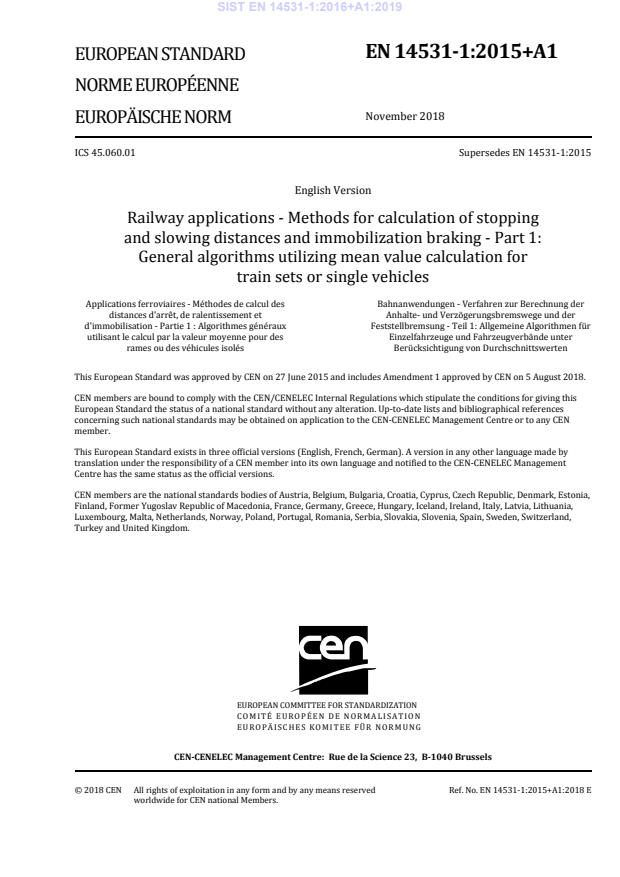
EUROPEAN STANDARD NORME EUROPÉENNE EUROPÄISCHE NORM
EN 14531-1:2015+A1
November
t r s z ICS
v wä r x rä r s Supersedes EN
s v w u sæ sã t r s wEnglish Version
Railway applications æ Methods for calculation of stopping and slowing distances and immobilization braking æ Part
sã General algorithms utilizing mean value calculation for train sets or single vehicles Applications ferroviaires æ Méthodes de calcul des distances d 5arrêtá de ralentissement et d 5immobilisation æ Partie
s ã Algorithmes généraux utilisant le calcul par la valeur moyenne pour des rames ou des véhicules isolés
Bahnanwendungen æ Verfahren zur Berechnung der Anhalteæ und Verzögerungsbremswege und der Feststellbremsung æ Teil
sã Allgemeine Algorithmen für Einzelfahrzeuge und Fahrzeugverbände unter Berücksichtigung von Durchschnittswerten This European Standard was approved by CEN on
t y June
t r s w and includes Amendment
s approved by CEN on
w August
t r s zä
egulations which stipulate the conditions for giving this European Standard the status of a national standard without any alterationä Upætoædate lists and bibliographical references concerning such national standards may be obtained on application to the CENæCENELEC Management Centre or to any CEN memberä
translation under the responsibility of a CEN member into its own language and notified to the CENæCENELEC Management Centre has the same status as the official versionsä
CEN members are the national standards bodies of Austriaá Belgiumá Bulgariaá Croatiaá Cyprusá Czech Republicá Denmarká Estoniaá Finlandá Former Yugoslav Republic of Macedoniaá Franceá Germanyá Greeceá Hungaryá Icelandá Irelandá Italyá Latviaá Lithuaniaá Luxembourgá Maltaá Netherlandsá Norwayá Polandá Portugalá Romaniaá Serbiaá Slovakiaá Sloveniaá Spainá Swedená Switzerlandá Turkey and United Kingdomä
EUROPEAN COMMITTEE FOR STANDARDIZATION COMITÉ EUROPÉEN DE NORMALISATION EUROPÄISCHES KOMITEE FÜR NORMUNG
CEN-CENELEC Management Centre:
Rue de la Science 23,
B-1040 Brussels
t r s z CEN All rights of exploitation in any form and by any means reserved worldwide for CEN national Membersä Refä Noä EN
s v w u sæ sã t r s w ªA sã t r s z ESIST EN 14531-1:2016+A1:2019
Workflow of stopping and slowing distance calculation method . 57 Annex B (informative)
Workflow of immobilization calculations . 59 Annex C (informative)
Brake equipment type example calculations . 60 Annex D (informative)
Train stopping distance and immobilization brake calculation example . 72 D.1 General . 72 D.2 Train stopping calculations . 73 D.3 Train stopping calculations on a gradient . 75 D.4 Train immobilization (parking) brake calculations . 75 Annex E (informative)
Development of the formula for the mean brake force with respect to the braking distance . 77 Annex F (informative)
Slowing or stopping distance calculation using alternative method of equivalent response time calculation as French Railway requirements in particular for trains operating in 'G' position . 78 Annex ZA (informative)
Relationship between this European Standard and the Essential Requirements of EU Directive 2008/57/EC . 80 Bibliography . 83 SIST EN 14531-1:2016+A1:2019
European foreword This document (EN 14531-1:2015+A1:2018) has been prepared by Technical Committee CEN/TC 256 “Railway applications”, the secretariat of which is held by DIN. This European Standard shall be given the status of a national standard, either by publication of an identical text or by endorsement, at the latest by May 2019, and conflicting national standards shall be withdrawn at the latest by May 2019. Attention is drawn to the possibility that some of the elements of this document may be the subject of patent rights. CEN shall not be held responsible for identifying any or all such patent rights. This document includes Amendment 1 approved by CEN on 2018-08-05. This document supersedes !EN 14531-1:2015". The start and finish of text introduced or altered by amendment is indicated in the text by tags !". This document has been prepared under a mandate given to CEN by the European Commission and the European Free Trade Association, and supports essential requirements of EU Directive 2008/57/EC. For relationship with EU Directive 2008/57/EC, see informative Annex ZA, which is an integral part of this document. This series of European standards EN 14531, Railway applications — Methods for calculation of stopping and slowing distances and immobilization braking consists of: — Part 1: General algorithms utilizing mean value calculation for train sets or single vehicles; — Part 2: Step-by-step calculations for train sets or single vehicles. The two parts are interrelated and should be considered together when conducting the step-by-step calculation of stopping and slowing distances. According to the CEN/CENELEC Internal Regulations, the national standards organizations of the following countries are bound to implement this European Standard: Austria, Belgium, Bulgaria, Croatia, Cyprus, Czech Republic, Denmark, Estonia, Finland, Former Yugoslav Republic of Macedonia, France, Germany, Greece, Hungary, Iceland, Ireland, Italy, Latvia, Lithuania, Luxembourg, Malta, Netherlands, Norway, Poland, Portugal, Romania, Serbia, Slovakia, Slovenia, Spain, Sweden, Switzerland, Turkey and the United Kingdom. SIST EN 14531-1:2016+A1:2019
E.g. per axle, for each operating condition. SIST EN 14531-1:2016+A1:2019
When brake equipment is used on one part of the train under certain conditions and used on another part of the same train under other conditions, two different brake equipment types shall be considered. 3.1.5 tread brake unit/disc brake unit functional unit from which brake force is delivered, typically consisting of a brake cylinder, slack adjuster portion and all associated component parts Note 1 to entry: Sometimes referred to as tread/disc brake actuator. 3.1.6 isolated brake equipment equipment not considered in the calculation due to assumed isolation Note 1 to entry: E.g. brake equipment of a bogie. 3.1.7 active brake equipment equipment considered to be operational in the calculation of a specific brake equipment type 3.1.8 mean value calculation calculation method in which the values used for each active brake equipment type are a mean value based on speed, force or distance as applicable for a particular speed range 3.1.9 decelerating force force resulting from summation of all forces acting contrary to the direction of movement when considering a train Note 1 to entry:
Each operational brake equipment type produces its own decelerating force which when added to the additional external forces opposing motion results in the total decelerating force of the train. Note 2 to entry:
For the purpose of this standard a decelerating force is considered as a positive value, therefore accelerating force is considered as a negative value. 3.1.10 braking force force produced by the active brake equipment types to brake the train Note 1 to entry: It does not include external forces which contribute to the overall decelerating force of the vehicle or train. SIST EN 14531-1:2016+A1:2019
E.g. train, vehicle, bogie, axle, wheel. 3.2 Symbols and indices For the purposes of this document, the general symbols given in Table 1 and indices given in Table 2 apply. NOTE Specific symbols and indices are defined in the relevant clauses. Table 1 — Symbols Symbol Definition Unit A area 2m a deceleration 2/sm sA area of a friction surface swept by the friction elements 2m B braked weight T D wheel diameter m F force N BF braking force related to the rail N gF downhill force on the train N ng standard acceleration of free fall = 9,80665 m/s2 (see: ISO 80000-3) 2/sm i gradient (rising gradient is positive; e.g. for a gradient of 5 ‰, i = 0,005) - ci cylinder ratio - rigi rigging ratio - trai transmission ratio - J inertia due to rotation of masses 2 mkg⋅ m mass kg n quantity - P power W p pressure Pa r radius m s distance m SIST EN 14531-1:2016+A1:2019
The wheel diameter used in the emergency brake calculation is usually that which gives the lowest deceleration e.g. in the case of disc brakes, this would normally be the maximum wheel diameter. When checking the required adhesion reqτ=≥he=wheel=≤iame≥er=use≤=shall=be=≥he=size=which=genera≥es=≥he=maximum=a≤hesion=≤eman≤=e.g.=in=≥he=case=of=≤isc=brakes,=≥his=woul≤=normally=be=≥he=minimum=wheel=≤iame≥er.=If=≥he=≥rain=is=equippe≤=wi≥h=≤ifferen≥=sizes=of=wheels=(by=≤esign=no≥=≤ue=≥o=wear)=each=size=of=wheel=shall=be=i≤en≥ifie≤=in=≥he=≥rain=composi≥ion.=4.3.2.6 Mean train resistance The train resistance is a component of the train decelerating force provided by the structure of the train, referred to as resistance to motion in EN 14067-4. This however uses instantaneous values. The SIST EN 14531-1:2016+A1:2019
Screw hand brake i) Tread brake equipment type ii) Disc brake equipment type 3) Electro-dynamic brake equipment type 4) Fluid retarder brake equipment type b) Adhesion independent 1) Eddy current brake equipment type 2) Magnetic track brake equipment type When using the following formulae to calculate the brake force for the different brake equipment types (i) and possible arrangements of this equipment e.g. a clasp brake arrangement of a tread brake, the number of arrangements fitted per entity shall be considered. As applicable, factors have been identified in each of the formulae and are shown in the examples given. For tread and disc brake equipment types typically a pressure applied brake cylinder is used. However, a spring applied brake cylinder may be used. For the calculation of the output force (Fc) the formula shall consider the following with reference to Figure 1: a) The internal ratio/factor of the cylinder (Ci) is normally one except for a design with an internal cylinder ratio. The sign of the ratio/factor when considered in the calculation formula is dependent on the type of brake equipment i.e. for pressure applied brake equipment it is a positive value and for spring applied brake equipment it is negative value. b) The cylinder spring force (,SCF) in a pressure applied brake cylinder operates to release the brake force (cylinder piston return) and is therefore a negative value. For a spring applied brake ,SCF operates as a braking force and is therefore a positive value.
Figure 1 — Basic principle of a pressure applied (left) and spring applied (right) cylinder SIST EN 14531-1:2016+A1:2019
Figure 2 — Representative tread brake unit The braking force characteristic of a tread brake unit can be expressed by: Cylinder output force FpAiFη=⋅⋅⋅+cccccs,c (4) Force on the application point FFiFη=⋅⋅+ncrigrig,dyns,rig (5) Mean braking force per brake unit `.FFµ=B,actnm (6) Pressure per application point FpA=napb (7) where: pC brake cylinder pressure, in Pa AC brake cylinder piston area, in m2 ηC internal brake cylinder efficiency iC internal brake cylinder ratio/factor FS,C sum of internal brake actuator spring forces, in N ηrig,dyn rigging efficiency in dynamic condition SIST EN 14531-1:2016+A1:2019
NOTE
Dashed lines represent additional tread brake arrangements, if applicable. Figure 3 — Typical tread brake arrangement The braking force characteristic of a tread brake arrangement can be expressed by: Output cylinder force CS,CCCCCFiApF+⋅⋅⋅=η=(8)=To≥al=force=on=≥he=applica≥ion=poin≥s=()RRRS,rigCbη⋅⋅+⋅=iFiFF
(9) With the ratios barig/lli==(10)=an≤=rig,axapaxRinni⋅⋅==(11)=SIST EN 14531-1:2016+A1:2019
...