

prEN 16568
(Main)Automotive fuels - Fatty acid methyl ester (FAME) fuel and blends with diesel fuel - Determination of oxidation stability by rapidly accelerated oxidation method at 120 °C
- Abstract
This document specifies a test method for the determination of the oxidation stability at 120 °C of fuels for diesel engines, by means of measuring the induction period of the fuel. Two different areas of application with separate precision statements are covered. For diesel fuel having a FAME content in the range between 2 % and 50 %, an induction period of up to 20 hours can be determined. For neat FAME, the maximum induction period is limited to 12 hours. The precision of the test method has been developed for petroleum-based diesel originating from conventional sources.
This test method is applicable for FAME blends with paraffinic diesel fuels as specified in EN 15940 [5], however, precision has not been determined for this type of fuel.
NOTE 1 An almost identical test method for oxidation stability at 110 °C is described in EN 15751 [1] , which applies to neat FAME and diesel/FAME blends containing 2 % of FAME at minimum. Other alternative test methods for the determination of the oxidation stability of distillate fuels are described in CEN/TR 17225 [6].
NOTE 2 The precision of this method was determined by two studies using samples of diesel fuel blends with FAME displaying a maximum induction period of approximately 20 h, respectively of neat FAME with a maximum induction period of 12 hours. Higher induction periods are not covered by the precision statement; however, experience from EN 15751 [1] indicates that this method can be used to determine induction periods up to 48 h.
NOTE 3 The presence of cetane improver can reduce the oxidation stability determined by this test method. Limited studies with 2-ethyl hexyl nitrate (EHN) indicated that the stability is reduced to an extent which is within the reproducibility of the test method.
NOTE 4 For the purposes of this document, percentages referring to FAME or other fuel content blends (e.g. "FAME content in the range of 2 % to 50 %"), are volume fractions unless otherwise specified.
- Status
- Not Published
- Publication Date
- 23-Apr-2028
- Technical Committee
- CEN/TC 19 - Petroleum products, lubricants and related products

prEN 16568 is a draft European Standard published by CEN for measuring the oxidation stability of automotive fuels at 120 °C by the rapidly accelerated oxidation method. It applies to diesel fuel blends containing FAME and to neat FAME, and it expresses the result as the fuel’s induction period.
What does prEN 16568 specify?
prEN 16568 specifies a laboratory test method for oxidation stability by measuring the induction period of the fuel. In practice, this tells a lab how to compare fuel samples under a controlled accelerated oxidation test.
The document is organized into 13 clauses: scope, normative references, terms and definitions, principle, reagents and materials, apparatus, sampling, preparation of measurement, measurement, calculation and evaluation, expression of results, precision, and test report. It also includes a bibliography. This structure matters because the method is not just a result calculation - it also defines how to prepare the sample, run the instrument, and report the outcome.
What are the key requirements of prEN 16568?
prEN 16568 covers two application areas with separate precision statements: diesel fuel with FAME content between 2 % and 50 %, and neat FAME. For diesel fuel blends, the method can determine induction periods up to 20 hours; for neat FAME, up to 12 hours. That matters because the reported result must be interpreted within the covered range.
Clause 7 requires representative sampling, normally according to EN ISO 3170 or EN ISO 3171, and the sample should be stored in the dark and tested as soon as possible. This reduces changes during transport and storage that could alter oxidation behavior before the test starts.
Clause 8 requires careful sample homogenization and immediate analysis after preparation. The apparatus must also be cleaned with the specified solvents and drying steps, or validated by a blank run. In practice, this avoids residue from previous tests affecting the conductivity curve.
Clause 8.2.2 adds temperature correction. The heating block temperature and the actual sample temperature in the reaction vessel can differ, so the method requires determining that difference before testing at a new temperature. This is important because the oxidation result is sensitive to temperature.
Clause 9 sets the core test conditions: 7.5 g of sample, 60 ml of water in the measurement cell, and an air flow of 10 l/h. The test ends when the conductivity reaches the set limit, when the curve flattens again after the induction period, or after 48 h. This gives the operator clear stop criteria and avoids over-testing.
Clause 10 allows automatic evaluation when the second derivative of the conductivity curve has a clear maximum, but requires manual evaluation when the curve is noisy. For labs, this means the software result must be checked against the shape of the curve, especially for borderline cases.
Clause 11 requires reporting the induction period in hours, rounded to the nearest 0.1 h. If the test is stopped after 48 h, the result is reported as greater than 48 h. Clause 12 gives repeatability and reproducibility statements separately for diesel/FAME blends and for neat FAME, which is important for comparing results between laboratories. Clause 13 lists the minimum items for the test report, including the product identification, sampling method if known, result, deviations, unusual features, and test date.
What terms does prEN 16568 define?
- Induction period - the time from the start of measurement until oxidation products begin to increase rapidly.
- Oxidation stability - the induction period determined by the procedure in this document.
- FAME - fatty acid methyl ester, the fuel component or neat fuel covered by the standard.
- Volume fraction - the way fuel blend percentages are expressed in this document unless stated otherwise.
- Cetane improver - an additive mentioned in the scope note because it can reduce the measured oxidation stability.
Who uses prEN 16568?
prEN 16568 is used by fuel-testing laboratories, quality control teams, fuel producers, and buyers checking diesel/FAME products. It is also relevant to organizations working with paraffinic diesel fuels and laboratories that need a repeatable way to compare oxidation stability results across batches or suppliers.
What changed in prEN 16568 from the previous edition?
prEN 16568 supersedes EN 16568:2023. The foreword states three significant changes: the scope is extended from FAME/diesel blends to neat FAME, additional precision data are added for neat FAME, and the document is aligned with the revised EN 15751.
Which standards are used with prEN 16568?
- EN ISO 3170 - manual sampling of hydrocarbon liquids, used when taking representative samples.
- EN ISO 3171 - automatic pipeline sampling of petroleum liquids, used when sampling from a pipeline system.
- EN ISO 3696 - specification for water for analytical laboratory use, used for the distilled or demineralized water in the test.
The document also cites EN 15751, EN 15940, EN 14112, CEN/TR 17225, and EN ISO 4259 series documents as related references for method background, applicability, or precision practice.
What does the prEN 16568 document contain?
prEN 16568 contains the test principle, equipment description, cleaning procedure, temperature correction procedure, and the measurement sequence for the oxidation stability test. It also includes figures for the apparatus and conductivity curves, which help operators set up the instrument and recognize valid or invalid results.
The document gives both automatic and manual evaluation routes, so it can be used with dedicated software or with recorder-paper style evaluation. It also provides formulas for repeatability and reproducibility, which laboratories use when checking agreement between results.
Its precision section is based on inter-laboratory studies for diesel/FAME blends and neat FAME, and the test report section shows what must be recorded for traceability and comparison of results.
Relations
- Effective Date
- 13-Feb-2026
Get Certified
Connect with accredited certification bodies for this standard

Element Materials Technology
Materials testing and product certification.

ABS Group Brazil
ABS Group certification services in Brazil.

ABS Quality Evaluations Inc.
American Bureau of Shipping quality certification.
Sponsored listings
Frequently Asked Questions
prEN 16568 is a draft published by the European Committee for Standardization (CEN). Its full title is "Automotive fuels - Fatty acid methyl ester (FAME) fuel and blends with diesel fuel - Determination of oxidation stability by rapidly accelerated oxidation method at 120 °C". This standard covers: This document specifies a test method for the determination of the oxidation stability at 120 °C of fuels for diesel engines, by means of measuring the induction period of the fuel. Two different areas of application with separate precision statements are covered. For diesel fuel having a FAME content in the range between 2 % and 50 %, an induction period of up to 20 hours can be determined. For neat FAME, the maximum induction period is limited to 12 hours. The precision of the test method has been developed for petroleum-based diesel originating from conventional sources. This test method is applicable for FAME blends with paraffinic diesel fuels as specified in EN 15940 [5], however, precision has not been determined for this type of fuel. NOTE 1 An almost identical test method for oxidation stability at 110 °C is described in EN 15751 [1] , which applies to neat FAME and diesel/FAME blends containing 2 % of FAME at minimum. Other alternative test methods for the determination of the oxidation stability of distillate fuels are described in CEN/TR 17225 [6]. NOTE 2 The precision of this method was determined by two studies using samples of diesel fuel blends with FAME displaying a maximum induction period of approximately 20 h, respectively of neat FAME with a maximum induction period of 12 hours. Higher induction periods are not covered by the precision statement; however, experience from EN 15751 [1] indicates that this method can be used to determine induction periods up to 48 h. NOTE 3 The presence of cetane improver can reduce the oxidation stability determined by this test method. Limited studies with 2-ethyl hexyl nitrate (EHN) indicated that the stability is reduced to an extent which is within the reproducibility of the test method. NOTE 4 For the purposes of this document, percentages referring to FAME or other fuel content blends (e.g. "FAME content in the range of 2 % to 50 %"), are volume fractions unless otherwise specified.
This document specifies a test method for the determination of the oxidation stability at 120 °C of fuels for diesel engines, by means of measuring the induction period of the fuel. Two different areas of application with separate precision statements are covered. For diesel fuel having a FAME content in the range between 2 % and 50 %, an induction period of up to 20 hours can be determined. For neat FAME, the maximum induction period is limited to 12 hours. The precision of the test method has been developed for petroleum-based diesel originating from conventional sources. This test method is applicable for FAME blends with paraffinic diesel fuels as specified in EN 15940 [5], however, precision has not been determined for this type of fuel. NOTE 1 An almost identical test method for oxidation stability at 110 °C is described in EN 15751 [1] , which applies to neat FAME and diesel/FAME blends containing 2 % of FAME at minimum. Other alternative test methods for the determination of the oxidation stability of distillate fuels are described in CEN/TR 17225 [6]. NOTE 2 The precision of this method was determined by two studies using samples of diesel fuel blends with FAME displaying a maximum induction period of approximately 20 h, respectively of neat FAME with a maximum induction period of 12 hours. Higher induction periods are not covered by the precision statement; however, experience from EN 15751 [1] indicates that this method can be used to determine induction periods up to 48 h. NOTE 3 The presence of cetane improver can reduce the oxidation stability determined by this test method. Limited studies with 2-ethyl hexyl nitrate (EHN) indicated that the stability is reduced to an extent which is within the reproducibility of the test method. NOTE 4 For the purposes of this document, percentages referring to FAME or other fuel content blends (e.g. "FAME content in the range of 2 % to 50 %"), are volume fractions unless otherwise specified.
prEN 16568 is classified under the following ICS (International Classification for Standards) categories: 75.160.20 - Liquid fuels. The ICS classification helps identify the subject area and facilitates finding related standards.
prEN 16568 has the following relationships with other standards: It is inter standard links to EN 16568:2023. Understanding these relationships helps ensure you are using the most current and applicable version of the standard.
prEN 16568 is available in PDF format for immediate download after purchase. The document can be added to your cart and obtained through the secure checkout process. Digital delivery ensures instant access to the complete standard document.
Standards Content (Sample)
SLOVENSKI STANDARD
01-december-2026
Goriva za motorna vozila - Metilni estri maščobnih kislin (FAME) goriv in mešanic z
dizelskim gorivom - Določanje oksidacijske stabilnosti z metodo pospešene
oksidacije pri 120 °C
Automotive fuels - Blends of Fatty acid methyl ester (FAME) with diesel fuel -
Determination of oxidation stability by rapidly accelerated oxidation method at 120 °C
Kraftstoffe - Mischungen von Fettsäure-Methylestern (FAME) mit Dieselkraftstoff -
Bestimmung der Oxidationsstabilität mittels stark beschleunigtem Oxidationsverfahren
bei 120 °C
Carburants pour automobiles - Mélanges d'esters méthyliques d'acides gras (EMAG)
avec du gazole - Détermination de la stabilité à l'oxydation par méthode d'oxydation plus
accélérée à 120 °C
Ta slovenski standard je istoveten z: prEN 16568
ICS:
75.160.20 Tekoča goriva Liquid fuels
2003-01.Slovenski inštitut za standardizacijo. Razmnoževanje celote ali delov tega standarda ni dovoljeno.
DRAFT
EUROPEAN STANDARD
NORME EUROPÉENNE
EUROPÄISCHE NORM
December 2026
ICS Will supersede EN 16568:2023
English Version
Automotive fuels - Fatty acid methyl ester (FAME) fuel and
blends with diesel fuel - Determination of oxidation
stability by rapidly accelerated oxidation method at 120 °C
Carburants pour automobiles - Esters méthyliques d' Kraftstoffe für Kraftfahrzeuge - Fettsäuremethylester
acides gras (EMAG) et mélanges avec du gazole - (FAME) Kraftstoff und Mischungen mit Dieselkraftstoff
Détermination de la stabilité à l'oxydation par méthode - Bestimmung der Oxidationsstabilität mittels stark
d'oxydation plus accélérée à 120 °C beschleunigtem Oxidationsverfahren bei 120 °C
This draft European Standard is submitted to CEN members for enquiry. It has been drawn up by the Technical Committee
CEN/TC 19.
If this draft becomes a European Standard, CEN members are bound to comply with the CEN/CENELEC Internal Regulations
which stipulate the conditions for giving this European Standard the status of a national standard without any alteration.
This draft European Standard was established by CEN in three official versions (English, French, German). A version in any other
language made by translation under the responsibility of a CEN member into its own language and notified to the CEN-CENELEC
Management Centre has the same status as the official versions.
CEN members are the national standards bodies of Austria, Belgium, Bulgaria, Croatia, Cyprus, Czech Republic, Denmark,
Estonia, Finland, France, Germany, Greece, Hungary, Iceland, Ireland, Italy, Latvia, Lithuania, Luxembourg, Malta, Netherlands,
Norway, Poland, Portugal, Republic of North Macedonia, Romania, Serbia, Slovakia, Slovenia, Spain, Sweden, Switzerland, Türkiye
and United Kingdom.
Recipients of this draft are invited to submit, with their comments, notification of any relevant patent rights of which they are
aware and to provide supporting documentation.
Warning : This document is not a European Standard. It is distributed for review and comments. It is subject to change without
notice and shall not be referred to as a European Standard.
EUROPEAN COMMITTEE FOR STANDARDIZATION
C O M I T É E U R O P É E N D E N O R M A L I S A T I O N
E U R O P Ä I S C H E S K O M I T E E F Ü R N O R M U N G
CEN-CENELEC Management Centre: Rue de la Science 23, B-1040 Brussels
© 2026 CEN All rights of exploitation in any form and by any means reserved Ref. No. prEN 16568 E
worldwide for CEN national Members.
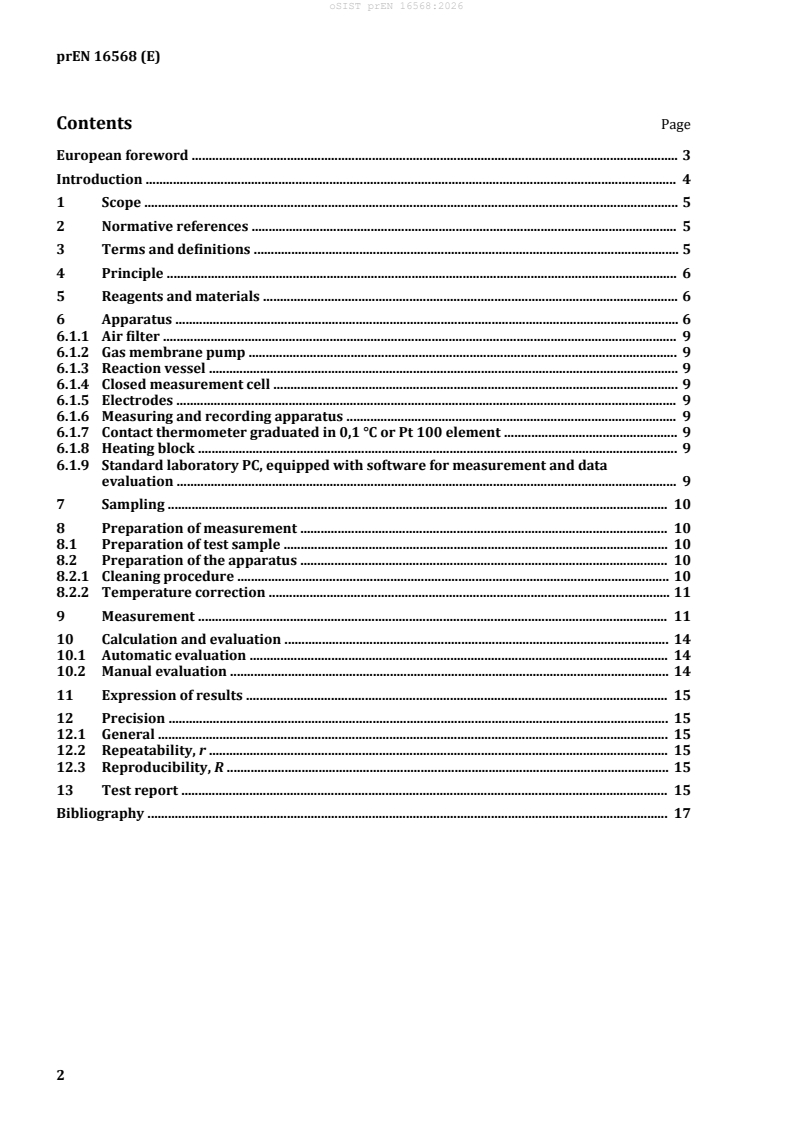
Contents Page
European foreword . 3
Introduction . 4
1 Scope . 5
2 Normative references . 5
3 Terms and definitions . 5
4 Principle . 6
5 Reagents and materials . 6
6 Apparatus . 6
6.1.1 Air filter . 9
6.1.2 Gas membrane pump . 9
6.1.3 Reaction vessel . 9
6.1.4 Closed measurement cell . 9
6.1.5 Electrodes . 9
6.1.6 Measuring and recording apparatus . 9
6.1.7 Contact thermometer graduated in 0,1 °C or Pt 100 element . 9
6.1.8 Heating block . 9
6.1.9 Standard laboratory PC, equipped with software for measurement and data
evaluation . 9
7 Sampling . 10
8 Preparation of measurement . 10
8.1 Preparation of test sample . 10
8.2 Preparation of the apparatus . 10
8.2.1 Cleaning procedure . 10
8.2.2 Temperature correction . 11
9 Measurement . 11
10 Calculation and evaluation . 14
10.1 Automatic evaluation . 14
10.2 Manual evaluation . 14
11 Expression of results . 15
12 Precision . 15
12.1 General . 15
12.2 Repeatability, r . 15
12.3 Reproducibility, R . 15
13 Test report . 15
Bibliography . 17
European foreword
This document (prEN 16568:2026) has been prepared by Technical Committee CEN/TC 19 “Gaseous
and liquid fuels, lubricants and related products of petroleum, synthetic and biological origin”, the
secretariat of which is held by NEN.
This document will supersede EN 16568:2023.
— extension of the scope from blends of fatty acid methyl ester with diesel fuel to neat FAME
— introduction of additional precision data for neat FAME
— alignment with the revised EN 15751 [1] .
Introduction
This document is based on EN 15751 [1], which was specifically developed for the determination of the
oxidation stability of neat fatty acid methyl esters (FAME) and blends with diesel fuel. The oxidation
stability is assessed by determining the induction period of the fuel. The induction period is a measure
for the ageing reserve of the fuel.
The first version of EN 15751 [1] was developed under CEN/TC 19 for a test temperature of 110 °C in
order to stay directly comparable to EN 14112 [2] which is used to determine the oxidation stability of
neat FAME. The stability of diesel/FAME blends is generally higher compared to neat FAME, thus leading
to long measuring times. To better accommodate the needs of laboratories, the reaction temperature
was raised to 120 °C. Degradation of the ageing reserve of the fuel follows the Arrhenius law. By
increasing the temperature by 10 °C, the reaction rate is doubled, cutting in half the induction period.
The modifications introduced into EN 16568:2014 [3] relative to EN 15751 [1] were restricted to diesel
fuel blends containing a volume fraction of FAME in the range of 2 % to 50 %. Neat FAME was not
included in the scope. Not enough adequate data was available showing that the ability is sufficient to
differentiate between different qualities of neat FAME when the induction period is reduced by 50 %.
Hence, a new validation was required to cover neat FAME. In 2024, an Inter-Laboratory Study (ILS) was
organized, executed by CEN/TC 19/JWG 1 (Vegetable fats and oils and their by-products for use in
automotive fuels, Joint working group with CEN/TC 307) in cooperation with CEN/TC 19/WG 44 (FAME
fuel developments) and CEN/ TC 19/WG 36 (Precision evaluation). The results obtained confirmed that
EN 16568 [4] at 120 °C is suitable for measuring the oxidation stability of neat FAME with a precision
that is in the same range as that determined for EN 15751 [1].
While developing the specification for paraffinic diesel fuel, three labs executed a small test on neat
paraffinic diesel and on 7 % FAME blends based on products originating from both Fischer-Tropsch
synthesis and hydrotreatment process. As no indications towards a different interaction were found
when EN 15751 [1] was applied, it was concluded that the stability of paraffinic diesel fuels can be
determined by the induction period. With respect to EN 16568 [4] , no verification at 120 °C was
performed, leaving the applicability of EN 16568 [4] to paraffinic diesel and FAME blends likely but
unconfirmed.
1 Scope
This document specifies a test method for the determination of the oxidation stability at 120 °C of fuels
for diesel engines, by means of measuring the induction period of the fuel. Two different areas of
application with separate precision statements are covered. For diesel fuel having a FAME content in
the range between 2 % and 50 %, an induction period of up to 20 hours can be determined. For neat
FAME, the maximum induction period is limited to 12 hours. The precision of the test method has been
developed for petroleum-based diesel originating from conventional sources.
This test method is applicable for FAME blends with paraffinic diesel fuels as specified in EN 15940
[5], however, precision has not been determined for this type of fuel.
NOTE 1 An almost identical test method for oxidation stability at 110 °C is described in EN 15751 [1] , which
applies to neat FAME and diesel/FAME blends containing 2 % of FAME at minimum. Other alternative test methods
for the determination of the oxidation stability of distillate fuels are described in CEN/TR 17225 [6].
NOTE 2 The precision of this method was determined by two studies using samples of diesel fuel blends with
FAME displaying a maximum induction period of approximately 20 h, respectively of neat FAME with a maximum
induction period of 12 hours. Higher induction periods are not covered by the precision statement; however,
experience from EN 15751 [1] indicates that this method can be used to determine induction periods up to 48 h.
NOTE 3 The presence of cetane improver can reduce the oxidation stability determined by this test method.
Limited studies with 2-ethyl hexyl nitrate (EHN) indicated that the stability is reduced to an extent which is within
the reproducibility of the test method.
NOTE 4 For the purposes of this document, percentages referring to FAME or other fuel content blends (e.g.
"FAME content in the range of 2 % to 50 %"), are volume fractions unless otherwise specified.
2 Normative references
The following documents are referred to in the text in such a way that some or all of their content
constitutes requirements of this document. For dated references, only the edition cited applies. For
undated references, the latest edition of the referenced document (including any amendments) applies.
EN ISO 3170, Hydrocarbon Liquids - Manual Sampling (ISO 3170:2025)
EN ISO 3171, Petroleum liquids - Automatic pipeline sampling (ISO 3171:1988)
EN ISO 3696, Water for analytical laboratory use - Specification and test methods (ISO 3696:1987)
3 Terms and definitions
For the purposes of this document, the following terms and definitions apply.
• ISO Online browsing platform: available at http://www.iso.org/obp
• IEC Electropedia: available at http://www.electropedia.org/
3.1
induction period
time which passes between the moment when the measurement is started and the moment when the
formation of oxidation products begins to increase rapidly
3.2
oxidation stability
induction period determined in accordance with the procedure specified in this document
4 Principle
A stream of purified air is passed through the sample which has been heated to the specified, elevated
temperature. Volatile compounds are formed during the oxidation process. They are passed, together
with the air, into a measurement cell containing demineralized or distilled water and equipped with a
conductivity electrode. The electrode is connected to a measuring and recording device. It indicates the
end of the induction period by rapid increase of the conductivity due to the dissociation of volatile
carboxylic acids produced during the oxidation process and absorbed in the water. For more details on
the background of the method see CEN/TR 17225 [6].
5 Reagents and materials
5.1 Distilled or demineralized water, conforming to EN ISO 3696.
5.2 Alkaline laboratory glass cleaning solution.
5.3 Ternary solvent mixture, 1 + 1 + 1 (by volume), consisting of methanol/toluene/acetone, each
of recognized analytical grade.
5.4 2-Propanol, of recognized analytical grade.
5.5 Thermo-stable oil, e.g. silicon oil.
6 Apparatus
6.1 Device for the determination of oxidation stability, consisting of the following parts (see
Figure 1 and Figure 2).
NOTE An instrument for determining the oxidation stability is commercially available under the trade name
Rancimat® (model 743 or higher) or OSI® Instrument.
Key
1 air filter 6.1.1
Rancimat® is a trademark of Metrohm AG, Herisau, Switzerland and OSI® Instrument is a trademark from
Omnion Inc., Rockland, Massachusetts, USA. This information is given for the convenience of users of this document
and does not constitute an endorsement by CEN of the products named. Equivalent devices may be used if they
can be shown to lead to the same results, at the same or better precision.
...