

EN ISO 14720-1:2026
(Main)Testing of ceramic materials - Determination of sulfur in non-oxidic ceramic raw materials and ceramic materials - Part 1: Infrared measurement methods (ISO 14720-1:2026)
- Abstract
This document specifies a method for the determination of sulfur in non-oxidic ceramic raw materials and ceramic materials, such as silicon carbides, silicon nitrides, graphites, carbon blacks, cokes, carbon powders. If demonstrated by the recovery rate, this document can also be applied for other non-metallic powdered and granular materials, e.g. silicon dioxide.
This document is applicable for materials with mass fractions of sulfur from 0,005 % to 2 %.
This document can also be applied for materials with higher mass fractions of sulfur after verification of the particular case.
- Status
- Published
- Publication Date
- 17-Mar-2026
- Technical Committee
- CEN/TC 187 - Refractory products and materials
- Drafting Committee
- CEN/TC 187/WG 4 - Chemical analysis
- Current Stage
- 6060 - Definitive text made available (DAV) - Publishing
- Start Date
- 18-Mar-2026
- Completion Date
- 18-Mar-2026

Overview
EN ISO 14720-1:2026 (Testing of ceramic materials - Determination of sulfur in non-oxidic ceramic raw materials and ceramic materials - Part 1: Infrared measurement methods) is a European and international standard that specifies procedures for quantifying sulfur in non-oxidic ceramic raw materials and ceramic products. This document is a joint publication by CEN and ISO, developed under technical committees for refractories and ceramic materials. Its scope covers a variety of materials including silicon carbides, silicon nitrides, graphites, carbon blacks, cokes, and related carbon powders. The standard primarily applies to sulfur mass fractions ranging from 0.005% to 2%, but can also be extended to higher concentrations after proper verification.
Key Topics
- Infrared Measurement Methods: The standard details procedures using infrared (IR)-and, where relevant, ultraviolet (UV)-absorption measurement following high-temperature combustion under oxygen. This analytical method ensures reliable quantification of sulfur content in non-oxidic ceramics.
- Sample Preparation: Emphasizes representative sampling, sample drying (at 110°C to constant mass), particle size reduction (≤ 160 µm), and appropriate storage to ensure accuracy and reproducibility.
- Combustion Process: Uses combustion accelerators (typically tungsten, tin, or iron granules) to enhance the release of sulfur as SO₂, which is then measured via IR or UV absorption for quantification.
- Calibration and Reference Materials: Highlights the necessity of calibration using suitable certified reference materials (CRMs) and robust blank value determination.
- Precision and Reporting: Specifies requirements for repeatability, reproducibility, and comprehensive test reporting, including uncertainty quantification when required.
Applications
The procedures outlined in EN ISO 14720-1:2026 provide essential tools for:
- Ceramic Raw Material Quality Control: Reliable sulfur determination helps manufacturers validate product properties and ensure conformance to technical specifications for materials such as silicon carbide and graphite, which are widely used in high-performance ceramics and refractories.
- Refractory and Advanced Ceramic Manufacturing: Monitoring sulfur in raw materials prevents defects and optimizes thermomechanical performance, crucial for industries such as steel, glass, and energy sectors using non-oxidic refractories.
- Research and Development: Laboratories engaged in material research use these standardized methods to benchmark new materials, validate alternative test methods, or develop improved production processes.
- Powder and Granular Material Testing: The standard is applicable beyond ceramics, extending-with verification-to other non-metallic materials such as silicon dioxide, aiding broader material science and chemical industry applications.
- Accredited Laboratory Services: Ensures analytical laboratories can offer sulfur determination services that are recognized internationally, supporting certification and regulatory compliance.
Related Standards
Several key standards are referenced or complement the implementation of EN ISO 14720-1:2026:
- ISO 8656-1: Sampling of raw materials and unshaped refractory products.
- ISO 5725-2, ISO 5725-4: Guidelines on measurement accuracy, repeatability, and reproducibility.
- ISO/IEC Guide 98-3 (GUM: 1995): Guidance on expressing uncertainty in measurement.
- ISO 21748: Instructions for using precision data in uncertainty evaluation.
- EURACHEM and EUROLAB Guides: Provide additional methodologies and best practices for uncertainty assessment and method validation.
- Certified Reference Materials Databases (e.g., COMAR): Comprehensive resources for suitable calibration materials for the relevant measurement range.
Implementing EN ISO 14720-1:2026 assures reliable, precise sulfur measurement in non-oxidic ceramics and related materials, supporting product quality, innovation, and regulatory compliance across the ceramics supply chain.
Relations
- Effective Date
- 17-Apr-2024
- Effective Date
- 12-Feb-2026
Frequently Asked Questions
EN ISO 14720-1:2026 is a standard published by the European Committee for Standardization (CEN). Its full title is "Testing of ceramic materials - Determination of sulfur in non-oxidic ceramic raw materials and ceramic materials - Part 1: Infrared measurement methods (ISO 14720-1:2026)". This standard covers: This document specifies a method for the determination of sulfur in non-oxidic ceramic raw materials and ceramic materials, such as silicon carbides, silicon nitrides, graphites, carbon blacks, cokes, carbon powders. If demonstrated by the recovery rate, this document can also be applied for other non-metallic powdered and granular materials, e.g. silicon dioxide. This document is applicable for materials with mass fractions of sulfur from 0,005 % to 2 %. This document can also be applied for materials with higher mass fractions of sulfur after verification of the particular case.
This document specifies a method for the determination of sulfur in non-oxidic ceramic raw materials and ceramic materials, such as silicon carbides, silicon nitrides, graphites, carbon blacks, cokes, carbon powders. If demonstrated by the recovery rate, this document can also be applied for other non-metallic powdered and granular materials, e.g. silicon dioxide. This document is applicable for materials with mass fractions of sulfur from 0,005 % to 2 %. This document can also be applied for materials with higher mass fractions of sulfur after verification of the particular case.
EN ISO 14720-1:2026 is classified under the following ICS (International Classification for Standards) categories: 81.060.10 - Raw materials. The ICS classification helps identify the subject area and facilitates finding related standards.
EN ISO 14720-1:2026 has the following relationships with other standards: It is inter standard links to EN ISO 14720-1:2013, ISO 14720-1:2026. Understanding these relationships helps ensure you are using the most current and applicable version of the standard.
EN ISO 14720-1:2026 is available in PDF format for immediate download after purchase. The document can be added to your cart and obtained through the secure checkout process. Digital delivery ensures instant access to the complete standard document.
Standards Content (Sample)
SLOVENSKI STANDARD
01-maj-2026
Preskušanje keramičnih materialov - Ugotavljanje žvepla v neoksidativnih
keramičnih surovinah in osnovnih materialih - 1. del: Infrardeče merilne metode
(ISO 14720-1:2026)
Testing of ceramic materials - Determination of sulfur in non-oxidic ceramic raw materials
and ceramic materials - Part 1: Infrared measurement methods (ISO 14720-1:2026)
Prüfung keramischer Werkstoffe - Bestimmung des Schwefelgehaltes in nichtoxidischen
keramischen Roh- und Werkstoffen - Teil 1: Infrarotmessverfahren (ISO 14720-1:2026)
Analyse des matériaux céramiques - Dosage du soufre dans les produits et les matières
premières céramiques non oxydes - Partie 1: Méthodes d'essai par infrarouge (ISO
14720-1:2026)
Ta slovenski standard je istoveten z: EN ISO 14720-1:2026
ICS:
81.060.10 Surovine Raw materials
2003-01.Slovenski inštitut za standardizacijo. Razmnoževanje celote ali delov tega standarda ni dovoljeno.
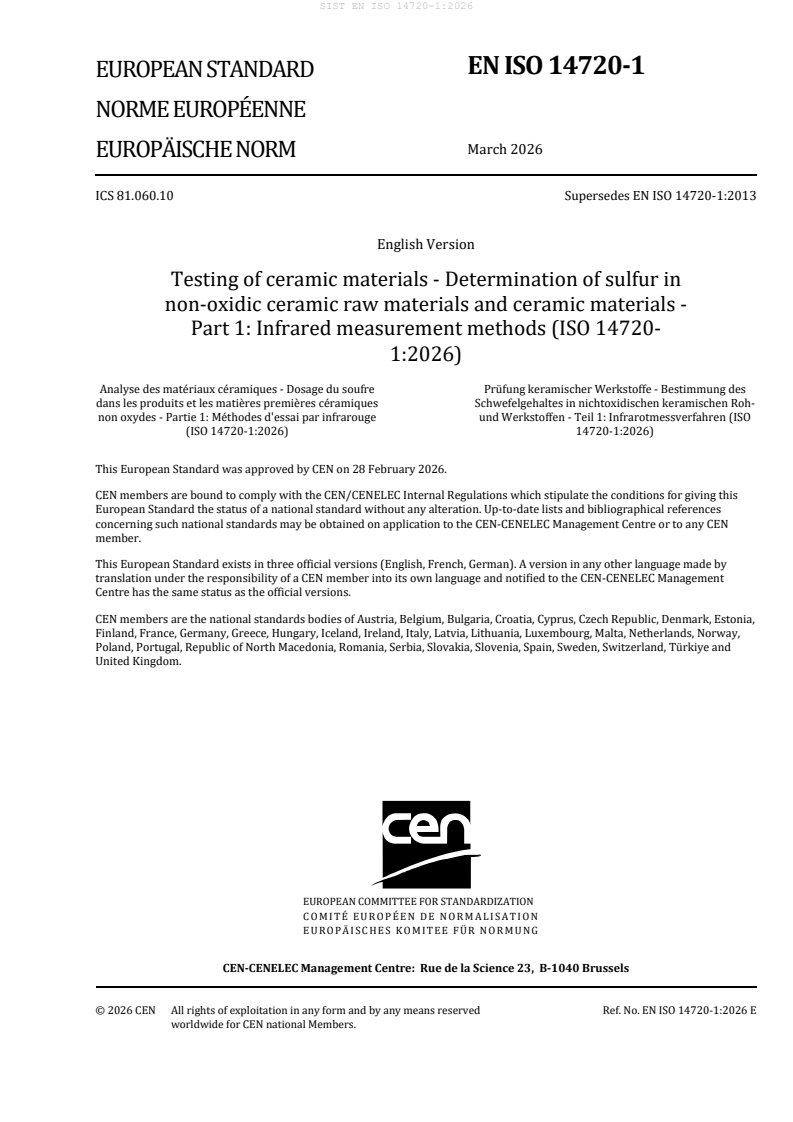
EN ISO 14720-1
EUROPEAN STANDARD
NORME EUROPÉENNE
March 2026
EUROPÄISCHE NORM
ICS 81.060.10 Supersedes EN ISO 14720-1:2013
English Version
Testing of ceramic materials - Determination of sulfur in
non-oxidic ceramic raw materials and ceramic materials -
Part 1: Infrared measurement methods (ISO 14720-
1:2026)
Analyse des matériaux céramiques - Dosage du soufre Prüfung keramischer Werkstoffe - Bestimmung des
dans les produits et les matières premières céramiques Schwefelgehaltes in nichtoxidischen keramischen Roh-
non oxydes - Partie 1: Méthodes d'essai par infrarouge und Werkstoffen - Teil 1: Infrarotmessverfahren (ISO
(ISO 14720-1:2026) 14720-1:2026)
This European Standard was approved by CEN on 28 February 2026.
CEN members are bound to comply with the CEN/CENELEC Internal Regulations which stipulate the conditions for giving this
European Standard the status of a national standard without any alteration. Up-to-date lists and bibliographical references
concerning such national standards may be obtained on application to the CEN-CENELEC Management Centre or to any CEN
member.
This European Standard exists in three official versions (English, French, German). A version in any other language made by
translation under the responsibility of a CEN member into its own language and notified to the CEN-CENELEC Management
Centre has the same status as the official versions.
CEN members are the national standards bodies of Austria, Belgium, Bulgaria, Croatia, Cyprus, Czech Republic, Denmark, Estonia,
Finland, France, Germany, Greece, Hungary, Iceland, Ireland, Italy, Latvia, Lithuania, Luxembourg, Malta, Netherlands, Norway,
Poland, Portugal, Republic of North Macedonia, Romania, Serbia, Slovakia, Slovenia, Spain, Sweden, Switzerland, Türkiye and
United Kingdom.
EUROPEAN COMMITTEE FOR STANDARDIZATION
COMITÉ EUROPÉEN DE NORMALISATION
EUROPÄISCHES KOMITEE FÜR NORMUNG
CEN-CENELEC Management Centre: Rue de la Science 23, B-1040 Brussels
© 2026 CEN All rights of exploitation in any form and by any means reserved Ref. No. EN ISO 14720-1:2026 E
worldwide for CEN national Members.
Contents Page
European foreword . 3
European foreword
This document (EN ISO 14720-1:2026) has been prepared by Technical Committee ISO/TC 33
"Refractories" in collaboration with Technical Committee CEN/TC 187 “Refractory products and
materials” the secretariat of which is held by BSI.
This European Standard shall be given the status of a national standard, either by publication of an
identical text or by endorsement, at the latest by September 2026, and conflicting national standards
shall be withdrawn at the latest by September 2026.
Attention is drawn to the possibility that some of the elements of this document may be the subject of
patent rights. CEN shall not be held responsible for identifying any or all such patent rights.
This document supersedes EN ISO 14720-1:2013.
Any feedback and questions on this document should be directed to the users’ national standards
body/national committee. A complete listing of these bodies can be found on the CEN website.
According to the CEN-CENELEC Internal Regulations, the national standards organizations of the
following countries are bound to implement this European Standard: Austria, Belgium, Bulgaria,
Croatia, Cyprus, Czech Republic, Denmark, Estonia, Finland, France, Germany, Greece, Hungary, Iceland,
Ireland, Italy, Latvia, Lithuania, Luxembourg, Malta, Netherlands, Norway, Poland, Portugal, Republic of
North Macedonia, Romania, Serbia, Slovakia, Slovenia, Spain, Sweden, Switzerland, Türkiye and the
United Kingdom.
Endorsement notice
The text of ISO 14720-1:2026 has been approved by CEN as EN ISO 14720-1:2026 without any
modification.
International
Standard
ISO 14720-1
Second edition
Testing of ceramic materials —
2026-03
Determination of sulfur in non-
oxidic ceramic raw materials and
ceramic materials —
Part 1:
Infrared measurement methods
Analyse des matériaux céramiques — Dosage du soufre dans les
produits et les matières premières céramiques non oxydes —
Partie 1: Méthodes d'essai par infrarouge
Reference number
ISO 14720-1:2026(en) © ISO 2026
ISO 14720-1:2026(en)
© ISO 2026
All rights reserved. Unless otherwise specified, or required in the context of its implementation, no part of this publication may
be reproduced or utilized otherwise in any form or by any means, electronic or mechanical, including photocopying, or posting on
the internet or an intranet, without prior written permission. Permission can be requested from either ISO at the address below
or ISO’s member body in the country of the requester.
ISO copyright office
CP 401 • Ch. de Blandonnet 8
CH-1214 Vernier, Geneva
Phone: +41 22 749 01 11
Email: copyright@iso.org
Website: www.iso.org
Published in Switzerland
ii
ISO 14720-1:2026(en)
Contents Page
Foreword .iv
1 Scope . 1
2 Normative references . 1
3 Terms and definitions . 1
4 Principle . 1
5 Apparatus . 2
6 Reagents . 2
7 Sampling and sample preparation . 2
8 Calibration . 2
9 Performance . 3
9.1 Preparation of analysis .3
9.2 Determination of blank value .3
9.3 Determination of sulfur content .3
10 Calculation and report of the results . 3
11 Precision . 3
11.1 Repeatability .3
11.2 Reproducibility .4
12 Test report . 4
Annex A (informative) Results of the round-robin test . 5
Annex B (informative) Information regarding validation of the uncertainty of the mean value . 7
Annex C (informative) Commercial certified reference materials (CRM) . 8
Bibliography . 9
iii
ISO 14720-1:2026(en)
Foreword
ISO (the International Organization for Standardization) is a worldwide federation of national standards
bodies (ISO member bodies). The work of preparing International Standards is normally carried out through
ISO technical committees. Each member body interested in a subject for which a technical committee
has been established has the right to be represented on that committee. International organizations,
governmental and non-governmental, in liaison with ISO, also take part in the work. ISO collaborates closely
with the International Electrotechnical Commission (IEC) on all matters of electrotechnical standardization.
The procedures used to develop this document and those intended for its further maintenance are described
in the ISO/IEC Directives, Part 1. In particular, the different approval criteria needed for the different types
of ISO document should be noted. This document was drafted in accordance with the editorial rules of the
ISO/IEC Directives, Part 2 (see www.iso.org/directives).
ISO draws attention to the possibility that the implementation of this document may involve the use of (a)
patent(s). ISO takes no position concerning the evidence, validity or applicability of any claimed patent
rights in respect thereof. As of the date of publication of this document, ISO had not received notice of (a)
patent(s) which may be required to implement this document. However, implementers are cautioned that
this may not represent the latest information, which may be obtained from the patent database available at
www.iso.org/patents. ISO shall not be held responsible for identifying any or all such patent rights.
Any trade name used in this document is information given for the convenience of users and does not
constitute an endorsement.
For an explanation of the voluntary nature of standards, the meaning of ISO specific terms and expressions
related to conformity assessment, as well as information about ISO's adherence to the World Trade
Organization (WTO) principles in the Technical Barriers to Trade (TBT), see www.iso.org/iso/foreword.html.
This document was prepared by Technical Committee ISO/TC 33, Refractories, in collaboration with the
European Committee for Standardization (CEN) Technical Committee CEN/TC 187, Refractory products
and materials, in accordance with the Agreement on technical cooperation between ISO and CEN (Vienna
Agreement).
This second edition cancels and replaces the first edition (ISO 14720-1:2013), which has been technically
revised.
The main changes are as follows:
— title of this document has been revised to better describe its field of application;
— Clause 1 adapted to the new title;
— Clauses 2 and 3 added, noting that neither add any normative references or terms and definitions to the
document;
— ultraviolet absorption cell was added to Clause 4 and 5.1;
— resistance furnace removed from 5.1;
— storage of pre-cleaned crucibles in a desiccator added to 9.1;
— subclause 9.3 adds more detail about the use of combustion accelerators.
A list of all parts in the ISO 14720 series can be found on the ISO website.
Any feedback or questions on this document should be directed to the user’s national standards body. A
complete listing of these bodies can be found at www.iso.org/members.html.
iv
International Standard ISO 14720-1:2026(en)
Testing of ceramic materials — Determination of sulfur in
non-oxidic ceramic raw materials and ceramic materials —
Part 1:
Infrared measurement methods
1 Scope
This document specifies a method for the determination of sulfur in non-oxidic ceramic raw materials and
ceramic materials, such as silicon carbides, silicon nitrides, graphites, carbon blacks, cokes, carbon powders.
If demonstrated by the recovery rate
...