

EN 14207:2003
(Main)Water quality - Determination of epichlorohydrin
- Abstract
This European Standard specifies a method for the determination of epichlorohydrin in drinking water and water used for drinking water processing. According to the given procedure, the limit of determination in routine analysis is about 0,5 µg/l 1) . The limit of determination may be lowered to monitor 0,1 µg/l.
1) This value will be checked in an interlaboratory trial.
- Status
- Published
- Publication Date
- 29-Apr-2003
- Technical Committee
- CEN/TC 230 - Water analysis
- Drafting Committee
- CEN/TC 230/WG 1 - Physical and biochemical methods
- Current Stage
- 9093 - Decision to confirm - Review Enquiry
- Start Date
- 09-Feb-2022
- Completion Date
- 21-Oct-2026

Overview
EN 14207:2003 is a CEN European Standard for water quality - determination of epichlorohydrin in drinking water and water used for drinking water processing. The method specifies sample handling, solid‑phase extraction (SPE) enrichment and capillary gas chromatography with mass spectrometric detection (GC‑MS) or, alternatively, electron capture detection (ECD). The routine limit of determination is about 0.5 µg/l, with the procedure able to be extended to monitor down to 0.1 µg/l; the stated performance was verified in interlaboratory trials.
Key topics and technical requirements
- Scope: Target analyte is epichlorohydrin in drinking‑water matrices; intended for routine monitoring and compliance testing.
- Analytical principle: SPE (styrene‑divinylbenzene sorbent ≈200 mg) followed by GC with MS (preferred) or ECD.
- Sampling & preservation: Use clean (preferably brown glass) bottles, fill completely and analyze promptly; if storage is necessary keep samples at 2–5 °C. Samples containing free chlorine should be preserved with a reducing agent (e.g., sodium thiosulfate).
- Sample volume & extraction: Typical sample volume is 100 ml; SPE flow rate 1–3 ml/min; avoid breakthrough by not exceeding 100 ml.
- Sorbent drying & elution: Remove residual water using nitrogen (1–2 l/min for ~5 min) leaving ~250–350 mg water in the sorbent, then elute with diisopropyl ether (2 ml).
- Calibration & internal standards: Multipoint aqueous calibration (five levels) prepared from spiking solutions. Use isotopically labelled 13C3‑epichlorohydrin for GC‑MS or ethyl 2‑chloropropionate for GC‑ECD as internal standards.
- Identification criteria (GC‑MS): Match retention time (±0.08 min) and spectral ion patterns; diagnostic ion pair m/z 49/51 is used due to isotopic chlorine pattern. Quantitative and blank controls are required.
- Apparatus & reagents: Capillary GC, MS (or ECD), dimethylpolysiloxane capillary columns, high‑purity gases, reagent‑grade solvents (diisopropyl ether, methanol), and double‑distilled water.
Applications and users
This standard is designed for:
- Public‑health and regulatory laboratories conducting drinking water monitoring
- Water utilities and treatment plants performing compliance testing and process control
- Third‑party analytical service labs and contract testing facilities
- Manufacturers of water‑analysis instrumentation validating methods and detection limits
EN 14207:2003 supports reliable detection of epichlorohydrin for risk assessment, regulatory compliance and operational decision‑making in drinking‑water supply systems.
Related standards
- EN 25667‑1 / EN 25667‑2 (sampling guidance)
- EN ISO 5667‑3 and ISO 5667‑5 (sample preservation and drinking water sampling)
- ISO 8466‑1 (calibration and evaluation of analytical methods)
Keywords: EN 14207:2003, epichlorohydrin determination, water quality, SPE GC‑MS, drinking water analysis, limit of determination.
Relations
- Effective Date
- 25-Aug-2026
- Effective Date
- 09-Feb-2026
- Effective Date
- 28-Jan-2026
- Effective Date
- 28-Jan-2026
- Effective Date
- 28-Jan-2026
- Effective Date
- 28-Jan-2026
- Effective Date
- 28-Jan-2026
Get Certified
Connect with accredited certification bodies for this standard

CIS Institut d.o.o.
Personal Protective Equipment (PPE) certification body. Notified Body NB-2890 for EU Regulation 2016/425 PPE.

Kiwa BDA Testing
Building and construction product certification.
Kmetijski inštitut Slovenije
Agricultural Institute of Slovenia. Soil testing, plant health, agricultural product analysis.
Sponsored listings
Frequently Asked Questions
EN 14207:2003 is a standard published by the European Committee for Standardization (CEN). Its full title is "Water quality - Determination of epichlorohydrin". This standard covers: This European Standard specifies a method for the determination of epichlorohydrin in drinking water and water used for drinking water processing. According to the given procedure, the limit of determination in routine analysis is about 0,5 µg/l 1) . The limit of determination may be lowered to monitor 0,1 µg/l. 1) This value will be checked in an interlaboratory trial.
This European Standard specifies a method for the determination of epichlorohydrin in drinking water and water used for drinking water processing. According to the given procedure, the limit of determination in routine analysis is about 0,5 µg/l 1) . The limit of determination may be lowered to monitor 0,1 µg/l. 1) This value will be checked in an interlaboratory trial.
EN 14207:2003 is classified under the following ICS (International Classification for Standards) categories: 13.060.50 - Examination of water for chemical substances. The ICS classification helps identify the subject area and facilitates finding related standards.
EN 14207:2003 has the following relationships with other standards: It is inter standard links to ISO 5667-5:1991, ISO 8466-1:1990, EN ISO 5667-1:2023, EN ISO 5667-3:2024, EN ISO 5470-2:2003, CEN/TS 17332:2019, EN 17332:2023. Understanding these relationships helps ensure you are using the most current and applicable version of the standard.
EN 14207:2003 is available in PDF format for immediate download after purchase. The document can be added to your cart and obtained through the secure checkout process. Digital delivery ensures instant access to the complete standard document.
Standards Content (Sample)
2003-01.Slovenski inštitut za standardizacijo. Razmnoževanje celote ali delov tega standarda ni dovoljeno.Wasserbeschaffenheit - Bestimmung von EpichlorhydrinQualité de l'eau - Dosage de l'épichlorhydrineWater quality - Determination of epichlorohydrin13.060.50VQRYLExamination of water for chemical substancesICS:Ta slovenski standard je istoveten z:EN 14207:2003SIST EN 14207:2003en01-september-2003SIST EN 14207:2003SLOVENSKI
STANDARD
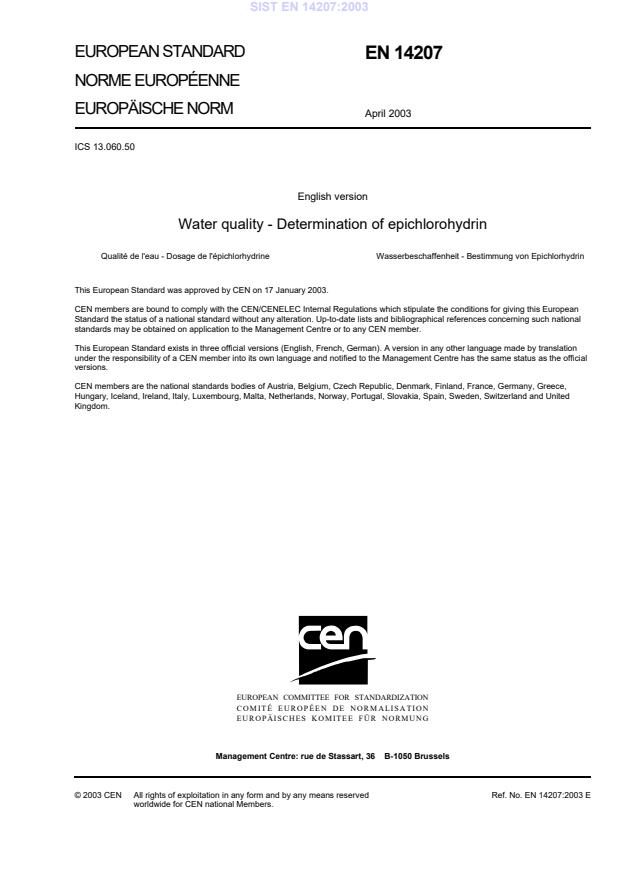
EUROPEAN STANDARDNORME EUROPÉENNEEUROPÄISCHE NORMEN 14207April 2003ICS 13.060.50English versionWater quality - Determination of epichlorohydrinQualité de l'eau - Dosage de l'épichlorhydrineWasserbeschaffenheit - Bestimmung von EpichlorhydrinThis European Standard was approved by CEN on 17 January 2003.CEN members are bound to comply with the CEN/CENELEC Internal Regulations which stipulate the conditions for giving this EuropeanStandard the status of a national standard without any alteration. Up-to-date lists and bibliographical references concerning such nationalstandards may be obtained on application to the Management Centre or to any CEN member.This European Standard exists in three official versions (English, French, German). A version in any other language made by translationunder the responsibility of a CEN member into its own language and notified to the Management Centre has the same status as the officialversions.CEN members are the national standards bodies of Austria, Belgium, Czech Republic, Denmark, Finland, France, Germany, Greece,Hungary, Iceland, Ireland, Italy, Luxembourg, Malta, Netherlands, Norway, Portugal, Slovakia, Spain, Sweden, Switzerland and UnitedKingdom.EUROPEAN COMMITTEE FOR STANDARDIZATIONCOMITÉ EUROPÉEN DE NORMALISATIONEUROPÄISCHES KOMITEE FÜR NORMUNGManagement Centre: rue de Stassart, 36
B-1050 Brussels© 2003 CENAll rights of exploitation in any form and by any means reservedworldwide for CEN national Members.Ref. No. EN 14207:2003 ESIST EN 14207:2003
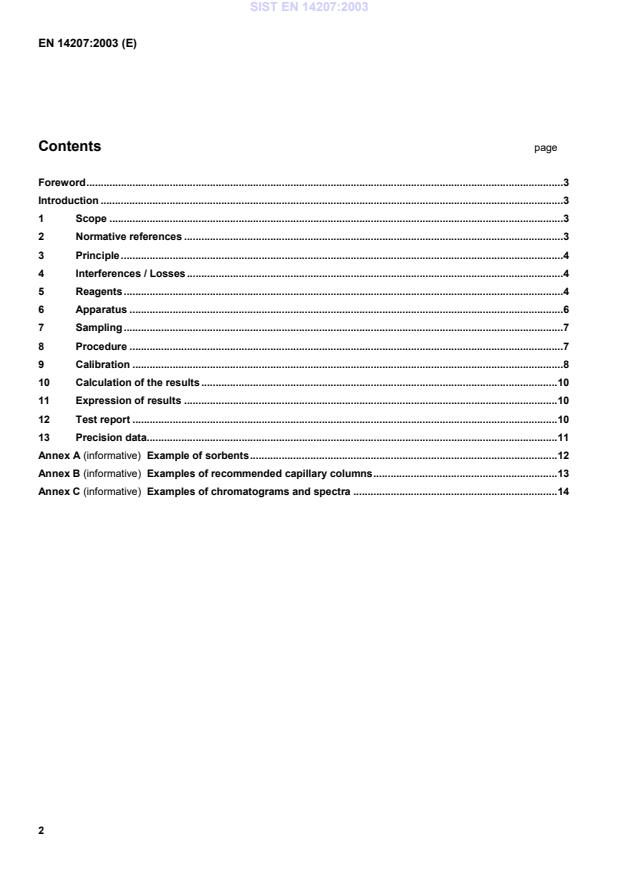
Example of sorbents.12Annex B (informative)
Examples of recommended capillary columns.13Annex C (informative)
Examples of chromatograms and spectra.14SIST EN 14207:2003
1)This value was checked in an interlaboratory trial.SIST EN 14207:2003
...