

EN ISO 9092:2026
(Main)Nonwovens - Vocabulary (ISO 9092:2026)
- Abstract
This document defines the term nonwovens and provides auxiliary terminology to distinguish nonwovens from other materials.
- Status
- Published
- Publication Date
- 21-Apr-2026
- Technical Committee
- CEN/TC 248 - Textiles and textile products
- Drafting Committee
- CEN/TC 248 - Textiles and textile products
- Current Stage
- 6060 - Definitive text made available (DAV) - Publishing
- Start Date
- 22-Apr-2026
- Completion Date
- 22-Apr-2026
Overview
EN ISO 9092:2026 - Nonwovens Vocabulary (ISO 9092:2026) establishes a clear and internationally recognized terminology for nonwovens. Developed by the European Committee for Standardization (CEN) in cooperation with ISO, this standard serves as the authoritative reference for defining the term “nonwovens” and auxiliary terminology that differentiates nonwovens from other textile materials, such as woven fabrics, knitted fabrics, films, and paper products. The standard provides precision for manufacturers, buyers, and researchers involved in the rapidly expanding nonwovens industry.
Key Topics
- Definition of Nonwovens: EN ISO 9092 provides a precise definition, identifying nonwovens as engineered fibrous assemblies, mainly planar, given structural integrity by physical and/or chemical means-explicitly excluding weaving, knitting, or papermaking processes.
- Engineered Materials: Clarifies that nonwovens result from the application of science and technology to design products meeting specific utility requirements.
- Auxiliary Terms: Offers terminology to distinguish nonwovens from materials such as paper, films, wadding, stitchbond, and composites.
- Manufacturing Processes: Addresses bonding technologies (e.g., entanglement, adhesive methods) that impart structural integrity to nonwovens.
- Distinction from Papermaking: Differentiates nonwovens produced by web forming and bonding from traditional paper, where hydrogen bonding is predominant.
- Nonwoven Composites: Covering hybrid materials and multi-component structures combining nonwovens with other discrete materials.
Applications
The standardized vocabulary in EN ISO 9092:2026 is essential for a range of industries operating with nonwoven materials, providing practical benefits in:
- Specification and Procurement: Ensures that contracts, material specifications, and tenders are based on unambiguous terminology, reducing errors and misunderstandings.
- Manufacturing: Supports quality assurance and process control by defining clear boundaries between nonwovens and other textile or fibrous materials.
- Product Development: Facilitates innovation by providing a common language for research and development teams to describe new materials and composite structures.
- International Trade: Enhances cross-border transactions and regulatory compliance by aligning terminology across global markets.
- Education and Training: Valuable for academics, technical trainers, and students for developing curricula and training materials aligned with international standards.
- Market Analysis and Reporting: Enables clear communication in industry reports, market research, and statistical analyses related to nonwoven products.
Related Standards
EN ISO 9092:2026 is closely aligned with other important standards in the textile and nonwovens sector, including:
- ISO 4046-3: Paper, board, pulps, and related terms - Vocabulary - Part 3: Paper-making terminology (for distinguishing nonwovens from paper)
- NWSP 001.0.R1 (24): Standard Terminology Relating to the Nonwoven Industry
- ICS 01.040.59: Textile and leather technology (Vocabularies)
- ICS 59.080.30: Textile fabrics
These standards collectively provide a robust framework for terminology in the textile and nonwovens industry.
EN ISO 9092:2026 is a crucial resource for anyone involved in nonwovens manufacturing, innovation, procurement, or research, offering clarity and consistency in communication across the global textile supply chain. For the full and latest definitions, consult the official CEN or ISO publications.
Relations
- Effective Date
- 16-Oct-2024
- Effective Date
- 29-Apr-2026
- Consolidated By
ISO 9092:2026 - Nonwovens — Vocabulary - Effective Date
- 12-Feb-2026
Frequently Asked Questions
EN ISO 9092:2026 is a standard published by the European Committee for Standardization (CEN). Its full title is "Nonwovens - Vocabulary (ISO 9092:2026)". This standard covers: This document defines the term nonwovens and provides auxiliary terminology to distinguish nonwovens from other materials.
This document defines the term nonwovens and provides auxiliary terminology to distinguish nonwovens from other materials.
EN ISO 9092:2026 is classified under the following ICS (International Classification for Standards) categories: 01.040.59 - Textile and leather technology (Vocabularies). The ICS classification helps identify the subject area and facilitates finding related standards.
EN ISO 9092:2026 has the following relationships with other standards: It is inter standard links to EN ISO 9092:2019, EN 13121-1:2003, ISO 9092:2026. Understanding these relationships helps ensure you are using the most current and applicable version of the standard.
EN ISO 9092:2026 is available in PDF format for immediate download after purchase. The document can be added to your cart and obtained through the secure checkout process. Digital delivery ensures instant access to the complete standard document.
Standards Content (Sample)
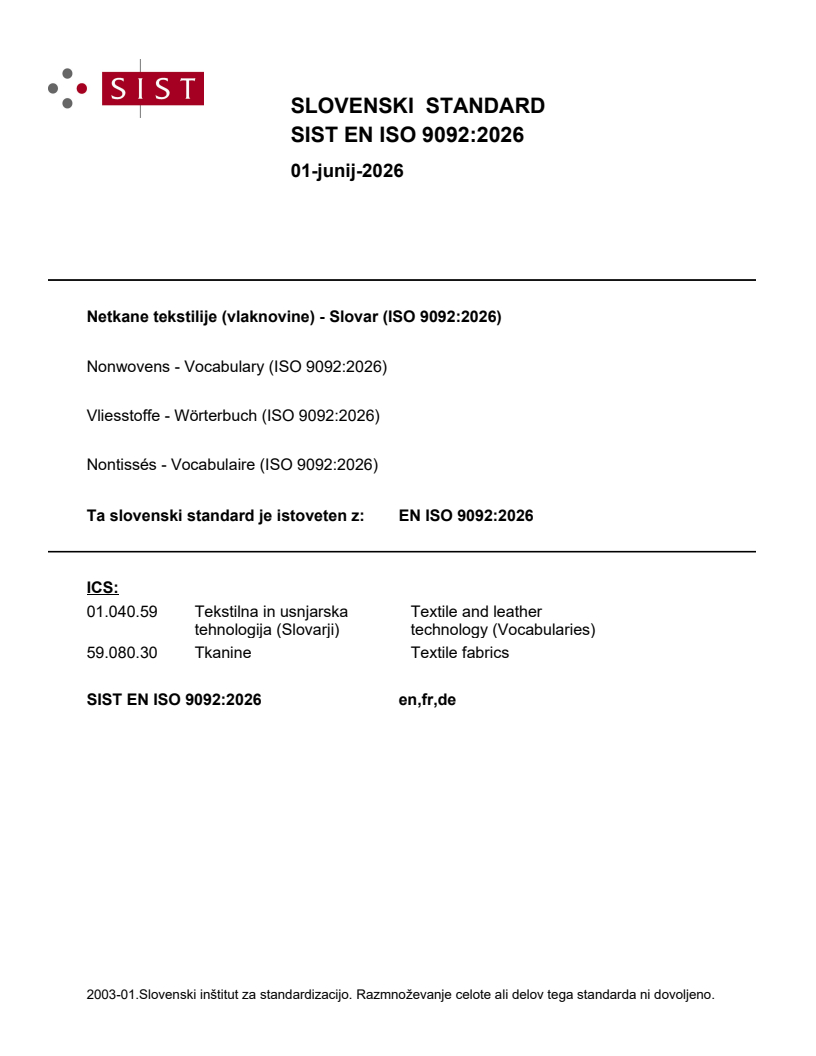
SLOVENSKI STANDARD
01-junij-2026
Netkane tekstilije (vlaknovine) - Slovar (ISO 9092:2026)
Nonwovens - Vocabulary (ISO 9092:2026)
Vliesstoffe - Wörterbuch (ISO 9092:2026)
Nontissés - Vocabulaire (ISO 9092:2026)
Ta slovenski standard je istoveten z: EN ISO 9092:2026
ICS:
01.040.59 Tekstilna in usnjarska Textile and leather
tehnologija (Slovarji) technology (Vocabularies)
59.080.30 Tkanine Textile fabrics
2003-01.Slovenski inštitut za standardizacijo. Razmnoževanje celote ali delov tega standarda ni dovoljeno.
EN ISO 9092
EUROPEAN STANDARD
NORME EUROPÉENNE
April 2026
EUROPÄISCHE NORM
ICS 01.040.59 Supersedes EN ISO 9092:2019
English Version
Nonwovens - Vocabulary (ISO 9092:2026)
Nontiss? - Vocabulaire (ISO 9092:2026) Vliesstoffe - W?terbuch (ISO 9092:2026)
This European Standard was approved by CEN on 4 November 2025.
CEN members are bound to comply with the CEN/CENELEC Internal Regulations which stipulate the conditions for giving this
European Standard the status of a national standard without any alteration. Up-to-date lists and bibliographical references
concerning such national standards may be obtained on application to the CEN-CENELEC Management Centre or to any CEN
member.
This European Standard exists in three official versions (English, French, German). A version in any other language made by
translation under the responsibility of a CEN member into its own language and notified to the CEN-CENELEC Management
Centre has the same status as the official versions.
CEN members are the national standards bodies of Austria, Belgium, Bulgaria, Croatia, Cyprus, Czech Republic, Denmark, Estonia,
Finland, France, Germany, Greece, Hungary, Iceland, Ireland, Italy, Latvia, Lithuania, Luxembourg, Malta, Netherlands, Norway,
Poland, Portugal, Republic of North Macedonia, Romania, Serbia, Slovakia, Slovenia, Spain, Sweden, Switzerland, Türkiye and
United Kingdom.
EUROPEAN COMMITTEE FOR STANDARDIZATION
COMITÉ EUROPÉEN DE NORMALISATION
EUROPÄISCHES KOMITEE FÜR NORMUNG
CEN-CENELEC Management Centre: Rue de la Science 23, B-1040 Brussels
© 2026 CEN All rights of exploitation in any form and by any means reserved Ref. No. EN ISO 9092:2026 E
worldwide for CEN national Members.
Contents Page
European foreword . 3
European foreword
This document (EN ISO 9092:2026) has been prepared by Technical Committee ISO/TC 38 "Textiles" in
collaboration with Technical Committee CEN/TC 248 “Textiles and textile products” the secretariat of
which is held by BSI.
This European Standard shall be given the status of a national standard, either by publication of an
identical text or by endorsement, at the latest by October 2026, and conflicting national standards shall
be withdrawn at the latest by October 2026.
Attention is drawn to the possibility that some of the elements of this document may be the subject of
patent rights. CEN shall not be held responsible for identifying any or all such patent rights.
This document supersedes EN ISO 9092:2019.
Any feedback and questions on this document should be directed to the users’ national standards
body/national committee. A complete listing of these bodies can be found on the CEN website.
According to the CEN-CENELEC Internal Regulations, the national standards organizations of the
following countries are bound to implement this European Standard: Austria, Belgium, Bulgaria,
Croatia, Cyprus, Czech Republic, Denmark, Estonia, Finland, France, Germany, Greece, Hungary, Iceland,
Ireland, Italy, Latvia, Lithuania, Luxembourg, Malta, Netherlands, Norway, Poland, Portugal, Republic of
North Macedonia, Romania, Serbia, Slovakia, Slovenia, Spain, Sweden, Switzerland, Türkiye and the
United Kingdom.
Endorsement notice
The text of ISO 9092:2026 has been approved by CEN as EN ISO 9092:2026 without any modification.
International
Standard
ISO 9092
Fourth edition
Nonwovens — Vocabulary
2026-04
Nontissés — Vocabulaire
Reference number
ISO 9092:2026(en) © ISO 2026
ISO 9092:2026(en)
© ISO 2026
All rights reserved. Unless otherwise specified, or required in the context of its implementation, no part of this publication may
be reproduced or utilized otherwise in any form or by any means, electronic or mechanical, including photocopying, or posting on
the internet or an intranet, without prior written permission. Permission can be requested from either ISO at the address below
or ISO’s member body in the country of the requester.
ISO copyright office
CP 401 • Ch. de Blandonnet 8
CH-1214 Vernier, Geneva
Phone: +41 22 749 01 11
Email: copyright@iso.org
Website: www.iso.org
Published in Switzerland
ii
ISO 9092:2026(en)
Contents Page
Foreword .iv
1 Scope . 1
2 Normative references . 1
3 Terms and definitions . 1
3.1 General terminology .1
3.2 Auxiliary terminology to distinguish nonwovens from other materials .2
Bibliography . 3
Index . 4
iii
ISO 9092:2026(en)
Foreword
ISO (the International Organization for Standardization) is a worldwide federation of national standards
bodies (ISO member bodies). The work of preparing International Standards is normally carried out through
ISO technical committees. Each member body intere
...