

prEN IEC 80601-2-86:2026
(Main)Medical electrical equipment - Part 2-86: Particular requirements for the basic safety and essential performance of electrocardiographs, including diagnostic equipment, monitoring equipment, ambulatory equipment, electrodes, cables and leadwires
- Status
- Not Published
- Publication Date
- 01-Feb-2028
- Technical Committee
- CLC/TC 62 - Electrical equipment in medical practice
- Drafting Committee
- IEC/SC 62D - IEC_SC_62D
- Current Stage
- 4060 - Enquiry results established and sent to TC, SR, BTTF - Enquiry
- Start Date
- 02-Oct-2026
- Completion Date
- 02-Oct-2026
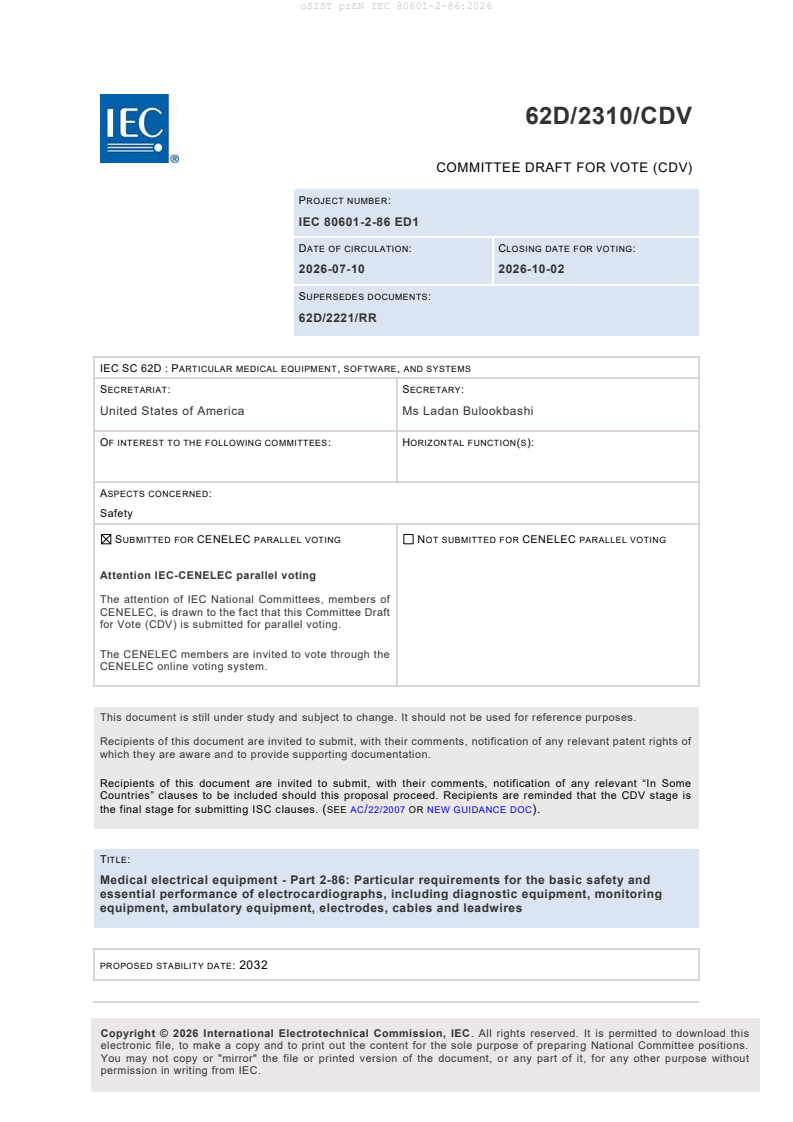



prEN IEC 80601-2-86:2026 is a CLC Committee Draft for Vote for medical electrical equipment. It specifies particular requirements for the basic safety and essential performance of electrocardiographs, including diagnostic, monitoring and ambulatory ECG equipment, together with ECG electrodes, cables and leadwires, for manufacturers, test laboratories and other users of IEC 60601 equipment.
What does prEN IEC 80601-2-86:2026 specify?
prEN IEC 80601-2-86:2026 applies to ECG ME EQUIPMENT and accessories and sets out how the general IEC 60601-1 requirements are adapted for ECG use. The document is organized into clauses for scope, references, terminology, general requirements, testing, classification, marking, hazards, electromagnetic compatibility, alarms and several ECG-specific annexes.
The scope covers ECG ME EQUIPMENT for professional healthcare facilities, EMERGENCY MEDICAL SERVICE ENVIRONMENTS and HOME HEALTHCARE ENVIRONMENTS. It includes MONITORING ECG ME EQUIPMENT, DIAGNOSTIC ECG ME EQUIPMENT and AMBULATORY ECG ME EQUIPMENT, as well as ECG ELECTRODEs, TRUNK CABLEs and LEAD WIRES when used with ECG systems.
The scope also makes practical exclusions. It does not include direct fetal ECG equipment or Fetal & Maternal Monitoring Equipment, MRI-specific ECG TRUNK CABLES and PATIENT LEAD WIRES, wellness-only devices such as fitness trackers that only measure heart rate for general wellness, or external defibrillators unless their intended use also includes diagnosis, monitoring or treatment from the ECG waveform.
| Annex | What it covers |
|---|---|
| AA | General guidance and rationale |
| BB | Positions, identifications and colour codes of additional ECG ELECTRODEs |
| CC | ECG clinical use cases |
| DD | Definitions and rules for the measurement of ELECTROCARDIOGRAMs |
| EE | CTS test atlas |
| GG | Alarm diagrams of Clause 208 / IEC 60601-1-8 |
What are the key requirements of prEN IEC 80601-2-86:2026?
prEN IEC 80601-2-86:2026 focuses on ECG-specific safety, signal performance, alarm behavior and accessory performance. In practice, it tells manufacturers what to design, what to test, what to declare in the instructions for use and what to verify in the technical file.
ECG type and intended-use structure
Clause 201.1.2.101 separates the document into general requirements, plus requirements specific to DIAGNOSTIC ECG ME EQUIPMENT, MONITORING ECG ME EQUIPMENT and AMBULATORY ECG ME EQUIPMENT. This matters because the applicable performance claims depend on the intended use stated by the MANUFACTURER.
The same clause also adds dedicated requirements for ECG TRUNK CABLEs and LEAD WIRES, and for DISPOSABLE ECG ELECTRODEs. That means accessory makers and system integrators need to look beyond the base ECG unit and check the accessory-specific clauses too.
Defibrillation protection and defibrillation safety
Clause 201.8.5.5.1 and 201.8.5.5.2 require ECG ME EQUIPMENT and APPLIED PARTS to manage defibrillation effects, with separate concepts for DEFIBRILLATION PROOF and DEFIBRILLATION SAFE. In practice, the equipment must either recover after defibrillation without creating a hazard, or at minimum avoid harm if it remains attached during a shock.
The document gives detailed defibrillation test arrangements for different lead configurations, including 12-lead, 5-lead, 4-lead, 3-lead, 2-lead, Frank and ambulatory configurations. That matters because the test conditions change with the lead set, so a manufacturer has to test the actual combinations it supplies.
Ingress, power interruption and battery behavior
Clause 201.11.6.5 requires TRANSPORTABLE ECG ME EQUIPMENT to have at least IPX1 ingress protection. For users, this means accidental wetting must not create a hazardous situation, so the enclosure has to survive a basic water-ingress challenge.
Clause 201.11.8 requires MONITORING ECG ME EQUIPMENT to keep settings and stored patient data through a SUPPLY MAINS interruption of up to 30 s, and to generate an appropriate technical alarm when monitoring or alarming stops. It also requires automatic continuation from an INTERNAL ELECTRICAL POWER SOURCE, with a visual indication that battery operation is active.
Clause 201.11.8.101 adds battery-depletion protection. The equipment has to warn the operator at least 5 minutes before it can no longer meet the manufacturer’s specification, then power down in a controlled way that does not create a hazard.
Frequency response and ST performance
Clause 201.12.4.102 sets frequency-response requirements by ECG category. All ECG ME EQUIPMENT must support the general ECG frequency range, and DIAGNOSTIC ECG ME EQUIPMENT must also meet the wider diagnostic bandwidth or equivalent waveform-performance criteria.
For equipment that measures or interprets the ST segment, the standard sets an ST measurement response requirement using a defined triangle pulse. This is important because ST analysis is sensitive to baseline shifts and slope errors, so the device has to preserve clinically relevant waveform shape, not just display a trace.
Pacemaker pulse handling
Clauses 201.12.4.113 and 201.12.4.114 address pacemaker pulse display, detection and rejection. Diagnostic equipment and devices claiming pacemaker detection must show the pacemaker pulse clearly, use separate markers when applicable, disclose the pulse limits they can detect, and document any false-pulse detection analysis.
For MONITORING ECG ME EQUIPMENT, the document also requires disclosure of pacemaker rejection capability and, where rejection can be disabled, a visible indication of that state. In practice, this is a safety and usability issue because a missing or misidentified pacer pulse can affect clinical interpretation.
Noise, common-mode behavior and recovery
Clause 201.12.4.111 covers common-mode rejection, and clause 201.12.4.112 requires baseline recovery after overload. These clauses matter when the patient signal is small and the environment is noisy, because the ECG unit must reject interference and return to usable operation quickly after a disturbance.
Clause 201.15.101.1.4 adds a noise limit for TRUNK CABLE material. That means cable design and connector choice can affect measured ECG noise and therefore the quality of the recording.
EMC and HF surgical interference
Clauses 202 and 202.8 apply electromagnetic disturbance requirements and immunity testing, including a specific electrosurgery-interference clause. The practical point is that ECG equipment has to keep working, or fail safely, when exposed to electromagnetic sources found in clinical environments.
Alarm system behavior for monitoring ECG equipment
Clause 208 applies IEC 60601-1-8 with ECG-specific additions for MONITORING ECG ME EQUIPMENT. Heart-rate alarm conditions are assigned priority levels, cardiac standstill, ventricular tachycardia and ventricular fibrillation are high priority, and technical alarm conditions that prevent physiological alarms must be given at least low priority.
The clause also sets timing and display rules for inoperable conditions, low-battery conditions and alarm delays. That matters because alarms are part of the clinical workflow: the operator must be warned fast enough to act, but not so quickly that nuisance alarms dominate.
What terms does prEN IEC 80601-2-86:2026 define?
AMBULATORY ECG ME EQUIPMENT - ECG ME EQUIPMENT that acquires an ECG signal from an ambulatory PATIENT.
AMBULATORY ECG RECORDER - ECG ME EQUIPMENT connected to the PATIENT, including associated ECG ELECTRODES and cables, for recording an ECG signal from an ambulatory PATIENT.
DEFIBRILLATION PROOF - ECG ME EQUIPMENT and APPLIED PARTS designed to protect the patient from a defibrillator discharge and recover operation afterward.
DEFIBRILLATION SAFE - ECG ME EQUIPMENT and APPLIED PARTS designed not to harm the patient if left attached during external defibrillation, even if the device is damaged.
DIAGNOSTIC ECG ME EQUIPMENT - ECG ME EQUIPMENT intended to acquire 12 or more leads for diagnosis based on rhythm, conduction and waveform contour.
DISPOSABLE ECG ELECTRODE - an ECG ELECTRODE intended for single-patient, single-use application with an adhesive body-surface interface.
ECG ELECTRODE IMPEDANCE - the combined resistive and capacitive opposition of the electrode interface to current flow, measured with alternating current.
ECG ME EQUIPMENT - any ECG device, system or part of a system that acquires body-surface ECG and displays, records, analyzes or transmits the result for diagnosis, treatment or monitoring.
Who uses prEN IEC 80601-2-86:2026?
prEN IEC 80601-2-86:2026 is used by ECG equipment manufacturers, component suppliers and system integrators to design products that meet basic safety and essential performance expectations. It is also used by test laboratories, conformity assessment bodies and regulatory or quality teams that verify ECG performance, alarm behavior and accessory safety.
It is relevant to clinical buyers and quality managers in hospitals, emergency medical services and home-healthcare organizations because the scope includes all three environments. These users can check whether a device claim is really covered by the document, especially for diagnostic, monitoring and ambulatory ECG systems.
The standard is also useful for teams preparing technical files, instructions for use and risk-management records. Several clauses require disclosure of performance limits, testing methods and alarm settings, so documentation is part of conformity, not just design.
What changed in prEN IEC 80601-2-86:2026 from the previous edition?
prEN IEC 80601-2-86:2026 is the first edition of IEC 80601-2-86. It cancels and replaces IEC 60601-2-25:2011, IEC 60601-2-27:2011 and IEC 60601-2-47:2012.
The introduction states that this edition aligns with IEC 60601-1:2005/AMD1:2012 and later updates to the general and collateral standards. It also combines the three ECG particular standards into one, brings in requirements omitted when 60601-2-51 was combined earlier, and adds requirements for ECG TRUNK CABLEs, LEAD WIRES, DISPOSABLE ECG ELECTRODEs, and cardiac rhythm and ST segment measurement algorithms.
Which standards are used with prEN IEC 80601-2-86:2026?
The document names IEC 60601-1-2:2014 and IEC 60601-1-2:2014/AMD1:2020 for electromagnetic disturbances and tests. It also names IEC 60601-1-8:2006, IEC 60601-1-8:2006/AMD1:2012 and IEC 60601-1-8:2006/AMD2:2020 for alarm systems.
IEC 60601-2-2:2017 is added as a normative reference for high frequency surgical equipment and accessories. In practice, these references supply the EMC, alarm and HF-surgery test framework that ECG equipment must fit into.
What does the prEN IEC 80601-2-86:2026 document contain?
The document contains detailed test setups, figures and tables for ECG-specific safety and performance checks. These include defibrillation test circuits, common-mode rejection circuits, baseline-recovery tests, pacemaker pulse figures, cable-noise setups, dielectric-withstand tests and alarm diagrams.
It also contains performance tables for frequency response, electrode colour coding, lead configurations, arrhythmia-algorithm reporting and accessory tests. Annex DD gives definitions and rules for measuring ECGs, Annex EE provides a CTS test atlas, and Annex AA gives rationale and guidance for the main requirements.
For algorithm-based functions, the document includes database-driven evaluation tables and worked reporting formats for beat detection, arrhythmia detection, shutdown statistics and heart-rate variability. That is useful when the product outputs analyzed ECG results, not just waveforms, because the standard expects repeatable evidence for the reported performance.
Relations
- Effective Date
- 30-Jun-2026
- Effective Date
- 26-May-2026
- Effective Date
- 26-May-2026
Get Certified
Connect with accredited certification bodies for this standard

BSI Group
BSI (British Standards Institution) is the business standards company that helps organizations make excellence a habit.

TÜV Rheinland
TÜV Rheinland is a leading international provider of technical services.

TÜV SÜD
TÜV SÜD is a trusted partner of choice for safety, security and sustainability solutions.
Sponsored listings
Frequently Asked Questions
prEN IEC 80601-2-86:2026 is a draft published by CLC. Its full title is "Medical electrical equipment - Part 2-86: Particular requirements for the basic safety and essential performance of electrocardiographs, including diagnostic equipment, monitoring equipment, ambulatory equipment, electrodes, cables and leadwires". This standard covers: Medical electrical equipment - Part 2-86: Particular requirements for the basic safety and essential performance of electrocardiographs, including diagnostic equipment, monitoring equipment, ambulatory equipment, electrodes, cables and leadwires
Medical electrical equipment - Part 2-86: Particular requirements for the basic safety and essential performance of electrocardiographs, including diagnostic equipment, monitoring equipment, ambulatory equipment, electrodes, cables and leadwires
prEN IEC 80601-2-86:2026 is classified under the following ICS (International Classification for Standards) categories: 11.040.55 - Diagnostic equipment; 11.040.99 - Other medical equipment. The ICS classification helps identify the subject area and facilitates finding related standards.
prEN IEC 80601-2-86:2026 has the following relationships with other standards: It is inter standard links to EN 60601-2-25:2015, EN 60601-2-47:2015, EN 60601-2-27:2014. Understanding these relationships helps ensure you are using the most current and applicable version of the standard.
prEN IEC 80601-2-86:2026 is available in PDF format for immediate download after purchase. The document can be added to your cart and obtained through the secure checkout process. Digital delivery ensures instant access to the complete standard document.
Standards Content (Sample)
SLOVENSKI STANDARD
01-september-2026
Medicinska električna oprema - 2-86. del: Posebne zahteve za osnovno varnost in
bistvene lastnosti elektrokardiografov, vključno z diagnostično opremo, opremo
za spremljanje, ambulantno opremo, elektrodami, kabli in priključnimi vodniki
Medical electrical equipment - Part 2-86: Particular requirements for the basic safety and
essential performance of electrocardiographs, including diagnostic equipment,
monitoring equipment, ambulatory equipment, electrodes, cables and leadwires
Ta slovenski standard je istoveten z: prEN IEC 80601-2-86:2026
ICS:
11.040.55 Diagnostična oprema Diagnostic equipment
2003-01.Slovenski inštitut za standardizacijo. Razmnoževanje celote ali delov tega standarda ni dovoljeno.
62D/2310/CDV
COMMITTEE DRAFT FOR VOTE (CDV)
PROJECT NUMBER:
IEC 80601-2-86 ED1
DATE OF CIRCULATION: CLOSING DATE FOR VOTING:
2026-07-10 2026-10-02
SUPERSEDES DOCUMENTS:
62D/2221/RR
IEC SC 62D : PARTICULAR MEDICAL EQUIPMENT, SOFTWARE, AND SYSTEMS
SECRETARIAT: SECRETARY:
United States of America Ms Ladan Bulookbashi
OF INTEREST TO THE FOLLOWING COMMITTEES: HORIZONTAL FUNCTION(S):
ASPECTS CONCERNED:
Safety
SUBMITTED FOR CENELEC PARALLEL VOTING NOT SUBMITTED FOR CENELEC PARALLEL VOTING
Attention IEC-CENELEC parallel voting
The attention of IEC National Committees, members of
CENELEC, is drawn to the fact that this Committee Draft
for Vote (CDV) is submitted for parallel voting.
The CENELEC members are invited to vote through the
CENELEC online voting system.
This document is still under study and subject to change. It should not be used for reference purposes.
Recipients of this document are invited to submit, with their comments, notification of any relevant patent rights of
which they are aware and to provide supporting documentation.
Recipients of this document are invited to submit, with their comments, notification of any relevant “In Some
Countries” clauses to be included should this proposal proceed. Recipients are reminded that the CDV stage is
the final stage for submitting ISC clauses. (SEE AC/22/2007 OR NEW GUIDANCE DOC).
TITLE:
Medical electrical equipment - Part 2-86: Particular requirements for the basic safety and
essential performance of electrocardiographs, including diagnostic equipment, monitoring
equipment, ambulatory equipment, electrodes, cables and leadwires
PROPOSED STABILITY DATE: 2032
electronic file, to make a copy and to print out the content for the sole purpose of preparing National Committee positions.
You may not copy or "mirror" the file or printed version of the document, or any part of it, for any other purpose without
permission in writing from IEC.
NOTE FROM TC/SC OFFICERS:
IEC CDV 80601-2-86 © IEC 2026
1 CONTENTS
2 FOREWORD . 4
3 INTRODUCTION . 7
4 Scope, objective and related standards . 8
5 Normative references . 11
6 *Terminology and definitions . 12
7 General requirements . 16
8 General requirements for testing of ECG ME EQUIPMENT . 17
9 Classification of ECG ME EQUIPMENT and ME SYSTEMS . 18
10 ECG ME EQUIPMENT identification, marking and documents . 19
11 Protection against electrical HAZARDS from ECG ME EQUIPMENT . 27
12 Protection against mechanical hazards of ECG ME EQUIPMENT and ME SYSTEMS . 34
13 Protection against unwanted and excessive radiation HAZARDS . 34
14 Protection against excessive temperatures and other HAZARDS . 34
15 Accuracy of controls and instruments and protection against
16 hazardous outputs . 36
17 HAZARDOUS SITUATIONS and fault conditions . 77
18 Programmable electrical medical systems (PEMS) . 78
19 Construction of ME EQUIPMENT . 78
20 201.16 ME SYSTEMS . 94
21 201.17 Electromagnetic compatibility of ME EQUIPMENT and ME SYSTEMS . 94
22 202 Electromagnetic disturbances – Requirements and tests . 95
23 202.8 Electromagnetic immunity requirements for ecg me equipment and me
24 systems . 97
25 202.8.101 * Electrosurgery interference . 98
26 208 General requirements, tests and guidance for ALARM SYSTEMS in ME EQUIPMENT and
27 ME SYSTEMS . 101
28 Alarm systems . 101
29 Annex AA (informative) General guidance and rationale . 107
30 Annex BB (informative) Positions, identifications and colour codes of additional ECG
31 ELECTRODEs . 202
32 Annex CC (informative) ECG clinical use cases . 208
33 Annex DD (informative) Definitions and rules for the measurement of
34 ELECTROCARDIOGRAMS . 226
35 Annex EE (informative) CTS test atlas . 232
36 Annex GG (informative) Alarm diagrams of Clause 208/IEC 60601-1-8:2006 +A1:2012 . 265
37 Bibliography . 268
39 Figure 201.101 – Alternating QRS complexes and ventricular tachycardia waveforms for
40 testing pattern recognition capability for 201.7.8.2 c) - 13) and 15) . 24
41 Figure 201.102 – Test of protection against the effects of defibrillation (common mode) . 29
42 Figure 201.103 – Test of protection against the effects of defibrillation (differential mode) . 30
43 Figure 201.104 – Application of the test voltage between LEAD WIREs to test the energy
44 delivered by the defibrillator . 31
45 Figure 201.105 – General test circuit . 35
46 Figure 201.106 – Input impulse signal and electrocardiograph response . 37
47 Figure 201.107 – Test circuit for common mode rejection . 45
48 Figure 201.108 – Pacemaker pulse . 47
49 Figure 201.109 – Test waveforms for T-wave rejection . 49
50 Figure 201.110 – Normal paced rhythm . 50
IEC CDV 80601-2-86 © IEC 2026
51 – Ineffective pacing (heart rate at 30 complexes/min, pacemaker pulse at 80 complexes/min)
52 50
53 Figure 201.112 – Simulated QRS complex . 50
54 Figure 201.113 – Pacemaker test circuit . 51
55 Figure 201.114: dielectric withstand test . 69
56 Figure 201.115 — Test setup for cable noise measurement . 70
57 Figure 201.116 - Flex life test setup . 71
58 Figure 201.117 – Test circuit for offset instability/internal noise determination . 76
59 Figure 201.118 – Defibrillation overload test circuit (all capacitor and resistor values have a
60 tolerance of 10%) . 77
61 Figure 201.119 – Defibrillation overload test circuit for cables containing resistors . 77
62 Figure 202.101 – Test layout for radiated and conducted emission tests . 79
63 Figure 202.102 – Set-up for immunity tests . 80
64 Figure 202.103 – Test circuit for HF surgery protection measurement . 83
65 Figure 202.104 – Test setup for HF surgery protection measurement . 83
66 Figure AA.1 – Applied part with multiple PATIENT connections . 101
67 Figure AA.2 – D-sub connector . 101
68 Figure AA.3 Simulation of a rectangular pulse filtered by 0,05 Hz causal highpass filter (right)
69 and a 0,5 Hz non-causal highpass filter (left) . 109
70 Figure AA.4 - Example of scatter plot of ST amplitude measurement . 137
71 Figure AA.5 - Example of scatter plot of ST amplitude error values for all measurements . 137
72 Figure AA.6 - Example of scatter plot of ST amplitude error values for ST reference values
73 from -200 microvolt to + 200 microvolt . 138
74 Figure AA.7 - Example of scatter plot of ST slope measurements . 138
75 Figure AA.8 - Example of scatter plot of all ST slope measurement errors . 139
76 Figure AA.9—Example of scatter plot of all ST slope measurement errors for ST reference
77 values from -2.0 mV/sec to + 2.0 mV/sec . 140
79 Figure BB.1 – LEADs and colours for fetal ecg . 4
80 Figure BB.2 – Positions of the ECG ELECTRODEs on the fetus for fetal ECG (see Table BB.2) . 4
81 Figure BB.3 – LEAD positions and colours for fetal scalp ECG (see Table BB.2) . 4
82 Figure DD.1 – Normal electrocardiogram . 23
83 Figure DD.2 – Determination of global intervals (example) . 24
84 Figure DD.3 – Waveform durations, isoelectric segments . 25
85 Figure DD.4 – QRS complex with small R-wave(s) (see Figure DD.5, DD.6) . 27
86 Figure DD.5 – Detail of small accepted R-wave . 27
87 Figure DD.6 – Detail of small rejected R-wave . 28
88 Figure FF.1 – Nomenclature of CALIBRATION ECG S . 35
89 Figure FF.2 – Nomenclature of analytical ECG s . 38
90 Figure FF.3 – Noise Characteristics . 40
91 Figure GG.1 – NON-LATCHING ALARM SIGNALS without ALARM RESET . 2
92 Figure GG.2 – NON-LATCHING ALARM SIGNALS with ALARM RESET . 3
93 Figure GG.3 – LATCHING ALARM SIGNALS with ALARM RESET . 3
94 Figure GG.4 – Two ALARM CONDITIONS with ALARM RESET . 4
96 Table 201.101 – ESSENTIAL PERFORMANCE requirements . 17
97 Table 201.102 – ECG ELECTRODE colour codes, identification codes, and position, for standard
98 12 LEAD & Frank ECG placement . 20
99 Table 201.103 – Identification and colour for AMBULATORY ECG placement . 21
100 Table 201.104 – Protection against the effect of defibrillation (test conditions) . 28
101 Table 201.105 – Frequency response by ECG category . 35
102 Table 201.106 – Electrode connection configurations for test of multichannel crosstalk . 38
103 Table 201.107 – Acceptable mean differences and standard deviations for global intervals and
104 Q-, R-, S-durations on calibration and analytical ECGs . 54
105 Table 201.108 – Acceptable mean differences and standard deviations for global durations
106 and intervals for biological ECGs. 55
107 Table 201.109 – Disclosed changes of measurements caused by NOISE on ECGs . 55
108 Table 201.110 – Example for the documentation of accuracy measures for diagnostic
109 interpretative statements. 57
110 Table 201.111 – Example for the documentation of accuracy measures for rhythm
111 interpretative statements. 58
IEC CDV 80601-2-86 © IEC 2026
112 Table 201.112: Databases . 59
113 Table 201.113 – Records to be included in a complete test . 60
114 Table 201.114 – Requirements for all arrhythmia algorithms . 61
115 Table 201.115: TRUNK CABLE and LEAD WIRE flex life . 70
116 Table 201.116—Tensile strength of cable connections in N . 71
117 Table 201.117 - Number of connector mating/unmating cycles . 72
118 Table 201.118 - LEAD WIRE resistance (Ω) . 73
119 Table 202.101 – Test signals and IMMUNITY Pass/Fail criteria . 81
120 Table AA.1 – Summary of requirements for different types of ECG ME EQUIPMENT . 95
121 Table AA.2 – Summary of subclauses excluded in General Requirements . 95
122 Table AA.3 Summary of specific ME EQUIPMENT type applicability for subclauses excluded from
123 General Requirements . 96
124 Table AA.4 Prior definitions of ESSENTIAL PERFORMANCE . 98
125 Table AA.5 – ECG ELECTRODE positions and electrical strength requirements . 105
126 Table AA.6 – Tabulation of test results . 116
127 Table AA.7—AHA and MIT–BIH database labels . 121
128 Table AA.8 – Beat label classifications . 125
129 Table AA.9 – Example of a line-format, beat-by-beat performance report . 126
130 Table AA.10 – Run sensitivity summary matrix . 128
131 Table AA.11 – Run positive predictivity summary matrix . 128
132 Table AA.12 – Condensed beat-by-beat summary matrix containing 11 elements . 129
133 Table AA.13 – Summary table (matrix format) of beat-by-beat comparison . 129
134 Table AA.14 – Example of a line-format couplet and run performance report . 130
135 Table AA.15 – Example of a line-format shutdown report . 131
136 Table AA.16 – Example of a line-format report . 133
137 Table AA.17 – Example of vf performance report . 134
138 Table AA.18 – Example of false vf false positive report . 134
139 Table AA.19—Example of a line-format report . 140
140 Table AA.20 – Example of definitions for test patterns 2-5 . 143
141 Table AA.21 – Example of choice of test patterns . 143
142 Table AA.22 – Example of RMS interval differences . 146
143 Table AA.23 – Example of summary of frequency components . 147
144 Table AA.24 – Example of noise floor calculation results . 147
145 Table AA.25 – Example of device measurements of synthetic test patterns . 148
146 Table BB.1 – LEADs and their identification (nomenclature and definition) . 2
147 Table BB.2 – Additional ECG ELECTRODES positions, identifiers and colour codes. . 2
148 Table BB.3 – ecg electrode polarities . 5
149 Table BB.4 – Recommended identification and colour code for a 14-wire TRUNK CABLE . 6
150 Table EE.1 – Calibration and analytical ECGs . 29
151 Table EE.2 – Data set for testing of measurement and wave recognition accuracy of biological
152 data – 100 selected ECGs of the CSE-study with their numbering in the CSE database, to be
153 used in 201.12.1.101.3.2 . 30
154 Table EE.3 – Data set for testing NOISE stability . 30
155 Table FF.1 – Naming of signals (calibration ECGs) . 36
156 Table FF.2 – Naming of signals (analytical ECGs) . 37
IEC CDV 80601-2-86 © IEC 2026
159 INTERNATIONAL ELECTROTECHNICAL COMMISSION
160 ____________
162 MEDICAL ELECTRICAL EQUIPMENT –
164 Part 2-86: Particular requirements for the basic safety and essential
165 performance of electrocardiographic equipment, including diagnostic
166 equipment, monitoring equipment, ambulatory equipment, electrodes,
167 cables and lead wires
170 FOREWORD
172 1) The International Electrotechnical Commission (IEC) is a worldwide organization for standardization comprising
173 all national electrotechnical committees (IEC National Committees). The object of IEC is to promote international
174 co-operation on all questions concerning standardization in the electrical and electronic fields. To this end and
175 in addition to other activities, IEC publishes International Standards, Technical Specifications, Technical Reports,
176 Publicly Available Specifications (PAS) and Guides (hereafter referred to as “IEC Publication(s)”). Their
177 preparation is entrusted to technical committees; any IEC National Committee interested in the subject dealt with
178 may participate in this preparatory work. International, governmental and non-governmental organizations liaising
179 with the IEC also participate in this preparation. IEC collaborates closely with the International Organization for
180 Standardization (ISO) in accordance with conditions determined by agreement between the two organizations.
181 2) The formal decisions or agreements of IEC on technical matters express, as nearly as possible, an international
182 consensus of opinion on the relevant subjects since each technical committee has representation from all
183 interested IEC National Committees.
184 3) IEC Publications have the form of recommendations for international use and are accepted by IEC National
185 Committees in that sense. While all reasonable efforts are made to ensure that the technical content of IEC
186 Publications is accurate, IEC cannot be held responsible for the way in which they are used or for any
187 misinterpretation by any end user.
188 4) In order to promote international uniformity, IEC National Committees undertake to apply IEC Publications
189 transparently to the maximum extent possible in their national and regional publications. Any divergence between
190 any IEC Publication and the corresponding national or regional publication shall be clearly indicated in the latter.
191 5) IEC itself does not provide any attestation of conformity. Independent certification bodies provide conformity
192 assessment services and, in some areas, access to IEC marks of conformity. IEC is not responsible for any
193 services carried out by independent certification bodies.
194 6) All users should ensure that they have the latest edition of this publication.
195 7) No liability shall attach to IEC or its directors, employees, servants or agents including individual experts and
196 members of its technical committees and IEC National Committees for any personal injury, property damage or
197 other damage of any nature whatsoever, whether direct or indirect, or for costs (including legal fees) and
198 expenses arising out of the publication, use of, or reliance upon, this IEC Publication or any other IEC Publications.
IEC CDV 80601-2-86 © IEC 2026
199 8) Attention is drawn to the Normative references cited in this publication. Use of the referenced publications is
200 indispensable for the correct application of this publication.
201 9) Attention is drawn to the possibility that some of the elements of this IEC Publication may be the subject of patent
202 rights. IEC shall not be held responsible for identifying any or all such patent rights.
203 International standard IEC 80601-2-86 has been prepared by a Joint Working Group of IEC
204 subcommittee 62D: Particular medical equipment, software, and systems, of IEC technical
205 committee 62: Medical equipment, software, and systems and ISO subcommittee SC 3:
206 Respiratory devices and related equipment used for patient care, of ISO technical committee
207 121: Anaesthetic and respiratory equipment.
208 This first edition cancels and replaces the second edition of IEC 60601-2-25 published in 2011;
209 the third edition of IEC 60601-2-27 published in 2011; and the second edition of IEC 60601-2-
210 47 published in 2012. This edition constitutes a technical revision to align with Amendment
211 1:2012 of IEC 60601-1:2005, new versions of collateral standards and amendments thereto.
212 The text of this particular standard is based on the following documents:
FDIS Report on voting
62D/XXX/FDIS 62D/XXX/RVD
214 Full information on the voting for the approval of this particular standard can be found in the
215 report on voting indicated in the above Table.
216 This publication has been drafted in accordance with the ISO/IEC Directives, Part 2.
217 In this standard, the following print types are used:
218 – Requirements and definitions: roman type.
219 – Test specifications: italic type.
220 – Informative material appearing outside of Tables, such as notes, examples and references: in smaller type.
221 Normative text of Tables is also in a smaller type.
222 – TERMS DEFINED IN CLAUSE 3 OF THE GENERAL STANDARD, IN THIS PARTICULAR STANDARD OR AS
223 NOTED: SMALL CAPITALS.
224 In referring to the structure of this standard, the term
225 – “clause” means one of the eighteen numbered divisions within the Table of contents,
226 inclusive of all subdivisions (e.g. Clause 7 includes subclauses 7.1, 7.2, etc.);
227 – “subclause” means a numbered subdivision of a clause (e.g. 7.1, 7.2 and 7.2.1 are all
228 subclauses of Clause 7).
229 References to clauses within this standard are preceded by the term “Clause” followed by the
230 clause number. References to subclauses within this particular standard are by number only.
231 In this standard, the conjunctive “or” is used as an “inclusive or” so a statement is true if any
232 combination of the conditions is true.
233 The verbal forms used in this standard conform to usage described in Annex H of the ISO/IEC
234 Directives, Part 2. For the purposes of this standard, the auxiliary verb:
IEC CDV 80601-2-86 © IEC 2026
235 – “shall” means that compliance with a requirement or a test is mandatory for compliance with
236 this standard.
237 – “should” means that compliance with a requirement or a test is recommended but is not
238 mandatory for compliance with this standard.
239 – “may” is used to describe a permissible way to achieve compliance with a requirement or
240 test.
241 An asterisk (*) as the first character of a title or at the beginning of a paragraph or Table title
242 indicates that there is guidance or rationale related to that item in Annex AA.
243 A list of all parts of the IEC 60601 series, published under the general title Medical electrical
244 equipment, can be found on the IEC website.
245 The committee has decided that the contents of this publication will remain unchanged until the
246 stability date indicated on the IEC web site under "http://webstore.iec.ch" in the data related to
247 the specific publication. At this date, the publication will be
248 • reconfirmed,
249 • withdrawn,
250 • replaced by a revised edition, or
251 • amended.
252 NOTE The attention of National Committees and Member Bodies is drawn to the fact that equipment
253 MANUFACTURERS and testing organizations may need a transitional period following publication of a new, amended
254 or revised IEC publication in which to make products in accordance with the new requirements and to equip
255 themselves for conducting new or revised tests. It is the recommendation of the committees that the content of this
256 publication be adopted for implementation nationally not earlier than 3 years from the date of publication.
257 The National Committees are requested to note that for this document the stability date
258 is 20xx.
259 This text is included for the information of the national committees and will be deleted at the
260 publication stage.
IEC CDV 80601-2-86 © IEC 2026
263 INTRODUCTION
264 This particular standard concerns the BASIC SAFETY and ESSENTIAL PERFORMANCE of
265 electrocardiographic equipment, including diagnostic equipment, monitoring equipment,
266 ambulatory equipment, electrodes, cables and LEAD WIREs. It amends and supplements
267 IEC 60601-1:2005 (third edition), IEC 60601-1:2005/AMD1:2012 and IEC 60601-
268 1:2005/AMD2:2020: Medical electrical equipment – Part 1: General requirements for basic
269 safety and ESSENTIAL PERFORMANCE hereinafter referred to as the general standard.
270 The aim of this first edition is to bring this particular standard up to date with reference to the
271 third edition of the general standard through reformatting and technical changes. Furthermore,
272 the purpose of this is to also accomplish the following additional goals:
273 1) To combine the three ECG particular standards into one particular standard, which will
274 cover general ECG requirements as well as specific requirements for monitoring,
275 diagnostic, and ambulatory ECG systems.
276 2) Inclusion of previously omitted requirements from 60601-2-51.
277 3) Addition of requirements for ECG TRUNK CABLES and patient LEAD WIREs (ANSI/AAMI
278 EC53), DISPOSABLE ECG ELECTRODES (ANSI/AAMI EC12), and cardiac rhythm and ST
279 segment measurement algorithms (ANSI/AAMI EC57).
280 The requirements of this particular standard take priority over those of the general standard.
281 A “General guidance and rationale” for the more important requirements of this particular
282 standard is included in Annex AA. It is considered that knowledge of the reasons for these
283 requirements will not only facilitate the proper application of the standard but will, in due course,
284 expedite any revision necessitated by changes in clinical practice or as a result of developments
285 in technology. However, Annex AA does not form part of the requirements of this standard.
IEC CDV 80601-2-86 © IEC 2026
287 MEDICAL ELECTRICAL EQUIPMENT –
289 Part 2-86: Particular requirements for the basic safety and essential
290 performance of electrocardiographic equipment, including diagnostic
291 equipment, monitoring equipment, ambulatory equipment, electrodes,
292 cables and lead wires
293 Scope, objective and related standards
1)
294 Clause 1 of the general standard applies, except as follows:
295 201.1.1 * Scope
296 Replacement:
297 This particular standard applies to BASIC SAFETY and ESSENTIAL PERFORMANCE of ECG ME
298 EQUIPMENT and ACCESSORIES (including ECG ELECTRODES, TRUNK CABLES, and LEAD WIRES) as
299 defined in 201.3.211, 201.3.240, and 201.3.222, hereinafter also referred to as ECG ME
300 EQUIPMENT. Additional specific requirements apply to the ECG ME EQUIPMENT based on the
301 INTENDED USE claimed by the MANUFACTURER for equipment intended for ECG PATIENT monitoring,
302 diagnostic, or ambulatory use as defined in 201.3.226, 201.3.207 and 201.3.202 respectively.
303 This particular standard applies to ECG ME EQUIPMENT for use in professional healthcare facilities
304 as well as in EMERGENCY MEDICAL SERVICE ENVIRONMENTS and HOME HEALTHCARE ENVIRONMENTS.
305 In addition, clauses may be applied to ACCESSORIES (including ECG ELECTRODES, TRUNK CABLES,
306 and LEAD WIRES) or a part or parts of an ECG system (e.g. AMBULATORY ECG RECORDER).
307 The scope for each of these types of ECG ME EQUIPMENT are described as follows:
308 ECG ME EQUIPMENT Any ECG device or system or part of a system, including ECG ELECTRODEs,
309 TRUNK CABLEs, and LEAD WIREs and interconnecting means, that acquires an ECG signal from the
310 body surface of one PATIENT and/or displays, records, analyses, or transmits the resultant data
311 for the purpose of diagnosing, treating, or monitoring that PATIENT. This includes any device or
312 system or part of a system that meets the definition of MONITORING, DIAGNOSTIC, or AMBULATORY
313 ECG ME EQUIPMENT as well as any other device that acquires and/or processes an ECG signal for
314 the purpose of diagnosing, treating or monitoring a PATIENT based on the acquired body surface
315 ECG signal. This does not include devices that are used for diagnosing, treating or monitoring
316 PATIENTS based only on other types of cardiac signals such as magnetocardiographic signals
317 or derived from other cardiac signals such as heart rate monitors derived from a photo
318 plethysmograph or phonocardiograph. In addition, ECG ME EQUIPMENT does not include devices
319 that are solely used for health and wellness (e.g. fitness trackers measuring heart rate solely
320 to improve general wellness or athletic performance). However, devices that are part of
321 consumer devices (such as watches, patches, body-worn devices and similar devices) that
322 acquired an ECG and displays, records, analyses, and/or transmits the ECG for the purpose of
323 diagnosing, treating or monitoring the PATIENT are included in the scope of an ECG ME
324 EQUIPMENT. This does not include external defibrillators unless they have an INTENDED USE for
325 making a diagnosis, monitoring or treatment from the ECG waveform in addition to the function
326 of delivering a defibrillation shock based on the ECG.
327 This does not include direct fetal ECG equipment and Fetal & Maternal MONITORING EQUIPMENT
—————————
IEC CDV 80601-2-86 © IEC 2026
329 Note: Fetal & Maternal Monitor: A Fetal-Maternal monitor that non-invasively measures and displays Fetal heart rate
330 (FHR), Maternal heart rate (MHR) and uterine activity (UA). The equipment acquires and displays the FHR & MHR
331 tracing from abdominal surface ELECTRODES that pick up the Fetal ECG (FECG) and Maternal ECG (MECG) signal.
332 Note: while this standard applies to certain EQUIPMENT, manufacturers may consider relevant requirements of this
333 standards for testing similar equipment not in scope.
334 DIAGNOSTIC ECG ME EQUIPMENT
335 Any ECG ME EQUIPMENT that acquires and/or displays, records, analyzes, or transmits a 12 LEAD
336 ECG signal for the purpose of diagnosis from the interpretation of the cardiac rhythm, conduction,
337 and waveform contour. This includes any device that acquires diagnostic resting ECG as well as
338 any other type of ECG ME EQUIPMENT that claims to have the capability of acquiring a diagnostic
339 12 LEAD ECG. Devices which have multiple purposes and include the DIAGNOSTIC ECG ME EQUIPMENT
340 definition in the INTENDED USE are included within this scope.
341 AMBULATORY ECG ME EQUIPMENT
342 Any ECG ME EQUIPMENT that acquires and/or displays, records, analyzes, or transmits an ECG
343 signal from an ambulatory PATIENT. Examples of AMBULATORY ECG ME EQUIPMENT include Holter
344 systems and continuous long-term ambulatory full disclosure recording systems; Holter
345 recorders, mobile cardiac telemetry and long-term ambulatory patch recorders, event recorders,
346 and non-continuous loop recorders. Devices which have multiple purposes and include the
347 AMBULATORY ECG ME EQUIPMENT definition in the INTENDED USE are included within this scope.
348 MONITORING ECG ME EQUIPMENT
349 Any ECG ME EQUIPMENT that acquires and/or displays, records, analyzes, or transmits an ECG for the
350 purpose of monitoring the cardiac activity of one PATIENT and devices used as part of an ALARM SYSTEM.
351 This includes displaying ECG, displaying measurements such as heart rate, and generating alarms based
352 on analysis of the ECG. It also includes devices where ECG or ECG-derived information device is
353 intended to be relied upon in deciding to take immediate clinical action. Examples of MONITORING ECG
354 EQUIPMENT include ECG and hardwired bedside patient monitors, telemetry systems, and other system
355 used to identify of patient conditions requiring intervention based on manual and/or automated analysis
356 of the ECG signal.
357 ECG TRUNK CABLES and PATIENT LEAD WIRES
358 ECG TRUNK CABLES and PATIENT LEAD WIRES that are used in applications that require special
359 characteristics, such as a magnetic resonance imaging (MRI) suite, are excluded from this standard.
360 However, non-MRI ECG TRUNK CABLES and PATIENT LEAD WIRES must meet all of the requirements of this
361 standard, unless a requirement is specifically excluded.
362 ECG ELECTRODES
363 This standard establishes minimum labeling, safety, and performance requirements for disposable ECG
364 ELECTRODES.
365 Included within the scope of this standard is any disposable ECG ELECTRODE SYSTEM
366 ELECTRODES excluded from the scope of this standard are active ELECTRODES, needle ELECTRODES,
367 reusable (non-disposable) ELECTRODES, ELECTRODES intended to deliver therapeutic energy, and
368 ELECTRODES intended solely for the measurement of physiologic signals other than the
369 ELECTROCARDIOGRAM (e.g., ELECTRODES used with apnea monitors, if the ELECTRODE is solely used for
—————————
Unless otherwise specified, the term 12 LEAD indicates 12 or more LEADs, including at least the limb LEADs and
precordial LEADs, as defined elsewhere in this document.
IEC CDV 80601-2-86 © IEC 2026
370 non-ECG purposes, e.g., impedance plethysmography). Also, requirements for electrolyte composition
371 are not covered by this standard.
372 201.1.2 Object
373 Replacement:
374 The object of this particular standard is to establish BASIC SAFETY and ESSENTIAL PERFORMANCE
375 requirements for ECG ME EQUIPMENT.
376 201.1.2.101 * Organization of this particular standard
377 The requirements in this particular standard are organized into the following types of
378 requirements:
379 1) General requirements – all requirements are considered general requirements and apply
380 to all types of ECG ME EQUIPMENT unless explicitly noted.
381 2) Diagnostic requirements specific to DIAGNOSTIC ECG ME EQUIPMENT will be explicitly
382 identified as such.
383 3) Monitoring requirements specific to MONITORING ECG ME EQUIPMENT will be explicitly
384 identified as such.
385 4) Ambulatory requirements specific to AMBULATORY ECG ME EQUIPMENT will be explicitly
386 identified as such.
387 Additionally, the following requirements have been added to this particular standard:
388 • ECG TRUNK CABLE and LEAD WIREs, as in ANSI/AAMI EC53. These requirements apply
389 to any ECG ME EQUIPMENT, including MONITORING, DIAGNOSTIC, AND AMBULATORY ECG
390 ME EQUIPMENT.
391 • DISPOSABLE ECG ELECTRODE, as in ANSI/AAMI EC12. These requirements apply to
392 any ECG ME EQUIPMENT that includes DISPOSABLE ECG ELECTRODES as an APPLIED PART.
393 • Requirements from the last edition of 60601-2-51 that were omitted when it was
394 combined with 60601-2-25.
395 A summary of requirements for compliance to this standard for ECG ME EQUIPMENT are listed in
396 Table AA.1 – AA.4 in Annex AA.
397 201.1.3 Collateral standards
398 Addition:
399 This particular standard refers to those applicable collateral standards that are listed in Clause
400 2 of the general standard and Clause 201.2 of this particular standard.
401 IEC 60601-1-2:2014 and IEC 60601-1-2:2014/AMD1:2020, and IEC 60601-1-8:2006, IEC
402 60601-1-8:2006/AMD1:2012 and IEC 60601-1-8:2006/AMD2:2020 apply as modified in Clauses
403 202 and 208 respectively. All other published collateral standards in the IEC 60601-1 series
404 apply as published.
IEC CDV 80601-2-86 © IEC 2026
405 201.1.4 Particular standards
406 Replacement:
407 In the IEC 60601 series, particular standards may modify, replace or delete requirements
408 contained in the general standard and collateral standards as appropriate for the particular ECG
409 ME EQUIPMENT under consideration, and may add other BASIC SAFETY and ESSENTIAL
410 PERFORMANCE requirements.
411 A requirement of a particular standard takes priority over the general standard.
412 For brevity, IEC 60601-1 is referred to in this particular standard as the general standard.
413 Collateral standards are referred to by their document number.
414 The numbering of clauses and subclauses of this particular standard corresponds to that of the
415 general standard with the prefix “201” (e.g. 201.1 in this standard addresses the content of
416 Clause 1 of the general standard) or applicable collateral standard with the prefix “20x” where
417 x is the final digit(s) of the collateral standard document number (e.g. 202.4 in this particular
418 standard addresses the content of Clause 4 of the IEC 60601-1-2 collateral standard, 203.4 in
419 this particular standard addresses the content of Clause 4 of the IEC 60601-1-3 collateral
420 standard, etc.). The changes to the text of the general standard are specified by the use of the
421 following words:
422 “Replacement” means that the clause or subclause of the general standard or applicable
423 collateral standard is replaced completely by the text of this particular standard.
424 “Addition” means that the text of this particular standard is additional to the requirements of the
425 general standard or applicable collateral standard.
426 “Amendment” means that the clause or subclause of the general standard or applicable
427 collateral standard is amended as indicated by the text of this particular standard.
428 Subclauses, Figures or Tables which are additional to those of the general standard are
429 numbered starting from 201.101. However, because definitions in the general standard are
430 numbered 3.1 through 3.139, additional definitions in this standard are numbered beginning
431 from 201.3.201. Additional Annexes are lettered AA, BB, etc., and additional items aa), bb), etc.
432 Subclauses, Figures or Tables which are additional to those of a collateral standard are
433 numbered starting from 20x, where “x” is the final digit(s) of the collateral standard, e.g. 202 for
434 IEC 60601-1-2, 203 for IEC 60601-1-3, etc.
435 The term “this standard” is used to reference to the general standard, any applicable collateral
436 standards and this particular standard taken together.
437 Where there is no corresponding clause or subclause in this particular standard, the clause or
438 subclause of the general standard or applicable collateral standard, although possibly not
439 relevant, applies without modification; where it is intended that any part of the general standard
440 or applicable collateral standard, although possibly relevant, is not to be applied, a statement
441 to that effect is given in this particular standard.
442 Normative references
443 Clause 2 of the general standard applies, except as follows:
444 Replacement:
IEC CDV 80601-2-86 © IEC 2026
445 IEC 60601-1-2:2014 and IEC 60601-1-2:2014/AMD1:2020, Medical electrical equipment – Part
446 1-2: General requirements for basic safety and ESSENTIAL PERFORMANCE – Collateral standard:
447 Electromagnetic disturbances – Requirements and tests
448 IEC 60601-1-8:2006, IEC 60601-1-8:2006/AMD1:2012 and IEC 60601-1-8:2006/AMD2:2020,
449 Medical electrical equipment – Part 1-8: General requirements for basic s
...