

EN IEC 60695-5-2:2026
(Main)Fire hazard testing - Part 5-2: Corrosion damage effects of fire effluent - Summary and relevance of test methods
- Status
- Not Published
- Publication Date
- 29-Oct-2026
- Technical Committee
- CLC/SR 89 - Fire hazard testing
- Current Stage
- 5060 - Voting results sent to TC, SR - Formal Approval
- Start Date
- 04-Sep-2026
- Completion Date
- 04-Sep-2026

EN IEC 60695-5-2:2026 is a CLC publication in the IEC 60695 fire hazard testing series. It summarises test methods for assessing the corrosivity of fire effluent and explains how those methods relate to electrotechnical products, their materials and real fire scenarios.
The document is meant for technical committees, product committees, designers and test laboratories that need to choose or interpret a corrosion-damage test. It helps them compare indirect gas tests and direct corrosion-target methods before deciding which approach fits a product, material or end use.
What does EN IEC 60695-5-2:2026 specify?
EN IEC 60695-5-2:2026 summarises the test methods used to assess the corrosivity of fire effluent. It gives short descriptions of methods in common use, notes where they are relevant to electrotechnical products and their materials, and offers guidance on their use in real fire scenarios.
Clause 1 says the document is a summary, not a full replacement for the method standards it reviews. Clause 2 lists the referenced standards needed to apply it correctly. Clause 3 defines the key fire-safety terms, Clause 4 classifies the test methods, Clause 5 reviews published methods, and Clause 6 compares their relevance and limitations.
| Annex | What it covers |
|---|---|
| Annex A | Test methods for acidity and conductivity of aqueous solutions obtained after bubbling combustion effluent through water |
| Annex B | Repeatability and reproducibility from comparative tests of solutions of combustion gases |
The main body also contains Table 1 on fire-stage characteristics, Table 2 on the overview of corrosivity test methods, and Figure 1 showing a typical corrosion target.
What are the key requirements of EN IEC 60695-5-2:2026?
EN IEC 60695-5-2:2026 does not set one single corrosion test for all products. Instead, it requires the user to match the test to the specimen, the fire model and the way corrosivity will be measured.
Clause 4 - classify the method before testing
Clause 4 classifies methods in three ways: by test specimen, by physical fire model, and by the type of corrosivity measurement. In practice, this means a committee or laboratory must first decide whether it is testing a product, a material, or a composite sample, and whether it wants direct damage, a simulated target or an indirect gas measurement.
Clause 4.2 separates product testing from material or composite sample testing. That matters because the choice changes what the result can represent: a finished product can be judged directly, while a basic material usually needs a more abstract interpretation.
Clause 4.3 links the test to the fire stage represented by the physical fire model. The document points to oxygen concentration, irradiance and temperature as the main variables. In practice, the test should resemble the fire phase of interest, otherwise the corrosion data may not reflect the expected effluent.
Clause 4.4 distinguishes three corrosion approaches:
- product as target
- simulated product as target
- indirect assessment
That matters because direct targets measure damage, while indirect methods only measure gas properties that are used as proxies for corrosive potential.
Clause 5.2 - halogen acid in combustion gases
Clause 5.2 reviews the method for determining halogen acid gas from cable materials. It uses a small sample heated in a tube furnace, with the evolved gases absorbed in alkaline solution and then measured by titration.
In practice, this is an analytical chemistry test for halogen acid, not a direct corrosion test. The document says it indicates corrosive potential, but a low reading does not automatically mean low corrosion hazard because other corrosive species may also be present.
Clause 5.3 - acidity and conductivity of gases dissolved in water
Clause 5.3 covers methods that bubble combustion gases through water and then measure pH and, in some cases, conductivity. This is a common indirect way to compare the corrosive tendency of combustion products.
The document explains that these results can rank materials within a similar family, especially when a correlation to corrosive potential has been established. That is important because the method is simple and relatively low-cost, but it does not directly measure metal damage.
Annex A compares the main versions of these methods, and Annex B gives repeatability and reproducibility information from comparative tests.
Clause 5.4 - copper corrosion methods
Clause 5.4 reviews ASTM D 2671 procedures that use copper as the corrosion target, mainly for heat-shrinkable insulating tubing. The methods include a copper mirror test, a heated contact test on conductors, and a cyclic humidity test with copper dust.
These methods are qualitative. In practice, they are useful when the concern is whether decomposition products can visibly attack copper, especially under non-flaming oxidative conditions.
Clause 5.5 - cone corrosimeter method
Clause 5.5 reviews the cone corrosimeter method used in ISO 11907-4 and ASTM D 5485. It measures metal loss on a target by tracking the increase in electrical resistance after exposure to combustion effluent.
This is a direct corrosion-damage method, so it is closer to how fire effluent can affect exposed metal parts in service. The document also notes that target thickness matters, so results from different targets should be kept separate rather than mixed.
Clause 6 - use the results as part of a wider assessment
Clause 6 says the reviewed methods are for controlled laboratory evaluation of relative corrosion effects. They are not to be used by themselves to describe actual fire risk under real conditions.
In practice, corrosion ranking should be combined with other fire-behaviour data such as ignitability, surface spread of flame and rate of heat release. The document also points to fuel load, ventilation, humidity and exposed surfaces as factors that shape the real outcome.
What terms does EN IEC 60695-5-2:2026 define?
EN IEC 60695-5-2:2026 uses a small set of fire-safety terms that anchor its method summaries.
- corrosion damage - physical or chemical damage, or impaired function, caused by chemical action.
- corrosion target - the sensor or object used to measure the degree of corrosion damage under specified test conditions.
- fire effluent - the gases and aerosols, including suspended particles, created by combustion or pyrolysis and released to the environment.
- fire scenario - a qualitative description of a fire over time, including the key events that distinguish it from other fires.
- physical fire model - the laboratory process, including apparatus, environment and procedure, that represents a phase of a fire.
- pyrolysis - chemical decomposition caused by heat.
- smoke - the visible part of fire effluent.
Who uses EN IEC 60695-5-2:2026?
EN IEC 60695-5-2:2026 is used by IEC and product committees responsible for electrotechnical products, because they choose the test method and the severity level. It is also used by test laboratories that assess materials, components and finished products for corrosive fire effluent.
Designers and assessors of cables, printed wiring boards, switchboards, computers, heat-shrinkable tubing and other electrotechnical products can use it to decide whether an indirect gas test or a direct corrosion-target test is more suitable. It is especially relevant where corrosion damage could affect high-value or safety-related installations.
What changed in EN IEC 60695-5-2:2026 from the previous edition?
EN IEC 60695-5-2:2026 is identified as IEC 60695-5-2 ED2 and supersedes 89/1614/CD and 89/1638/CC.
Which standards are used with EN IEC 60695-5-2:2026?
| Standard | Role in this document |
|---|---|
| IEC 60695-4 | Provides the terminology for fire tests |
| IEC 60695-5-1 | Gives the general guidance that this part is read with |
| ISO 13943:2017 | Supplies fire-safety vocabulary used in the definitions |
| IEC 60695-1-10 | Background guidance on assessing fire hazard of electrotechnical products |
| IEC 60695-1-11 | Background guidance on fire-hazard assessment |
| IEC 60695-1-12 | Background guidance on fire safety engineering |
| IEC 60754-1 | Basis for the halogen acid gas test reviewed in Clause 5.2 |
| IEC 60754-2 | Basis for the acidity and conductivity test reviewed in Clause 5.3 |
| IEC 60754-3 | Mentioned as a low-halogen method, but noted as not relevant to predicting corrosivity |
| ISO 19706:2011 | Supplies the fire-stage characteristics shown in Table 1 |
| ISO 11907-4 | One of the standards using the cone corrosimeter method |
| ASTM D 5485 | Another standard using the cone corrosimeter method |
| ASTM D 2671 | Source of the copper corrosion procedures reviewed in Clause 5.4 |
| CAN/CSA-C22.2 No. 0.3 | Another standard based on the acidity and conductivity method |
| DIN VDE 0472, Part 813 | Another standard based on the acidity and conductivity method |
| NF C20-453 | French standard used in the repeatability and reproducibility study |
What does the EN IEC 60695-5-2:2026 document contain?
EN IEC 60695-5-2:2026 contains short summaries of four method families: halogen acid measurement, acidity and conductivity in aqueous solution, copper corrosion tests, and the cone corrosimeter method. It also contains a classification scheme for test specimens, fire models and corrosion measurements, which is the core tool for deciding how to use each method.
Table 1 links the methods to fire-stage characteristics taken from ISO 19706:2011, and Table 2 compares method limits and applicability. Figure 1 shows the structure of a typical corrosion target with defined metal thickness, which helps readers understand the direct metal-loss approach used in the cone corrosimeter method.
Annex A compares different acidity and conductivity methods for combustion effluent dissolved in water. Annex B gives comparative pH and resistivity data, together with repeatability and reproducibility information, so laboratories can judge how stable the results are when methods are compared.
Get Certified
Connect with accredited certification bodies for this standard

IMQ S.p.A. (Certification)
Italian electrical product certification.

SLG Prüf- und Zertifizierungs GmbH
German testing and certification body.

UL Solutions
Global safety science company with testing, inspection and certification.
Sponsored listings
Frequently Asked Questions
EN IEC 60695-5-2:2026 is a draft published by CLC. Its full title is "Fire hazard testing - Part 5-2: Corrosion damage effects of fire effluent - Summary and relevance of test methods". This standard covers: Fire hazard testing - Part 5-2: Corrosion damage effects of fire effluent - Summary and relevance of test methods
Fire hazard testing - Part 5-2: Corrosion damage effects of fire effluent - Summary and relevance of test methods
EN IEC 60695-5-2:2026 is classified under the following ICS (International Classification for Standards) categories: 13.220.99 - Other standards related to protection against fire; 19.020 - Test conditions and procedures in general; 29.020 - Electrical engineering in general. The ICS classification helps identify the subject area and facilitates finding related standards.
EN IEC 60695-5-2:2026 is available in PDF format for immediate download after purchase. The document can be added to your cart and obtained through the secure checkout process. Digital delivery ensures instant access to the complete standard document.
Standards Content (Sample)
SLOVENSKI STANDARD
oSIST prEN IEC 60695-5-2:2026
01-marec-2026
Preskušanje požarne ogroženosti - 5-2. del: Poškodbe zaradi korozijskega učinka
izžarevanja ognja - Povzetek in relevantnost preskusnih metod
Fire hazard testing - Part 5-2: Corrosion damage effects of fire effluent - Summary and
relevance of test methods
Ta slovenski standard je istoveten z: prEN IEC 60695-5-2:2026
ICS:
13.220.99 Drugi standardi v zvezi z Other standards related to
varstvom pred požarom protection against fire
19.020 Preskuševalni pogoji in Test conditions and
postopki na splošno procedures in general
29.020 Elektrotehnika na splošno Electrical engineering in
general
oSIST prEN IEC 60695-5-2:2026 en
2003-01.Slovenski inštitut za standardizacijo. Razmnoževanje celote ali delov tega standarda ni dovoljeno.
oSIST prEN IEC 60695-5-2:2026
oSIST prEN IEC 60695-5-2:2026
89/1641/CDV
COMMITTEE DRAFT FOR VOTE (CDV)
PROJECT NUMBER:
IEC 60695-5-2 ED2
DATE OF CIRCULATION: CLOSING DATE FOR VOTING:
2026-01-16 2026-04-10
SUPERSEDES DOCUMENTS:
89/1614/CD, 89/1638/CC
IEC TC 89 : FIRE HAZARD TESTING
SECRETARIAT: SECRETARY:
Germany Mr Bernd Komanschek
OF INTEREST TO THE FOLLOWING COMMITTEES: HORIZONTAL FUNCTION(S):
TC 10,TC 14,TC 20,SC 22F,SC 23A,TC 46,TC 61,SC
86A,TC 99,TC 104,TC 112,SC 121A,ACOS
ASPECTS CONCERNED:
Safety
SUBMITTED FOR CENELEC PARALLEL VOTING NOT SUBMITTED FOR CENELEC PARALLEL VOTING
Attention IEC-CENELEC parallel voting
The attention of IEC National Committees, members of
CENELEC, is drawn to the fact that this Committee Draft
for Vote (CDV) is submitted for parallel voting.
The CENELEC members are invited to vote through the
CENELEC online voting system.
This document is still under study and subject to change. It should not be used for reference purposes.
Recipients of this document are invited to submit, with their comments, notification of any relevant patent rights of
which they are aware and to provide supporting documentation.
Recipients of this document are invited to submit, with their comments, notification of any relevant “In Some
Countries” clauses to be included should this proposal proceed. Recipients are reminded that the CDV stage is the
final stage for submitting ISC clauses. (SEE AC/22/2007 OR NEW GUIDANCE DOC).
TITLE:
Fire hazard testing - Part 5-2: Corrosion damage effects of fire effluent - Summary and relevance
of test methods
PROPOSED STABILITY DATE: 2029
NOTE FROM TC/SC OFFICERS:
this electronic file, to make a copy and to print out the content for the sole purpose of preparing National Committee
positions. You may not copy or "mirror" the file or printed version of the document, or any part of it, for any other
purpose without permission in writing from IEC.
oSIST prEN IEC 60695-5-2:2026
IEC CDV 60695-5-2 © IEC 2025
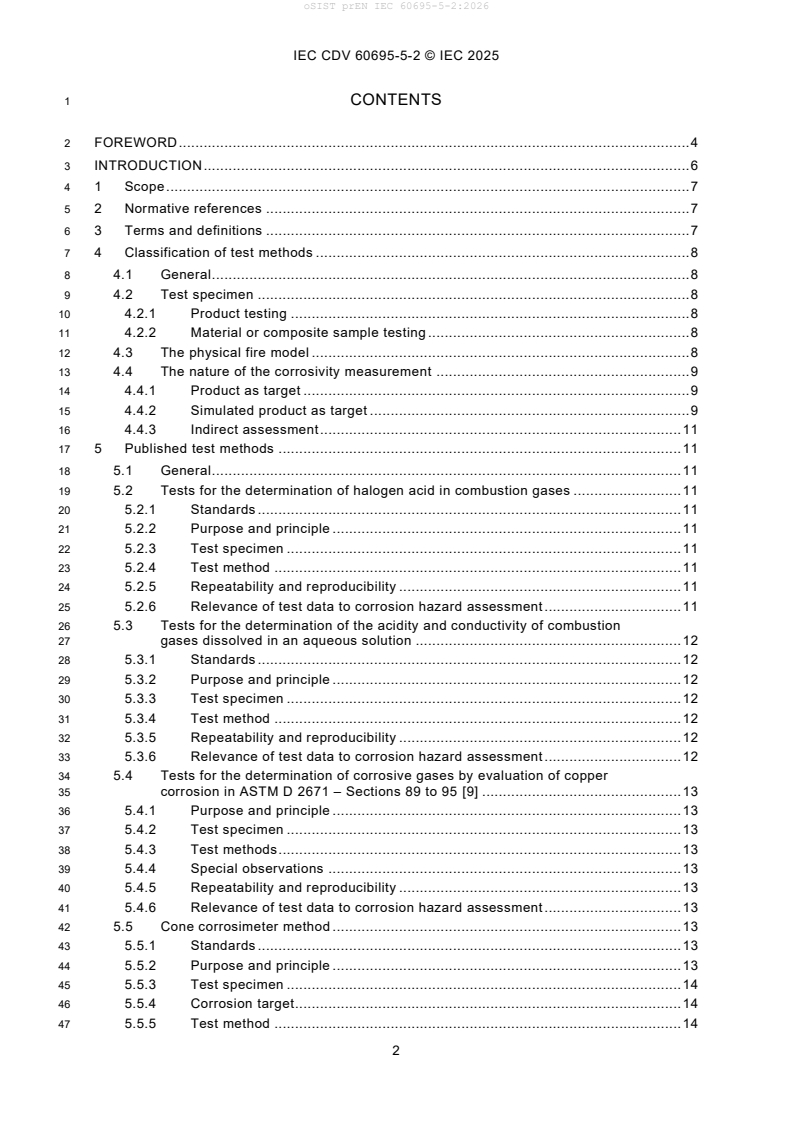
1 CONTENTS
2 FOREWORD . 4
3 INTRODUCTION . 6
4 1 Scope . 7
5 2 Normative references . 7
6 3 Terms and definitions . 7
7 4 Classification of test methods . 8
8 4.1 General . 8
9 4.2 Test specimen . 8
10 4.2.1 Product testing . 8
11 4.2.2 Material or composite sample testing . 8
12 4.3 The physical fire model . 8
13 4.4 The nature of the corrosivity measurement . 9
14 4.4.1 Product as target . 9
15 4.4.2 Simulated product as target . 9
16 4.4.3 Indirect assessment . 11
17 5 Published test methods . 11
18 5.1 General . 11
19 5.2 Tests for the determination of halogen acid in combustion gases . 11
20 5.2.1 Standards . 11
21 5.2.2 Purpose and principle . 11
22 5.2.3 Test specimen . 11
23 5.2.4 Test method . 11
24 5.2.5 Repeatability and reproducibility . 11
25 5.2.6 Relevance of test data to corrosion hazard assessment . 11
26 5.3 Tests for the determination of the acidity and conductivity of combustion
27 gases dissolved in an aqueous solution . 12
28 5.3.1 Standards . 12
29 5.3.2 Purpose and principle . 12
30 5.3.3 Test specimen . 12
31 5.3.4 Test method . 12
32 5.3.5 Repeatability and reproducibility . 12
33 5.3.6 Relevance of test data to corrosion hazard assessment . 12
34 5.4 Tests for the determination of corrosive gases by evaluation of copper
35 corrosion in ASTM D 2671 – Sections 89 to 95 [9] . 13
36 5.4.1 Purpose and principle . 13
37 5.4.2 Test specimen . 13
38 5.4.3 Test methods . 13
39 5.4.4 Special observations . 13
40 5.4.5 Repeatability and reproducibility . 13
41 5.4.6 Relevance of test data to corrosion hazard assessment . 13
42 5.5 Cone corrosimeter method . 13
43 5.5.1 Standards . 13
44 5.5.2 Purpose and principle . 13
45 5.5.3 Test specimen . 14
46 5.5.4 Corrosion target . 14
47 5.5.5 Test method . 14
oSIST prEN IEC 60695-5-2:2026
IEC CDV 60695-5-2 © IEC 2025
48 5.5.6 Special observation . 15
49 5.5.7 Repeatability and reproducibility . 15
50 5.5.8 Relevance of test data to corrosion hazard assessment . 15
51 6 Overview of methods and relevance of data . 15
52 Annex A (informative) Acidity and conductivity of aqueous solutions – Test methods . 18
53 Annex B (informative) Determination of repeatability and reproducibility –
54 Comparative tests of solutions of combustion gases . 19
55 Bibliography . 23
57 Figure 1 – Schematic drawing of a typical corrosion target of defined metal thickness …….15
59 Table 1 – Characteristics of fire stages (from Table 1 in ISO 19706:2011) . 10
60 Table 2 – Overview of corrosivity test methods . 17
61 Table A.1 – Test methods for the measurement of acidity and conductivity of aqueous
62 solutions obtained after bubbling combustion effluent through water . 18
63 Table B.1 – Determination of repeatability and reproducibility – Comparative pH tests
64 on solutions of combustion gases . 20
65 Table B.2 – Determination of repeatability and reproducibility – Comparative resistivity
66 tests on solutions of combustion gases . 20
67 Table B.3 – Results obtained on brominated polycarbonate . 22
oSIST prEN IEC 60695-5-2:2026
IEC CDV 60695-5-2 © IEC 2025
70 INTERNATIONAL ELECTROTECHNICAL COMMISSION
71 ____________
73 FIRE HAZARD TESTING –
75 Part 5-2: Corrosion damage effects of fire effluent –
76 Summary and relevance of test methods
78 FOREWORD
79 1) The International Electrotechnical Commission (IEC) is a worldwide organization for standardization comprising
80 all national electrotechnical committees (IEC National Committees). The object of IEC is to promote international
81 co-operation on all questions concerning standardization in the electrical and electronic fields. To this end and
82 in addition to other activities, IEC publishes International Standards, Technical Specifications, Technical Reports,
83 Publicly Available Specifications (PAS) and Guides (hereafter referred to as “IEC Publication(s)”). Their
84 preparation is entrusted to technical committees; any IEC National Committee interested in the subject dealt with
85 may participate in this preparatory work. International, governmental and non-governmental organizations liaising
86 with the IEC also participate in this preparation. IEC collaborates closely with the International Organization for
87 Standardization (ISO) in accordance with conditions determined by agreement between the two organizations.
88 2) The formal decisions or agreements of IEC on technical matters express, as nearly as possible, an international
89 consensus of opinion on the relevant subjects since each technical committee has representation from all
90 interested IEC National Committees.
91 3) IEC Publications have the form of recommendations for international use and are accepted by IEC National
92 Committees in that sense. While all reasonable efforts are made to ensure that the technical content of IEC
93 Publications is accurate, IEC cannot be held responsible for the way in which they are used or for any
94 misinterpretation by any end user.
95 4) In order to promote international uniformity, IEC National Committees undertake to apply IEC Publications
96 transparently to the maximum extent possible in their national and regional publications. Any divergence between
97 any IEC Publication and the corresponding national or regional publication shall be clearly indicated in the latter.
98 5) IEC itself does not provide any attestation of conformity. Independent certification bodies provide conformity
99 assessment services and, in some areas, access to IEC marks of conformity. IEC is not responsible for any
100 services carried out by independent certification bodies.
101 6) All users should ensure that they have the latest edition of this publication.
102 7) No liability shall attach to IEC or its directors, employees, servants or agents including individual experts and
103 members of its technical committees and IEC National Committees for any personal injury, property damage or
104 other damage of any nature whatsoever, whether direct or indirect, or for costs (including legal fees) and
105 expenses arising out of the publication, use of, or reliance upon, this IEC Publication or any other IEC
106 Publications.
107 8) Attention is drawn to the Normative references cited in this publication. Use of the referenced publications is
108 indispensable for the correct application of this publication.
109 9) Attention is drawn to the possibility that some of the elements of this IEC Publication may be the subject of patent
110 rights. IEC shall not be held responsible for identifying any or all such patent rights.
111 International Standard IEC 60695-5-2 has been prepared by IEC technical committee 89: Fire
112 hazard testing.
113 It has the status of a basic safety publication in accordance with IEC Guide 104 and
114 ISO/IEC Guide 51.
115 The text of this International Standard is based on the following documents:
FDIS Report on voting
89/XXXX/FDIS 89/YYYY/RVD
117 Full information on the voting for its approval can be found in the report on voting indicated in
118 the above table.
119 This document was drafted in accordance with ISO/IEC Directives, Part 2.
120 This International Standard is to be read in conjunction with IEC 60695-5-1.
oSIST prEN IEC 60695-5-2:2026
IEC CDV 60695-5-2 © IEC 2025
121 A list of all parts in the IEC 60695 series, published under the general title Fire hazard testing,
122 can be found on the IEC website.
123 IEC 60695-5 consists of the following parts:
124 Part 5-1: Corrosion damage effects of fire effluent - General guidance
125 Part 5-2: Corrosion damage effects of fire effluent – Summary and relevance of test methods
126 The committee has decided that the contents of this document will remain unchanged until the
127 stability date indicated on the IEC website under webstore.iec.ch in the data related to the
128 specific document. At this date, the document will be
129 • reconfirmed,
130 • withdrawn,
131 • replaced by a revised edition, or
132 • amended.
133 The National Committees are requested to note that for this document the stability date is 2029.
oSIST prEN IEC 60695-5-2:2026
IEC CDV 60695-5-2 © IEC 2025
135 INTRODUCTION
136 In the design of an electrotechnical product the risk of fire and the potential hazards associated
137 with fire need to be considered. In this respect the objective of component, circuit and
138 equipment design, as well as the choice of materials, is to reduce the risk of fire to a tolerable
139 level even in the event of reasonably foreseeable (mis)use, malfunction or failure.
140 IEC 60695-1-10 [1] , IEC 60695-1-11 [2], and IEC 60695-1-12 [3] provide guidance on how this
141 is to be accomplished.
142 Fires involving electrotechnical products can also be initiated from external non -electrical
143 sources. Considerations of this nature are dealt with in an overall fire hazard assessment.
144 The aim of the IEC 60695 series is to save lives and property by reducing the number of fires
145 or reducing the consequences of the fire. This can be accomplished by:
146 • trying to prevent ignition caused by an electrically energised component part and, in the
147 event of ignition, to confine any resulting fire within the bounds of the enclosure of the
148 electrotechnical product.
149 • trying to minimise flame spread beyond the product’s enclosure and to minimise the harmful
150 effects of fire effluents including heat, smoke, and toxic or corrosive combustion products.
151 All fire effluent is corrosive to some degree and the level of potential to corrode depends on the
152 nature of the fire, the combination of combustible materials involved in the fire, the nature of
153 the substrate under attack, and the temperature and relative humidity of the environment in
154 which the corrosion is taking place. There is no evidence that fire effluent from electrotechnical
155 products offers greater risk of corrosion damage than the fire effluent from other products such
156 as furnishings, building materials, etc.
157 The performance of electrical and electronic components can be adversely affected by
158 corrosion damage when subjected to fire effluent. A wide variety of combinations of small
159 quantities of effluent gases, smoke particles, moisture and temperature may provide conditions
160 for electrical component or system failures from breakage, overheating or shorting.
161 Evaluation of potential corrosion damage is particularly important for high value and safety-
162 related electrotechnical products and installations.
163 Technical committees responsible for the products will choose the test(s) and specify the level
164 of severity.
165 The study of corrosion damage requires an interdisciplinary approach involving chemistry,
166 electricity, physics, mechanical engineering, metallurgy and electrochemistry. In the
167 preparation of this part of IEC 60695, all of the above have been considered.
168 IEC 60695-5-1 defines the scope of the guidance and indicates the field of application.
169 IEC 60695-5-2 provides a summary of test methods including relevance and usefulness.
Numbers in square brackets refer to the bibliography.
oSIST prEN IEC 60695-5-2:2026
IEC CDV 60695-5-2 © IEC 2025
172 FIRE HAZARD TESTING –
174 Part 5-2: Corrosion damage effects of fire effluent –
175 Summary and relevance of test methods
179 1 Scope
180 This part of IEC 60695 summarises the test methods that are used in the assessment of the
181 corrosivity of fire effluent. It presents a brief summary of test methods in common use, either
182 as international standards, national or industry standards. It includes special observations on
183 their relevance, for electrotechnical products and their materials, to real fire scenarios and gives
184 recommendations on their use.
185 2 Normative references
186 The following documents are referred to in the text in such a way that some or all of their content
187 constitutes requirements of this document. For dated references, only the edition cited applies.
188 For undated references, the latest edition of the referenced document (including any
189 amendments) applies.
190 IEC 60695-4, Fire hazard testing – Part 4: Terminology concerning fire tests
191 IEC 60695-5-1, Fire hazard testing – Part 5-1: Corrosion damage effects of fire effluent -
192 General guidance
193 ISO 13943:2017, Fire safety – Vocabulary
194 3 Terms and definitions
195 For the purposes of this document, the terms and definitions given in IEC 60695-4 and
196 ISO 13943:2017 (some of which are reproduced below) apply.
197 3.1
198 corrosion damage
199 physical and/or chemical damage or impaired function caused by chemical action
200 [SOURCE: ISO 13943:2017, 3.69]
201 3.2
202 corrosion target
203 sensor used to determine the degree of corrosion damage (3.1), under specified test conditions
204 Note 1 to entry: This sensor may be a product, a component. It may also be a reference material or object used to
205 simulate the behaviour of a product or a component.
206 [SOURCE: ISO 13943:2017, 3.70]
207 3.3
208 fire effluent
209 all gases and aerosols, including suspended particles created by combustion or pyrolysis (3.6)
210 and emitted to the environment
211 [SOURCE: ISO 13943:2017, 3.123]
212 3.4
213 fire scenario
214 qualitative description of the course of a fire with respect to time, identifying key events that
215 characterize the studied fire and differentiate it from other possible fires
oSIST prEN IEC 60695-5-2:2026
IEC CDV 60695-5-2 © IEC 2025
216 Note 1 to entry: See fire scenario cluster (ISO 13943:2017, 3.154) and representative fire scenario
217 (ISO 13943:2017, 3.153).
218 Note to entry: It typically defines the ignition and fire growth processes, the fully developed fire stage, the fire decay
219 stage, and the environment and systems that will impact on the course of the fire.
220 Note to entry: Unlike deterministic fire analysis, where fire scenarios are individually selected and used as design
221 fire scenarios, in fire risk assessment, fire scenarios are used as representative fire scenarios within fire scenario
222 clusters.
223 [SOURCE: ISO 13943:2017, 3.152]
224 3.5
225 physical fire model
226 laboratory process, including the apparatus, the environment and the fire test procedure
227 intended to represent a certain phase of a fire
228 [SOURCE: ISO 13943:2017, 3.298]
229 3.6
230 pyrolysis
231 chemical decomposition of a substance by the action of heat
232 Note 1 to entry: Pyrolysis is often used to refer to a stage of fire before flaming combustion has begun.
233 Note 2 to entry: In fire science, no assumption is made about the presence or absence of oxygen.
234 [SOURCE: ISO 13943:2017, 3.316]
235 3.7
236 smoke
237 visible part of a fire effluent (3.3)
238 [SOURCE: ISO 13943:2017, 3.347]
239 4 Classification of test methods
240 4.1 General
241 The test methods included in this document can generally be classified according to the
242 following three criteria:
243 a) the nature of the test specimen which is burnt;
244 b) the physical fire model used in the test;
245 c) the nature of the measurement of corrosivity.
246 4.2 Test specimen
247 4.2.1 Product testing
248 The test specimen is a manufactured product or a representative portion of a product. Examples
249 include a printed circuit board, a switchboard, a computer or a cable.
250 4.2.2 Material or composite sample testing
251 The test specimen is a basic material (solid or liquid), or composite of materials.
252 4.3 The physical fire model
253 Test methods use a wide variety of heat sources and geometries. The amount, the rate of
254 production and the corrosive nature of fire effluent released from a given material or product is
255 not an inherent property of that material or product, but is critically dependent on the conditions
256 under which that material or product is burnt. In a fire scenario or a fire test, the chemical nature
257 of the fuel, the decomposition temperature and the amount of ventilation are the main variables
258 which affect the composition of fire effluent.
259 It is critical to show that the test conditions defined in a standardized test method are relevant
260 to, and replicate, the desired stage of a real fire. ISO has published a general classification of
261 fire stages in ISO 19706:2011, shown in Table 1. The important factors affecting effluent
262 production are oxygen concentration, irradiance and temperature.
oSIST prEN IEC 60695-5-2:2026
IEC CDV 60695-5-2 © IEC 2025
263 4.4 The nature of the corrosivity measurement
264 4.4.1 Product as target
265 The corrosion target is a manufactured product or a representative portion of a product, which
266 can be represented by a test specimen. Examples include: printed wiring boards, switchboards,
267 washing machines and computers.
268 The corrosion damage effects of fire effluent on the product can be assessed by degradation of
269 function as determined by inspection or measurement.
270 4.4.2 Simulated product as target
271 When a simulated product is used as the target, the corrosion target is typically a reference
272 circuit, a thin sheet of metal or a metal mirror. The corrosion damage effects of fire effluent on
273 the target can be assessed by changes in appearance, mass or measurements of mechanical,
274 physical or electrical characteristics.
oSIST prEN IEC 60695-5-2:2026
IEC CDV 60695-5-2 © IEC 2025
275 Table 1 – Characteristics of fire stages (from Table 1 in ISO 19706:2011)
Max. temperature Oxygen volume
Heat flux to
100[CO ]
[CO] 2
Fuel/air
fuel surface
C %
Fire stage equivalence [CO2]
[CO2]+[CO]
ratio (plume)
v/v
kW/m Fuel surface Upper layer Entrained Exhausted
% efficiency
1 Non-flaming
a self-sustaining not
d
450 to 800 25 to 85 20 20 – 0,1 to 1 50 to 90
(smouldering) applicable
b oxidative pyrolysis
a
b c c
from externally applied – 300 to 600 20 20 1
radiation
c anaerobic pyrolysis
b c c
from externally applied – 100 to 500 0 0 1
radiation
d e
2 Well-ventilated flaming 0 to 60 350 to 650 50 to 500 20 20 1 0,05 95
f
3 Underventilated flaming
a small, localized fire,
generally in a poorly
a
0 to 30 300 to 600 50 to 500 15 to 20 5 to 10 1 0,2 to 0,4 70 to 80
ventilated
compartment
g h i
b post-flashover fire 50 to 150 350 to 650 600 15 5 1 0,1 to 0,4 70 to 90
a
The upper limit is lower than for well-ventilated flaming combustion of a given combustible.
b
The temperature in the upper layer of the fire room is most likely determined by the source of the externally applied radiati on and room geometry.
c
There are few data, but for pyrolysis this ratio is expected to vary widely depending on the material chemistry and the local ventilation and thermal conditions.
d
The fire’s oxygen consumption is small compared to that in the room or the inflow, the flame tip is below the hot gas upper l ayer or the upper layer is not yet significantly
vitiated to increase the CO yield significantly, the flames are not truncated by contact with another object, and the burning rate is controlled by the availability of fuel.
e
The ratio can be up to an order of magnitude higher for materials that are fire-resistant. There is no significant increase in this ratio for equivalence ratios up to 0,75, and
between 0,75 and 1, some increase in this ratio may occur.
f
The fire’s oxygen
...