

IEC 61726:2015
(Main)Cable assemblies, cables, connectors and passive microwave components - Screening attenuation measurement by the reverberation chamber method
General Information
- Abstract
IEC 61726:2015 describes the measurement of screening attenuation by the reverberation chamber test method, sometimes named mode stirred chamber, suitable for virtually any type of microwave component and having no theoretical upper frequency limit. It is only limited toward low frequencies due to the size of the test equipment, which is frequency-dependent and is only one of several methods of measuring screening attenuation. For the purpose of this standard, examples of microwave components are waveguides, phase shifters, diplexers/multiplexers, power dividers/combiners etc. This third edition cancels and replaces the second edition, published in 1999. This edition constitutes a technical revision. It takes into account the latest developments in the design of reverberation chambers as described in IEC 61000-4-21, which is also referencing this standard as a possible test method. Furthermore, an alternative measurement procedure is added which is able to reduce the measurement time needed.
- Status
- Published
- Publication Date
- 07-Sep-2015
- Technical Committee
- TC 46 - Cables, wires, waveguides, RF connectors, RF and microwave passive components and accessories
- Drafting Committee
- WG 5 - TC 46/WG 5
- Current Stage
- DELPUB - Deleted Publication
- Start Date
- 18-Jul-2022
- Completion Date
- 30-Jun-2021
Buy Documents
IEC 61726:2015 - Cable assemblies, cables, connectors and passive microwave components - Screening attenuation measurement by the reverberation chamber method Released:9/8/2015
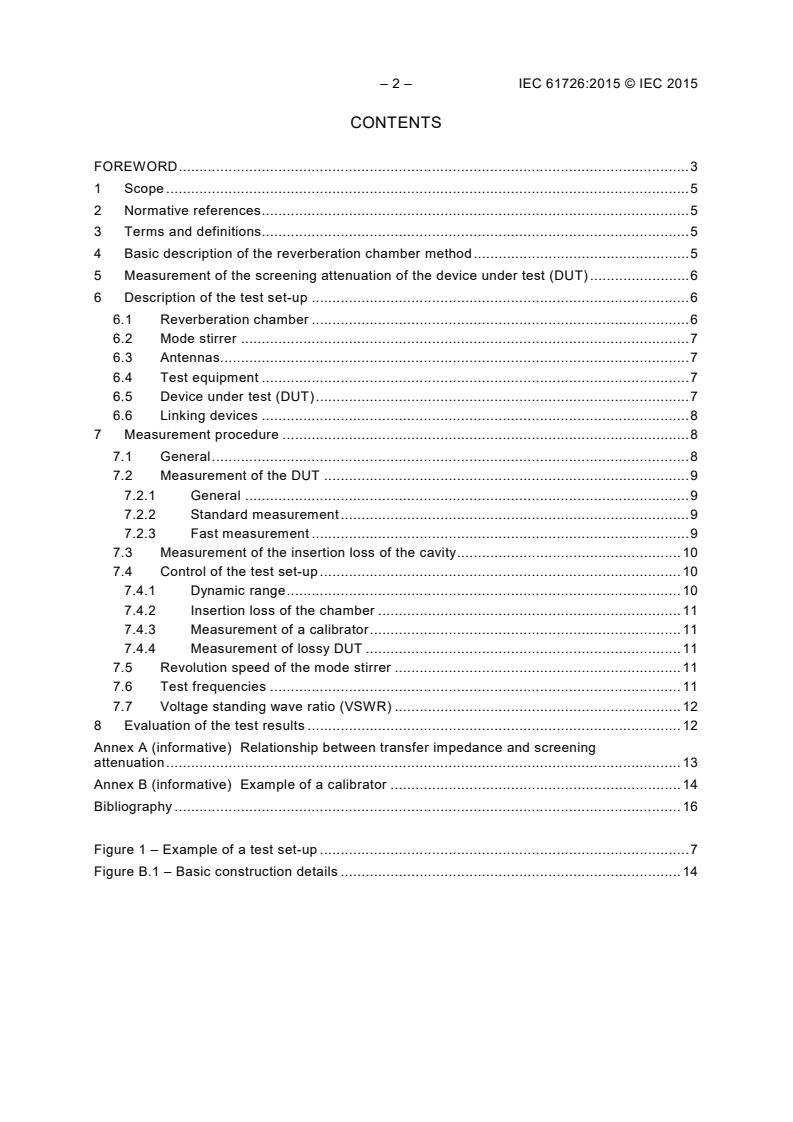
IEC 61726:2015 - Cable assemblies, cables, connectors and passive microwave components - Screening attenuation measurement by the reverberation chamber method Released:10/25/2017
Overview
IEC 61726:2015 specifies the reverberation chamber (mode‑stirred chamber) method for measuring screening attenuation of cable assemblies, cables, connectors and passive microwave components. The standard defines how to expose a device under test (DUT) to an almost homogeneous, isotropic electromagnetic field inside a high‑Q shielded cavity and how to quantify the power coupled into the DUT. IEC 61726:2015 is the third edition (replacing the 1999 edition) and updates procedures in line with modern reverberation chamber design and faster measurement options.
Key topics and technical requirements
- Measurement principle: Screening attenuation is determined by comparing power induced into the DUT with the reference field in the chamber (direct power ratio or using the chamber insertion loss).
- Reverberation chamber design: Chamber must comply with IEC 61000‑4‑21 requirements; avoid perfect cubic shape; use conductive, non‑lossy materials.
- Mode stirrer: Large relative to wavelength; minimum size guidance-at least two wavelengths tip‑to‑tip at the lowest test frequency.
- Antennas: Input and reference antennas with limited resonances and minimal loss; return loss better than 6 dB recommended. Isotropic field conditions reduce directionality effects.
- Calibration and controls: Verify insertion loss of cavity, dynamic range, VSWR, and use of calibrators. The standard includes both a standard measurement and a fast measurement procedure to reduce test time.
- Frequency applicability: No theoretical upper frequency limit; practical lower frequency limit is set by chamber size (sufficient modes-e.g., ≥100 modes at lowest test frequency).
- Evaluation: Includes relation between transfer impedance/transfer functions and screening attenuation for electrically short or distributed leakage scenarios.
Applications and who uses it
- Manufacturers and test labs performing screening attenuation and EMC characterization of:
- Waveguides, phase shifters, diplexers/multiplexers
- Power dividers/combiners, passive microwave components
- Cable assemblies, coaxial cables and RF connectors
- EMC engineers and compliance laboratories using reverberation chamber testing to validate shielding performance across wide microwave frequency ranges.
- R&D teams evaluating enclosure, connector and cable leakage where traditional low‑frequency methods are inadequate.
Related standards
- IEC 61000‑4‑21 - Reverberation chamber test methods (design and calibration guidance)
- IEC 61196‑1 - Coaxial communication cables (definitions and requirements)
- IEC TS 62153‑4‑1 - Introduction to electromagnetic screening measurements
Keywords: IEC 61726:2015, reverberation chamber, screening attenuation, mode‑stirred chamber, microwave components, cable assemblies, EMC testing, insertion loss, shielding measurement.
Relations
- Effective Date
- 25-Aug-2026
- Effective Date
- 05-Sep-2023
- Effective Date
- 05-Sep-2023
Buy Documents
IEC 61726:2015 - Cable assemblies, cables, connectors and passive microwave components - Screening attenuation measurement by the reverberation chamber method Released:9/8/2015
IEC 61726:2015 - Cable assemblies, cables, connectors and passive microwave components - Screening attenuation measurement by the reverberation chamber method Released:10/25/2017
Get Certified
Connect with accredited certification bodies for this standard

ANCE
Mexican certification and testing association.

Intertek Slovenia
Intertek testing, inspection, and certification services in Slovenia.

LNE (Laboratoire National de Métrologie et d'Essais)
French national laboratory for metrology and testing.
Sponsored listings
Frequently Asked Questions
IEC 61726:2015 is a standard published by the International Electrotechnical Commission (IEC). Its full title is "Cable assemblies, cables, connectors and passive microwave components - Screening attenuation measurement by the reverberation chamber method". This standard covers: IEC 61726:2015 describes the measurement of screening attenuation by the reverberation chamber test method, sometimes named mode stirred chamber, suitable for virtually any type of microwave component and having no theoretical upper frequency limit. It is only limited toward low frequencies due to the size of the test equipment, which is frequency-dependent and is only one of several methods of measuring screening attenuation. For the purpose of this standard, examples of microwave components are waveguides, phase shifters, diplexers/multiplexers, power dividers/combiners etc. This third edition cancels and replaces the second edition, published in 1999. This edition constitutes a technical revision. It takes into account the latest developments in the design of reverberation chambers as described in IEC 61000-4-21, which is also referencing this standard as a possible test method. Furthermore, an alternative measurement procedure is added which is able to reduce the measurement time needed.
IEC 61726:2015 describes the measurement of screening attenuation by the reverberation chamber test method, sometimes named mode stirred chamber, suitable for virtually any type of microwave component and having no theoretical upper frequency limit. It is only limited toward low frequencies due to the size of the test equipment, which is frequency-dependent and is only one of several methods of measuring screening attenuation. For the purpose of this standard, examples of microwave components are waveguides, phase shifters, diplexers/multiplexers, power dividers/combiners etc. This third edition cancels and replaces the second edition, published in 1999. This edition constitutes a technical revision. It takes into account the latest developments in the design of reverberation chambers as described in IEC 61000-4-21, which is also referencing this standard as a possible test method. Furthermore, an alternative measurement procedure is added which is able to reduce the measurement time needed.
IEC 61726:2015 is classified under the following ICS (International Classification for Standards) categories: 33.120.10 - Coaxial cables. Waveguides; 33.120.30 - RF connectors. The ICS classification helps identify the subject area and facilitates finding related standards.
IEC 61726:2015 has the following relationships with other standards: It is inter standard links to EN 4165-001:2015, IEC 61726:2022, IEC 61726:1999. Understanding these relationships helps ensure you are using the most current and applicable version of the standard.
IEC 61726:2015 is available in PDF format for immediate download after purchase. The document can be added to your cart and obtained through the secure checkout process. Digital delivery ensures instant access to the complete standard document.
Standards Content (Sample)
IEC 61726 ®
Edition 3.0 2015-09
INTERNATIONAL
STANDARD
Cable assemblies, cables, connectors and passive microwave components –
Screening attenuation measurement by the reverberation chamber method
All rights reserved. Unless otherwise specified, no part of this publication may be reproduced or utilized in any form
or by any means, electronic or mechanical, including photocopying and microfilm, without permission in writing from
either IEC or IEC's member National Committee in the country of the requester. If you have any questions about IEC
copyright or have an enquiry about obtaining additional rights to this publication, please contact the address below or
your local IEC member National Committee for further information.
IEC Central Office Tel.: +41 22 919 02 11
3, rue de Varembé Fax: +41 22 919 03 00
CH-1211 Geneva 20 info@iec.ch
Switzerland www.iec.ch
About the IEC
The International Electrotechnical Commission (IEC) is the leading global organization that prepares and publishes
International Standards for all electrical, electronic and related technologies.
About IEC publications
The technical content of IEC publications is kept under constant review by the IEC. Please make sure that you have the
latest edition, a corrigenda or an amendment might have been published.
IEC Catalogue - webstore.iec.ch/catalogue Electropedia - www.electropedia.org
The stand-alone application for consulting the entire The world's leading online dictionary of electronic and
bibliographical information on IEC International Standards, electrical terms containing more than 30 000 terms and
Technical Specifications, Technical Reports and other definitions in English and French, with equivalent terms in 15
documents. Available for PC, Mac OS, Android Tablets and additional languages. Also known as the International
iPad. Electrotechnical Vocabulary (IEV) online.
IEC publications search - www.iec.ch/searchpub IEC Glossary - std.iec.ch/glossary
The advanced search enables to find IEC publications by a More than 60 000 electrotechnical terminology entries in
variety of criteria (reference number, text, technical English and French extracted from the Terms and Definitions
committee,…). It also gives information on projects, replaced clause of IEC publications issued since 2002. Some entries
and withdrawn publications. have been collected from earlier publications of IEC TC 37,
77, 86 and CISPR.
IEC Just Published - webstore.iec.ch/justpublished
Stay up to date on all new IEC publications. Just Published IEC Customer Service Centre - webstore.iec.ch/csc
details all new publications released. Available online and If you wish to give us your feedback on this publication or
also once a month by email. need further assistance, please contact the Customer Service
Centre: csc@iec.ch.
IEC 61726 ®
Edition 3.0 2015-09
INTERNATIONAL
STANDARD
Cable assemblies, cables, connectors and passive microwave components –
Screening attenuation measurement by the reverberation chamber method
INTERNATIONAL
ELECTROTECHNICAL
COMMISSION
ICS 33.120.10; 33.120.30 ISBN 978-2-8322-2893-7
– 2 – IEC 61726:2015 © IEC 2015
CONTENTS
FOREWORD . 3
1 Scope . 5
2 Normative references . 5
3 Terms and definitions. 5
4 Basic description of the reverberation chamber method . 5
5 Measurement of the screening attenuation of the device under test (DUT) . 6
6 Description of the test set-up . 6
6.1 Reverberation chamber . 6
6.2 Mode stirrer . 7
6.3 Antennas. 7
6.4 Test equipment . 7
6.5 Device under test (DUT) . 7
6.6 Linking devices . 8
7 Measurement procedure . 8
7.1 General . 8
7.2 Measurement of the DUT . 9
7.2.1 General . 9
7.2.2 Standard measurement . 9
7.2.3 Fast measurement . 9
7.3 Measurement of the insertion loss of the cavity . 10
7.4 Control of the test set-up . 10
7.4.1 Dynamic range . 10
7.4.2 Insertion loss of the chamber . 11
7.4.3 Measurement of a calibrator . 11
7.4.4 Measurement of lossy DUT . 11
7.5 Revolution speed of the mode stirrer . 11
7.6 Test frequencies . 11
7.7 Voltage standing wave ratio (VSWR) . 12
8 Evaluation of the test results . 12
Annex A (informative) Relationship between transfer impedance and screening
attenuation . 13
Annex B (informative) Example of a calibrator . 14
Bibliography . 16
Figure 1 – Example of a test set-up . 7
Figure B.1 – Basic construction details . 14
INTERNATIONAL ELECTROTECHNICAL COMMISSION
____________
CABLE ASSEMBLIES, CABLES, CONNECTORS AND PASSIVE
MICROWAVE COMPONENTS –
SCREENING ATTENUATION MEASUREMENT BY THE
REVERBERATION CHAMBER METHOD
FOREWORD
1) The International Electrotechnical Commission (IEC) is a worldwide organization for standardization comprising
all national electrotechnical committees (IEC National Committees). The object of IEC is to promote
international co-operation on all questions concerning standardization in the electrical and electronic fields. To
this end and in addition to other activities, IEC publishes International Standards, Technical Specifications,
Technical Reports, Publicly Available Specifications (PAS) and Guides (hereafter referred to as “IEC
Publication(s)”). Their preparation is entrusted to technical committees; any IEC National Committee interested
in the subject dealt with may participate in this preparatory work. International, governmental and non-
governmental organizations liaising with the IEC also participate in this preparation. IEC collaborates closely
with the International Organization for Standardization (ISO) in accordance with conditions determined by
agreement between the two organizations.
2) The formal decisions or agreements of IEC on technical matters express, as nearly as possible, an international
consensus of opinion on the relevant subjects since each technical committee has representation from all
interested IEC National Committees.
3) IEC Publications have the form of recommendations for international use and are accepted by IEC National
Committees in that sense. While all reasonable efforts are made to ensure that the technical content of IEC
Publications is accurate, IEC cannot be held responsible for the way in which they are used or for any
misinterpretation by any end user.
4) In order to promote international uniformity, IEC National Committees undertake to apply IEC Publications
transparently to the maximum extent possible in their national and regional publications. Any divergence
between any IEC Publication and the corresponding national or regional publication shall be clearly indicated in
the latter.
5) IEC itself does not provide any attestation of conformity. Independent certification bodies provide conformity
assessment services and, in some areas, access to IEC marks of conformity. IEC is not responsible for any
services carried out by independent certification bodies.
6) All users should ensure that they have the latest edition of this publication.
7) No liability shall attach to IEC or its directors, employees, servants or agents including individual experts and
members of its technical committees and IEC National Committees for any personal injury, property damage or
other damage of any nature whatsoever, whether direct or indirect, or for costs (including legal fees) and
expenses arising out of the publication, use of, or reliance upon, this IEC Publication or any other IEC
Publications.
8) Attention is drawn to the Normative references cited in this publication. Use of the referenced publications is
indispensable for the correct application of this publication.
9) Attention is drawn to the possibility that some of the elements of this IEC Publication may be the subject of
patent rights. IEC shall not be held responsible for identifying any or all such patent rights.
International Standard IEC 61726 has been prepared by IEC technical committee 46: Cables,
wires, waveguides, R.F. connectors, R.F. and microwave passive components and
accessories.
This third edition cancels and replaces the second edition, published in 1999. This edition
constitutes a technical revision.
It takes into account the latest developments in the design of reverberation chambers as
described in IEC 61000-4-21, which is also referencing this standard as a possible test method.
Furthermore, an alternative measurement procedure is added which is able to reduce the
measurement time needed.
– 4 – IEC 61726:2015 © IEC 2015
The text of this standard is based on the following documents:
FDIS Report on voting
46/551/FDIS 46/569/RVD
Full information on the voting for the approval of this standard can be found in the report on
voting indicated in the above table.
This publication has been drafted in accordance with the ISO/IEC Directives, Part 2.
The committee has decided that the contents of this publication will remain unchanged until the
stability date indicated on the IEC web site under "http://webstore.iec.ch" in the data related to
the specific publication. At this date, the publication will be
• reconfirmed,
• withdrawn,
• replaced by a revised edition, or
• amended.
A bilingual version of this publication may be issued at a later date.
CABLE ASSEMBLIES, CABLES, CONNECTORS AND PASSIVE
MICROWAVE COMPONENTS –
SCREENING ATTENUATION MEASUREMENT BY THE
REVERBERATION CHAMBER METHOD
1 Scope
The requirements of modern electronic equipment have indicated a demand for a method for
testing screening attenuation of microwave components over their whole frequency range.
Convenient test methods exist for low frequencies and components of regular shape. These
test methods are described in the relevant IEC product specifications (e.g.
IEC 62153-4-3). For higher frequencies and for components of irregular shape, a new test
method has become necessary and such a test method is described in this International
Standard.
This International Standard describes the measurement of screening attenuation by the
reverberation chamber test method, sometimes named mode stirred chamber, suitable for
virtually any type of microwave component and having no theoretical upper frequency limit. It is
only limited toward low frequencies due to the size of the test equipment, which is frequency-
dependent and is only one of several methods of measuring screening attenuation.
For the purpose of this standard, examples of microwave components are waveguides, phase
shifters, diplexers/multiplexers, power dividers/combiners etc.
2 Normative references
The following documents, in whole or in part, are normatively referenced in this document and
are indispensable for its application. For dated references, only the edition cited applies. For
undated references, the latest edition of the referenced document (including any amendments)
applies.
IEC 61196-1, Coaxial communication cables – Part 1: Generic specification – General,
definitions and requirements
IEC TS 62153-4-1, Metallic communication cable test methods – Part 4-1: Electromagnetic
compatibility (EMC) – Introduction to electromagnetic screening measurements
IEC 61000-4-21, Electromagnetic compatibility (EMC) – Part 4-21: Testing and measurement
techniques – Reverberation chamber test methods
3 Terms and definitions
For the purposes of this document, the terms and definitions given in IEC 61196-1 and
IEC 61000-4-21 apply.
4 Basic description of the reverberation chamber method
The reverberation chamber method for measurement of the screening attenuation of
microwave components consists of exposing the device under test (DUT) to an almost
homogeneous and isotropic electromagnetic field and then measuring the signal level induced
into the device.
– 6 – IEC 61726:2015 © IEC 2015
These conditions are achieved by the use of a shielded enclosure, which acts as an oversized
cavity (in terms of wavelength), with a high quality factor. Its boundary conditions are
continuously agitated by a rotating reflective surface (mode stirrer), mounted within the
chamber, which enables the field to approach homogeneous and isotropic conditions during
one revolution.
Electromagnetic power is fed to the chamber by means of an input or transmitting antenna. The
strength of the field inside the chamber is measured through a reference antenna. The ratio of
the injected power (input antenna) to the received power (reference antenna) is the insertion
loss of the cavity. The insertion loss is strongly frequency dependent and is also dependent on
the quality factor of the cavity. More detailed explanation on the measurement facility can be
found in IEC 61000-4-21.
It has been shown that, due to the isotropic field, any antenna placed inside the cavity behaves
as if its gain was unity [2] , therefore no directional effect is to be expected. If the device under
test is electrically short, its screening attenuation will be directly related to usual transfer
parameters (Z and Z). If the device under test is not electrically short, the screening
t f
attenuation may still be related to Z and Z in some simple cases (evenly distributed leakage,
t f
periodically distributed leakage) using summing functions derived from antenna network theory.
5 Measurement of the screening attenuation of the device under test (DUT)
The measurement of screening attenuation is based on the comparison of the electromagnetic
field power outside the DUT to the electromagnetic field power induced into the DUT. The
screening attenuation is then defined as:
P
DUT
a =−10 log (1)
s 10
P
REF
or
P
DUT
(2)
a =−10 log −D
s 10 ins
P
INJ
where
P is the power coupled to the device under test (W);
DUT
P is the power coupled to the reference antenna (W);
REF
P is the power injected into the chamber (W);
INJ
D is the insertion loss of the chamber in decibels (dB).
ins
6 Description of the test set-up
6.1 Reverberation chamber
The used reverberation chamber shall be compliant to IEC 61000-4-21.
In general, a reverberation chamber is a shielded enclosure having any shape. A perfect cubic
shape should be avoided for optimum performance at lower frequencies. It shall be made of
conductive materials (copper, aluminium or steel) and shall not contain lossy materials. The
size of the cavity depends on the lowest test frequency. For a sufficient test facility, a number
of at least 100 modes need to be present at this frequency. The upper frequency limit depends
___________
Figures in square brackets refer to the Bibliography.
on the quality of the shielding enclosure and cables. Furthermore, the sensitivity of the used
measurement instruments limits the maximum useable frequency.
6.2 Mode stirrer
The mode stirrer shall be large with respect to wavelength and be bent at angles to the walls of
the chamber. The mode stirrer shall be at least two wavelengths from tip to tip at the lowest
test frequency.
6.3 Antennas
The reverberation chamber is equipped with input and reference antennas. Both antennas shall
present limited resonances in the frequency range and shall not introduce losses; their return
loss shall be better than 6 dB.
For convenience, the same antenna should be kept for the whole frequency range. However,
strongly polarised and directional antennas may disturb measurements due to lack of isotropic
field state. This is checked during the calibration of the reverberation chamber acc
...
IEC 61726 ®
Edition 3.0 2015-09
INTERNATIONAL
STANDARD
NORME
INTERNATIONALE
Cable assemblies, cables, connectors and passive microwave components –
Screening attenuation measurement by the reverberation chamber method
Câbles, cordons, connecteurs et composants hyperfréquence passifs – Mesure
de l'affaiblissement d'écran par la méthode de la chambre réverbérante
All rights reserved. Unless otherwise specified, no part of this publication may be reproduced or utilized in any form
or by any means, electronic or mechanical, including photocopying and microfilm, without permission in writing from
either IEC or IEC's member National Committee in the country of the requester. If you have any questions about IEC
copyright or have an enquiry about obtaining additional rights to this publication, please contact the address below or
your local IEC member National Committee for further information.
Droits de reproduction réservés. Sauf indication contraire, aucune partie de cette publication ne peut être reproduite
ni utilisée sous quelque forme que ce soit et par aucun procédé, électronique ou mécanique, y compris la photocopie
et les microfilms, sans l'accord écrit de l'IEC ou du Comité national de l'IEC du pays du demandeur. Si vous avez des
questions sur le copyright de l'IEC ou si vous désirez obtenir des droits supplémentaires sur cette publication, utilisez
les coordonnées ci-après ou contactez le Comité national de l'IEC de votre pays de résidence.
IEC Central Office Tel.: +41 22 919 02 11
3, rue de Varembé Fax: +41 22 919 03 00
CH-1211 Geneva 20 info@iec.ch
Switzerland www.iec.ch
About the IEC
The International Electrotechnical Commission (IEC) is the leading global organization that prepares and publishes
International Standards for all electrical, electronic and related technologies.
About IEC publications
The technical content of IEC publications is kept under constant review by the IEC. Please make sure that you have the
latest edition, a corrigenda or an amendment might have been published.
IEC Catalogue - webstore.iec.ch/catalogue Electropedia - www.electropedia.org
The stand-alone application for consulting the entire The world's leading online dictionary of electronic and
bibliographical information on IEC International Standards, electrical terms containing 20 000 terms and definitions in
Technical Specifications, Technical Reports and other English and French, with equivalent terms in 16 additional
documents. Available for PC, Mac OS, Android Tablets and languages. Also known as the International Electrotechnical
iPad. Vocabulary (IEV) online.
IEC publications search - www.iec.ch/searchpub IEC Glossary - std.iec.ch/glossary
The advanced search enables to find IEC publications by a 65 000 electrotechnical terminology entries in English and
variety of criteria (reference number, text, technical French extracted from the Terms and Definitions clause of
committee,…). It also gives information on projects, replaced IEC publications issued since 2002. Some entries have been
and withdrawn publications. collected from earlier publications of IEC TC 37, 77, 86 and
CISPR.
IEC Just Published - webstore.iec.ch/justpublished
Stay up to date on all new IEC publications. Just Published IEC Customer Service Centre - webstore.iec.ch/csc
details all new publications released. Available online and If you wish to give us your feedback on this publication or
also once a month by email. need further assistance, please contact the Customer Service
Centre: csc@iec.ch.
A propos de l'IEC
La Commission Electrotechnique Internationale (IEC) est la première organisation mondiale qui élabore et publie des
Normes internationales pour tout ce qui a trait à l'électricité, à l'électronique et aux technologies apparentées.
A propos des publications IEC
Le contenu technique des publications IEC est constamment revu. Veuillez vous assurer que vous possédez l’édition la
plus récente, un corrigendum ou amendement peut avoir été publié.
Catalogue IEC - webstore.iec.ch/catalogue Electropedia - www.electropedia.org
Application autonome pour consulter tous les renseignements
Le premier dictionnaire en ligne de termes électroniques et
bibliographiques sur les Normes internationales,
électriques. Il contient 20 000 termes et définitions en anglais
Spécifications techniques, Rapports techniques et autres
et en français, ainsi que les termes équivalents dans 16
documents de l'IEC. Disponible pour PC, Mac OS, tablettes
langues additionnelles. Egalement appelé Vocabulaire
Android et iPad.
Electrotechnique International (IEV) en ligne.
Recherche de publications IEC - www.iec.ch/searchpub
Glossaire IEC - std.iec.ch/glossary
65 000 entrées terminologiques électrotechniques, en anglais
La recherche avancée permet de trouver des publications IEC
en utilisant différents critères (numéro de référence, texte, et en français, extraites des articles Termes et Définitions des
comité d’études,…). Elle donne aussi des informations sur les publications IEC parues depuis 2002. Plus certaines entrées
projets et les publications remplacées ou retirées. antérieures extraites des publications des CE 37, 77, 86 et
CISPR de l'IEC.
IEC Just Published - webstore.iec.ch/justpublished
Service Clients - webstore.iec.ch/csc
Restez informé sur les nouvelles publications IEC. Just
Published détaille les nouvelles publications parues. Si vous désirez nous donner des commentaires sur cette
Disponible en ligne et aussi une fois par mois par email. publication ou si vous avez des questions contactez-nous:
csc@iec.ch.
IEC 61726 ®
Edition 3.0 2015-09
INTERNATIONAL
STANDARD
NORME
INTERNATIONALE
Cable assemblies, cables, connectors and passive microwave components –
Screening attenuation measurement by the reverberation chamber method
Câbles, cordons, connecteurs et composants hyperfréquence passifs – Mesure
de l'affaiblissement d'écran par la méthode de la chambre réverbérante
INTERNATIONAL
ELECTROTECHNICAL
COMMISSION
COMMISSION
ELECTROTECHNIQUE
INTERNATIONALE
ICS 33.120.10; 33.120.30 ISBN 978-2-8322-4922-2
– 2 – IEC 61726:2015 © IEC 2015
CONTENTS
FOREWORD . 3
1 Scope . 5
2 Normative references . 5
3 Terms and definitions. 5
4 Basic description of the reverberation chamber method . 5
5 Measurement of the screening attenuation of the device under test (DUT) . 6
6 Description of the test set-up . 6
6.1 Reverberation chamber . 6
6.2 Mode stirrer . 7
6.3 Antennas. 7
6.4 Test equipment . 7
6.5 Device under test (DUT) . 7
6.6 Linking devices . 8
7 Measurement procedure . 8
7.1 General . 8
7.2 Measurement of the DUT . 9
7.2.1 General . 9
7.2.2 Standard measurement . 9
7.2.3 Fast measurement . 9
7.3 Measurement of the insertion loss of the cavity . 10
7.4 Control of the test set-up . 10
7.4.1 Dynamic range . 10
7.4.2 Insertion loss of the chamber . 11
7.4.3 Measurement of a calibrator . 11
7.4.4 Measurement of lossy DUT . 11
7.5 Revolution speed of the mode stirrer . 11
7.6 Test frequencies . 11
7.7 Voltage standing wave ratio (VSWR) . 12
8 Evaluation of the test results . 12
Annex A (informative) Relationship between transfer impedance and screening
attenuation . 13
Annex B (informative) Example of a calibrator . 14
Bibliography . 16
Figure 1 – Example of a test set-up . 7
Figure B.1 – Basic construction details . 14
INTERNATIONAL ELECTROTECHNICAL COMMISSION
____________
CABLE ASSEMBLIES, CABLES, CONNECTORS AND PASSIVE
MICROWAVE COMPONENTS –
SCREENING ATTENUATION MEASUREMENT BY THE
REVERBERATION CHAMBER METHOD
FOREWORD
1) The International Electrotechnical Commission (IEC) is a worldwide organization for standardization comprising
all national electrotechnical committees (IEC National Committees). The object of IEC is to promote
international co-operation on all questions concerning standardization in the electrical and electronic fields. To
this end and in addition to other activities, IEC publishes International Standards, Technical Specifications,
Technical Reports, Publicly Available Specifications (PAS) and Guides (hereafter referred to as “IEC
Publication(s)”). Their preparation is entrusted to technical committees; any IEC National Committee interested
in the subject dealt with may participate in this preparatory work. International, governmental and non-
governmental organizations liaising with the IEC also participate in this preparation. IEC collaborates closely
with the International Organization for Standardization (ISO) in accordance with conditions determined by
agreement between the two organizations.
2) The formal decisions or agreements of IEC on technical matters express, as nearly as possible, an international
consensus of opinion on the relevant subjects since each technical committee has representation from all
interested IEC National Committees.
3) IEC Publications have the form of recommendations for international use and are accepted by IEC National
Committees in that sense. While all reasonable efforts are made to ensure that the technical content of IEC
Publications is accurate, IEC cannot be held responsible for the way in which they are used or for any
misinterpretation by any end user.
4) In order to promote international uniformity, IEC National Committees undertake to apply IEC Publications
transparently to the maximum extent possible in their national and regional publications. Any divergence
between any IEC Publication and the corresponding national or regional publication shall be clearly indicated in
the latter.
5) IEC itself does not provide any attestation of conformity. Independent certification bodies provide conformity
assessment services and, in some areas, access to IEC marks of conformity. IEC is not responsible for any
services carried out by independent certification bodies.
6) All users should ensure that they have the latest edition of this publication.
7) No liability shall attach to IEC or its directors, employees, servants or agents including individual experts and
members of its technical committees and IEC National Committees for any personal injury, property damage or
other damage of any nature whatsoever, whether direct or indirect, or for costs (including legal fees) and
expenses arising out of the publication, use of, or reliance upon, this IEC Publication or any other IEC
Publications.
8) Attention is drawn to the Normative references cited in this publication. Use of the referenced publications is
indispensable for the correct application of this publication.
9) Attention is drawn to the possibility that some of the elements of this IEC Publication may be the subject of
patent rights. IEC shall not be held responsible for identifying any or all such patent rights.
International Standard IEC 61726 has been prepared by IEC technical committee 46: Cables,
wires, waveguides, R.F. connectors, R.F. and microwave passive components and
accessories.
This bilingual version (2017-10) corresponds to the monolingual English version, published in
2015-09.
This third edition cancels and replaces the second edition, published in 1999. This edition
constitutes a technical revision.
It takes into account the latest developments in the design of reverberation chambers as
described in IEC 61000-4-21, which is also referencing this standard as a possible test method.
Furthermore, an alternative measurement procedure is added which is able to reduce the
measurement time needed.
– 4 – IEC 61726:2015 © IEC 2015
The text of this standard is based on the following documents:
FDIS Report on voting
46/551/FDIS 46/569/RVD
Full information on the voting for the approval of this standard can be found in the report on
voting indicated in the above table.
The French version of this standard has not been voted upon.
This publication has been drafted in accordance with the ISO/IEC Directives, Part 2.
The committee has decided that the contents of this publication will remain unchanged until the
stability date indicated on the IEC web site under "http://webstore.iec.ch" in the data related to
the specific publication. At this date, the publication will be
• reconfirmed,
• withdrawn,
• replaced by a revised edition, or
• amended.
CABLE ASSEMBLIES, CABLES, CONNECTORS AND PASSIVE
MICROWAVE COMPONENTS –
SCREENING ATTENUATION MEASUREMENT BY THE
REVERBERATION CHAMBER METHOD
1 Scope
The requirements of modern electronic equipment have indicated a demand for a method for
testing screening attenuation of microwave components over their whole frequency range.
Convenient test methods exist for low frequencies and components of regular shape. These
test methods are described in the relevant IEC product specifications (e.g.
IEC 62153-4-3). For higher frequencies and for components of irregular shape, a new test
method has become necessary and such a test method is described in this International
Standard.
This International Standard describes the measurement of screening attenuation by the
reverberation chamber test method, sometimes named mode stirred chamber, suitable for
virtually any type of microwave component and having no theoretical upper frequency limit. It is
only limited toward low frequencies due to the size of the test equipment, which is frequency-
dependent and is only one of several methods of measuring screening attenuation.
For the purpose of this standard, examples of microwave components are waveguides, phase
shifters, diplexers/multiplexers, power dividers/combiners etc.
2 Normative references
The following documents, in whole or in part, are normatively referenced in this document and
are indispensable for its application. For dated references, only the edition cited applies. For
undated references, the latest edition of the referenced document (including any amendments)
applies.
IEC 61196-1, Coaxial communication cables – Part 1: Generic specification – General,
definitions and requirements
IEC TS 62153-4-1, Metallic communication cable test methods – Part 4-1: Electromagnetic
compatibility (EMC) – Introduction to electromagnetic screening measurements
IEC 61000-4-21, Electromagnetic compatibility (EMC) – Part 4-21: Testing and measurement
techniques – Reverberation chamber test methods
3 Terms and definitions
For the purposes of this document, the terms and definitions given in IEC 61196-1 and
IEC 61000-4-21 apply.
4 Basic description of the reverberation chamber method
The reverberation chamber method for measurement of the screening attenuation of
microwave components consists of exposing the device under test (DUT) to an almost
homogeneous and isotropic electromagnetic field and then measuring the signal level induced
into the device.
– 6 – IEC 61726:2015 © IEC 2015
These conditions are achieved by the use of a shielded enclosure, which acts as an oversized
cavity (in terms of wavelength), with a high quality factor. Its boundary conditions are
continuously agitated by a rotating reflective surface (mode stirrer), mounted within the
chamber, which enables the field to approach homogeneous and isotropic conditions during
one revolution.
Electromagnetic power is fed to the chamber by means of an input or transmitting antenna. The
strength of the field inside the chamber is measured through a reference antenna. The ratio of
the injected power (input antenna) to the received power (reference antenna) is the insertion
loss of the cavity. The insertion loss is strongly frequency dependent and is also dependent on
the quality factor of the cavity. More detailed explanation on the measurement facility can be
found in IEC 61000-4-21.
It has been shown that, due to the isotropic field, any antenna placed inside the cavity behaves
as if its gain was unity [2] , therefore no directional effect is to be expected. If the device under
test is electrically short, its screening attenuation will be directly related to usual transfer
parameters (Z and Z). If the device under test is not electrically short, the screening
t f
attenuation may still be related to Z and Z in some simple cases (evenly distributed leakage,
t f
periodically distributed leakage) using summing functions derived from antenna network theory.
5 Measurement of the screening attenuation of the device under test (DUT)
The measurement of screening attenuation is based on the comparison of the electromagnetic
field power outside the DUT to the electromagnetic field power induced into the DUT. The
screening attenuation is then defined as:
P
DUT
a =−10 log (1)
s 10
P
REF
or
P
DUT
(2)
a =−10 log −D
s 10 ins
P
INJ
where
P is the power coupled to the device under test (W);
DUT
P is the power coupled to the reference antenna (W);
REF
P is the power injected into the chamber (W);
INJ
D is the insertion loss of the chamber in decibels (dB).
ins
6 Description of the test set-up
6.1 Reverberation chamber
The used reverberation chamber shall be compliant to IEC 61000-4-21.
In general, a reverberation chamber is a shielded enclosure having any shape. A perfect cubic
shape should be avoided for optimum performance at lower frequencies. It shall be made of
conductive materials (copper, aluminium or steel) and shall not contain lossy materials. The
size of the cavity depends on the lowest test frequency. For a sufficient test facility, a number
of at least 100 modes need to be present at this frequency. The upper frequency limit depends
___________
Figures in square brackets refer to the Bibliography.
on the quality of the shielding enclosure and cables. Furthermore, the sensitivity of the used
measurement instruments limits the maximum useable frequency.
6.2 Mode stirrer
The mode stirrer shall be large with respect to wavelength and be bent at angles to the walls of
the chamber. The mode stirrer shall be at least two wavelengths from tip to tip at the lowest
test frequency.
6.3 Antennas
The reverberation chamber is equipped with input and reference antennas. Both antennas shall
present limited resonances in the frequency range and shall not introduce losses; their return
loss shall be better than 6 dB.
For convenience, the same antenna should be kept for the whole frequency range. However,
strongly polarised and directional antennas may disturb measurements due to lack of isotropic
field state. This is checked during the calibration of the reverberation chamber according to
IEC 61000-4-21.
6.4 Test equipment
The essential test equipment and components required for an automated screening attenuation
measurement are shown in Figure 1. Preamplifiers, amplifiers and other control equipment may
also be included in order to improve performance. The generator and the spectrum analyser
shall have a common, highly stable frequency reference.
Reverberation chamber
P
INJ
Input
antenna
50 Ω
Mode-
Stepper
DUT
stirrer
motor
P
DUT
Frequency
Spectrum
synthesizer
analyser
Reference
antenna
P
REF
Insertion loss measurement
(calibration) otherwise 50 Ω load
Motor
Computer
control
IEC
Figure 1 – Example of a test set-up
6.5 Device under test (DUT)
To avoid resonances, the DUT is inserted into a loop (made of semi-rigid coaxial cable) having
a length of more than four wavelengths at minimum frequency. The other ports of the DUT
should be terminated with matched loads having a screening attenuation at least 10 dB better
than the DUT. The assembly is then placed inside the chamber in any orientation and location,
the coupling zone being inside the area of homogeneous field according to IEC 61000-4-21.
– 8 – IEC 61726:2015 © IEC 2015
This is usually the case if a minimum distance from the chamber panels of one wavelength at
the lowest frequency is kept. If the DUT is a cable, it shall be ensured that the connectors used
are those recommended for the particular type of cable, in order to minimize interface losses. If
the cable is to be used in a bent form, than it shall be tested within the limitations imposed by a
relevant standard or the manufacturer.
Both ends of the loop are connected to the outputs from the chamber. One end is terminated
with a matched load and the other end is connected to the spectrum analyzer. It is also
acceptable to terminate the DUT inside the chamber, in which case the second leg of the loop
shall be replaced by a single wire, one end being electrically linked to the DUT, the other end to
a panel of the chamber.
For the purpose of this method of measurement, waveguides and waveguide accessories
(WUT) are not coaxial devices. Therefore, they require to be connected to the appropriate
waveguide to coaxial transition(s) in order to be tested in the reverberation chamber.
The measurement of the dynamic range, insertion loss and coaxial calibrator shall be carried
out with the waveguide to coaxial transition assembled in the test circuit in the same manner as
for the testing of the WUT.
The design of the waveguide to coaxial transitions shall be such that their input and output
return loss shall be better than 15 dB. Their design shall ensure that when they are assembled
into the test circuit, with a highly screened waveguide in place of the WUT, the total screening
effectiveness (dynamic range) shall be at least 10 dB better than the specification for the WUT.
6.6 Linking devices
Linking devices are normally 50 Ω coaxial lines having a screening attenuation at least 10 dB
better than the DUT. Depending on practical considerations, semi-rigid or semi-flexible cables
may be used.
All linking lines shall be characterized for attenuation at all test frequencies prior to starting the
test (attenuators, cable assemblies, etc.).
Equation (2) shall be corrected, taking into account the insertion losses of linking devices:
P
DUT
(3)
a =−10log −Δ − X
s 10 ins L
P
INJ
where X is the insertion loss of all linking devices inside or outside the chamber and is
L
expressed in decibels (dB).
These corrections may be included as part of the test programme for an automated test
system. They shall be checked periodically and, at least, during calibration of the test system.
7 Measurement procedure
7.1 General
Different approaches are acceptable depending on the performance of the equipment:
– discrete tuning (step positioning of the mode stirrer);
– continuous tuning (constant rotation of the stirrer);
– peak power acquisition on one revolution of the mode stirrer;
– averaged power calculation on one rotation of the mode stirrer.
When deciding on a measurement procedure, it shall be recognized that:
– discrete tuning is slow and requires a large number of sample measurements to be taken
per revolution of the mode stirrer (200 is a usual value up to 20 GHz). This does, however,
result in the acquisition of more accurate measurements;
– averaged power calculation during one revolution of the mode stirrer dramatically
decreases the dynamic range of the method. In this case, acquisitions shall be recorded in
watts (W) and not in dBm.
The measurement procedure described here is very economical in time, but requires a modern
and stable spectrum analyser.
7.2 Measurement of the DUT
7.2.1 General
Depending on the available measurement instruments and the need on dynamic range, there
are two possibilities on measurement.
7.2.2 Standard measurement
The standard measurement offers a high dynamic range, especially if power controlled
amplifiers are used at the output of the generator.
The synthesized generator is connected to the input antenna and set to deliver a constant
power at a fixed frequency. The mode stirrer is set to rotate at a constant speed (for example,
1 revolution every 5 s).
The spectrum analyser is connected to the output of the device under test. Its resolution filter is
centred on the emitting frequency of the synthesizer and is fixed (SPAN 0: demodulator mode).
The spot scans the screen during a period which is equal to the time of one revolution of the
mode stirrer.
The resulting trace which appears on the screen shows the evolution of the power as a function
of the angular position of the mode stirrer.
After one complete revolution of the mode stirrer, the maximum value of the power is recorded.
Screening attenuation is then calculated, taking into account the attenuation of links and
insertion loss of the cavity (equation (3)).
The same procedure is repeated for all the required test frequencies.
7.2.3 Fast measurement
For a faster measurement, a spectrum analyser with synchronized tracking generator is used
[5]. The resolution bandwidth is set according to the requirements on dynamic range.
Furthermore, the maximum hold function has to be used.
To calibrate the chamber set up and to determine the insertion loss, a first measurement is
performed in which the spectrum analyser input is connected to the reference antenna and the
tracking generator output is connected to the input antenna. The mode stirrer is turning
continuously with e.g. 1 revolution every 5 s. The analyser needs to be set into a continuous
sweep mode with max hold function. To ensure that a sufficient amount of independent
samples have been recorded, the sweep time of the spectrum analyser and the revolution time
of the stirred must not be equivalent or integer multiple of each other. If no changes in the max
– 10 – IEC 61726:2015 © IEC 2015
hold values can be recognized, the insertion loss of the chamber has been determined.
Therefore, at least 20 sweeps are necessary.
For the determination of the screening attenuation, the tracking generator output has to be
connected to the DUT instead of the input antenna and the measurement sequence from the
first step is repeated. Then the screening attenuation simply can be calculated by subtracting
the result from the first step from the one of the second step. This can either be done in a post
processing step as well as by using the thru-calibration of modern spectrum analysers with
build in tracking generators (therefore the first step is used to calibrate the system).
To check the maximum dynamic range, the DUT needs to be replaced by a shielded match
load and the second measurement has to be performed with this configuration. If the result is
not fulfilling the needs on dynamic range, the resolution bandwidth hast to be reduced. It has to
be kept in mind that this might enlarge the measurement time a lot because a reduced
measurement bandwidth is coming along with an enlarged sweep time.
7.3 Measurement of the insertion loss of the cavity
The synthesized generator is connected to the input antenna and set to deliver a constant
power at a fixed frequency. The mode stirrer is also set to rotate at a constant speed. All
parameters, i.e. rotation speed and spectrum analyzer set-up (except for input attenuator and
reference level) shall be the same as those used during DUT measurement.
The spectrum analyser is connected to the output of the reference antenna. After a complete
revolution of the mode stirrer, the maximum value of the power is recorded.
The insertion loss, D , of the chamber is then calculated:
ins
P
REF
(4)
D =−10log + X
ins 10 L
P
INJ
where
P is the input power (W);
INJ
P is the output power (W);
REF
X is the insertion loss of linking devices (dB).
L
NOTE The insertion loss D of the chamber is a function of frequency and is a characteristic of each
ins
reverberation chamber. It depends on construction parameters such as conductivity of panels, geometry, lossy
materials inside the cavity, coupling through apertures, and measurement parameters such as rotation velocity of
the mode stirrer and bandwidth of the spectrum filter. It may be measured either before each DUT measurement or
made part of the test programme for an automated test system.
7.4 Control of the test set-up
7.4.1 Dynamic range
Prior to taking a set of measurements, the dynamic range of the test set-up shall be checked
using the same linking devices (cables, connectors) and terminations as for the DUT, except
that the DUT shall be replaced by a highly screened device. The dynamic range shall be at
least 10 dB better than the specification of the DUT.
7.4.2 Insertion loss of the chamber
If the insertion loss of the chamber is part of the programme, in an automated test system, its
suitability shall be checked before each set of measurements, a DUT being installed into the
chamber. The spectrum analyzer shall be connected to the output of the reference antenna,
which will be measured as if it was a DUT. If a preamplifier is used, it should not be
overloaded; calibrated attenuators shall be added to the output of the reference antenna, as
required, in order to prevent overload.
The screening attenuation should oscillate (±3 dB) around a 0 dB value, or around the value for
the attenuators, if used. A systematic discrepancy indicates that the modelling of insertion loss
is incorrect, either due to losses in the DUT (see 7.4.4) or to antenna problems.
7.4.3 Measurement of a calibrator
A calibrator is a device having stable screening attenuation. An example of a calibrator is given
in Annex B. Such a calibrator should be measured during the full calibration procedure for the
test set-up, and compared to previous measurements. This enables the detection of any
deviations or malfunctioning of the test set-up.
The calibrator is the subject of on-going study to derive its theoretical screening attenuation
from Z and Z , in order to provide the necessary data for calibration of the test equipment.
t f
7.4.4 Measurement of lossy DUT
Some inaccuracy may occur when measuring a lossy DUT, due to insufficient moding of the
reverberation chamber. This may be checked by verifying that during one revolution of the
mode stirrer, the ratio between the maximum and the minimum power at the output of the
reference antenna exceeds 20 dB.
7.5 Revolution speed of the mode stirrer
The speed of the mode stirrer has two effects on the test results:
– broadening of the frequency spectrum delivered by the synthesized generator;
– levelling of power peaks and gaps.
Due to both these effects, the same revolution speed and the same bandwidth of the analysis
filter of the spectrum analyser should be used for both DUT and insertion loss measurements.
If this is not done, a systematic error up to 10 dB could appear at higher frequencies.
In practice, one turn every 5 s is a good compromise between accuracy, measurement dynamic
range and time saving.
7.6 Test frequencies
The mode stirred method exhibits significant changes in measured screening attenuation for
close frequencies (±3 dB). This is due to real wave impedance at the maximum coupling
position of the mode stirrer (the averaged wave impedance is 377 Ω, but the real wave
impedance may vary widely [2]). To maintain accuracy, an adequate number of test
frequencies should be taken. One hundred points per decade is an adequate value.
For narrow-band measurement, the screening attenuation value is the average of at least
10 closely spaced frequencies.
– 12 – IEC 61726:2015 © IEC 2015
7.7 Voltage standing wave ratio (VSWR)
The individual components of the measurement system should be of good quality, with an input
and output return loss of 15 dB or better. This applies especially to all components, cables and
instrumentation in the signal paths between both the reference antenna and the DUT.
This requirement may be difficult to achieve for some DUTs, in which case a graph of return
loss against frequency shall be included in the documentation. The return loss shall be ≥6 dB.
Masking attenuators may also be used. Measurement shall be limited to the frequency range
that can only be propagated by transverse electromagnetic modes (TEM).
8 Evaluation of the test results
By using the described test method, the screening attenuation of the DUT is measured. For the
reasons given in 7.6, the ideal curve is not a smooth one. Whatever the frequency steps are,
the measurements will oscillate around a mean curve. The order of magnitude of the oscil-
lations is ±3 dB. The true screening attenuation under 377 Ω conditions is said to be the
average curve. Care shall be taken not to confuse normal oscillations with resonances of the
DUT.
These resonances may be distinguished by subdividing the frequency step, in which case
normal oscillations will still present the same aspect whereas a resonance peak will be clearly
apparent.
When loading the mode stirrer chamber with the DUT, the results shall be corrected by the
corresponding power level difference measured with the receiving antenna.
Annex A
(informative)
Relationship between transfer impedance and screening attenuation
For a single hole leakage, the proposed relationship between the transfer impedance para-
meters and the screening attenuation is:
2 2 −a / 10
s
Z + Z = 2Z × Z × 10 (A.1)
t f
1 2
where
Z is the surface transfer impedance (Ω);
t
Z is the capacitive coupling impedance (Ω);
f
Z is the characteristic impedance of the internal system (usually 50 Ω);
Z is equal to 377 Ω;
a is the screening attenuation.
s
For distributed leakages (ideal cables for example), this relation becomes:
−[a +S(D /λ)] / 10
s
2 × Z × Z × 10
2 2 1 2
Z + Z = (A.2)
t f
D
where
S(D/λ) is a summing function;
D is the length of the coupling zone;
λ is the free space wavelength (m).
(λ ≡ c/f)
πD
sin (cosφ− ε)
π
1 λ
S(D/λ)= 10log dφ
∫
(A.3)
π πD
( )
0 cosφ− ε
λ
where
φ is the angle coordinate in a cylindrical coordination system to be integrated from 0° to 180°.
ε is the relative permittivity of the cable.
Measurement experience shows that these formulae are accurate up to 5 GHz. For higher
frequencies, they must be used with caution and the correct value for comparison should then
be the screening attenuation.
NOTE 1 This method does not allow Z and Z to be calculated separately. However, this is not usually a problem
t f
since Z is often equal to 0.
f
NOTE 2 For electrically long cables (more than 0,1λ at lowest test frequency), the screening attenuation can be
assumed to be nearly constant versus frequency and length of the DUT when its surface transfer impedance
increases by 20 dB/decade. This behaviour can be explained with the summing function, see IEC TS 62153-4-1.
– 14 – IEC 61726:2015 © IEC 2015
Annex B
(informative)
Example of a calibrator
The centre part of the calibrator is a 50 Ω airline. End connectors are of a highly screened type
such as SMA. Two holes diametrically opposed are drilled in the outer screen of the airline, see
Figure B.1.
2 holes ∅d
IEC
–3
D = 4,1 × 10 m
–3
d = t = 2,15 × 10 m
Figure B.1 – Basic construction details
As d = t, Z is negligible. Z can be computed using the following formulae (see [3] and [4]):
f t
3 −7 2 −3,68
Z = 8d [10 /(3D )]× f × e (B.1)
t
where f is the frequency (Hz).
−3,68t
vµ d × f
d
Alternatively Z = × e (B.2)
t
3πD
−3,68t
−7 3
4× 10 × d v
d
or Z = × f× e (B.3)
t
3D
where
v is the number of holes (in this application v = 2);
–7
µ is 4π × 10 (Vs/Am);
f is the frequency in hertz (Hz).
The predicted screening attenuation in a reverberation chamber is (see Annex A)
∅D
t
Z
t
a =−20log
s 10
(B.4)
2Z × Z
1 2
if Z = 50 Ω and Z = 377 Ω
1 2
then [ ( )] ( ) (B.5)
a = – 20log Z /Ω + 46 dB
s 10 t
With the values listed above, a at 1 GHz is typically +94 dB with the slope of –20 dB/decade.
s
The Z formula applies mainly for a triaxial or injection line test set-up having longitudinal
t
currents on the calibrator.
Thus a perfect correlation between experimental measures and theoretical values cannot be
expected. Nevertheless these formulae can be used to estimate the order of magnitude of the
predicted screening attenuation.
Further studies are continuing in order to derive more accurate formulae for use during the
reverberation chamber test set-up.
– 16 – IEC 61726:2015 © IEC 2015
Bibliography
[1] IEC 62153-4-3, Metallic communication cable test methods – Part 4-1: Electromagnetic
compatibility (EMC) – Surface transfer impedance – Triaxial method
[2] CRAWORD, M. L. and KOEPKE, G. H.; "Design, Evaluation and Use of a Reverberation
Chamber for Performing Electromagnetic Susceptibility/Vulnerability Measurements".
Technical Note 1902, National Bureau of Standards.
[3] KADEN, H.; "Loch und Schlitzkopplungen Zwischen Koaxialen Leitungssystemen".
Z.Angew.Physik, 3, 1951, 44.
[4] KADEN, H.; Wirbelströme und Schirmung in der Nachrichtentechnik, Springer Verlag,
Berlin/Göttingen/Heidelberg 1959, Zweite Auflage.
[5] HILLGÄRTNER, M. and PEIER, D.; “Effiziente Bestimmung der Kabelschirmdämpfung
bei hohen Frequenzen in Modenverwirbelungskammern“, in EMV 2006, VDE Verlag,
Berlin, 2006.
_____________
– 18 – IEC 61726:2015 © IEC 2015
SOMMAIRE
SOMMAIRE . 18
AVANT-PROPOS . 19
1 Domaine d'application . 21
2 Références normatives . 21
3 Termes et définitions . 21
4 Description de base de la méthode de la chambre réverbérante . 22
5 Mesure de l'affaiblissement d'écran du dispositif en essai (DUT) . 22
6 Description du montage d'essai . 23
6.1 Chambre réverbérante . 23
6.2 Brasseur de mode . 23
6.3 Antennes. 23
6.4 Equipement d'essai . 23
6.5 Dispositif en essai (DUT) . 24
6.6 Dispositifs de liaison . 25
7 Procédure de mesure . 25
7.1 Généralités . 25
7.2 Mesure du DUT . 26
7.2.1 Généralités . 26
7.2.2 Mesure normalisée . 26
7.2.3 Mesure rapide . 26
7.3 Mesure des pertes d'insertion de la cavité . 27
7.4 Contrôle du montage d'essai . 28
7.4.1 Plage dynamique . 28
7.4.2 Pertes d'insertion de la chambre .
...