

IEC 60669-2-2:1996
(Main)Switches for household and similar fixed-electrical installations - Part 2: Particular requirements - Section 2: Electromagnetic remote-control switches (R.C.S.)
General Information
- Abstract
Applies to electromagnetic remote-control switches (referred to as RCS) with a rated voltage not exceeding 440 V and a rated current not exceeding 63A, intended for household and similar fixed electrical installations, either indoors or outdoors.
- Status
- Published
- Publication Date
- 13-May-2002
- Technical Committee
- SC 23B - Plugs, socket-outlets and switches
- Current Stage
- DELPUB - Deleted Publication
- Start Date
- 29-Aug-2006
- Completion Date
- 28-Aug-2026
Buy Documents
IEC 60669-2-2:1996 - Switches for household and similar fixed-electrical installations - Part 2: Particular requirements - Section 2: Electromagnetic remote-control switches (R.C.S.) Released:11/14/1996
IEC 60669-2-2:1996+AMD1:1997 CSV - Switches for household and similar fixed electrical installations - Part 2: Particular requirements - Section 2: Remote-control switches (RCS) Released:5/14/2002
Overview
IEC 60669-2-2:1996+A1:1997 sets forth the international standard for electromagnetic remote-control switches (RCS) designed for household and similar fixed electrical installations. This standard applies to switches with a rated voltage up to 440 V and rated current up to 63 A, for use both indoors and outdoors. It outlines the general and particular technical requirements that ensure safe, reliable, and efficient operation of remote-control switching devices used in residential or comparable fixed electrical environments.
Developed by the IEC Technical Committee 23, Subcommittee 23B, this consolidated second edition includes the original 1996 publication and amendment 1 from 1997. It replaces the first edition issued in 1984, reflecting advances in electrical switch technology and safety practices for electromagnetic remote-control switches.
Key Topics
The IEC 60669-2-2 standard covers comprehensive technical criteria, including:
- Scope and Definitions – Clarifies the intended applications and terminology for electromagnetic remote-control switches within household fixed installations.
- General Requirements – Specifies performance, durability, and safety guidelines to ensure switches operate correctly under normal and abnormal conditions.
- Testing Protocols – Details the test methods and verification procedures for electrical, mechanical, and environmental characteristics, such as insulation, temperature rise, and resistance to aging and moisture.
- Ratings and Classification – Defines rated voltage, current limits, and classification of switches to match application needs.
- Marking and Instructions – Sets the requirements for clear labeling, marking of rated values, and user guidance to ensure correct installation and use.
- Safety Measures – Prescribes protection against electric shock, requirements for earthing, insulation, clearance, mechanical strength, and fire resistance.
- Electromagnetic Compatibility (EMC) – Establishes criteria for mitigating electromagnetic disturbances to ensure interference-free operation in residential settings.
Additional essential elements include terminal construction, mechanical mechanism requirements, and abnormal operation handling to safeguard users and equipment.
Applications
IEC 60669-2-2 is pivotal for manufacturers, designers, and installers of electromagnetic remote-control switches in:
- Residential Electrical Systems – For lighting and appliances controlled remotely to enhance convenience and energy efficiency.
- Outdoor Installations – Enabling safe remote operation of devices exposed to environmental factors such as humidity and temperature variations.
- Building Automation – Integrated switch control for smart homes and automated electrical systems ensuring compliance with safety and performance standards.
- Electrical Accessory Manufacturing – Providing standardized design criteria enabling global market compatibility and user safety.
By adhering to this standard, stakeholders ensure high-quality remote-control switches that meet international safety, reliability, and interoperability expectations in household and similar electrical fixed installations.
Related Standards
IEC 60669-2-2 complements and should be used alongside other IEC publications:
- IEC 60669-1 – General requirements for switches for household and similar fixed electrical installations, providing the foundational principles referenced by Part 2.
- IEC 60034 Series – Covers electrical rotating machines, which may be controlled through electromagnetic switches in some applications.
- IEC 61000 Series – Related to electromagnetic compatibility testing, critical for ensuring switches meet EMC requirements stipulated in IEC 60669-2-2.
- ISO/IEC Standards for Electrical Safety – Address broader electrical safety guidance in conjunction with IEC specific technical requirements.
Following IEC 60669-2-2 and the related standards guarantees consistent quality, safety, and performance in electromagnetic remote-control switches worldwide. This promotes international harmonization and supports manufacturers and users in achieving regulatory compliance and operational excellence.
Keywords: IEC 60669-2-2, electromagnetic remote-control switches, RCS, household electrical installations, fixed electrical installations, switch standards, IEC electrical switch requirements, remote-control switch safety, switch ratings, electromagnetic compatibility, IEC switch testing, electrical accessory standards, household switch applications.
Relations
- Effective Date
- 05-Sep-2023
- Effective Date
- 05-Sep-2023
Buy Documents
IEC 60669-2-2:1996 - Switches for household and similar fixed-electrical installations - Part 2: Particular requirements - Section 2: Electromagnetic remote-control switches (R.C.S.) Released:11/14/1996
IEC 60669-2-2:1996+AMD1:1997 CSV - Switches for household and similar fixed electrical installations - Part 2: Particular requirements - Section 2: Remote-control switches (RCS) Released:5/14/2002
Get Certified
Connect with accredited certification bodies for this standard

IMQ S.p.A. (Certification)
Italian electrical product certification.

SLG Prüf- und Zertifizierungs GmbH
German testing and certification body.

UL Solutions
Global safety science company with testing, inspection and certification.
Sponsored listings
Frequently Asked Questions
IEC 60669-2-2:1996 is a standard published by the International Electrotechnical Commission (IEC). Its full title is "Switches for household and similar fixed-electrical installations - Part 2: Particular requirements - Section 2: Electromagnetic remote-control switches (R.C.S.)". This standard covers: Applies to electromagnetic remote-control switches (referred to as RCS) with a rated voltage not exceeding 440 V and a rated current not exceeding 63A, intended for household and similar fixed electrical installations, either indoors or outdoors.
Applies to electromagnetic remote-control switches (referred to as RCS) with a rated voltage not exceeding 440 V and a rated current not exceeding 63A, intended for household and similar fixed electrical installations, either indoors or outdoors.
IEC 60669-2-2:1996 is classified under the following ICS (International Classification for Standards) categories: 29.120.40 - Switches; 33.200 - Telecontrol. Telemetering. The ICS classification helps identify the subject area and facilitates finding related standards.
IEC 60669-2-2:1996 has the following relationships with other standards: It is inter standard links to IEC 60669-2-2:1996/AMD1:1997, IEC 60669-2-2:2006. Understanding these relationships helps ensure you are using the most current and applicable version of the standard.
IEC 60669-2-2:1996 is available in PDF format for immediate download after purchase. The document can be added to your cart and obtained through the secure checkout process. Digital delivery ensures instant access to the complete standard document.
Standards Content (Sample)
NORME
CEI
INTERNATIONALE
IEC
669-2-2
INTERNATIONAL
Deuxième édition
STANDARD
Second edition
1996-11
Interrupteurs pour installations électriques
fixes domestiques et analogues –
Partie 2:
Prescriptions particulières –
Section 2: Interrupteurs à commande
électromagnétique à distance (télérupteurs)
Switches for household and similar
fixed electrical installations –
Part 2:
Particular requirements –
Section 2: Electromagnetic remote-control
switches (RCS)
Numéro de référence
Reference number
CEI/IEC 669-2-2: 1996
Validité de la présente publication Validity of this publication
Le contenu technique des publications de la CEI est cons- The technical content of IEC publications is kept under
tamment revu par la CEI afin qu'il reflète l'état actuel de constant review by the IEC, thus ensuring that the
la technique. content reflects current technology.
Des renseignements relatifs à la date de reconfirmation de Information relating to the date of the reconfirmation of
la publication sont disponibles auprès du Bureau Central de the publication is available from the IEC Central Office.
la CEI.
Les renseignements relatifs à ces révisions, à l'établis- Information on the revision work, the issue of revised
sement des éditions révisées et aux amendements peuvent editions and amendments may be obtained from IEC
être obtenus auprès des Comités nationaux de la CEI et National Committees and from the following IEC
dans les documents ci-dessous: sources:
• Bulletin de la CEI • IEC Bulletin
• Annuaire de la CEI • IEC Yearbook
Publié annuellement Published yearly
• Catalogue des publications de la CEI • Catalogue of IEC publications
Publié annuellement et mis à jour régulièrement Published yearly with regular updates
Terminologie Terminology
En ce qui concerne la terminologie générale, le lecteur se For general terminology, readers are referred to IEC
reportera à la CEI 50: Vocabulaire Electrotechnique Inter- 50: International Electrotechnical Vocabulary (IEV),
national (VEI), qui se présente sous forme de chapitres which is issued in the form of separate chapters
séparés traitant chacun d'un sujet défini. Des détails each dealing with a specific field. Full details of the
complets sur le VEI peuvent être obtenus sur demande. IEV will be supplied on request. See also the IEC
Voir également le dictionnaire multilingue de la CEI. Multilingual Dictionary.
Les termes et définitions figurant dans la présente publi- The terms and definitions contained in the present publi-
cation ont été soit tirés du VEI, soit spécifiquement cation have either been taken from the IEV or have been
approuvés aux fins de cette publication. specifically approved for the purpose of this publication.
Symboles graphiques et littéraux Graphical and letter symbols
Pour les symboles graphiques, les symboles littéraux et les For graphical symbols, and letter symbols and signs
signes d'usage général approuvés par la CEI, le lecteur approved by the IEC for general use, readers are
consultera: referred to publications:
– la CEI 27: Symboles littéraux à utiliser en – IEC 27: Letter symbols to be used in
électro-technique; electrical technology;
– la CEI 417: Symboles graphiques utilisables – IEC 417: Graphical symbols for use on
sur le matériel. Index, relevé et compilation des equipment. Index, survey and compilation of the
feuilles individuelles; single sheets;
– la CEI 617: Symboles graphiques pour schémas; – IEC 617: Graphical symbols for diagrams;
et pour les appareils électromédicaux, and for medical electrical equipment,
– la CEI 878: Symboles graphiques pour – IEC 878: Graphical symbols for
équipements électriques en pratique médicale. electromedical equipment in medical practice.
Les symboles et signes contenus dans la présente publi- The symbols and signs contained in the present
cation ont été soit tirés de la CEI 27, de la CEI 417, de la publication have either been taken from IEC 27, IEC
CEI 617 et/ou de la CEI 878, soit spécifiquement approuvés 417, IEC 617 and/or IEC 878, or have been specifically
aux fins de cette publication. approved for the purpose of this publication.
Publications de la CEI établies par le IEC publications prepared by the same
même comité d'études technical committee
L'attention du lecteur est attirée sur les listes figurant à la fin The attention of readers is drawn to the end pages of
de cette publication, qui énumèrent les publications de la this publication which list the IEC publications issued by
CEI préparées par le comité d'études qui a établi la the technical committee which has prepared the present
présente publication. publication.
NORME
CEI
INTERNATIONALE
IEC
669-2-2
INTERNATIONAL
Deuxième édition
STANDARD
Second edition
1996-11
Interrupteurs pour installations électriques
fixes domestiques et analogues –
Partie 2:
Prescriptions particulières –
Section 2: Interrupteurs à commande
électromagnétique à distance (télérupteurs)
Switches for household and similar
fixed electrical installations –
Part 2:
Particular requirements –
Section 2: Electromagnetic remote-control
switches (RCS)
CEI 1996 Droits de reproduction réservés Copyright - all rights reserved
Aucune partie de cette publication ne peut être reproduite ni No part of this publication may be reproduced or utilized
utilisée sous quelque forme que ce soit et par aucun procédé, in any form or by any means, electronic or mechanical,
électronique ou mécanique, y compris la photocopie et les including photocopying and microfilm, without permission
microfilms, sans l'accord écrit de l'éditeur. in writing from the publisher
Bureau central de la Commission Electrotechnique Internationale 3, rue de Varembé Genève, Suisse
CODE PRIX
Commission Electrotechnique Internationale
M
International Electrotechnical Commission PRICE CODE
Pour prix, voir catalogue en vigueur
For price, see current catalogue
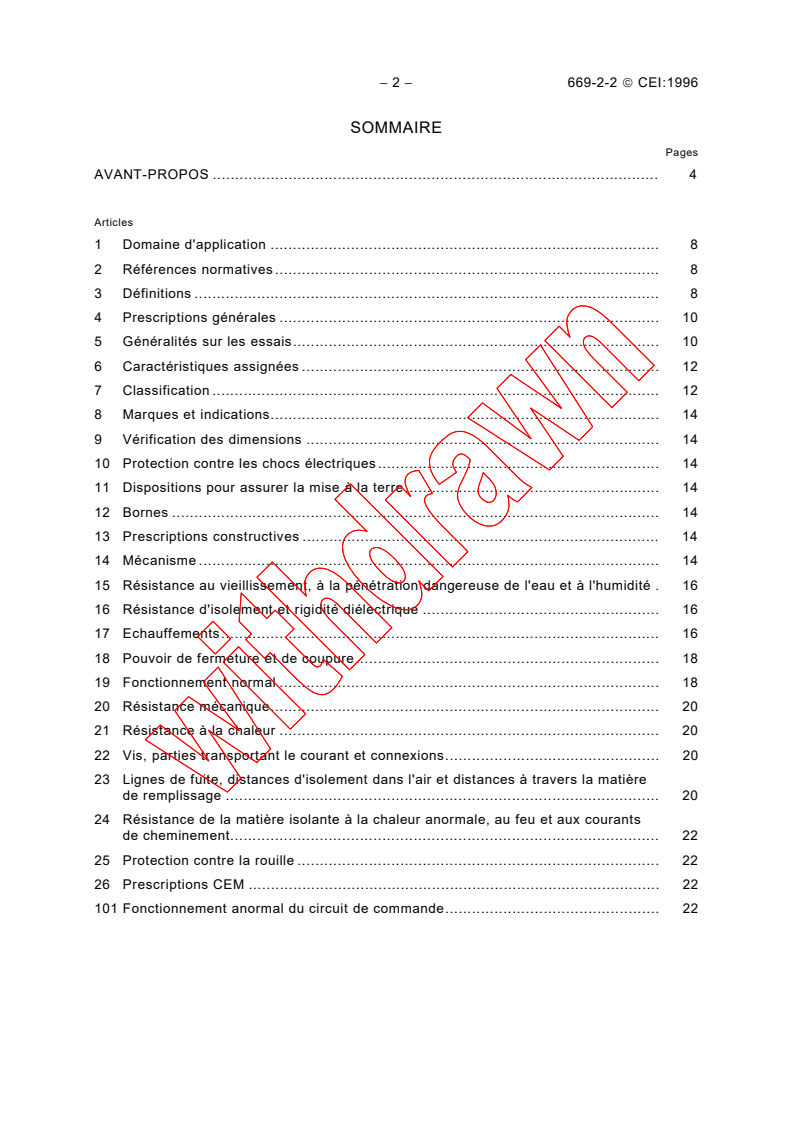
− 2 − 669-2-2 CEI:1996
SOMMAIRE
Pages
AVANT-PROPOS . 4
Articles
1 Domaine d'application . 8
2 Références normatives . 8
3 Définitions . 8
4 Prescriptions générales . 10
5 Généralités sur les essais. 10
6 Caractéristiques assignées . 12
7 Classification . 12
8 Marques et indications. 14
9 Vérification des dimensions . 14
10 Protection contre les chocs électriques. 14
11 Dispositions pour assurer la mise à la terre. 14
12 Bornes . 14
13 Prescriptions constructives . 14
14 Mécanisme . 14
15 Résistance au vieillissement, à la pénétration dangereuse de l'eau et à l'humidité . 16
16 Résistance d'isolement et rigidité diélectrique . 16
17 Echauffements. 16
18 Pouvoir de fermeture et de coupure. 18
19 Fonctionnement normal . 18
20 Résistance mécanique. 20
21 Résistance à la chaleur . 20
22 Vis, parties transportant le courant et connexions. 20
23 Lignes de fuite, distances d'isolement dans l'air et distances à travers la matière
de remplissage . 20
24 Résistance de la matière isolante à la chaleur anormale, au feu et aux courants
de cheminement. 22
25 Protection contre la rouille . 22
26 Prescriptions CEM . 22
101 Fonctionnement anormal du circuit de commande. 22
669-2-2 IEC:1996 − 3 −
CONTENTS
Page
FOREWORD. 5
Clause
1 Scope. 9
2 Normative references. 9
3 Definitions. 9
4 General requirements. 11
5 General notes on tests . 11
6 Ratings. 13
7 Classification. 13
8 Marking. 15
9 Checking of dimensions. 15
10 Protection against electric shock . 15
11 Provision for earthing . 15
12 Terminals. 15
13 Constructional requirements. 15
14 Mechanism. 15
15 Resistance to ageing, to harmful ingress of water and to humidity . 17
16 Insulation resistance and electric strength. 17
17 Temperature rise. 17
18 Making and breaking capacity . 19
19 Normal operation. 19
20 Mechanical strength. 21
21 Resistance to heat . 21
22 Screws, current-carrying parts and connections. 21
23 Creepage distances, clearances and distances through sealing compound . 21
24 Resistance of insulating material to abnormal heat, to fire and to tracking . 23
25 Resistance to rusting. 23
26 EMC requirements. 23
101 Abnormal operation of the control circuit . 23
− 4 − 669-2-2 CEI:1996
COMMISSION ÉLECTROTECHNIQUE INTERNATIONALE
_____________
INTERRUPTEURS POUR INSTALLATIONS ÉLECTRIQUES FIXES
DOMESTIQUES ET ANALOGUES –
Partie 2: Prescriptions particulières –
Section 2: Interrupteurs à commande électromagnétique à distance
(télérupteurs)
AVANT-PROPOS
1) La CEI (Commission Electrotechnique Internationale) est une organisation mondiale de normalisation
composée de l'ensemble des comités électrotechniques nationaux (Comités nationaux de la CEI). La CEI a
pour objet de favoriser la coopération internationale pour toutes les questions de normalisation dans les
domaines de l'électricité et de l'électronique. A cet effet, la CEI, entre autres activités, publie des Normes
Internationales. Leur élaboration est confiée à des comités d'études, aux travaux desquels tout Comité
national intéressé par le sujet traité peut participer. Les organisations internationales, gouvernementales et
non gouvernementales, en liaison avec la CEI, participent également aux travaux. La CEI collabore
étroitement avec l'Organisation Internationale de Normalisation (ISO), selon des conditions fixées par accord
entre les deux organisations.
2) Les décisions ou accords officiels de la CEI concernant les questions techniques, représentent, dans la
mesure du possible un accord international sur les sujets étudiés, étant donné que les Comités nationaux
intéressés sont représentés dans chaque comité d’études.
3) Les documents produits se présentent sous la forme de recommandations internationales. Ils sont publiés
comme normes, rapports techniques ou guides et agréés comme tels par les Comités nationaux.
4) Dans le but d'encourager l'unification internationale, les Comités nationaux de la CEI s'engagent à appliquer
de façon transparente, dans toute la mesure possible, les Normes internationales de la CEI dans leurs
normes nationales et régionales. Toute divergence entre la norme de la CEI et la norme nationale ou
régionale correspondante doit être indiquée en termes clairs dans cette dernière.
5) La CEI n’a fixé aucune procédure concernant le marquage comme indication d’approbation et sa
responsabilité n’est pas engagée quand un matériel est déclaré conforme à l’une de ses normes.
6) L’attention est attirée sur le fait que certains des éléments de la présente Norme internationale peuvent faire
l’objet de droits de propriété intellectuelle ou de droits analogues. La CEI ne saurait être tenue pour
responsable de ne pas avoir identifié de tels droits de propriété et de ne pas avoir signalé leur existence.
La Norme internationale CEI 669-2-2 a été établie par le sous-comité 23B: Prises de courant
et interrupteurs, du comité d’études 23 de la CEI: Petit appareillage.
Cette deuxième édition annule et remplace la première édition parue en 1984 dont elle
constitue une révision technique.
Le texte de cette norme est issu de la première édition et des documents suivants:
FDIS Rapport de vote
23B/477/FDIS 23B/497/RVD
Le rapport de vote indiqué dans le tableau ci-dessus donne toute information sur le vote
ayant abouti à l'approbation de cette norme.
La présente section de la CEI 669-2 doit être utilisée conjointement avec la CEI 669-1. Elle
contient les modifications à apporter à cette norme pour la transformer en norme de la CEI.
669-2-2 IEC:1996 − 5 −
INTERNATIONAL ELECTROTECHNICAL COMMISSION
_____________
SWITCHES FOR HOUSEHOLD AND SIMILAR FIXED
ELECTRICAL INSTALLATIONS –
Part 2: Particular requirements –
Section 2: Electromagnetic remote-control switches
(RCS)
FOREWORD
1) The IEC (International Electrotechnical Commission) is a worldwide organization for standardization
comprising all national electrotechnical committees (IEC National Committees). The object of the IEC is to
promote international co-operation on all questions concerning standardization in the electrical and electronic
fields. To this end and in addition to other activities, the IEC publishes International Standards. Their
preparation is entrusted to technical committees; any IEC National Committee interested in the subject dealt
with may participate in this preparatory work. International, governmental and non-governmental
organizations liaising with the IEC also participate in this preparation. The IEC collaborates closely with the
International Organization for Standardization (ISO) in accordance with conditions determined by agreement
between the two organizations.
2) The formal decisions or agreements of the IEC on technical matters express, as nearly as possible, an
international consensus of opinion on the relevant subjects since each technical committee has
representation from all interested National Committees.
3) The documents produced have the form of recommendations for international use and are published in the
form of standards, technical reports or guides and they are accepted by the National Committees in that
sense.
4) In order to promote international unification, IEC National Committees undertake to apply IEC International
Standards transparently to the maximum extent possible in their national and regional standards. Any
divergence between the IEC Standard and the corresponding national or regional standard shall be clearly
indicated in the latter.
5) The IEC provides no marking procedure to indicate its approval and cannot be rendered responsible for any
equipment declared to be in conformity with one of its standards.
6) Attention is drawn to the possibility that some of the elements of this International Standard may be the subject
of patent rights. The IEC shall not be held responsible for identifying any or all such patent rights.
International Standard IEC 669-2-2 has been prepared by subcommittee 23B: Plugs, socket-
outlets and switches, of IEC technical committee 23: Electrical accessories.
This second edition cancels and replaces the fist edition published in 1984 of which it
constitutes a technical revision.
The text of this standard is based on the first edition and on the following documents:
FDIS Report on voting
23B/477/FDIS 23B/497/RVD
Full information on the voting for the approval of this standard can be found in the report on
voting indicated in the above table.
This section of IEC 669-2 shall be used in conjunction with IEC 669-1. It lists the changes
necessary to convert that standard into an IEC standard.
− 6 − 669-2-2 CEI:1996
Dans la présente publication:
1) Les caractères d’imprimerie suivants sont utilisés:
− prescriptions proprement dites: caractères romains.
− modalités d’essais: caractères italiques.
− notes: petits caractères romains.
2) Les paragraphes, figures ou tableaux complémentaires à ceux de la première partie
sont numérotés à partir de 101.
669-2-2 IEC:1996 − 7 −
In this publication:
1) The following print types are used:
− requirements proper: in roman type.
− test specifications: in italic type.
− notes: in smaller roman type.
2) Subclauses, figures or tables which are additional to those in part 1 are numbered
starting from 101.
− 8 − 669-2-2 CEI:1996
INTERRUPTEURS POUR INSTALLATIONS ÉLECTRIQUES FIXES
DOMESTIQUES ET ANALOGUES –
Partie 2: Prescriptions particulières –
Section 2: Interrupteurs à commande électromagnétique à distance
(télérupteurs)
1 Domaine d'application
L'article de la partie 1 s'applique avec les exceptions suivantes:
Remplacer la première phrase par:
La présente norme s'applique aux interrupteurs à commande électromagnétique à distance
(appelés dans la suite du texte télérupteurs) de tension assignée ne dépassant pas 440 V et
de courant assigné ne dépassant pas 63 A, destinés aux installations électriques fixes,
domestiques et analogues, soit intérieures soit extérieures.
La bobine du télérupteur peut être soit excitée soit non excitée en permanence.
NOTES
1 Les télérupteurs comprenant des composants électroniques dans le circuit de commande ou le circuit
d'interruption ne sont pas régis par cette norme. Des prescriptions complémentaires correspondantes sont à
l'étude. Les prescriptions de cette norme, en même temps que les prescriptions, pour autant qu'elles sont
applicables, de la CEI 669-2-1, peuvent s'appliquer, provisoirement.
2 Les contacteurs ne sont pas couverts par cette norme.
2 Références normatives
L'article de la partie 1 s'applique avec les additions suivantes:
CEI 85: 1984, Evaluation et classification thermique de l'isolation électrique
CEI 317, Spécifications pour types particuliers de fils de bobinage
CEI 669-2-1: 1996, Interrupteurs pour installations électriques fixes domestiques et analogues –
Partie 2: Prescriptions particulières – Section 1: Interrupteurs électroniques
3 Définitions
L'article de la partie 1 s'applique avec les additions suivantes:
3.17 Ajouter la note suivante:
NOTE – Cette définition s'applique seulement au circuit de l'interrupteur.
3.18 Ajouter la note suivante:
NOTE – Cette définition s'applique seulement au circuit de l'interrupteur.
669-2-2 IEC:1996 − 9 −
SWITCHES FOR HOUSEHOLD AND SIMILAR FIXED
ELECTRICAL INSTALLATIONS –
Part 2: Particular requirements –
Section 2: Electromagnetic remote-control switches
(RCS)
1 Scope
This clause of Part 1 is applicable, except as follows:
Replace the first sentence by:
This standard applies to electromagnetic remote-control switches (hereinafter referred to as
RCS) with a rated voltage not exceeding 440 V and a rated current not exceeding 63 A,
intended for household and similar fixed electrical installations, either indoors or outdoors.
The RCS coil may or may not be permanently energized.
NOTES
1 RCSs including parts with electronic components in control or switching circuits are not covered by this
standard. Relevant additional requirements are under consideration. Provisionally the requirements of this
standard together with the requirements, as far as applicable, of IEC 669-2-1, may apply.
2 Contactors are not covered by this standard.
2 Normative references
This clause of Part 1 is applicable with the following additions:
IEC 85: 1984, Thermal evaluation and classification of electrical insulation
IEC 317, Specifications for particular types of winding wires
IEC 669-2-1: 1996, Switches for household and similar fixed electrical installations − Part 2:
Particular requirements − Section 1: Electronic switches
3 Definitions
This clause of Part 1 is applicable with the following additions:
3.17 Add the following note:
NOTE – This definition is only applicable to the switching circuit.
3.18 Add the following note:
NOTE – This definition is only applicable to the switching circuit.
− 10 − 669-2-2 CEI:1996
Ajouter les définitions suivantes:
3.101 télérupteur: Interrupteur muni d'une bobine commandée au moyen d'impulsions ou
qui peut être excitée en permanence au moyen d'un circuit de commande.
3.102 tension de commande assignée: Tension assignée au circuit de commande par le
fabricant. Généralement, c'est la tension de fonctionnement de la bobine de commande
électromagnétique.
3.103 circuit de l'interrupteur: Circuit comportant les parties permettant le passage du
courant assigné dans le télérupteur.
3.104 circuit de commande: Circuit comportant les parties électriques pour la commande
du mécanisme de commutation.
3.105 mécanisme de commande: Mécanisme comprenant toutes les parties qui sont
destinées à la commande du télérupteur.
3.106 commande manuelle incorporée: Dispositif permettant de commander directement
ou indirectement le circuit d’interrupteur. Ce dispositif n'est pas destiné au fonctionnement
normal du télérupteur.
3.107 télérupteur à verrouillage: Télérupteur verrouillé mécaniquement dans chacune
des deux positions. Il a une bobine séparée pour chaque position.
3.108 télérupteur débrochable: Télérupteur composé de deux parties, l'une servant de
base et portant les bornes, l'autre amovible portant le circuit de l'interrupteur et le circuit de
commande, les deux parties s'adaptant l'une dans l'autre par des connexions élastiques. les
deux parties étant solidarisées et/ou séparées avec ou sans l'aide d'un outil.
4 Prescriptions générales
L'article de la partie 1 s'applique avec les additions suivantes:
Ajouter après le deuxième alinéa:
Le fonctionnement d'un télérupteur ne doit pas être perturbé quand il est monté avec un
angle qui n'est pas supérieur à 5° de sa position spécifiée d'utilisation.
5 Généralités sur les essais
L'article de la partie 1 s'applique avec les additions suivantes:
5.4 Ajouter après le dernier alinéa:
Pour les essais de l'article 101, trois échantillons supplémentaires sont nécessaires.
Ajouter le paragraphe suivant:
5.101 Si un télérupteur est équipé d'une commande manuelle incorporée, il doit être
essayé conformément aux prescriptions de l'article 19.
669-2-2 IEC:1996 − 11 −
Add the following definitions:
3.101 RCS: A switch provided with a coil which is operated by means of impulses or may
be permanently energized by means of a control circuit.
3.102 rated control voltage: The voltage assigned to the control circuit by the
manufacturer. This is generally the operating voltage of the electromagnetic control coil.
3.103 switching circuit: The circuit which contains the parts which allow the rated current
to flow through the RCS.
3.104 control circuit: The circuit which includes electrical parts to actuate the switching
mechanism.
3.105 control mechanism: Mechanism which includes all the parts which are intended for
the operation of the RCS.
3.106 incorporated hand-operated device: A device which allows the switching circuit to
be operated, directly or indirectly. This device is not intended for the normal operation of the
RCS.
3.107 latching RCS: An RCS which is mechanically locked in either of the two positions,
having a separate coil for each position.
3.108 disconnectable RCS: An RCS including two parts, the first being used as a base
and includes the terminals, the other being removable and includes the switching and the
control circuits, the two parts being resiliently connected together using a means which
allows joining and/or separating with or without the use of a tool.
4 General requirements
This clause of Part 1 is applicable with the following additions:
Add after the second paragraph:
The operation of an RCS shall not be impaired when it is mounted at an angle deviating not
more than 5° from the specified position of use.
5 General notes on tests
This clause of Part 1 is applicable with the following addition:
5.4 Add after the last paragraph:
For the tests of clause 101, three additional specimens are necessary.
Add the following subclause:
5.101 If an RCS is provided with an incorporated hand-operated device, it shall be tested
as specified in clause 19.
− 12 − 669-2-2 CEI:1996
NOTES
1 Lors des essais de pouvoir de fermeture et de coupure et des essais de fonctionnement normal, on évitera
d'appliquer la tension à la bobine du télérupteur toujours au même angle de phase, ce qui aurait pour
conséquence de fausser les résultats.
2 Des précautions devront être prises lors de l'utilisation de combinateurs équipés de moteurs synchrones et
de dispositifs de commande similaires.
6 Caractéristiques assignées
L’article de la partie 1 s’applique avec les additions suivantes:
6.2 Ajouter, après le dernier alinéa, la note suivante:
NOTE – Dans certains types de télérupteurs, des contacts auxiliaires d'intensité plus basse que le courant
assigné au circuit de interrupteur peuvent être ajoutés. Les valeurs assignées et les prescriptions s'y rapportant
sont à l'étude.
Ajouter le paragraphe suivant:
6.101 Les tensions de commande assignées préférentielles sont:
− en courant alternatif: 6 V, 8 V, 12 V, 24 V, 42 V, 48 V, 110 V, 130 V, 220 V, 230 V et 240 V;
− en courant continu: 12 V, 24 V, 48 V, 60 V, 110 V et 220 V.
7 Classification
L'article de la partie 1 s'applique avec les additions suivantes:
7.1.6 Ajouter ce qui suit:
− interrupteurs à commande électromagnétique à distance (télérupteurs)
7.1.7 Ajouter ce qui suit:
− télérupteurs débrochables;
Ajouter les paragraphes suivants:
7.101 D'après le type de mécanisme de commutation:
– mécanisme à action simple;
– mécanisme à action séquentielle.
NOTES
1 Les télérupteurs à action simple sont ceux qui, à chaque impulsion, donnent un état soit fermé soit ouvert,
ces états se répétant à chaque impulsion sur 1, 2, 3 ou 4 pôles, soit en interrupteur, soit en inverseur.
2 Cela permet de classer les télérupteurs d'après le numéro de fonction de 7.1.1.
3 La fonction numéro 5 peut être réalisée par deux télérupteurs de numéro de fonction 1 ou 6, câblés
conformément à la figure 1 de la CEI 669-1.
4 La fonction numéro 7 peut être remplie par la fonction 6/2 en réalisant le câblage avec connexions
extérieures conformément à la figure 1 de la CEI 669-1.
5 Les télérupteurs à action séquentielle associent plusieurs contacts interrupteurs ou inverseurs, en général
mis en mouvement par une came permettant de combiner par impulsions successives ces contacts en
combinaisons différentes. Ce nombre d'impulsions est donné par le nombre de crans de la came.
669-2-2 IEC:1996 − 13 −
NOTES
1 During the making and breaking capacity tests and the normal operation tests, the application of the voltage
to the RCS coil always at the same phase angle is to be avoided, as this application may give misleading results.
2 Precautions should be taken when using combinations equipped with synchronous motors and similar
operating devices.
6 Ratings
This clause of Part 1 is applicable with the following additions:
6.2 Add, after the last paragraph, the following note:
NOTE – In certain types of RCS, auxiliary contacts designed for a current lower than the rated current of the
switching circuit may be added. Relevant ratings and requirements are under consideration.
Add the following subclause:
6.101 Preferred rated control voltages are:
− a.c.: 6 V, 8 V, 12 V, 24 V, 42 V, 48 V, 110 V, 130 V, 220 V, 230 V and 240 V;
− d.c.: 12 V, 24 V, 48 V, 60 V, 110 V and 220 V.
7 Classification
This clause of Part 1 is applicable with the following additions:
7.1.6 Add the following:
− electromagnetic remote control switches (RCS).
7.1.7 Add the following:
− disconnectable RCS;
Add the following subclauses:
7.101 According to the type of switching mechanism:
− directly operated mechanism;
− sequentially operated mechanism.
NOTES
1 Directly operated RCSs are those which, for each impulse, show an ON or OFF state, these states occurring
for each impulse on 1, 2, 3 or 4 poles, either as a switch or as a reversing switch.
2 This allows the RCS to be classified according to the pattern number of 7.1.1.
3 Pattern number 5 may be met by two RCS pattern numbers 1 or 6 and wiring in accordance with figure 1 of
IEC 669-1.
4 Pattern number 7 may be met by pattern number 6/2 and wiring with external connections in accordance with
figure 1 of IEC 669-1.
5 Sequentially operated RCSs include several switching or reversing contacts generally operated by means of
a cam allowing different circuit combinations by means of successive impulses. This number of impulses is
given by the number of cam slots.
− 14 − 669-2-2 CEI:1996
7.102 En fonction du mode d'excitation du circuit de commande:
– télérupteurs excités par impulsions;
– télérupteurs excités en permanence.
8 Marques et indications
L'article de la partie 1 s'applique avec les additions suivantes:
8.1 Ajouter après le deuxième alinéa:
– la tension de commande assignée en volts, si celle-ci diffère de la tension assignée.
NOTE – Les télérupteurs dont le circuit de commande est prévu pour être alimenté par une alimentation TBTS
doivent être munis d'un marquage spécial dont le symbole est à l'étude.
8.4 Ajouter après le dernier alinéa:
Si nécessaire, le schéma de câblage où est indiqué clairement le repérage des bornes doit
être fixé sur l'appareil ou à l'intérieur du couvercle de protection des bornes.
8.6 Ajouter ce qui suit:
Ce paragraphe s'applique uniquement aux télérupteurs munis d'une commande manuelle
incorporée agissant directement sur le circuit de l'interrupteur.
9 Vérification des dimensions
L'article de la partie 1 s'applique.
10 Protection contre les chocs électriques
L'article de la partie 1 s'applique.
11 Dispositions pour assurer la mise à la terre
L'article de la partie 1 s'applique.
12 Bornes
L'article de la partie 1 s'applique.
13 Prescriptions constructives
L'article de la partie 1 s'applique.
14 Mécanisme
L'article de la partie 1 s'applique avec les additions suivantes:
669-2-2 IEC:1996 − 15 −
7.102 According to the kind of energization of the control circuit:
− RCS energized by impulses;
− RCS permanently energized.
8 Marking
This clause of Part 1 is applicable with the following additions:
8.1 Add after the second dashed text:
− rated control voltage in volts, if different from the rated voltage.
NOTE – An RCS having a control circuit suitable for connection to a SELV supply shall have a special marking,
whose symbol is under consideration.
8.4 Add after the last paragraph:
If necessary, the wiring diagram on which the terminal references are clearly indicated shall
be fixed to the accessory or inside the protective cover for the terminals.
8.6 Add the following:
This subclause is only applicable to an RCS equipped with an incorporated hand-operated
device, acting directly on the switching circuit.
9 Checking of dimensions
This clause of Part 1 is applicable.
10 Protection against electric shock
This clause of Part 1 is applicable.
11 Provision for earthing
This clause of Part 1 is applicable.
12 Terminals
This clause of Part 1 is applicable.
13 Constructional requirements
This clause of Part 1 is applicable.
14 Mechanism
This clause of Part 1 is applicable with the following additions:
− 16 − 669-2-2 CEI:1996
Ajouter, à la fin de l'article, la note suivante:
NOTE – Des prescriptions complémentaires pour les télérupteurs à verrouillage sont à l'étude.
Ajouter le paragraphe suivant:
14.101 Si un télérupteur est équipé d'une commande manuelle incorporée, et si un
indicateur de position est exigé, il doit indiquer clairement et sans ambiguïté la position du
circuit de l'interrupteur.
15 Résistance au vieillissement, à la pénétration dangereuse de l'eau et à l'humidité
L'article de la partie 1 s'applique.
16 Résistance d'isolement et rigidité diélectrique
L'article de la partie 1 s'applique avec les additions suivantes:
16.2 Ajouter au tableau 13:
9 Entre circuit de l'interrupteur et circuit de 5 2000 3000
commande quand ils sont séparés**
**
Pour les télérupteurs dont le circuit de commande est prévu pour être alimenté par une alimentation TBTS, le
circuit de l'interrupteur étant alimenté par une tension supérieure à la TBTS, les tensions d'essai sont les
suivantes:
Tension assignée jusqu'à 130 V inclus Tension d'essai (V) 2000
de 130 V à 250 V inclus 3500
supérieur à 250 V 4200
17 Echauffements
L'article de la partie 1 s'applique avec l'addition suivante:
L'essai est effectué sur des télérupteurs non excités en permanence, sans connecter la
bobine.
Pour les télérupteurs qui sont excités en permanence, la bobine est alimentée à une tension
équivalant à 1,06 fois la tension assignée, à la fréquence assignée.
La température de la bobine est calculée selon la méthode de la résistance au moyen de la
formule suivante:
RR−
Echauffement = ()234,5+−tt( −t)
12 1
R
où
R est la résistance en condition chaude;
R est la résistance en condition froide;
t est la température ambiante au début de l'essai;
t est la température ambiante à la fin de l'essai.
669-2-2 IEC:1996 − 17 −
Add, at the end of the clause, the following note:
NOTE – Additional requirements for latching RCS are under consideration.
Add the following subclause:
14.101 If an RCS is equipped with an incorporated hand-operated device, and if a position
indicator is required, it shall indicate the position of the switching circuit clearly and without
ambiguity.
15 Resistance to ageing, to harmful ingress of water and to humidity
This clause of Part 1 is applicable.
16 Insulation resistance and electric strength
This clause of Part 1 is applicable with the following additions:
16.2 Add to table 13:
9 Between switching and control circuits 5 2000 3000
if they are separated **
** For RCSs having the control circuit suitable for connection to a SELV supply, the switching circuit being
supplied with a voltage greater than the SELV, the test voltages are as follows:
Rated voltage: up to and including 130 V Test voltage (V): 2000
above 130 V up to and including 250 V 3500
above 250 V 4200
17 Temperature rise
This clause of Part 1 is applicable with the following addition:
The test is carried out on RCSs which are not permanently energized without connecting the
coil.
For RCSs that are permanently energized, the coil is connected to a voltage equivalent to
1,06 times its rated voltage at rated frequency.
The temperature of the coil is calculated in accordance with the resistance method by
means of the following formula:
RR−
Temperature rise = ()234,5+−tt( −t)
12 1
R
where
R is the resistance in the warm condition;
R is the resistance in the cold condition;
t is the ambient temperature at the beginning of the test;
t is the ambient temperature at the end of the test.
− 18 − 669-2-2 CEI:1996
Les enroulements des bobines ne doivent pas dépasser les limites spécifiées dans le
tableau suivant:
Limites d'échauffement des bobines isolées dans l'air
Classe d'isolation Limite d'échauffement
du matériau (mesurée par variation de la résistance)
K
A 85
E 100
B 110
F 135
H 160
NOTE – Les limites données dans ce tableau sont basées sur une température
ambiante de l'air de 20 °C
18 Pouvoir de fermeture et de coupure
L'article de la partie 1 s'applique avec les additions suivantes:
18.1 Ajouter ce qui suit:
Pendant les essais de 18.1 et 18.2, le circuit de commande est alimenté sous sa tension
assignée de commande avec la durée d'impulsion déclarée par le constructeur.
19 Fonctionnement normal
L'article de la partie 1 s'applique avec les additions suivantes:
19.1 Ajouter, après le dernier alinéa, ce qui suit:
Pour les télérupteurs équipés d'une commande manuelle incorporée, agissant directement
sur le circuit de l'interrupteur, 10 % des manoeuvres indiquées au tableau 16 sont faites
manuellement ou d'une manière équivalente et, dans le cas des télérupteurs pour courant
alternatif seulement, l'essai est suivi de celui de 14.3.
Pour les 90 % des manoeuvres restantes, le circuit de commande est alimenté comme
indiqué à l'article 18.
Pendant l'essai de fonctionnement normal, des défauts de fonctionnement sont tolérés dans
la limite de 1 %, toutefois il ne doit pas se produire plus de trois défauts consécutifs.
Ajouter les paragraphes suivants:
19.101 Les télérupteurs excités par des impulsions doivent fonctionner correctement si la
tension de commande fluctue entre 0,9 et 1,1 fois la valeur assignée avec la durée
d'impulsion déclarée par le constructeur.
669-2-2 IEC:1996 − 19 −
The windings of coils shall not exceed the limits specified in the following table:
Temperature-rise limits for insulated coils in air
Class of insulating Temperature-rise limit
material (measured by resistance variation)
K
A 85
E 100
B 110
F 135
H 160
NOTE − The limits given in this table are based on an ambient temperature of
20 °C.
18 Making and breaking capacity
This clause of Part 1 is applicable with the following additions:
18.1 Add the following:
During the tests of 18.1 and 18.2, the rated control voltage is applied to the control circuit
with an impulse duration as declared by the manufacturer.
19 Normal operation
This clause of Part 1 is applicable with the following additions:
19.1 Add, after the last paragraph, the following:
For RCS equipped with an incorporated hand-operated device, acting directly on the
switching circuit, 10 % of the operations indicated in table 16 are made by hand or in an
equivalent manner and for those for a.c. operation, the test is followed by that of 14.3.
For the remaining 90 % of the operations, the control circuit is supplied as specified in clause 18.
During the normal operation test, failures of correct operation are allowed to occur within
1 %, but not more than three consecutive failures are allowed.
Add the following subclauses:
19.101 An RCS energized by impulses shall operate correctly if the control voltage
fluctuates between 0,9 and 1,1 times the rated value with an impulse duration as declared
by the manufacturer.
− 20 − 669-2-2 CEI:1996
La conformité est vérifiée par l'essai suivant:
On effectue, hors charge, sur chacun des trois échantillons, 20 manoeuvres avec une
tension de commande égale à 0,9 fois la valeur assignée et 20 manoeuvres avec une
tension de commande égale à 1,1 fois la valeur assignée.
Le tétérupteur doit fonctionner correctement.
19.102 Les télérupteurs alimentés en permanence doivent fonctionner correctement pour
toutes les valeurs de la tension de commande comprise entre 85 % et 110 % de la valeur
assignée. Si une plage est déclarée, 85 % doit s'appliquer à la valeur inférieure et 110 % à
la valeur supérieure.
Les limites entre lesquelles un télérupteur alimenté en permanence doit se fermer et s'ouvrir
complètement sont 75 % et 20 % de leur tension assignée de commande. Si une plage est
déclarée, 75 % doit s'appliquer à la valeur inférieure et 20 % à la valeur supérieure.
Les limites de fermeture sont applicables après que les enroulements ont atteint une
température stable correspondant à des conditions d'état stable à 100 % de la tension
assignée de commande, dans une température ambiante de +40 °C.
Les limites d'ouverture sont applicables avec l'enroulement à –5 °C. Cela peut être vérifié
par calcul en utilisant les valeurs obtenues à température ambiante.
La conformité est vérifiée en effectuant un essai à chacune des limites sur trois échantillons
différents.
Le télérupteur doit fonctionner correctement.
20 Résistance mécanique
L'article de la partie 1 s'applique.
21 Résistance à la chaleur
L'article de la partie 1 s'applique avec l'addition suivante:
Ajouter la note suivante:
NOTE – Les prescriptions de cet article sont applicables à la fois au circuit de commande et au circuit de
l'interrupteur.
22 Vis, parties transportant le courant et connexions
L'article de la partie 1 s'applique.
23 Lignes de fuite, distances d'isolement dans l'air et distances à travers la matière
de remplissage
L'article de la partie 1 s'applique avec les addit
...
NORME CEI
INTERNATIONALE IEC
60669-2-2
INTERNATIONAL
Edition 2.1
STANDARD
2002-05
Edition 2:1996 consolidée par l'amendement 1:1997
Edition 2:1996 consolidated with amendment 1:1997
Interrupteurs pour installations électriques
fixes domestiques et analogues –
Partie 2:
Prescriptions particulières –
Section 2: Interrupteurs à commande à distance
(télérupteurs)
Switches for household and similar fixed
electrical installations –
Part 2:
Particular requirements –
Section 2: Remote-control switches (RCS)
Numéro de référence
Reference number
CEI/IEC 60669-2-2:1996+A1:1997
Numérotation des publications Publication numbering
Depuis le 1er janvier 1997, les publications de la CEI As from 1 January 1997 all IEC publications are
sont numérotées à partir de 60000. Ainsi, la CEI 34-1 issued with a designation in the 60000 series. For
devient la CEI 60034-1. example, IEC 34-1 is now referred to as IEC 60034-1.
Editions consolidées Consolidated editions
Les versions consolidées de certaines publications de la The IEC is now publishing consolidated versions of its
CEI incorporant les amendements sont disponibles. Par publications. For example, edition numbers 1.0, 1.1
exemple, les numéros d’édition 1.0, 1.1 et 1.2 indiquent and 1.2 refer, respectively, to the base publication,
respectivement la publication de base, la publication de the base publication incorporating amendment 1 and
base incorporant l’amendement 1, et la publication de the base publication incorporating amendments 1
base incorporant les amendements 1 et 2. and 2.
Informations supplémentaires Further information on IEC publications
sur les publications de la CEI
Le contenu technique des publications de la CEI est The technical content of IEC publications is kept
constamment revu par la CEI afin qu'il reflète l'état under constant review by the IEC, thus ensuring that
actuel de la technique. Des renseignements relatifs à the content reflects current technology. Information
cette publication, y compris sa validité, sont dispo- relating to this publication, including its validity, is
nibles dans le Catalogue des publications de la CEI available in the IEC Catalogue of publications
(voir ci-dessous) en plus des nouvelles éditions, (see below) in addition to new editions, amendments
amendements et corrigenda. Des informations sur les and corrigenda. Information on the subjects under
sujets à l’étude et l’avancement des travaux entrepris consideration and work in progress undertaken by the
par le comité d’études qui a élaboré cette publication, technical committee which has prepared this
ainsi que la liste des publications parues, sont publication, as well as the list of publications issued,
également disponibles par l’intermédiaire de: is also available from the following:
• Site web de la CEI (www.iec.ch) • IEC Web Site (www.iec.ch)
• Catalogue des publications de la CEI • Catalogue of IEC publications
Le catalogue en ligne sur le site web de la CEI The on-line catalogue on the IEC web site
(www.iec.ch/catlg-f.htm) vous permet de faire des (www.iec.ch/catlg-e.htm) enables you to search
recherches en utilisant de nombreux critères, by a variety of criteria including text searches,
comprenant des recherches textuelles, par comité technical committees and date of publication. On-
d’études ou date de publication. Des informations line information is also available on recently
en ligne sont également disponibles sur les issued publications, withdrawn and replaced
nouvelles publications, les publications rempla- publications, as well as corrigenda.
cées ou retirées, ainsi que sur les corrigenda.
• IEC Just Published
• IEC Just Published
Ce résumé des dernières publications parues
This summary of recently issued publications
(www.iec.ch/JP.htm) est aussi disponible par
(www.iec.ch/JP.htm) is also available by email.
courrier électronique. Veuillez prendre contact
Please contact the Customer Service Centre (see
avec le Service client (voir ci-dessous) pour plus
below) for further information.
d’informations.
• Service clients
• Customer Service Centre
Si vous avez des questions au sujet de cette
If you have any questions regarding this
publication ou avez besoin de renseignements
publication or need further assistance, please
supplémentaires, prenez contact avec le Service
contact the Customer Service Centre:
clients:
Email: custserv@iec.ch
Email: custserv@iec.ch
Tél: +41 22 919 02 11
Tel: +41 22 919 02 11
Fax: +41 22 919 03 00
Fax: +41 22 919 03 00
.
NORME CEI
INTERNATIONALE IEC
60669-2-2
INTERNATIONAL
Edition 2.1
STANDARD
2002-05
Edition 2:1996 consolidée par l'amendement 1:1997
Edition 2:1996 consolidated with amendment 1:1997
Interrupteurs pour installations électriques
fixes domestiques et analogues –
Partie 2:
Prescriptions particulières –
Section 2: Interrupteurs à commande à distance
(télérupteurs)
Switches for household and similar fixed
electrical installations –
Part 2:
Particular requirements –
Section 2: Remote-control switches (RCS)
IEC 2002 Droits de reproduction réservés Copyright - all rights reserved
Aucune partie de cette publication ne peut être reproduite ni No part of this publication may be reproduced or utilized in
utilisée sous quelque forme que ce soit et par aucun procédé, any form or by any means, electronic or mechanical,
électronique ou mécanique, y compris la photocopie et les including photocopying and microfilm, without permission in
microfilms, sans l'accord écrit de l'éditeur. writing from the publisher.
International Electrotechnical Commission 3, rue de Varembé Geneva, Switzerland
Telefax: +41 22 919 0300 e-mail: inmail@iec.ch IEC web site http://www.iec.ch
CODE PRIX
Commission Electrotechnique Internationale
N
PRICE CODE
International Electrotechnical Commission
Pour prix, voir catalogue en vigueur
For price, see current catalogue
− 2 − 60669-2-2 © CEI:1996+A1:1997
SOMMAIRE
AVANT-PROPOS .4
1 Domaine d'application.8
2 Références normatives .8
3 Définitions .8
4 Prescriptions générales .12
5 Généralités sur les essais.12
6 Caractéristiques assignées .14
7 Classification .14
8 Marques et indications .16
9 Vérification des dimensions .18
10 Protection contre les chocs électriques .18
11 Dispositions pour assurer la mise à la terre.18
12 Bornes.18
13 Prescriptions constructives .18
14 Mécanisme .18
15 Résistance au vieillissement, à la pénétration dangereuse de l'eau et à l'humidité .20
16 Résistance d'isolement et rigidité diélectrique .20
17 Echauffements.20
18 Pouvoir de fermeture et de coupure .22
19 Fonctionnement normal .22
20 Résistance mécanique.24
21 Résistance à la chaleur.24
22 Vis, parties transportant le courant et connexions.24
23 Lignes de fuite, distances d'isolement dans l'air et distances à travers la matière
de remplissage .24
24 Résistance de la matière isolante à la chaleur anormale, au feu et aux courants
de cheminement .24
25 Protection contre la rouille .24
26 Prescriptions CEM .26
101 Fonctionnement anormal du circuit de commande.26
60669-2-2 © IEC:1996+A1:1997 − 3 −
CONTENTS
FOREWORD.5
1 Scope.9
2 Normative references.9
3 Definitions .9
4 General requirements .13
5 General notes on tests.13
6 Ratings.15
7 Classification .15
8 Marking .17
9 Checking of dimensions .19
10 Protection against electric shock.19
11 Provision for earthing.19
12 Terminals .19
13 Constructional requirements .19
14 Mechanism .19
15 Resistance to ageing, to harmful ingress of water and to humidity .21
16 Insulation resistance and electric strength.21
17 Temperature rise .21
18 Making and breaking capacity .23
19 Normal operation .23
20 Mechanical strength.25
21 Resistance to heat .25
22 Screws, current-carrying parts and connections .25
23 Creepage distances, clearances and distances through sealing compound.25
24 Resistance of insulating material to abnormal heat, to fire and to tracking .25
25 Resistance to rusting .25
26 EMC requirements .27
101 Abnormal operation of the control circuit .27
− 4 − 60669-2-2 © CEI:1996+A1:1997
COMMISSION ÉLECTROTECHNIQUE INTERNATIONALE
____________
INTERRUPTEURS POUR INSTALLATIONS ÉLECTRIQUES FIXES
DOMESTIQUES ET ANALOGUES –
Partie 2: Prescriptions particulières –
Section 2: Interrupteurs à commande à distance (télérupteurs)
AVANT-PROPOS
1) La CEI (Commission Electrotechnique Internationale) est une organisation mondiale de normalisation composée
de l'ensemble des comités électrotechniques nationaux (Comités nationaux de la CEI). La CEI a pour objet de
favoriser la coopération internationale pour toutes les questions de normalisation dans les domaines de
l'électricité et de l'électronique. A cet effet, la CEI, entre autres activités, publie des Normes internationales.
Leur élaboration est confiée à des comités d'études, aux travaux desquels tout Comité national intéressé par le
sujet traité peut participer. Les organisations internationales, gouvernementales et non gouvernementales, en
liaison avec la CEI, participent également aux travaux. La CEI collabore étroitement avec l'Organisation
Internationale de Normalisation (ISO), selon des conditions fixées par accord entre les deux organisations.
2) Les décisions ou accords officiels de la CEI concernant les questions techniques représentent, dans la mesure
du possible, un accord international sur les sujets étudiés, étant donné que les Comités nationaux intéressés
sont représentés dans chaque comité d’études.
3) Les documents produits se présentent sous la forme de recommandations internationales. Ils sont publiés
comme normes, spécifications techniques, rapports techniques ou guides et agréés comme tels par les Comités
nationaux.
4) Dans le but d'encourager l'unification internationale, les Comités nationaux de la CEI s'engagent à appliquer de
façon transparente, dans toute la mesure possible, les Normes internationales de la CEI dans leurs normes
nationales et régionales. Toute divergence entre la norme de la CEI et la norme nationale ou régionale
correspondante doit être indiquée en termes clairs dans cette dernière.
5) La CEI n’a fixé aucune procédure concernant le marquage comme indication d’approbation et sa responsabilité
n’est pas engagée quand un matériel est déclaré conforme à l’une de ses normes.
6) L’attention est attirée sur le fait que certains des éléments de la présente Norme internationale peuvent faire
l’objet de droits de propriété intellectuelle ou de droits analogues. La CEI ne saurait être tenue pour
responsable de ne pas avoir identifié de tels droits de propriété et de ne pas avoir signalé leur existence.
La Norme internationale CEI 60669-2-2 a été établie par le sous-comité 23B: Prises de courant
et interrupteurs, du comité d’études 23 de la CEI: Petit appareillage.
Cette deuxième édition annule et remplace la première édition parue en 1984 dont elle
constitue une révision technique.
La présente version consolidée de la CEI 60669-2-2 est issue de la deuxième édition (1996)
[documents 23B/477/FDIS et 23B/497/RVD] et de son amendement 1 (1997) [documents
23B/519/FDIS et 23B/524/RVD].
Elle porte le numéro d'édition 2.1.
Une ligne verticale dans la marge indique où la publication de base a été modifiée par
l'amendement 1.
La présente section de la CEI 60669-2 doit être utilisée conjointement avec la CEI 60669-1.
Elle contient les modifications à apporter à cette norme pour la transformer en norme de
la CEI.
60669-2-2 © IEC:1996+A1:1997 − 5 −
INTERNATIONAL ELECTROTECHNICAL COMMISSION
____________
SWITCHES FOR HOUSEHOLD AND SIMILAR FIXED
ELECTRICAL INSTALLATIONS –
Part 2: Particular requirements –
Section 2: Remote-control switches (RCS)
FOREWORD
1) The IEC (International Electrotechnical Commission) is a worldwide organization for standardization comprising
all national electrotechnical committees (IEC National Committees). The object of the IEC is to promote
international co-operation on all questions concerning standardization in the electrical and electronic fields. To
this end and in addition to other activities, the IEC publishes International Standards. Their preparation is
entrusted to technical committees; any IEC National Committee interested in the subject dealt with may
participate in this preparatory work. International, governmental and non-governmental organizations liaising
with the IEC also participate in this preparation. The IEC collaborates closely with the International Organization
for Standardization (ISO) in accordance with conditions determined by agreement between the two
organizations.
2) The formal decisions or agreements of the IEC on technical matters express, as nearly as possible, an
international consensus of opinion on the relevant subjects since each technical committee has representation
from all interested National Committees.
3) The documents produced have the form of recommendations for international use and are published in the form
of standards, technical specifications, technical reports or guides and they are accepted by the National
Committees in that sense.
4) In order to promote international unification, IEC National Committees undertake to apply IEC International
Standards transparently to the maximum extent possible in their national and regional standards. Any
divergence between the IEC Standard and the corresponding national or regional standard shall be clearly
indicated in the latter.
5) The IEC provides no marking procedure to indicate its approval and cannot be rendered responsible for any
equipment declared to be in conformity with one of its standards.
6) Attention is drawn to the possibility that some of the elements of this International Standard may be the subject
of patent rights. The IEC shall not be held responsible for identifying any or all such patent rights.
International Standard IEC 60669-2-2 has been prepared by subcommittee 23B: Plugs, socket-
outlets and switches, of IEC technical committee 23: Electrical accessories.
This second edition cancels and replaces the fist edition published in 1984 of which it
constitutes a technical revision.
This consolidated version of IEC 60669-2-2 is based on the second edition (1996) [documents
23B/477/FDIS and 23B/497/RVD] and its amendment 1 (1997) [documents 23B/519/FDIS and
23B/524/RVD].
It bears the edition number 2.1.
A vertical line in the margin shows where the base publication has been modified by
amendment 1.
This section of IEC 60669-2 shall be used in conjunction with IEC 60669-1. It lists the changes
necessary to convert that standard into an IEC standard.
− 6 − 60669-2-2 © CEI:1996+A1:1997
Dans la présente publication:
1) Les caractères d’imprimerie suivants sont utilisés:
− prescriptions proprement dites: caractères romains.
− modalités d’essais: caractères italiques.
− notes: petits caractères romains.
2) Les paragraphes, figures ou tableaux complémentaires à ceux de la première partie sont
numérotés à partir de 101.
Le comité a décidé que le contenu de cette publication de base et de son amendement ne sera
pas modifié avant 2004. A cette date, la publication sera
• reconduite;
• supprimée;
• remplacée par une édition révisée, ou
• amendée.
60669-2-2 © IEC:1996+A1:1997 − 7 −
In this publication:
1) The following print types are used:
− requirements proper: in roman type.
− test specifications: in italic type.
− notes: in smaller roman type.
2) Subclauses, figures or tables which are additional to those in part 1 are numbered starting
from 101.
The committee has decided that the contents of the base publication and its amendment will
remain unchanged until 2004. At this date, the publication will be
• reconfirmed;
• withdrawn;
• replaced by a revised edition, or
• amended.
− 8 − 60669-2-2 © CEI:1996+A1:1997
INTERRUPTEURS POUR INSTALLATIONS ÉLECTRIQUES FIXES
DOMESTIQUES ET ANALOGUES –
Partie 2: Prescriptions particulières –
Section 2: Interrupteurs à commande à distance (télérupteurs)
1 Domaine d'application
La présente norme s'applique aux interrupteurs à commande à distance (appelés ci-après
télérupteurs).
Cette norme s'applique aux télérupteurs électromagnétiques de tension assignée ne dépassant
pas 440 V et de courant assigné ne dépassant pas 63 A, et aux télérupteurs électroniques de
tension assignée ne dépassant pas 250 V et de courant assigné ne dépassant pas 16 A,
destinés aux installations électrodomestiques fixes et similaires, soit intérieures, soit
extérieures.
Il convient que les télérupteurs électroniques comprenant des parties avec composants
électroniques dans les circuits de commande ou de coupure répondent aux prescriptions de
la CEI 60669-2-1 lorsqu'elles s'appliquent.
NOTE Les contacteurs ne sont pas régis par cette norme.
2 Références normatives
L'article de la partie 1 s'applique avec les additions suivantes:
CEI 60085:1984, Evaluation et classification thermique de l'isolation électrique
CEI 60317, Spécifications pour types particuliers de fils de bobinage
CEI 60445:1988, Identification des bornes de matériels et des extrémités de certains
conducteurs désignés et règles générales pour un système alphanumérique
CEI 60669-2-1:1996, Interrupteurs pour installations électriques fixes domestiques et analogues –
Partie 2: Prescriptions particulières – Section 1: Interrupteurs électroniques
CEI 60742:1983, Transporteurs de séparation des circuits et transformateurs de sécurité – Règles
3 Définitions
L'article de la partie 1 s'applique avec les additions suivantes:
3.17 Ajouter la note suivante:
NOTE Cette définition s'applique seulement au circuit de l'interrupteur.
3.18 Ajouter la note suivante:
NOTE Cette définition s'applique seulement au circuit de l'interrupteur.
60669-2-2 © IEC:1996+A1:1997 − 9 −
SWITCHES FOR HOUSEHOLD AND SIMILAR FIXED
ELECTRICAL INSTALLATIONS –
Part 2: Particular requirements –
Section 2: Remote-control switches (RCS)
1 Scope
This standard applies to remote-control switches (hereinafter referred to as RCS).
This standard applies to electromagnetic RCS with a rated voltage not exceeding 440 V and a
rated current not exceeding 63 A, and to electronic RCS with a rated voltage not exceeding
250 V and a rated current not exceeding 16 A, intended for household and similar fixed
electrical installations, either indoors or outdoors.
Electronic RCS which include parts with electronic components in the control or switching
circuits should fulfil the requirements, where applicable, of IEC 60669-2-1.
NOTE Contactors are not covered by this standard.
2 Normative references
This clause of Part 1 is applicable with the following additions:
IEC 60085:1984, Thermal evaluation and classification of electrical insulation
IEC 60317, Specifications for particular types of winding wires
IEC 60445:1988, Identification of equipment terminals and of terminations of certain designated
conductors, including general rules for an alphanumeric system designated conductors,
including general rules of an alphanumeric system
IEC 60669-2-1:1996, Switches for household and similar fixed electrical installations − Part 2:
Particular requirements − Section 1: Electronic switches
IEC 60742:1983, Isolating transformers and safety isolating transformers – Requirements
3 Definitions
This clause of Part 1 is applicable with the following additions:
3.17 Add the following note:
NOTE This definition is only applicable to the switching circuit.
3.18 Add the following note:
NOTE This definition is only applicable to the switching circuit.
− 10 − 60669-2-2 © CEI:1996+A1:1997
Remplacer le texte de ce paragraphe par le texte suivant:
3.101
télérupteur
interrupteur destiné à être commandé à distance
Ajouter les définitions suivantes:
3.101.1
télérupteur électromagnétique
télérupteur pourvu d'une bobine qui est commandée aux moyens d'impulsions ou qui peut être
alimentée en permanence au moyen d'un circuit de commande
3.101.2
télérupteur électronique
télérupteur contenant des composants électroniques et/ou une combinaison de composants
électroniques et d'une ou de plusieurs bobines, qui est manœuvré au moyen d'une ou de
plusieurs unités électroniques supplémentaires
3.102
tension de commande assignée
tension assignée au circuit de commande par le fabricant. Généralement, c'est la tension de
fonctionnement de la bobine de commande électromagnétique.
3.103
circuit de l'interrupteur
circuit comportant les parties permettant le passage du courant assigné dans le télérupteur
3.104
circuit de commande
circuit comportant les parties électriques pour la commande du mécanisme de commutation
3.105
mécanisme de commande
mécanisme comprenant toutes les parties qui sont destinées à la commande du télérupteur
Remplacer le texte de ce paragraphe par le texte suivant:
3.106
commande manuelle incorporée
dispositif qui permet de faire fonctionner le circuit de coupure directement ou indirectement
3.107
télérupteur à verrouillage
télérupteur verrouillé mécaniquement dans chacune des deux positions. Il a une bobine
séparée pour chaque position.
3.108
télérupteur débrochable
télérupteur composé de deux parties, l'une servant de base et portant les bornes, l'autre
amovible portant le circuit de l'interrupteur et le circuit de commande, les deux parties
s'adaptant l'une dans l'autre par des connexions élastiques, les deux parties étant solidarisées
et/ou séparées avec ou sans l'aide d'un outil
60669-2-2 © IEC:1996+A1:1997 − 11 −
Replace the text of this subclause by the following:
3.101
RCS
switch intended to be operated from a distance
Add the following new definitions:
3.101.1
electromagnetic RCS
RCS provided with a coil which is operated by means of impulses or which may be permanently
energized by means of a control circuit
3.101.2
electronic RCS
RCS containing electronic components and/or a combination of electronic components and a
coil or coils, which is operated by means of an electronic extension unit or units
3.102
rated control voltage
the voltage assigned to the control circuit by the manufacturer. This is generally the operating
voltage of the electromagnetic control coil.
3.103
switching circuit
the circuit which contains the parts which allow the rated current to flow through the RCS
3.104
control circuit
the circuit which includes electrical parts to actuate the switching mechanism
3.105
control mechanism
mechanism which includes all the parts which are intended for the operation of the RCS
Replace the text of this subclause by the following:
3.106
incorporated hand-operated device
device which allows the switching circuit to be operated, directly or indirectly
3.107
latching RCS
an RCS which is mechanically locked in either of the two positions, having a separate coil for
each position
3.108
disconnectable RCS
an RCS including two parts, the first being used as a base and includes the terminals, the other
being removable and includes the switching and the control circuits, the two parts being
resiliently connected together using a means which allows joining and/or separating with or
without the use of a tool
− 12 − 60669-2-2 © CEI:1996+A1:1997
Ajouter les nouvelles définitions suivantes:
3.109
courant de commande assigné
courant nécessaire pour l'excitation du télérupteur, assigné par le fabricant à la bobine du
circuit de commande (seulement pour les télérupteurs pourvus d'une bobine de courant)
3.110
télérupteur bistable
télérupteur contenant un mécanisme de commande qui, en l'absence d'excitation électrique ou
manœuvre mécanique, reste dans sa position de fonctionnement et qui, sur excitation
électrique ou manœuvre mécanique, modifie sa position de fonctionnement
3.111
télérupteur monostable
télérupteur contenant un mécanisme de commande qui, sous une excitation électrique ou une
manœuvre mécanique, change la position de fonctionnement de l'interrupteur qui reste dans
cette condition tant que le télérupteur est excité ou manœuvré et qui retourne à la position
initiale après que l'excitation ou la manœuvre est interrompue
3.112
télérupteur prioritaire
télérupteur utilisé pour faire fonctionner directement ou indirectement un premier circuit de
charge ou un groupe de circuits de charge dont l’utilisation peut être arrêtée à certains
moments, le circuit de commande du télérupteur étant influencé par ou raccordé à un second
circuit ou groupe de circuit (priorité ou circuits) qui, lorsqu’ils sont mis sous tension, activent le
circuit de commande du télérupteur qui coupe l'alimentation du premier circuit de charge ou
des premiers circuits pour une durée correspondant à la durée d’alimentation du second circuit
ou groupe de circuits
NOTE 1 Le télérupteur peut disposer de moyens pour régler la sensibilité du circuit de commande du télérupteur
en fonction de la charge totale ou du courant fourni à tous les éléments des circuits (interrupteur prioritaire avec
bobine ampéremétrique) ou être sensible à la tension (interrupteur prioritaire avec bobine de tension) appliquée à la
seconde charge ou au groupe de charges.
NOTE 2 D'autres essais sont à l'étude.
3.113
télérupteur à fonctionnement séquentiel
télérupteur qui inclut plusieurs contacts interrupteurs ou inverseurs généralement mis en fonction-
nement au moyen d'une came permettant différentes combinaisons de circuit par impulsions
successives. Le nombre d'impulsions est donné par le nombre de bossages de la came.
4 Prescriptions générales
L'article de la partie 1 s'applique avec les additions suivantes:
Ajouter après le deuxième alinéa:
Le fonctionnement d'un télérupteur ne doit pas être perturbé quand il est monté avec un angle
qui n'est pas supérieur à 5° de sa position spécifiée d'utilisation.
5 Généralités sur les essais
L'article de la partie 1 s'applique avec les additions suivantes:
5.4 Ajouter après le dernier alinéa:
Pour les essais de l'article 101, trois échantillons supplémentaires sont nécessaires.
60669-2-2 © IEC:1996+A1:1997 − 13 −
Add the following new definitions:
3.109
rated control current
current required for initiation of the RCS assigned to the current coil in the control circuit by the
manufacturer (only for an RCS provided with a current sensitive coil)
3.110
bistable RCS
RCS containing a control mechanism which, when not initiated electrically or actuated
mechanically, remains stable in its operating position and will change its operating position on
initiation or actuation
3.111
monostable RCS
RCS containing a control mechanism which, on electrical initiation or mechanical actuation,
changes the operating position of the switch which remains in this condition while the RCS is
initiated or actuated, and returns to the position prior to initiation or actuation of the RCS after
initiation or actuation is discontinued
3.112
priority RCS
RCS used to operate directly or indirectly a first load circuit or group of load circuits the use of
which at times can be dispensed with, and where the control circuit of the RCS is influenced by
or connected to a second circuit or group of circuits (priority or circuits) which when energized
will thus initiate the control circuit of the RCS to de-energize the first load circuit or circuits for
the time during which the second circuit or group of circuits is energized
NOTE 1 The RCS may have a means for adjusting the sensitivity of the RCS control circuit to initiate the RCS
depending on the total load or current delivered to any part of the circuits (priority switch with current coil) or be
sensitive to the voltage (priority switch with voltage coil) applied to the second load or group of loads.
NOTE 2 Further tests are under consideration.
3.113
sequential operated RCS
RCS which includes several switching or reversing contacts generally operated by means of a
cam allowing different circuit combinations by successive impulses. The number of impulses is
given by the number of lobes.
4 General requirements
This clause of Part 1 is applicable with the following additions:
Add after the second paragraph:
The operation of an RCS shall not be impaired when it is mounted at an angle deviating not
more than 5° from the specified position of use.
5 General notes on tests
This clause of Part 1 is applicable with the following addition:
5.4 Add after the last paragraph:
For the tests of clause 101, three additional specimens are necessary.
− 14 − 60669-2-2 © CEI:1996+A1:1997
Ajouter le paragraphe suivant:
5.101 Si un télérupteur est équipé d'une commande manuelle incorporée, il doit être essayé
conformément aux prescriptions de l'article 19.
NOTE 1 Lors des essais de pouvoir de fermeture et de coupure et des essais de fonctionnement normal, on
évitera d'appliquer la tension à la bobine du télérupteur toujours au même angle de phase, ce qui aurait pour
conséquence de fausser les résultats.
NOTE 2 Des précautions devront être prises lors de l'utilisation de combinateurs équipés de moteurs synchrones
et de dispositifs de commande similaires.
6 Caractéristiques assignées
L'article de la partie 1 s'applique avec les additions suivantes:
6.2 Ajouter, après le dernier alinéa, la note suivante:
NOTE Dans certains types de télérupteurs, des contacts auxiliaires d'intensité plus basse que le courant assigné
au circuit de interrupteur peuvent être ajoutés. Les valeurs assignées et les prescriptions s'y rapportant sont à
l'étude.
Ajouter le paragraphe suivant:
6.101 Les tensions de commande assignées préférentielles sont:
− en courant alternatif: 6 V, 8 V, 12 V, 24 V, 42 V, 48 V, 110 V, 130 V, 220 V, 230 V et 240 V;
− en courant continu: 12 V, 24 V, 48 V, 60 V, 110 V et 220 V.
7 Classification
L'article de la partie 1 s'applique avec les additions suivantes:
7.1.5 Ajouter ce qui suit:
– bobine de courant (pour télérupteur à priorité);
– bobine de tension (pour télérupteur à priorité).
7.1.6 Supprimer l'addition
7.1.7 Ajouter ce qui suit:
− télérupteurs débrochables;
Ajouter les paragraphes suivants:
7.101 D'après le type de mécanisme de commutation:
– mécanisme à action simple;
– mécanisme à action séquentielle.
– mécanisme bistable;
– mécanisme monostable.
NOTE 1 Les télérupteurs à action simple sont ceux qui, à chaque impulsion, donnent un état soit fermé soit
ouvert, ces états se répétant à chaque impulsion sur 1, 2, 3 ou 4 pôles, soit en interrupteur, soit en inverseur.
NOTE 2 Cela permet de classer les télérupteurs d'après le numéro de fonction de 7.1.1.
NOTE 3 La fonction numéro 5 peut être réalisée par deux télérupteurs de numéro de fonction 1 ou 6, câblés
conformément à la figure 1 de la CEI 60669-1.
NOTE 4 La fonction numéro 7 peut être remplie par la fonction 6/2 en réalisant le câblage avec connexions
extérieures conformément à la figure 1 de la CEI 60669-1.
60669-2-2 © IEC:1996+A1:1997 − 15 −
Add the following subclause:
5.101 If an RCS is provided with an incorporated hand-operated device, it shall be tested as
specified in clause 19.
NOTE 1 During the making and breaking capacity tests and the normal operation tests, the application of the
voltage to the RCS coil always at the same phase angle is to be avoided, as this application may give misleading
results.
NOTE 2 Precautions should be taken when using combinations equipped with synchronous motors and similar
operating devices.
6 Ratings
This clause of Part 1 is applicable with the following additions:
6.2 Add, after the last paragraph, the following note:
NOTE In certain types of RCS, auxiliary contacts designed for a current lower than the rated current of the
switching circuit may be added. Relevant ratings and requirements are under consideration.
Add the following subclause:
6.101 Preferred rated control voltages are:
− a.c.: 6 V, 8 V, 12 V, 24 V, 42 V, 48 V, 110 V, 130 V, 220 V, 230 V and 240 V;
− d.c.: 12 V, 24 V, 48 V, 60 V, 110 V and 220 V.
7 Classification
This clause of Part 1 is applicable with the following additions:
7.1.5 Add the following:
– current coil (for priority RCS);
– voltage coil (for priority RCS).
7.1.6 Delete the addition
7.1.7 Add the following:
− plug-in RCS;
Add the following subclauses:
7.101 According to the type of switching mechanism:
− directly operated mechanism;
− sequentially operated mechanism.
– bistable mechanism;
– monostable mechanism.
NOTE 1 Directly operated RCSs are those which, for each impulse, show an ON or OFF state, these states
occurring for each impulse on 1, 2, 3 or 4 poles, either as a switch or as a reversing switch.
NOTE 2 This allows the RCS to be classified according to the pattern number of 7.1.1.
NOTE 3 Pattern number 5 may be met by two RCS pattern numbers 1 or 6 and wiring in accordance with figure 1
of IEC 60669-1.
NOTE 4 Pattern number 7 may be met by pattern number 6/2 and wiring with external connections in accordance
with figure 1 of IEC 60669-1.
− 16 − 60669-2-2 © CEI:1996+A1:1997
7.102 En fonction du mode d'excitation du circuit de commande:
– télérupteurs excités par impulsions;
– télérupteurs excités en permanence.
Ajouter le nouveau paragraphe suivant:
7.103 Selon la conception de l'interrupteur:
– télérupteur électromagnétique;
– télérupteur électronique.
8 Marques et indications
L'article de la partie 1 s'applique avec les additions suivantes:
8.1 Ajouter après le deuxième alinéa:
– la tension de commande assignée en volts, si celle-ci diffère de la tension assignée.
NOTE Les télérupteurs dont le circuit de commande est prévu pour être alimenté par une alimentation TBTS
doivent être munis d'un marquage spécial dont le symbole est à l'étude.
8.2 Ajouter ce qui suit:
Mécanisme de commande. ou
M
or
Interrupteur. ou ou ou
or or
or
Mécanisme monostable.
Mécanisme bistable .
Télérupteur à priorité. >>
I U
or
ou
A utiliser en position verticale.
A utiliser en position horizontale.
A utiliser en position inclinée, par exemple 60° .
60°
8.4 Ajouter après le dernier alinéa:
Si nécessaire, le schéma de câblage où est indiqué clairement le repérage des bornes doit être
fixé sur l'appareil ou à l'intérieur du couvercle de protection des bornes.
Ajouter le texte suivant:
Les bornes du circuit de commande doivent être marquées selon la CEI 60445 et/ou avec les
symboles selon 8.2.
Les bornes du circuit de commande d'interrupteurs à priorité à bobine de courant ou à bobine
de tension doivent être marquées du symbole approprié indiqué en 8.2.
60669-2-2 © IEC:1996+A1:1997 − 17 −
7.102 According to the kind of energization of the control circuit:
− RCS energized by impulses;
− RCS permanently energized.
Add the following subclause:
7. 103 According to the design of the switch:
– electromagnetic RCS;
– electronic RCS.
8 Marking
This clause of Part 1 is applicable with the following additions:
8.1 Add after the second dashed text:
− rated control voltage in volts, if different from the rated voltage.
NOTE An RCS having a control circuit suitable for connection to a SELV supply shall have a special marking,
whose symbol is under consideration.
8.2 Add the following:
Control mechanism .
or M
or
Switch. or or or
or or
or
Monostable mechanism.
Bistable mechanism .
Priority RCS. >>
I U
oror
To be used in a vertical position .
To be used in a horizontal position .
To be used in an inclined position, for example 60° .
60°
8.4 Add after the last paragraph:
If necessary, the wiring diagram on which the terminal references are clearly indicated shall be
fixed to the accessory or inside the protective cover for the terminals.
Add the following:
The terminals for the control circuit shall be marked according to IEC 60445 and/or with the
symbols according to 8.2.
The terminals for the control circuit of a priority RCS with a current sensitive coil or voltage
sensitive coil shall be marked with the appropriate symbols indicated in 8.2.
− 18 − 60669-2-2 © CEI:1996+A1:1997
8.6 Ajouter ce qui suit:
Ce paragraphe s'applique uniquement aux télérupteurs munis d'une commande manuelle
incorporée agissant directement sur le circuit de l'interrupteur.
8.7 N'est pas applicable.
9 Vérification des dimensions
L'article de la partie 1 s'applique.
10 Protection contre les chocs électriques
L'article de la partie 1 s'applique.
11 Dispositions pour assurer la mise à la terre
L'article de la partie 1 s'applique.
12 Bornes
L'article de la partie 1 s'applique.
13 Prescriptions constructives
L'article de la partie 1 s'applique.
Ajouter le nouveau paragraphe suivant:
13.101 Les transformateurs destinés aux circuits TBTS doivent être des transformateurs de
sécurité et doivent répondre aux prescriptions correspondantes de la CEI 60742.
NOTE Pour l'utilisation de la TBTS ou de la TBTP, voir la CEI 60364-4-41.
14 Mécanisme
L'article de la partie 1 s'applique avec les additions suivantes:
Ajouter, à la fin de l'article, la note suivante:
NOTE Des prescriptions complémentaires pour les télérupteurs à verrouillage sont à l'étude.
Ajouter le paragraphe suivant:
14.101 Si un télérupteur est équipé d'une commande manuelle incorporée, et si un indicateur
de position est exigé, il doit indiquer clairement et sans ambiguïté la position du circuit de
l'interrupteur.
60669-2-2 © IEC:1996+A1:1997 − 19 −
8.6 Add the following:
This subclause is only applicable to an RCS equipped with
...