

IEC 62792:2026
(Main)Measurement method for the output of electroshock weapons
General Information
- Abstract
IEC 62792:2026 specifies a method for measuring the electrical outputs, current and high voltage, from electroshock weapons (ESWs) that deliver an electrical stimulus to humans. This document is applicable to any and all ESWs.
- Status
- Published
- Publication Date
- 13-Apr-2026
- Technical Committee
- TC 85 - Measuring equipment for electrical and electromagnetic quantities
- Drafting Committee
- WG 22 - TC 85/WG 22
- Current Stage
- PPUB - Publication issued
- Start Date
- 14-Apr-2026
- Completion Date
- 17-Apr-2026
Buy Documents
IEC 62792:2026 - Measurement method for the output of electroshock weapons
REDLINE IEC 62792:2026 CMV - Measurement method for the output of electroshock weapons
Overview
IEC 62792:2026, developed by the International Electrotechnical Commission (IEC), establishes a standardized measurement method for determining the electrical output characteristics-specifically current and high voltage-of electroshock weapons (ESWs). This international standard is applicable to all types of ESWs, ensuring repeatable and comparable measurement data regardless of weapon model or manufacturer.
The main objective of IEC 62792:2026 is to eliminate variability and confusion caused by inconsistent test methods, terminology, and measurement parameters across the industry. By providing clear definitions and test procedures, this standard assists manufacturers, laboratories, regulatory agencies, and stakeholders in obtaining reliable, traceable, and accurate measurements of ESW performance.
Key Topics
- Measurement Methods: The standard details procedures for measuring the electrical output-current and voltage-of electroshock weapons under controlled conditions. It covers both the set-up of measurement systems and the processes for recording waveform data.
- Terminology and Definitions: A comprehensive set of standardized terms related to ESW measurement, including definitions for pulse duration, current waveform, impulse amplitude, and more, ensures unambiguous communication among all parties.
- Instrumentation Requirements: Guidance is provided on the minimum performance requirements and calibration procedures for measurement equipment like current and voltage probes, waveform recorders, and load impedances.
- Traceability and Calibration: IEC 62792:2026 mandates metrological traceability and outlines calibration methods, including the use of impedance matching networks to ensure test results are reproducible and consistent internationally.
- Waveform Analysis: Describes methods for parsing, measuring, and analyzing parameters like charge, energy, peak current, pulse rate, waveform period, and high voltage arcing characteristics.
- Measurement System Protection: Addresses environmental considerations, electrostatic discharge (ESD), and high-voltage safety protections required in ESW testing environments.
Applications
IEC 62792:2026 measurement methods are essential in a range of practical contexts, including:
- Manufacturing and Quality Control: Ensures all ESW devices meet consistent electrical performance criteria before market release.
- Testing and Calibration Laboratories: Applicable in accredited labs for routine testing, certification, or product evaluation, fulfilling compliance and traceability requirements per ISO/IEC 17025.
- Regulatory and Policy Development: Provides a robust foundation for policymakers to develop standards and regulations based on reliable data, supporting human safety and legal enforcement.
- Medical and Safety Research: Supplies reproducible measurement parameters essential for studies on the physiological effects and safe application of electroshock weapons.
- Product Development and Comparative Testing: Enables manufacturers to benchmark devices and innovate based on comparable industry-standard measurements.
Related Standards
For holistic compliance and best practices in electroshock weapon measurement, consider referencing these related standards:
- IEC 60469: Standard terminology, definitions, and algorithms for waveform transitions and pulses.
- IEEE Std. 1057: Standard for digitizing waveform recorders, vital for specifying measurement equipment requirements.
- ISO/IEC 17025: General requirements for the competence of testing and calibration laboratories, ensuring quality and reliability of test results.
- BIPM, SI Brochure: Definitions and implementation of the International System of Units (SI), supporting traceable and standardized measurements.
Conclusion
Adhering to IEC 62792:2026 ensures precise, repeatable, and internationally comparable measurement of electroshock weapon outputs. This benefits manufacturers, laboratories, regulators, and researchers by providing a common framework that enhances safety, compliance, and technological development in the field of ESW devices. For organizations involved in the production or testing of electroshock weapons, referencing IEC 62792:2026 is critical for maintaining quality assurance and regulatory compliance.
Relations
- Effective Date
- 10-Jul-2024
Buy Documents
IEC 62792:2026 - Measurement method for the output of electroshock weapons
REDLINE IEC 62792:2026 CMV - Measurement method for the output of electroshock weapons
Get Certified
Connect with accredited certification bodies for this standard

BSMI (Bureau of Standards, Metrology and Inspection)
Taiwan's standards and inspection authority.
Sponsored listings
Frequently Asked Questions
IEC 62792:2026 is a standard published by the International Electrotechnical Commission (IEC). Its full title is "Measurement method for the output of electroshock weapons". This standard covers: IEC 62792:2026 specifies a method for measuring the electrical outputs, current and high voltage, from electroshock weapons (ESWs) that deliver an electrical stimulus to humans. This document is applicable to any and all ESWs.
IEC 62792:2026 specifies a method for measuring the electrical outputs, current and high voltage, from electroshock weapons (ESWs) that deliver an electrical stimulus to humans. This document is applicable to any and all ESWs.
IEC 62792:2026 is classified under the following ICS (International Classification for Standards) categories: 17.220.20 - Measurement of electrical and magnetic quantities; 95.020 - Military in general. The ICS classification helps identify the subject area and facilitates finding related standards.
IEC 62792:2026 has the following relationships with other standards: It is inter standard links to IEC 62792:2015. Understanding these relationships helps ensure you are using the most current and applicable version of the standard.
IEC 62792:2026 is available in PDF format for immediate download after purchase. The document can be added to your cart and obtained through the secure checkout process. Digital delivery ensures instant access to the complete standard document.
Standards Content (Sample)
IEC 62792 ®
Edition 2.0 2026-04
INTERNATIONAL
STANDARD
Measurement method for the output of electroshock weapons
ICS 17.220.20; 95.020 ISBN 978-2-8327-1156-9
All rights reserved. Unless otherwise specified, no part of this publication may be reproduced or utilized in any form or
by any means, electronic or mechanical, including photocopying and microfilm, without permission in writing from either
IEC or IEC's member National Committee in the country of the requester. If you have any questions about IEC copyright
or have an enquiry about obtaining additional rights to this publication, please contact the address below or your local
IEC member National Committee for further information.
IEC Secretariat Tel.: +41 22 919 02 11
3, rue de Varembé info@iec.ch
CH-1211 Geneva 20 www.iec.ch
Switzerland
About the IEC
The International Electrotechnical Commission (IEC) is the leading global organization that prepares and publishes
International Standards for all electrical, electronic and related technologies.
About IEC publications
The technical content of IEC publications is kept under constant review by the IEC. Please make sure that you have the
latest edition, a corrigendum or an amendment might have been published.
IEC publications search - IEC Products & Services Portal - products.iec.ch
webstore.iec.ch/advsearchform Discover our powerful search engine and read freely all the
The advanced search enables to find IEC publications by a publications previews, graphical symbols and the glossary.
variety of criteria (reference number, text, technical With a subscription you will always have access to up to date
committee, …). It also gives information on projects, content tailored to your needs.
replaced and withdrawn publications.
Electropedia - www.electropedia.org
The world's leading online dictionary on electrotechnology,
IEC Just Published - webstore.iec.ch/justpublished
Stay up to date on all new IEC publications. Just Published containing more than 22 500 terminological entries in English
details all new publications released. Available online and and French, with equivalent terms in 25 additional languages.
once a month by email. Also known as the International Electrotechnical Vocabulary
(IEV) online.
IEC Customer Service Centre - webstore.iec.ch/csc
If you wish to give us your feedback on this publication or
need further assistance, please contact the Customer
Service Centre: sales@iec.ch.
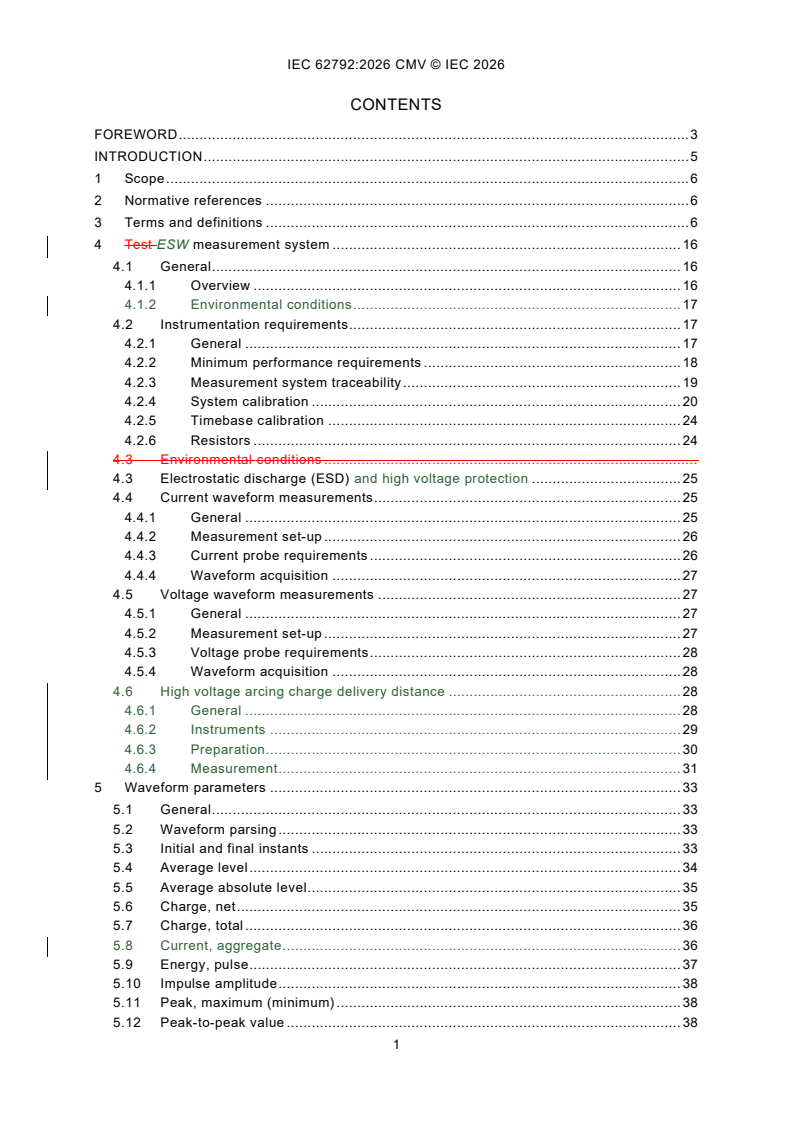
CONTENTS
FOREWORD . 3
INTRODUCTION . 5
1 Scope . 6
2 Normative references . 6
3 Terms and definitions . 6
4 ESW measurement system . 15
4.1 General . 15
4.1.1 Overview . 15
4.1.2 Environmental conditions . 16
4.2 Instrumentation requirements . 16
4.2.1 General . 16
4.2.2 Minimum performance requirements . 17
4.2.3 Measurement system traceability . 18
4.2.4 System calibration . 19
4.2.5 Timebase calibration . 22
4.2.6 Resistors . 22
4.3 Electrostatic discharge (ESD) and high voltage protection . 22
4.4 Current waveform measurements . 23
4.4.1 General . 23
4.4.2 Measurement set-up . 23
4.4.3 Current probe requirements . 24
4.4.4 Waveform acquisition . 24
4.5 Voltage waveform measurements . 25
4.5.1 General . 25
4.5.2 Measurement set-up . 25
4.5.3 Voltage probe requirements . 25
4.5.4 Waveform acquisition . 26
4.6 High voltage arcing charge delivery distance . 26
4.6.1 General . 26
4.6.2 Instruments . 26
4.6.3 Preparation . 28
4.6.4 Measurement . 28
5 Waveform parameters . 30
5.1 General . 30
5.2 Waveform parsing . 31
5.3 Initial and final instants . 31
5.4 Average level . 32
5.5 Average absolute level . 32
5.6 Charge, net . 32
5.7 Charge, total . 33
5.8 Current, aggregate . 33
5.9 Energy, pulse . 33
5.10 Impulse amplitude . 34
5.11 Peak, maximum (minimum) . 35
5.12 Peak-to-peak value . 35
5.13 Pulse duration . 35
5.14 Pulse rate . 35
5.15 Pulse separation . 35
5.16 Offset . 36
5.17 Transition duration . 36
5.18 Transition settling duration . 36
5.19 Transition settling error . 36
5.20 Waveform period. 36
Annex A (informative) Impedance matching network . 37
Bibliography . 41
Figure 1 –Long-range wired ESW showing components . 7
Figure 2 – Diagram of the ESW measurement system with voltage and current probes
in place . 15
Figure 3 –Set up for calibrating the vertical channel of the ESW measurement system . 20
Figure 4 –Set up for calibration of the magnitude frequency response of the ESW
measurement system . 21
Figure 5 – Set up for calibration of impulse response or step response of ESW
measurement system . 22
Figure 6 – Instrument arrangement for arcing charge-delivery-distance test method,
shown with jumpers (represented by double dashed lines) placed to measure arcing
distance for the top air gap . 26
Figure 7 – Diagram of air-gap test fixture . 27
Figure 8 – Air-gap test fixture set to measure arcing distance for both ESW darts . 28
Figure 9 – Typical arc . 29
Figure 10 – Example arc waveforms for two arcing distances, 5 mm and 20 mm . 30
Figure A.1 – Impedance matching network (IMN) . 37
Figure A.2 – Input impedance . 38
Table 1 –Waveform recorder minimum performance specifications . 17
Table 2 – Initial instants and final instants for the waveform sub-epochs . 31
Table A.1 – Resistance values . 40
INTERNATIONAL ELECTROTECHNICAL COMMISSION
____________
Measurement method for the output of electroshock weapons
FOREWORD
1) The International Electrotechnical Commission (IEC) is a worldwide organization for standardization comprising
all national electrotechnical committees (IEC National Committees). The object of IEC is to promote international
co-operation on all questions concerning standardization in the electrical and electronic fields. To this end and
in addition to other activities, IEC publishes International Standards, Technical Specifications, Technical Reports,
Publicly Available Specifications (PAS) and Guides (hereafter referred to as “IEC Publication(s)”). Their
preparation is entrusted to technical committees; any IEC National Committee interested in the subject dealt with
may participate in this preparatory work. International, governmental and non-governmental organizations liaising
with the IEC also participate in this preparation. IEC collaborates closely with the International Organization for
Standardization (ISO) in accordance with conditions determined by agreement between the two organizations.
2) The formal decisions or agreements of IEC on technical matters express, as nearly as possible, an international
consensus of opinion on the relevant subjects since each technical committee has representation from all
interested IEC National Committees.
3) IEC Publications have the form of recommendations for international use and are accepted by IEC National
Committees in that sense. While all reasonable efforts are made to ensure that the technical content of IEC
Publications is accurate, IEC cannot be held responsible for the way in which they are used or for any
misinterpretation by any end user.
4) In order to promote international uniformity, IEC National Committees undertake to apply IEC Publications
transparently to the maximum extent possible in their national and regional publications. Any divergence between
any IEC Publication and the corresponding national or regional publication shall be clearly indicated in the latter.
5) IEC itself does not provide any attestation of conformity. Independent certification bodies provide conformity
assessment services and, in some areas, access to IEC marks of conformity. IEC is not responsible for any
services carried out by independent certification bodies.
6) All users should ensure that they have the latest edition of this publication.
7) No liability shall attach to IEC or its directors, employees, servants or agents including individual experts and
members of its technical committees and IEC National Committees for any personal injury, property damage or
other damage of any nature whatsoever, whether direct or indirect, or for costs (including legal fees) and
expenses arising out of the publication, use of, or reliance upon, this IEC Publication or any other IEC
Publications.
8) Attention is drawn to the Normative references cited in this publication. Use of the referenced publications is
indispensable for the correct application of this publication.
9) IEC draws attention to the possibility that the implementation of this document may involve the use of (a)
patent(s). IEC takes no position concerning the evidence, validity or applicability of any claimed patent rights in
respect thereof. As of the date of publication of this document, IEC had not received notice of (a) patent(s), which
may be required to implement this document. However, implementers are cautioned that this may not represent
the latest information, which may be obtained from the patent database available at https://patents.iec.ch. IEC
shall not be held responsible for identifying any or all such patent rights.
IEC 62792 has been prepared by IEC technical committee 85: Measuring equipment for
electrical and electromagnetic quantities. It is an International Standard.
This second edition cancels and replaces the first edition published in 2015. This edition
constitutes a technical revision.
This edition includes the following significant technical changes with respect to the previous
edition:
a) addition of a new clause describing a method for measuring the high voltage arcing charge
delivery distance; and
b) an annex describing an impedance matching network that is necessary to calibrate the
measurement system.
The text of this International Standard is based on the following documents:
Draft Report on voting
85/988/FDIS 85/995/RVD
Full information on the voting for its approval can be found in the report on voting indicated in
the above table.
The language used for the development of this International Standard is English.
This document was drafted in accordance with ISO/IEC Directives, Part 2, and developed in
accordance with ISO/IEC Directives, Part 1 and ISO/IEC Directives, IEC Supplement, available
at www.iec.ch/members_experts/refdocs. The main document types developed by IEC are
described in greater detail at www.iec.ch/publications.
Words in italics in the text are defined in Clause 3.
The committee has decided that the contents of this document will remain unchanged until the
stability date indicated on the IEC website under webstore.iec.ch in the data related to the
specific document. At this date, the document will be
– reconfirmed,
– withdrawn, or
– revised.
INTRODUCTION
Manufacturers, medical researchers, policy makers, users, and other interested parties involved
with different aspects of electroshock weapons (ESWs) use a variety of different measurement
methods, different terminologies, and different parameters to measure and describe the
performance of an ESW. These differences generate confusion and misunderstanding within
this stakeholder community, and this impacts the ability to perform accurate, reliable, and
reproducible measurement comparisons. By developing a generally-accepted terminology, set
of performance parameters, and test methods, this document will facilitate accurate and precise
communication for the parameters that describe the electrical outputs, current and high voltage,
of ESWs. This improved communication will aid this stakeholder community in collectively
developing uniform methods for describing the ESW output and its effect on human physiology
consistently and accurately, thereby enabling the development of safe use performance
standards or regulations by the appropriate standardization body.
1 Scope
This document specifies a method for measuring the electrical outputs, current and high voltage,
from electroshock weapons (ESWs) that deliver an electrical stimulus to humans. This
document is applicable to any and all ESWs. This document describes ESW measurement
systems to help guide the user of this document in developing their own ESW measurement
system. It includes methods for measuring or computing a variety of parameters that can be
used to characterize the electrical output of the ESW. The user of this document will select
those parameters that are appropriate for their applications and stakeholders.
2 Normative references
The following documents are referred to in the text in such a way that some or all of their content
constitutes requirements of this document. For dated references, only the edition cited applies.
For undated references, the latest edition of the referenced document (including any
amendments) applies.
IEC 60469:2013, Transitions, pulses and related waveforms - Terms, definitions and algorithms
ISO/IEC 17025, General requirements for the competence of testing and calibration laboratories
BIPM, The International System of Units (SI), 9th Edition, 2019
3 Terms and definitions
For the purposes of this document, the following terms and definitions apply.
ISO and IEC maintain terminology databases for use in standardization at the following
addresses:
– IEC Electropedia: available at https://www.electropedia.org/
– ISO Online browsing platform: available at https://www.iso.org/obp
NOTE The parameters included here and suggested for use in describing the performance of an ESW are those
typically used to describe the waveforms of pulse-like signals that are produced by pulse generators, such as an
ESW, and the step-response or impulse-response of waveform recorders that are used to measure these pulse-like
signals.
3.1
aggregate current
flow of charge per second delivered by the ESW pulse train
3.2
impulse amplitude
difference between the specified level corresponding to the maximum peak (minimum peak) of
the positive (negative) impulse-like waveform and the level of the state preceding the first
transition of that impulse-like waveform
[SOURCE: IEC 60469:2013, 3.2.3.1]
3.3
correction
operation combining the results of the conversion operation with the transfer function
information to yield a waveform that is a more accurate representation of the signal
Note 1 to entry: Correction may be affected by a manual process by an operator, a computational process, or a
compensating device or apparatus. Correction shall be performed to an accuracy that is consistent with the overall
accuracy desired in the waveform measurement process.
[SOURCE: IEC 60469:2013, 3.2.4, modified – Note 2 to entry has been deleted.]
3.4
electroshock weapon
ESW
weapon that generates a high-voltage transient electrical signal that is transmitted to a person
Note 1 to entry: The ESW comprises, at a minimum, a signal generator located in the body of the ESW and a pair
of electrical contacts to make electrical connection between the generator and a person.
3.4.1
long-range wired ESW
ESW that uses propelled, tethered, skin-penetrating or adhering (for example, to clothing)
barbed darts as the electrical contacts
Note 1 to entry: See Figure 1.
Note 2 to entry: Adhering darts attach sufficiently close to the surface of the person to complete a circuit capable
of delivering an electrical charge to that person. These barbed darts are tethered to the ESW cartridge that is
mechanically attached to the body of the ESW and travel away from the cartridge when deployed. The ESW cartridge
is often used to convert a contact ESW to a long-range wired ESW.
Figure 1 –Long-range wired ESW showing components
3.4.2
contact ESW
ESW that uses fixed metal electrodes located on the body or cartridge of the ESW as the
electrical contacts
3.4.3
ESW cartridge
component of the long-range wired ESW that contains the tethered skin-penetrating or adhering
barbed darts (ESW darts) and mechanically attaches and electrically connects to the body of
the ESW to complete the circuit and facilitate the delivery of electrical charge
Note 1 to entry: The ESW cartridge is often used to convert a contact ESW to a long-range wired ESW.
3.4.4
ESW dart
probe
component of the long-range wired ESW that is connected to the ESW tether and makes
electrical contact to the target by penetrating the skin of the target or adhering to the clothing
of the target
3.4.5
ESW tether
conductive wire providing electrical contact between the ESW dart and the ESW cartridge of
the long-range wired ESW as the ESW dart travels from the ESW to the target
3.5
high voltage
voltage having a value above a conventionally adopted limit
Note 1 to entry: For ESW, this conventionally adopted limit is specified by the user of this document.
[SOURCE: IEC 60050-151:2001,151-15-05, modified – Note 1 to entry has been been adapted
for ESW.]
3.6
impulse response
time response of a linear time-invariant system to an impulse excitation
3.7
instant
particular time value within a waveform epoch that, unless otherwise specified, is referenced to
the initial instant of that waveform epoch
[SOURCE: IEC 60469:2013, 3.2.13]
3.7.1
final instant
last sample instant in the waveform
[SOURCE: IEC 60469:2013, 3.2.13.1]
3.7.2
initial instant
first sample instant in the waveform
[SOURCE: IEC 60469:2013, 3.2.13.3]
3.8
interval
set of all values of time between a first instant and a second instant, where the second instant
is later in time than the first
Note 1 to entry: These first and second instants are called the endpoints of the interval. The endpoints, unless
otherwise specified, are assumed to be part of the interval.
[SOURCE: IEC 60469:2013, 3.2.15]
3.9
level
constant value having the same units as y
Note 1 to entry: y is the signal.
[SOURCE: IEC 60469:2013, 3.2.17, modified – the Note 1 to entry has been added.]
3.9.1
average level
pertaining to the value of the mean of the waveform level
If the waveform takes on n discrete values, y all equally spaced in time, the average level is,
j,
n
yy=
∑ (1)
j
n
j=1
[SOURCE: IEC 60469:2013, 3.2.17.1, modified – The formula for the average level of a
continuous function of time has been deleted and the notes have been deleted.]
3.9.2
average absolute level
pertaining to the mean value of the absolute waveform value
If the waveform takes on n discrete values, y , all equally spaced in time, the average absolute
j
level is,
n
1
yy=
(2)
∑ j
n
j=1
[SOURCE: IEC 60469:2013, 3.2.17.2, modified – The formula for the average level of a
continuous function of time has been deleted and Note 1 to entry has been deleted.]
3.10
measurand
quantity intended to be measured
[SOURCE: ISO/IEC Guide 99:2007, 2.3, modified – The notes have been deleted.]
3.11
measured quantity value
measured value of a quantity
measured value
quantity value representing a measurement result
[SOURCE: ISO/IEC Guide 99:2007, 2.10, modified – The notes have been deleted.]
3.12
measurement trueness
trueness of measurement
trueness
closeness of agreement between the average of an infinite number of replicate measured
quantity values and a reference quantity value
[SOURCE: ISO/IEC Guide 99:2007, 2.14, modified – The notes have been deleted.]
3.13
measurement uncertainty
uncertainty of measurement
uncertainty
non-negative parameter characterizing the dispersion of the quantity values being attributed to
a measurand, based on the information used
[SOURCE: ISO/IEC Guide 99:2007, 2.26, modified – The notes have been deleted.]
3.14
metrological traceability
property of a measurement result whereby the result can be related to a reference through a
documented unbroken chain of calibrations, each contributing to the measurement uncertainty
[SOURCE: ISO/IEC Guide 99:2007, 2.41, modified – The notes have been deleted.]
3.15
offset
algebraic difference between two specified levels
Note 1 to entry: Unless otherwise specified, the two levels are state 1 and the base state.
[SOURCE: IEC 60469:2013, 3.2.18, modified – Figure references have been deleted.]
3.16
parameter
any value (number multiplied by a unit of measure) that can be calculated from a waveform
[SOURCE: IEC 60469:2013, 3.2.20]
3.17
maximum peak
pertaining to the greatest value of the waveform
[SOURCE: IEC 60469:2013, 3.2.21]
3.18
minimum peak
pertaining to the least value of the waveform
[SOURCE: IEC 60469:2013, 3.2.22]
3.19
peak-to-peak
pertaining to the value of the difference between the extrema of the specified waveform
[SOURCE: IEC 60469:2013, 3.2.23]
3.20
pulse duration
difference between the first and second transition occurrence instants
[SOURCE: IEC 60469:2013, 3.2.27, modified – Note 1 to entry and figure references have been
deleted.]
3.21
pulse rate
number of pulses per second within an ESW output pulse train
3.22
pulse separation
duration between the 50 % reference level instant, unless otherwise specified, of the second
transition of one pulse in a pulse train and that of the first transition of the immediately following
pulse in the same pulse train
[SOURCE: IEC 60469:2013, 3.2.28]
3.23
pulse train
repetitive sequence of pulse waveforms
Note 1 to entry: Unless otherwise specified, all the pulse waveforms in the sequence are assumed to be identical.
[SOURCE: IEC 60469:2013, 3.2.29, modified – The second part of the definition has been put
into a note and the figure has been deleted.]
3.24
reconstruction
waveform deconvolution
process of removing the effect of the measurement instrument on the acquired waveform
Note 1 to entry: This process mathematically removes the estimated impulse response of the measurement
instrument from the acquired waveform.
3.25
reference measurement procedure
measurement procedure accepted as providing measurement results fit for their intended use
in assessing measurement trueness of measured quantity values obtained from other
measurement procedures for quantities of the same kind, in calibration, or in characterizing
reference materials
[SOURCE: ISO/IEC Guide 99:2007, 2.7]
3.26
reference measurement system
reference system
ESW measurement system that is used to support a reference measurement procedure
3.27
sample
element of a sampled waveform
3.28
signal
physical phenomenon, one or more of whose characteristics may vary to represent information
Note 1 to entry: This phenomenon is a function of time.
[SOURCE: IEC 60050-701:1988, 701-01-02, modified – The note has been replaced.]
3.29
state
particular level or, when applicable, a particular level and upper and lower limits (the upper and
lower state boundaries) that are referenced to or associated with that level
Note 1 to entry: Unless otherwise specified, multiple states are ordered from the most negative level to the most
positive level, and the state levels are not allowed to overlap. The most negative state is called state 1. The most
positive state is called state n. The states are denoted by s , s , …, s ; the state levels are denoted by level(s ),
1 2 n 1
level(s ), …, level(s ); the upper state boundaries are denoted by upper(s ), upper(s ), …, upper(s ); and the lower
2 n 1 2 n
state boundaries are denoted by lower(s ), lower(s ), …, lower(s ).
1 2 n
Note 2 to entry: States, levels, and state boundaries are defined to accommodate pulse metrology and digital
applications. In pulse metrology, the levels of a waveform are measured and states (with or without associated state
boundaries) are then associated with those levels. In digital applications, states are defined (with state boundaries)
and the waveform values are determined to either lie within a state or not.
[SOURCE: IEC 60469:2013, 3.2.40]
3.29.1
base state
state of a waveform that, unless otherwise specified, possesses a level closest to zero
[SOURCE: IEC 60469:2013, 3.2.40.1, modified – figures references have been deleted.]
3.29.2
state boundaries
upper and lower limits of the states of a waveform
Note 1 to entry: All values of a waveform that are within the boundaries of a given state are said to be in that state.
The state boundaries are defined by the user.
[SOURCE: IEC 60469:2013, 3.2.41]
3.29.3
state occurrence
contiguous region of a waveform that is bounded by the upper and lower state boundaries of a
state, and whose duration equals or exceeds the specified minimum duration for state
attainment
Note 1 to entry: The state occurrence consists of the entire portion of the waveform that remains within the
boundaries of that state.
Note 2 to entry: State occurrences are numbered as ordered pairs (s,n), where s refers to the ith state, and n is
i
the ordered numbering of the occurrence of that particular state within the waveform epoch. In a given waveform
epoch, when the waveform first enters a state s , that state occurrence is (s , 1). If and when the waveform exits
1 1
that state, that state occurrence is over. If and when the waveform next enters and remains in state s , that state
, 2); and so on.
occurrence would be labeled (s
[SOURCE: IEC 60469:2013, 3.2.42, modified – The note to entry has been replaced.]
3.30
timebase
component of a measurement instrument that provides the unique instant for each sample in a
sampled waveform
Note 1 to entry: The timebase provides a vector of sampling instants where each instant corresponds to a unique
sample in the waveform.
Note 2 to entry: Often the interval between sample instants is not uniform and exhibits both systematic and random
errors.
3.31
transient
any contiguous region of a waveform that begins at one state, leaves and subsequently returns
to that state, and contains no state occurrences
[SOURCE: IEC 60469:2013, 3.2.46]
3.32
transition
contiguous region of a waveform that connects, either directly or via intervening transients, two
state occurrences that are consecutive in time but are occurrences of different states
[SOURCE: IEC 60469:2013, 3.2.47]
3.33
transition duration
difference between the two reference level instants of the same transition
Note 1 to entry: Unless otherwise specified, these two reference levels are the 10 % and 90 % reference levels.
[SOURCE: IEC 60469:2013, 3.2.48, modified – Note 2 to entry has been deleted and figures
references have been deleted.]
3.34
transition settling error
maximum error between the waveform value and a specified reference level within a user-
specified interval relative to the 50 % reference level instant
[SOURCE: IEC 60469:2013, 3.2.50, modified – the words "of the waveform epoch. The interval
starts at a use-specified instant" have been deleted.]
3.35
waveform
representation of a signal (for example, a graph, plot, oscilloscope presentation, discrete time
series, equations, or table of values)
Note 1 to entry: Note that the term waveform refers to a measured or otherwise-defined estimate of the physical
phenomenon or signal.
[SOURCE: IEC 60469:2013, 3.2.54, modified – The figures references have been deleted.]
3.35.1
impulse-like waveform
waveform that, when convolved with an ideal step, yields a step-like waveform
[SOURCE: IEC 60469:2013, 3.2.54.2, modified – The figure reference has been deleted.]
3.35.2
sampled waveform representation
waveform that is a series of sampled numerical values taken sequentially or nonsequentially as
a function of time
[SOURCE: IEC 60469:2013, 3.2.61.2, modified – The Note to entry has been deleted.]
3.35.3
acquired waveform
sampled waveform that is the output of a measurement system before any corrections or
reconstructions are applied
3.35.4
corrected waveform
sampled waveform that is the result of applying corrections to the acquired waveform
3.35.5
reconstructed waveform
sampled waveform that is the result of applying waveform reconstruction methods to the
corrected waveform
3.36
waveform epoch
interval to which consideration of a waveform is restricted for a particular calculation, procedure,
or discussion. Except when otherwise specified, the waveform epoch is assumed to be the span
over which the waveform is measured or defined
[SOURCE: IEC 60469:2013, 3.2.57, modified – The figures references have been deleted.]
3.37
waveform period
minimum duration after which a periodic waveform repeats
Note 1 to entry: The period of a repetitive two-state waveform is the duration between specified reference level
instants for the same transition, either the negative-going transition or the positive-going transition, of two
consecutive pulses in a pulse train. The period is equal to the sum of the pulse separation and the pulse duration.
[SOURCE: IEC 60469:2013, 3.2.60]
3.38
waveform measurement process
realization of a method of waveform measurement in terms of specific devices, apparatus,
instruments, auxiliary equipment, conditions, operators, and observers
Note 1 to entry: In this process, a value (a number multiplied by a unit) of measurement is assigned to the elements
of the waveform.
[SOURCE: IEC 60469:2013, 3.2.59]
3.39
waveform recorder
instrument or device for acquiring and subsequently storing a sequence of data corresponding
to the signal being measured
4 ESW measurement system
4.1 General
4.1.1 Overview
Z is the load impedance of the ESW.
L
Figure 2 – Diagram of the ESW measurement system with voltage and current probes in
place
There are many commercially-available models of ESWs and each can generate a unique
output pulse. These outputs can have a burst of pulses with a continuous duration exceeding
10 s, and thus require the waveform recorders to be capable of acquiring long waveform epochs.
The analog bandwidth and sampling rate of the ESW measurement system should be sufficient
to accurately (within ±10 % of the manufacturer-supplied value of the specified parameter)
capture the high-frequency content of the pulse output. A typical ESW measurement system
comprises a waveform recorder, a high-voltage resistor (indicated by Z ), a voltage probe or a
L
current probe, or both, as shown in Figure 2.
Without a priori knowledge regarding the effect of this low-frequency and high-frequency signal
content on the ability of ESW to perform its function, waveforms of the ESW pulses should be
captured in such a way as to simultaneously preserve the fidelity of the low-frequency and high-
frequency content of the pulse. The waveform measurement processes and corresponding
instrumentation described in this document support the acquisition of these high-fidelity
waveforms. These waveforms can be subsequently analyzed to extract the desired waveform
parameters (Clause 5). Figure 2 provides a depiction of a generalized ESW measurement
system that can be used to measure the output of an ESW. Details of the ESW measurement
system are given in 4.4 and 4.5.
The user of this document shall determine the waveform parameters that are appropriate for
their purposes.
The waveform recorder measures voltage values present at its input port and converts those
values to integer representations via analog-to-digital converters. These integer values can be
subsequently restored to the voltage input values that they represent by multiplying the stored
integer values by an appropriate conversion factor. All transducers, such as pressure sensors,
thermocouples, electric current sensors, optical power meters, are designed to provide a
voltage input into an analog or digital indicating device, a waveform recorder, or any other
device/instrument that is used to present the measurement of the physical phenomenon to a
human operator or analysis instrumentation.
The battery shall have sufficient charge for the ESW to operate in accordance with manufacturer
specifications. If the ESW is removed from the field for post-discharge testing or performance
verification, the ESW shall be tested as received without changing the battery unless otherwise
indicated by the user of the document.
4.1.2 Environmental conditions
The temperature during the time of the measurement shall be 21 °C ± 2 °C for the reference
EWS measurement system, 21 °C ± 4 °C for the secondary ESW measurement system, and
user defined for the tertiary ESW measurement system. The relative humidity shall be
40 % ± 10 % for the reference measurement system, 40 % ± 20 % for the secondary ESW
measurement system, and user defined for the tertiary ESW measurement system.
Temperature and relative humidity shall be recorded at least once immediately prior to the start
of the ESW waveform measurement processes and at least once immediately following its
completion. The laboratory environment shall remain within the valid humidity and temperature
ranges for the measurement equipment.
4.2 Instrumentation requirements
4.2.1 General
The instrumentation requirements described in 4.2 are those intended for laboratory
measurement conditions and not for emulating the effect of varying external conditions. Such
requirements would be the subject of a performance requirement or standard for the ESW.
4.2.2 Minimum performance requirements
The minimum performance specifications for the instrumentation required to acquire ESW
waveforms are listed in Table 1. The performance characteristics of three different ESW
measurement systems are recommended. The tertiary system is envisioned for point-of-use,
for example, at a law enforcement agency before issue of an ESW or by an ESW user in the
field. The tertiary system can be very simple and only provide a go/no-go indication. The
secondary system is envisioned for use by manufacturers, testing laboratories, medical
practitioners conducting research on ESW effects, etc. This system, because it will be the basis
for most ESW understanding, monitoring, and improvements, should be able to acquire a
waveform of the ESW output pursuant to the requirements of Table 1. If the secondary system
performance is not sufficient, then methods such as waveform reconstruction and corrections
can be applied to improve the fidelity of the waveform. These operations will introduce additional
measurement uncertainty into any parameters extracted from the waveforms. It is the decision
of the user of this document as to what is an acceptable limit of measurement uncertainty and
should design their ESW measurement system accordingly. Lastly, the reference system is
expected to provide a means of measurement traceability to a national metrology institute or
other qualified metrology laboratory. The performance characteristics of the reference
measurement system should be sufficiently better than that of a secondary ESW measurement
system to minimize instrumental uncertainty in the traceability path. The reference
measurement system can be used to establish artifact standards for measurement traceability.
For the waveform recorder, three sets of performance specifications are provided. The
waveform recorder shall be capable of simultaneously demonstrating all the minimum
performance specifications listed in Table 1. One set reflects the minimum requirements for a
reference measurement system, another for a secondary system that shall be traceable to the
reference system, and a third that shall be traceable to a secondary or reference system. It is
the responsibility of the user of the secondary or tertiary system to demonstrate metrological
traceability to the reference system.
Table 1 –Waveform recorder minimum performance specifications
Reference Secondary ESW Tertiary ESW
Parameter
measurement measurement measurement
b
system system
system
a
≥ 50
User defined
Analog bandwidth (MHz) ≥ 500
8 a
9 ≥ 2 × 10 User defined
Sampling rate (samples/s)
≥ 1 × 10
a
≥ 2
User defined
Epoch, min (s) ≥ 10
≥ 30 ≥ 30
Signal-to-noise ratio (SNR) (dB) ≥ 40
TM
[IEEE Std. 1057-2017 , 8.3]
≥ 30 ≥ 30
Signal-to-noise-and-distortion ratio (SINAD) (dB) ≥ 40
TM
[IEEE Std. 1057-2017 , 8.2]
≥ 40 ≥ 40
Spurious-free dynamic range (SFDR) (dB) ≥ 50
TM
[IEEE Std. 1057-2017 , 8.8]
≥ 6 ≥ 6
Effective number of bits (ENOB) (bits) ≥ 7
TM
[IEEE Std. 1057-2017 , 8.5]
Z ± 0,05 Z Z ± 0,05 Z
Input impedance: matched to probe impedance, Z ± probe probe probe probe
probe
given by Z
0,02 Z
probe
probe
≥ 10 Z ≥ 10 Z
Input impedance: not matched to Z ≥ 10 Z probe probe
probe probe
a
The tertiary system allows the user of the standard to define performance specifications for certain parameters,
where these user-defined specifications are based on the user's documented interpretation and knowledge of
the operation of ESW and expected response to exposure to ESW output. The user of the tertiary ESW
measurement system shall demonstrate metrological traceability to a secondary ESW measurement system or
a reference measurement system.
b
The parameter values listed above are the default values for the ESW measurement system unless otherwise
specified by the manufacturer of the ESW.
IE
...
IEC 62792 ®
Edition 2.0 2026-04
INTERNATIONAL
STANDARD
COMMENTED VERSION
Measurement method for the output of electroshock weapons
ICS 17.220.20; 95.020 ISBN 978-2-8327-1210-8
All rights reserved. Unless otherwise specified, no part of this publication may be reproduced or utilized in any form or
by any means, electronic or mechanical, including photocopying and microfilm, without permission in writing from either
IEC or IEC's member National Committee in the country of the requester. If you have any questions about IEC copyright
or have an enquiry about obtaining additional rights to this publication, please contact the address below or your local
IEC member National Committee for further information.
IEC Secretariat Tel.: +41 22 919 02 11
3, rue de Varembé info@iec.ch
CH-1211 Geneva 20 www.iec.ch
Switzerland
About the IEC
The International Electrotechnical Commission (IEC) is the leading global organization that prepares and publishes
International Standards for all electrical, electronic and related technologies.
About IEC publications
The technical content of IEC publications is kept under constant review by the IEC. Please make sure that you have the
latest edition, a corrigendum or an amendment might have been published.
IEC publications search - IEC Products & Services Portal - products.iec.ch
webstore.iec.ch/advsearchform Discover our powerful search engine and read freely all the
The advanced search enables to find IEC publications by a publications previews, graphical symbols and the glossary.
variety of criteria (reference number, text, technical With a subscription you will always have access to up to date
committee, …). It also gives information on projects, content tailored to your needs.
replaced and withdrawn publications.
Electropedia - www.electropedia.org
The world's leading online dictionary on electrotechnology,
IEC Just Published - webstore.iec.ch/justpublished
Stay up to date on all new IEC publications. Just Published containing more than 22 500 terminological entries in English
details all new publications released. Available online and and French, with equivalent terms in 25 additional languages.
once a month by email. Also known as the International Electrotechnical Vocabulary
(IEV) online.
IEC Customer Service Centre - webstore.iec.ch/csc
If you wish to give us your feedback on this publication or
need further assistance, please contact the Customer
Service Centre: sales@iec.ch.
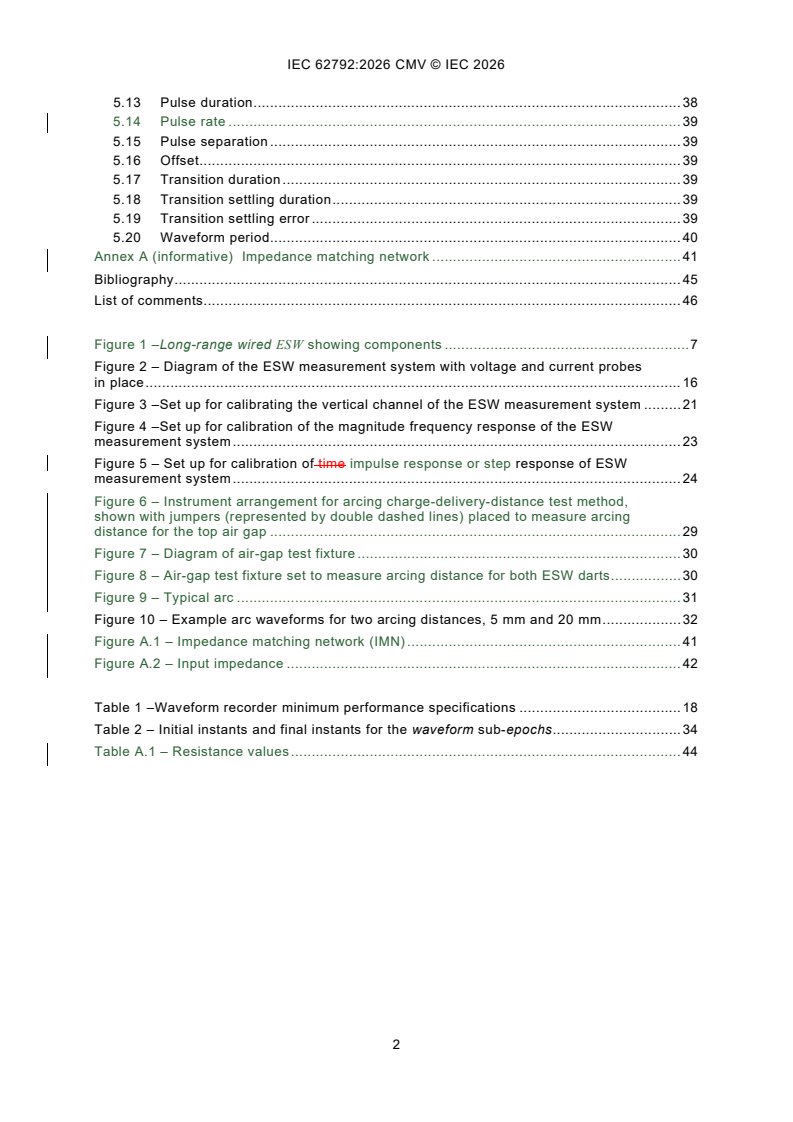
CONTENTS
FOREWORD . 3
INTRODUCTION . 5
1 Scope . 6
2 Normative references . 6
3 Terms and definitions . 6
4 Test ESW measurement system . 16
4.1 General . 16
4.1.1 Overview . 16
4.1.2 Environmental conditions . 17
4.2 Instrumentation requirements . 17
4.2.1 General . 17
4.2.2 Minimum performance requirements . 18
4.2.3 Measurement system traceability . 19
4.2.4 System calibration . 20
4.2.5 Timebase calibration . 24
4.2.6 Resistors . 24
4.3 Environmental conditions .
4.3 Electrostatic discharge (ESD) and high voltage protection . 25
4.4 Current waveform measurements . 25
4.4.1 General . 25
4.4.2 Measurement set-up . 26
4.4.3 Current probe requirements . 26
4.4.4 Waveform acquisition . 27
4.5 Voltage waveform measurements . 27
4.5.1 General . 27
4.5.2 Measurement set-up . 27
4.5.3 Voltage probe requirements . 28
4.5.4 Waveform acquisition . 28
4.6 High voltage arcing charge delivery distance . 28
4.6.1 General . 28
4.6.2 Instruments . 29
4.6.3 Preparation . 30
4.6.4 Measurement . 31
5 Waveform parameters . 33
5.1 General . 33
5.2 Waveform parsing . 33
5.3 Initial and final instants . 33
5.4 Average level . 34
5.5 Average absolute level . 35
5.6 Charge, net . 35
5.7 Charge, total . 36
5.8 Current, aggregate . 36
5.9 Energy, pulse . 37
5.10 Impulse amplitude . 38
5.11 Peak, maximum (minimum) . 38
5.12 Peak-to-peak value . 38
5.13 Pulse duration . 38
5.14 Pulse rate . 39
5.15 Pulse separation . 39
5.16 Offset . 39
5.17 Transition duration . 39
5.18 Transition settling duration . 39
5.19 Transition settling error . 39
5.20 Waveform period. 40
Annex A (informative) Impedance matching network . 41
Bibliography . 45
List of comments. 46
Figure 1 –Long-range wired ESW showing components . 7
Figure 2 – Diagram of the ESW measurement system with voltage and current probes
in place . 16
Figure 3 –Set up for calibrating the vertical channel of the ESW measurement system . 21
Figure 4 –Set up for calibration of the magnitude frequency response of the ESW
measurement system . 23
Figure 5 – Set up for calibration of time impulse response or step response of ESW
measurement system . 24
Figure 6 – Instrument arrangement for arcing charge-delivery-distance test method,
shown with jumpers (represented by double dashed lines) placed to measure arcing
distance for the top air gap . 29
Figure 7 – Diagram of air-gap test fixture . 30
Figure 8 – Air-gap test fixture set to measure arcing distance for both ESW darts . 30
Figure 9 – Typical arc . 31
Figure 10 – Example arc waveforms for two arcing distances, 5 mm and 20 mm . 32
Figure A.1 – Impedance matching network (IMN) . 41
Figure A.2 – Input impedance . 42
Table 1 –Waveform recorder minimum performance specifications . 18
Table 2 – Initial instants and final instants for the waveform sub-epochs . 34
Table A.1 – Resistance values . 44
INTERNATIONAL ELECTROTECHNICAL COMMISSION
____________
Measurement method for the output of electroshock weapons
FOREWORD
1) The International Electrotechnical Commission (IEC) is a worldwide organization for standardization comprising
all national electrotechnical committees (IEC National Committees). The object of IEC is to promote international
co-operation on all questions concerning standardization in the electrical and electronic fields. To this end and
in addition to other activities, IEC publishes International Standards, Technical Specifications, Technical Reports,
Publicly Available Specifications (PAS) and Guides (hereafter referred to as “IEC Publication(s)”). Their
preparation is entrusted to technical committees; any IEC National Committee interested in the subject dealt with
may participate in this preparatory work. International, governmental and non-governmental organizations liaising
with the IEC also participate in this preparation. IEC collaborates closely with the International Organization for
Standardization (ISO) in accordance with conditions determined by agreement between the two organizations.
2) The formal decisions or agreements of IEC on technical matters express, as nearly as possible, an international
consensus of opinion on the relevant subjects since each technical committee has representation from all
interested IEC National Committees.
3) IEC Publications have the form of recommendations for international use and are accepted by IEC National
Committees in that sense. While all reasonable efforts are made to ensure that the technical content of IEC
Publications is accurate, IEC cannot be held responsible for the way in which they are used or for any
misinterpretation by any end user.
4) In order to promote international uniformity, IEC National Committees undertake to apply IEC Publications
transparently to the maximum extent possible in their national and regional publications. Any divergence between
any IEC Publication and the corresponding national or regional publication shall be clearly indicated in the latter.
5) IEC itself does not provide any attestation of conformity. Independent certification bodies provide conformity
assessment services and, in some areas, access to IEC marks of conformity. IEC is not responsible for any
services carried out by independent certification bodies.
6) All users should ensure that they have the latest edition of this publication.
7) No liability shall attach to IEC or its directors, employees, servants or agents including individual experts and
members of its technical committees and IEC National Committees for any personal injury, property damage or
other damage of any nature whatsoever, whether direct or indirect, or for costs (including legal fees) and
expenses arising out of the publication, use of, or reliance upon, this IEC Publication or any other IEC
Publications.
8) Attention is drawn to the Normative references cited in this publication. Use of the referenced publications is
indispensable for the correct application of this publication.
9) IEC draws attention to the possibility that the implementation of this document may involve the use of (a)
patent(s). IEC takes no position concerning the evidence, validity or applicability of any claimed patent rights in
respect thereof. As of the date of publication of this document, IEC had not received notice of (a) patent(s), which
may be required to implement this document. However, implementers are cautioned that this may not represent
the latest information, which may be obtained from the patent database available at https://patents.iec.ch. IEC
shall not be held responsible for identifying any or all such patent rights.
This commented version (CMV) of the official standard IEC 62792:2026 edition 2.0 allows the
user to identify the changes made to the previous IEC 62792:2015 edition 1.0. Furthermore,
comments from IEC TC 85 experts are provided to explain the reasons of the most relevant
changes, or to clarify any part of the content.
A vertical bar appears in the margin wherever a change has been made. Additions are in green
text, deletions are in strikethrough red text. Experts' comments are identified by a blue-
background number. Mouse over a number to display a pop-up note with the comment.
This publication contains the CMV and the official standard. The full list of comments is available
at the end of the CMV.
IEC 62792 has been prepared by IEC technical committee 85: Measuring equipment for
electrical and electromagnetic quantities. It is an International Standard.
This second edition cancels and replaces the first edition published in 2015. This edition
constitutes a technical revision.
This edition includes the following significant technical changes with respect to the previous
edition:
a) addition of a new clause describing a method for measuring the high voltage arcing charge
delivery distance; and
b) an annex describing an impedance matching network that is necessary to calibrate the
measurement system.
The text of this International Standard is based on the following documents:
Draft Report on voting
85/988/FDIS 85/995/RVD
Full information on the voting for its approval can be found in the report on voting indicated in
the above table.
The language used for the development of this International Standard is English.
This document was drafted in accordance with ISO/IEC Directives, Part 2, and developed in
accordance with ISO/IEC Directives, Part 1 and ISO/IEC Directives, IEC Supplement, available
at www.iec.ch/members_experts/refdocs. The main document types developed by IEC are
described in greater detail at www.iec.ch/publications.
Words in italics in the text are defined in Clause 3.
The committee has decided that the contents of this document will remain unchanged until the
stability date indicated on the IEC website under webstore.iec.ch in the data related to the
specific document. At this date, the document will be
– reconfirmed,
– withdrawn, or
– revised.
INTRODUCTION
Manufacturers, medical researchers, policy makers, users, and other interested parties involved
with different aspects of electroshock weapons (ESWs) use a variety of different measurement
methods, different terminologies, and different parameters to measure and describe the
performance of an ESW. These differences generate confusion and misunderstanding within
this stakeholder community, and this impacts the ability to perform accurate, reliable, and
reproducible measurement comparisons. By developing a generally-accepted terminology, set
of performance parameters, and test methods, this document will facilitate accurate and precise
communication for the parameters that describe the electrical outputs, current and high voltage,
of ESWs. This improved communication will aid this stakeholder community in collectively
developing uniform methods for describing the ESW output and its effect on human physiology
consistently and accurately, thereby enabling the development of safe use performance
standards/ or regulations by the appropriate standardization body. 1
1 Scope
This document specifies a method for measuring the electrical outputs, current and high voltage,
from electroshock weapons (ESWs) that deliver an electrical stimulus to humans. This
document is applicable to any and all ESWs. This document describes ESW measurement
systems to help guide the user of this document in developing their own ESW measurement
system. It includes methods for measuring or computing a variety of parameters that can be
used to characterize the electrical output of the ESW. The user of this document will select
those parameters that are appropriate for their applications and stakeholders.
2 Normative references
The following documents are referred to in the text in such a way that some or all of their content
constitutes requirements of this document. For dated references, only the edition cited applies.
For undated references, the latest edition of the referenced document (including any
amendments) applies.
IEC 60469:2013, Transitions, pulses and related waveforms - Terms, definitions and algorithms
IEEE Std. 1057-2007, IEEE Standard for digitizing waveform recorders
ISO/IEC 17025, General requirements for the competence of testing and calibration laboratories
BIPM, The International System of Units (SI), 8th9th Edition, 20062019
3 Terms and definitions
For the purposes of this document, the following terms and definitions apply.
ISO and IEC maintain terminology databases for use in standardization at the following
addresses:
– IEC Electropedia: available at https://www.electropedia.org/
– ISO Online browsing platform: available at https://www.iso.org/obp
NOTE The parameters included here and suggested for use in describing the performance of an ESW are those
typically used to describe the waveforms of pulse-like signals that are produced by pulse generators, such as an
ESW, and the step-response or impulse-response of waveform recorders that are used to measure these pulse-like
signals.
3.1
aggregate current 2
flow of charge per second delivered by the ESW pulse train
3.2
impulse amplitude
difference between the specified level corresponding to the maximum peak (minimum peak) of
the positive (negative) impulse-like waveform and the level of the state preceding the first
transition of that impulse-like waveform
[SOURCE: IEC 60469:2013, 3.2.3.1]
3.3
correction
operation combining the results of the conversion operation with the transfer function
information to yield a waveform that is a more accurate representation of the signal
Note 1 to entry: Correction may be effected affected by a manual process by an operator, a computational process,
or a compensating device or apparatus. Correction must shall be performed to an accuracy that is consistent with
the overall accuracy desired in the waveform measurement process.
[SOURCE: IEC 60469:2013, 3.2.4, modified – Note 2 to entry has been deleted.]
3.3
effective number of bits
ENOB
for an input sinewave of specified frequency and amplitude, the number of bits of an ideal
waveform recorder for which the root-mean-square (r.m.s.) quantization error is equal to the
r.m.s. noise and distortion of the waveform recorder under test
[SOURCE: IEEE Std. 1057-2007, 3.1.29]
3.4
electroshock weapon
ESW
weapon that generates a high-voltage transient electrical signal that is transmitted to a person
Note 1 to entry: The ESW comprises, at a minimum, a signal generator located in the body of the ESW and a pair
of electrical contacts to make electrical connection between the generator and a person.
3.4.1
long-range wired ESW
ESW that uses propelled, tethered, skin-penetrating or adhering (for example, to clothing)
barbed darts as the electrical contacts
Note 1 to entry: See Figure 1.
Note 2 to entry: Adhering darts attach sufficiently close to the surface of the person to complete a circuit capable
of delivering an electrical charge to that person. These barbed darts are tethered to the ESW cartridge that is
mechanically attached to the body of the ESW and travel away from the cartridge when deployed. The ESW cartridge
is often used to convert a contact ESW to a long-range wired ESW.
Figure 1 –Long-range wired ESW showing components
3.4.2
long-range wireless ESW
ESW that is compact in size and that is fired or launched from a separate and independent
firearm, device, or apparatus and to which there is no physical connection between the ESW
and the firearm, device, or apparatus after it is fired or launched
ESW contact ESW
ESW that uses fixed metal electrodes located on the body or cartridge of the ESW as the
electrical contacts
3.4.3
ESW cartridge
component of the long-range wired ESW that contains the tethered skin-penetrating or adhering
barbed darts (ESW darts) and mechanically attaches and electrically connects to the body of
the ESW to complete the circuit and facilitate the delivery of electrical charge
Note 1 to entry: The ESW cartridge is often used to convert a contact ESW to a long-range wired ESW.
3.4.4
ESW dart
probe
component of the long-range wired ESW that is connected to the ESW tether and makes
electrical contact to the target by penetrating the skin of the target or adhering to the clothing
of the target
3.4.5
ESW tether
conductive wire providing electrical contact between the ESW dart and the ESW cartridge of
the long-range wired ESW as the ESW dart travels from the ESW to the target
3.5
high voltage
voltage having a value above a conventionally adopted limit
Note 1 to entry: For ESW, this conventionally adopted limit shall be is specified by the user of this document.
[SOURCE: IEC 60050-151:2001,151-15-05, modified – Note 1 to entry has been added been
adapted for ESW.]
3.6
impulse response
time response of a linear time-invariant system to an impulse excitation, which initially is in
steady state U , V , produced by application of an impulse function ∆u (t) = K δ(t) to one of the
0 0 δ δ
input variables, where ∆v (t) = v(t) – V and ∆u (t) = u(t) – U
δ 0 δ 0
3.7
instant
particular time value within a waveform epoch that, unless otherwise specified, is referenced to
the initial instant of that waveform epoch
[SOURCE: IEC 60469:2013, 3.2.13]
3.7.1
final instant
last sample instant in the waveform
[SOURCE: IEC 60469:2013, 3.2.13.1]
3.7.2
initial instant
first sample instant in the waveform
[SOURCE: IEC 60469:2013, 3.2.13.3]
3.8
interval
set of all values of time between a first instant and a second instant, where the second instant
is later in time than the first
Note 1 to entry: These first and second instants are called the endpoints of the interval. The endpoints, unless
otherwise specified, are assumed to be part of the interval.
[SOURCE: IEC 60469:2013, 3.2.15]
3.9
level
constant value having the same units as y
Note 1 to entry: y is the signal.
[SOURCE: IEC 60469:2013, 3.2.17, modified – the Note 1 to entry has been added.]
3.9.1
average level
pertaining to the value of the mean of the waveform level
If the waveform takes on n discrete values, y all equally spaced in time, the average level is,
j,
n
yy=
∑ (1)
j
n
j=1
[SOURCE: IEC 60469:2013, 3.2.17.1, modified – The formula for the average level of a
continuous function of time has been deleted and the notes have been deleted.]
3.9.2
average absolute level
pertaining to the mean value of the absolute waveform value
If the waveform takes on n discrete values, y , all equally spaced in time, the average absolute
j
level is,
n
yy=
∑ (2)
j
n
j=1
[SOURCE: IEC 60469:2013, 3.2.17.2, modified – The formula for the average level of a
continuous function of time has been deleted and Note 1 to entry has been deleted.]
3.10
measurand
quantity intended to be measured
[SOURCE: ISO/IEC Guide 99:2007, 2.3, modified – The notes have been deleted.]
3.11
measured quantity value
measured value of a quantity
measured value
quantity value representing a measurement result
[SOURCE: ISO/IEC Guide 99:2007, 2.10, modified – The notes have been deleted.]
3.12
measurement trueness
trueness of measurement
trueness
closeness of agreement between the average of an infinite number of replicate measured
quantity values and a reference quantity value
[SOURCE: ISO/IEC Guide 99:2007, 2.14, modified – The notes have been deleted.]
3.13
measurement uncertainty
uncertainty of measurement
uncertainty
non-negative parameter characterizing the dispersion of the quantity values being attributed to
a measurand, based on the information used
[SOURCE: ISO/IEC Guide 99:2007, 2.26, modified – The notes have been deleted.]
3.14
metrological traceability
property of a measurement result whereby the result can be related to a reference through a
documented unbroken chain of calibrations, each contributing to the measurement uncertainty
[SOURCE: ISO/IEC Guide 99:2007, 2.41, modified – The notes have been deleted.]
3.15
offset
algebraic difference between two specified levels
Note 1 to entry: Unless otherwise specified, the two levels are state 1 and the base state.
[SOURCE: IEC 60469:2013, 3.2.18, modified – Figure references have been deleted.]
3.16
parameter
any value (number multiplied by a unit of measure) that can be calculated from a waveform
[SOURCE: IEC 60469:2013, 3.2.20]
3.17
maximum peak (minimum)
pertaining to the greatest (least) value of the waveform
[SOURCE: IEC 60469:2013, 3.2.21 and 3.2.22]
3.18
minimum peak
pertaining to the least value of the waveform
[SOURCE: IEC 60469:2013, 3.2.22]
3.19
peak-to-peak
pertaining to the value of the difference between the extrema of the specified waveform
[SOURCE: IEC 60469:2013, 3.2.23]
3.20
pulse duration
difference between the first and second transition occurrence instants
[SOURCE: IEC 60469:2013, 3.2.27, modified – Note 1 to entry and figure references have been
deleted.]
3.21
pulse rate 3
number of pulses per second within an ESW output pulse train
3.22
pulse separation
duration between the 50 % reference level instant, unless otherwise specified, of the second
transition of one pulse in a pulse train and that of the first transition of the immediately following
pulse in the same pulse train
[SOURCE: IEC 60469:2013, 3.2.28]
3.23
pulse train
repetitive sequence of pulse waveforms
Note 1 to entry: Unless otherwise specified, all the pulse waveforms in the sequence are assumed to be identical.
[SOURCE: IEC 60469:2013, 3.2.29, modified – The second part of the definition has been put
into a note and the figure has been deleted.]
3.24
reconstruction
waveform deconvolution
process of removing the effect of the measurement instrument on the acquired waveform
Note 1 to entry: This process mathematically removes the estimated impulse response of the test measurement
instrument from the acquired waveform.
3.25
reference measurement procedure
measurement procedure accepted as providing measurement results fit for their intended use
in assessing measurement trueness of measured quantity values obtained from other
measurement procedures for quantities of the same kind, in calibration, or in characterizing
reference materials
[SOURCE: ISO/IEC Guide 99:2007, 2.7]
3.26
reference measurement system
reference system
ESW measurement system that is used to support a reference measurement procedure
3.27
sample
element of a sampled waveform
3.28
signal
physical phenomenon, one or more of whose characteristics may vary to represent information
Note 1 to entry: This phenomenon is a function of time.
[SOURCE: IEC 60050-701:1988, 701-01-02, modified – The note has been replaced.]
3.29
state
particular level or, when applicable, a particular level and upper and lower limits (the upper and
lower state boundaries) that are referenced to or associated with that level
Note 1 to entry: Unless otherwise specified, multiple states are ordered from the most negative level to the most
positive level, and the state levels are not allowed to overlap. The most negative state is called state 1. The most
positive state is called state n. The states are denoted by s , s , …, s ; the state levels are denoted by level(s ),
1 2 n 1
level(s ), …, level(s ); the upper state boundaries are denoted by upper(s ), upper(s ), …, upper(s ); and the lower
2 n 1 2 n
state boundaries are denoted by lower(s ), lower(s ), …, lower(s ).
1 2 n
Note 2 to entry: States, levels, and state boundaries are defined to accommodate pulse metrology and digital
applications. In pulse metrology, the levels of a waveform are measured and states (with or without associated state
boundaries) are then associated with those levels. In digital applications, states are defined (with state boundaries)
and the waveform values are determined to either lie within a state or not.
[SOURCE: IEC 60469:2013, 3.2.40]
3.29.1
base state
state of a waveform that, unless otherwise specified, possesses a level closest to zero
[SOURCE: IEC 60469:2013, 3.2.40.1, modified – figures references have been deleted.]
3.29.2
state boundaries
upper and lower limits of the states of a waveform
Note 1 to entry: All values of a waveform that are within the boundaries of a given state are said to be in that state.
The state boundaries are defined by the user.
[SOURCE: IEC 60469:2013, 3.2.41]
3.29.3
state occurrence
contiguous region of a waveform that is bounded by the upper and lower state boundaries of a
state, and whose duration equals or exceeds the specified minimum duration for state
attainment
Note 1 to entry: The state occurrence consists of the entire portion of the waveform that remains within the
boundaries of that state.
Note 2 to entry: State occurrences are numbered as ordered pairs (s,n), where s refers to the ith state, and n is
i
the number ordered numbering of the occurrence of that particular state within the waveform epoch. In a given
waveform epoch, when the waveform first enters a state s , that state occurrence is (s , 1). If and when the waveform
1 1
exits that state, that state occurrence is over. If and when the waveform next enters and remains in state s , that
, 2); and so on.
state occurrence would be labeled (s
[SOURCE: IEC 60469:2013, 3.2.42, modified – The note to entry has been replaced.]
3.30
timebase
component of a measurement instrument that provides the unique instant for each sample in a
sampled waveform
Note 1 to entry: The timebase provides a vector of sampling instants where each instant corresponds to a unique
sample in the waveform.
Note 2 to entry: Often the interval between sample instants is not uniform and exhibits both systematic and random
errors.
3.31
transient
any contiguous region of a waveform that begins at one state, leaves and subsequently returns
to that state, and contains no state occurrences
[SOURCE: IEC 60469:2013, 3.2.46]
3.32
transition
contiguous region of a waveform that connects, either directly or via intervening transients, two
state occurrences that are consecutive in time but are occurrences of different states
[SOURCE: IEC 60469:2013, 3.2.47]
3.33
transition duration
difference between the two reference level instants of the same transition
Note 1 to entry: Unless otherwise specified, these two reference levels are the 10 % and 90 % reference levels.
[SOURCE: IEC 60469:2013, 3.2.48, modified – Note 2 to entry has been deleted and figures
references have been deleted.]
3.34
transition settling error
maximum error between the waveform value and a specified reference level within a user-
specified interval relative to the 50 % reference level instant
[SOURCE: IEC 60469:2013, 3.2.50, modified – the words "of the waveform epoch. The interval
starts at a use-specified instant" have been deleted.]
3.35
waveform
representation of a signal (for example, a graph, plot, oscilloscope presentation, discrete time
series, equations, or table of values)
Note 1 to entry: Note that the term waveform refers to a measured or otherwise-defined estimate of the physical
phenomenon or signal.
[SOURCE: IEC 60469:2013, 3.2.54, modified – The figures references have been deleted.]
3.35.1
impulse-like waveform
waveform that, when convolved with an ideal step, yields a step-like waveform
[SOURCE: IEC 60469:2013, 3.2.54.2, modified – The figure reference has been deleted.]
3.35.2
sampled waveform representation
waveform that is a series of sampled numerical values taken sequentially or nonsequentially as
a function of time
[SOURCE: IEC 60469:2013, 3.2.61.2, modified – The Note to entry has been deleted.]
3.35.3
acquired waveform
sampled waveform that is the output of a measurement system before any corrections or
reconstructions are applied
3.35.4
corrected waveform
sampled waveform that is the result of applying corrections to the acquired waveform
3.35.5
reconstructed waveform
sampled waveform that is the result of applying waveform reconstruction methods to the
corrected waveform
3.36
waveform epoch
interval to which consideration of a waveform is restricted for a particular calculation, procedure,
or discussion. Except when otherwise specified, the waveform epoch is assumed to be the span
over which the waveform is measured or defined
[SOURCE: IEC 60469:2013, 3.2.57, modified – The figures references have been deleted.]
3.37
waveform period
minimum duration after which a periodic waveform repeats
Note 1 to entry: The period of a repetitive two-state waveform is the duration between specified reference level
instants for the same transition, either the negative-going transition or the positive-going transition, of two
consecutive pulses in a pulse train. The period is equal to the sum of the pulse separation and the pulse duration.
[SOURCE: IEC 60469:2013, 3.2.60]
3.38
waveform measurement process
realization of a method of waveform measurement in terms of specific devices, apparatus,
instruments, auxiliary equipment, conditions, operators, and observers
Note 1 to entry: In this process, a value (a number multiplied by a unit) of measurement is assigned to the elements
of the waveform.
[SOURCE: IEC 60469:2013, 3.2.59]
3.39
waveform recorder
instrument or device for acquiring and subsequently storing a sequence of data corresponding
to the signal being measured
4 Test ESW measurement system
4.1 General
4.1.1 Overview
Current
probe
Waveform
Voltage
Z
ESW Computer
L
recorder
probe
IEC
Z is the load impedance of the ESW.
L
Figure 2 – Diagram of the ESW measurement system with voltage and current
probes in place
ESWs generate a variety of different electrical signals. Often these signals have a long duration,
exceeding 10 s, and thus require the waveform recorders to be capable of acquiring long
waveform epochs. Furthermore, the transients in these signals may have durations less than
10 ns, requiring a sampling interval of about 5 ns (sample rate to 2 × 10 samples/s) to
accurately capture the high-frequency content of the signal.
There are many commercially-available models of ESWs and each can generate a unique
output pulse. These outputs can have a burst of pulses with a continuous duration exceeding
10 s, and thus require the waveform recorders to be capable of acquiring long waveform epochs.
The analog bandwidth and sampling rate of the ESW measurement system should be sufficient
to accurately (within ±10 % of the manufacturer-supplied value of the specified parameter)
capture the high-frequency content of the pulse output. A typical ESW measurement system
comprises a waveform recorder, a high-voltage resistor (indicated by Z ), a voltage probe or a
L
current probe, or both, as shown in Figure 2. 4
Without a priori knowledge regarding the effect of this low-frequency and high-frequency signal
content on the ability of ESW to perform its function, waveforms of the ESW signals are pulses
should be captured in such a way as to simultaneously preserve the fidelity of the low-frequency
and high-frequency content of the signal pulse. The waveform measurement processes and
corresponding instrumentation described in this document support the acquisition of these high-
fidelity waveforms. These waveforms can be subsequently analyzed to extract the desired
waveform parameters (Clause 5). Figure 2 provides a depiction of a generalized ESW
measurement system that can be used to measure the output of an ESW. Details of the ESW
measurement system are given in 4.4 and 4.5.
Install in the ESW new or fully charged batteries of the type specified by the manufacturer of
the ESW. All measurements shall be made before approximately 10 % of the charged energy
of The battery has been depleted. If the ESW is taken out of field operation for post-deployment
testing and/or performance verification, the ESW shall be tested as received without changing
the battery unless otherwise indicated by the user of the standard.
The user of this document shall determine the waveform parameters that are appropriate for
their purposes.
The waveform recorder measures voltage values present at its input port and converts those
values to integer representations via analog-to-digital converters. These integer values can be
subsequently restored to the voltage input values that they represent by multiplying the stored
integer values by an appropriate conversion factor. All transducers, such as pressure sensors,
thermocouples, electric current sensors, optical power meters, are designed to provide a
voltage input into an analog or digital indicating device, a waveform recorder, or any other
device/instrument that is used to present the measurement of the physical phenomenon to a
human operator or analysis instrumentation.
The battery shall have sufficient charge for the ESW to operate in accordance with manufacturer
specifications. If the ESW is removed from the field for post-discharge testing or performance
verification, the ESW shall be tested as received without changing the battery unless otherwise
indicated by the user of the document. 5
4.1.2 Environmental conditions
The temperature during the time of the measurement shall be 21 °C ± 2 °C for the reference
EWS measurement system, 21 °C ± 4 °C for the secondary ESW measurement system, and
user defined for the tertiary ESW measurement system. The relative humidity shall be
40 % ± 10 % for the reference measurement system, 40 % ± 20 % for the secondary ESW
measurement system, and user defined for the tertiary ESW measurement system.
Temperature and relative humidity shall be recorded at least once immediately prior to the start
of the ESW waveform measurement processes and at least once immediately following its
completion. The laboratory environment shall remain within the valid humidity and temperature
ranges for the measurement equipment. 6
4.2 Instrumentation requirements
4.2.1 General
The instrumentation requirements described in 4.2 are those intended for laboratory
measurement conditions and not for emulating the effect of varying external conditions. Such
requirements would be the subject of a performance requirement or standard for the ESW.
4.2.2 Minimum performance requirements
The minimum performance specifications for the instrumentation required to acquire ESW
waveforms are listed in Table 1. The performance characteristics of three different ESW
measurement systems are recommended. The tertiary system is envisioned for point-of-use,
for example, at a law enforcement agency before issue of an ESW or by an ESW user in the
field. The tertiary system can be very simple and only provide a go/no-go indication. The
secondary system is envisioned for use by manufacturers, testing laboratories, medical
practitioners conducting research on ESW effects, etc. This system, because it will be the basis
for most ESW understanding, monitoring, and improvements, should be able to acquire a
waveform of the ESW output pursuant to the requirements of Table 1. If th
...