

IEC 61400-2:2013
(Main)Wind turbines - Part 2: Small wind turbines
General Information
- Abstract
IEC 61400-2:2013 deals with safety philosophy, quality assurance, and engineering integrity and specifies requirements for the safety of small wind turbines (SWTs) including design, installation, maintenance and operation under specified external conditions. It provides the appropriate level of protection against damage from hazards from these systems during their planned lifetime. This standard is concerned with all subsystems of SWTs such as protection mechanisms, internal electrical systems, mechanical systems, support structures, foundations and the electrical interconnection with the load. While this standard is similar to IEC 61400-1, it does simplify and make significant changes in order to be applicable to small wind turbines. The main changes with respect to the previous edition are as follows:
- the title has been modified to better reflect the scope;
- restructured into a part Design evaluation and a part Type testing to harmonise use with IEC 61400-22 conformity testing and certification;
- caution provided regarding the use of simplified equations;
- added various annexes (wind conditions, tropical storms, extreme environmental conditions, EMC testing, dynamic behavior, etc.).
The contents of the corrigendum of October 2019 have been included in this copy.
- Status
- Published
- Publication Date
- 11-Dec-2013
- Technical Committee
- TC 88 - Wind energy generation systems
- Drafting Committee
- MT 2 - TC 88/MT 2
- Current Stage
- PPUB - Publication issued
- Start Date
- 12-Dec-2013
- Completion Date
- 31-Dec-2013
Overview
IEC 61400-2:2013 is an international standard developed by the International Electrotechnical Commission (IEC) specifically targeting small wind turbines (SWTs). This standard outlines comprehensive safety philosophy, quality assurance, and engineering integrity requirements to ensure the safe design, installation, operation, and maintenance of small wind turbines under various environmental and operational conditions. It aims to provide adequate protection against hazards throughout the planned lifetime of these systems.
This edition introduces refinements including restructuring for better conformity with IEC 61400-22, added annexes covering extreme environmental conditions and dynamic behaviors, and enhanced caution regarding simplified load calculations. IEC 61400-2:2013 is vital for manufacturers, installers, and certifying bodies involved in small wind turbine projects, ensuring a robust, safe, and reliable renewable energy resource.
Key Topics
Design Evaluation and Type Testing
The standard distinctly divides the process into design evaluation and type testing phases, harmonizing with global certification methodologies. This ensures systematic verification of turbine design and function before market deployment.Environmental and Wind Conditions
It specifies classification of SWTs based on external conditions such as normal and extreme wind, tropical storms, and other environmental factors. Structural design must address these classes to guarantee durability and operational safety.Structural Loads and Safety Factors
Detailed methodologies for calculating loads-vibrational, aerodynamic, operational, and transient events-are provided. Limit state design approaches including ultimate strength, fatigue, and deflection are emphasized to maintain structural integrity.Protection and Shutdown Systems
Safety mechanisms including functional requirements for protection systems, manual and automatic shutdown protocols, are prescribed, minimizing damage and hazards in emergency or maintenance scenarios.Electrical System Requirements
Guidelines cover protective devices, earthing (grounding), lightning protection, electrical cable standards, and interconnection options to ensure electrical safety and compatibility with local power systems or direct load applications.Support Structures and Foundations
The standard requires careful consideration of dynamic loads, environmental influences, and foundation design to secure the turbine’s mechanical stability.Documentation and Markings
Comprehensive documentation including specification, installation, operation, maintenance manuals, and mandatory labeling are specified to facilitate proper use and ongoing safety compliance.
Applications
Small Wind Turbine Manufacturing
IEC 61400-2 guides manufacturers in designing SWTs that meet international safety and performance benchmarks, helping device acceptance worldwide.Installation and Certification
Installers benefit from clear requirements for turbine siting, installation under different climatic conditions, and procedures for certification testing.Maintenance Planning
The standard’s maintenance protocols assist operators and technicians in establishing routine inspection schedules and troubleshooting guidelines to maximize operational lifespan and safety.Renewable Energy Deployment
Community and residential renewable projects use SWTs designed per IEC 61400-2 to ensure reliable, safe, and sustainable energy generation while complying with regional regulations.Grid-Connected and Off-Grid Systems
The electrical system provisions support both grid-tied and stand-alone applications such as water pumping or heating, expanding the utility of small wind turbines.
Related Standards
- IEC 61400-1 – Covers design requirements for larger wind turbines and provides a framework from which IEC 61400-2 adapts specific needs for smaller turbines.
- IEC 61400-12 – Specifies methods for power performance testing of wind turbines, relevant during type testing phases.
- IEC 61400-22 – Focuses on certification procedures for wind turbines, complementing the design evaluation part of IEC 61400-2.
- IEC Electropedia – The International Electrotechnical Vocabulary source helps clarify terminology related to wind turbine technology as used in IEC 61400 standards.
IEC 61400-2:2013 is essential for ensuring the safety, reliability, and performance of small wind turbines used globally. By adhering to this standard, stakeholders in wind energy can confidently advance small-scale sustainable power solutions with internationally recognized compliance.
Relations
- Corrected By
IEC 61400-2:2013/COR1:2019 - Corrigendum 1 - Wind turbines - Part 2: Small wind turbines - Effective Date
- 05-Sep-2023
- Effective Date
- 05-Sep-2023
Get Certified
Connect with accredited certification bodies for this standard

DNV
DNV is an independent assurance and risk management provider.

Lloyd's Register
Lloyd's Register is a global professional services organisation specialising in engineering and technology.
DNV Energy Systems
Energy and renewable energy certification.
Sponsored listings
Frequently Asked Questions
IEC 61400-2:2013 is a standard published by the International Electrotechnical Commission (IEC). Its full title is "Wind turbines - Part 2: Small wind turbines". This standard covers: IEC 61400-2:2013 deals with safety philosophy, quality assurance, and engineering integrity and specifies requirements for the safety of small wind turbines (SWTs) including design, installation, maintenance and operation under specified external conditions. It provides the appropriate level of protection against damage from hazards from these systems during their planned lifetime. This standard is concerned with all subsystems of SWTs such as protection mechanisms, internal electrical systems, mechanical systems, support structures, foundations and the electrical interconnection with the load. While this standard is similar to IEC 61400-1, it does simplify and make significant changes in order to be applicable to small wind turbines. The main changes with respect to the previous edition are as follows: - the title has been modified to better reflect the scope; - restructured into a part Design evaluation and a part Type testing to harmonise use with IEC 61400-22 conformity testing and certification; - caution provided regarding the use of simplified equations; - added various annexes (wind conditions, tropical storms, extreme environmental conditions, EMC testing, dynamic behavior, etc.). The contents of the corrigendum of October 2019 have been included in this copy.
IEC 61400-2:2013 deals with safety philosophy, quality assurance, and engineering integrity and specifies requirements for the safety of small wind turbines (SWTs) including design, installation, maintenance and operation under specified external conditions. It provides the appropriate level of protection against damage from hazards from these systems during their planned lifetime. This standard is concerned with all subsystems of SWTs such as protection mechanisms, internal electrical systems, mechanical systems, support structures, foundations and the electrical interconnection with the load. While this standard is similar to IEC 61400-1, it does simplify and make significant changes in order to be applicable to small wind turbines. The main changes with respect to the previous edition are as follows: - the title has been modified to better reflect the scope; - restructured into a part Design evaluation and a part Type testing to harmonise use with IEC 61400-22 conformity testing and certification; - caution provided regarding the use of simplified equations; - added various annexes (wind conditions, tropical storms, extreme environmental conditions, EMC testing, dynamic behavior, etc.). The contents of the corrigendum of October 2019 have been included in this copy.
IEC 61400-2:2013 is classified under the following ICS (International Classification for Standards) categories: 27.180 - Wind turbine energy systems; 33.200 - Telecontrol. Telemetering. The ICS classification helps identify the subject area and facilitates finding related standards.
IEC 61400-2:2013 has the following relationships with other standards: It is inter standard links to IEC 61400-2:2013/COR1:2019, IEC 61400-2:2006. Understanding these relationships helps ensure you are using the most current and applicable version of the standard.
IEC 61400-2:2013 is available in PDF format for immediate download after purchase. The document can be added to your cart and obtained through the secure checkout process. Digital delivery ensures instant access to the complete standard document.
Standards Content (Sample)
IEC 61400-2 ®
Edition 3.0 2013-12
INTERNATIONAL
STANDARD
NORME
INTERNATIONALE
colour
inside
Wind turbines –
Part 2: Small wind turbines
Eoliennes –
Partie 2: Petits aérogénérateurs
All rights reserved. Unless otherwise specified, no part of this publication may be reproduced or utilized in any form
or by any means, electronic or mechanical, including photocopying and microfilm, without permission in writing from
either IEC or IEC's member National Committee in the country of the requester.
If you have any questions about IEC copyright or have an enquiry about obtaining additional rights to this publication,
please contact the address below or your local IEC member National Committee for further information.
Droits de reproduction réservés. Sauf indication contraire, aucune partie de cette publication ne peut être reproduite ni
utilisée sous quelque forme que ce soit et par aucun procédé, électronique ou mécanique, y compris la photocopie et les
microfilms, sans l'accord écrit de la CEI ou du Comité national de la CEI du pays du demandeur.
Si vous avez des questions sur le copyright de la CEI ou si vous désirez obtenir des droits supplémentaires sur cette
publication, utilisez les coordonnées ci-après ou contactez le Comité national de la CEI de votre pays de résidence.
IEC Central Office Tel.: +41 22 919 02 11
3, rue de Varembé Fax: +41 22 919 03 00
CH-1211 Geneva 20 info@iec.ch
Switzerland www.iec.ch
About the IEC
The International Electrotechnical Commission (IEC) is the leading global organization that prepares and publishes
International Standards for all electrical, electronic and related technologies.
About IEC publications
The technical content of IEC publications is kept under constant review by the IEC. Please make sure that you have the
latest edition, a corrigenda or an amendment might have been published.
Useful links:
IEC publications search - www.iec.ch/searchpub Electropedia - www.electropedia.org
The advanced search enables you to find IEC publications The world's leading online dictionary of electronic and
by a variety of criteria (reference number, text, technical electrical terms containing more than 30 000 terms and
committee,…). definitions in English and French, with equivalent terms in
It also gives information on projects, replaced and additional languages. Also known as the International
withdrawn publications. Electrotechnical Vocabulary (IEV) on-line.
IEC Just Published - webstore.iec.ch/justpublished Customer Service Centre - webstore.iec.ch/csc
Stay up to date on all new IEC publications. Just Published If you wish to give us your feedback on this publication
details all new publications released. Available on-line and or need further assistance, please contact the
also once a month by email. Customer Service Centre: csc@iec.ch.
A propos de la CEI
La Commission Electrotechnique Internationale (CEI) est la première organisation mondiale qui élabore et publie des
Normes internationales pour tout ce qui a trait à l'électricité, à l'électronique et aux technologies apparentées.
A propos des publications CEI
Le contenu technique des publications de la CEI est constamment revu. Veuillez vous assurer que vous possédez
l’édition la plus récente, un corrigendum ou amendement peut avoir été publié.
Liens utiles:
Recherche de publications CEI - www.iec.ch/searchpub Electropedia - www.electropedia.org
La recherche avancée vous permet de trouver des Le premier dictionnaire en ligne au monde de termes
publications CEI en utilisant différents critères (numéro de électroniques et électriques. Il contient plus de 30 000
référence, texte, comité d’études,…). termes et définitions en anglais et en français, ainsi que
Elle donne aussi des informations sur les projets et les les termes équivalents dans les langues additionnelles.
publications remplacées ou retirées. Egalement appelé Vocabulaire Electrotechnique
International (VEI) en ligne.
Just Published CEI - webstore.iec.ch/justpublished
Service Clients - webstore.iec.ch/csc
Restez informé sur les nouvelles publications de la CEI.
Just Published détaille les nouvelles publications parues. Si vous désirez nous donner des commentaires sur
Disponible en ligne et aussi une fois par mois par email. cette publication ou si vous avez des questions
contactez-nous: csc@iec.ch.
IEC 61400-2 ®
Edition 3.0 2013-12
INTERNATIONAL
STANDARD
NORME
INTERNATIONALE
colour
inside
Wind turbines –
Part 2: Small wind turbines
Eoliennes –
Partie 2: Petits aérogénérateurs
INTERNATIONAL
ELECTROTECHNICAL
COMMISSION
COMMISSION
ELECTROTECHNIQUE
PRICE CODE
INTERNATIONALE
CODE PRIX XF
ICS 27.180 ISBN 978-2-8322-1284-4
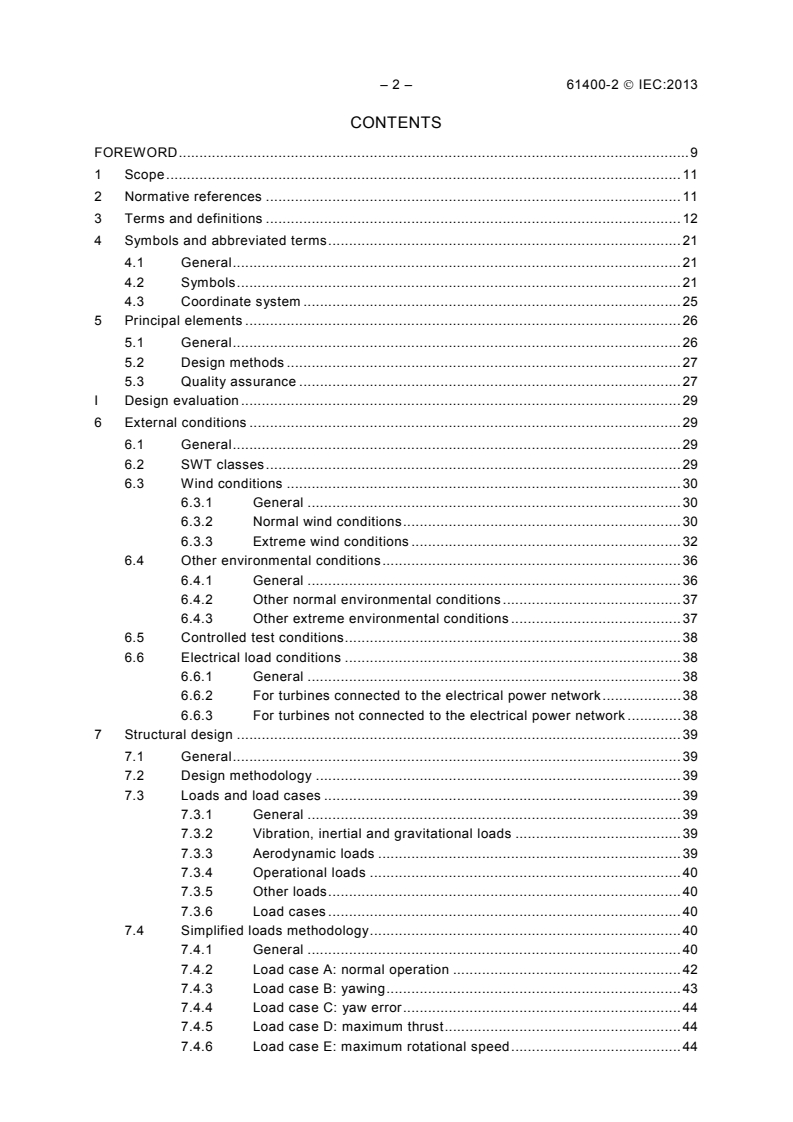
– 2 – 61400-2 IEC:2013
CONTENTS
FOREWORD . 9
1 Scope . 11
2 Normative references . 11
3 Terms and definitions . 12
4 Symbols and abbreviated terms . 21
4.1 General . 21
4.2 Symbols . 21
4.3 Coordinate system . 25
5 Principal elements . 26
5.1 General . 26
5.2 Design methods . 27
5.3 Quality assurance . 27
I Design evaluation . 29
6 External conditions . 29
6.1 General . 29
6.2 SWT classes . 29
6.3 Wind conditions . 30
6.3.1 General . 30
6.3.2 Normal wind conditions . 30
6.3.3 Extreme wind conditions . 32
6.4 Other environmental conditions . 36
6.4.1 General . 36
6.4.2 Other normal environmental conditions . 37
6.4.3 Other extreme environmental conditions . 37
6.5 Controlled test conditions . 38
6.6 Electrical load conditions . 38
6.6.1 General . 38
6.6.2 For turbines connected to the electrical power network . 38
6.6.3 For turbines not connected to the electrical power network . 38
7 Structural design . 39
7.1 General . 39
7.2 Design methodology . 39
7.3 Loads and load cases . 39
7.3.1 General . 39
7.3.2 Vibration, inertial and gravitational loads . 39
7.3.3 Aerodynamic loads . 39
7.3.4 Operational loads . 40
7.3.5 Other loads . 40
7.3.6 Load cases . 40
7.4 Simplified loads methodology . 40
7.4.1 General . 40
7.4.2 Load case A: normal operation . 42
7.4.3 Load case B: yawing . 43
7.4.4 Load case C: yaw error . 44
7.4.5 Load case D: maximum thrust . 44
7.4.6 Load case E: maximum rotational speed . 44
61400-2 IEC:2013 – 3 –
7.4.7 Load case F: short at load connection . 44
7.4.8 Load case G: shutdown (braking) . 44
7.4.9 Load case H: extreme wind loading . 45
7.4.10 Load case I: parked wind loading, maximum exposure . 46
7.4.11 Load case J: transportation, assembly, maintenance and
repair . 47
7.5 Simulation modelling . 47
7.5.1 General . 47
7.5.2 Power production (DLC 1.1 to 1.5) . 48
7.5.3 Power production plus occurrence of fault (DLC 2.1 to 2.3). 49
7.5.4 Normal shutdown (DLC 3.1 and 3.2) . 49
7.5.5 Emergency or manual shutdown (DLC 4.1) . 49
7.5.6 Extreme wind loading (stand-still or idling or spinning) (DLC
5.1 to 5.2) . 49
7.5.7 Parked plus fault conditions (DLC 6.1) . 50
7.5.8 Transportation, assembly, maintenance and repair (DLC 7.1) . 50
7.5.9 Load calculations . 50
7.6 Load measurements. 50
7.7 Stress calculation . 50
7.8 Safety factors. 51
7.8.1 Material factors and requirements . 51
7.8.2 Partial safety factor for loads . 52
7.9 Limit state analysis . 52
7.9.1 Ultimate strength analysis . 52
7.9.2 Fatigue failure . 53
7.9.3 Critical deflection analysis . 53
8 Protection and shutdown system . 54
8.1 General . 54
8.2 Functional requirements of the protection system . 54
8.3 Manual shutdown . 54
8.4 Shutdown for maintenance . 55
9 Electrical system . 55
9.1 General . 55
9.2 Protective devices . 55
9.3 Disconnect device . 56
9.4 Earthing (grounding) systems . 56
9.5 Lightning protection . 56
9.6 Electrical conductors and cables . 56
9.7 Electrical loads . 56
9.7.1 General . 56
9.7.2 Battery charging . 56
9.7.3 Electrical power network (grid connected systems) . 57
9.7.4 Direct connect to electric motors (e.g. water pumping) . 57
9.7.5 Direct resistive load (e.g. heating) . 57
9.8 Local requirements . 57
10 Support structure . 58
10.1 General . 58
10.2 Dynamic requirements . 58
10.3 Environmental factors . 58
– 4 – 61400-2 IEC:2013
10.4 Earthing . 58
10.5 Foundation . 58
10.6 Turbine access design loads . 58
11 Documentation requirements . 58
11.1 General . 58
11.2 Product manuals . 59
11.2.1 General . 59
11.2.2 Specification . 59
11.2.3 Installation . 60
11.2.4 Operation . 60
11.2.5 Maintenance and routine inspection . 61
11.3 Consumer label . 62
12 Wind turbine markings . 62
II Type testing. 63
13 Testing . 63
13.1 General . 63
13.2 Tests to verify design data . 63
13.2.1 General . 63
13.2.2 P , n , V and Q . 63
design design design design
13.2.3 Maximum yaw rate . 64
13.2.4 Maximum rotational speed . 64
13.3 Mechanical loads testing . 64
13.4 Duration testing . 65
13.4.1 General . 65
13.4.2 Reliable operation . 66
13.4.3 Dynamic behaviour . 68
13.4.4 Reporting of duration test . 69
13.5 Mechanical component testing . 70
13.5.1 General . 70
13.5.2 Blade test . 70
13.5.3 Hub test . 71
13.5.4 Nacelle frame test . 71
13.5.5 Yaw mechanism test . 71
13.5.6 Gearbox test . 71
13.6 Safety and function . 71
13.7 Environmental testing . 72
13.8 Electrical . 72
Annex A (informative) Variants of small wind turbine systems . 73
A.1 General . 73
A.2 Example 1: power forms. 73
A.3 Example 2: blades . 73
A.4 Example 3: support structures . 73
Annex B (normative) Design parameters for describing SWT class S . 75
Annex C (informative) Stochastic turbulence models . 76
C.1 General . 76
C.2 Exponential coherency model . 77
C.3 Von Karman isotropic turbulence model . 77
Annex D (informative) Deterministic turbulence description . 79
61400-2 IEC:2013 – 5 –
Annex E (informative) Partial safety factors for materials . 81
E.1 General . 81
E.2 Symbols . 81
E.3 Characteristic value versus design values . 81
E.4 Material factors and requirements . 82
E.4.1 General . 82
E.4.2 Composites . 83
E.4.3 Metals . 85
E.4.4 Wood . 85
E.5 Geometry effects . 88
E.6 Reference documents . 89
Annex F (informative) Development of the simplified loads methodology . 90
F.1 Symbols used in this annex . 90
F.2 General . 91
F.3 Caution regarding use of simplified equations . 91
F.4 General relationships . 92
F.5 Reference documents . 100
Annex G (informative) Example of test reporting formats . 101
G.1 Overview. 101
G.2 Duration test . 101
G.2.1 General . 101
G.2.2 Table summarizing the duration test results . 101
G.2.3 Plot showing any potential power degradation . 102
G.3 Power/energy performance . 102
G.3.1 General . 102
G.4 Acoustic noise test . 105
Annex H (informative) EMC measurements . 106
H.1 Overview. 106
H.2 Measurement for radiated emissions . 106
H.3 Measurements of conducted emissions . 108
H.4 Reference documents . 108
Annex I (normative) Natural frequency analysis . 110
Annex J (informative) Extreme environmental conditions . 112
J.1 Overview. 112
J.2 Extreme conditions . 112
J.3 Low temperature . 112
J.4 Ice . 112
J.5 High temperature . 113
J.6 Marine . 113
Annex K (informative) Extreme wind conditions of tropical cyclones . 114
K.1 General . 114
K.2 Using SWT classes in tropical cyclone areas . 114
K.3 Extreme wind conditions . 114
K.3.1 Definition of tropical cyclones . 114
K.3.2 General features of tropical cyclones . 114
K.3.3 Extreme wind conditions . 115
K.4 Stochastic simulation (Monte Carlo simulation) . 116
K.5 Reference documents . 117
– 6 – 61400-2 IEC:2013
Annex L (informative) Other wind conditions . 120
L.1 General . 120
L.2 Typical situations . 120
L.3 Directionally dependent flow . 120
L.4 Inclined flow . 120
L.5 Turbulence . 122
L.6 Extreme wind direction changes . 125
L.7 Gust factors . 126
L.8 Reference documents . 127
Annex M (informative) Consumer label . 128
M.1 General . 128
M.2 Administration . 128
M.2.1 General . 128
M.2.2 Test summary report . 128
M.2.3 Publication of labels . 129
M.2.4 Wind turbine variants . 129
M.3 Tests for labelling . 129
M.3.1 General . 129
M.3.2 Duration test . 129
M.3.3 Power curve and reference annual energy . 130
M.3.4 Acoustic noise test . 130
M.4 Label layout . 130
M.5 Reference documents . 130
Bibliography . 133
Figure 1 – Definition of the system of axes for HAWT . 25
Figure 2 – Definition of the system of axes for VAWT . 26
Figure 3 – IEC 61400-2 decision path . 28
Figure 4 – Characteristic wind turbulence . 32
Figure 5 – Example of extreme operating gust (N=1, V = 25 m/s) . 33
hub
Figure 6 – Example of extreme direction change magnitude (N = 50, D = 5 m, z =
hub
20 m) . 35
Figure 7 – Example of extreme direction change transient (N = 50, V = 25 m/s) . 35
hub
Figure 8 – Extreme coherent gust (V = 25 m/s) (ECG) . 35
hub
Figure 9 – The direction change for ECD . 36
Figure 10 – Time development of direction change for V = 25 m/s . 36
hub
Figure E.1 – Normal and Weibull distribution . 82
Figure E.2 – Typical S-N diagram for fatigue of glass fibre composites (Figure 41 from
reference [E.2]) . 84
Figure E.3 – Typical environmental effects on glass fibre composites (Figure 25 from
reference [E.2]) . 84
Figure E.4 – Fatigue strain diagram for large tow unidirectional 0° carbon fibre/vinyl
ester composites, R = 0,1 and 10 (Figure 107 from reference [E.2]) . 84
Figure E.5 – S-N curves for fatigue of typical metals . 85
Figure E.6 – Fatigue life data for jointed softwood (from reference [E.5]) . 86
Figure E.7 – Typical S-N curve for wood (from reference [E.5]) . 86
61400-2 IEC:2013 – 7 –
Figure E.8 – Effect of moisture content on compressive strength of lumber parallel to
grain (Figure 4-13 from reference [E.6]) . 87
Figure E.9 – Effect of moisture content on wood strength properties (Figure 4-11 from
reference [E.6]) . 87
Figure E.10 – Effect of grain angle on mechanical property of clear wood according to
Hankinson-type formula (Figure 4-4 from reference [E.6]) . 88
Figure G.1 – Example power degradation plot . 102
Figure G.2 – Example binned sea level normalized power curve . 103
Figure G.3 – Example scatter plot of measured power and wind speed . 104
Figure G.4 – Example immission noise map . 105
Figure H.1 – Measurement setup of radiated emissions (set up type A) . 107
Figure H.2 – Measurement setup of radiated emissions (set up type B) . 107
Figure H.3 – Measurement setup of conducted emissions (setup type A) . 108
Figure H.4 – Measurement setup of conducted emissions (setup type B) . 108
Figure I.1 – Example of a Campbell diagram . 111
Figure K.1 – Comparison of predicted and observed extreme winds in a mixed climate
region (after Isihara, T. and Yamaguchi, A.) . 117
Figure K.2 – Tropical cyclone tracks between 1945 and 2006 . 119
Figure L.1 – Simulation showing inclined flow on a building (courtesy Sander Mertens) . 121
Figure L.2 – Example wind flow around a building . 122
Figure L.3 – Turbulence intensity and wind speed distribution, 5 m above treetops in a
forest north of Uppsala, Sweden, during Jan-Dec 2009 . 123
Figure L.4 – Turbulence intensity and wind speed distribution, 69 m above treetops in
a forest north of Uppsala, Sweden, during 2009 (limited data for high wind speeds) . 123
Figure L.5 – Turbulence intensity and wind distribution, 2 m above rooftop in Melville,
Western Australia, during Jan-Feb 2009, reference [L.4] . 124
Figure L.6 – Turbulence intensity and wind speed distribution, 5,7 m above a rooftop in
Port Kennedy, Western Australia, during Feb-Mar 2010, reference [L.4] . 124
Figure L.7 – Example extreme direction changes; 1,5 m above a rooftop in Tokyo,
Japan during three months February-May of 2007 (0,5 Hz data, reference [L.5]). 125
Figure L.8 – Example extreme direction changes; 1,5 m above a rooftop in Tokyo,
Japan during five months September 2010 to February 2011 (1,0 Hz data, reference
[L.5]) . 126
Figure L.9 – Gust factor measurements during storm in Port Kennedy, Western
Australia, during March 2010, measured 5 m above rooftop compared with 10-min
average wind speed . 126
Figure M.1 – Sample label in English . 131
Figure M.2 – Sample bilingual label (English/French) . 132
Table 1 – Basic parameters for SWT classes . 30
Table 2 – Design load cases for the simplified load calculation method . 42
Table 3 – Force coefficients (C ) . 47
f
Table 4 – Minimum set of design load cases (DLC) for simulation by aero-elastic
models . 48
Table 5 – Equivalent stresses . 51
Table 6 – Partial safety factors for materials . 52
Table 7 – Partial safety factors for loads . 52
– 8 – 61400-2 IEC:2013
Table C.1 – Turbulence spectral parameters for Kaimal model . 76
Table E.1 – Factors for different survival probabilities and variabilities. 82
Table E.2 – Geometric discontinuities . 89
Table G.1 – Example duration test result . 101
Table G.2 – Example calculated annual energy production (AEP) table . 104
Table K.1 – Top five average extreme wind speeds recorded at meteorological stations . 115
Table K.2 – Extreme wind speeds recorded at meteorological stations . 116
61400-2 IEC:2013 – 9 –
INTERNATIONAL ELECTROTECHNICAL COMMISSION
____________
WIND TURBINES –
Part 2: Small wind turbines
FOREWORD
1) The International Electrotechnical Commission (IEC) is a worldwide organization for standardization comprising
all national electrotechnical committees (IEC National Committees). The object of IEC is to promote
international co-operation on all questions concerning standardization in the electrical and electronic fields. To
this end and in addition to other activities, IEC publishes International Standards, Technical Specifications,
Technical Reports, Publicly Available Specifications (PAS) and Guides (hereafter referred to as “IEC
Publication(s)”). Their preparation is entrusted to technical committees; any IEC National Committee interested
in the subject dealt with may participate in this preparatory work. International, governmental and non-
governmental organizations liaising with the IEC also participate in this preparation. IEC collaborates closely
with the International Organization for Standardization (ISO) in accordance with conditions determined by
agreement between the two organizations.
2) The formal decisions or agreements of IEC on technical matters express, as nearly as possible, an international
consensus of opinion on the relevant subjects since each technical committee has representation from all
interested IEC National Committees.
3) IEC Publications have the form of recommendations for international use and are accepted by IEC National
Committees in that sense. While all reasonable efforts are made to ensure that the technical content of IEC
Publications is accurate, IEC cannot be held responsible for the way in which they are used or for any
misinterpretation by any end user.
4) In order to promote international uniformity, IEC National Committees undertake to apply IEC Publications
transparently to the maximum extent possible in their national and regional publications. Any divergence
between any IEC Publication and the corresponding national or regional publication shall be clearly indicated in
the latter.
5) IEC itself does not provide any attestation of conformity. Independent certification bodies provide conformity
assessment services and, in some areas, access to IEC marks of conformity. IEC is not responsible for any
services carried out by independent certification bodies.
6) All users should ensure that they have the latest edition of this publication.
7) No liability shall attach to IEC or its directors, employees, servants or agents including individual experts and
members of its technical committees and IEC National Committees for any personal injury, property damage or
other damage of any nature whatsoever, whether direct or indirect, or for costs (including legal fees) and
expenses arising out of the publication, use of, or reliance upon, this IEC Publication or any other IEC
Publications.
8) Attention is drawn to the Normative references cited in this publication. Use of the referenced publications is
indispensable for the correct application of this publication.
9) Attention is drawn to the possibility that some of the elements of this IEC Publication may be the subject of
patent rights. IEC shall not be held responsible for identifying any or all such patent rights.
International Standard IEC 61400-2 has been prepared by IEC technical committee 88: Wind
turbines.
This third edition cancels and replaces the second edition published in 2006.
This edition constitutes a technical revision. This edition includes the following significant
technical changes with respect to the previous edition:
• the title has been modified to better reflect the scope;
• restructured into part I (design evaluation) and part II (type testing) to harmonise use with
IEC 61400-22 conformity testing and certification;
• caution provided regarding the use of simplified equations;
• added annex on other wind conditions;
• added annex on tropical storms;
• added annex on extreme environmental conditions;
– 10 – 61400-2 IEC:2013
• added annex on EMC testing;
• added annex on dynamic behaviour;
• duration testing requirements modified;
• added annex on standardised format consumer label;
• many minor changes and all known errata corrected.
The text of this standard is based on the following documents:
FDIS Report on voting
88/465/FDIS 88/469/RVD
Full information on the voting for the approval of this standard can be found in the report on
voting indicated in the above table.
This publication has been drafted in accordance with the ISO/IEC Directives, Part 2.
A list of all parts in the IEC 61400 series, published under the general title Wind turbines, can
be found on the IEC website.
The committee has decided that the contents of this publication will remain unchanged until
the stability date indicated on the IEC web site under "http://webstore.iec.ch" in the data
related to the specific publication. At this date, the publication will be
• reconfirmed,
• withdrawn,
• replaced by a revised edition, or
• amended.
The contents of the corrigendum of October 2019 have been included in this copy.
IMPORTANT – The 'colour inside' logo on the cover page of this publication indicates
that it contains colours which are considered to be useful for the correct
understanding of its contents. Users should therefore print this document using a
colour printer.
61400-2 IEC:2013 – 11 –
WIND TURBINES –
Part 2: Small wind turbines
1 Scope
This part of IEC 61400 deals with safety philosophy, quality assurance, and engineering
integrity and specifies requirements for the safety of small wind turbines (SWTs) including
design, installation, maintenance and operation under specified external conditions. Its
purpose is to provide the appropriate level of protection against damage from hazards from
these systems during their planned lifetime.
This standard is concerned with all subsystems of SWTs such as protection mechanisms,
internal electrical systems, mechanical systems, support structures, foundations and the
electrical interconnection with the load. A small wind turbine system includes the wind turbine
itself including support structures, the turbine controller, the charge controller / inverter (if
required), wiring and disconnects, the installation and operation manual(s) and other
documentation.
While this standard is similar to IEC 61400-1, it does simplify and make significant changes in
order to be applicable to small wind turbines. Any of the requirements of this standard may be
altered if it can be suitably demonstrated that th
...