

IEC 62841-2-5:2014
(Main)Electric motor-operated hand-held tools, transportable tools and lawn and garden machinery - Safety - Part 2-5: Particular requirements for hand-held circular saws
General Information
- Abstract
IEC 62841-2-5:2014 applies to hand-held circular saws. This standard does not apply to saws designed for use with abrasive wheels. Saws designed for use with abrasive wheels as cut-off machines are covered by IEC 62841-2-22. The rated voltage is not more than 250 V for single-phase a.c. or d.c. tools, and 480 V for three-phase a.c. tools. The rated input is not more than 3 700 W. The limits for the applicability of this standard for battery tools is given in Annex K. This standard deals with the hazards presented by tools which are encountered by all persons in the normal use and reasonably foreseeable misuse of the tools. Hand-held electric tools, which can be mounted on a support or working stand for use as fixed tools without any alteration of the tool itself, are within the scope of this standard and such combination of a hand-held tool and a support is considered to be a transportable tool and thus covered by the relevant Part 3. The attention of National Committees is drawn to the fact that equipment manufacturers and testing organizations may need a transitional period following publication of a new, amended or revised IEC publication in which to make products in accordance with the new requirements and to equip themselves for conducting new or revised tests. It is the recommendation of the committee that the content of this publication be adopted for implementation nationally not earlier than 36 months from the date of publication. Key words: Saw, Circular, Cutting,
This publication is to be read in conjunction with IEC 62841-1:2014.
- Status
- Published
- Publication Date
- 16-Feb-2025
- Technical Committee
- TC 116 - Safety of motor-operated electric tools
- Drafting Committee
- WG 8 - TC 116/WG 8
- Current Stage
- PPUB - Publication issued
- Start Date
- 10-Jun-2014
- Completion Date
- 15-May-2014
Buy Documents
IEC 62841-2-5:2014+AMD1:2025 CSV - Electric motor-operated hand-held tools, transportable tools and lawn and garden machinery - Safety - Part 2-5: Particular requirements for hand-held circular saws Released:2/17/2025
IEC 62841-2-5:2014 - Electric motor-operated hand-held tools, transportable tools and lawn and garden machinery - Safety - Part 2-5: Particular requirements for hand-held circular saws Released:6/10/2014
Overview - IEC 62841-2-5:2014 (Part 2‑5)
IEC 62841-2-5:2014 specifies safety requirements for electric motor‑operated hand‑held circular saws (hereafter “saws”). It is a particular part of the IEC 62841 series and is to be read in conjunction with IEC 62841-1:2014. The standard addresses hazards encountered in normal use and reasonably foreseeable misuse of hand‑held circular saws and transportable combinations (hand‑held saws mounted on supports). It excludes saws designed for abrasive wheels (these are covered by IEC 62841-2-22).
Scope limits include:
- Rated voltage not more than 250 V for single‑phase a.c. or d.c., and 480 V for three‑phase a.c.
- Rated input not more than 3 700 W
- Battery tool applicability and limits given in Annex K
The committee recommends a transitional adoption period (not earlier than 36 months from publication) to allow manufacturers and test labs to implement new requirements.
Key topics and technical requirements
This Part 2‑5 supplements IEC 62841-1 with circular saw‑specific provisions. Key topics include:
- Guarding system requirements (upper guard, lower guard, base plate, riving knife) and performance tests
- Kickback hazards - definitions and protective measures (mechanical design and guards)
- Mechanical hazards - blade exposure, cutting edge zone, plunge‑type saw considerations
- Starting, input and current, heating, overload and endurance tests to ensure safe operation under normal and abnormal conditions
- Protection against access to live parts and insulation/earthing provisions
- Noise and vibration measurement (Annex I) and battery tool requirements (Annex K)
- Specific annexes: riving knife (Annex AA), lower guard for saws without riving knife (Annex BB)
- Marking and instructions, test conditions, mechanical strength and construction requirements
Figures and dimensional requirements (e.g., base plate geometry, guard clearances, blade exposure angles) are provided to standardize safety margins and testing.
Applications - who uses this standard
IEC 62841-2-5 is essential for:
- Circular saw manufacturers (design, verification, technical files)
- Test laboratories and certification bodies performing safety and conformity testing
- Regulatory authorities and procurement teams specifying safe tools for workplaces
- R&D and safety engineers designing cutting tools and guarding systems
- Compliance professionals preparing user manuals, markings and safety instructions
Applying this standard helps reduce cutting‑related incidents (kickback, blade contact), ensures product conformity, and supports market access in regions adopting IEC/EN requirements.
Related standards
- IEC 62841-1:2014 - General requirements for hand‑held and transportable motor‑operated tools (must be read together)
- IEC 62841-2-22 - Particular requirements for cut‑off machines with abrasive wheels
- EN 847-1 - (European normative reference) Tools for woodworking - circular saw blade safety aspects
Keywords: IEC 62841-2-5, hand‑held circular saws, saw safety, circular saw, cutting, riving knife, lower guard, kickback, base plate.
Relations
- Effective Date
- 04-Sep-2026
- Effective Date
- 08-Dec-2023
Buy Documents
IEC 62841-2-5:2014+AMD1:2025 CSV - Electric motor-operated hand-held tools, transportable tools and lawn and garden machinery - Safety - Part 2-5: Particular requirements for hand-held circular saws Released:2/17/2025
IEC 62841-2-5:2014 - Electric motor-operated hand-held tools, transportable tools and lawn and garden machinery - Safety - Part 2-5: Particular requirements for hand-held circular saws Released:6/10/2014
Get Certified
Connect with accredited certification bodies for this standard

DVS-ZERT GmbH
German welding certification society.
CARES (UK Certification Authority for Reinforcing Steels)
UK certification for reinforcing steels and construction.
EWF/IIW (European/International Welding Federation)
International welding personnel certification.
Sponsored listings
Frequently Asked Questions
IEC 62841-2-5:2014 is a standard published by the International Electrotechnical Commission (IEC). Its full title is "Electric motor-operated hand-held tools, transportable tools and lawn and garden machinery - Safety - Part 2-5: Particular requirements for hand-held circular saws". This standard covers: IEC 62841-2-5:2014 applies to hand-held circular saws. This standard does not apply to saws designed for use with abrasive wheels. Saws designed for use with abrasive wheels as cut-off machines are covered by IEC 62841-2-22. The rated voltage is not more than 250 V for single-phase a.c. or d.c. tools, and 480 V for three-phase a.c. tools. The rated input is not more than 3 700 W. The limits for the applicability of this standard for battery tools is given in Annex K. This standard deals with the hazards presented by tools which are encountered by all persons in the normal use and reasonably foreseeable misuse of the tools. Hand-held electric tools, which can be mounted on a support or working stand for use as fixed tools without any alteration of the tool itself, are within the scope of this standard and such combination of a hand-held tool and a support is considered to be a transportable tool and thus covered by the relevant Part 3. The attention of National Committees is drawn to the fact that equipment manufacturers and testing organizations may need a transitional period following publication of a new, amended or revised IEC publication in which to make products in accordance with the new requirements and to equip themselves for conducting new or revised tests. It is the recommendation of the committee that the content of this publication be adopted for implementation nationally not earlier than 36 months from the date of publication. Key words: Saw, Circular, Cutting, This publication is to be read in conjunction with IEC 62841-1:2014.
IEC 62841-2-5:2014 applies to hand-held circular saws. This standard does not apply to saws designed for use with abrasive wheels. Saws designed for use with abrasive wheels as cut-off machines are covered by IEC 62841-2-22. The rated voltage is not more than 250 V for single-phase a.c. or d.c. tools, and 480 V for three-phase a.c. tools. The rated input is not more than 3 700 W. The limits for the applicability of this standard for battery tools is given in Annex K. This standard deals with the hazards presented by tools which are encountered by all persons in the normal use and reasonably foreseeable misuse of the tools. Hand-held electric tools, which can be mounted on a support or working stand for use as fixed tools without any alteration of the tool itself, are within the scope of this standard and such combination of a hand-held tool and a support is considered to be a transportable tool and thus covered by the relevant Part 3. The attention of National Committees is drawn to the fact that equipment manufacturers and testing organizations may need a transitional period following publication of a new, amended or revised IEC publication in which to make products in accordance with the new requirements and to equip themselves for conducting new or revised tests. It is the recommendation of the committee that the content of this publication be adopted for implementation nationally not earlier than 36 months from the date of publication. Key words: Saw, Circular, Cutting, This publication is to be read in conjunction with IEC 62841-1:2014.
IEC 62841-2-5:2014 is classified under the following ICS (International Classification for Standards) categories: 25.140.20 - Electric tools. The ICS classification helps identify the subject area and facilitates finding related standards.
IEC 62841-2-5:2014 has the following relationships with other standards: It is inter standard links to IEC 60745-2-5:2010, IEC 62841-2-5:2014/AMD1:2025. Understanding these relationships helps ensure you are using the most current and applicable version of the standard.
IEC 62841-2-5:2014 is available in PDF format for immediate download after purchase. The document can be added to your cart and obtained through the secure checkout process. Digital delivery ensures instant access to the complete standard document.
Standards Content (Sample)
IEC 62841-2-5 ®
Edition 1.1 2025-02
CONSOLIDATED VERSION
INTERNATIONAL
STANDARD
Electric motor-operated hand-held tools, transportable tools and lawn and
garden machinery – Safety –
Part 2-5: Particular requirements for hand-held circular saws
All rights reserved. Unless otherwise specified, no part of this publication may be reproduced or utilized in any form
or by any means, electronic or mechanical, including photocopying and microfilm, without permission in writing from
either IEC or IEC's member National Committee in the country of the requester. If you have any questions about IEC
copyright or have an enquiry about obtaining additional rights to this publication, please contact the address below or
your local IEC member National Committee for further information.
IEC Secretariat Tel.: +41 22 919 02 11
3, rue de Varembé info@iec.ch
CH-1211 Geneva 20 www.iec.ch
Switzerland
About the IEC
The International Electrotechnical Commission (IEC) is the leading global organization that prepares and publishes
International Standards for all electrical, electronic and related technologies.
About IEC publications
The technical content of IEC publications is kept under constant review by the IEC. Please make sure that you have the
latest edition, a corrigendum or an amendment might have been published.
IEC publications search - webstore.iec.ch/advsearchform IEC Products & Services Portal - products.iec.ch
The advanced search enables to find IEC publications by a Discover our powerful search engine and read freely all the
variety of criteria (reference number, text, technical publications previews, graphical symbols and the glossary.
committee, …). It also gives information on projects, replaced With a subscription you will always have access to up to date
and withdrawn publications. content tailored to your needs.
IEC Just Published - webstore.iec.ch/justpublished
Electropedia - www.electropedia.org
Stay up to date on all new IEC publications. Just Published
The world's leading online dictionary on electrotechnology,
details all new publications released. Available online and once
containing more than 22 500 terminological entries in English
a month by email.
and French, with equivalent terms in 25 additional languages.
Also known as the International Electrotechnical Vocabulary
IEC Customer Service Centre - webstore.iec.ch/csc
(IEV) online.
If you wish to give us your feedback on this publication or need
further assistance, please contact the Customer Service
Centre: sales@iec.ch.
IEC 62841-2-5 ®
Edition 1.1 2025-02
CONSOLIDATED VERSION
INTERNATIONAL
STANDARD
Electric motor-operated hand-held tools, transportable tools and lawn and
garden machinery – Safety –
Part 2-5: Particular requirements for hand-held circular saws
INTERNATIONAL
ELECTROTECHNICAL
COMMISSION
ICS 25.140.20 ISBN 978-2-8327-0247-5
REDLINE VERSION – 2 – IEC 62841-2-5:2014+AMD1:2025 CSV
© IEC 2025
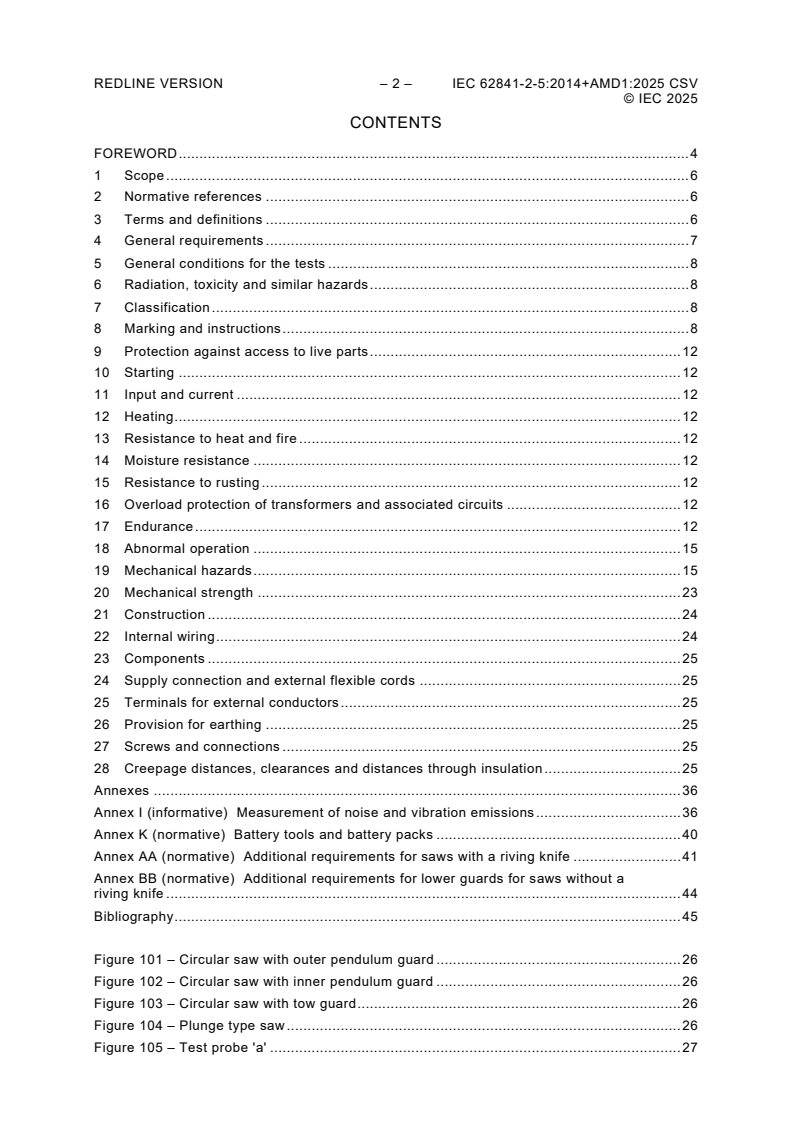
CONTENTS
FOREWORD . 4
1 Scope . 6
2 Normative references . 6
3 Terms and definitions . 6
4 General requirements . 7
5 General conditions for the tests . 8
6 Radiation, toxicity and similar hazards . 8
7 Classification . 8
8 Marking and instructions . 8
9 Protection against access to live parts . 12
10 Starting . 12
11 Input and current . 12
12 Heating . 12
13 Resistance to heat and fire . 12
14 Moisture resistance . 12
15 Resistance to rusting . 12
16 Overload protection of transformers and associated circuits . 12
17 Endurance . 12
18 Abnormal operation . 15
19 Mechanical hazards . 15
20 Mechanical strength . 23
21 Construction . 24
22 Internal wiring . 24
23 Components . 25
24 Supply connection and external flexible cords . 25
25 Terminals for external conductors . 25
26 Provision for earthing . 25
27 Screws and connections . 25
28 Creepage distances, clearances and distances through insulation . 25
Annexes . 36
Annex I (informative) Measurement of noise and vibration emissions . 36
Annex K (normative) Battery tools and battery packs . 40
Annex AA (normative) Additional requirements for saws with a riving knife . 41
Annex BB (normative) Additional requirements for lower guards for saws without a
riving knife . 44
Bibliography . 45
Figure 101 – Circular saw with outer pendulum guard . 26
Figure 102 – Circular saw with inner pendulum guard . 26
Figure 103 – Circular saw with tow guard . 26
Figure 104 – Plunge type saw . 26
Figure 105 – Test probe 'a' . 27
© IEC 2025
Figure 106 – Use of test probe ‘a’ on circular saw guards . 28
Figure 107 – Distance from the gripping surface to the blade’s cutting edge zone . 30
Figure 108 – Height restriction of the viewing aperture (see 19.101.2.2) . 31
Figure 109 – Distance from the edge of the lateral side of the upper guard to the base
plate . 32
Figure 110 – Test probe 'b' . 32
Figure 111 – Accessibility to the front cutting edge zone . 33
Figure 112 – Blade exposure angle of the lower guard . 34
Figure 113 – Principal dimensions of the base plate . 34
Figure 114 – Flange characteristics . 35
Figure I.101 − Position of transducers for circular saws . 39
Figure AA.101 – Riving knife stability test . 43
Figure AA.102 – Riving knife adjustment . 43
Table 4 – Required performance levels . 15
Table 101 – Lower guard exposure angle. 19
Table I.101 – Operating conditions for circular saws cutting wood . 36
Table I.102 – Operating conditions for circular saws cutting metal . 37
REDLINE VERSION – 4 – IEC 62841-2-5:2014+AMD1:2025 CSV
© IEC 2025
INTERNATIONAL ELECTROTECHNICAL COMMISSION
____________
ELECTRIC MOTOR-OPERATED HAND-HELD TOOLS, TRANSPORTABLE
TOOLS AND LAWN AND GARDEN MACHINERY –
SAFETY –
Part 2-5: Particular requirements for hand-held circular saws
FOREWORD
1) The International Electrotechnical Commission (IEC) is a worldwide organization for standardization comprising
all national electrotechnical committees (IEC National Committees). The object of IEC is to promote
international co-operation on all questions concerning standardization in the electrical and electronic fields. To
this end and in addition to other activities, IEC publishes International Standards, Technical Specifications,
Technical Reports, Publicly Available Specifications (PAS) and Guides (hereafter referred to as "IEC
Publication(s)"). Their preparation is entrusted to technical committees; any IEC National Committee interested
in the subject dealt with may participate in this preparatory work. International, governmental and non-
governmental organizations liaising with the IEC also participate in this preparation. IEC collaborates closely
with the International Organization for Standardization (ISO) in accordance with conditions determined by
agreement between the two organizations.
2) The formal decisions or agreements of IEC on technical matters express, as nearly as possible, an international
consensus of opinion on the relevant subjects since each technical committee has representation from all
interested IEC National Committees.
3) IEC Publications have the form of recommendations for international use and are accepted by IEC National
Committees in that sense. While all reasonable efforts are made to ensure that the technical content of IEC
Publications is accurate, IEC cannot be held responsible for the way in which they are used or for any
misinterpretation by any end user.
4) In order to promote international uniformity, IEC National Committees undertake to apply IEC Publications
transparently to the maximum extent possible in their national and regional publications. Any divergence
between any IEC Publication and the corresponding national or regional publication shall be clearly indicated in
the latter.
5) IEC itself does not provide any attestation of conformity. Independent certification bodies provide conformity
assessment services and, in some areas, access to IEC marks of conformity. IEC is not responsible for any
services carried out by independent certification bodies.
6) All users should ensure that they have the latest edition of this publication.
7) No liability shall attach to IEC or its directors, employees, servants or agents including individual experts and
members of its technical committees and IEC National Committees for any personal injury, property damage or
other damage of any nature whatsoever, whether direct or indirect, or for costs (including legal fees) and
expenses arising out of the publication, use of, or reliance upon, this IEC Publication or any other IEC
Publications.
8) Attention is drawn to the Normative references cited in this publication. Use of the referenced publications is
indispensable for the correct application of this publication.
9) IEC draws attention to the possibility that the implementation of this document may involve the use of (a)
patent(s). IEC takes no position concerning the evidence, validity or applicability of any claimed patent rights in
respect thereof. As of the date of publication of this document, IEC had not received notice of (a) patent(s),
which may be required to implement this document. However, implementers are cautioned that this may not
represent the latest information, which may be obtained from the patent database available at
https://patents.iec.ch. IEC shall not be held responsible for identifying any or all such patent rights.
This consolidated version of the official IEC Standard and its amendment has been
prepared for user convenience.
IEC 62841-2-5 edition 1.1 contains the first edition (2014-06) [documents 116/166/FDIS
and 116/180/RVD] and its amendment 1 (2025-02) [documents 116/860/FDIS and
116/878/RVD].
In this Redline version, a vertical line in the margin shows where the technical content
is modified by amendment 1. Additions are in green text, deletions are in strikethrough
red text. A separate Final version with all changes accepted is available in this
publication.
© IEC 2025
International Standard IEC 62841-2-5 has been prepared by IEC technical committee 116:
Safety of motor-operated electric tools.
This publication has been drafted in accordance with the ISO/IEC Directives, Part 2.
This Part 2-5 is to be used in conjunction with the first edition of IEC 62841-1 (2014).
This Part 2-5 supplements or modifies the corresponding clauses in IEC 62841-1, so as to
convert it into the IEC Standard: Particular requirements for hand-held circular saws.
Where a particular subclause of Part 1 is not mentioned in this Part 2-5, that subclause
applies as far as reasonable. Where this standard states “addition”, “modification” or
“replacement”, the relevant text in Part 1 is to be adapted accordingly.
The following print types are used:
– requirements: in roman type;
– test specifications: in italic type;
– notes: in small roman type.
The terms defined in Clause 3 are printed in bold typeface.
Subclauses, notes and figures which are additional to those in Part 1 are numbered starting
from 101.
A list of all parts of the IEC 62841 series, under the general title: Electric motor-operated
hand-held tools, transportable tools and lawn and garden machinery – Safety, can be found
on the IEC website.
The committee has decided that the contents of this document and its amendment will remain
unchanged until the stability date indicated on the IEC website under webstore.iec.ch in the
data related to the specific document. At this date, the document will be
• reconfirmed,
• withdrawn, or
• revised.
NOTE The attention of National Committees is drawn to the fact that equipment manufacturers and testing
organizations may need a transitional period following publication of a new, amended or revised IEC publication in
which to make products in accordance with the new requirements and to equip themselves for conducting new or
revised tests.
It is the recommendation of the committee that the content of this publication be adopted for implementation
nationally not earlier than 36 months from the date of publication.
REDLINE VERSION – 6 – IEC 62841-2-5:2014+AMD1:2025 CSV
© IEC 2025
ELECTRIC MOTOR-OPERATED HAND-HELD TOOLS, TRANSPORTABLE
TOOLS AND LAWN AND GARDEN MACHINERY –
SAFETY –
Part 2-5: Particular requirements for hand-held circular saws
1 Scope
This clause of Part 1 is applicable, except as follows:
Addition:
This part of IEC 62841 applies to hand-held circular saws, which hereinafter will be referred
to as saws.
This standard does not apply to saws designed for use with abrasive wheels.
NOTE Saws designed for use with abrasive wheels as cut-off machines are covered by IEC 62841-2-22.
2 Normative references
This clause of Part 1 is applicable, except as follows:
Addition:
NOTE In Europe (EN 62841-2-5), the following normative reference applies:
EN 847-1, Tools for woodworking - Safety requirements - Part 1: Milling tools, circular saw blade
3 Terms and definitions
This clause of Part 1 is applicable, except as follows:
Addition:
3.101
base plate
part supporting the saw on the material being cut (see Figure 113)
3.102
bevel angle
angular displacement of the saw blade plane with respect to the base plate plane, the
position of the saw blade plane that is perpendicular to the base plate being the 0° bevel
position
3.103
circular saw
tool intended for cutting various materials with a rotating toothed blade
3.104
cutting edge zone
outer 20 % of the blade’s radius
© IEC 2025
3.105
D
maximum specified diameter of the saw blade
3.106
guarding system
combination of some or all of the following elements as applicable for the type of saw: upper
guard, lower guard, base plate and the mechanism to facilitate the performance of these
elements
3.107
kickback
sudden reaction to a pinched, jammed or misaligned saw blade, causing an uncontrolled saw
to lift up and out of the workpiece
3.108
lower guard
movable blade-covering device which, in the closed or rest position, is mainly situated below
the base plate
3.109
maximum depth of cut
maximum thickness of the workpiece that can be cut through when the saw is set to 0° bevel
position, at the maximum protrusion of the largest specified saw blade through the plane of
the base plate
3.110
plunge type saw
saw having only an upper guard into which the saw blade retracts when not in use (see
Figure 104)
3.111
riving knife
metal part placed in the plane of the saw blade with the intent of preventing the kerf in the
workpiece from closing on the rear part of the saw blade
3.112
saw with outer pendulum guard
saw having a lower guard which swings outside the upper guard (see Figure 101)
3.113
saw with inner pendulum guard
saw having a lower guard which swings inside the upper guard (see Figure 102)
3.114
saw with tow guard
saw having a lower guard which slides along the upper guard (see Figure 103)
3.115
upper guard
fixed and/or movable cover of the blade situated above the base plate
4 General requirements
This clause of Part 1 is applicable.
REDLINE VERSION – 8 – IEC 62841-2-5:2014+AMD1:2025 CSV
© IEC 2025
5 General conditions for the tests
This clause of Part 1 is applicable, except as follows:
5.17 Addition:
The weight of the tool includes the dust extraction adapter and the auxiliary handle, if any.
6 Radiation, toxicity and similar hazards
This clause of Part 1 is applicable.
7 Classification
This clause of Part 1 is applicable.
8 Marking and instructions
This clause of Part 1 is applicable, except as follows:
8.1 Addition:
Saws shall be marked with:
– rated no-load speed of the output spindle.
8.2 Addition:
NOTE 101 In Canada and the United States of America, the following additional requirements apply.
Tools shall be marked with the following additional safety warnings:
– "DANGER – Keep hands and body away from and to the side of the blade. Contact with blade will result in
serious injury."
In Canada, the equivalent French wording of the above warning is as follows: "DANGER – Tenir les mains et le
corps à l'écart de la lame et se tenir de côté par rapport à la lame. Le contact avec la lame entraînera des
blessures graves."
– "WARNING – Check guarding system. It must cover the blade instantly!"
In Canada, the equivalent French wording of the above warning is as follows: "AVERTISSEMENT – Vérifiez le
système de protection. Il doit couvrir la lame instantanément!"
– For saws with a blade diameter greater than 140 mm, the following warning shall be used: "WARNING – Hold
saw with both hands."
In Canada, the equivalent French wording of the above warning is as follows: "AVERTISSEMENT – Tenir la
scie avec les deux mains."
– "WARNING – Support and clamp workpiece."
In Canada, the equivalent French wording of the above warning is as follows: "AVERTISSEMENT – Supporter
et assujettir la pièce à travailler."
8.3 Addition:
– specified blade diameter or specified blade diameter range.
The direction of rotation of the spindle shall be indicated on the tool by an arrow, raised or
recessed or by any other means no less visible and indelible.
© IEC 2025
8.14.1.101 Additional safety instructions for circular saws
8.14.101.1 General
The additional safety instructions as specified in 8.14.1.101.2 to 8.14.1.101.6 shall be given.
If in English they shall be verbatim and in the following order as applicable and equivalent in
any other language. This part may be printed separately from the "General Power Tool Safety
Warnings".
All notes are not to be printed; they are information for the designer of the manual.
8.14.1.101.2 Safety instructions for all saws
Cutting procedures
a) DANGER: Keep hands away from cutting area and the blade. Keep your second
hand on auxiliary handle, or motor housing. If both hands are holding the saw, they
cannot be cut by the blade.
NOTE For circular saws with a maximum blade diameter of 140 mm or smaller, the words "Keep your
second hand on auxiliary handle, or motor housing" do not apply.
b) Do not reach underneath the workpiece. The guard cannot protect you from the blade
below the workpiece.
c) Adjust the cutting depth to the thickness of the workpiece. Less than a full tooth of
the blade teeth should be visible below the workpiece.
d) Never hold the workpiece in your hands or across your leg while cutting. Secure the
workpiece to a stable platform. It is important to support the work properly to minimise
body exposure, blade binding, or loss of control.
e) Hold the power tool by insulated gripping surfaces, when performing an operation
where the cutting tool may contact hidden wiring or its own cord. Contact with a
"live" wire will also make exposed metal parts of the power tool "live" and could give the
operator an electric shock.
f) When ripping, always use a rip fence or straight edge guide. This improves the
accuracy of cut and reduces the chance of blade binding.
g) Always use blades with correct size and shape (diamond versus round) of arbour
holes. Blades that do not match the mounting hardware of the saw will run off-centre,
causing loss of control.
h) Never use damaged or incorrect blade washers or bolt. The blade washers and bolt
were specially designed for your saw, for optimum performance and safety of operation.
8.14.1.101.3 Further safety instructions for all saws
Kickback causes and related warnings
– kickback is a sudden reaction to a pinched, jammed or misaligned saw blade, causing an
uncontrolled saw to lift up and out of the workpiece toward the operator;
– when the blade is pinched or jammed tightly by the kerf closing down, the blade stalls and
the motor reaction drives the unit rapidly back toward the operator;
– if the blade becomes twisted or misaligned in the cut, the teeth at the back edge of the
blade can dig into the top surface of the wood causing the blade to climb out of the kerf
and jump back toward the operator.
Kickback is the result of saw misuse and/or incorrect operating procedures or conditions and
can be avoided by taking proper precautions as given below.
a) Maintain a firm grip with both hands on the saw and position your arms to resist
kickback forces. Position your body to either side of the blade, but not in line with
REDLINE VERSION – 10 – IEC 62841-2-5:2014+AMD1:2025 CSV
© IEC 2025
the blade. Kickback could cause the saw to jump backwards, but kickback forces can be
controlled by the operator, if proper precautions are taken.
NOTE For circular saws with a maximum blade diameter of 140 mm or smaller, the words "with both hands"
do not apply.
b) When blade is binding, or when interrupting a cut for any reason, release the trigger
and hold the saw motionless in the material until the blade comes to a complete
stop. Never attempt to remove the saw from the work or pull the saw backward while
the blade is in motion or kickback may occur. Investigate and take corrective actions to
eliminate the cause of blade binding.
c) When restarting a saw in the workpiece, centre the saw blade in the kerf so that the
saw teeth are not engaged into the material. If a saw blade binds, it may walk up or
kickback from the workpiece as the saw is restarted.
d) Support large panels to minimise the risk of blade pinching and kickback. Large
panels tend to sag under their own weight. Supports must be placed under the panel on
both sides, near the line of cut and near the edge of the panel.
e) Do not use dull or damaged blades. Unsharpened or improperly set blades produce
narrow kerf causing excessive friction, blade binding and kickback.
f) Blade depth and bevel adjusting locking levers must be tight and secure before
making the cut. If blade adjustment shifts while cutting, it may cause binding and
kickback.
g) Use extra caution when sawing into existing walls or other blind areas. The
protruding blade may cut objects that can cause kickback.
8.14.1.101.4 Safety instructions for saws with pendulum guard and saws with tow
guard as shown in Figures 101, 102 and 103
Lower guard function
a) Check the lower guard for proper closing before each use. Do not operate the saw if
the lower guard does not move freely and close instantly. Never clamp or tie the
lower guard into the open position. If the saw is accidentally dropped, the lower guard
may be bent. Raise the lower guard with the retracting handle and make sure it moves
freely and does not touch the blade or any other part, in all angles and depths of cut.
NOTE Alternate wording for "retracting handle" is possible.
b) Check the operation of the lower guard spring. If the guard and the spring are not
operating properly, they must be serviced before use. Lower guard may operate
sluggishly due to damaged parts, gummy deposits, or a build-up of debris.
c) The lower guard may be retracted manually only for special cuts such as "plunge
cuts" and "compound cuts". Raise the lower guard by the retracting handle and as
soon as the blade enters the material, the lower guard must be released. For all other
sawing, the lower guard should operate automatically.
NOTE Alternate wording for "retracting handle" is possible.
d) Always observe that the lower guard is covering the blade before placing the saw
down on bench or floor. An unprotected, coasting blade will cause the saw to walk
backwards, cutting whatever is in its path. Be aware of the time it takes for the blade to
stop after switch is released.
8.14.1.101.5 Safety instructions for plunge type saws shown in Figure 104
Guard function
a) Check the guard for proper closing before each use. Do not operate the saw if the
guard does not move freely and enclose the blade instantly. Never clamp or tie the
guard so that the blade is exposed. If the saw is accidentally dropped, the guard may
be bent. Check to make sure that the guard moves freely and does not touch the blade or
any other part, in all angles and depths of cut.
© IEC 2025
b) Check the operation and condition of the guard return spring. If the guard and the
spring are not operating properly, they must be serviced before use. The guard may
operate sluggishly due to damaged parts, gummy deposits, or a build-up of debris.
c) Assure that the base plate of the saw will not shift while performing a “plunge cut”.
Blade shifting sideways will cause binding and likely kick back.
d) Always observe that the guard is covering the blade before placing the saw down on
bench or floor. An unprotected, coasting blade will cause the saw to walk backwards,
cutting whatever is in its path. Be aware of the time it takes for the blade to stop after the
switch is released.
8.14.1.101.6 Additional safety instructions for all saws with riving knife
Riving knife function
a) Use the appropriate saw blade for the riving knife. For the riving knife to function, the
body of the blade must be thinner than the riving knife and the cutting width of the blade
must be wider than the thickness of the riving knife.
b) Adjust the riving knife as described in this instruction manual. Incorrect spacing,
positioning and alignment can make the riving knife ineffective in preventing kickback.
c) Always use the riving knife except when plunge cutting. The riving knife must be
replaced after plunge cutting. The riving knife causes interference during plunge cutting
and can create kickback.
NOTE This warning is not applicable for plunge type saws with a spring loaded riving knife.
d) For the riving knife to work, it must be engaged in the workpiece. The riving knife is
ineffective in preventing kickback during short cuts.
e) Do not operate the saw if the riving knife is bent. Even a light interference can slow the
closing rate of a guard.
8.14.2 a) Addition:
101) Instruction not to use any abrasive wheels;
102) For saws with riving knife the instruction shall include the following:
– instruction to ensure that the riving knife is adjusted so that the distance between
the riving knife and the rim of the blade is not more than 5 mm, and the rim of the
blade does not extend more than 5 mm beyond the lowest edge of the riving knife;
– information about the allowed range of saw blade body thickness and the tooth set
of the blade;
103) Instruction to use only blade diameter(s) in accordance with the markings;
104) Instruction to identify the correct saw blade to be used for the material to be cut;
105) Instruction to use only saw blades that are marked with a speed equal or higher than
the speed marked on the tool.
NOTE In Europe (EN 62841-2-5), the following additional requirement applies:
Instruction to use only saw blades recommended by the manufacturer, which conform to EN 847-1, if intended for
wood and analogous materials.
8.14.2 b) Addition:
101) Information regarding the maximum depth of cut;
102) Instruction for the blade changing procedure;
103) Instruction how to check the function of all blade guard operations;
104) Information regarding what materials can be cut. Instructions to avoid overheating the
blade tips and, if cutting plastics is permitted, to avoid melting the plastic;
105) Instructions on the correct use of the dust collection system;
REDLINE VERSION – 12 – IEC 62841-2-5:2014+AMD1:2025 CSV
© IEC 2025
106) Instruction to wear a dust mask.
8.14.2 c) Addition:
101) Instruction how to properly clean the tool and guarding system.
9 Protection against access to live parts
This clause of Part 1 is applicable.
10 Starting
This clause of Part 1 is applicable.
11 Input and current
This clause of Part 1 is applicable.
12 Heating
This clause of Part 1 is applicable.
13 Resistance to heat and fire
This clause of Part 1 is applicable.
14 Moisture resistance
This clause of Part 1 is applicable.
15 Resistance to rusting
This clause of Part 1 is applicable.
16 Overload protection of transformers and associated circuits
This clause of Part 1 is applicable.
17 Endurance
This clause of Part 1 is applicable, except as follows:.
17.101 Guarding system – Longevity
17.101.1 To provide sufficient endurance for extended use, the guarding system shall have
a longevity of 50 000 operating cycles.
Compliance is checked by a new saw sample completing the following test.
The saw is to be set for 0° bevel angle with the base plate in horizontal position and the
blade removed. The lower guard, or the guarding system as shown in Figure 104, is
© IEC 2025
retracted from the fully closed position to the maximum open working position and then
released. This sequence is repeated at a rate not less than 10 cycles per minute.
The sample used for this test may be positioned in a manner other than horizontal provided
that it can be shown that the alternate position is equal or more severe.
After completion of cycling test as specified above, the saw shall then comply with the tests of
17.101.2 and 17.101.3.
17.101.2 The test and measurement is carried out at maximum depth of cut and 0° bevel
angle. The saw is held or secured with the base plate in a horizontal position, the upper
guard being at the top.
Without any restoration or cleaning, the lower guard as shown in Figures 101, 102 and 103,
or the guarding system as shown in Figure 104, is retracted fully and then allowed to close.
The closing time from the fully open position to the fully closed position shall not exceed
0,3 s.
17.101.3 The following tests and measurements are carried out at maximum depth of cut,
at 0° bevel angle and in the following positions:
a) The saw is held with the base plate in the horizontal position, with the upper guard being
at the top.
b) The saw is then held with the base plate in the vertical position, with the front of the saw
pointing upwards.
For saws using a lower guard as shown in Figures 101 and 102, the lower guard is retracted
fully and then allowed to close. Without any alteration, the final position of the lower guard in
both cases shall be in contact with the lower guard stopper and shall not change as a result
of moving the base plate to a minimum depth-of-cut setting and the guarding shall comply
with the requirements of 19.102.3.
For saws using a lower guard as shown in Figure 103 or a guarding system as shown in
Figure 104, the lower guard or the guarding system is fully retracted, released and then
shall lock in the blade covering position.
17.102 Guarding System-Resistance
17.102.1 The guarding system shall be resistant against environmental and foreseeable
dust accumulation.
Compliance is checked by the tests of 17.102.2 and 17.102.3, as applicable.
During the tests, ventilation in the test area is permitted providing that air flow does not
influence the distribution of dust within the tool.
17.102.2 For a saw intended to cut wood based materials in accordance with 8.14.2 b) 104),
a new saw sample is subjected to 1 000 cuts through each of the materials and in the order as
specified below:
a) crosscutting soft wood;
b) crosscutting plywood with a minimum of 5 layers;
c) cutting standard medium density fibreboard (MDF) having a density between 650 kg/m³
and 850 kg/m .
REDLINE VERSION – 14 – IEC 62841-2-5:2014+AMD1:2025 CSV
© IEC 2025
The materials are stored indoors for 72 h prior to sawing. The thickness and length of each
material to be cut may vary in size, provided the thickness of the material is minimum 10 mm
and the cross sectional area of each cut is at least 30 mm times D.
Each cut is made with the saw set to 0° bevel angle and maximum depth of cut. The cutting
is conducted with a carbide-tipped general purpose combination blade. An external dust
extraction system attached to the saw shall not be used. A non-detachable dust collection
system shall be maintained per 8.14.2 b) 105).
NOTE Use of personal protective equipment will help to protect the operator during these tests.
During each cut, the lower guard or the guarding system shall cycle from the fully closed
position to the maximum open working position for each cutting cycle, without manual
assistance. Moreover, for plunge type saws with a spring loaded riving knife, the riving
knife shall cycle from its fully extended to the fully retracted position.
If the lower guard, guarding system or the riving knife fails to return to its normal position
at any time during the test, this is considered a failure.
After completion of all cuts as specified above, the saw is conditioned for 24 h in air at a
relative humidity of (93 ± 3) %. The temperature of the air is maintained within 2 K of any
convenient value between 20 °C and 30 °C.
The saw shall then comply with the tests of 17.101.2 and 17.101.3.
17.102.3 For a saw intended to cut materials such as plastic, ferrous metal or masonry in
accordance with 8.14.2 b) 104), a new saw sample for each specified material is subjected to
the tests as specified below.
− Plastics: 1 000 cuts through PVC. The thickness and length of the material may vary in
size, provided the cross sectional area of each cut is at least 0,012 D .
NOTE 1 The above formula simulates the cross sectional area of typical PVC pipes of a diameter approximately
equal to 2/3 of the maximum depth of cut of the saw. Sawing of such pipes is the predominant application for
plastic.
− Ferrous metals: 200 cuts through soft steel. The thickness and length of the material may
1,46 2
vary in size, provided the cross sectional area of each cut is at least 0,13 D in mm ,
where D is measured in mm.
NOTE 2 The above formula simulates the cross sectional area of typical metal pipes of a diameter approximately
equal to 1/2 of the maximum depth of cut of the saw. Sawing of such pipes is the predominant application for
metal.
− Masonry: 500 cuts through masonry fibreboard (fibre cement board). The thickness and
length of the fibreboard may vary in size, provided the thickness of the material is
minimum 10 mm and the cross sectional area of each cut is at least 30 mm times D.
Each cut is made with the saw set to 0° bevel angle. The depth of cut, the saw blade and the
rate of sawing shall be as specified for the respective material. An external dust extraction
system attached to the saw shall not be used. A non-detachable dust collection system shall
be maintained per 8.14.2 b) 105).
NOTE 3 Use of personal protective equipment will help to protect the operator during these tests.
During each cut, the lower guard or the guarding system shall cycle from the fully closed
position to the maximum open working position for each cutting cycle, without manual
assistance. Moreover, for plunge type saws with a spring loaded riving knife, the riving
knife shall cycle from its fully extended to the fully retracted position.
If the lower guard, guarding system or the riving knife fails to return to its normal position
at any time during the test, this is considered a failure.
© IEC 2025
After completion of all cuts as specified above, the saw is conditioned for 24 h in air at a
relative humidity of (93 ± 3) %. The temperature of the air is maintained within 2 K of any
convenient value between 20 °C and 30 °C.
The saw shall then comply with the tests of 17.101.2 and 17.101.3.
18 Abnormal operation
This clause of Part 1 is applicable, except as follows:
18.8 Replacement of Table 4 by the following:
Table 4 – Required performance levels
Type and purpose of SCF Minimum Performance
Level (PL)
Power switch - prevent unwanted switch-on Shall be evaluated using
the fault conditions of
18.6.1 without the loss of
this SCF
Power switch - provide desired switch-off Shall be evaluated using
the fault conditions of
18.6.1 without the loss of
this SCF
Provide desired direction of rotation c
Any electronic control to pass the test of 18.3 a
Overspeed prevention to prevent output speed above 130 % c
of rated (no-load) speed
Prevent exceeding thermal limits as in Clause 18 18.4 and a
18.5.3
Prevent self-resetting as required in 23.3 c a
Lock-off function as required by 21.18.1.2 c
19 Mechanical hazards
This clause of Part 1 is applicable, except as follows:
19.1 Replacement of the first paragraph:
Moving and dangerous parts other than the rotating blade shall be so positioned or enclosed
to provide adequate protection against personal injury. The guarding of rotating blade is
covered in 19.1.101.
19.1.101 Saws shall be so guarded as to minimise the risk of accidental access to the
rotating blade. Guarding systems shall not be removable without the aid of a tool.
There are four commonly used guarding systems for saws, as shown in Figures 101, 102,
103 and 104. Guarding systems can be designed with the blade on the right or on the left
side of the saw. These guarding systems shall comply with the requirements of 19.101 and
19.102. Each one of these guarding system types can be designed with or without the riving
knife (item 6 in the figures).
– If a guarding system is designed with a riving knife, it shall meet the additional
requirements of Annex AA.
REDLINE VERSION – 16 – IEC 62841-2-5:2014+AMD1:2025 CSV
© IEC 2025
– If a guarding system is designed without a riving knife, it shall meet the additional
requirements of Annex BB.
Compliance is checked by inspection.
19.3 This subclause is not applicable.
NOTE The requirements for accessibility of dangerous moving parts through dust collection openings are
specified in 19.101.2.1.
19.101 Guarding above the base plate
19.101.1 For saws using a guarding system as shown in Figures 101, 102 and 103, the
upper guard shall meet the requirements of 19.101.2.
19.101.2 Specific requirements
19.101.2.1 Apertures in the guarding system above the base plate, unless otherwise
specified in 19.101.2.2 to 19.101.2.5, shall be designed to prevent contact with the cutting
edge zone of any specified blade diameter in accordance with the marking required by 8.3.
Compliance is checked with the test probe ‘a' of Figure 105, which is inserted at any angle
and to the depth possible. The test is performed with the saw set for 0° bevel angle and
maximum depth of cut.
19.101.2.2 On the motor side of the upper guard, adjacent to the cutting edge zone at the
front of the blade an aperture may be provided for viewing the line of the cut. This viewing
aperture shall either meet the requirements of 19.101.2.1, as illustrated in Figure 106, or it
shall be limited by proximity and height restrictions (see Figure 108).
• Proximity restriction
Any unobs
...
IEC 62841-2-5 ®
Edition 1.0 2014-06
INTERNATIONAL
STANDARD
NORME
INTERNATIONALE
Electric motor-operated hand-held tools, transportable tools and lawn and
garden machinery – Safety –
Part 2-5: Particular requirements for hand-held circular saws
Outils électroportatifs à moteur, outils transportables et machines pour jardins
et pelouses – Sécurité –
Partie 2-5: Exigences particulières pour les scies circulaires portatives
All rights reserved. Unless otherwise specified, no part of this publication may be reproduced or utilized in any form
or by any means, electronic or mechanical, including photocopying and microfilm, without permission in writing from
either IEC or IEC's member National Committee in the country of the requester. If you have any questions about IEC
copyright or have an enquiry about obtaining additional rights to this publication, please contact the address below or
your local IEC member National Committee for further information.
Droits de reproduction réservés. Sauf indication contraire, aucune partie de cette publication ne peut être reproduite
ni utilisée sous quelque forme que ce soit et par aucun procédé, électronique ou mécanique, y compris la photocopie
et les microfilms, sans l'accord écrit de l'IEC ou du Comité national de l'IEC du pays du demandeur. Si vous avez des
questions sur le copyright de l'IEC ou si vous désirez obtenir des droits supplémentaires sur cette publication, utilisez
les coordonnées ci-après ou contactez le Comité national de l'IEC de votre pays de résidence.
IEC Central Office Tel.: +41 22 919 02 11
3, rue de Varembé Fax: +41 22 919 03 00
CH-1211 Geneva 20 info@iec.ch
Switzerland www.iec.ch
About the IEC
The International Electrotechnical Commission (IEC) is the leading global organization that prepares and publishes
International Standards for all electrical, electronic and related technologies.
About IEC publications
The technical content of IEC publications is kept under constant review by the IEC. Please make sure that you have the
latest edition, a corrigenda or an amendment might have been published.
IEC Catalogue - webstore.iec.ch/catalogue Electropedia - www.electropedia.org
The stand-alone application for consulting the entire The world's leading online dictionary of electronic and
bibliographical information on IEC International Standards, electrical terms containing more than 30 000 terms and
Technical Specifications, Technical Reports and other definitions in English and French, with equivalent terms in 14
documents. Available for PC, Mac OS, Android Tablets and additional languages. Also known as the International
iPad. Electrotechnical Vocabulary (IEV) online.
IEC publications search - www.iec.ch/searchpub IEC Glossary - std.iec.ch/glossary
The advanced search enables to find IEC publications by a More than 55 000 electrotechnical terminology entries in
variety of criteria (reference number, text, technical English and French extracted from the Terms and Definitions
committee,…). It also gives information on projects, replaced clause of IEC publications issued since 2002. Some entries
and withdrawn publications. have been collected from earlier publications of IEC TC 37,
77, 86 and CISPR.
IEC Just Published - webstore.iec.ch/justpublished
Stay up to date on all new IEC publications. Just Published IEC Customer Service Centre - webstore.iec.ch/csc
details all new publications released. Available online and If you wish to give us your feedback on this publication or
also once a month by email. need further assistance, please contact the Customer Service
Centre: csc@iec.ch.
A propos de l'IEC
La Commission Electrotechnique Internationale (IEC) est la première organisation mondiale qui élabore et publie des
Normes internationales pour tout ce qui a trait à l'électricité, à l'électronique et aux technologies apparentées.
A propos des publications IEC
Le contenu technique des publications IEC est constamment revu. Veuillez vous assurer que vous possédez l’édition la
plus récente, un corrigendum ou amendement peut avoir été publié.
Catalogue IEC - webstore.iec.ch/catalogue Electropedia - www.electropedia.org
Application autonome pour consulter tous les renseignements
Le premier dictionnaire en ligne de termes électroniques et
bibliographiques sur les Normes internationales,
électriques. Il contient plus de 30 000 termes et définitions en
Spécifications techniques, Rapports techniques et autres
anglais et en français, ainsi que les termes équivalents dans
documents de l'IEC. Disponible pour PC, Mac OS, tablettes
14 langues additionnelles. Egalement appelé Vocabulaire
Android et iPad.
Electrotechnique International (IEV) en ligne.
Recherche de publications IEC - www.iec.ch/searchpub
Glossaire IEC - std.iec.ch/glossary
Plus de 55 000 entrées terminologiques électrotechniques, en
La recherche avancée permet de trouver des publications IEC
en utilisant différents critères (numéro de référence, texte, anglais et en français, extraites des articles Termes et
comité d’études,…). Elle donne aussi des informations sur les Définitions des publications IEC parues depuis 2002. Plus
projets et les publications remplacées ou retirées. certaines entrées antérieures extraites des publications des
CE 37, 77, 86 et CISPR de l'IEC.
IEC Just Published - webstore.iec.ch/justpublished
Service Clients - webstore.iec.ch/csc
Restez informé sur les nouvelles publications IEC. Just
Published détaille les nouvelles publications parues. Si vous désirez nous donner des commentaires sur cette
Disponible en ligne et aussi une fois par mois par email. publication ou si vous avez des questions contactez-nous:
csc@iec.ch.
IEC 62841-2-5 ®
Edition 1.0 2014-06
INTERNATIONAL
STANDARD
NORME
INTERNATIONALE
Electric motor-operated hand-held tools, transportable tools and lawn and
garden machinery – Safety –
Part 2-5: Particular requirements for hand-held circular saws
Outils électroportatifs à moteur, outils transportables et machines pour jardins
et pelouses – Sécurité –
Partie 2-5: Exigences particulières pour les scies circulaires portatives
INTERNATIONAL
ELECTROTECHNICAL
COMMISSION
COMMISSION
ELECTROTECHNIQUE
PRICE CODE
INTERNATIONALE
CODE PRIX X
ICS 25.140.20 ISBN 978-2-8322-1634-7
– 2 – IEC 62841-2-5:2014 © IEC 2014
CONTENTS
FOREWORD . 4
1 Scope . 6
2 Normative references . 6
3 Terms and definitions . 6
4 General requirements . 7
5 General conditions for the tests . 8
6 Radiation, toxicity and similar hazards . 8
7 Classification . 8
8 Marking and instructions . 8
9 Protection against access to live parts . 11
10 Starting . 11
11 Input and current . 11
12 Heating . 11
13 Resistance to heat and fire . 12
14 Moisture resistance . 12
15 Resistance to rusting . 12
16 Overload protection of transformers and associated circuits . 12
17 Endurance . 12
18 Abnormal operation . 14
19 Mechanical hazards . 15
20 Mechanical strength . 20
21 Construction . 21
22 Internal wiring . 22
23 Components . 22
24 Supply connection and external flexible cords . 22
25 Terminals for external conductors . 22
26 Provision for earthing . 22
27 Screws and connections . 22
28 Creepage distances, clearances and distances through insulation . 22
Annexes . 33
Annex I (informative) Measurement of noise and vibration emissions . 33
Annex K (normative) Battery tools and battery packs . 36
Annex AA (normative) Additional requirements for saws with a riving knife . 37
Annex BB (normative) Additional requirements for lower guards for saws without a
riving knife . 40
Bibliography . 41
Figure 101 – Circular saw with outer pendulum guard . 23
Figure 102 – Circular saw with inner pendulum guard . 23
Figure 103 – Circular saw with tow guard . 23
Figure 104 – Plunge type saw . 23
Figure 105 – Test probe 'a' . 24
Figure 106 – Use of test probe ‘a’ on circular saw guards . 25
Figure 107 – Distance from the gripping surface to the blade’s cutting edge zone . 27
Figure 108 – Height restriction of the viewing aperture (see 19.101.2.2) . 28
Figure 109 – Distance from the edge of the lateral side of the upper guard to the base
plate . 29
Figure 110 – Test probe 'b' . 29
Figure 111 – Accessibility to the front cutting edge zone . 30
Figure 112 – Blade exposure angle of the lower guard . 31
Figure 113 – Principal dimensions of the base plate . 31
Figure 114 – Flange characteristics . 32
Figure I.101 − Position of transducers for circular saws . 35
Figure AA.101 – Riving knife stability test . 39
Figure AA.102 – Riving knife adjustment . 39
Table 4 – Required performance levels . 14
Table 101 – Lower guard exposure angle. 18
Table I.101 – Operating conditions for circular saws cutting wood . 33
Table I.102 – Operating conditions for circular saws cutting metal . 34
– 4 – IEC 62841-2-5:2014 © IEC 2014
INTERNATIONAL ELECTROTECHNICAL COMMISSION
____________
ELECTRIC MOTOR-OPERATED HAND-HELD TOOLS, TRANSPORTABLE
TOOLS AND LAWN AND GARDEN MACHINERY –
SAFETY –
Part 2-5: Particular requirements for hand-held circular saws
FOREWORD
1) The International Electrotechnical Commission (IEC) is a worldwide organization for standardization comprising
all national electrotechnical committees (IEC National Committees). The object of IEC is to promote
international co-operation on all questions concerning standardization in the electrical and electronic fields. To
this end and in addition to other activities, IEC publishes International Standards, Technical Specifications,
Technical Reports, Publicly Available Specifications (PAS) and Guides (hereafter referred to as “IEC
Publication(s)”). Their preparation is entrusted to technical committees; any IEC National Committee interested
in the subject dealt with may participate in this preparatory work. International, governmental and non-
governmental organizations liaising with the IEC also participate in this preparation. IEC collaborates closely
with the International Organization for Standardization (ISO) in accordance with conditions determined by
agreement between the two organizations.
2) The formal decisions or agreements of IEC on technical matters express, as nearly as possible, an international
consensus of opinion on the relevant subjects since each technical committee has representation from all
interested IEC National Committees.
3) IEC Publications have the form of recommendations for international use and are accepted by IEC National
Committees in that sense. While all reasonable efforts are made to ensure that the technical content of IEC
Publications is accurate, IEC cannot be held responsible for the way in which they are used or for any
misinterpretation by any end user.
4) In order to promote international uniformity, IEC National Committees undertake to apply IEC Publications
transparently to the maximum extent possible in their national and regional publications. Any divergence
between any IEC Publication and the corresponding national or regional publication shall be clearly indicated in
the latter.
5) IEC itself does not provide any attestation of conformity. Independent certification bodies provide conformity
assessment services and, in some areas, access to IEC marks of conformity. IEC is not responsible for any
services carried out by independent certification bodies.
6) All users should ensure that they have the latest edition of this publication.
7) No liability shall attach to IEC or its directors, employees, servants or agents including individual experts and
members of its technical committees and IEC National Committees for any personal injury, property damage or
other damage of any nature whatsoever, whether direct or indirect, or for costs (including legal fees) and
expenses arising out of the publication, use of, or reliance upon, this IEC Publication or any other IEC
Publications.
8) Attention is drawn to the Normative references cited in this publication. Use of the referenced publications is
indispensable for the correct application of this publication.
9) Attention is drawn to the possibility that some of the elements of this IEC Publication may be the subject of
patent rights. IEC shall not be held responsible for identifying any or all such patent rights.
International Standard IEC 62841-2-5 has been prepared by IEC technical committee 116:
Safety of motor-operated electric tools.
The text of this standard is based on the following documents:
FDIS Report on voting
116/166/FDIS 116/180/RVD
Full information on the voting for the approval of this standard can be found in the report on
voting indicated in the above table.
This publication has been drafted in accordance with the ISO/IEC Directives, Part 2.
This Part 2-5 is to be used in conjunction with the first edition of IEC 62841-1 (2014).
This Part 2-5 supplements or modifies the corresponding clauses in IEC 62841-1, so as to
convert it into the IEC Standard: Particular requirements for hand-held circular saws.
Where a particular subclause of Part 1 is not mentioned in this Part 2-5, that subclause
applies as far as reasonable. Where this standard states “addition”, “modification” or
“replacement”, the relevant text in Part 1 is to be adapted accordingly.
The following print types are used:
– requirements: in roman type;
– test specifications: in italic type;
– notes: in small roman type.
The terms defined in Clause 3 are printed in bold typeface.
Subclauses, notes and figures which are additional to those in Part 1 are numbered starting
from 101.
A list of all parts of the IEC 62841 series, under the general title: Electric motor-operated
hand-held tools, transportable tools and lawn and garden machinery – Safety, can be found
on the IEC website.
The committee has decided that the contents of this publication will remain unchanged until
the stability date indicated on the IEC web site under "http://webstore.iec.ch" in the data
related to the specific publication. At this date, the publication will be
• reconfirmed,
• withdrawn,
• replaced by a revised edition, or
• amended.
NOTE The attention of National Committees is drawn to the fact that equipment manufacturers and testing
organizations may need a transitional period following publication of a new, amended or revised IEC publication in
which to make products in accordance with the new requirements and to equip themselves for conducting new or
revised tests.
It is the recommendation of the committee that the content of this publication be adopted for implementation
nationally not earlier than 36 months from the date of publication.
– 6 – IEC 62841-2-5:2014 © IEC 2014
ELECTRIC MOTOR-OPERATED HAND-HELD TOOLS, TRANSPORTABLE
TOOLS AND LAWN AND GARDEN MACHINERY –
SAFETY –
Part 2-5: Particular requirements for hand-held circular saws
1 Scope
This clause of Part 1 is applicable, except as follows:
Addition:
This part of IEC 62841 applies to hand-held circular saws, which hereinafter will be referred
to as saws.
This standard does not apply to saws designed for use with abrasive wheels.
NOTE Saws designed for use with abrasive wheels as cut-off machines are covered by IEC 62841-2-22.
2 Normative references
This clause of Part 1 is applicable, except as follows:
Addition:
NOTE In Europe (EN 62841-2-5), the following normative reference applies:
EN 847-1, Tools for woodworking - Safety requirements - Part 1: Milling tools, circular saw blade
3 Terms and definitions
This clause of Part 1 is applicable, except as follows:
Addition:
3.101
base plate
part supporting the saw on the material being cut (see Figure 113)
3.102
bevel angle
angular displacement of the saw blade plane with respect to the base plate plane, the
position of the saw blade plane that is perpendicular to the base plate being the 0° bevel
position
3.103
circular saw
tool intended for cutting various materials with a rotating toothed blade
3.104
cutting edge zone
outer 20 % of the blade’s radius
3.105
D
maximum specified diameter of the saw blade
3.106
guarding system
combination of some or all of the following elements as applicable for the type of saw: upper
guard, lower guard, base plate and the mechanism to facilitate the performance of these
elements
3.107
kickback
sudden reaction to a pinched, jammed or misaligned saw blade, causing an uncontrolled saw
to lift up and out of the workpiece
3.108
lower guard
movable blade-covering device which, in the closed or rest position, is mainly situated below
the base plate
3.109
maximum depth of cut
maximum thickness of the workpiece that can be cut through when the saw is set to 0° bevel
position, at the maximum protrusion of the largest specified saw blade through the plane of
the base plate
3.110
plunge type saw
saw having only an upper guard into which the saw blade retracts when not in use (see
Figure 104)
3.111
riving knife
metal part placed in the plane of the saw blade with the intent of preventing the kerf in the
workpiece from closing on the rear part of the saw blade
3.112
saw with outer pendulum guard
saw having a lower guard which swings outside the upper guard (see Figure 101)
3.113
saw with inner pendulum guard
saw having a lower guard which swings inside the upper guard (see Figure 102)
3.114
saw with tow guard
saw having a lower guard which slides along the upper guard (see Figure 103)
3.115
upper guard
fixed and/or movable cover of the blade situated above the base plate
4 General requirements
This clause of Part 1 is applicable.
– 8 – IEC 62841-2-5:2014 © IEC 2014
5 General conditions for the tests
This clause of Part 1 is applicable, except as follows:
5.17 Addition:
The weight of the tool includes the dust extraction adapter and the auxiliary handle, if any.
6 Radiation, toxicity and similar hazards
This clause of Part 1 is applicable.
7 Classification
This clause of Part 1 is applicable.
8 Marking and instructions
This clause of Part 1 is applicable, except as follows:
8.1 Addition:
Saws shall be marked with:
– rated no-load speed of the output spindle.
8.3 Addition:
– specified blade diameter or specified blade diameter range.
The direction of rotation of the spindle shall be indicated on the tool by an arrow, raised or
recessed or by any other means no less visible and indelible.
8.14.1.101 Additional safety instructions for circular saws
8.14.101.1 General
The additional safety instructions as specified in 8.14.1.101.2 to 8.14.1.101.6 shall be given.
If in English they shall be verbatim and in the following order as applicable and equivalent in
any other language. This part may be printed separately from the "General Power Tool Safety
Warnings".
All notes are not to be printed; they are information for the designer of the manual.
8.14.1.101.2 Safety instructions for all saws
Cutting procedures
DANGER: Keep hands away from cutting area and the blade. Keep your second
a)
hand on auxiliary handle, or motor housing. If both hands are holding the saw, they
cannot be cut by the blade.
NOTE For circular saws with a maximum blade diameter of 140 mm or smaller, the words "Keep your
second hand on auxiliary handle, or motor housing" do not apply.
b) Do not reach underneath the workpiece. The guard cannot protect you from the blade
below the workpiece.
c) Adjust the cutting depth to the thickness of the workpiece. Less than a full tooth of
the blade teeth should be visible below the workpiece.
d) Never hold the workpiece in your hands or across your leg while cutting. Secure the
workpiece to a stable platform. It is important to support the work properly to minimise
body exposure, blade binding, or loss of control.
e) Hold the power tool by insulated gripping surfaces, when performing an operation
where the cutting tool may contact hidden wiring or its own cord. Contact with a "live"
wire will also make exposed metal parts of the power tool "live" and could give the
operator an electric shock.
f) When ripping, always use a rip fence or straight edge guide. This improves the
accuracy of cut and reduces the chance of blade binding.
g) Always use blades with correct size and shape (diamond versus round) of arbour
holes. Blades that do not match the mounting hardware of the saw will run off-centre,
causing loss of control.
h) Never use damaged or incorrect blade washers or bolt. The blade washers and bolt
were specially designed for your saw, for optimum performance and safety of operation.
8.14.1.101.3 Further safety instructions for all saws
Kickback causes and related warnings
– kickback is a sudden reaction to a pinched, jammed or misaligned saw blade, causing an
uncontrolled saw to lift up and out of the workpiece toward the operator;
– when the blade is pinched or jammed tightly by the kerf closing down, the blade stalls and
the motor reaction drives the unit rapidly back toward the operator;
– if the blade becomes twisted or misaligned in the cut, the teeth at the back edge of the
blade can dig into the top surface of the wood causing the blade to climb out of the kerf
and jump back toward the operator.
Kickback is the result of saw misuse and/or incorrect operating procedures or conditions and
can be avoided by taking proper precautions as given below.
a) Maintain a firm grip with both hands on the saw and position your arms to resist
kickback forces. Position your body to either side of the blade, but not in line with
the blade. Kickback could cause the saw to jump backwards, but kickback forces can be
controlled by the operator, if proper precautions are taken.
NOTE For circular saws with a maximum blade diameter of 140 mm or smaller, the words "with both hands"
do not apply.
b) When blade is binding, or when interrupting a cut for any reason, release the trigger
and hold the saw motionless in the material until the blade comes to a complete
stop. Never attempt to remove the saw from the work or pull the saw backward while
the blade is in motion or kickback may occur. Investigate and take corrective actions to
eliminate the cause of blade binding.
c) When restarting a saw in the workpiece, centre the saw blade in the kerf so that the
saw teeth are not engaged into the material. If a saw blade binds, it may walk up or
kickback from the workpiece as the saw is restarted.
d) Support large panels to minimise the risk of blade pinching and kickback. Large
panels tend to sag under their own weight. Supports must be placed under the panel on
both sides, near the line of cut and near the edge of the panel.
e) Do not use dull or damaged blades. Unsharpened or improperly set blades produce
narrow kerf causing excessive friction, blade binding and kickback.
f) Blade depth and bevel adjusting locking levers must be tight and secure before
making the cut. If blade adjustment shifts while cutting, it may cause binding and
kickback.
g) Use extra caution when sawing into existing walls or other blind areas. The
protruding blade may cut objects that can cause kickback.
– 10 – IEC 62841-2-5:2014 © IEC 2014
8.14.1.101.4 Safety instructions for saws with pendulum guard and saws with tow
guard as shown in Figures 101, 102 and 103
Lower guard function
a) Check the lower guard for proper closing before each use. Do not operate the saw if
the lower guard does not move freely and close instantly. Never clamp or tie the
lower guard into the open position. If the saw is accidentally dropped, the lower guard
may be bent. Raise the lower guard with the retracting handle and make sure it moves
freely and does not touch the blade or any other part, in all angles and depths of cut.
NOTE Alternate wording for "retracting handle" is possible.
b) Check the operation of the lower guard spring. If the guard and the spring are not
operating properly, they must be serviced before use. Lower guard may operate
sluggishly due to damaged parts, gummy deposits, or a build-up of debris.
c) The lower guard may be retracted manually only for special cuts such as "plunge
cuts" and "compound cuts". Raise the lower guard by the retracting handle and as
soon as the blade enters the material, the lower guard must be released. For all other
sawing, the lower guard should operate automatically.
NOTE Alternate wording for "retracting handle" is possible.
d) Always observe that the lower guard is covering the blade before placing the saw
down on bench or floor. An unprotected, coasting blade will cause the saw to walk
backwards, cutting whatever is in its path. Be aware of the time it takes for the blade to
stop after switch is released.
8.14.1.101.5 Safety instructions for plunge type saws shown in Figure 104
Guard function
a) Check the guard for proper closing before each use. Do not operate the saw if the
guard does not move freely and enclose the blade instantly. Never clamp or tie the
guard so that the blade is exposed. If the saw is accidentally dropped, the guard may
be bent. Check to make sure that the guard moves freely and does not touch the blade or
any other part, in all angles and depths of cut.
b) Check the operation and condition of the guard return spring. If the guard and the
spring are not operating properly, they must be serviced before use. The guard may
operate sluggishly due to damaged parts, gummy deposits, or a build-up of debris.
c) Assure that the base plate of the saw will not shift while performing a “plunge cut”.
Blade shifting sideways will cause binding and likely kick back.
d) Always observe that the guard is covering the blade before placing the saw down on
bench or floor. An unprotected, coasting blade will cause the saw to walk backwards,
cutting whatever is in its path. Be aware of the time it takes for the blade to stop after the
switch is released.
8.14.1.101.6 Additional safety instructions for all saws with riving knife
Riving knife function
a) Use the appropriate saw blade for the riving knife. For the riving knife to function, the
body of the blade must be thinner than the riving knife and the cutting width of the blade
must be wider than the thickness of the riving knife.
b) Adjust the riving knife as described in this instruction manual. Incorrect spacing,
positioning and alignment can make the riving knife ineffective in preventing kickback.
c) Always use the riving knife except when plunge cutting. The riving knife must be
replaced after plunge cutting. The riving knife causes interference during plunge cutting
and can create kickback.
NOTE This warning is not applicable for plunge type saws with a spring loaded riving knife.
d) For the riving knife to work, it must be engaged in the workpiece. The riving knife is
ineffective in preventing kickback during short cuts.
e) Do not operate the saw if the riving knife is bent. Even a light interference can slow the
closing rate of a guard.
8.14.2 a) Addition:
101) Instruction not to use any abrasive wheels;
102) For saws with riving knife the instruction shall include the following:
– instruction to ensure that the riving knife is adjusted so that the distance between
the riving knife and the rim of the blade is not more than 5 mm, and the rim of the
blade does not extend more than 5 mm beyond the lowest edge of the riving knife;
– information about the allowed range of saw blade body thickness and the tooth set
of the blade;
103) Instruction to use only blade diameter(s) in accordance with the markings;
104) Instruction to identify the correct saw blade to be used for the material to be cut;
105) Instruction to use only saw blades that are marked with a speed equal or higher than
the speed marked on the tool.
NOTE In Europe (EN 62841-2-5), the following additional requirement applies:
Instruction to use only saw blades recommended by the manufacturer, which conform to EN 847-1, if intended for
wood and analogous materials.
8.14.2 b) Addition:
101) Information regarding the maximum depth of cut;
102) Instruction for the blade changing procedure;
103) Instruction how to check the function of all blade guard operations;
104) Information regarding what materials can be cut. Instructions to avoid overheating the
blade tips and, if cutting plastics is permitted, to avoid melting the plastic;
105) Instructions on the correct use of the dust collection system;
106) Instruction to wear a dust mask.
8.14.2 c) Addition:
101) Instruction how to properly clean the tool and guarding system.
9 Protection against access to live parts
This clause of Part 1 is applicable.
10 Starting
This clause of Part 1 is applicable.
11 Input and current
This clause of Part 1 is applicable.
12 Heating
This clause of Part 1 is applicable.
– 12 – IEC 62841-2-5:2014 © IEC 2014
13 Resistance to heat and fire
This clause of Part 1 is applicable.
14 Moisture resistance
This clause of Part 1 is applicable.
15 Resistance to rusting
This clause of Part 1 is applicable.
16 Overload protection of transformers and associated circuits
This clause of Part 1 is applicable.
17 Endurance
This clause of Part 1 is applicable, except as follows:
17.101 Guarding system – Longevity
17.101.1 To provide sufficient endurance for extended use, the guarding system shall have
a longevity of 50 000 operating cycles.
Compliance is checked by a new saw sample completing the following test.
The saw is to be set for 0° bevel angle with the base plate in horizontal position and the
blade removed. The lower guard, or the guarding system as shown in Figure 104, is
retracted from the fully closed position to the maximum open working position and then
released. This sequence is repeated at a rate not less than 10 cycles per minute.
The sample used for this test may be positioned in a manner other than horizontal provided
that it can be shown that the alternate position is equal or more severe.
After completion of cycling test as specified above, the saw shall then comply with the tests of
17.101.2 and 17.101.3.
17.101.2 The test and measurement is carried out at maximum depth of cut and 0° bevel
angle. The saw is held or secured with the base plate in a horizontal position, the upper
guard being at the top.
Without any restoration or cleaning, the lower guard as shown in Figures 101, 102 and 103,
or the guarding system as shown in Figure 104, is retracted fully and then allowed to close.
The closing time from the fully open position to the fully closed position shall not exceed
0,3 s.
17.101.3 The following tests and measurements are carried out at maximum depth of cut,
at 0° bevel angle and in the following positions:
a) The saw is held with the base plate in the horizontal position, with the upper guard being
at the top.
b) The saw is then held with the base plate in the vertical position, with the front of the saw
pointing upwards.
For saws using a lower guard as shown in Figures 101 and 102, the lower guard is retracted
fully and then allowed to close. Without any alteration, the final position of the lower guard in
both cases shall be in contact with the lower guard stopper and shall not change as a result
of moving the base plate to a minimum depth-of-cut setting and the guarding shall comply
with the requirements of 19.102.3.
For saws using a lower guard as shown in Figure 103 or a guarding system as shown in
Figure 104, the lower guard or the guarding system is fully retracted, released and then
shall lock in the blade covering position.
17.102 Guarding System-Resistance
17.102.1 The guarding system shall be resistant against environmental and foreseeable
dust accumulation.
Compliance is checked by the tests of 17.102.2 and 17.102.3, as applicable.
During the tests, ventilation in the test area is permitted providing that air flow does not
influence the distribution of dust within the tool.
17.102.2 For a saw intended to cut wood based materials in accordance with 8.14.2 b) 104),
a new saw sample is subjected to 1 000 cuts through each of the materials and in the order as
specified below:
a) crosscutting soft wood;
b) crosscutting plywood with a minimum of 5 layers;
c) cutting standard medium density fibreboard (MDF) having a density between 650 kg/m³
and 850 kg/m .
The materials are stored indoors for 72 h prior to sawing. The thickness and length of each
material to be cut may vary in size, provided the thickness of the material is minimum 10 mm
and the cross sectional area of each cut is at least 30 mm times D.
Each cut is made with the saw set to 0° bevel angle and maximum depth of cut. The cutting
is conducted with a carbide-tipped general purpose combination blade. An external dust
extraction system attached to the saw shall not be used. A non-detachable dust collection
system shall be maintained per 8.14.2 b) 105).
NOTE Use of personal protective equipment will help to protect the operator during these tests.
During each cut, the lower guard or the guarding system shall cycle from the fully closed
position to the maximum open working position for each cutting cycle, without manual
assistance. Moreover, for plunge type saws with a spring loaded riving knife, the riving
knife shall cycle from its fully extended to the fully retracted position.
If the lower guard, guarding system or the riving knife fails to return to its normal position
at any time during the test, this is considered a failure.
After completion of all cuts as specified above, the saw is conditioned for 24 h in air at a
relative humidity of (93 ± 3) %. The temperature of the air is maintained within 2 K of any
convenient value between 20 °C and 30 °C.
The saw shall then comply with the tests of 17.101.2 and 17.101.3.
17.102.3 For a saw intended to cut materials such as plastic, ferrous metal or masonry in
accordance with 8.14.2 b) 104), a new saw sample for each specified material is subjected to
the tests as specified below.
– 14 – IEC 62841-2-5:2014 © IEC 2014
− Plastics: 1 000 cuts through PVC. The thickness and length of the material may vary in
size, provided the cross sectional area of each cut is at least 0,012 D .
NOTE 1 The above formula simulates the cross sectional area of typical PVC pipes of a diameter approximately
equal to 2/3 of the maximum depth of cut of the saw. Sawing of such pipes is the predominant application for
plastic.
− Ferrous metals: 200 cuts through soft steel. The thickness and length of the material may
1,46 2
vary in size, provided the cross sectional area of each cut is at least 0,13 D in mm ,
where D is measured in mm.
NOTE 2 The above formula simulates the cross sectional area of typical metal pipes of a diameter approximately
equal to 1/2 of the maximum depth of cut of the saw. Sawing of such pipes is the predominant application for
metal.
− Masonry: 500 cuts through masonry fibreboard (fibre cement board). The thickness and
length of the fibreboard may vary in size, provided the thickness of the material is
minimum 10 mm and the cross sectional area of each cut is at least 30 mm times D.
Each cut is made with the saw set to 0° bevel angle. The depth of cut, the saw blade and the
rate of sawing shall be as specified for the respective material. An external dust extraction
system attached to the saw shall not be used. A non-detachable dust collection system shall
be maintained per 8.14.2 b) 105).
NOTE 3 Use of personal protective equipment will help to protect the operator during these tests.
During each cut, the lower guard or the guarding system shall cycle from the fully closed
position to the maximum open working position for each cutting cycle, without manual
assistance. Moreover, for plunge type saws with a spring loaded riving knife, the riving
knife shall cycle from its fully extended to the fully retracted position.
If the lower guard, guarding system or the riving knife fails to return to its normal position
at any time during the test, this is considered a failure.
After completion of all cuts as specified above, the saw is conditioned for 24 h in air at a
± 3) %. The temperature of the air is maintained within 2 K of any
relative humidity of (93
convenient value between 20 °C and 30 °C.
The saw shall then comply with the tests of 17.101.2 and 17.101.3.
18 Abnormal operation
This clause of Part 1 is applicable, except as follows:
18.8 Replacement of Table 4 by the following:
Table 4 – Required performance levels
Type and purpose of SCF Minimum Performance
Level (PL)
Power switch - prevent unwanted switch-on Shall be evaluated using
the fault conditions of
18.6.1 without the loss of
this SCF
Power switch - provide desired switch-off Shall be evaluated using
the fault conditions of
18.6.1 without the loss of
this SCF
Provide desired direction of rotation c
Any electronic control to pass the test of 18.3 a
Type and purpose of SCF Minimum Performance
Level (PL)
Overspeed prevention to prevent output speed above 130 % c
of rated (no-load) speed
Prevent exceeding thermal limits as in Clause 18 a
Prevent self-resetting as required in 23.3 c
Lock-off function as required by 21.18.1.2 c
19 Mechanical hazards
This clause of Part 1 is applicable, except as follows:
19.1 Replacement of the first paragraph:
Moving and dangerous parts other than the rotating blade shall be so positioned or enclosed
to provide adequate protection against personal injury. The guarding of rotating blade is
covered in 19.1.101.
19.1.101 Saws shall be so guarded as to minimise the risk of accidental access to the
rotating blade. Guarding systems shall not be removable without the aid of a tool.
There are four commonly used guarding systems for saws, as shown in Figures 101, 102,
103 and 104. Guarding systems can be designed with the blade on the right or on the left
side of the saw. These guarding systems shall comply with the requirements of 19.101 and
19.102. Each one of these guarding system types can be designed with or without the riving
knife (item 6 in the figures).
– If a guarding system is designed with a riving knife, it shall meet the additional
requirements of Annex AA.
– If a guarding system is designed without a riving knife, it shall meet the additional
requirements of Annex BB.
Compliance is checked by inspection.
19.3 This subclause
...