

IEC 61851-23:2023
(Main)Electric vehicle conductive charging system - Part 23: DC electric vehicle supply equipment
General Information
- Abstract
IEC 61851-23:2023 applies to the EV supply equipment to provide energy transfer between the supply network and electric vehicles (EVs), with a rated maximum voltage at side A of up to 1 000 V AC or up to 1 500 V DC and a rated maximum voltage at side B up to 1 500 V DC.
This document specifies the EV supply equipment of system A, system B and system C as defined in Annex AA, Annex BB and Annex CC. Other systems are under consideration.
This document provides the requirements for bidirectional power transfer (BPT) EV supply equipment for system A, with a rated maximum voltage at side A up to 1 000 V AC or 1 500 V DC. The requirements for reverse power transfer (RPT) and BPT for system B and system C are under consideration and are not specified in this document.
This second edition cancels and replaces the first edition published in 2014. This edition constitutes a technical revision. This edition includes the following significant technical changes with respect to the previous edition:
a) the structure has been rearranged according to IEC 61851-1:2017;
b) electrical safety requirements in Clause 8 and Clause 12 have been revised based on the requirements in IEC 62477-1 and inspired by the hazard based safety approach of IEC 62368-1;
c) test methods for checking conformity to the stated requirements have been mostly added; general provisions for compliance tests have been specified in Clause 102;
d) specific requirements and/or information for the following functions have been added: energy transfer with thermal management system (101.2), bi-directional power transfer control (Annex DD), multi- side B separated EV supply equipment (Annex FF), and communication and energy transfer process (Annex GG);
e) Annex AA (system A), Annex BB (system B) and Annex CC (system C) have been updated including additions in conjunction with b) and c). This document has been limited to be applicable to system A, system B and system C;
f) the former Annex DD and Annex EE have been deleted. A new Annex EE, with the requirements for the artificial test load, has been added.
g) a new informative annex for the touch current and the touch impulse current (Annex HH) has been added
- Status
- Published
- Publication Date
- 12-Dec-2023
- Technical Committee
- TC 69 - Electrical power/energy transfer systems for electrically propelled road vehicles and industrial trucks
- Drafting Committee
- MT 5 - TC 69/MT 5
- Current Stage
- PPUB - Publication issued
- Start Date
- 13-Dec-2023
- Completion Date
- 12-Jan-2024
Buy Documents
IEC 61851-23:2023 - Electric vehicle conductive charging system - Part 23: DC electric vehicle supply equipment Released:12/13/2023
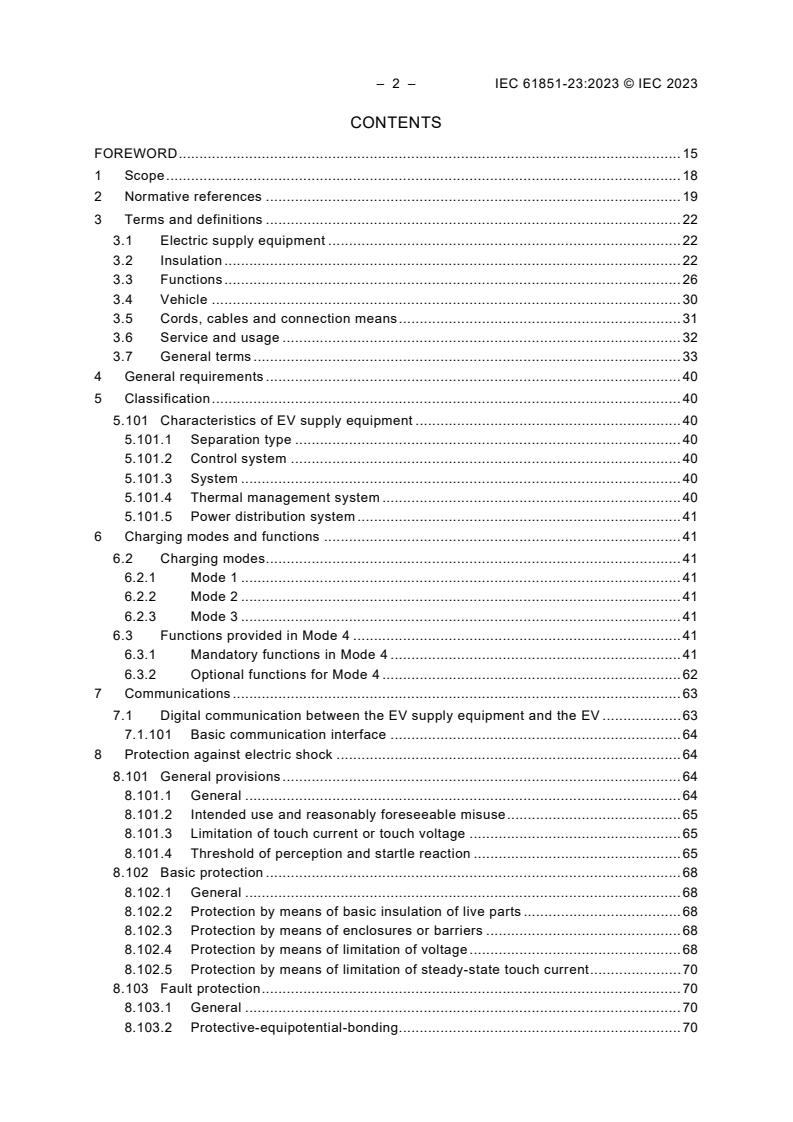
IEC 61851-23:2023 - Electric vehicle conductive charging system - Part 23: DC electric vehicle supply equipment/13/2023
Overview
IEC 61851-23:2023 - "Electric vehicle conductive charging system - Part 23: DC electric vehicle supply equipment" is the 2nd edition (2023) international standard that defines safety, performance and test requirements for DC electric vehicle supply equipment (EVSE). It applies to EV supply equipment with rated maximum voltages at side A up to 1 000 V AC or 1 500 V DC and side B up to 1 500 V DC, and covers system A, system B and system C (see Annex AA/BB/CC). The document updates the 2014 edition and introduces revised electrical safety rules, new test methods, and expanded requirements for bidirectional power transfer (BPT) for system A.
Key Topics and Technical Requirements
- Scope and systems: Specifies EV supply equipment types (system A, B, C) for DC charging and clarifies BPT/RPT coverage (BPT requirements provided for system A; RPT and BPT for systems B/C are under consideration).
- Electrical safety & insulation: Revised protection requirements inspired by IEC 62477-1 and the hazard-based approach of IEC 62368-1, including limits on touch current and touch impulse current (new Annex HH).
- Protection against electric shock: Detailed provisions for basic, fault and enhanced protection, equipotential bonding, residual current protection and separation requirements for multi-side or separated EVSE.
- Construction & tests: New and expanded test methods and compliance procedures (general provisions in Clause 102), including dielectric withstand, impulse overvoltage suppression, temperature rise, damp heat, mechanical strength and abnormal operation tests.
- Cable & connector requirements: Cable assembly strain relief, cable breakaway, surface temperature limits, and short‑circuit/overload protection for charging cables.
- Energy transfer functions: Requirements for bidirectional power transfer control, reverse power transfer considerations, thermal management systems for energy transfer, multi‑side B separated EVSE and communication-driven energy transfer processes (Annexes DD, FF, GG).
- Documentation & marking: Installation and user manual requirements for EV charging stations and EV supply equipment.
Practical Applications and Who Uses This Standard
IEC 61851-23 is essential for:
- Manufacturers of DC fast chargers and EV supply equipment (EVSE) developing compliant products.
- Test laboratories and certification bodies performing type tests and conformity assessments.
- Charging network operators and utilities ensuring safe grid integration and protection coordination.
- EV OEMs and system integrators for interoperability and vehicle-to-grid (V2G)/bidirectional energy exchange considerations.
- Regulators and certification authorities adopting standards into national regulations for EV charging infrastructure.
Keywords: IEC 61851-23, DC electric vehicle supply equipment, EVSE, DC fast charging, bidirectional power transfer, EV charging safety, EV charging standards.
Related Standards
- IEC 61851-1:2017 (structure alignment)
- IEC 62477-1 (electrical safety requirements)
- IEC 62368-1 (hazard-based safety inspiration)
This standard is a core reference for safe, tested and interoperable DC EV charging systems and bidirectional charging implementations.
Relations
- Effective Date
- 25-Aug-2026
- Effective Date
- 05-Sep-2023
- Effective Date
- 05-Sep-2023
Buy Documents
IEC 61851-23:2023 - Electric vehicle conductive charging system - Part 23: DC electric vehicle supply equipment Released:12/13/2023
IEC 61851-23:2023 - Electric vehicle conductive charging system - Part 23: DC electric vehicle supply equipment/13/2023
Get Certified
Connect with accredited certification bodies for this standard

TÜV Rheinland
TÜV Rheinland is a leading international provider of technical services.

TÜV SÜD
TÜV SÜD is a trusted partner of choice for safety, security and sustainability solutions.

DEKRA Certification Inc.
DEKRA US certification services.
Sponsored listings
Frequently Asked Questions
IEC 61851-23:2023 is a standard published by the International Electrotechnical Commission (IEC). Its full title is "Electric vehicle conductive charging system - Part 23: DC electric vehicle supply equipment". This standard covers: IEC 61851-23:2023 applies to the EV supply equipment to provide energy transfer between the supply network and electric vehicles (EVs), with a rated maximum voltage at side A of up to 1 000 V AC or up to 1 500 V DC and a rated maximum voltage at side B up to 1 500 V DC. This document specifies the EV supply equipment of system A, system B and system C as defined in Annex AA, Annex BB and Annex CC. Other systems are under consideration. This document provides the requirements for bidirectional power transfer (BPT) EV supply equipment for system A, with a rated maximum voltage at side A up to 1 000 V AC or 1 500 V DC. The requirements for reverse power transfer (RPT) and BPT for system B and system C are under consideration and are not specified in this document. This second edition cancels and replaces the first edition published in 2014. This edition constitutes a technical revision. This edition includes the following significant technical changes with respect to the previous edition: a) the structure has been rearranged according to IEC 61851-1:2017; b) electrical safety requirements in Clause 8 and Clause 12 have been revised based on the requirements in IEC 62477-1 and inspired by the hazard based safety approach of IEC 62368-1; c) test methods for checking conformity to the stated requirements have been mostly added; general provisions for compliance tests have been specified in Clause 102; d) specific requirements and/or information for the following functions have been added: energy transfer with thermal management system (101.2), bi-directional power transfer control (Annex DD), multi- side B separated EV supply equipment (Annex FF), and communication and energy transfer process (Annex GG); e) Annex AA (system A), Annex BB (system B) and Annex CC (system C) have been updated including additions in conjunction with b) and c). This document has been limited to be applicable to system A, system B and system C; f) the former Annex DD and Annex EE have been deleted. A new Annex EE, with the requirements for the artificial test load, has been added. g) a new informative annex for the touch current and the touch impulse current (Annex HH) has been added
IEC 61851-23:2023 applies to the EV supply equipment to provide energy transfer between the supply network and electric vehicles (EVs), with a rated maximum voltage at side A of up to 1 000 V AC or up to 1 500 V DC and a rated maximum voltage at side B up to 1 500 V DC. This document specifies the EV supply equipment of system A, system B and system C as defined in Annex AA, Annex BB and Annex CC. Other systems are under consideration. This document provides the requirements for bidirectional power transfer (BPT) EV supply equipment for system A, with a rated maximum voltage at side A up to 1 000 V AC or 1 500 V DC. The requirements for reverse power transfer (RPT) and BPT for system B and system C are under consideration and are not specified in this document. This second edition cancels and replaces the first edition published in 2014. This edition constitutes a technical revision. This edition includes the following significant technical changes with respect to the previous edition: a) the structure has been rearranged according to IEC 61851-1:2017; b) electrical safety requirements in Clause 8 and Clause 12 have been revised based on the requirements in IEC 62477-1 and inspired by the hazard based safety approach of IEC 62368-1; c) test methods for checking conformity to the stated requirements have been mostly added; general provisions for compliance tests have been specified in Clause 102; d) specific requirements and/or information for the following functions have been added: energy transfer with thermal management system (101.2), bi-directional power transfer control (Annex DD), multi- side B separated EV supply equipment (Annex FF), and communication and energy transfer process (Annex GG); e) Annex AA (system A), Annex BB (system B) and Annex CC (system C) have been updated including additions in conjunction with b) and c). This document has been limited to be applicable to system A, system B and system C; f) the former Annex DD and Annex EE have been deleted. A new Annex EE, with the requirements for the artificial test load, has been added. g) a new informative annex for the touch current and the touch impulse current (Annex HH) has been added
IEC 61851-23:2023 is classified under the following ICS (International Classification for Standards) categories: 31.240 - Mechanical structures for electronic equipment; 43.120 - Electric road vehicles. The ICS classification helps identify the subject area and facilitates finding related standards.
IEC 61851-23:2023 has the following relationships with other standards: It is inter standard links to EN ISO 15118-21:2025, IEC 61851-23:2014, IEC 61851-23:2014/COR1:2016. Understanding these relationships helps ensure you are using the most current and applicable version of the standard.
IEC 61851-23:2023 is available in PDF format for immediate download after purchase. The document can be added to your cart and obtained through the secure checkout process. Digital delivery ensures instant access to the complete standard document.
Standards Content (Sample)
IEC 61851-23 ®
Edition 2.0 2023-12
INTERNATIONAL
STANDARD
colour
inside
Electric vehicle conductive charging system –
Part 23: DC electric vehicle supply equipment
All rights reserved. Unless otherwise specified, no part of this publication may be reproduced or utilized in any form
or by any means, electronic or mechanical, including photocopying and microfilm, without permission in writing from
either IEC or IEC's member National Committee in the country of the requester. If you have any questions about IEC
copyright or have an enquiry about obtaining additional rights to this publication, please contact the address below or
your local IEC member National Committee for further information.
IEC Secretariat Tel.: +41 22 919 02 11
3, rue de Varembé info@iec.ch
CH-1211 Geneva 20 www.iec.ch
Switzerland
About the IEC
The International Electrotechnical Commission (IEC) is the leading global organization that prepares and publishes
International Standards for all electrical, electronic and related technologies.
About IEC publications
The technical content of IEC publications is kept under constant review by the IEC. Please make sure that you have the
latest edition, a corrigendum or an amendment might have been published.
IEC publications search - webstore.iec.ch/advsearchform IEC Products & Services Portal - products.iec.ch
The advanced search enables to find IEC publications by a Discover our powerful search engine and read freely all the
variety of criteria (reference number, text, technical publications previews. With a subscription you will always have
committee, …). It also gives information on projects, replaced access to up to date content tailored to your needs.
and withdrawn publications.
Electropedia - www.electropedia.org
IEC Just Published - webstore.iec.ch/justpublished
The world's leading online dictionary on electrotechnology,
Stay up to date on all new IEC publications. Just Published
containing more than 22 300 terminological entries in English
details all new publications released. Available online and once
and French, with equivalent terms in 19 additional languages.
a month by email.
Also known as the International Electrotechnical Vocabulary
(IEV) online.
IEC Customer Service Centre - webstore.iec.ch/csc
If you wish to give us your feedback on this publication or need
further assistance, please contact the Customer Service
Centre: sales@iec.ch.
IEC 61851-23 ®
Edition 2.0 2023-12
INTERNATIONAL
STANDARD
colour
inside
Electric vehicle conductive charging system –
Part 23: DC electric vehicle supply equipment
INTERNATIONAL
ELECTROTECHNICAL
COMMISSION
ICS 43.120 ISBN 978-2-8322-7961-8
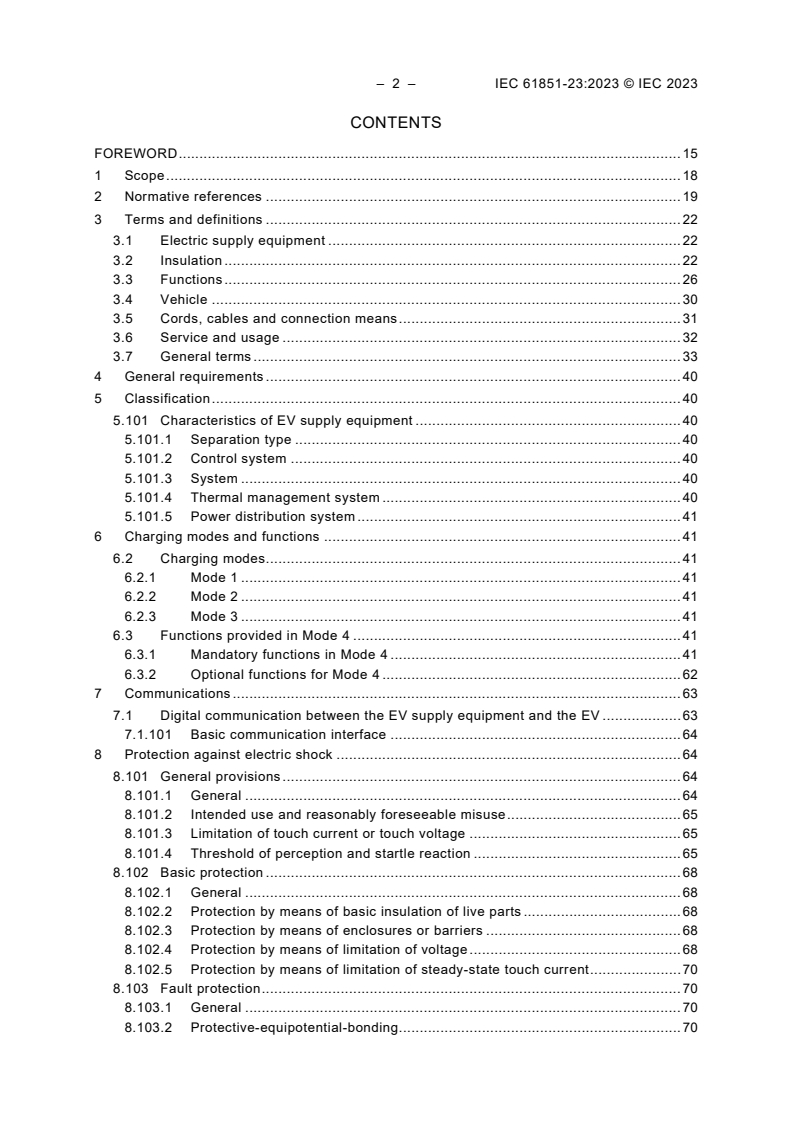
– 2 – IEC 61851-23:2023 © IEC 2023
CONTENTS
FOREWORD . 15
1 Scope . 18
2 Normative references . 19
3 Terms and definitions . 22
3.1 Electric supply equipment . 22
3.2 Insulation . 22
3.3 Functions . 26
3.4 Vehicle . 30
3.5 Cords, cables and connection means . 31
3.6 Service and usage . 32
3.7 General terms . 33
4 General requirements . 40
5 Classification . 40
5.101 Characteristics of EV supply equipment . 40
5.101.1 Separation type . 40
5.101.2 Control system . 40
5.101.3 System . 40
5.101.4 Thermal management system . 40
5.101.5 Power distribution system . 41
6 Charging modes and functions . 41
6.2 Charging modes . 41
6.2.1 Mode 1 . 41
6.2.2 Mode 2 . 41
6.2.3 Mode 3 . 41
6.3 Functions provided in Mode 4 . 41
6.3.1 Mandatory functions in Mode 4 . 41
6.3.2 Optional functions for Mode 4 . 62
7 Communications . 63
7.1 Digital communication between the EV supply equipment and the EV . 63
7.1.101 Basic communication interface . 64
8 Protection against electric shock . 64
8.101 General provisions . 64
8.101.1 General . 64
8.101.2 Intended use and reasonably foreseeable misuse . 65
8.101.3 Limitation of touch current or touch voltage . 65
8.101.4 Threshold of perception and startle reaction . 65
8.102 Basic protection . 68
8.102.1 General . 68
8.102.2 Protection by means of basic insulation of live parts . 68
8.102.3 Protection by means of enclosures or barriers . 68
8.102.4 Protection by means of limitation of voltage . 68
8.102.5 Protection by means of limitation of steady-state touch current . 70
8.103 Fault protection . 70
8.103.1 General . 70
8.103.2 Protective-equipotential-bonding. 70
8.103.3 Effective protective conductor continuity between the enclosure and the
external protective circuit . 70
8.103.4 Automatic disconnection of supply . 71
8.103.5 Supplementary insulation. 71
8.103.6 Electrically protective screening . 71
8.104 Enhanced protective provision . 71
8.104.1 General . 71
8.104.2 Double or reinforced insulation . 71
8.104.3 Protective separation between circuits . 72
8.105 Requirements for separated EV supply equipment . 72
8.105.1 General . 72
8.105.2 Equipotential bonding on side B . 74
8.105.3 Impedance to protective conductor on side B . 74
8.105.4 Degrees of protection against access to hazardous-live-parts . 75
8.105.5 Insulation barriers . 76
8.105.6 Stored energy . 77
8.105.7 Disconnection from vehicle . 78
8.105.8 Protective (earthing) conductor from the supply network . 78
8.105.9 Residual current protective devices . 79
8.105.10 Safety requirements for auxiliary circuits between the EV supply
equipment and the EV . 79
8.105.11 Protective conductor dimension cross-sectional area . 79
9 Conductive electrical interface requirements. 80
9.1 General . 80
9.5 Functional description of the DC interface . 80
9.7 Wiring of the neutral conductor . 80
9.101 Avoidance of breaking under load . 80
10 Requirements for adaptors . 81
11 Cable assembly requirements . 82
11.1 General . 82
11.6 Strain relief . 82
11.6.101 Strain relief of the EV supply equipment's side B cable assembly . 82
11.6.102 Test of the anchorage of the side B cable assembly . 83
11.101 Cable breakaway . 85
11.102 Surface temperature of the side B cable assembly . 85
12 EV supply equipment constructional requirements and tests . 87
12.1 General . 87
12.2 Characteristics of mechanical switching devices . 87
12.2.5 Relays . 87
12.3 Clearances and creepage distances. 87
12.4 IP degrees . 87
12.4.1 Degrees of protection against solid foreign objects and water for the
enclosures . 87
12.5 Insulation resistance . 88
12.6 Touch current . 88
12.6.101 Touch current limit . 88
12.6.102 Test . 88
12.6.103 Protection measures for the test touch current more than 3,5 mA . 89
12.7 Dielectric withstand voltage . 90
– 4 – IEC 61851-23:2023 © IEC 2023
12.7.2 Impulse dielectric withstand (1,2 μs/50 μs) . 90
12.7.101 Suppression of transient overvoltage at side A (insulation coordination) . 90
12.7.102 Protection against transient overvoltages of atmospheric origin or due
to switching . 92
12.8 Temperature rise . 94
12.9 Damp heat functional test . 94
12.10 Minimum temperature functional test . 94
12.11 Mechanical strength . 94
12.101 Side A current . 95
12.102 Power supply cords . 96
12.102.1 General . 96
12.102.2 Cross-sectional area . 96
12.102.3 Cord anchorages and strain relief for non-detachable power supply
cords . 97
12.103 Stress relief test . 98
12.104 Abnormal operation and simulated fault condition tests . 99
12.104.1 General . 99
12.104.2 Pass criteria . 99
12.104.3 Breakdown of components test . 100
12.104.4 Loss of AC supply phase test . 100
12.104.5 Inoperative blower/fan motor test . 100
12.104.6 Clogged filter test . 101
12.105 Protection against electrically caused fire . 101
12.105.1 General . 101
12.105.2 Fire enclosure . 101
12.106 Protection against chemical hazards . 101
12.106.1 Type of coolant . 101
12.106.2 Flammability . 102
12.106.3 Material compatibility . 102
12.107 Enclosures . 102
12.107.1 General . 102
12.107.2 Strength of materials and parts . 103
12.107.3 Enclosure integrity tests . 103
12.108 Components bridging insulation . 103
12.108.1 General . 103
12.108.2 Capacitors . 104
12.109 Isolating transformers . 104
13 Overload and short-circuit protection . 104
13.1 General . 104
13.2 Overload protection of the cable assembly . 104
13.3 Short-circuit protection of the charging cable . 104
13.101 Short-circuit protection of the DC connection during energy transfer . 105
14 Automatic reclosing of protective devices . 106
15 Emergency switching or disconnect (optional) . 106
16 Marking and instructions . 106
16.1 Installation manual of EV charging stations . 106
16.2 User manual for EV supply equipment . 107
16.3 Marking of EV supply equipment . 108
16.4 Marking of charging cable assemblies case B . 108
101 Specific requirements for EV supply equipment . 108
101.1 Specific requirements for separated EV supply equipment . 108
101.1.1 Operating ranges for voltage, current, and power at side B. 108
101.1.2 Voltage and current tolerance at side B . 109
101.1.3 Control delay of present current at side B in CCM . 111
101.1.4 Descending rate of present current at side B . 114
101.1.5 Periodic and random deviation (current ripple at side B during CCM) . 114
101.1.6 Periodic and random deviation (voltage ripple at side B during CVM) . 115
101.1.7 Load dump . 117
101.1.8 Side B inductance . 117
101.2 Specific requirement for energy transfer with a thermal management system
or thermal sensing only . 118
101.2.1 General . 118
101.2.2 Temperature limits and self-diagnostics . 118
101.2.3 Temperature monitoring . 119
101.2.4 Tests for thermal management system performance of the EV supply
equipment . 120
101.3 Specific requirements for temperature-controlled energy transfer . 129
102 Test methods . 130
102.1 Technical data . 130
102.2 General test conditions . 130
102.2.1 Ambient test conditions. 130
102.2.2 Measuring instruments . 131
102.2.3 Test setups . 131
102.2.4 Test load . 134
102.2.5 Operating points for tests . 136
Annexes . 138
Annex AA (normative) EV supply equipment of system A . 139
AA.1 General . 139
AA.2 Circuit diagram . 139
AA.3 Specific safety requirements . 142
AA.3.1 Fault protection in side B . 142
AA.3.2 De-energization of the power supply to the EV . 146
AA.3.3 Voltage measurement of side B live parts (DC+/DC–) for vehicle
connector unlatch . 147
AA.3.4 Overcurrent protection of side B . 147
AA.3.5 Short-circuit protection of side B . 147
AA.3.6 Latch monitoring for the vehicle connector . 148
AA.3.7 Protection of the EV disconnection device . 149
AA.3.8 Fault conditions and criteria for transfer to error and emergency
shutdown . 149
AA.3.9 Inrush current limitation by the EV supply equipment . 154
AA.3.10 Regulation of the present current at side B in CCM . 155
AA.3.11 Periodic and random deviation (current ripple at side B during CCM) . 156
AA.3.12 Overvoltage protection including load dump . 157
AA.3.13 Power supply to the EV for the actuation of EV disconnection device . 158
AA.3.14 Impedance of the side B circuit . 158
AA.3.15 Assistance of welding detection . 158
AA.3.16 Specific requirements for temperature-controlled energy transfer . 159
– 6 – IEC 61851-23:2023 © IEC 2023
AA.4 FPT process and communication between the EV supply equipment and the
EV for energy transfer control . 159
AA.4.1 Forward power transfer states . 159
AA.4.2 Communication measures . 161
AA.4.3 Forward power transfer control process . 162
AA.4.4 Measuring current and voltage at side B . 168
AA.5 Response to an EV command on charge current . 170
AA.6 Bidirectional power transfer (optional) . 172
AA.6.1 General . 172
AA.6.2 Circuit diagram . 172
AA.6.3 Functional requirements . 174
AA.6.4 Bidirectional power transfer control process. 176
AA.7 Optional functions . 181
AA.7.1 General . 181
AA.7.2 Compatibility check . 181
AA.7.3 Dynamic control . 181
AA.7.4 High-current control . 182
AA.7.5 High-voltage control. 182
AA.8 Compliance test for user-initiated shutdown . 182
AA.9 Specific requirement for energy transfer with thermal management system . 183
Annex BB (normative) EV supply equipment of system B . 184
BB.1 General . 184
BB.2 Circuit diagrams . 184
BB.2.1 Circuit diagram . 184
BB.2.2 Requirements of IMD and discharge circuit . 186
BB.3 Parameters of control pilot circuit . 186
BB.4 Forward power transfer control process under normal condition . 187
BB.4.1 Side B regulation . 187
BB.4.2 Measuring current and voltage . 187
BB.4.3 Vehicle coupler mating confirmation . 189
BB.4.4 Forward power transfer control sequence . 189
BB.4.5 Normal shutdown . 191
BB.5 Safety requirements under failure mode . 191
BB.5.1 Error shutdown and emergency shutdown. 191
BB.5.2 Terminate energy transfer due to an EV supply equipment fault. 193
BB.5.3 Terminate energy transfer due to an EV fault . 194
BB.5.4 Digital communication timeout . 194
BB.5.5 Loss of electrical continuity of the control pilot . 195
BB.5.6 Overvoltage fault . 195
BB.5.7 Load dump . 196
BB.5.8 Short-circuit protection of side B . 197
BB.5.9 Lock and latch monitoring for vehicle connector . 198
BB.5.10 Overcurrent protection of side B . 198
BB.5.11 Insulation fault monitoring . 198
BB.6 Timing sequence diagram of forward power transfer . 199
BB.7 Side B current regulation in CCM . 200
BB.8 Insulation resistance check before energy transfer. 202
BB.9 Side B voltage regulation in CVM . 204
BB.10 Periodic and random deviation (voltage ripple at side B in CVM) . 206
BB.11 Energy transfer control mode . 206
BB.11.1 Definition . 206
BB.11.2 Typical forward power transfer process . 207
BB.12 Standby mode . 208
BB.13 Smart charging . 209
BB.14 Minimum cross-sectional area of the protective conductor . 209
Annex CC (normative) EV supply equipment of system C . 210
CC.1 General . 210
CC.2 Circuit diagrams . 210
CC.2.1 General . 210
CC.2.2 Circuit diagram for configuration EE . 210
CC.2.3 Circuit diagram for configuration FF . 213
CC.2.4 Disabled side B . 216
CC.3 Process of energy transfer . 217
CC.3.1 General . 217
CC.3.2 Normal startup . 219
CC.3.3 Normal shutdown or pause after energy transfer . 225
CC.3.4 Error and emergency handling . 229
CC.3.5 Pause by EV supply equipment using ISO 15118-2:2014 . 241
CC.3.6 Renegotiation initiated by EV or EV supply equipment using ISO 15118-
2:2014 . 251
CC.4 Safety related functions . 255
CC.4.1 Safety measures for side B . 255
CC.4.2 Vehicle coupler latching function . 259
CC.4.3 Loss of electrical continuity of the control pilot conductor . 259
CC.4.4 Loss of electrical continuity of the proximity detection conductor . 259
CC.4.5 Voltage check at initialization . 259
CC.4.6 Minimum cross-sectional area of the protective conductor . 259
CC.4.7 Loss of electrical continuity of the protective conductor . 259
CC.5 Additional functions. 260
CC.5.1 Pre-charge . 260
CC.5.2 Sleep mode and communication session restart methods . 262
CC.5.3 Configuration EE vehicle connector latch position switch (S 3)
S
activation . 269
CC.5.4 Configuration EE vehicle connector latch position switch (S 3)
S
verification . 269
CC.5.5 Handling of operating ranges . 270
CC.5.6 Compatibility check . 277
CC.5.7 Considerations for CCM, CVM and CPM (informative) . 281
CC.6 Specific requirements . 283
CC.6.1 Requirements for load dump . 283
CC.6.2 Side B current regulation . 283
CC.6.3 Measuring current and voltage at side B . 283
CC.6.4 Overcurrent protection of side B . 284
CC.7 General test conditions . 284
CC.7.1 Operating points – Definitions . 284
CC.7.2 Standard test setup . 286
CC.7.3 Definition of measured values at side B . 286
CC.7.4 Exemplary approach to set a test point in CCM . 286
– 8 – IEC 61851-23:2023 © IEC 2023
CC.7.5 Test cases . 289
CC.7.6 Wake up of EV supply equipment by EV . 293
Annex DD (informative) Bidirectional power transfer control . 354
DD.1 General . 354
DD.2 Forward power transfer (FPT) and reverse power transfer (RPT) . 354
Annex EE (normative) Test load impedance verification . 355
EE.1 General . 355
EE.2 Response curve verification . 355
EE.3 Test setup for test load verification (informative) . 358
EE.4 Result . 359
Annex FF (normative) Multi-side B separated EV supply equipment . 360
FF.1 General . 360
FF.2 Classification and use case of multi-side B EV supply equipment . 360
FF.2.1 System operation . 360
FF.2.2 Side B system . 360
FF.2.3 Configuration . 360
FF.3 Constructional requirements of a side B system . 363
FF.3.1 Constructional requirements of a side B system according to Annex AA . 363
FF.3.2 Constructional requirements of a side B system according to Annex BB . 364
FF.3.3 Constructional requirements of a side B system according to Annex CC . 364
FF.4 Side B system performance . 364
FF.4.1 General performance requirements . 364
FF.4.2 Performance of multi-side B EV supply equipment providing
simultaneous operation . 364
FF.5 Safety requirements . 364
FF.5.1 General safety requirements . 364
FF.5.2 Short-circuit protection . 365
FF.5.3 Overload protection . 365
FF.5.4 Access to live parts through an unmated vehicle connector during
energy transfer . 365
FF.5.5 Additional safety requirements for multi-side B EV supply equipment
providing simultaneous operation . 366
FF.5.6 Diagnostic check of mechanical disconnection device in the side B
system . 366
FF.5.7 Interconnected side B live parts (DC+/DC–) in multi-side B EV supply
equipment . 366
Annex GG (informative) Communication and energy transfer process between the EV
supply equipment and the EV . 367
GG.1 General . 367
GG.2 System configuration . 367
GG.3 Energy transfer control process and state . 367
GG.3.1 General . 367
GG.3.2 Description of the initialization stage . 368
GG.3.3 Description of the energy transfer stage . 368
GG.3.4 Description of the shutdown stage . 369
Annex HH (informative) Touch current and touch impulse current . 370
HH.1 General . 370
HH.2 Current through the human body . 375
HH.3 Conditional dependent thresholds . 376
HH.4 Hazards due to leakage between side B live parts and the protective
conductor . 376
HH.5 Balanced versus unbalanced voltages at side B live parts (DC+/DC–) . 377
HH.6 Insulation monitoring device. 378
HH.7 IMD reaction time . 379
HH.8 Conclusion . 379
Bibliography . 380
Figure 101 – Example of a coupling session . 27
Figure 102 – Voltage V 8 to apply to simulate short period overvoltage at side B
T
between DC+ and DC– . 52
Figure 103 – Typical voltages between side B live parts (DC+/DC–) and protective
conductor under normal operation . 55
Figure 104 – IMD connection which results in a voltage more than the maximum
voltage limits . 56
Figure 105 – Examples of a fault between the secondary circuit and the protective
conductor . 59
Figure 106 – Measurement of the touch leakage current . 67
Figure 107 – Touch time – DC voltage under single fault condition (water wet, fingertip
to feet) . 69
Figure 108 – Insulation barriers . 76
Figure 109 – Construction types of vehicle adapters . 81
Figure 110 – Apparatus to test the side B cable assembly anchorage . 83
Figure 111 – Test setup the side B cable assembly anchorage .
...
IEC 61851-23 ®
Edition 2.0 2023-12
INTERNATIONAL
STANDARD
NORME
INTERNATIONALE
Electric vehicle conductive charging system –
Part 23: DC electric vehicle supply equipment
Système de charge par conduction pour véhicules électriques –
Partie 23: Système d'alimentation en courant continu pour véhicules électriques
All rights reserved. Unless otherwise specified, no part of this publication may be reproduced or utilized in any form
or by any means, electronic or mechanical, including photocopying and microfilm, without permission in writing from
either IEC or IEC's member National Committee in the country of the requester. If you have any questions about IEC
copyright or have an enquiry about obtaining additional rights to this publication, please contact the address below or
your local IEC member National Committee for further information.
Droits de reproduction réservés. Sauf indication contraire, aucune partie de cette publication ne peut être reproduite ni
utilisée sous quelque forme que ce soit et par aucun procédé, électronique ou mécanique, y compris la photocopie et
les microfilms, sans l'accord écrit de l'IEC ou du Comité national de l'IEC du pays du demandeur. Si vous avez des
questions sur le copyright de l'IEC ou si vous désirez obtenir des droits supplémentaires sur cette publication, utilisez
les coordonnées ci-après ou contactez le Comité national de l'IEC de votre pays de résidence.
IEC Secretariat Tel.: +41 22 919 02 11
3, rue de Varembé info@iec.ch
CH-1211 Geneva 20 www.iec.ch
Switzerland
About the IEC
The International Electrotechnical Commission (IEC) is the leading global organization that prepares and publishes
International Standards for all electrical, electronic and related technologies.
About IEC publications
The technical content of IEC publications is kept under constant review by the IEC. Please make sure that you have the
latest edition, a corrigendum or an amendment might have been published.
IEC publications search - webstore.iec.ch/advsearchform IEC Products & Services Portal - products.iec.ch
The advanced search enables to find IEC publications by a Discover our powerful search engine and read freely all the
variety of criteria (reference number, text, technical publications previews, graphical symbols and the glossary.
committee, …). It also gives information on projects, replaced With a subscription you will always have access to up to date
and withdrawn publications. content tailored to your needs.
IEC Just Published - webstore.iec.ch/justpublished
Electropedia - www.electropedia.org
Stay up to date on all new IEC publications. Just Published
The world's leading online dictionary on electrotechnology,
details all new publications released. Available online and once
containing more than 22 500 terminological entries in English
a month by email.
and French, with equivalent terms in 25 additional languages.
Also known as the International Electrotechnical Vocabulary
IEC Customer Service Centre - webstore.iec.ch/csc
(IEV) online.
If you wish to give us your feedback on this publication or need
further assistance, please contact the Customer Service
Centre: sales@iec.ch.
A propos de l'IEC
La Commission Electrotechnique Internationale (IEC) est la première organisation mondiale qui élabore et publie des
Normes internationales pour tout ce qui a trait à l'électricité, à l'électronique et aux technologies apparentées.
A propos des publications IEC
Le contenu technique des publications IEC est constamment revu. Veuillez vous assurer que vous possédez l’édition la
plus récente, un corrigendum ou amendement peut avoir été publié.
Recherche de publications IEC - IEC Products & Services Portal - products.iec.ch
webstore.iec.ch/advsearchform Découvrez notre puissant moteur de recherche et consultez
La recherche avancée permet de trouver des publications IEC gratuitement tous les aperçus des publications, symboles
en utilisant différents critères (numéro de référence, texte, graphiques et le glossaire. Avec un abonnement, vous aurez
comité d’études, …). Elle donne aussi des informations sur les toujours accès à un contenu à jour adapté à vos besoins.
projets et les publications remplacées ou retirées.
Electropedia - www.electropedia.org
IEC Just Published - webstore.iec.ch/justpublished
Le premier dictionnaire d'électrotechnologie en ligne au monde,
Restez informé sur les nouvelles publications IEC. Just
avec plus de 22 500 articles terminologiques en anglais et en
Published détaille les nouvelles publications parues.
français, ainsi que les termes équivalents dans 25 langues
Disponible en ligne et une fois par mois par email.
additionnelles. Egalement appelé Vocabulaire
Electrotechnique International (IEV) en ligne.
Service Clients - webstore.iec.ch/csc
Si vous désirez nous donner des commentaires sur cette
publication ou si vous avez des questions contactez-nous:
sales@iec.ch.
IEC 61851-23 ®
Edition 2.0 2023-12
INTERNATIONAL
STANDARD
NORME
INTERNATIONALE
Electric vehicle conductive charging system –
Part 23: DC electric vehicle supply equipment
Système de charge par conduction pour véhicules électriques –
Partie 23: Système d'alimentation en courant continu pour véhicules électriques
INTERNATIONAL
ELECTROTECHNICAL
COMMISSION
COMMISSION
ELECTROTECHNIQUE
INTERNATIONALE
ICS 43.120 ISBN 978-2-8322-8868-9
– 2 – IEC 61851-23:2023 © IEC 2023
CONTENTS
FOREWORD . 15
1 Scope . 18
2 Normative references . 19
3 Terms and definitions . 22
3.1 Electric supply equipment . 22
3.2 Insulation . 22
3.3 Functions . 26
3.4 Vehicle . 30
3.5 Cords, cables and connection means . 31
3.6 Service and usage . 32
3.7 General terms . 33
4 General requirements . 40
5 Classification . 40
5.101 Characteristics of EV supply equipment . 40
5.101.1 Separation type . 40
5.101.2 Control system . 40
5.101.3 System . 40
5.101.4 Thermal management system . 40
5.101.5 Power distribution system . 41
6 Charging modes and functions . 41
6.2 Charging modes . 41
6.2.1 Mode 1 . 41
6.2.2 Mode 2 . 41
6.2.3 Mode 3 . 41
6.3 Functions provided in Mode 4 . 41
6.3.1 Mandatory functions in Mode 4 . 41
6.3.2 Optional functions for Mode 4 . 62
7 Communications . 63
7.1 Digital communication between the EV supply equipment and the EV . 63
7.1.101 Basic communication interface . 64
8 Protection against electric shock . 64
8.101 General provisions . 64
8.101.1 General . 64
8.101.2 Intended use and reasonably foreseeable misuse . 65
8.101.3 Limitation of touch current or touch voltage . 65
8.101.4 Threshold of perception and startle reaction . 65
8.102 Basic protection . 68
8.102.1 General . 68
8.102.2 Protection by means of basic insulation of live parts . 68
8.102.3 Protection by means of enclosures or barriers . 68
8.102.4 Protection by means of limitation of voltage . 68
8.102.5 Protection by means of limitation of steady-state touch current . 70
8.103 Fault protection . 70
8.103.1 General . 70
8.103.2 Protective-equipotential-bonding. 70
8.103.3 Effective protective conductor continuity between the enclosure and the
external protective circuit . 70
8.103.4 Automatic disconnection of supply . 71
8.103.5 Supplementary insulation. 71
8.103.6 Electrically protective screening . 71
8.104 Enhanced protective provision . 71
8.104.1 General . 71
8.104.2 Double or reinforced insulation . 71
8.104.3 Protective separation between circuits . 72
8.105 Requirements for separated EV supply equipment . 72
8.105.1 General . 72
8.105.2 Equipotential bonding on side B . 74
8.105.3 Impedance to protective conductor on side B . 74
8.105.4 Degrees of protection against access to hazardous-live-parts . 75
8.105.5 Insulation barriers . 76
8.105.6 Stored energy . 77
8.105.7 Disconnection from vehicle . 78
8.105.8 Protective (earthing) conductor from the supply network . 78
8.105.9 Residual current protective devices . 79
8.105.10 Safety requirements for auxiliary circuits between the EV supply
equipment and the EV . 79
8.105.11 Protective conductor dimension cross-sectional area . 79
9 Conductive electrical interface requirements. 80
9.1 General . 80
9.5 Functional description of the DC interface . 80
9.7 Wiring of the neutral conductor . 80
9.101 Avoidance of breaking under load . 80
10 Requirements for adaptors . 81
11 Cable assembly requirements . 82
11.1 General . 82
11.6 Strain relief . 82
11.6.101 Strain relief of the EV supply equipment's side B cable assembly . 82
11.6.102 Test of the anchorage of the side B cable assembly . 83
11.101 Cable breakaway . 85
11.102 Surface temperature of the side B cable assembly . 85
12 EV supply equipment constructional requirements and tests . 87
12.1 General . 87
12.2 Characteristics of mechanical switching devices . 87
12.2.5 Relays . 87
12.3 Clearances and creepage distances. 87
12.4 IP degrees . 87
12.4.1 Degrees of protection against solid foreign objects and water for the
enclosures . 87
12.5 Insulation resistance . 88
12.6 Touch current . 88
12.6.101 Touch current limit . 88
12.6.102 Test . 88
12.6.103 Protection measures for the test touch current more than 3,5 mA . 89
12.7 Dielectric withstand voltage . 90
– 4 – IEC 61851-23:2023 © IEC 2023
12.7.2 Impulse dielectric withstand (1,2 μs/50 μs) . 90
12.7.101 Suppression of transient overvoltage at side A (insulation coordination) . 90
12.7.102 Protection against transient overvoltages of atmospheric origin or due
to switching . 92
12.8 Temperature rise . 94
12.9 Damp heat functional test . 94
12.10 Minimum temperature functional test . 94
12.11 Mechanical strength . 94
12.101 Side A current . 95
12.102 Power supply cords . 96
12.102.1 General . 96
12.102.2 Cross-sectional area . 96
12.102.3 Cord anchorages and strain relief for non-detachable power supply
cords . 97
12.103 Stress relief test . 98
12.104 Abnormal operation and simulated fault condition tests . 99
12.104.1 General . 99
12.104.2 Pass criteria . 99
12.104.3 Breakdown of components test . 100
12.104.4 Loss of AC supply phase test . 100
12.104.5 Inoperative blower/fan motor test . 100
12.104.6 Clogged filter test . 101
12.105 Protection against electrically caused fire . 101
12.105.1 General . 101
12.105.2 Fire enclosure . 101
12.106 Protection against chemical hazards . 101
12.106.1 Type of coolant . 101
12.106.2 Flammability . 102
12.106.3 Material compatibility . 102
12.107 Enclosures . 102
12.107.1 General . 102
12.107.2 Strength of materials and parts . 103
12.107.3 Enclosure integrity tests . 103
12.108 Components bridging insulation . 103
12.108.1 General . 103
12.108.2 Capacitors . 104
12.109 Isolating transformers . 104
13 Overload and short-circuit protection . 104
13.1 General . 104
13.2 Overload protection of the cable assembly . 104
13.3 Short-circuit protection of the charging cable . 104
13.101 Short-circuit protection of the DC connection during energy transfer . 105
14 Automatic reclosing of protective devices . 106
15 Emergency switching or disconnect (optional) . 106
16 Marking and instructions . 106
16.1 Installation manual of EV charging stations . 106
16.2 User manual for EV supply equipment . 107
16.3 Marking of EV supply equipment . 108
16.4 Marking of charging cable assemblies case B . 108
101 Specific requirements for EV supply equipment . 108
101.1 Specific requirements for separated EV supply equipment . 108
101.1.1 Operating ranges for voltage, current, and power at side B. 108
101.1.2 Voltage and current tolerance at side B . 109
101.1.3 Control delay of present current at side B in CCM . 111
101.1.4 Descending rate of present current at side B . 114
101.1.5 Periodic and random deviation (current ripple at side B during CCM) . 114
101.1.6 Periodic and random deviation (voltage ripple at side B during CVM) . 115
101.1.7 Load dump . 117
101.1.8 Side B inductance . 117
101.2 Specific requirement for energy transfer with a thermal management system
or thermal sensing only . 118
101.2.1 General . 118
101.2.2 Temperature limits and self-diagnostics . 118
101.2.3 Temperature monitoring . 119
101.2.4 Tests for thermal management system performance of the EV supply
equipment . 120
101.3 Specific requirements for temperature-controlled energy transfer . 129
102 Test methods . 130
102.1 Technical data . 130
102.2 General test conditions . 130
102.2.1 Ambient test conditions. 130
102.2.2 Measuring instruments . 131
102.2.3 Test setups . 131
102.2.4 Test load . 134
102.2.5 Operating points for tests . 136
Annexes . 138
Annex AA (normative) EV supply equipment of system A . 139
AA.1 General . 139
AA.2 Circuit diagram . 139
AA.3 Specific safety requirements . 142
AA.3.1 Fault protection in side B . 142
AA.3.2 De-energization of the power supply to the EV . 146
AA.3.3 Voltage measurement of side B live parts (DC+/DC–) for vehicle
connector unlatch . 147
AA.3.4 Overcurrent protection of side B . 147
AA.3.5 Short-circuit protection of side B . 147
AA.3.6 Latch monitoring for the vehicle connector . 148
AA.3.7 Protection of the EV disconnection device . 149
AA.3.8 Fault conditions and criteria for transfer to error and emergency
shutdown . 149
AA.3.9 Inrush current limitation by the EV supply equipment . 154
AA.3.10 Regulation of the present current at side B in CCM . 155
AA.3.11 Periodic and random deviation (current ripple at side B during CCM) . 156
AA.3.12 Overvoltage protection including load dump . 157
AA.3.13 Power supply to the EV for the actuation of EV disconnection device . 158
AA.3.14 Impedance of the side B circuit . 158
AA.3.15 Assistance of welding detection . 158
AA.3.16 Specific requirements for temperature-controlled energy transfer . 159
– 6 – IEC 61851-23:2023 © IEC 2023
AA.4 FPT process and communication between the EV supply equipment and the
EV for energy transfer control . 159
AA.4.1 Forward power transfer states . 159
AA.4.2 Communication measures . 161
AA.4.3 Forward power transfer control process . 162
AA.4.4 Measuring current and voltage at side B . 168
AA.5 Response to an EV command on charge current . 170
AA.6 Bidirectional power transfer (optional) . 172
AA.6.1 General . 172
AA.6.2 Circuit diagram . 172
AA.6.3 Functional requirements . 174
AA.6.4 Bidirectional power transfer control process. 176
AA.7 Optional functions . 181
AA.7.1 General . 181
AA.7.2 Compatibility check . 181
AA.7.3 Dynamic control . 181
AA.7.4 High-current control . 182
AA.7.5 High-voltage control. 182
AA.8 Compliance test for user-initiated shutdown . 182
AA.9 Specific requirement for energy transfer with thermal management system . 183
Annex BB (normative) EV supply equipment of system B . 184
BB.1 General . 184
BB.2 Circuit diagrams . 184
BB.2.1 Circuit diagram . 184
BB.2.2 Requirements of IMD and discharge circuit . 186
BB.3 Parameters of control pilot circuit . 186
BB.4 Forward power transfer control process under normal condition . 187
BB.4.1 Side B regulation . 187
BB.4.2 Measuring current and voltage . 187
BB.4.3 Vehicle coupler mating confirmation . 189
BB.4.4 Forward power transfer control sequence . 189
BB.4.5 Normal shutdown . 191
BB.5 Safety requirements under failure mode . 191
BB.5.1 Error shutdown and emergency shutdown. 191
BB.5.2 Terminate energy transfer due to an EV supply equipment fault. 193
BB.5.3 Terminate energy transfer due to an EV fault . 194
BB.5.4 Digital communication timeout . 194
BB.5.5 Loss of electrical continuity of the control pilot . 195
BB.5.6 Overvoltage fault . 195
BB.5.7 Load dump . 196
BB.5.8 Short-circuit protection of side B . 197
BB.5.9 Lock and latch monitoring for vehicle connector . 198
BB.5.10 Overcurrent protection of side B . 198
BB.5.11 Insulation fault monitoring . 198
BB.6 Timing sequence diagram of forward power transfer . 199
BB.7 Side B current regulation in CCM . 200
BB.8 Insulation resistance check before energy transfer. 202
BB.9 Side B voltage regulation in CVM . 204
BB.10 Periodic and random deviation (voltage ripple at side B in CVM) . 206
BB.11 Energy transfer control mode . 206
BB.11.1 Definition . 206
BB.11.2 Typical forward power transfer process . 207
BB.12 Standby mode . 208
BB.13 Smart charging . 209
BB.14 Minimum cross-sectional area of the protective conductor . 209
Annex CC (normative) EV supply equipment of system C . 210
CC.1 General . 210
CC.2 Circuit diagrams . 210
CC.2.1 General . 210
CC.2.2 Circuit diagram for configuration EE . 210
CC.2.3 Circuit diagram for configuration FF . 213
CC.2.4 Disabled side B . 216
CC.3 Process of energy transfer . 217
CC.3.1 General . 217
CC.3.2 Normal startup . 219
CC.3.3 Normal shutdown or pause after energy transfer . 225
CC.3.4 Error and emergency handling . 229
CC.3.5 Pause by EV supply equipment using ISO 15118-2:2014 . 241
CC.3.6 Renegotiation initiated by EV or EV supply equipment using ISO 15118-
2:2014 . 251
CC.4 Safety related functions . 255
CC.4.1 Safety measures for side B . 255
CC.4.2 Vehicle coupler latching function . 259
CC.4.3 Loss of electrical continuity of the control pilot conductor . 259
CC.4.4 Loss of electrical continuity of the proximity detection conductor . 259
CC.4.5 Voltage check at initialization . 259
CC.4.6 Minimum cross-sectional area of the protective conductor . 259
CC.4.7 Loss of electrical continuity of the protective conductor . 259
CC.5 Additional functions. 260
CC.5.1 Pre-charge . 260
CC.5.2 Sleep mode and communication session restart methods . 262
CC.5.3 Configuration EE vehicle connector latch position switch (S 3)
S
activation . 269
CC.5.4 Configuration EE vehicle connector latch position switch (S 3)
S
verification . 269
CC.5.5 Handling of operating ranges . 270
CC.5.6 Compatibility check . 277
CC.5.7 Considerations for CCM, CVM and CPM (informative) . 281
CC.6 Specific requirements . 283
CC.6.1 Requirements for load dump . 283
CC.6.2 Side B current regulation . 283
CC.6.3 Measuring current and voltage at side B . 283
CC.6.4 Overcurrent protection of side B . 284
CC.7 General test conditions . 284
CC.7.1 Operating points – Definitions . 284
CC.7.2 Standard test setup . 286
CC.7.3 Definition of measured values at side B . 286
CC.7.4 Exemplary approach to set a test point in CCM . 286
– 8 – IEC 61851-23:2023 © IEC 2023
CC.7.5 Test cases . 289
Annex DD (informative) Bidirectional power transfer control . 354
DD.1 General . 354
DD.2 Forward power transfer (FPT) and reverse power transfer (RPT) . 354
Annex EE (normative) Test load impedance verification . 355
EE.1 General . 355
EE.2 Response curve verification . 355
EE.3 Test setup for test load verification (informative) . 358
EE.4 Result . 359
Annex FF (normative) Multi-side B separated EV supply equipment . 360
FF.1 General . 360
FF.2 Classification and use case of multi-side B EV supply equipment . 360
FF.2.1 System operation . 360
FF.2.2 Side B system . 360
FF.2.3 Configuration . 360
FF.3 Constructional requirements of a side B system . 363
FF.3.1 Constructional requirements of a side B system according to Annex AA . 363
FF.3.2 Constructional requirements of a side B system according to Annex BB . 364
FF.3.3 Constructional requirements of a side B system according to Annex CC . 364
FF.4 Side B system performance . 364
FF.4.1 General performance requirements . 364
FF.4.2 Performance of multi-side B EV supply equipment providing
simultaneous operation . 364
FF.5 Safety requirements . 364
FF.5.1 General safety requirements . 364
FF.5.2 Short-circuit protection . 365
FF.5.3 Overload protection . 365
FF.5.4 Access to live parts through an unmated vehicle connector during
energy transfer . 365
FF.5.5 Additional safety requirements for multi-side B EV supply equipment
providing simultaneous operation . 366
FF.5.6 Diagnostic check of mechanical disconnection device in the side B
system . 366
FF.5.7 Interconnected side B live parts (DC+/DC–) in multi-side B EV supply
equipment . 366
Annex GG (informative) Communication and energy transfer process between the EV
supply equipment and the EV . 367
GG.1 General . 367
GG.2 System configuration . 367
GG.3 Energy transfer control process and state . 367
GG.3.1 General . 367
GG.3.2 Description of the initialization stage . 368
GG.3.3 Description of the energy transfer stage . 368
GG.3.4 Description of the shutdown stage . 369
Annex HH (informative) Touch current and touch impulse current . 370
HH.1 General . 370
HH.2 Current through the human body . 37
...