

IEC 60050-511:2018
(Main)International Electrotechnical Vocabulary (IEV) - Part 511: Nano-enabled electrotechnical products and systems
General Information
- Abstract
IEC 60050-511:2018 gives the general terminology for electrotechnical products and systems reliant on nanomaterials for their essential functionalities. It is intended to facilitate communication between bodies and individuals in industry and those who interact with them. This terminology is consistent with the terminology developed in the other specialized parts of the IEV.
It has the status of a horizontal standard in accordance with IEC Guide 108.
- Status
- Published
- Publication Date
- 14-May-2018
- Technical Committee
- TC 1 - Terminology
- Current Stage
- PPUB - Publication issued
- Start Date
- 15-May-2018
- Completion Date
- 25-May-2018
Overview
IEC 60050-511:2018 is an internationally recognized standard developed by the International Electrotechnical Commission (IEC). Titled "International Electrotechnical Vocabulary (IEV) - Part 511: Nano-enabled electrotechnical products and systems," this standard provides clear, consistent terminology for describing electrotechnical products and systems that rely on nanomaterials for essential functionalities. As a horizontal standard in accordance with IEC Guide 108, it ensures coherence across IEC publications, facilitating effective communication and collaboration within the global electrotechnical and nanotechnology industries.
The terminology outlined in IEC 60050-511 is harmonized with other specialized parts of the International Electrotechnical Vocabulary (IEV), supporting uniformity and clarity in documentation, product development, and regulatory standards related to nano-enabled systems.
Key Topics
IEC 60050-511:2018 covers a range of essential topics associated with nano-enabled electrotechnical products and systems, including:
- General terminology: Definitions of key terms such as nanomaterial, nano-object, nanostructured material, engineered nanomaterial, and manufactured nanomaterial.
- Nano-enabled devices: Vocabulary specific to products that utilize nanomaterials for their core functions.
- Nanoscale definitions: Clarity on size ranges (typically 1 nm to 100 nm) and the unique properties observed at these scales.
- Nanostructures: Description of materials and systems with internal or external nanoscale features.
- Specialized subsections: Terms related to nano-enabled photovoltaics, thin-film organic electronics, and luminescent nanomaterials.
By standardizing these concepts, IEC 60050-511 supports interoperability, regulatory compliance, and innovation in nanotechnology applications across electrical and electronic industries.
Applications
Adoption of IEC 60050-511:2018 delivers significant benefits across a wide spectrum of practical applications:
- Product development: Ensures that manufacturers, engineers, and researchers use a common vocabulary for the accurate design, production, and evaluation of nano-enabled electrical products and systems.
- Industry communication: Facilitates clear and effective communication between different stakeholders, including technical committees, standardization bodies, regulatory agencies, and interdisciplinary project teams.
- Technical documentation: Provides a standardized reference for preparing technical documents, instruction manuals, safety datasheets, and compliance reports related to products utilizing nanomaterials.
- Regulatory alignment: Aids organizations in aligning their processes with both IEC and ISO nanotechnology guidelines, ensuring global compatibility and market access for innovative technologies.
- Education and research: Serves as a primary resource for academic curricula and scientific research, promoting a unified understanding of nanotechnology terminology within elecrotechnical contexts.
- Cross-industry use: Supports consistent terminology in sectors such as energy, healthcare, consumer electronics, and environmental monitoring, where nano-enabled products and systems are increasingly applied.
Related Standards
IEC 60050-511:2018 is part of the broader IEC 60050 International Electrotechnical Vocabulary (IEV). Related standards and documents that support its application include:
- IEC TS 80004 series: Technical specifications for nanotechnologies - vocabulary (various parts addressing different nanotechnology domains).
- ISO TS 80004-1: Terminology for core nanotechnology concepts.
- IEC Guide 108: Guidelines for applying horizontal standards across IEC publications.
- Other IEV parts: Cover complementary areas such as electromagnetic compatibility (IEC 60050-161) and rotating machines (IEC 60050-411).
For up-to-date definitions and expanded multilingual coverage, the Electropedia (www.electropedia.org) provides online access to the full IEV and is an essential resource for professionals.
Keywords: IEC 60050-511, International Electrotechnical Vocabulary, nano-enabled products, nanomaterials, nanotechnology standards, electrotechnical systems, horizontal standard, IEC Guide 108, Electropedia
Frequently Asked Questions
IEC 60050-511:2018 is a standard published by the International Electrotechnical Commission (IEC). Its full title is "International Electrotechnical Vocabulary (IEV) - Part 511: Nano-enabled electrotechnical products and systems". This standard covers: IEC 60050-511:2018 gives the general terminology for electrotechnical products and systems reliant on nanomaterials for their essential functionalities. It is intended to facilitate communication between bodies and individuals in industry and those who interact with them. This terminology is consistent with the terminology developed in the other specialized parts of the IEV. It has the status of a horizontal standard in accordance with IEC Guide 108.
IEC 60050-511:2018 gives the general terminology for electrotechnical products and systems reliant on nanomaterials for their essential functionalities. It is intended to facilitate communication between bodies and individuals in industry and those who interact with them. This terminology is consistent with the terminology developed in the other specialized parts of the IEV. It has the status of a horizontal standard in accordance with IEC Guide 108.
IEC 60050-511:2018 is classified under the following ICS (International Classification for Standards) categories: 01.040.29 - Electrical engineering (Vocabularies); 07.120 - Nanotechnologies. The ICS classification helps identify the subject area and facilitates finding related standards.
IEC 60050-511:2018 is available in PDF format for immediate download after purchase. The document can be added to your cart and obtained through the secure checkout process. Digital delivery ensures instant access to the complete standard document.
Standards Content (Sample)
IEC 60050-511 ®
Edition 1.0 2018-05
INTERNATIONAL
STANDARD
NORME
INTERNATIONALE
HORIZONTAL STANDARD
NORME HORIZONTALE
International electrotechnical vocabulary –
Part 511: Nano-enabled electrotechnical products and systems
Vocabulaire électrotechnique international –
Partie 511: Produits et systèmes électrotechniques nanotechnologiques
All rights reserved. Unless otherwise specified, no part of this publication may be reproduced or utilized in any form
or by any means, electronic or mechanical, including photocopying and microfilm, without permission in writing from
either IEC or IEC's member National Committee in the country of the requester. If you have any questions about IEC
copyright or have an enquiry about obtaining additional rights to this publication, please contact the address below or
your local IEC member National Committee for further information.
Droits de reproduction réservés. Sauf indication contraire, aucune partie de cette publication ne peut être reproduite
ni utilisée sous quelque forme que ce soit et par aucun procédé, électronique ou mécanique, y compris la photocopie
et les microfilms, sans l'accord écrit de l'IEC ou du Comité national de l'IEC du pays du demandeur. Si vous avez des
questions sur le copyright de l'IEC ou si vous désirez obtenir des droits supplémentaires sur cette publication, utilisez
les coordonnées ci-après ou contactez le Comité national de l'IEC de votre pays de résidence.
IEC Central Office Tel.: +41 22 919 02 11
3, rue de Varembé info@iec.ch
CH-1211 Geneva 20 www.iec.ch
Switzerland
About the IEC
The International Electrotechnical Commission (IEC) is the leading global organization that prepares and publishes
International Standards for all electrical, electronic and related technologies.
About IEC publications
The technical content of IEC publications is kept under constant review by the IEC. Please make sure that you have the
latest edition, a corrigenda or an amendment might have been published.
IEC Catalogue - webstore.iec.ch/catalogue Electropedia - www.electropedia.org
The stand-alone application for consulting the entire The world's leading online dictionary of electronic and
bibliographical information on IEC International Standards, electrical terms containing 21 000 terms and definitions in
Technical Specifications, Technical Reports and other English and French, with equivalent terms in 16 additional
documents. Available for PC, Mac OS, Android Tablets and languages. Also known as the International Electrotechnical
iPad. Vocabulary (IEV) online.
IEC publications search - webstore.iec.ch/advsearchform IEC Glossary - std.iec.ch/glossary
The advanced search enables to find IEC publications by a 67 000 electrotechnical terminology entries in English and
variety of criteria (reference number, text, technical French extracted from the Terms and Definitions clause of
committee,…). It also gives information on projects, replaced IEC publications issued since 2002. Some entries have been
and withdrawn publications. collected from earlier publications of IEC TC 37, 77, 86 and
CISPR.
IEC Just Published - webstore.iec.ch/justpublished
Stay up to date on all new IEC publications. Just Published IEC Customer Service Centre - webstore.iec.ch/csc
details all new publications released. Available online and If you wish to give us your feedback on this publication or
also once a month by email. need further assistance, please contact the Customer Service
Centre: sales@iec.ch.
A propos de l'IEC
La Commission Electrotechnique Internationale (IEC) est la première organisation mondiale qui élabore et publie des
Normes internationales pour tout ce qui a trait à l'électricité, à l'électronique et aux technologies apparentées.
A propos des publications IEC
Le contenu technique des publications IEC est constamment revu. Veuillez vous assurer que vous possédez l’édition la
plus récente, un corrigendum ou amendement peut avoir été publié.
Catalogue IEC - webstore.iec.ch/catalogue Electropedia - www.electropedia.org
Application autonome pour consulter tous les renseignements
Le premier dictionnaire en ligne de termes électroniques et
bibliographiques sur les Normes internationales,
électriques. Il contient 21 000 termes et définitions en anglais
Spécifications techniques, Rapports techniques et autres
et en français, ainsi que les termes équivalents dans 16
documents de l'IEC. Disponible pour PC, Mac OS, tablettes
langues additionnelles. Egalement appelé Vocabulaire
Android et iPad.
Electrotechnique International (IEV) en ligne.
Recherche de publications IEC -
Glossaire IEC - std.iec.ch/glossary
webstore.iec.ch/advsearchform
67 000 entrées terminologiques électrotechniques, en anglais
La recherche avancée permet de trouver des publications IEC et en français, extraites des articles Termes et Définitions des
en utilisant différents critères (numéro de référence, texte, publications IEC parues depuis 2002. Plus certaines entrées
comité d’études,…). Elle donne aussi des informations sur les antérieures extraites des publications des CE 37, 77, 86 et
projets et les publications remplacées ou retirées. CISPR de l'IEC.
IEC Just Published - webstore.iec.ch/justpublished Service Clients - webstore.iec.ch/csc
Restez informé sur les nouvelles publications IEC. Just Si vous désirez nous donner des commentaires sur cette
Published détaille les nouvelles publications parues. publication ou si vous avez des questions contactez-nous:
Disponible en ligne et aussi une fois par mois par email. sales@iec.ch.
IEC 60050-511 ®
Edition 1.0 2018-05
INTERNATIONAL
STANDARD
NORME
INTERNATIONALE
HORIZONTAL STANDARD
NORME HORIZONTALE
International electrotechnical vocabulary –
Part 511: Nano-enabled electrotechnical products and systems
Vocabulaire électrotechnique international –
Partie 511: Produits et systèmes électrotechniques nanotechnologiques
INTERNATIONAL
ELECTROTECHNICAL
COMMISSION
COMMISSION
ELECTROTECHNIQUE
INTERNATIONALE
ICS 01.040.29; 07.120 ISBN 978-2-8322-5679-4
– II – IEC 60050-511:2018 © IEC 2018
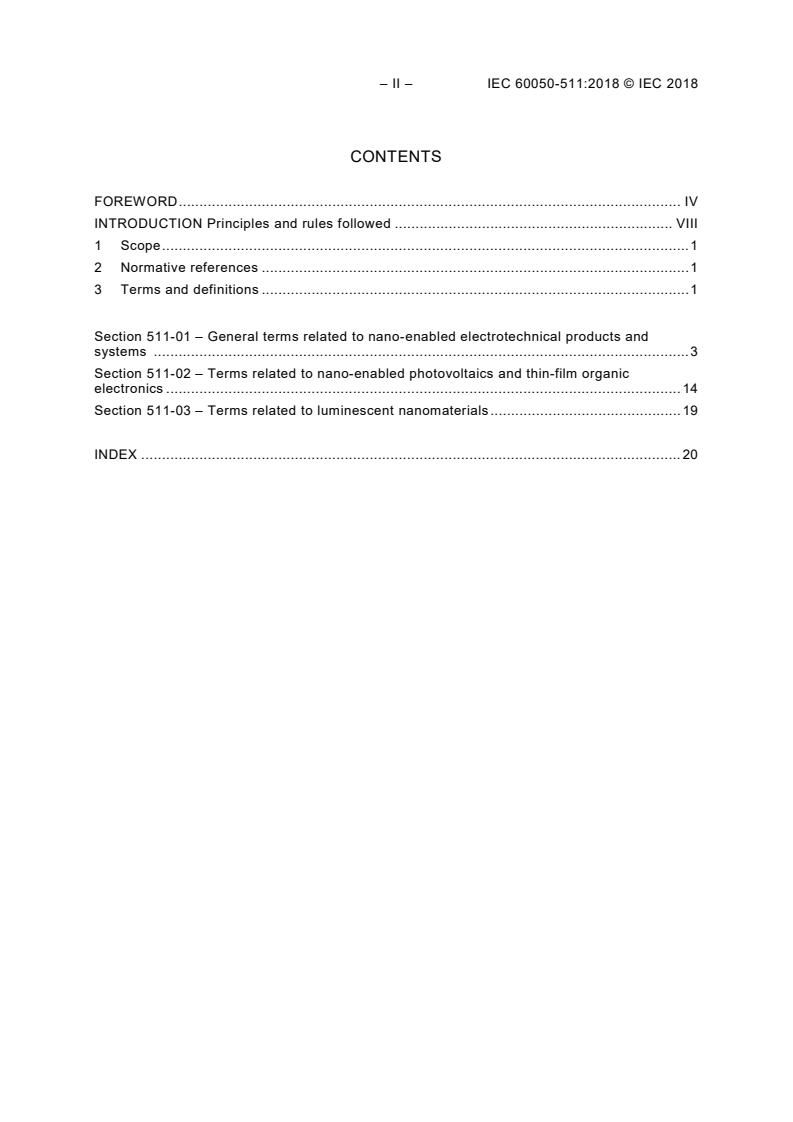
CONTENTS
FOREWORD . IV
INTRODUCTION Principles and rules followed . VIII
1 Scope . 1
2 Normative references . 1
3 Terms and definitions . 1
Section 511-01 – General terms related to nano-enabled electrotechnical products and
systems . 3
Section 511-02 – Terms related to nano-enabled photovoltaics and thin-film organic
electronics . 14
Section 511-03 – Terms related to luminescent nanomaterials . 19
INDEX . 20
SOMMAIRE
AVANT-PROPOS . VI
INTRODUCTION Principes d’établissement et règles suivies . XI
1 Domaine d’application . 2
2 Références normatives . 2
3 Termes et définitions . 2
Section 511-01 – Termes généraux relatifs aux produits et systèmes électrotechniques
nanotechnologiques . 3
Section 511-02 – Termes relatifs aux systèmes photovoltaïques nanotechnologiques et
à l’électronique organique en couches minces . 14
Section 511-03 – Termes relatifs aux nanomatériaux luminescents . 19
INDEX . 20
– IV – IEC 60050-511:2018 © IEC 2018
INTERNATIONAL ELECTROTECHNICAL COMMISSION
_______________
INTERNATIONAL ELECTROTECHNICAL VOCABULARY –
Part 511: Nano-enabled electrotechnical products and systems
FOREWORD
1) The International Electrotechnical Commission (IEC) is a worldwide organization for standardization comprising
all national electrotechnical committees (IEC National Committees). The object of IEC is to promote
international co-operation on all questions concerning standardization in the electrical and electronic fields. To
this end and in addition to other activities, IEC publishes International Standards, Technical Specifications,
Technical Reports, Publicly Available Specifications (PAS) and Guides (hereafter referred to as "IEC
Publication(s)"). Their preparation is entrusted to technical committees; any IEC National Committee interested
in the subject dealt with may participate in this preparatory work. International, governmental and non-
governmental organizations liaising with the IEC also participate in this preparation. IEC collaborates closely
with the International Organization for Standardization (ISO) in accordance with conditions determined by
agreement between the two organizations.
2) The formal decisions or agreements of IEC on technical matters express, as nearly as possible, an international
consensus of opinion on the relevant subjects since each technical committee has representation from all
interested IEC National Committees.
3) IEC Publications have the form of recommendations for international use and are accepted by IEC National
Committees in that sense. While all reasonable efforts are made to ensure that the technical content of IEC
Publications is accurate, IEC cannot be held responsible for the way in which they are used or for any
misinterpretation by any end user.
4) In order to promote international uniformity, IEC National Committees undertake to apply IEC Publications
transparently to the maximum extent possible in their national and regional publications. Any divergence
between any IEC Publication and the corresponding national or regional publication shall be clearly indicated in
the latter.
5) IEC itself does not provide any attestation of conformity. Independent certification bodies provide conformity
assessment services and, in some areas, access to IEC marks of conformity. IEC is not responsible for any
services carried out by independent certification bodies.
6) All users should ensure that they have the latest edition of this publication.
7) No liability shall attach to IEC or its directors, employees, servants or agents including individual experts and
members of its technical committees and IEC National Committees for any personal injury, property damage or
other damage of any nature whatsoever, whether direct or indirect, or for costs (including legal fees) and
expenses arising out of the publication, use of, or reliance upon, this IEC Publication or any other IEC
Publications.
8) Attention is drawn to the Normative references cited in this publication. Use of the referenced publications is
indispensable for the correct application of this publication.
9) Attention is drawn to the possibility that some of the elements of this IEC Publication may be the subject of
patent rights. IEC shall not be held responsible for identifying any or all such patent rights.
This first edition of International Standard IEC 60050-511 comprises terminology formerly
published in IEC TS 80004-9:2017, and developed by IEC technical committee 113:
Nanotechnology for electrotechnical products and systems, in cooperation with ISO TC 229:
Nanotechnologies. It includes also a few entries defining basic nanotechnology concepts
derived from ISO TS 80004-1:2015, ISO TS 80004-4:2011, and ISO TS 80004-12:2016.
IEC 60050-511 was reviewed by IEC technical committee 113: Nanotechnology for
electrotechnical products and systems, and IEC technical committee 1: Terminology, as
change request C00036 for inclusion in the International Electrotechnical Vocabulary.
This publication was developed in accordance with the ISO/IEC Directives, Part 1, IEC
Supplement, Annexes SK and SL, and was approved by the validation team of IEC technical
committee 1: Terminology, under the normal database procedure.
A list of all parts of the IEC 60050 series, published under the general title International
Electrotechnical Vocabulary can be found on the IEC website and is available at
www.electropedia.org.
All parts of the IEC 60050 series have the status of a horizontal standard in accordance with
IEC Guide 108.
– VI – IEC 60050-511:2018 © IEC 2018
COMMISSION ÉLECTROTECHNIQUE INTERNATIONALE
________________
VOCABULAIRE ÉLECTROTECHNIQUE INTERNATIONAL –
Partie 511: Produits et systèmes électrotechniques nanotechnologiques
AVANT-PROPOS
1) La Commission Electrotechnique Internationale (IEC) est une organisation mondiale de normalisation
composée de l'ensemble des comités électrotechniques nationaux (Comités nationaux de l’IEC). L’IEC a pour
objet de favoriser la coopération internationale pour toutes les questions de normalisation dans les domaines
de l'électricité et de l'électronique. A cet effet, l’IEC – entre autres activités – publie des Normes
internationales, des Spécifications techniques, des Rapports techniques, des Spécifications accessibles au
public (PAS) et des Guides (ci-après dénommés "Publication(s) de l’IEC"). Leur élaboration est confiée à des
comités d'études, aux travaux desquels tout Comité national intéressé par le sujet traité peut participer. Les
organisations internationales, gouvernementales et non gouvernementales, en liaison avec l’IEC, participent
également aux travaux. L’IEC collabore étroitement avec l'Organisation Internationale de Normalisation (ISO),
selon des conditions fixées par accord entre les deux organisations.
2) Les décisions ou accords officiels de l’IEC concernant les questions techniques représentent, dans la mesure
du possible, un accord international sur les sujets étudiés, étant donné que les Comités nationaux de l’IEC
intéressés sont représentés dans chaque comité d’études.
3) Les Publications de l’IEC se présentent sous la forme de recommandations internationales et sont agréées
comme telles par les Comités nationaux de l’IEC. Tous les efforts raisonnables sont entrepris afin que l’IEC
s'assure de l'exactitude du contenu technique de ses publications; l’IEC ne peut pas être tenue responsable de
l'éventuelle mauvaise utilisation ou interprétation qui en est faite par un quelconque utilisateur final.
4) Dans le but d'encourager l'uniformité internationale, les Comités nationaux de l’IEC s'engagent, dans toute la
mesure possible, à appliquer de façon transparente les Publications de l’IEC dans leurs publications nationales
et régionales. Toutes divergences entre toutes Publications de l’IEC et toutes publications nationales ou
régionales correspondantes doivent être indiquées en termes clairs dans ces dernières.
5) L’IEC elle-même ne fournit aucune attestation de conformité. Des organismes de certification indépendants
fournissent des services d'évaluation de conformité et, dans certains secteurs, accèdent aux marques de
conformité de l’IEC. L’IEC n'est responsable d'aucun des services effectués par les organismes de certification
indépendants.
6) Tous les utilisateurs doivent s'assurer qu'ils sont en possession de la dernière édition de cette publication.
7) Aucune responsabilité ne doit être imputée à l’IEC, à ses administrateurs, employés, auxiliaires ou
mandataires, y compris ses experts particuliers et les membres de ses comités d'études et des Comités
nationaux de l’IEC, pour tout préjudice causé en cas de dommages corporels et matériels, ou de tout autre
dommage de quelque nature que ce soit, directe ou indirecte, ou pour supporter les coûts (y compris les frais
de justice) et les dépenses découlant de la publication ou de l'utilisation de cette Publication de l’IEC ou de
toute autre Publication de l’IEC, ou au crédit qui lui est accordé.
8) L'attention est attirée sur les références normatives citées dans cette publication. L'utilisation de publications
référencées est obligatoire pour une application correcte de la présente publication.
9) L’attention est attirée sur le fait que certains des éléments de la présente Publication de l’IEC peuvent faire
l’objet de droits de propriété intellectuelle ou de droits analogues. L’IEC ne saurait être tenue pour responsable
de ne pas avoir identifié de tels droits de propriété et de ne pas avoir signalé leur existence.
Cette première édition de la Norme internationale IEC 60050-511 comprend la terminologie
publiée auparavant dans l'IEC TS 80004-9:2017, et établie par le comité d'études 113 de
l’IEC: Nanotechnologies relatives aux appareils et systèmes électrotechnologiques en
collaboration avec le comité d'études 229 de l'ISO: Nanotechnologies. Elle inclut également
quelques articles définissant les concepts de base dérivés de l'ISO TS 80004-1:2015, l'ISO
TS 80004-4:2011, et l'ISO TS 80004-12:2016.
L'IEC 60050-511 a été passée en revue par le comité d'études 113 de l’IEC:
Nanotechnologies relatives aux appareils et systèmes électrotechnologiques, et le comité
d'études 1 de l’IEC: Terminologie, en tant que "change request" C00036 pour inclusion dans
le Vocabulaire Electrotechnique International.
Cette publication a été développée en conformité avec les Annexes SK et SL du Supplément
IEC aux Directives ISO/IEC, Partie 1, et a été approuvée par l’équipe de validation du comité
d'études 1 de l’IEC: Terminologie, selon la procédure base de données "normale".
Une liste de toutes les parties de la série IEC 60050, publiée sous le titre général Vocabulaire
Electrotechnique International, peut être consultée sur le site web de l’IEC et est disponible à
l’adresse www.electropedia.org.
Toutes les parties de la série IEC 60050 ont le statut d'une norme horizontale conformément
au Guide IEC 108.
– VIII – IEC 60050-511:2018 © IEC 2018
INTRODUCTION
Principles and rules followed
General
The IEV (IEC 60050, International Electrotechnical Vocabulary) is a general purpose
multilingual vocabulary covering the field of electrotechnology, electronics and
telecommunication (available at www.electropedia.org). It comprises about 22 000
terminological entries, each corresponding to a concept. These terminological entries are
distributed among about 90 parts, each part corresponding to a given field.
EXAMPLE
Part 161 (IEC 60050-161): Electromagnetic compatibility
Part 411 (IEC 60050-411): Rotating machines
The terminological entries follow a hierarchical classification scheme part/section/concept;
within the sections, the terminological entries are organized in a systematic order.
The terms and definitions (and possibly non-verbal representations, examples, notes to entry
and sources) in the entries are given in two or more of the three IEC languages, that is
French, English and Russian (principal IEV languages).
In each terminological entry, the terms alone are also given in several of the additional IEV
languages [Arabic (ar), Czech (cs), German (de), Spanish (es), Finnish (fi), Italian (it),
Japanese (ja), Korean (ko), Norwegian [Bokmål (nb) and Nynorsk (nn)], Polish (pl),
Portuguese (pt), Slovenian (sl), Serbian (sr), Swedish (sv) and Chinese (zh)].
Information regarding the IEV and the drafting and presentation of the terminological entries
is provided in the IEC Supplement to the ISO/IEC Directives, Annex SK. The following
constitutes a summary of these rules.
Organization of a terminological entry
Each of the terminological entries corresponds to a concept, and comprises:
- an IEV number,
- possibly a letter symbol for the quantity or unit,
then, for the principal IEV languages present in the part:
- the term designating the concept, called "preferred term", possibly accompanied by
synonyms and abbreviations,
- the definition of the concept,
- possibly non-verbal representations, examples and notes to entry,
- possibly the source,
and finally, for the additional IEV languages, the terms alone.
IEV number
The IEV number is comprised of three elements, separated by hyphens:
part number: 3 digits,
section number: 2 digits,
entry number: sequence of decimal digits in which leading zeroes are permissible but
redundant (e.g. 1 to 113, 01 to 99, 001 to 127).
EXAMPLE 845-27-003
Letter symbols for quantities and units
These symbols, which are language independent, are given on a separate line following the
IEV number.
EXAMPLE
131-12-04
R
resistance
Preferred term and synonyms
The preferred term is the term that heads a terminological entry in a given language; it can be
followed by synonyms. It is printed in boldface.
Synonyms:
The synonyms are printed on separate lines under the preferred term: preferred synonyms are
printed in boldface, admitted and and deprecated synonyms are printed in lightface.
Deprecated synonyms are prefixed by the text "DEPRECATED:".
Absence of an appropriate term:
When no appropriate term exists in a given language, the preferred term is replaced by five
dots, as follows:
.....
" " (and there are of course no synonyms).
Attributes
Each term (and synonym) can be followed by attributes giving additional information, and
printed in lightface on the same line as the corresponding term, following this term.
EXAMPLE
specific use of the term:
transmission line,
– X – IEC 60050-511:2018 © IEC 2018
national variant:
lift, GB
grammatical information:
quantize, verb
transient, noun
AC, adj
Source
In some cases, it has been necessary to include in an IEV part a concept taken from another
IEV part, or from another authoritative terminology document (ISO/IEC Guide 99,
ISO/IEC 2382, etc.), either with or without modification to the definition (and possibly to the
term).
This is indicated by the mention of this source, printed in lightface, and placed at the end of
the terminological entry in each of the principal IEV languages present.
EXAMPLE SOURCE: IEC 60050-131:2002, 131-03-13, modified
Terms in additional IEV languages
These terms are placed following the terminological entries in the principal IEV languages, on
separate lines (a single line for each language), preceded by the alpha-2 code for the
language defined in ISO 639-1, and in the alphabetic order of this code.
INTRODUCTION
Principes d’établissement et règles suivies
Généralités
L'IEV (IEC 60050 – Vocabulaire Electrotechnique International) est un vocabulaire multilingue
à usage général couvrant le champ de l’électrotechnique, de l’électronique et des
télécommunications (disponible à www.electropedia.org). Il comprend environ 22 000 articles
terminologiques correspondant chacun à un concept (une notion). Ces articles
terminologiques sont répartis dans environ 90 parties, chacune correspondant à un domaine
donné.
EXEMPLE
Partie 161 (IEC 60050-161): Compatibilité électromagnétique
Partie 411 (IEC 60050-411): Machines tournantes
Les articles terminologiques suivent un schéma de classification hiérarchique
partie/section/concept, les articles terminologiques étant, au sein des sections, classés par
ordre systématique.
Les termes et définitions (et éventuellement les représentations non verbales, exemples,
notes à l'article et sources) sont donnés dans deux ou plus des trois langues de l’IEC, c’est-à-
dire français, anglais et russe (langues principales de l'IEV).
Dans chaque article terminologique, les termes seuls sont également donnés dans plusieurs
des langues additionnelles de l'IEV [arabe (ar), tchèque (cs), allemand (de), espagnol (es),
finnois (fi), italien (it), japonais (ja), coréen (ko), norvégien [bokmål (nb) et nynorsk (nn)],
polonais (pl), portugais (pt), slovène (sl), serbe (sr), suédois (sv) et chinois (zh)].
Des informations concernant l'IEV, la rédaction ainsi que la présentation des articles
terminologiques sont fournies dans le Supplément de l'IEC aux Directives ISO/IEC, à
l'Annexe SK. Un résumé de ces règles est donné ci-dessous.
Constitution d’un article terminologique
Chacun des articles terminologique correspond à un concept, et comprend:
- un numéro IEV,
- éventuellement un symbole littéral de grandeur ou d’unité,
puis, pour chaque langue principale de l'IEV présente dans la partie:
- le terme désignant le concept, appelé "terme privilégié", éventuellement accompagné
de synonymes et d’abréviations,
- la définition du concept,
– XII – IEC 60050-511:2018 © IEC 2018
- éventuellement des représentations non verbales, des exemples et des notes à
l’article,
- éventuellement la source,
et enfin, pour les langues additionnelles de l'IEV, les termes seuls.
Numéro IEV
Le numéro IEV comprend trois éléments, séparés par des traits d’union:
numéro de partie: 3 chiffres,
numéro de section: 2 chiffres,
numéro d'article: série de chiffres décimaux dans laquelle les zéro initiaux sont permis
mais superflus (par exemple 1 à 113, 01 à 99, 001 à 127).
EXEMPLE 845-27-003
Symboles littéraux de grandeurs et d’unités
Ces symboles, indépendants de la langue, sont donnés sur une ligne séparée suivant le
numéro IEV.
EXEMPLE
131-12-04
R
résistance, f
Terme privilégié et synonymes
Le terme privilégié est le terme qui figure en tête d’un article dans une langue donnée; il peut
être suivi par des synonymes. Il est imprimé en gras.
Synonymes:
Les synonymes sont imprimés sur des lignes séparées sous le terme privilégié: les
synonymes privilégiés sont imprimés en gras, et les synonymes admis et déconseillés sont
imprimés en maigre. Les synonymes déconseillés sont précédés par le texte
"DÉCONSEILLÉ:".
Absence de terme approprié:
Lorsqu’il n’existe pas de terme approprié dans une langue, le terme privilégié est remplacé
par cinq points, comme ceci:
.....
" " (et il n’y a alors bien entendu pas de synonymes).
Attributs
Chaque terme (et synonyme) peut être suivi d’attributs donnant des informations
supplémentaires; ces attributs sont imprimés en maigre, à la suite de ce terme, et sur la
même ligne.
EXEMPLE
spécificité d’utilisation du terme:
rang,
variante nationale:
unité de traitement, CA
catégorie grammaticale:
quantifier, verbe
électronique, f
électronique, adj
Source
Dans certains cas, il a été nécessaire d’inclure dans une partie de l'IEV un concept pris dans
une autre partie de l'IEV, ou dans un autre document de terminologie faisant autorité
(Guide ISO/IEC 99, ISO/IEC 2382, etc.), avec ou sans modification de la définition (ou
éventuellement du terme).
Ceci est indiqué par la mention de cette source, imprimée en maigre et placée à la fin de
l’article terminologique dans chacune des langues principales de l'IEV présentes.
EXEMPLE SOURCE: IEC 60050-131:2002, 131-03-13, modifié
Termes dans les langues additionnelles de l'IEV
Ces termes sont placés à la fin des articles terminologiques dans les langues principales de
l'IEV, sur des lignes séparées (une ligne par langue), précédés par le code alpha-2 de la
langue, défini dans l'ISO 639-1, et dans l'ordre alphabétique de ce code.
– 1 – IEC 60050-511:2018 © IEC 2018
INTERNATIONAL ELECTROTECHNICAL VOCABULARY –
Part 511: Nano-enabled electrotechnical products and systems
1 Scope
This part of IEC 60050 gives the general terminology for electrotechnical products and
systems reliant on nanomaterials for their essential functionalities. It is intended to facilitate
communication between bodies and individuals in industry and those who interact with them.
It has the status of a horizontal standard in accordance with IEC Guide 108, Guidelines for
ensuring the coherency of IEC publications – Application of horizontal standards.
This terminology is consistent with the terminology developed in the other specialized parts of
the IEV.
This horizontal standard is primarily intended for use by technical committees in the
preparation of standards in accordance with the principles laid down in IEC Guide 108.
One of the responsibilities of a technical committee is, wherever applicable, to make use of
horizontal standards in the preparation of its publications.
2 Normative references
There are no normative references in this document.
3 Terms and definitions
The terms and definitions contained in this part of IEC 60050 were extracted from the
Electropedia (www.electropedia.org) (also known as the "IEV Online") – the world's most
comprehensive online terminology database covering the field of electrotechnology,
electronics and telecommunication.
VOCABULAIRE ÉLECTROTECHNIQUE INTERNATIONAL –
Partie 511: Produits et systèmes électrotechniques nanotechnologiques
1 Domaine d’application
La présente partie de l’IEC 60050 donne la terminologie générale pour les produits et
systèmes électrotechniques qui dépendent des nanomatériaux pour leurs fonctionnalités
essentielles. Elle est destinée à faciliter la communication entre les différents organismes et
membres de l'industrie, et leurs interlocuteurs. Elle a le statut de norme horizontale
conformément au Guide IEC 108, Lignes directrices pour assurer la cohérence des
publications de l’IEC – Application des normes horizontales.
Cette terminologie est en accord avec la terminologie figurant dans les autres parties
spécialisées de l'IEV.
La présente norme horizontale est essentiellement destinée à l'usage des comités d'études
dans la préparation des normes, conformément aux principes établis dans le Guide IEC 108.
L'une des responsabilités d'un comité d'études est d'utiliser, autant que possible, les normes
horizontales lors de la préparation de ses publications.
2 Références normatives
Le présent document ne contient aucune référence normative.
3 Termes et définitions
Les termes et définitions contenus dans la présente partie de l’IEC 60050 ont été extraits de
l’Electropedia (www.electropedia.org) (également connue sous le nom "IEV Online") – la base
de données terminologique en ligne la plus complète couvrant le champ de l’électrotechnique,
de l’électronique et des télécommunications.
– 3 – IEC 60050-511:2018 © IEC 2018
511-01 General terms related to nano-enabled electrotechnical products and systems
511-01 Termes généraux relatifs aux produits et systèmes électrotechniques
nanotechnologiques
511-01-01
device
See IEV 151-11-20
dispositif, m
Voir IEV 151-11-20
511-01-02
molecular electronics
field of science and technology concerned with the development and production of electronic devices
using molecules as components
Note 1 to entry: Some molecules need to be functionalized in order to act as components.
SOURCE: IEC TS 80004-9:2017, 3.1.2, modified – In the definition "design and fabrication" has
been replaced by "development and production" for alignment with the definition of
"nanoelectronics" (IEV 511-01-14).
électronique moléculaire, f
domaine des sciences et technologies concerné par le développement et la production de dispositifs
électroniques utilisant des molécules comme composants
Note 1 à l'article: Certaines molécules doivent être fonctionnalisées pour agir comme des composants
actifs.
SOURCE: IEC TS 80004-9:2017, 3.1.2, modifié – "la conception et la fabrication" a été remplacé par
"le développement et la production" dans la définition afin de l'aligner avec celle de
"nanoélectronique" (IEV 511-01-14).
511-01-03
nanoscale
length range approximately from 1 nm to 100 nm
Note 1 to entry: Properties that are not extrapolations from larger sizes are predominantly exhibited in
this length range.
SOURCE: ISO TS 80004-1:2015, 2.1
échelle nanométrique, f
échelle de longueur s'étendant approximativement de 1 nm à 100 nm
Note 1 à l’article: Les propriétés qui ne constituent pas des extrapolations par rapport à des
dimensions plus grandes sont principalement manifestes dans cette échelle de longueur.
SOURCE: ISO TS 80004-1:2015, 2.1
511-01-04
nanomaterial
material with any external dimension in the nanoscale or having internal structure or surface structure
in the nanoscale
Note 1 to entry: This generic term is inclusive of nano-object and nanostructured material.
Note 2 to entry: Engineered nanomaterial and manufactured nanomaterial are different types of
nanomaterial.
SOURCE: ISO TS 80004-1:2015, 2.4, modified – Note 2 to entry has been reworded.
nanomatériau, m
matériau ayant une dimension externe à l'échelle nanométrique ou ayant une structure interne ou une
structure de surface à l'échelle nanométrique
Note 1 à l'article: Ce terme générique englobe les nano-objets et les matériaux nanostructures.
Note 2 à l’article: Le nanomatériau d’ingénierie et le nanomatériau manufacture sont différents types
de nanomatériau.
SOURCE: ISO TS 80004-1:2015, 2.4, modifié – Note 2 à l'article a été réécrite.
511-01-05
engineered nanomaterial
nanomaterial designed for a specific purpose or function
SOURCE: ISO TS 80004-1:2015, 2.8
nanomatériau d’ingénierie, m
nanomatériau conçu pour un but ou une fonction spécifique
SOURCE: ISO TS 80004-1:2015, 2.8
511-01-06
manufactured nanomaterial
nanomaterial intentionally produced to have selected properties or composition
SOURCE: ISO TS 80004-1:2015, 2.9
– 5 – IEC 60050-511:2018 © IEC 2018
nanomatériau manufacturé, m
nanomatériau produit intentionnellement pour avoir des propriétés choisies ou une composition
choisie
SOURCE: ISO TS 80004-1:2015, 2.9
511-01-07
nano-object
discrete piece of material with one, two or three external dimensions in the nanoscale
Note 1 to entry: The second and third external dimensions are orthogonal to the first dimension and to
each other.
SOURCE: ISO TS 80004-1:2015, 2.5
nano-objet, m
portion discrète de matériau dont une, deux ou les trois dimensions externes sont à l'échelle
nanométrique
Note 1 à l'article: Les deuxièmes et troisième dimensions externes sont orthogonales à la première
dimension et l'une par rapport à l'autre.
SOURCE: ISO TS 80004-1:2015, 2.5
511-01-08
nanostructure
composition of inter-related constituent parts in which one or more of those parts is a nanoscale
region
Note 1 to entry: A region is defined by a boundary representing a discontinuity in properties.
SOURCE: ISO TS 80004-1:2015, 2.6
nanostructure, f
composition de parties constitutives liées entre elles, dans laquelle une ou plusieurs de ces parties est
une région à l'échelle nanométrique
Note 1 à l’article: Une région est définie par une limite représentant une discontinuité des propriétés.
SOURCE: ISO TS 80004-1:2015, 2.6
511-01-09
nanostructured material
material having internal nanostructure or surface nanostructure
Note 1 to entry: This definition does not exclude the possibility of a nano-object having internal
structure or surface structure. A material having external dimension(s) in the nanoscale is a nano-
object.
SOURCE: ISO TS 80004-1:2015, 2.7, modified – Note 1 to entry has been revised.
matériau nanostructuré, m
matériau ayant une nanostructure interne ou une nanostructure de surface
Note 1 à l’article: Cette définition n'exclut pas la possibilité qu'un nano-objet ait une structure interne
ou une structure de surface. Un matériau ayant la ou les dimensions externes à l'échelle nanométrique
est un nano-objet.
SOURCE: ISO TS 80004-1:2015, 2.7, modifié – La Note 1 à l’article a été revisée.
511-01-10
nanofibre
nano-object with two external dimensions in the nanoscale and the third external dimension
significantly larger
SOURCE: ISO TS 80004-4:2011, 2.5, modified – In the definition "similar" has been omitted since it
is superflous, and "external" has been added after "the third". The note has been omitted.
nanofibre, f
nano-objet ayant deux dimensions externes à l'échelle nanométrique et la troisième dimension externe
significativement plus grande
SOURCE: ISO TS 80004-4:2011, 2.5, modifié – Dans la définition, "similaires" a été supprimé. La
note a été omise.
– 7 – IEC 60050-511:2018 © IEC 2018
511-01-11
nanoplate
nano-object with one external dimension in the nanoscale and the two other external dimensions
significantly larger
Note 1 to entry: The smallest external dimension is the thickness of the nanoplate.
Note 2 to entry: The two significantly larger external dimensions are considered to differ from the
nanoscale dimension by more than three times.
Note 3 to entry: The larger external dimensions are not necessarily in the nanoscale.
SOURCE: ISO TS 80004-4:2011, 2.6, modified – In note 2 to entry "external" has been added after
"larger".
nanoplaque, f
nano-objet ayant une dimension externe à l'échelle nanométrique et les deux autres dimensions
externes significativement plus grandes
Note 1 à l’article: La plus petite des dimensions externes est l’épaisseur de la nanoplaque.
Note 2 à l’article: Les deux dimensions externes significativement plus grandes diffèrent de la
dimension à l'échelle nanométrique d’un facteur supérieur à trois.
Note 3 à l’article: Les dimensions externes les plus grandes ne sont pas nécessairement à l'échelle
nanométrique.
SOURCE: ISO TS 80004-4:2011, 2.6
511-01-12
nanoparticle
nano-object with all three external dimensions in the nanoscale
Note 1 to entry: If the lengths of the longest to the shortest axes of the nano-object differ significantly
(typically by more than three times), the terms nanofibre or nanoplate should be used instead of the
term nanoparticle.
SOURCE: ISO TS 80004-4:2011, 2.4, modified – In Note 1 to entry "are intended to" has been
replaced by "should".
nanoparticule, f
nano-objet ayant les trois dimensions externes à l'échelle nanométrique
Note 1 à l’article: Si les longueurs du plus grand et du plus petit axe du nano-objet diffèrent de
manière significative (généralement d’un facteur supérieur à trois), les termes nanofibre ou
nanoplaque sont destinés à être utilisés à la place du terme nanoparticule.
SOURCE: ISO TS 80004-4:2011, 2.4
511-01-13
nano-electromechanical system
NEMS
nanoscale device or embedded system involving one or more electronic and non-electronic
components enabling the integration of electric and mechanical functionality of the system
Note 1 to entry: The components can be organic, inorganic or hybrid nanotechnology-based and
function on the nanoscale for sensing, actuation, signal processing, display, or control.
Note 2 to entry: The components can be micro- or nano-machined to produce free surfaces and
volumes that will be able to couple with the environment so that a physical, optical, chemical, or
biological phenomenon is transduced to an electric signal.
SOURCE: IEC TS 80004-9:2017, 3.1.3, modified – In the definition "of this interface" has been
deleted since no interface is referred to earlier in the definition. In Note 2 to entry, the sentence has
been redrafted for clarity: "an electric transduction" has been deleted and "produced" has been
replaced by "transduced to an electric signal".
système nanoélectromécanique, m
NEMS, m
nanodispositif ou système incorporé mettant en œuvre un ou plusieurs composants électroniques et
non électroniques permettant l'intégration des fonctionnalités électriques et mécaniques du système
Note 1 à l'article: Les composants peuvent être des composants nanotechnologiques organiques,
inorganiques ou hybrides qui fonctionnent à l'échelle nanométrique pour la détection, l'actionnement,
le traitement des signaux, l'affichage ou la commande.
Note 2 à l'article: Les composants peuvent être micro- ou nano-usinés pour produire des surfaces et
des volumes libres qui seront capables d'interagir avec l'environnement de manière à transformer un
phénomène physique, optique, chimique ou biologique en un signal électrique.
SOURCE: IEC TS 80004-9:2017, 3.1.3, modifié – Dans la définition, "de l'interface" a été supprimé
puisque aucune interface n'est mentionnée précédemment dans la définition. Dans la Note 2 à l'article,
la phrase suivante a été réécrite pour plus de clarté: "à produire une transformation électrique d'un
phénomène physique, optique, chimique ou biologique" a été remplacé par "à transformer un
phénomène physique, optique, chimique ou biologique en un signal électrique".
511-01-14
nanoelectronics
field of science and technology concerned with the development and production of electronic devices
using nanoscale components
SOURCE: IEC TS 80004-9:2017, 3.1.4, modified – In the definition "functional" has been deleted
and "with" has been replaced by "using" for alignment with the definition of "molecular electronics"
(IEV 511-01-02).
– 9 – IEC 60050-511:2018 © IEC 2018
nanoélectronique, f
domaine des sciences et technologies concerné par le développement et la production de dispositifs
électroniques utilisant des composants à l'échelle nanométrique
SOURCE: IEC TS 80004-9:2017, 3.1.4, modifié – "fonctionnels à l'aide de" a été remplacé par
"utilisant des" pour aligner la définition avec celle de "électronique moléculaire" (IEV 511-01-02).
511-01-15
nano-enabled, adj
exhibiting a function or performance possible only with nanotechnology
SOURCE: ISO TS 80004-1:2015, 2.15
nanotechnologique, adj
présentant une fonction ou une performance possible uniquement avec les nanotechnologies
SOURCE: ISO TS 80004-1:2015, 2.15
511-01-16
nano-enabled device
device in which the material elements or assembly of such elements exhibit performance or function
only possible with nanotechnology
Note 1 to entry: The material element is a nanomaterial.
Note 2 to entry: The performance or function exhibited is measurable and significant for the
application of the nano-enabled device.
Note 3 to entry: Applications of nano-enabled devices can include, but are not limited to, energy
storage devices (capacitors, materials for lithium ion battery, fuel cell mem
...