

ISO/FDIS 18841
(Main)Interpreting services — General requirements and recommendations
- Abstract
ISO 18841:2018 specifies basic requirements for the provision of interpreting services. Additionally, it provides recommendations of good practice. NOTE Interpreting specializations/specialized interpreting services can be covered in other International Standards (e.g. ISO 20228, Legal interpreting).
- Status
- Not Published
- Technical Committee
- ISO/TC 37/SC 5 - Translation, interpreting and related technology
- Drafting Committee
- ISO/TC 37/SC 5/WG 2 - Interpreting
- Current Stage
- 5020 - Proof sent to secretariat or FDIS ballot initiated: 8 weeks - 50 Approval
- Start Date
- 15-Oct-2026
- Due Date
- 15-Oct-2026
- Completion Date
- 15-Oct-2026
Buy Documents

ISO/FDIS 18841 - Interpreting services — General requirements and recommendations
REDLINE ISO/FDIS 18841 - Interpreting services — General requirements and recommendations
ISO/FDIS 18841 is an ISO document on interpreting services, published by ISO. It sets general requirements for human interpreting between spoken or signed languages and gives recommendations of good practice for interpreters, interpreting service providers and clients. It applies to interpreting work in many settings and excludes AI-driven interpreting.
What does ISO/FDIS 18841 specify?
ISO/FDIS 18841 specifies general requirements for the provision of interpreting services and adds recommendations of good practice. It covers interpreting as a human activity, for spoken or signed content, and it is organized so readers can move from definitions to working methods, assignment conditions, and competence.
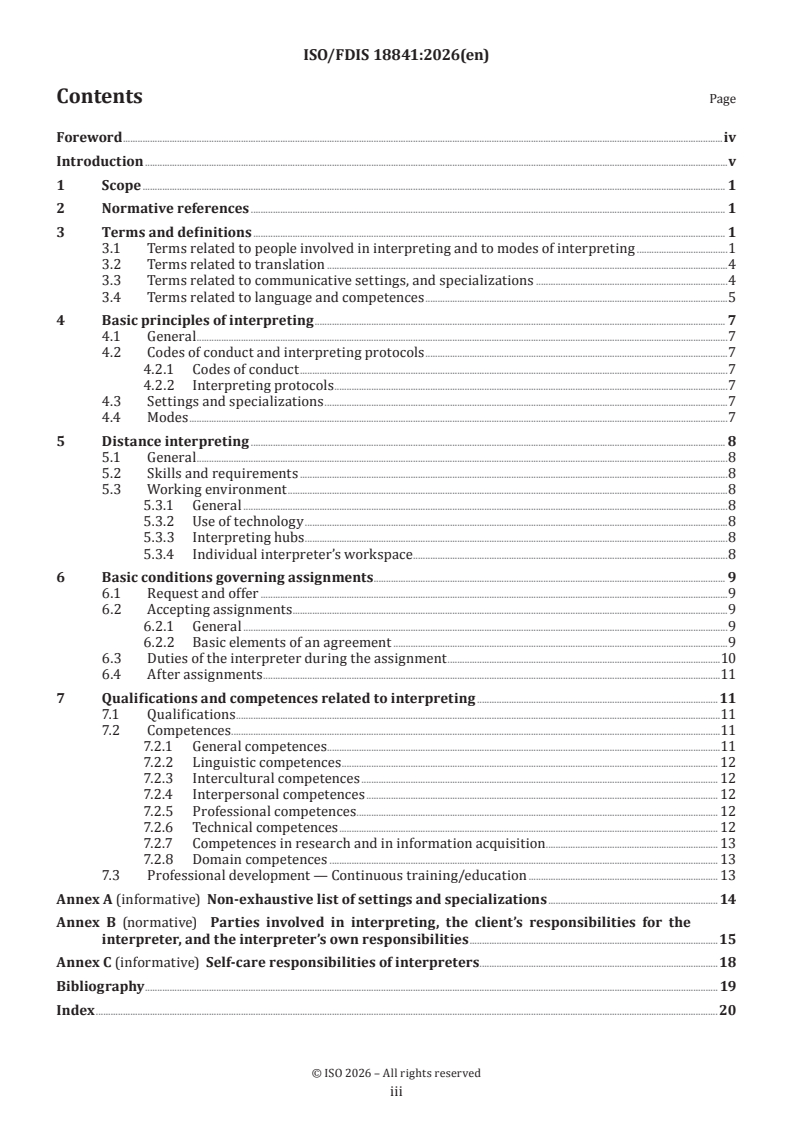
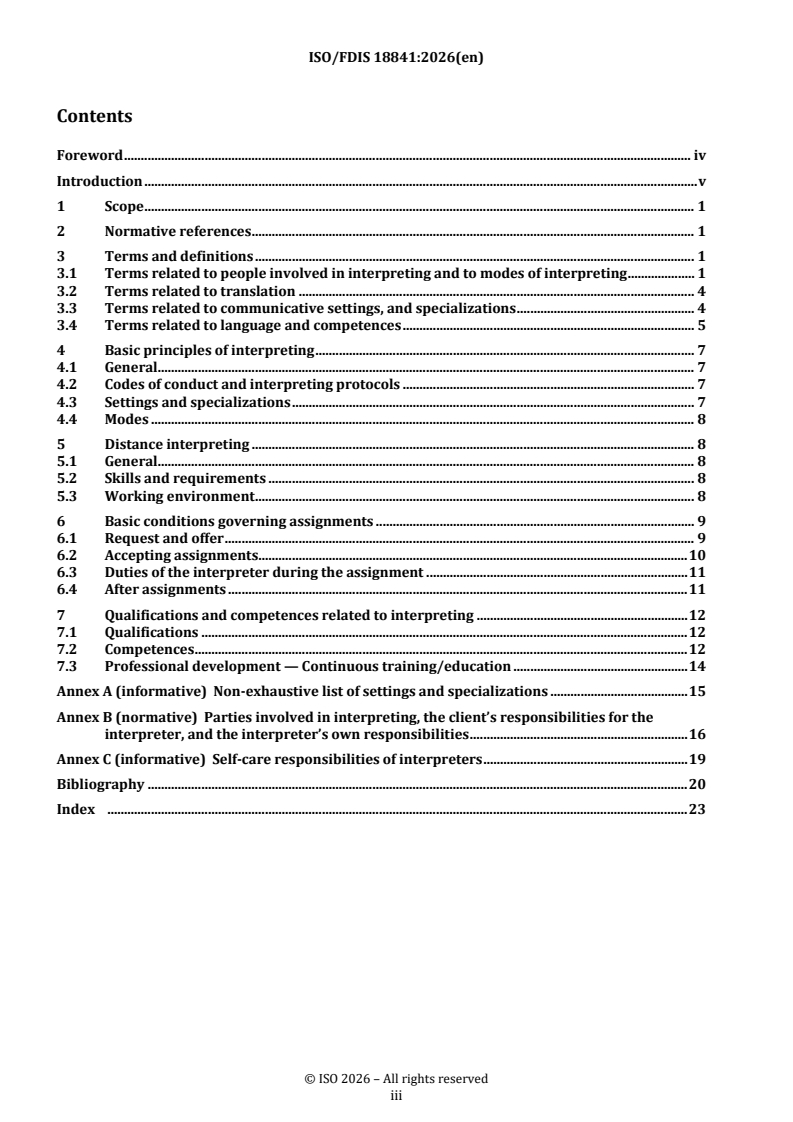
The document is structured into seven clauses and three annexes:
| Annex | What it covers |
|---|---|
| Annex A | Non-exhaustive list of settings and specializations |
| Annex B | Parties involved in interpreting, plus the client’s and interpreter’s responsibilities |
| Annex C | Self-care responsibilities of interpreters |
Clause 1 gives the scope, Clause 2 lists normative references, Clause 3 defines terms, Clause 4 sets basic principles, Clause 5 covers distance interpreting, Clause 6 covers assignment conditions, and Clause 7 covers qualifications and competences. In practice, this means the standard is both a service guide and a working framework for planning, delivery and review.
What are the key requirements of ISO/FDIS 18841?
ISO/FDIS 18841 focuses on faithful communication, clear assignment agreements, suitable working conditions, and the competence needed to interpret accurately. The requirements are practical: they tell parties what to agree before an assignment, how to conduct the work, and what skills the interpreter needs.
Interpreting must preserve meaning and follow professional practice
Clause 4.1 says the interpreter shall facilitate communication between at least two parties who do not share the same language by faithfully rendering the content. The note explains that fidelity means no additions, alterations or omissions that change content, style, intent or purpose. In practice, this sets the core quality expectation for every assignment.
Clause 4.2 requires compliance with applicable codes of ethics, standards of practice and accepted protocols. Because protocols vary by specialization, setting, country and region, organizations need to match the assignment to the right professional rules, not rely on a one-size-fits-all procedure.
Clause 4.4 says the interpreting service provider shall discuss the appropriate mode with the client. The standard lists consecutive interpreting, simultaneous interpreting, sight translation and whispered interpreting, so the service can be matched to dialogues, speeches, meetings, or very small audiences.
Distance interpreting has its own setup and technology expectations
Clause 5 says both consecutive and simultaneous interpreting can be delivered as distance interpreting, using the most suitable technology for the communicative event. That matters because remote delivery is not just a location change - it affects equipment, visibility, sound quality and preparation.
Clause 5.2 requires the interpreter to have the skills and requirements of a professional interpreter and to use the correct protocols and techniques for the mode and technology in use. It also expects the speaker at the other location to use appropriate equipment, such as a high-quality microphone or headset, so the interpreter can hear and render accurately.
Clause 5.3 covers working environments. It says an interpreter may work from an interpreting hub or from an individual workspace, and the workspace should support privacy, concentration and data protection. The standard also points to ISO 17651-3 for interpreting hubs, ISO 17651-4 for signed language interpreting environments, ISO 24019 for simultaneous interpreting delivery platforms, and ISO 20109 for equipment such as microphones, headphones and hearing protection.
Assignment terms must be agreed in advance
Clause 6.1 requires advance agreement on pricing, terms, policies, procedures and technical equipment, unless a legal act or collective agreement already governs the relationship. This is important because interpreting work often depends on logistics that must be settled before the event starts.
Clause 6.2 says the interpreter shall accept only assignments for which they are qualified and that match their language combination, domain competence and expertise. The agreement should cover practical points such as date, venue, language combination, mode, team composition, breaks, equipment, safety, reimbursement, recording or streaming, and the handling of pre-recorded content. That helps clients avoid misunderstandings and helps interpreters prepare properly.
Clause 6.3 and 6.4 describe conduct during and after the assignment. The interpreter shall interpret in the first person unless that impedes communication, manage turn-taking, avoid adding personal views, intervene only when needed for communication, report fatigue or trauma risks, and handle debriefing, incident reporting, invoicing and appropriate self-care after the job.
Qualifications and competences must match the assignment
Clause 7.1 says qualifications can vary by specialization, and interpreters shall be able to show documented evidence when specialized qualifications are required or recommended by relevant standards. Clause 7.2 sets out the competence areas: linguistic, intercultural, interpersonal, professional, technical, research and domain competences.
In practical terms, ISO/FDIS 18841 expects interpreters to work in at least two languages, handle registers and terminology, use interpreting equipment, research assignments, and understand the subject area. Clause 7.3 adds continuous development, including feedback, training, documentation of learning, and keeping pace with interpreting technology.
What terms does ISO/FDIS 18841 define?
- Interpreting - rendering spoken or signed information from a source language into a target language in spoken or signed form, while conveying meaning and language register.
- Interpreting service provider (ISP) - an interpreter or organization that makes interpreting available to a client.
- Distance interpreting - interpreting where the speaker or signer is in a different location from the interpreter, enabled by information and communications technology.
- Mode - the established method used to deliver spoken language interpreting or signed language interpreting.
- Communicative event - an encounter between two or more parties during which information is transmitted.
- Working language - a language from or into which the interpreter is qualified to interpret.
- Source language - the language from which content is interpreted or translated.
- Target language - the language into which content is interpreted or translated.
Who uses ISO/FDIS 18841?
ISO/FDIS 18841 is used by interpreters, interpreting service providers, clients, and organizations that manage multilingual communication. It is relevant for procurement and quality teams because it gives a common basis for defining service terms, equipment, schedules, confidentiality, and responsibility.
It is also useful in healthcare settings, legal settings, educational institutions, public services, conferences, international organizations, business meetings, humanitarian settings and military or conflict-related settings. In practice, these users rely on the standard to choose the mode, assign qualified interpreters, prepare briefings, and set expectations for on-site or distance interpreting.
What changed in ISO/FDIS 18841 from the previous edition?
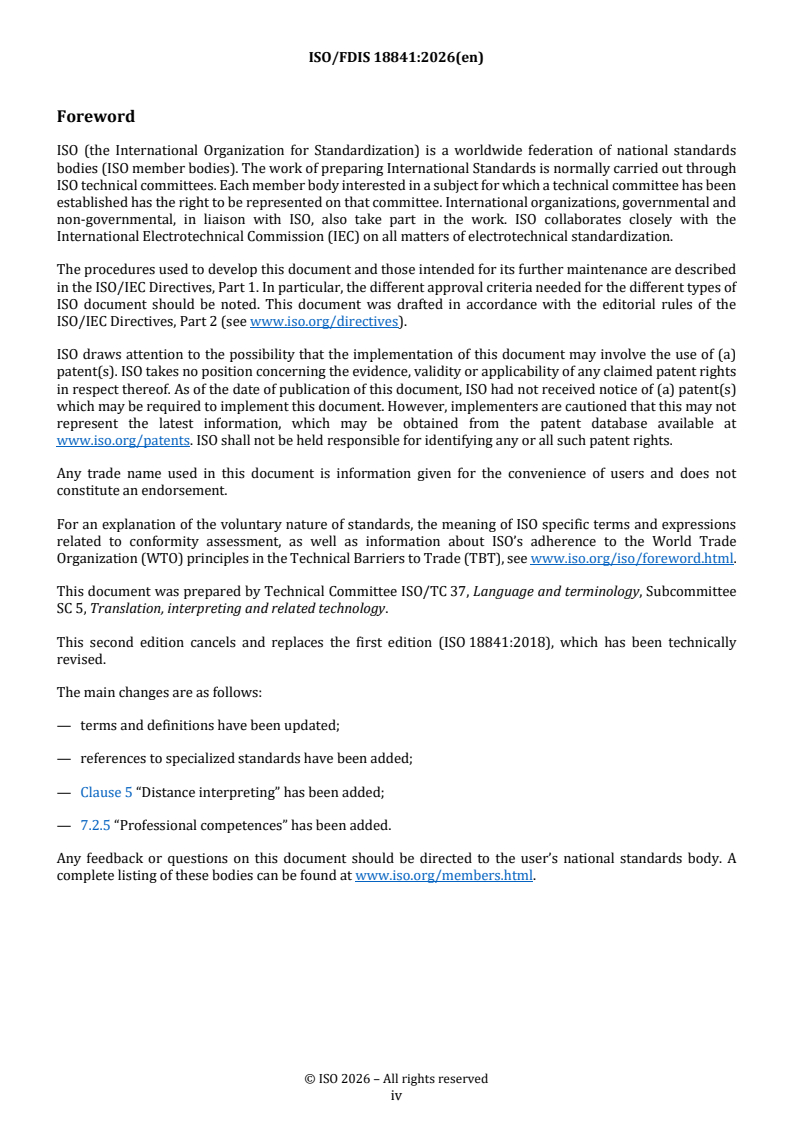
ISO/FDIS 18841 is the second edition and it cancels and replaces ISO 18841:2018. The document says it has been technically revised.
The main changes stated are:
- terms and definitions have been updated;
- references to specialized standards have been added;
- Clause 5 on distance interpreting has been added;
- 7.2.5 on professional competences has been added.
Which standards are used with ISO/FDIS 18841?
| Standard | What it contributes |
|---|---|
| ISO 20539 | Core vocabulary for translation, interpreting and related technology |
| ISO 23155 | Requirements and recommendations for conference interpreting |
| ISO 24019 | Requirements and recommendations for simultaneous interpreting delivery platforms |
| ISO 20109 | Requirements for simultaneous interpreting equipment |
| ISO 17651-3 | Requirements and recommendations for interpreting hubs |
| ISO 17651-4 | Working environment requirements for signed language interpreting |
| ISO 13611 | Specialized requirements for community interpreting |
| ISO 20228 | Specialized requirements for legal interpreting |
| ISO 21998 | Specialized requirements for healthcare interpreting |
These references show that ISO/FDIS 18841 is meant to be used alongside more specific standards when the assignment is in a particular setting or uses a particular platform or working environment.
What does the ISO/FDIS 18841 document contain?
ISO/FDIS 18841 contains the full set of terms and definitions, plus a structured framework for service delivery and professional conduct. Table 1 summarizes interpreting modes and their typical use, which helps clients and service providers select the right method for an event.
The document also gives agreement points for advance planning, including language combination, team composition, timing, breaks, equipment, recording and streaming terms, and rehearsal arrangements for distance interpreting. Annex B is especially practical because it separates the responsibilities of clients, interpreters and interpreting service providers.
Annex C adds self-care guidance, including workload management, rest time, technical issue reporting and measures for vicarious trauma. That makes the document useful not only for service design and contracting, but also for quality management, training and post-assignment review.
Relations
- Effective Date
- 21-Oct-2023
Buy Documents
ISO/FDIS 18841 - Interpreting services — General requirements and recommendations
REDLINE ISO/FDIS 18841 - Interpreting services — General requirements and recommendations
Get Certified
Connect with accredited certification bodies for this standard

Great Wall Tianjin Quality Assurance Center
Established 1993, first batch to receive national accreditation with IAF recognition.

Hong Kong Quality Assurance Agency (HKQAA)
Hong Kong's leading certification body.

Innovative Quality Certifications Pvt. Ltd. (IQCPL)
Known for integrity, providing ethical & impartial Assessment & Certification. CMMI Institute Partner.
Sponsored listings
Frequently Asked Questions
ISO/FDIS 18841 is a draft published by the International Organization for Standardization (ISO). Its full title is "Interpreting services — General requirements and recommendations". This standard covers: ISO 18841:2018 specifies basic requirements for the provision of interpreting services. Additionally, it provides recommendations of good practice. NOTE Interpreting specializations/specialized interpreting services can be covered in other International Standards (e.g. ISO 20228, Legal interpreting).
ISO 18841:2018 specifies basic requirements for the provision of interpreting services. Additionally, it provides recommendations of good practice. NOTE Interpreting specializations/specialized interpreting services can be covered in other International Standards (e.g. ISO 20228, Legal interpreting).
ISO/FDIS 18841 is classified under the following ICS (International Classification for Standards) categories: 01.020 - Terminology (principles and coordination); 03.080.99 - Other services. The ICS classification helps identify the subject area and facilitates finding related standards.
ISO/FDIS 18841 has the following relationships with other standards: It is inter standard links to ISO 18841:2018. Understanding these relationships helps ensure you are using the most current and applicable version of the standard.
ISO/FDIS 18841 is available in PDF format for immediate download after purchase. The document can be added to your cart and obtained through the secure checkout process. Digital delivery ensures instant access to the complete standard document.
Standards Content (Sample)
Contents
- Introduction
- 1 Scope
- 2 Normative references
- 3 Terms and definitions
- 3.1 Terms related to people involved in interpreting and to modes of interpreting
- 3.1.1 interpret
- 3.1.2 interpreting
- 3.1.3 interpreter
- 3.1.4 interpreting service provider
- 3.1.5 client
- 3.1.6 end user
- 3.1.7 speaker
- 3.1.8 signer
- 3.1.9 spoken language interpreting
- 3.1.10 signed language interpreting
- 3.1.11 distance interpreting
- 3.1.12 mode
- 3.1.13 consecutive interpreting
- 3.1.14 simultaneous interpreting
- 3.1.15 sight translation
- 3.1.16 note-taking
- 3.1.17 whispered interpreting
- 3.1.18 protocol
- 3.1.19 participant
- 3.1.20 communicative event
- 3.2 Terms related to translation
- 3.2.1 translate
- 3.2.2 translation
- 3.3 Terms related to communicative settings, and specializations
- 3.3.1 community interpreting
- 3.3.2 conference interpreting
- 3.3.3 legal interpreting
- 3.3.4 healthcare interpreting
- 3.3.5 communicative setting
- 3.3.6 interpreting hub
- 3.4 Terms related to language and competences
- 3.4.1 language
- 3.4.2 spoken language
- 3.4.3 signed language
- 3.4.4 content
- 3.4.5 source language
- 3.4.6 source language content
- 3.4.7 target language
- 3.4.8 target language content
- 3.4.9 ‘A’ language
- 3.4.10 ‘B’ language
- 3.4.11 ‘C’ language
- 3.4.12 language register
- 3.4.13 working language
- 4 Basic principles of interpreting
- 4.1 General
- 4.2 Codes of conduct and interpreting protocols
- 4.3 Settings and specializations
- 4.4 Modes
- 5 Distance interpreting
- 5.1 General
- 5.2 Skills and requirements
- 5.3 Working environment
- 6 Basic conditions governing assignments
- 6.1 Request and offer
- 6.2 Accepting assignments
- 6.3 Duties of the interpreter during the assignment
- 6.4 After assignments
- 7 Qualifications and competences related to interpreting
- 7.1 Qualifications
- 7.2 Competences
- 7.3 Professional development — Continuous training/education
- Annex A
- Annex B
- Annex C
- Bibliography
Introduction
This document responds to the need to lay down general requirements and recommendations for the provision of quality services in the field of interpreting.
Interpreters convey spoken or signed information across languages. Interpreting differs from translation, which is the rendering of written content from one language into another in written form or signed language. The document is intended to be used in conjunction with technical standards related to interpreting as well as specialized standards on interpreting applicable in specific settings. The document establishes requirements and recommendations for interpreting in all languages and societal contexts. It also establishes requirements and recommendations to ensure the effective delivery of distance interpreting while maintaining the highest standards of professionalism and accuracy.
FINAL DRAFT International Standard ISO/FDIS 18841:2026(en) Interpreting services — General requirements and recommendations
1 Scope
This document specifies general requirements for the provision of interpreting services. Additionally, it provides recommendations of good practice.
NOTE Interpreting specializations/specialized interpreting services are covered in other International Standards (e.g. ISO 13611, ISO 20228, ISO 21998, ISO 23155).
This document is applicable to interpreting as an activity performed by human beings to convey spoken or signed content from one language to another. It does not apply to interpreting driven by artificial intelligence (AI).
2 Normative references
The following documents are referred to in the text in such a way that some or all of their content constitutes requirements of this document. For dated references, only the edition cited applies. For undated references, the latest edition of the referenced document (including any amendments) applies. ISO 17651-3, Simultaneous interpreting — Interpreters’ working environment — Part 3: Requirements and recommendations for interpreting hubs 1) ISO 17651-4 , Simultaneous interpreting — Interpreters’ working environment — Part 4: Requirements and recommendations for signed language interpreting ISO 20539, Translation, interpreting and related technology — Vocabulary ISO 23155, Interpreting services — Conference interpreting — Requirements and recommendations ISO 24019, Simultaneous interpreting delivery platforms — Requirements and recommendations
3 Terms and definitions
For the purposes of this document, the terms and definitions given in ISO 20539 and the following apply. ISO and IEC maintain terminology databases for use in standardization at the following addresses:
- ISO Online browsing platform: available at https:// www .iso .org/ obp
- IEC Electropedia: available at https:// www .electropedia .org/
3.1 Terms related to people involved in interpreting and to modes of interpreting
3.1.1 interpret
render spoken or signed information from a source language (3.4.5) into a target language (3.4.7) in spoken or signed form, conveying both the meaning and language register (3.4.12) of the source language content (3.4.6) [SOURCE: ISO 20539:2023, 3.1.10] 1) Under preparation. Stage at the time of publication: ISO/FDIS 17651-4:2026.
ISO/FDIS 18841:2026(en)
3.1.2 interpreting
interpretation rendering spoken or signed information from a source language (3.4.5) into a target language (3.4.7) in spoken or signed form, conveying both meaning and language register (3.4.12) of the source language content (3.4.6) [SOURCE: ISO 20539:2023, 3.1.11]
3.1.3 interpreter
person who interprets (3.1.1) [SOURCE: ISO 20539:2023, 3.1.13]
3.1.4 interpreting service provider
ISP interpreter (3.1.3) or organization making interpreting (3.1.2) available to a client (3.1.5) [SOURCE: ISO 20539:2023, 3.4.20]
3.1.5 client
customer person, or organization, who enters into a formal agreement for the provision of a service Note 1 to entry: The formal agreement can, for example, take the form of a contract or of an interdepartmental service agreement between units of an organization.
Note 2 to entry: The client can be the end user (3.1.6), but this does not have to be the case. [SOURCE: ISO 20539:2023, 3.2.9]
3.1.6 end user
person or group of persons that ultimately uses a service [SOURCE: ISO 20539:2023, 3.2.8]
3.1.7 speaker
person addressing others using spoken language (3.4.2) [SOURCE: ISO 20539:2023, 3.4.5]
3.1.8 signer
person addressing others using signed language (3.4.3) [SOURCE: ISO 20539:2023, 3.4.6]
3.1.9 spoken language interpreting
interpreting (3.1.2) between two spoken languages (3.4.2) [SOURCE: ISO 20539:2023, 3.4.2]
ISO/FDIS 18841:2026(en)
3.1.10 signed language interpreting
interpreting (3.1.2) between two signed languages (3.4.3) or between a signed language and a spoken language (3.4.2) [SOURCE: ISO 20539:2023, 3.4.3]
3.1.11 distance interpreting
remote interpreting interpreting (3.1.2) of a speaker (3.1.7) or signer (3.1.8) in a different location from that of the interpreter (3.1.3), enabled by information and communications technology [SOURCE: ISO 20539:2023, 3.4.16]
3.1.12 mode
established method for the delivery of spoken language interpreting (3.1.9) and signed language interpreting (3.1.10) [SOURCE: ISO 20539:2023, 3.4.11]
3.1.13 consecutive interpreting
mode (3.1.12) of interpreting (3.1.2) performed after the speaker (3.1.7) or signer (3.1.8) pauses Note 1 to entry: Interpreters (3.1.3) can use note-taking (3.1.16) to help in rendering lengthy passages. [SOURCE: ISO 20539:2023, 3.4.13]
3.1.14 simultaneous interpreting
mode (3.1.12) of interpreting (3.1.2) performed while a speaker (3.1.7) or signer (3.1.8) is still speaking or signing [SOURCE: ISO 20539:2023, 3.4.12]
3.1.15 sight translation
sight interpreting rendering written source language content (3.4.6) into the target language (3.4.7) in the form of spoken language (3.4.2) or signed language (3.4.3) [SOURCE: ISO 20539:2023, 3.4.17]
3.1.16 note-taking
technique in consecutive interpreting (3.1.13) used by interpreters (3.1.3) for remembering, conceptualizing and summarizing information Note 1 to entry: Note-taking is highly individual and can involve a mixture of symbols, abbreviations, words and diagrams.
[SOURCE: ISO 20539:2023, 3.4.14]
3.1.17 whispered interpreting
chuchotage simultaneous interpreting (3.1.14) where the interpreter (3.1.3) speaks very quietly in close proximity to participants (3.1.19) Note 1 to entry: Whispered interpreting is used for interpreting (3.1.2) to a very small number of listeners, ideally one or two.
ISO/FDIS 18841:2026(en) [SOURCE: ISO 20539:2023, 3.4.15, modified — Note 2 to entry has been removed.]
3.1.18 protocol
rule, official procedure or common practice that guides the conduct of members of a profession [SOURCE: ISO 20539:2023, 3.4.37]
3.1.19 participant
person who takes an active part in a communicative event (3.1.20) [SOURCE: ISO 20539:2023, 3.4.33]
3.1.20 communicative event
encounter between two or more parties during which information is transmitted [SOURCE: ISO 20539:2023, 3.4.32]
3.2 Terms related to translation
3.2.1 translate
render source language content (3.4.6) into target language content (3.4.8) in written form or signed language (3.4.3) [SOURCE: ISO 20539:2023, 3.1.8]
3.2.2 translation
rendering source language content (3.4.6) into target language content (3.4.8) in written form or signed language (3.4.3) [SOURCE: ISO 20539:2023, 3.1.9]
3.3 Terms related to communicative settings, and specializations
3.3.1 community interpreting
public service interpreting interpreting (3.1.2) that enables people to access services available to society as a whole, and which they would otherwise be unable to access owing to a language (3.4.1) barrier [SOURCE: ISO 20539:2023, 3.4.27]
3.3.2 conference interpreting
interpreting (3.1.2) used for multilingual communication at technical, political, scientific and other formal meetings [SOURCE: ISO 20539:2023, 3.4.21]
3.3.3 legal interpreting
interpreting (3.1.2) at communicative settings (3.3.5) related to the law [SOURCE: ISO 20539:2023, 3.4.25]
ISO/FDIS 18841:2026(en)
3.3.4 healthcare interpreting
medical interpreting interpreting (3.1.2) of health-related communication between patients, accompanying persons and treatment providers, or administrators, who do not use the same language (3.4.1) [SOURCE: ISO 20539:2023, 3.4.29]
3.3.5 communicative setting
environment where an interaction between interlocutors takes place [SOURCE: ISO 20539:2023, 3.4.31]
3.3.6 interpreting hub
hub facility with booth(s), fully equipped for the provision of distance interpreting (3.1.11) and managed by technical support staff [SOURCE: ISO 17651-3:2026, 3.11]
3.4 Terms related to language and competences
3.4.1 language
systematic use of voice, characters, symbols or signs by which to communicate [SOURCE: ISO 20539:2023, 3.1.1]
3.4.2 spoken language
language (3.4.1) expressed orally [SOURCE: ISO 20539:2023, 3.4.1]
3.4.3 signed language
language (3.4.1) which uses a combination of hand shapes, orientation and movement of the hands, arms or body, and facial expressions [SOURCE: ISO 20539:2023, 3.1.7]
3.4.4 content
information in any form EXAMPLE Text, audio, video.
[SOURCE: ISO 20539:2023, 3.1.2]
3.4.5 source language
language (3.4.1) from which content (3.4.4) is interpreted (3.1.1) or translated (3.2.1) [SOURCE: ISO 20539:2023, 3.1.3, modified — The wording “translated or interpreted” has been changed to “interpreted or translated”.]
ISO/FDIS 18841:2026(en)
3.4.6 source language content
content (3.4.4) to be interpreted (3.1.1) or translated (3.2.1) [SOURCE: ISO 20539:2023, 3.1.5, modified — The wording “translated or interpreted” has been changed to “interpreted or translated”.]
3.4.7 target language
language (3.4.1) into which content (3.4.4) is interpreted (3.1.1) or translated (3.2.1) [SOURCE: ISO 20539:2023, 3.1.4, modified — The wording “translated or interpreted” has been changed to “interpreted or translated”.]
3.4.8 target language content
content (3.4.4)interpreted (3.1.1) or translated (3.2.1) from a source language (3.4.5) [SOURCE: ISO 20539:2023, 3.1.6, modified — The wording “translated or interpreted” has changed to “interpreted or translated”.]
3.4.9 ‘A’ language
primary language (3.4.1) or its strict equivalent of which the interpreter (3.1.3) has complete command and into which the interpreter interprets (3.1.1) from all their other ‘A’ languages, ‘B’ languages (3.4.10) or ‘C’ languages (3.4.11) [SOURCE: ISO 20539:2023, 3.4.8]
3.4.10 ‘B’ language
language (3.4.1) in which the interpreter (3.1.3) is proficient, but which is not their primary language or its strict equivalent Note 1 to entry: An interpreter interprets (3.1.1) into their ‘B’ language from one or more other languages. [SOURCE: ISO 20539:2023, 3.4.9]
3.4.11 ‘C’ language
language (3.4.1) from which the interpreter (3.1.3) interprets (3.1.1) into their ‘A’ languages (3.4.9) or ‘B’ languages (3.4.10) Note 1 to entry: An interpreter can have more than one ‘A’ language, ‘B’ language or ‘C’ language. [SOURCE: ISO 20539:2023, 3.4.10]
3.4.12 language register
language (3.4.1) variety used for a particular purpose or in an event of language use, depending on the type of situation, especially its degree of formality Note 1 to entry: A person usually has more than one language register in their linguistic repertoire and can vary their use of language register according to their perception of what is appropriate for different purposes or domains. [SOURCE: ISO 20539:2023, 3.2.2]
3.4.13 working language
language (3.4.1) from or into which an interpreter (3.1.3) is qualified to interpret (3.1.1) Note 1 to entry: An interpreter’s working languages are classified as ‘A’ language (3.4.9), ‘B’ language (3.4.10) or ‘C’ language (3.4.11).
ISO/FDIS 18841:2026(en) [SOURCE: ISO 20539:2023, 3.4.7]
4 Basic principles of interpreting
4.1 General
When interpreting, the interpreter shall facilitate spoken or signed communication by faithfully rendering content between at least two parties who do not share the same language. NOTE In the context of interpreting, “faithfully” means to convey the information without additions, alterations or omissions affecting its content, style, intent, and purpose.
4.2 Codes of conduct and interpreting protocols
4.2.1 Codes of conduct
Codes of ethics, codes of conduct and standards of practice exist in many countries. Such documents can be developed by governments, judicial bodies, interpreters’ associations, organizations that promote interpreting, and other entities. The interpreter shall adhere to the applicable codes of ethics and professional standards of practice.
4.2.2 Interpreting protocols
The interpreter shall adhere to accepted professional practices and protocols which can vary by specialization and setting, and by country or region.
4.3 Settings and specializations
A non-exhaustive list of specializations and settings is set out in Annex A.
4.4 Modes
The interpreting service provider (ISP) shall discuss with the client the mode of interpreting which is appropriate for the setting (see Annex A for examples). The modes used are set out in Table 1. Table 1 — Modes Mode Description Applicability Consecutive interpreting Rendering a message from a source Dialogues, question-and-answer language into the target language after sessions, speeches, press conferences. a speaker or signer pauses to allow for interpreting.
...
Contents
- Introduction
- 1 Scope
- 2 Normative references
- 3 Terms and definitions
- 3.1 Terms related to people involved in interpreting and to modes of interpreting
- 3.1.1 interpret
- 3.1.2 interpreting
- 3.1.3 interpreter
- 3.1.4 interpreting service provider
- 3.1.5 client
- 3.1.6 end user
- 3.1.7 speaker
- 3.1.8 signer
- 3.1.9 spoken language interpreting
- 3.1.10 signed language interpreting
- 3.1.11 distance interpreting
- 3.1.12 mode
- 3.1.13 consecutive interpreting
- 3.1.14 simultaneous interpreting
- 3.1.15 sight translation
- 3.1.16 note-taking
- 3.1.17 whispered interpreting
- 3.1.18 protocol
- 3.1.19 participant
- 3.1.20 communicative event
- 3.2 Terms related to translation
- 3.2.1 translate
- 3.2.2 translation
- 3.3 Terms related to communicative settings, and specializations
- 3.3.1 community interpreting
- 3.3.2 conference interpreting
- 3.3.3 legal interpreting
- 3.3.4 healthcare interpreting
- 3.3.5 communicative setting
- 3.3.6 interpreting hub
- 3.4 Terms related to language and competences
- 3.4.1 language
- 3.4.2 spoken language
- 3.4.3 signed language
- 3.4.4 content
- 3.4.5 source language
- 3.4.6 source language content
- 3.4.7 target language
- 3.4.8 target language content
- 3.4.9 ‘A’ language
- 3.4.10 ‘B’ language
- 3.4.11 ‘C’ language
- 3.4.12 language register
- 3.4.13 working language
- 4 Basic principles of interpreting
- 4.1 General
- 4.2 Codes of Conductconduct and Interpreting Protocolsinterpreting protocols
- 4.3 Settings and Specializationsspecializations
- 4.4 Modes
- 5 Distance interpreting
- 5.1 General
- 5.2 Skills and requirements
- 5.3 Working environment
- 6 Basic conditions governing assignments
- 6.1 Request and offer
- 6.2 Accepting assignments
- 6.3 Duties of the interpreter during the assignment
- 6.4 After assignments
- 7 Qualifications and competences related to interpreting
- 7.1 Qualifications
- 7.2 Competences
- 7.3 Professional development — Continuous training/education
- Annex A
- Annex B
- Annex C
- Bibliography
Introduction
This document responds to the need to lay down general requirements and recommendations for the provision of quality services in the field of interpreting.
Interpreters convey spoken or signed information across languages. Interpreting differs from translation, which is the rendering of written content from one language into another in written form or signed language. The document is intended to be used in conjunction with technical standards related to interpreting as well as specialized standards on interpreting applicable in specific settings. The document establishes requirements and recommendations for interpreting in all languages and societal contexts. It also establishes requirements and recommendations to ensure the effective delivery of distance interpreting while maintaining the highest standards of professionalism and accuracy.
Interpreting services — General requirements and recommendations
1 Scope
This document specifies general requirements for the provision of interpreting services. Additionally, it provides recommendations of good practice.
NOTE Interpreting specializations/specialized interpreting services are covered in other International Standards (e.g.,. ISO 13611, ISO 20228, ISO 21998, and ISO 23155).
This document is applicable to interpreting as an activity performed by human beings to convey spoken or signed content from one language to another. It does not apply to interpreting driven by artificial intelligence (AI).
2 Normative references
The following documents are referred to in the text in such a way that some or all of their content constitutes requirements of this document. For dated references, only the edition cited applies. For undated references, the latest edition of the referenced document (including any amendments) applies. ISO 17651-3, Simultaneous interpreting — Interpreters’ working environment — Part 3: Requirements and recommendations for interpreting hubs 1) ISO 17651-4, , Simultaneous interpreting — Interpreters’ working environment — Part 4: Requirements and recommendations for signed language interpreting ISO 20109, Simultaneous interpreting — Equipment — Requirements ISO 20539, Translation, interpreting and related technology — Vocabulary ISO 23155, Interpreting services — Conference interpreting — Requirements and recommendations ISO 24019, Simultaneous interpreting delivery platforms — Requirements and recommendations
3 Terms and definitions
For the purposes of this document, the terms and definitions given in ISO 20539 and the following apply. ISO and IEC maintain terminology databases for use in standardization at the following addresses:
- ISO Online browsing platform: available at https://www.iso.org/obp
- IEC Electropedia: available at https://www.electropedia.org/
3.1 Terms related to people involved in interpreting and to modes of interpreting
3.1.1 interpret
render spoken or signed information from a source language (3.4.5) into a target language (3.4.7) in spoken or signed form, conveying both the meaning and language register (3.4.12) of the source language content (3.4.6)
1) Under preparation. Stage at the time of publication: ISO/FDIS 17651-4:2026.
ISO/FDIS 18841:2026(en) [SOURCE: ISO 20539:2023, 3.1.10]
3.1.2 interpreting
interpretation rendering spoken or signed information from a source language (3.4.5) into a target language (3.4.7) in spoken or signed form, conveying both meaning and language register (3.4.12) of the source language content (3.4.6) [SOURCE: ISO 20539:2023, 3.1.11]
3.1.3 interpreter
person who interprets (3.1.1) [SOURCE: ISO 20539:2023, 3.1.13]
3.1.4 interpreting service provider
ISP interpreter (3.1.3) or organization making interpreting (3.1.2) available to a client (3.1.5) [SOURCE: ISO 20539:2023, 3.4.20]
3.1.5 client
customer person, or organization, who enters into a formal agreement for the provision of a service Note 1 to entry: The formal agreement can, for example, take the form of a contract or of an interdepartmental service agreement between units of an organization.
Note 2 to entry: The client can be the end user (3.1.6), but this does not have to be the case. [SOURCE: ISO 20539:2023, 3.2.9]
3.1.6 end user
person or group of persons that ultimately uses a service [SOURCE: ISO 20539:2023, 3.2.8]
3.1.7 speaker
person addressing others using spoken language (3.4.2) [SOURCE: ISO 20539:2023, 3.4.5]
3.1.8 signer
person addressing others using signed language (3.4.3) [SOURCE: ISO 20539:2023, 3.4.6]
3.1.9 spoken language interpreting
interpreting (3.1.2) between two spoken languages (3.4.2)
ISO/FDIS 18841:2026(en) [SOURCE: ISO 20539:2023, 3.4.2]
3.1.10 signed language interpreting
interpreting (3.1.2) between two signed languages (3.4.3) or between a signed language and a spoken language (3.4.2) [SOURCE: ISO 20539:2023, 3.4.3]
3.1.11 distance interpreting
remote interpreting interpreting (3.1.2) of a speaker (3.1.7) or signer (3.1.8) in a different location from that of the interpreter (3.1.3), enabled by information and communications technology [SOURCE: ISO 20539:2023, 3.4.16]
3.1.12 mode
established method for the delivery of spoken language interpreting (3.1.9) and signed language interpreting (3.1.10) [SOURCE: ISO 20539:2023, 3.4.11]
3.1.13 consecutive interpreting
mode (3.1.12) of interpreting (3.1.2) performed after the speaker (3.1.7) or signer (3.1.8) pauses Note 1 to entry: Interpreters (3.1.3) can use note-taking (3.1.16) to help in rendering lengthy passages. [SOURCE: ISO 20539:2023, 3.4.13]
3.1.14 simultaneous interpreting
mode (3.1.12) of interpreting (3.1.2) performed while a speaker (3.1.7) or signer (3.1.8) is still speaking or signing [SOURCE: ISO 20539:2023, 3.4.12]
3.1.15 sight translation
sight interpreting rendering written source language content (3.4.6) into the target language (3.4.7) in the form of spoken language (3.4.2) or signed language (3.4.3) [SOURCE: ISO 20539:2023, 3.4.17]
3.1.16 note-taking
technique in consecutive interpreting (3.1.13) used by interpreters (3.1.3) for remembering, conceptualizing and summarizing information Note 1 to entry: Note-taking is highly individual and can involve a mixture of symbols, abbreviations, words and diagrams.
[SOURCE: ISO 20539:2023, 3.4.14]
ISO/FDIS 18841:2026(en)
3.1.17 whispered interpreting
chuchotage simultaneous interpreting (3.1.14) where the interpreter (3.1.3) speaks very quietly in close proximity to participants (3.1.19) Note 1 to entry: Whispered interpreting is used for interpreting (3.1.2) to a very small number of listeners, ideally one or two.
[SOURCE: ISO 20539:2023, 3.4.15, modified — Note 2 to entry has been removed.]
3.1.18 protocol
rule, official procedure or common practice that guides the conduct of members of a profession [SOURCE: ISO 20539:2023, 3.4.37]
3.1.19 participant
person who takes an active part in a communicative event (3.1.20) [SOURCE: ISO 20539:2023, 3.4.33]
3.1.20 communicative event
encounter between two or more parties during which information is transmitted [SOURCE: ISO 20539:2023, 3.4.32]
3.2 Terms related to translation
3.2.1 translate
render source language content (3.4.6) into target language content (3.4.8) in written form or signed language (3.4.3) [SOURCE: ISO 20539:2023, 3.1.8]
3.2.2 translation
rendering source language content (3.4.6) into target language content (3.4.8) in written form or signed language (3.4.3) [SOURCE: ISO 20539:2023, 3.1.9]
3.3 Terms related to communicative settings, and specializations
3.3.1 community interpreting
public service interpreting interpreting (3.1.2) that enables people to access services available to society as a whole, and which they would otherwise be unable to access owing to a language (3.4.1) barrier [SOURCE: ISO 20539:2023, 3.4.27]
ISO/FDIS 18841:2026(en)
3.3.2 conference interpreting
interpreting (3.1.2) used for multilingual communication at technical, political, scientific and other formal meetings [SOURCE: ISO 20539:2023, 3.4.21]
3.3.3 legal interpreting
interpreting (3.1.2) at communicative settings (3.3.5) related to the law [SOURCE: ISO 20539:2023, 3.4.25]
3.3.4 healthcare interpreting
medical interpreting interpreting (3.1.2) of health-related communication between patients, accompanying persons and treatment providers, or administrators, who do not use the same language (3.4.1) [SOURCE: ISO 20539:2023, 3.4.29]
3.3.5 communicative setting
environment where an interaction between interlocutors takes place [SOURCE: ISO 20539:2023, 3.4.31]
3.3.6 interpreting hub
hub facility with booth(s), fully equipped for the provision of distance interpreting (3.1.11) and managed by technical support staff [SOURCE: ISO 17651-3:2026, 3.11]
3.4 Terms related to language and competences
3.4.1 language
systematic use of voice, characters, symbols or signs by which to communicate [SOURCE: ISO 20539:2023, 3.1.1]
3.4.2 spoken language
language (3.4.1) expressed orally [SOURCE: ISO 20539:2023, 3.4.1]
3.4.3 signed language
language (3.4.1) which uses a combination of hand shapes, orientation and movement of the hands, arms or body, and facial expressions [SOURCE: ISO 20539:2023, 3.1.7]
ISO/FDIS 18841:2026(en)
3.4.4 content
information in any form EXAMPLE Text, audio, video.
[SOURCE: ISO 20539:2023, 3.1.2]
3.4.5 source language
language (3.4.1) from which content (3.4.4) is interpreted (3.1.1) or translated (3.2.1) [SOURCE: ISO 20539:2023, 3.1.3, modified –— The wording “translated or interpreted” has been changed to “interpreted or translated”.]
3.4.6 source language content
content (3.4.4) to be interpreted (3.1.1) or translated (3.2.1) [SOURCE: ISO 20539:2023, 3.1.5, modified –— The wording “translated or interpreted” has been changed to “interpreted or translated”.]
3.4.7 target language
language (3.4.1) into which content (3.4.4) is interpreted (3.1.1) or translated (3.2.1) [SOURCE: ISO 20539:2023, 3.1.4, modified –— The wording “translated or interpreted” has been changed to “interpreted or translated”.]
3.4.8 target language content
content (3.4.4)interpreted (3.1.1) or translated (3.2.1) from a source language (3.4.5) [SOURCE: ISO 20539:2023, 3.1.6, modified –— The wording “translated or interpreted” has changed to “interpreted or translated”.]
3.4.9 ‘A’ language
primary language (3.4.1) or its strict equivalent of which the interpreter (3.1.3) has complete command and into which the interpreter interprets (3.1.1) from all their other ‘A’ languages, ‘B’ languages (3.4.10) or ‘C’ languages (3.4.11) [SOURCE: ISO 20539:2023, 3.4.8]
3.4.10 ‘B’ language
language (3.4.1) in which the interpreter (3.1.3) is proficient, but which is not their primary language or its strict equivalent Note 1 to entry: An interpreter interprets (3.1.1) into their ‘B’ language from one or more other languages. [SOURCE: ISO 20539:2023, 3.4.9]
ISO/FDIS 18841:2026(en)
3.4.11 ‘C’ language
language (3.4.1) from which the interpreter (3.1.3) interprets (3.1.1) into their ‘A’ languages (3.4.9) or ‘B’ languages (3.4.10) Note 1 to entry: An interpreter can have more than one ‘A’ language, ‘B’ language or ‘C’ language. [SOURCE: ISO 20539:2023, 3.4.10]
3.4.12 language register
language (3.4.1) variety used for a particular purpose or in an event of language use, depending on the type of situation, especially its degree of formality Note 1 to entry: A person usually has more than one language register in their linguistic repertoire and can vary their use of language register according to their perception of what is appropriate for different purposes or domains. [SOURCE: ISO 20539:2023, 3.2.2]
3.4.13 working language
language (3.4.1) from or into which an interpreter (3.1.3) is qualified to interpret (3.1.1) Note 1 to entry: An interpreter’s working languages are classified as ‘A’ language (3.4.9), ‘B’ language (3.4.10) or ‘C’ language (3.4.11).
[SOURCE: ISO 20539:2023, 3.4.7]
4 Basic principles of interpreting
4.1 General
When interpreting, the interpreter shall facilitate spoken or signed communication by faithfully rendering content between at least two parties who do not share the same language. NOTE In the context of interpreting, “faithfully” means to convey the information without additions, alterations or omissions affecting its content, style, intent, and purpose.
4.2 Codes of Conductconduct and Interpreting Protocolsinterpreting protocols
4.2.1 Codes of Conductconduct
Codes of ethics, codes of conduct and standards of practice exist in many countries. Such documents can be developed by governments, judicial bodies, interpreters’ associations, organizations that promote interpreting, and other entities. The interpreter shall adhere to the applicable codes of ethics and professional standards of practice.
4.2.2 Interpreting Protocolsprotocols
The interpreter shall adhere to accepted professional practices and protocols which can vary by specialization and setting, and by country or region.
4.3 Settings and Specializationsspecializations
A non-exhaustive list of specializations and settings is set out in Annex A.
ISO/FDIS 18841:2026(en)
4.4 Modes
The interpreting service provider (ISP) shall discuss with the client the mode of interpreting which is appropriate for the setting (see Annex A for examples). The modes used are set out in Table 1. Table 1 — Modes Mode Description Applicability Consecutive interpreting Rendering a message from a source Dialogues, question-and-answer language into the target language after a sessions, speeches, press conferences. speaker or signer pauses to allow for interpreting.
a Simultaneous interpreting Rendering a message from a source Any type of communicative event with language into the target language as the at least one speaker or signer individual speaks or signs. addressing an audience.
...