

ISO 4925:2026
(Main)Road vehicles — Specification of non-petroleum-based brake fluids for hydraulic systems
- Abstract
This document provides the specifications, requirements and test methods for non-petroleum-based fluids used in road-vehicle hydraulic brake and clutch systems that are designed for use with such fluids and equipped with seals, cups or double-lipped type gland seals made of styrene-butadiene rubber (SBR) and ethylene-propylene elastomer (EPDM).
- Status
- Published
- Publication Date
- 07-Jun-2026
- Technical Committee
- ISO/TC 22/SC 33 - Vehicle dynamics and chassis components
- Drafting Committee
- ISO/TC 22/SC 33/WG 14 - Brake fluids
- Current Stage
- 6060 - International Standard published
- Start Date
- 08-Jun-2026
- Due Date
- 17-Nov-2026
- Completion Date
- 08-Jun-2026
ISO 4925:2026 is an ISO standard for non-petroleum-based brake fluids used in road-vehicle hydraulic systems. It sets the specifications, requirements and test methods for fluids intended for brake and clutch systems that use styrene-butadiene rubber (SBR) and ethylene-propylene elastomer (EPDM) sealing parts. For buyers, engineers and laboratories, it is the reference for checking whether a brake fluid matches the required fluid class and the expected material compatibility.
What does ISO 4925:2026 specify?
ISO 4925:2026 specifies the requirements for non-petroleum-based fluids used in road-vehicle hydraulic brake and clutch systems designed for those fluids. The document is focused on systems fitted with seals, cups or double-lipped gland seals made of SBR and EPDM, so it is aimed at the fluid and seal combination that must work together in service.
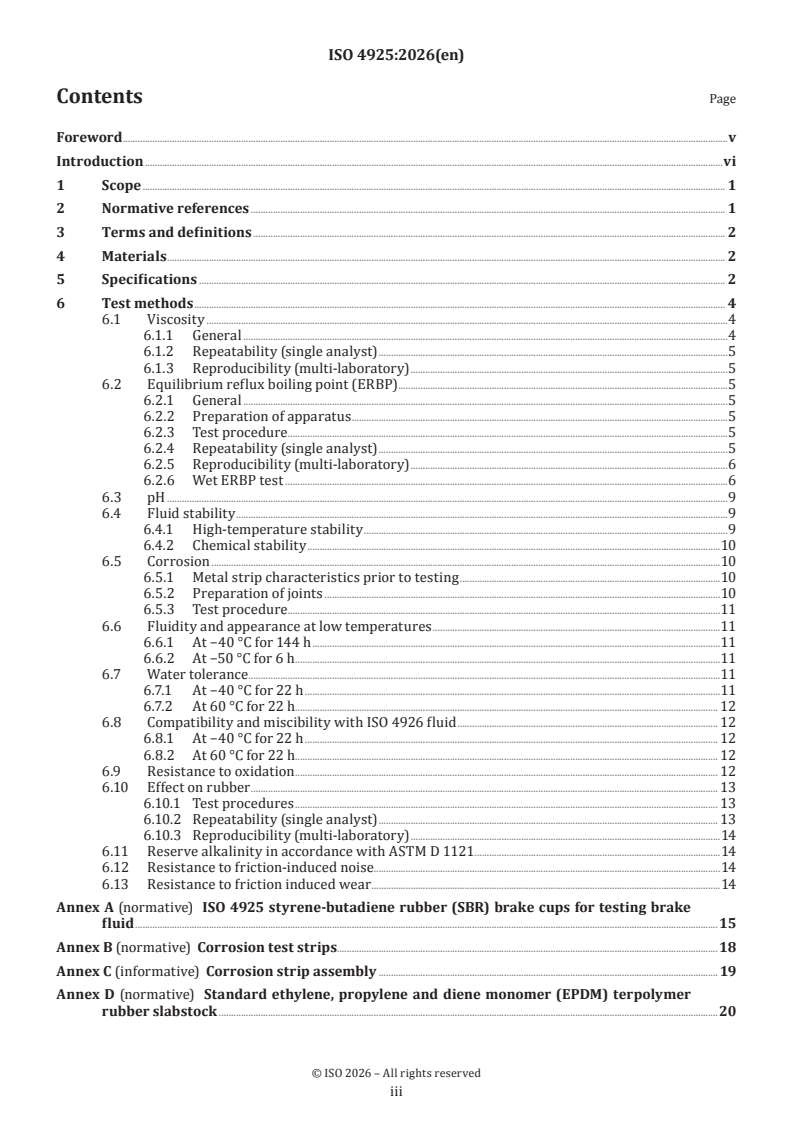
The document is organized into clauses on scope, normative references, terms and definitions, materials, specifications and test methods. It also includes six annexes that provide test materials, assemblies, a reference fluid and a wear test procedure.
| Annex | What it covers |
|---|---|
| Annex A | ISO 4925 SBR brake cups for testing brake fluid |
| Annex B | Corrosion test strips |
| Annex C | Corrosion strip assembly |
| Annex D | Standard EPDM rubber slabstock |
| Annex E | Triethylene glycol monomethyl ether (TEGME) brake fluid grade |
| Annex F | Wear test in the translatory oscillation tribometer for EPDM-metal contact |
What are the key requirements of ISO 4925:2026?
ISO 4925:2026 combines material quality checks with class-based performance limits. The practical message is simple: a fluid is not judged only by one property, but by how it behaves in heat, cold, moisture, metal contact and rubber contact.
Materials and class limits
Clause 4 requires the fluid to be clear and free from suspended matter, dirt and sediment. The fluid may be dyed if it cannot be confused with other fluids. In practice, this is a basic handling and identification check before more detailed testing begins.
Clause 5 says the product shall meet the requirements for the appropriate class in Table 1. The class system covers viscosity, equilibrium reflux boiling point (ERBP), wet ERBP, pH, fluid stability, corrosion, low-temperature fluidity, water tolerance, compatibility and miscibility with ISO 4926 fluid, oxidation resistance, effect on rubber, reserve alkalinity, friction-induced noise and friction-induced wear. For a buyer or qualifier, Table 1 is the pass/fail map for selecting the right brake fluid class.
Core fluid performance
Clause 6.1 measures viscosity using ISO 3104, with repeatability and reproducibility statements for laboratory work. This matters because brake feel and low-temperature flow depend on how the fluid thickens in cold conditions and thins when hot.
Clause 6.2 determines ERBP and wet ERBP with a modified ASTM D1120 method, including a humidification stage that uses TEGME from Annex E. In practice, these tests show how much boiling margin the fluid has when new and after moisture exposure.
Clause 6.3 measures pH electrometrically after mixing the fluid with a neutral ethanol-water mixture. Clause 6.4 then checks high-temperature stability and chemical stability against ISO 4926 reference fluid. Together, these tests show whether the fluid resists breakdown, acidity drift and boiling point loss during service.
Compatibility with metals, seals and cold operation
Clause 6.5 evaluates corrosion on tinned iron, steel, aluminium, cast iron, brass and copper strips, and also checks the effect on SBR cups. This matters because a brake fluid can pass a boiling-point test and still damage metals or seals in a hydraulic system.
Clauses 6.6 to 6.8 check low-temperature fluidity, water tolerance, and compatibility and miscibility with ISO 4926 fluid. These tests look for stratification, sediment and poor flow after cold soaking or water exposure, which is important where vehicles see winter conditions or moisture contamination.
Clause 6.9 assesses oxidation resistance using aluminium and cast-iron strips in an oxidizing environment. The test looks for pitting, roughness and gum formation, which helps reveal whether the fluid will keep parts clean over time.
Rubber, noise and wear
Clause 6.10 measures the effect on rubber using SBR cups from Annex A and EPDM slabstock from Annex D. The required observations cover swelling, hardness change, volume change and signs of blisters or carbon black separation. In practice, this tells seal manufacturers and fluid formulators whether the fluid is likely to preserve seal function.
Clause 6.11 covers reserve alkalinity in accordance with ASTM D 1121. Clauses 6.12 and 6.13 add lubrication-related checks for friction-induced noise and friction-induced wear. Clause 6.12 uses DIN 51834-5 for stick-slip oscillation and static friction coefficient, and Clause 6.13 uses Annex F to judge EPDM wear depth, load cycles before a friction jump and average friction coefficient. For users, these newer checks are aimed at real brake-system lubrication behaviour, not just chemical compatibility.
What changed in ISO 4925:2026 from the previous edition?
ISO 4925:2026 is the fourth edition and it cancels and replaces ISO 4925:2020. The foreword states that the document was technically revised, and the main changes are the addition of a lubrication requirement for the noise test as a pass/fail criterion in 6.12 and a lubrication requirement for the wear test as a pass/fail criterion in 6.13.
Which standards are used with ISO 4925:2026?
ISO 4925:2026 relies on several companion standards for the actual laboratory methods. ISO 3104 provides the viscosity method, ISO 37 and ISO 48-2 support rubber property measurement, and ISO 812 plus ISO 815-1 and ISO 815-2 support low-temperature brittleness and compression set checks.
ASTM D1120, ASTM D1121, ASTM D1123, ASTM D664, ASTM D91, ASTM D3182, ASTM D3185, ASTM D412, ASTM D746, ASTM D865, ASTM D1209, ASTM D1364 and ASTM D1613 supply methods for boiling point, reserve alkalinity, water content, sediment, rubber testing and fluid analysis. ISO 4926 provides the reference brake fluid used in compatibility and stability checks, DIN 51834-5 provides the friction-noise method, and ISO 683-17 is used in Annex F for the bearing-steel ball. Annex E also refers to SAE J1703 for the TEGME properties.
What does the ISO 4925:2026 document contain?
ISO 4925:2026 contains a class specification table, detailed test procedures and supporting annexes for the test materials and reference fluids. It includes setup descriptions, apparatus notes and figures for boiling-point and humidification tests, plus the corrosion strip and tribometer arrangements used in the laboratory.
The annexes provide the standardized SBR cups, EPDM slabstock, corrosion strips and TEGME needed for repeatable testing. Annex F gives the wear-test configuration for EPDM-metal contact, including the inclined tribometer setup, test sequence and the way wear depth is evaluated. The document also includes formulas for reporting volume change, TEGME composition by gas chromatography and wear-related results, so laboratories can generate comparable test reports.
Relations
- Effective Date
- 18-Nov-2023
Get Certified
Connect with accredited certification bodies for this standard

TÜV Rheinland
TÜV Rheinland is a leading international provider of technical services.

TÜV SÜD
TÜV SÜD is a trusted partner of choice for safety, security and sustainability solutions.

DEKRA Certification Inc.
DEKRA US certification services.
Sponsored listings
Frequently Asked Questions
ISO 4925:2026 is a standard published by the International Organization for Standardization (ISO). Its full title is "Road vehicles — Specification of non-petroleum-based brake fluids for hydraulic systems". This standard covers: This document provides the specifications, requirements and test methods for non-petroleum-based fluids used in road-vehicle hydraulic brake and clutch systems that are designed for use with such fluids and equipped with seals, cups or double-lipped type gland seals made of styrene-butadiene rubber (SBR) and ethylene-propylene elastomer (EPDM).
This document provides the specifications, requirements and test methods for non-petroleum-based fluids used in road-vehicle hydraulic brake and clutch systems that are designed for use with such fluids and equipped with seals, cups or double-lipped type gland seals made of styrene-butadiene rubber (SBR) and ethylene-propylene elastomer (EPDM).
ISO 4925:2026 is classified under the following ICS (International Classification for Standards) categories: 43.040.40 - Braking systems; 75.120 - Hydraulic fluids. The ICS classification helps identify the subject area and facilitates finding related standards.
ISO 4925:2026 has the following relationships with other standards: It is inter standard links to ISO 4925:2020. Understanding these relationships helps ensure you are using the most current and applicable version of the standard.
ISO 4925:2026 is available in PDF format for immediate download after purchase. The document can be added to your cart and obtained through the secure checkout process. Digital delivery ensures instant access to the complete standard document.
Standards Content (Sample)
International
Standard
ISO 4925
Fourth edition
Road vehicles — Specification of
2026-06
non-petroleum-based brake fluids
for hydraulic systems
Véhicules routiers — Spécifications pour liquides de frein à base
non pétrolière pour systèmes hydrauliques
Reference number
© ISO 2026
All rights reserved. Unless otherwise specified, or required in the context of its implementation, no part of this publication may
be reproduced or utilized otherwise in any form or by any means, electronic or mechanical, including photocopying, or posting on
the internet or an intranet, without prior written permission. Permission can be requested from either ISO at the address below
or ISO’s member body in the country of the requester.
ISO copyright office
CP 401 • Ch. de Blandonnet 8
CH-1214 Vernier, Geneva
Phone: +41 22 749 01 11
Email: copyright@iso.org
Website: www.iso.org
Published in Switzerland
ii
Contents Page
Foreword .v
Introduction .vi
1 Scope . 1
2 Normative references . 1
3 Terms and definitions . 2
4 Materials . 2
5 Specifications . 2
6 Test methods . 4
6.1 Viscosity .4
6.1.1 General .4
6.1.2 Repeatability (single analyst) .5
6.1.3 Reproducibility (multi-laboratory) .5
6.2 Equilibrium reflux boiling point (ERBP) .5
6.2.1 General .5
6.2.2 Preparation of apparatus .5
6.2.3 Test procedure.5
6.2.4 Repeatability (single analyst) .5
6.2.5 Reproducibility (multi-laboratory) .6
6.2.6 Wet ERBP test .6
6.3 pH .9
6.4 Fluid stability .9
6.4.1 High-temperature stability .9
6.4.2 Chemical stability .10
6.5 Corrosion .10
6.5.1 Metal strip characteristics prior to testing .10
6.5.2 Preparation of joints .10
6.5.3 Test procedure.11
6.6 Fluidity and appearance at low temperatures .11
6.6.1 At −40 °C for 144 h .11
6.6.2 At −50 °C for 6 h .11
6.7 Water tolerance .11
6.7.1 At −40 °C for 22 h .11
6.7.2 At 60 °C for 22 h. 12
6.8 Compatibility and miscibility with ISO 4926 fluid . 12
6.8.1 At −40 °C for 22 h . 12
6.8.2 At 60 °C for 22 h. 12
6.9 Resistance to oxidation . 12
6.10 Effect on rubber . 13
6.10.1 Test procedures . 13
6.10.2 Repeatability (single analyst) . 13
6.10.3 Reproducibility (multi-laboratory) .14
6.11 Reserve alkalinity in accordance with ASTM D 1121 .14
6.12 Resistance to friction-induced noise.14
6.13 Resistance to friction induced wear .14
Annex A (normative) ISO 4925 styrene-butadiene rubber (SBR) brake cups for testing brake
fluid .15
Annex B (normative) Corrosion test strips.18
Annex C (informative) Corrosion strip assembly . 19
Annex D (normative) Standard ethylene, propylene and diene monomer (EPDM) terpolymer
rubber slabstock .20
iii
Annex E (normative) Triethylene glycol monomethyl ether (TEGME) brake fluid grade.22
Annex F (normative) Wear test in the translatory oscillation tribometer to quantify the
friction-induced wear of a brake fluid in EPDM-metal contact .25
Bibliography .29
iv
Foreword
ISO (the International Organization for Standardization) is a worldwide federation of national standards
bodies (ISO member bodies). The work of preparing International Standards is normally carried out through
ISO technical committees. Each member body interested in a subject for which a technical committee
has been established has the right to be represented on that committee. International organizations,
governmental and non-governmental, in liaison with ISO, also take part in the work. ISO collaborates closely
with the International Electrotechnical Commission (IEC) on all matters of electrotechnical standardization.
The procedures used to develop this document and those intended for its further maintenance are described
in the ISO/IEC Directives, Part 1. In particular, the different approval criteria needed for the different types
of ISO documents should be noted. This document was drafted in accordance with the editorial rules of the
ISO/IEC Directives, Part 2 (see www.iso.org/directives).
ISO draws attention to the possibility that the implementation of this document may involve the use of (a)
patent(s). ISO takes no position concerning the evidence, validity or applicability of any claimed patent
rights in respect thereof. As of the date of publication of this document, ISO had not received notice of (a)
patent(s) which may be required to implement this document. However, implementers are cautioned that
this may not represent the latest information, which may be obtained from the patent database available at
www.iso.org/patents. ISO shall not be held responsible for identifying any or all such patent rights.
Any trade name used in this document is information given for the convenience of users and does not
constitute an endorsement.
For an explanation of the voluntary nature of standards, the meaning of ISO specific terms and expressions
related to conformity assessment, as well as information about ISO's adherence to the World Trade
Organization (WTO) principles in the Technical Barriers to Trade (TBT), see www.iso.org/iso/foreword.html.
This document was prepared by Technical Committee ISO/TC 22, Road vehicles, Subcommittee 33, Vehicle
dynamics, chassis components and driving automation systems testing.
[1]
This fourth edition cancels and replaces the third edition (ISO 4925:2020 ), which has been technically
revised.
The main changes are as follows:
— lubrication requirement for noise test is added as a pass/fail criterion 6.12;
— lubrication requirement for wear test is added as a pass/fail criterion 6.13.
Any feedback or questions on this document should be directed to the user’s national standards body. A
complete listing of these bodies can be found at www.iso.org/members.html.
v
Introduction
The specifications for fluids given in this document incorporate a range of performance standards in use
throughout the world at the time of publication. Further lubrication requirements are added for all classes 3,
4, 5–1, 6 and 7.
These fluids are mainly used in the hydraulic brake and clutch systems of road vehicles, but they can also be
used in any suitable hydraulic system.
vi
International Standard ISO 4925:2026(en)
Road vehicles — Specification of non-petroleum-based brake
fluids for hydraulic systems
1 Scope
This document provides the specifications, requirements and test methods for non-petroleum-based fluids
used in road-vehicle hydraulic brake and clutch systems that are designed for use with such fluids and
equipped with seals, cups or double-lipped type gland seals made of styrene-butadiene rubber (SBR) and
ethylene-propylene elastomer (EPDM).
2 Normative references
The following documents are referred to in the text in such a way that some or all of their content constitutes
requirements of this document. For dated references, only the edition cited applies. For undated references,
the latest edition of the referenced document (including any amendments) applies.
ISO 37, Rubber, vulcanized or thermoplastic — Determination of tensile stress-strain properties
ISO 48-2, Rubber, vulcanized or thermoplastic — Determination of hardness — Part 2: Hardness between 10
IRHD and 100 IRHD
ISO 812, Rubber, vulcanized or thermoplastic — Determination of low-temperature brittleness
ISO 815-1, Rubber, vulcanized or thermoplastic — Determination of compression set — Part 1: At ambient or
elevated temperatures
ISO 815-2, Rubber, vulcanized or thermoplastic — Determination of compression set — Part 2: At low
temperatures
ISO 3104, Petroleum products — Transparent and opaque liquids — Determination of kinematic viscosity and
calculation of dynamic viscosity
ISO 4926, Road vehicles — Hydraulic braking systems — Non-petroleum-based reference fluid
ASTM A 624, Standard specification for tin mill products, electrolytic tin plate, single reduced
ASTM D 91, Standard test method for precipitation number of lubricating oils
ASTM D 395, Standard test methods for rubber property — Compression set
ASTM D 412, Standard test methods for vulcanized rubber and thermoplastic elastomers — Tension
ASTM D 746, Standard test method for brittleness temperature of plastics and elastomers by impact
ASTM D 865, Standard test method for rubber — Deterioration by heating in air (test tube enclosure)
ASTM D 1120, Standard test method for boiling point of engine coolants
ASTM D 1121, Standard test method for reserve alkalinity of engine coolants and antirusts
ASTM D 1123, Standard test methods for water in engine coolant concentrate by the Karl Fisher reagent method
ASTM D 1415, Standard test method for rubber property — International hardness
ASTM D 3182, Standard practice for rubber — Materials, equipment and procedures for mixing standard
compounds and preparing standard vulcanized sheets
ASTM D 3185, Standard test methods for rubber — Evaluation of SBR (Styrene-Butadiene Rubber) including
mixtures with oil
ASTM D 3185:2006, Standard test methods for rubber — Evaluation of SBR (Styrene-Butadiene Rubber)
including mixtures with oil
ASTM E 298, Standard test methods for assay of organic peroxides
DIN 51834-5:2024, Testing of lubricants - Tribological test in the translatory oscillation apparatus - Part 5:
Quantification of the friction-induced noise development of brake fluids in EPDM-metal contacts
DIN 51834-5, Testing of lubricants - Tribological test in the translatory oscillation apparatus - Part 5:
Quantification of the friction-induced noise development of brake fluids in EPDM-metal contacts
3 Terms and definitions
No terms and definitions are listed in this document.
ISO and IEC maintain terminology databases for use in standardization at the following addresses:
— ISO Online browsing platform: available at https:// www .iso .org/ obp
— IEC Electropedia: available at https:// www .electropedia .org/
4 Materials
On visual inspection, the fluid shall be clear and free of suspended matter, dirt and sediment. The quality of
the materials used shall be such that the resulting product conforms to the requirements of this document
and that uniformity of performance is ensured. Fluids may be dyed, provided no confusion is possible
between them and other types of fluids.
5 Specifications
The product shall meet the requirements for the appropriate class in accordance with Table 1, using the test
methods according to Clause 6.
Table 1 — Brake fluid specifications — Tests and requirements
Requirement(s)
Test
method Test description Unit
Class Class Class Class Class
(subclause)
3 4 5–1 6 7
6.1 Viscosity
at −40 °C mm /s ≤1 500 ≤900 ≤750 ≤750
at 100 °C mm /s ≥1,5
6.2 Equilibrium reflux boiling point (ERBP) °C ≥205 ≥230 ≥260 ≥250 ≥260
6.2.6 Wet ERBP °C ≥140 ≥155 ≥180 ≥165 ≥180
6.3 pH — 7 to 11,5
6.4 Fluid stability
6.4.1 High-temperature stability °C ±5 °C
6.4.2 Chemical stability °C ±5 °C
6.5 Corrosion
Metal strip characteristics after testing
Mass change
TTaabblle 1 e 1 ((ccoonnttiinnueuedd))
Requirement(s)
Test
method Test description Unit
Class Class Class Class Class
(subclause)
3 4 5–1 6 7
Tinned iron mg/cm −0,2 to 0,2
Steel mg/cm −0,2 to 0,2
Aluminium mg/cm −0,1 to 0,1
Cast iron mg/cm −0,2 to 0,2
Brass mg/cm −0,4 to 0,4
Copper mg/cm −0,4 to 0,4
Aspect — No pitting or roughness outside
contact area
Staining/discolouration — Permitted
Liquid characteristics after testing
Aspect — No gel, none adhering crystals
pH — 7 to 11,5
Sediment % vol. ≤0,1
Rubber cup characteristics after testing
Blisters or carbon black separation at — None
surface
Hardness decrease IRHD ≤15
Base diameter increase mm ≤1,4
Volume increase % ≤16
6.6 Fluidity and appearance at low temperatures
6.6.1 at −40 °C for 144 h
Aspect — Clear and homogeneous
Bubble flow time s ≤10
Sediments — Absence
6.6.2 at −50 °C for 6 h
Aspect — Clear and homogeneous
Bubble flow time s ≤35
Sediments — Absence
6.7 Water tolerance
6.7.1 at −40 °C for 22 h
Aspect — Clear and homogeneous
Bubble flow time s ≤10
Sediments — Absence
6.7.2 at 60 °C for 22 h
Aspect — Clear and homogeneous
Sediments % vol. ≤0,05
6.8 Compatibility/miscibility with ISO 4926 fluid
6.8.1 at − 40 °C for 22 h
Aspect — Clear and homogeneous
Sediments — Absence
6.8.2 at 60 °C for 22 h
Aspect — Clear and homogeneous
Sediments % vol. ≤0,05
TTaabblle 1 e 1 ((ccoonnttiinnueuedd))
Requirement(s)
Test
method Test description Unit
Class Class Class Class Class
(subclause)
3 4 5–1 6 7
6.9 Resistance to oxidation
Metal strip aspect No pitting or roughness
—
no more than a trace of gum
Staining/discolouration — Permitted
Mass change of aluminium strip mg/cm −0,05 to +0,05
Mass change of cast iron strip mg/cm −0,3 to +0,3
6.10 Effect on rubber
6.10.1.2 Styrene butadiene rubber (SBR)
at 120 °C
Cup diameter increase mm 0,15 to 1,4
Hardness change IRHD −15 to 0
Volume increase % 1 to 16
Blisters or carbon black separation at None
—
surface
6.10.1.3 Ethylene propylene diene monomer (EPDM)
at 120 °C
Hardness change IRHD −15 to 0
Volume change % 0 to 10
Blisters or carbon black separation at None
—
surface
6.11 Reserve alkalinity in accordance with ASTM D 1121 ml to be reported
6.12 Resistance to friction introduced noise
Stick-slip oscillations, sigma — < 0,005
Static friction coefficient (SFC) — to be reported
6.13 Resistance to friction induced wear
Wear depth of EPDM disc: d mm < 0,18
wear
Load cycles before friction jump: n — to be reported
jump
Average friction coefficient: µ — to be reported
mean
6 Test methods
6.1 Viscosity
6.1.1 General
Determine the kinematic viscosity of the fluid in accordance with ISO 3104.
2 2
Report the viscosity to the nearest 1 mm /s at −40 °C and to the nearest 0,01 mm /s at +100 °C. Duplicate
runs that agree within 1,2 % relative are acceptable for averaging (95 % confidence level).
6.1.2 Repeatability (single analyst)
The coefficient of variation of results (each the average of duplicates) obtained by the same analyst on
different days shall not be greater than 0,4 % at 47 degrees of freedom. Two such values shall be considered
unacceptable (95 % confidence level) if they differ by more than 1,2 %.
6.1.3 Reproducibility (multi-laboratory)
The coefficient of variation of results (each the average of duplicates) obtained by analysts in different
laboratories shall not be greater than 1,0 % at 15 degrees of freedom. Two such values shall be considered
unacceptable (95 % confidence level) if they differ by more than 3,0 %.
6.2 Equilibrium reflux boiling point (ERBP)
6.2.1 General
1)
Determine the ERBP of the fluid in accordance with ASTM D 1120 , but with the following changes to the
procedure and to the apparatus (see Figure 1 and Figure 2).
— Thermometer: immersion shall be 76 mm and the thermometer shall be calibrated.
— Heat source: use either a suitable variac-controlled heating mantle designed to fit the flask, or an electric
heater with rheostat heat control.
6.2.2 Preparation of apparatus
Thoroughly clean and dry all glassware before use. Attach the flask to the condenser. When using a heating
mantle, place the mantle under the flask and support it with a suitable ring clamp and laboratory-type
stand, holding the whole assembly in place by a clamp. When using a rheostat-controlled heater, centre a
standard porcelain or other suitable refractory having a diameter opening of 32 mm to 38 mm over the
heating element of the electric heater and mount the flask on the refractory so that direct heat is applied to
the flask only through the opening in the refractory. Place the whole assembly in an area free from draughts
or other causes of sudden temperature changes.
6.2.3 Test procedure
Turn on the cooling water for the condenser and apply heat to the flask at such a rate that the fluid is refluxing
within (10 ± 2) min at a rate higher than one drop per second. The reflux rate shall not exceed five drops
per second. Immediately adjust the heat input to obtain a specified equilibrium reflux rate of one drop per
second to two drops per second over the next (5 ± 2) min period. Maintain a timed and constant equilibrium
reflux rate of one drop per second to two drops per second for an additional 2 min; record the average value
of four temperature readings taken at 30 s intervals at the equilibrium reflux boiling point.
Report the boiling point to the nearest degree Celsius. Duplicate results that agree within 3 °C are acceptable
for averages (95 % confidence level).
6.2.4 Repeatability (single analyst)
The standard deviation of results (each the average of duplicates), obtained by the same analyst on
different days shall not be greater than 1,3 °C at 34 degrees of freedom. Two such values shall be considered
unacceptable (95 % confidence level) if they differ by more than 4 °C.
1) Boiling chips are available from Electro Minerals Co. (US) or from the Society of Automotive Engineers (SAE). This
information is given for the convenience of users of this document and does not constitute an endorsement by ISO of the
products named. Equivalent products may be used if they can be shown to lead to the same results.
6.2.5 Reproducibility (multi-laboratory)
The standard deviation of results (each the average of duplicates), obtained by analysts in different
laboratories, shall be not greater than 3,5 °C at 15 degrees of freedom. Two such values shall be considered
unacceptable (95 % confidence level) if they differ by more than 10,5 °C.
6.2.6 Wet ERBP test
6.2.6.1 Apparatus
6.2.6.1.1 Two corrosion test jars or equivalent screw-top, straight-sided, round glass jars each having
a capacity of about 475 ml and approximate inner dimensions of 100 mm height by 75 mm diameter, with
2)
matching lids having new, clean inserts providing water-proof and vapour-proof seals .
6.2.6.1.2 Desiccator and cover, bowl-form glass desiccator with 250 mm inside diameter, having a
matching tubulated cover fitted with a No. eight rubber stopper (see Figure 3).
6.2.6.1.3 Desiccator plate of 230 mm diameter, perforated porcelain desiccator plate, without feet, glazed
3)
on one side (No.18 or equivalent).
2) Suitable corrosion test jars (RM-49) and tinned steel lids (RM-63) can be obtained from SAE, 400 Commonwealth
Drive, Warrendale, PA 15096, USA.
3) Desiccator plates (No. 08-641C) can be obtained from Fischer Scientific, Springfield, New Jersey, USA or CeramTec
[2]
AG (No. 602786), Glaswerk Wertheim KG (No. 911743431) or equivalents, according to ISO 12911 , diameter 235
mm. Corrosion test jars (RM-49), tinned steel lids (RM-63) and desiccator plates (No. 08-641C) are examples of suitable
products available commercially. This information is given for the convenience of users of this document and does not
constitute an endorsement by ISO of these products.
Dimensions in millimetres
Key
1 water outlet
2 water jacket
3 thermometer
4 plastic screw cap or rubber sleeve
5 boiling chips
6 19/38 joint
7 water inlet
Figure 1 — Boiling point test apparatus
Dimensions in millimetres
Key
1 19/38 joint
2 fire-polished
3 screw joint or rubber sleeve
a
Internal diameter: 8 to 9.
Figure 2 — Detail of 100 ml short-neck flask
6.2.6.2 Test procedure
To determine the wet ERBP of the fluid in duplicate (see Figure 3), first, humidify a 350 ml sample of the
fluid under controlled conditions, using 350 ml of triethylene glycol mono methyl ether (TEGME), follow
Annex E, to establish the end point for humidification.
Lubricate the ground-glass joint of the desiccator.
Then, pour (450 ± 10) ml of distilled water into the desiccator and insert the perforated porcelain plate.
Immediately place one open corrosion test jar containing (350 ± 5) ml of the humidified test fluid into the
desiccator. Place a second open corrosion test jar containing (350 ± 5) ml of TEGME control fluid into the same
desiccator. The water content of the TEGME control fluid at the start of exposure shall be (0,50 ± 0,05) % by
weight.
Next, replace the desiccator cover and place immediately in a forced ventilation oven set at (50 ± 1) °C.
Periodically, during oven humidification, remove the rubber stopper from the desiccator and, using a long-
needle hypodermic syringe, quickly sample the control fluid and determine its water content in accordance
with ASTM D 1123. A maximum of 10 ml of fluid shall be removed in total. When the water content of the
control fluid has reached (3,70 ± 0,05) % by weight, remove the desiccator from the oven and seal the test jar
promptly using a screw-cap jar lid. Allow the sealed jar to cool for 60 min to 90 min at (23 ± 5) °C. Determine
the ERBP in accordance with 6.2.1 and 6.2.3.
Dimensions in millimetres
Key
1 rubber stopper
2 glass desiccator with tubulated cover
3 lubricated ground joint
4 TEGME (see Annex E)
5 corrosion test jars
6 fluid sample
7 porcelain desiccator plate
8 water
Figure 3 — Humidification apparatus
6.3 pH
Mix the fluid with an equal volume of a mixture 50 % ethanol and 50 % distilled water neutralized to a pH
of 7,0 ± 0,1. Determine the pH of the resulting solution electrometrically at (23 ± 5) °C, using a pH meter
equipped with a calibrated full range (0 to 14) glass electrode and a calomel reference electrode, as specified
[3]
in ASTM D 664 .
Clouding or muddiness of the resulting solution is permitted in the determination.
6.4 Fluid stability
6.4.1 High-temperature stability
To determine the high-temperature stability of the fluid, heat a fresh sample of the original test fluid to a
temperature of (185 ± 2) °C according to the procedure specified in 6.2.3 and maintain it at that temperature
for (120 ± 5) min before determining the boiling point of the fluid, also in accordance with 6.2.3. The
difference between this observed boiling point and the previously determined ERBP (see 6.2 ) shall be
considered as the change in boiling point of the fluid.
6.4.2 Chemical stability
To determine the chemical stability of the fluid, first, mix 30 ml of the fluid with 30 ml of the fluid in
accordance with ISO 4926. Determine the ERBP of this fluid mixture by use of the test apparatus specified
in 6.2, applying heat to the flask at such a rate that the fluid refluxes within (10 ± 2) min at a rate of between
one drop per second and five drops per second.
Record the maximum fluid temperature observed during the first minute after the fluid begins refluxing
at a rate higher than one drop per second. Over the next (15 ± 1) min, adjust and maintain the rate of reflux
to one drop per second to two drops per second. Maintain a timed and constant equilibrium reflux rate of
from one drop per second to two drops per second for an additional 2 min, recording the average value of
four temperature readings at 30 s intervals as the final equilibrium reflux boiling point. Chemical reversion
is evidenced by the change in temperature between the maximum fluid temperature recorded and the final
equilibrium reflux boiling point.
6.5 Corrosion
6.5.1 Metal strip characteristics prior to testing
Prepare two sets of strips from each of the metals listed in Table B.1 (see Annex B), each strip having a
surface area of (25 ± 5) cm (approximately 8 cm long, 1,3 cm wide, and not more than 0,6 cm thick). Drill a
hole of between 4 mm and 5 mm in diameter and about 6 mm from one end of each strip. With the exception
of the tinned iron strips, clean the strips by abrading them on all surface areas with 320A or P400 waterproof
carborundum paper and ethanol (laboratory grade) until all surface scratches, cuts and pits are removed
from the strips, using a new piece of carborundum paper for each different type of metal. Wash the strips,
including the tinned iron, with ethanol (laboratory grade), then dry them with a clean lint-free cloth and
place them in a desiccator containing desiccant maintained at (23 ± 5) °C for at least 1 h. Handle the strips
with clean forceps after polishing to avoid fingerprint contamination.
Determine the mass of each strip to the nearest 0,1 mg and assemble each set of strips on an uncoated
steel cotter pin or bolt in the following order, so that the strips are in electrical contact: tinned iron, steel,
aluminium, cast iron, brass and copper. Bend the strips, except for the cast iron, so that there is a separation
of approximately 10 mm between two adjacent strips at their free ends. Immerse the strip assemblies in
ethanol (laboratory grade) to eliminate fingerprints (see Annex C).
6.5.2 Preparation of joints
Measure the base diameter of two standard SBR cups (in accordance with Annex A), using an optical
comparator or micrometer, to the nearest 0,02 mm, along the centreline of the ISO and rubber type
identifications and at right angles to this centreline. Take the measurements at least 0,4 mm and not more
than 2,4 mm above the bottom edge and parallel to the base of the cup. Discard any cup if the two measured
diameters differ by more than 0,08 mm. Take the average of the measurements on each cup. Determine
the hardness of each cup, thus supported by the procedure in accordance with ISO 48-2 (see Annex A).
Determine the volume change using the method given in 6.10.
Alternatively, the test may be carried out on rubber anvils prepared from the same material and having
the same properties as the cups. Place one rubber cup, with lip edge facing up, in each of two straight-sided
4)
round glass jars having a capacity of approximately 475 ml and inner dimensions of approximately 100 mm
height and 75 mm diameter. Apply four wrappings of 15 mm PTFE tape around the jar threads allowing
3 mm above the top of the jar. Use only tinned steel lids vented with a hole (0,8 ± 0,1) mm in diameter.
Insert a metal strip assembly inside each cup with the pinned end in contact with the concavity of the cup
and the free end extending upward in the jar. Mix 760 ml of the fluid with 40 ml of distilled water.
4) Suitable jars (RM-49) and lids (RM-64) are available from SAE, 400 Commonwealth Drive, Warendale, PA 15096, USA.
Jars (RM 49) and lids (RM 64) are examples of suitable products available commercially. This information is given for the
convenience of users of this document and does not constitute an endorsement by ISO of these products.
6.5.3 Test procedure
Add a sufficient amount of the mixture to cover the metal strip assembly in each jar to a depth of
approximately 10 mm above the tops of the strips. Tighten the lids and place the jars in an oven maintained
at (100 ± 2) °C for (120 ± 2) h. Then allow the jars to cool at (23 ± 5) °C for 60 min to 90 min. Immediately
following the cooling period, remove the metal strips from the jars by use of forceps, removing loose
adhering sediment by agitation of the metal strip assembly in the fluid in the jar. Examine the test strips and
test jars for adhering crystalline deposit. Disassemble the metal strips, remove adhering fluid by flushing
with water and clean individual strips by wiping with a cloth for evidence of deterioration. Place the strips
in a desiccator containing a desiccant maintained at (23 ± 5) °C for at least 1 h.
Determine the mass of each strip to the nearest 0,1 mg. Determine the difference in mass of each metal
strip and divide the difference by the total surface area of the metal strip measured in square centimetres.
Average the measured values of the duplicates. In the event of a marginal pass on inspection, or of a failure
in only one of the duplicates, another set of duplicate test samples shall be run. Both repeat samples shall
meet all the requirements of 6.5 in Table 1.
Immediately following the cooling period, remove the rubber cups from the jars by use of forceps, removing
loose adhering sediment by agitation of the cup in the fluid in the jar. Rinse the cups in ethanol (laboratory
grade) and dry them in air. Examine the cups for evidence of sloughing, blisters and other forms of
disintegration. Measure the base diameter, hardness and volume of each cup within 15 min after removal
from the fluid and calculate the changes according to 6.10.
Examine the fluid and water mixture in the jars for presence of gel. Agitate the fluid in the jars to suspend
and uniformly disperse sediment and transfer a 100 ml portion of this fluid to a cone-shaped centrifuge
tube. Determine the percentage sediment in accordance with ASTM D 91. Measure the pH of the corrosion
test fluid in accordance with 6.3.
6.6 Fluidity and appearance at low temperatures
6.6.1 At −40 °C for 144 h
5)
Place 100 ml of fluid in a glass sample bottle having a capacity of approximately 125 ml, an outside diameter
of (37 ± 0,5) mm and an overall height of (165 ± 2,5) mm. Stopper the bottle with a cork and place in a cold
bath maintained at (−40 ± 2) °C for (144 ± 4) h.
Examine the fluid for evidence of stratification and sedimentation. Invert the bottle and determine the
number of seconds required for the air bubble to travel to the top of the fluid.
6.6.2 At −50 °C for 6 h
Repeat the procedure and observations in accordance with 6.6.1 but maintain the cold bath at (−50 ± 2) °C
for (6 ± 0,2) h.
6.7 Water tolerance
6.7.1 At −40 °C for 22 h
Mix 3,5 ml of distilled water with 100 ml of fluid and pour the mixture into a cone-shaped centrifuge tube.
Stopper the tube with a cork and place in a cold bath maintained at (−40 ± 2) °C for (22 ± 2) h.
Examine the fluid for evidence of stratification and sedimentation. Invert the tube and determine the number
of seconds required for the air bubble to travel to the top of the fluid. The air bubble shall be considered to
have reached the top of the fluid when the top of the bubble reaches the 2 ml graduation of the centrifuge
tube.
5) Sample bottles (RM-59A) may be obtained from SAE, 400 Commonwealth Drive, Warrendale, PA 15096, USA.
Sample bottles (RM-59A) are an example of a suitable product available commercially. This information is given for the
convenience of users of this document and does not constitute an endorsement by ISO of this product.
6.7.2 At 60 °C for 22 h
Place the centrifuge tube from 6.7.1 in an oven maintained at (60 ± 2) °C for (22 ± 2) h. Remove the tube from
the oven and immediately examine the contents for evidence of stratification. Determine the percentage
sediment by volume in accordance with ASTM D 91.
6.8 Compatibility and miscibility with ISO 4926 fluid
6.8.1 At −40 °C for 22 h
Mix 50 ml of fluid with 50 ml of the fluid in accordance with ISO 4926 and pour this mixture into a cone-
shaped centrifuge tube and stopper with a cork. Place the centrifuge tube for (22 ± 2) h in a bath maintained
at (−40 ± 2) °C. Examine the fluid for stratification and sedimentation.
6.8.2 At 60 °C for 22 h
Place the centrifuge tube specified in 6.8.1 in an oven maintained at (60 ± 2) °C for (22 ± 2) h. Remove the
tube from the oven and immediately examine the contents for evidence of stratification. Determine the
percentage sediment by volume in accordance with ASTM D 91.
6.9 Resistance to oxidation
Prepare two sets of aluminium and cast-iron test strips using the procedure given in 6.5. Determine the
mass of each strip to the nearest 0,1 mg and assemble a strip of each metal on an uncoated steel cotter
6)
pin or bolt, separating the strips at each end with a piece of tinfoil (99,9 % tin, 0,025 % lead, maximum)
approximately 12 mm square and between 0,02 mm and 0,06 mm in thickness.
Place (30 ± 1) ml of fluid in a small glass bottle approximately 120 ml in capacity. Add (60 ± 2) mg of reagent
grade benzoyl peroxide and (1,5 ± 0,05) ml of distilled water to the bottle. Benzoyl peroxide that has more
than 90 % purity (excluding water) when tested in accordance with ASTM E 298 shall be used; brownish or
dusty product shall be discarded. Stopper the bottle and shake the contents, avoiding contact of the solution
with the stopper. Place the bottle in an oven at (70 ± 2) °C for (120 ± 10) min, shaking every 15 min to effect
solution of the peroxide. Remove the bottle from the oven, do not disturb the stopper and cool in air at a
temperature of (23 ± 5) °C for 2 h.
Place approximately 1/8 section of a standard SBR cup, as described in Annex A, in the bottom of each of
two test tubes about 22 mm in diameter and 175 mm in length. Add 10 ml of prepared test fluid to each test
tube. Place a metal strip assembly in each tube with the end of the strips resting on the rubber, the solution
covering about one half of the length of the strips, and the end having the cotter pin remaining out of the
solution. Stopper the tubes with corks and store upright for (70 ± 2) h at (23 ± 5) °C. Loosen the stoppers and
place the tubes for (168 ± 2) h in an oven maintained at (70 ± 2) °C.
After the heating period, remove and disassemble the metal strips and examine for gum deposits. Wipe the
strips with a cloth saturated with ethanol (laboratory grade) and examine for pitting or roughening of the
surface. Place the strips in a desiccator containing a desiccant maintained at (23 ± 5) °C for at least 1 h.
Determine the mass of each strip to the nearest 0,1 mg.
Determine the mass change by dividing the difference in mass of each metal strip by the total surface area
of each metal strip measured in square centimetres. Average the measured values of the duplicates. In the
event of a marginal pass on inspection, or of a failure in only one of the duplicates, another set of duplicate
test samples shall be run. Both repeat samples shall meet all the requirements of 6.9 in Table 1.
6) Tinfoil (RM-27) may be obtained from SAE, 400 Commonwealth Drive, Warrendale, PA 15096, USA. Tinfoil (RM-27)
is an example of a suitable product available commercially. This information is given for the convenience of users of this
document and does not constitute an endorsement by ISO of this product.
6.10 Effect on rubber
6.10.1 Test procedures
6.10.1.1 General
For the test procedure described in 6.10.1.2, use standard SBR cups in accordance with Annex A; for 6.10.1.3,
use standard EPDM slabstock in accordance with Annex D. Measure the base diameter and hardness of all
cups in accordance with 6.5, discarding any cup whose diameter differs by more than 0,08 mm.
Determine the mass of the cups in air (m ) to the nearest 1 mg and then determine the apparent mass of the
cup immersed in distilled water at (23 ± 5) °C (m ). Quickly dip each specimen in ethanol (laboratory grade)
and then air dry or blot dry with filter paper free of lint and foreign material.
6.10.1.2 At 120 °C — SBR cups
7)
Place two SBR cups in a straight-sided round glass ja
...