


ISO 2080:2008
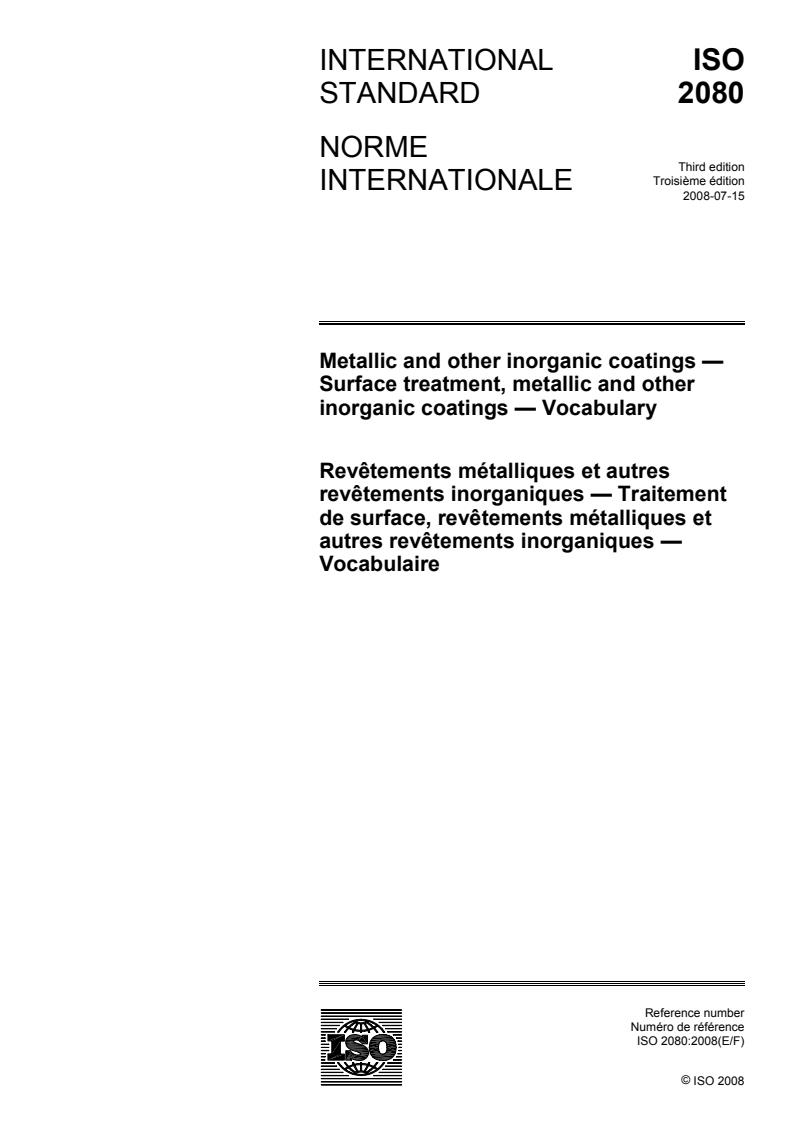
(Main)Metallic and other inorganic coatings — Surface treatment, metallic and other inorganic coatings — Vocabulary
Metallic and other inorganic coatings — Surface treatment, metallic and other inorganic coatings — Vocabulary
ISO 2080:2008 describes general types of surface-finishing processes and provides a vocabulary that defines terms related to these processes. Emphasis is placed on practical usage in surface-finishing technology in the metal-finishing field. The vocabulary does not include definitions and terms for porcelain and vitreous enamel, thermally sprayed coatings and hot-dip galvanizing for which specialized vocabularies and glossaries exist or are in preparation. For the most part, basic terms that have the same meaning in surface finishing as in other fields of technology, and that are defined in handbooks and dictionaries of chemistry and physics, are not included.
Revêtements métalliques et autres revêtements inorganiques — Traitement de surface, revêtements métalliques et autres revêtements inorganiques — Vocabulaire
L'ISO 2080:2008 décrit des types généraux de procédés de traitement de surface et fournit un vocabulaire qui définit les termes se rapportant à ces procédés. L'accent est mis sur l'utilisation pratique, en technologie de finition de surface, dans le domaine de la finition des métaux. Ce vocabulaire n'inclut pas les définitions et les termes relatifs à la porcelaine, à l'émail vitrifié, aux revêtements projetés thermiquement et à la galvanisation par immersion à chaud pour lesquels des vocabulaires et glossaires spécialisés existent déjà ou sont en cours d'élaboration. Le plus souvent, les termes fondamentaux possédant la même signification dans le domaine du traitement de surface que dans d'autres domaines de technologie, et qui sont définis dans des manuels et des dictionnaires de chimie et de physique, ne sont pas inclus.
General Information
- Status
- Withdrawn
- Publication Date
- 06-Jul-2008
- Technical Committee
- ISO/TC 107 - Metallic and other inorganic coatings
- Drafting Committee
- ISO/TC 107 - Metallic and other inorganic coatings
- Current Stage
- 9599 - Withdrawal of International Standard
- Start Date
- 08-Mar-2022
- Completion Date
- 12-Feb-2026
Relations
- Effective Date
- 09-Feb-2026
- Effective Date
- 09-Feb-2026
- Effective Date
- 09-Feb-2026
- Effective Date
- 09-Feb-2026
- Effective Date
- 09-Feb-2026
- Effective Date
- 09-Feb-2026
- Effective Date
- 09-Feb-2026
- Effective Date
- 09-Feb-2026
- Effective Date
- 09-Feb-2026
- Effective Date
- 09-Feb-2026
- Effective Date
- 09-Feb-2026
- Effective Date
- 09-Feb-2026
- Effective Date
- 09-Feb-2026
- Effective Date
- 09-Feb-2026
- Effective Date
- 16-Jun-2018
Get Certified
Connect with accredited certification bodies for this standard

National Aerospace and Defense Contractors Accreditation Program (NADCAP)
Global cooperative program for special process quality in aerospace.
CARES (UK Certification Authority for Reinforcing Steels)
UK certification for reinforcing steels and construction.
DVS-ZERT GmbH
German welding certification society.
Sponsored listings
Frequently Asked Questions
ISO 2080:2008 is a standard published by the International Organization for Standardization (ISO). Its full title is "Metallic and other inorganic coatings — Surface treatment, metallic and other inorganic coatings — Vocabulary". This standard covers: ISO 2080:2008 describes general types of surface-finishing processes and provides a vocabulary that defines terms related to these processes. Emphasis is placed on practical usage in surface-finishing technology in the metal-finishing field. The vocabulary does not include definitions and terms for porcelain and vitreous enamel, thermally sprayed coatings and hot-dip galvanizing for which specialized vocabularies and glossaries exist or are in preparation. For the most part, basic terms that have the same meaning in surface finishing as in other fields of technology, and that are defined in handbooks and dictionaries of chemistry and physics, are not included.
ISO 2080:2008 describes general types of surface-finishing processes and provides a vocabulary that defines terms related to these processes. Emphasis is placed on practical usage in surface-finishing technology in the metal-finishing field. The vocabulary does not include definitions and terms for porcelain and vitreous enamel, thermally sprayed coatings and hot-dip galvanizing for which specialized vocabularies and glossaries exist or are in preparation. For the most part, basic terms that have the same meaning in surface finishing as in other fields of technology, and that are defined in handbooks and dictionaries of chemistry and physics, are not included.
ISO 2080:2008 is classified under the following ICS (International Classification for Standards) categories: 01.040.25 - Manufacturing engineering (Vocabularies); 25.220.40 - Metallic coatings. The ICS classification helps identify the subject area and facilitates finding related standards.
ISO 2080:2008 has the following relationships with other standards: It is inter standard links to EN ISO 1456:2009, EN ISO 2081:2008, EN ISO 6158:2011, EN ISO 19598:2016, EN ISO 10111:2019, EN ISO 26945:2011, EN ISO 4521:2008, EN ISO 1891-2:2014, EN ISO 27874:2008, EN ISO 2082:2008, EN ISO 9717:2013, EN ISO 9717:2017, EN ISO 2082:2017, EN ISO 2081:2018, ISO 2080:2022. Understanding these relationships helps ensure you are using the most current and applicable version of the standard.
ISO 2080:2008 is available in PDF format for immediate download after purchase. The document can be added to your cart and obtained through the secure checkout process. Digital delivery ensures instant access to the complete standard document.
Standards Content (Sample)
INTERNATIONAL ISO
STANDARD 2080
NORME
Third edition
Troisième édition
INTERNATIONALE
2008-07-15
Metallic and other inorganic coatings —
Surface treatment, metallic and other
inorganic coatings — Vocabulary
Revêtements métalliques et autres
revêtements inorganiques — Traitement
de surface, revêtements métalliques et
autres revêtements inorganiques —
Vocabulaire
Reference number
Numéro de référence
©
ISO 2008
PDF disclaimer
This PDF file may contain embedded typefaces. In accordance with Adobe's licensing policy, this file may be printed or viewed but
shall not be edited unless the typefaces which are embedded are licensed to and installed on the computer performing the editing. In
downloading this file, parties accept therein the responsibility of not infringing Adobe's licensing policy. The ISO Central Secretariat
accepts no liability in this area.
Adobe is a trademark of Adobe Systems Incorporated.
Details of the software products used to create this PDF file can be found in the General Info relative to the file; the PDF-creation
parameters were optimized for printing. Every care has been taken to ensure that the file is suitable for use by ISO member bodies. In
the unlikely event that a problem relating to it is found, please inform the Central Secretariat at the address given below.
PDF – Exonération de responsabilité
Le présent fichier PDF peut contenir des polices de caractères intégrées. Conformément aux conditions de licence d'Adobe, ce fichier
peut être imprimé ou visualisé, mais ne doit pas être modifié à moins que l'ordinateur employé à cet effet ne bénéficie d'une licence
autorisant l'utilisation de ces polices et que celles-ci y soient installées. Lors du téléchargement de ce fichier, les parties concernées
acceptent de fait la responsabilité de ne pas enfreindre les conditions de licence d'Adobe. Le Secrétariat central de l'ISO décline toute
responsabilité en la matière.
Adobe est une marque déposée d'Adobe Systems Incorporated.
Les détails relatifs aux produits logiciels utilisés pour la création du présent fichier PDF sont disponibles dans la rubrique General Info
du fichier; les paramètres de création PDF ont été optimisés pour l'impression. Toutes les mesures ont été prises pour garantir
l'exploitation de ce fichier par les comités membres de l'ISO. Dans le cas peu probable où surviendrait un problème d'utilisation,
veuillez en informer le Secrétariat central à l'adresse donnée ci-dessous.
DOCUMENT PROTÉGÉ PAR COPYRIGHT
© ISO 2008
The reproduction of the terms and definitions contained in this International Standard is permitted in teaching manuals, instruction
booklets, technical publications and journals for strictly educational or implementation purposes. The conditions for such reproduction are:
that no modifications are made to the terms and definitions; that such reproduction is not permitted for dictionaries or similar publications
offered for sale; and that this International Standard is referenced as the source document.
With the sole exceptions noted above, no other part of this publication may be reproduced or utilized in any form or by any means,
electronic or mechanical, including photocopying and microfilm, without permission in writing from either ISO at the address below or
ISO's member body in the country of the requester.
La reproduction des termes et des définitions contenus dans la présente Norme internationale est autorisée dans les manuels
d'enseignement, les modes d'emploi, les publications et revues techniques destinés exclusivement à l'enseignement ou à la mise en
application. Les conditions d'une telle reproduction sont les suivantes: aucune modification n'est apportée aux termes et définitions; la
reproduction n'est pas autorisée dans des dictionnaires ou publications similaires destinés à la vente; la présente Norme internationale
est citée comme document source.
À la seule exception mentionnée ci-dessus, aucune partie de cette publication ne peut être reproduite ni utilisée sous quelque forme que
ce soit et par aucun procédé, électronique ou mécanique, y compris la photocopie et les microfilms, sans l'accord écrit de l'ISO à
l'adresse ci-après ou du comité membre de l'ISO dans le pays du demandeur.
ISO copyright office
Case postale 56 • CH-1211 Geneva 20
Tel. + 41 22 749 01 11
Fax + 41 22 749 09 47
E-mail copyright@iso.org
Web www.iso.org
Published in Switzerland/Publié en Suisse
ii © ISO 2008 – All rights reserved/Tous droits réservés
Foreword
ISO (the International Organization for Standardization) is a worldwide federation of national standards bodies
(ISO member bodies). The work of preparing International Standards is normally carried out through ISO
technical committees. Each member body interested in a subject for which a technical committee has been
established has the right to be represented on that committee. International organizations, governmental and
non-governmental, in liaison with ISO, also take part in the work. ISO collaborates closely with the
International Electrotechnical Commission (IEC) on all matters of electrotechnical standardization.
International Standards are drafted in accordance with the rules given in the ISO/IEC Directives, Part 2.
The main task of technical committees is to prepare International Standards. Draft International Standards
adopted by the technical committees are circulated to the member bodies for voting. Publication as an
International Standard requires approval by at least 75 % of the member bodies casting a vote.
Attention is drawn to the possibility that some of the elements of this document may be the subject of patent
rights. ISO shall not be held responsible for identifying any or all such patent rights.
ISO 2080 was prepared by Technical Committee ISO/TC 107, Metallic and other inorganic coatings.
This third edition cancels and replaces the second edition (ISO 2080:1981) and also ISO 2079:1981, which
have been technically revised.
Avant-propos
L'ISO (Organisation internationale de normalisation) est une fédération mondiale d'organismes nationaux de
normalisation (comités membres de l'ISO). L'élaboration des Normes internationales est en général confiée
aux comités techniques de l'ISO. Chaque comité membre intéressé par une étude a le droit de faire partie du
comité technique créé à cet effet. Les organisations internationales, gouvernementales et non
gouvernementales, en liaison avec l'ISO participent également aux travaux. L'ISO collabore étroitement avec
la Commission électrotechnique internationale (CEI) en ce qui concerne la normalisation électrotechnique.
Les Normes internationales sont rédigées conformément aux règles données dans les Directives ISO/CEI,
Partie 2.
La tâche principale des comités techniques est d'élaborer les Normes internationales. Les projets de Normes
internationales adoptés par les comités techniques sont soumis aux comités membres pour vote. Leur
publication comme Normes internationales requiert l'approbation de 75 % au moins des comités membres
votants.
L'attention est appelée sur le fait que certains des éléments du présent document peuvent faire l'objet de
droits de propriété intellectuelle ou de droits analogues. L'ISO ne saurait être tenue pour responsable de ne
pas avoir identifié de tels droits de propriété et averti de leur existence.
L'ISO 2080 a été élaborée par le comité technique ISO/TC 107, Revêtements métalliques et autres
revêtements inorganiques.
Cette troisième édition annule et remplace la deuxième édition (ISO 2080:1981) ainsi que l'ISO 2079:1981,
qui ont fait l'objet d'une révision technique.
iv © ISO 2008 – All rights reserved/Tous droits réservés
Introduction
The terms and definitions in this International Standard (a combined revision of ISO 2079 and ISO 2080)
apply to electroplating and other related surface-finishing processes. The terms and definitions are not
necessarily arranged in English alphabetical order. Related terms, giving different alternatives for a given
process, have been grouped under a leading term, as, for example, in the case of “chemical plating”,
“electrodeposition”, “blasting”, “cleaning” or “colour anodising”.
Basic terms and definitions relating to corrosion and electrochemical techniques used in corrosion science are
given in ISO 8044 and are not included. Basic terms used in chemistry, electrochemistry or physics are also
not included in this International Standard. The definitions for such terms can be found in handbooks or
dictionaries of chemistry or physics.
Introduction
Les termes et définitions donnés dans la présente Norme internationale (révision groupée de l'ISO 2079 et de
l'ISO 2080) s'appliquent à l'électrodéposition et autres procédés de finition de surface connexes. Les termes
et définitions ne sont pas nécessairement classés dans l'ordre alphabétique anglais. Les termes connexes
indiquant des alternatives pour un procédé donné ont été regroupés sous un terme clé, comme par exemple
dans le cas de «dépôt chimique», de «dépôt électrolytique», de «projection de particules», de «nettoyage» ou
de «anodisation colorée».
Les termes fondamentaux et les définitions relatifs à la corrosion et aux techniques électrochimiques utilisés
dans la science de la corrosion sont donnés dans l'ISO 8044. Les termes de base utilisés en chimie, en
électrochimie ou en physique ne sont pas inclus dans la présente Norme internationale. Les définitions de ces
termes peuvent être trouvées dans des manuels ou dans des dictionnaires de chimie ou de physique.
vi © ISO 2008 – All rights reserved/Tous droits réservés
INTERNATIONAL STANDARD
NORME INTERNATIONALE
Metallic and other inorganic coatings — Surface treatment,
metallic and other inorganic coatings — Vocabulary
Revêtements métalliques et autres revêtements inorganiques —
Traitement de surface, revêtements métalliques et autres
revêtements inorganiques — Vocabulaire
1 Scope 1 Domaine d'application
This International Standard describes general types La présente Norme Internationale décrit des types
of surface-finishing processes and provides a généraux de procédés de traitement de surface et
vocabulary that defines terms related to these fournit un vocabulaire qui définit les termes se
processes. Emphasis is placed on practical usage rapportant à ces procédés. L'accent est mis sur
in surface-finishing technology in the metal-finishing l'utilisation pratique, en technologie de finition de
field. The vocabulary does not include definitions surface, dans le domaine de la finition des métaux.
and terms for porcelain and vitreous enamel, Ce vocabulaire n'inclut pas les définitions et les
thermally sprayed coatings and hot-dip galvanizing termes relatifs à la porcelaine, à l'émail vitrifié, aux
for which specialized vocabularies and glossaries revêtements projetés thermiquement et à la
exist or are in preparation. For the most part, basic galvanisation par immersion à chaud pour lesquels
terms that have the same meaning in surface des vocabulaires et glossaires spécialisés existent
finishing as in other fields of technology, and that déjà ou sont en cours d'élaboration. Le plus
are defined in handbooks and dictionaries of souvent, les termes fondamentaux possédant la
chemistry and physics, are not included. même signification dans le domaine du traitement
de surface que dans d'autres domaines de
technologie, et qui sont définis dans des manuels et
des dictionnaires de chimie et de physique, sont
exclus de la présente Norme internationale.
2 General types of surface-finishing 2 Types généraux de traitements et de
processes and treatments procédés de finition de surface
2.1 2.1
chemical plating dépôt chimique
deposition of a metallic coating by chemical, non- déposition chimique
electrolytic methods dépôt d'un revêtement métallique par des méthodes
chimiques, non électrolytiques
2.1.1 2.1.1
autocatalytic plating dépôt autocatalytique
electroless plating (deprecated) dépôt sans courant (à éviter)
deposition of a metallic coating by a controlled déposition d'un revêtement métallique par une
chemical reduction that is catalysed by the metal or réduction chimique contrôlée qui est catalysée par
alloy being deposited le métal ou l'alliage déposé
2.1.2 2.1.2
contact plating dépôt par contact
deposition of a metal by use of an internal source of déposition d'un métal par l'intermédiaire d'une
current by immersing the work (3.202) in contact source interne de courant, obtenue par immersion
with another metal in a solution containing a de la pièce à traiter (3.202) en contact avec un
compound of the metal to be deposited autre métal dans une solution contenant un
composé du métal à déposer
2.1.3 2.1.3
immersion coating dépôt au trempé
immersion plate US revêtement métallique obtenu par une réaction
metallic coating produced by a displacement dans laquelle un métal déplace un autre métal de la
2+ 2+
reaction in which one metal displaces another from solution, par exemple, Fe + Cu → Cu + Fe
2+ 2+
a solution, for example, Fe + Cu → Cu + Fe
2.2 2.2
chemical vapour deposition GB déposition en phase vapeur par procédé
chemical vapor deposition US chimique
CVD déposition d'un revêtement par réaction chimique,
deposition of a coating by a chemical reaction, obtenue par réduction thermique ou gazeuse d'une
induced by heat or gaseous reduction of a vapour vapeur condensée sur un substrat (3.185)
condensing on a substrate (3.185)
2.3 2.3
conversion treatment traitement de conversion
chemical or electrochemical process producing a procédé chimique ou électrochimique formant une
superficial layer containing a compound of the couche superficielle comprenant un composé du
substrate metal (often referred to as conversion substrat métallique (souvent appelé couche de
coating) and an anion of an environment conversion) et un anion du milieu ambiant
EXAMPLE Chromate coatings on aluminium; zinc EXEMPLE Couches de chromate sur aluminium; zinc
(often erroneously referred to as passivate coating); oxide (souvent appelées à tort «couche à l'état passif»);
and phosphate coatings on steel. couches d'oxyde et phosphate sur acier.
NOTE Anodizing (3.8), although fulfilling the above NOTE L'anodisation (3.8), bien que correspondant à la
definition, is not normally referred to as a conversion définition ci-dessus, n'est normalement pas considérée
coating process or chromating. comme un «traitement de conversion» ou une
«chromatation».
2 © ISO 2008 – All rights reserved/Tous droits réservés
2.4 2.4
diffusion treatment traitement de diffusion
process of producing a surface layer (diffusion 〈électrodéposition〉 procédé de formation d'une
layer) by diffusion of another metal or non-metal couche superficielle (de diffusion), souvent appelée
into the surface of the substrate (3.185) (often «couche de diffusion», par diffusion d'un autre
referred to as diffusion coating) élément, métallique ou non, à travers la surface du
substrat (3.185)
EXAMPLE 〈electroplating〉 diffusion treatment to form
an alloy coating from two or more different electroplated
EXEMPLE Le traitement de diffusion est utilisé pour
coatings.
former une couche d'alliage à partir d'au moins deux
revêtements électrolytiques différents.
NOTE Post-coating heat treatment (3.111) after
electroplating (2.5), for example, to remove hydrogen, is
NOTE Le traitement thermique (3.111) post
not normally designated as a diffusion treatment.
revêtement après dépôt électrolytique (2.5), pour
éliminer l'hydrogène, par exemple, n'est normalement pas
désigné par «traitement de diffusion».
2.5 2.5
electroplating dépôt électrolytique
electrodeposition électrodéposition
deposition of an adherent coating of a metal or an déposition par électrolyse d'une couche adhérente
alloy upon a substrate (3.185) by electrolysis for de métal ou d'alliage sur un substrat (3.185) en
the purpose of securing a surface with properties or vue d'obtenir une surface ayant des propriétés ou
dimensions different from those of the basis metal des dimensions différentes de celles du métal de
(3.22) base (3.22)
NOTE “Plating” should not be used alone, but only NOTE Il convient de ne pas utiliser «déposition» mais
together with “electro”. «électrodéposition».
2.6 2.6
hot-dip metal coating revêtement métallique par immersion à
metallic coating obtained by dipping the basis chaud
metal (3.22) into a molten metal revêtement métallique obtenu par immersion du
métal de base (3.22) dans un métal fondu
NOTE The traditional term “galvanizing” referring to zinc
coatings obtained by immersion in a bath of molten zinc,
NOTE Il convient de toujours ajouter la mention «par
should always be preceded by “hot-dip”. The term “spelter
immersion à chaud» après le terme traditionnel
galvanizing” should not be used for “hot-dip metal
«galvanisation» employé dans le sens de zingage obtenu
coating”. For details of terms and definitions concerning
par immersion dans un bain de zinc fondu. Il convient de
“hot-dip galvanizing”, appropriate standards related to
ne pas utiliser le terme «galvanisation spelter» pour
that process are to be consulted.
désigner un «revêtement de zinc à chaud». Pour des
détails sur les termes et définitions concernant la
«galvanisation par immersion à chaud», consulter les
normes correspondant à ce procédé.
2.7 2.7
mechanical coating revêtement mécanique
process whereby hard, small spherical objects procédé lors duquel de petits objets durs et
(such as glass shot) are tumbled against a metallic sphériques (grenaille de verre, par exemple) sont
surface, in the presence of finely divided metal projetés contre une surface métallique en présence
powder (such as zinc dust) and appropriate d'une poudre métallique finement divisée (poussière
chemicals for the purpose of covering such surfaces de zinc, par exemple) et de produits chimiques
with metal appropriés en vue de recouvrir de métal la surface
NOTE The terms “mechanical plating”, “peen plating” NOTE Les termes «déposition mécanique»
and “mechanical galvanizing” are not recommended. «galvanisation par martelage» et «galvanisation
mécanique» ne sont pas recommandés.
2.8 2.8
metal cladding placage de métal
application of a coating of one metal to another by application d'une couche d'un métal sur un autre
mechanical fabrication techniques par des techniques de fabrication mécanique
2.9 2.9
metallizing métallisation
application of a metallic coating to the surface of application d'une couche métallique sur la surface
non-metallic or non-conducting materials d'un matériau non métallique ou non conducteur
NOTE It is not recommended to use this term as a NOTE Il n'est pas recommandé d'utiliser ce terme
synonym of metal spraying (2.10) or in the sense of comme synonyme de métallisation au pistolet (2.10) ou
depositing a metallic coating on a metal substrate dans le sens de déposition d'un revêtement métallique
(3.185). sur un substrat (3.185) métallique.
2.10 2.10
metal spraying métallisation au pistolet
application of a metal by thermal spraying (2.15) application d'un métal par projection thermique
(2.15)
2.11 2.11
porcelain enamelling émaillage par vitrification
vitreous enamelling procédé d'application d'un revêtement inorganique
process for applying a substantially vitreous or vitrifié adhérant avec un métal sous l'effet d'une
glassy inorganic coating bonded to metal by fusion fusion à une température supérieure à 425 °C
at a temperature above approximately 425 °C (approximativement)
2.12 2.12
physical vapour deposition GB déposition en phase gazeuse par procédé
physical vapor deposition US physique
PVD procédé de déposition d'une couche par
process of depositing a coating by vaporizing and évaporation, puis condensation d'un élément ou
subsequently condensing an element or compound, d'un composé, généralement sous vide poussé
usually in a high vacuum
cf. pulvérisation (3.175) et dépôt ionique (3.119)
cf. sputtering (3.175) and ion plating (3.119).
2.13 2.13
sherardizing shérardisation
formation of a coating of zinc/iron alloys on various formation d'une couche d'alliages zinc/fer sur
basis metals (3.22) by heating in a mixture of zinc différents métaux de base (3.22) par chauffage
dust with air, with or without inert media dans un mélange de poussière de zinc et d'air, avec
ou sans substances inertes
2.14 2.14
surface treatment traitement de surface
treatment involving a modification of the surface traitement impliquant une modification de la surface
NOTE The term may be used in a restrictive sense NOTE Ce terme peut également être utilisé dans un
excluding metallic coatings. sens restrictif excluant les revêtements métalliques.
4 © ISO 2008 – All rights reserved/Tous droits réservés
2.15 2.15
thermal spraying projection thermique
application of a coating by a process of projecting application d'un revêtement par projection d'un
molten or heat-softened material from a source matériau, fondu ou ramolli à chaud, au moyen d'une
(gun) onto any substrate (3.185) source (pistolet), sur un substrat (3.185)
3 General terms 3 Termes généraux
3.1 3.1
activation activation
elimination of a passive surface condition élimination d'un état passif de surface
3.2 3.2
addition agent agent d'addition
additive additif
a substance added to a solution, usually in small produit ajouté à une solution, généralement en
amounts, to modify the characteristics of the petites quantités, pour modifier ses propriétés ou
solution or the properties of the deposit obtained celles des dépôts obtenus à partir de ladite solution
from the solution
3.3 3.3
adhesion adhérence
amount of force required to separate different layers force requise pour séparer différentes couches d'un
of a coating, or a coating from its substrate (3.185) revêtement ou un revêtement de son substrat
and the area of the corresponding surface (3.185) et l'aire de la surface correspondante
3.4 3.4
anode corrosion dissolution des anodes
gradual dissolution or oxidation of a metal (known dissolution progressive ou oxydation d'un métal, ou
as anode), or dissolution of an anode material by dissolution du matériau de l'anode par action
the electrochemical action in the electroplating cell électrochimique dans la cellule électrolytique
NOTE The dissolution of the anode by chemical action NOTE La dissolution de l'anode par action chimique de
of the electrolyte without current is generally not called l'électrolyte sans passage de courant est généralement
corrosion, but dissolution. appelée «dissolution» et non «corrosion».
3.5 Anode film 3.5 Film anodique
3.5.1 3.5.1
anode film film anodique
〈solution contacting the anode〉 layer of solution in 〈solution〉 couche en contact avec l'anode dont la
contact with the anode that differs in composition composition diffère de celle du reste de la solution
from that of the bulk of the solution
3.5.2 3.5.2
anode film film anodique
〈anode itself〉 outer layer of the anode itself, 〈anode〉 couche extérieure de l'anode proprement
consisting of oxidation or reaction products of the dite, composée de produits d'oxydation ou de
anode metal réaction du métal de l'anode
3.6 3.6
anodic oxidation coating revêtement d'oxydation anodique
protective, decorative or functional oxide coating revêtement protecteur, décoratif ou fonctionnel,
formed by conversion on the surface of a metal in obtenu par transformation de la surface d'un métal
an electrolytic oxidation process par un procédé électrolytique d'oxydation
cf. anodic oxidation (3.8) cf. oxydation anodique (3.8)
3.7 3.7
anodic coating revêtement anodique
sacrificial coating US revêtement sacrificiel
metallic coating that is less noble than the basis revêtement métallique moins noble que le métal de
metal (3.22) base (3.22)
NOTE Anodic coatings provide cathodic protection to NOTE Les revêtements anodiques fournissent une
the basis metal (3.22) at open pores or other coating protection cathodique au métal de base (3.22) en cas de
defects. pores débouchant à la surface ou de tout autre défaut du
revêtement.
3.8 3.8
anodic oxidation oxydation anodique
anodising GB anodisation
anodizing US procédé électrolytique d'oxydation au cours duquel
electrolytic oxidation process in which the surface of la surface d'un métal, lorsqu'elle est anodique, est
a metal, when anodic, is converted to a coating transformée en une couche ayant des propriétés
having desirable protective, decorative or functional protectrices, décoratives ou fonctionnelles
properties déterminées
3.9 3.9
anolyte anolyte
in a divided cell (3.83), the portion of the dans une cellule à diaphragme (3.83), portion de
electrolyte on the anode side of the diaphragm l'électrolyte située entre le diaphragme (3.80) et
(3.80) l'anode
3.10 3.10
anti-pitting agent agent antipiqûre
addition agent (3.2) for the specific purpose of agent d'addition (3.2) visant à empêcher la
preventing gas pits in electrodeposits formation de piqûres dues au gaz dans les dépôts
électrolytiques
6 © ISO 2008 – All rights reserved/Tous droits réservés
3.11 3.11
automatic machine machine automatique
conveyer convoyeur
〈electroplating〉 machine for mechanically 〈électrodéposition〉 machine conçue pour acheminer
processing parts through treatment cycles, such as mécaniquement les pièces pendant les divers
cleaning, anodising, or electroplating cycles de traitement, tels que le nettoyage,
l'anodisation, ou la déposition électrolytique
3.12 Automatic plating 3.12 Revêtement automatique
3.12.1 3.12.1
fully-automatic electroplating revêtement automatique
automatic plating in which the work (3.202) pieces 〈entièrement automatique〉 dépôt au cours duquel
are automatically conveyed through successive les pièces à traiter (3.202) sont transportées
cleaning (3.54) and plating tanks automatiquement dans des cuves successives de
nettoyage (3.54) et de déposition
3.12.2 3.12.2
semi-automatic electroplating revêtement automatique
automatic plating in which the work (3.202) pieces 〈semi-automatique〉 électrodéposition (2.5) au
are conveyed automatically through only one plating cours de laquelle les pièces à traiter (3.202) sont
tank transportées automatiquement dans une cuve de
déposition uniquement
3.13 3.13
auxiliary anode anode auxiliaire
supplementary anode employed during anode supplémentaire utilisée pendant
electrodeposition (2.5) to achieve a desired l'électrodéposition (2.5) pour obtenir une
thickness distribution of the electrodeposit distribution déterminée de l'épaisseur du dépôt
électrolytique
3.14 3.14
auxiliary cathode cathode auxiliaire
thief écran voleur de courant
robber cathode auxiliaire placée de telle façon qu'elle dévie
auxiliary cathode so placed as to divert to itself à son profit une partie du courant de la pièce à
some portion of the current from portions of the traiter (3.202) qui, en son absence, recevrait une
work (3.202) which otherwise receive too high a densité de courant (3.68) trop élevée
current density (3.68)
3.15 3.15
baking (deprecated) étuvage
cuisson (à éviter)
SEE heat treatment (3.111)
VOIR traitement thermique (3.111)
3.16 3.16
barrel burnishing brunissage au tonneau
smoothing of surfaces by tumbling the work (3.202) polissage des surfaces par tonnelage de la pièce à
in rotary barrels in the presence of metallic or traiter (3.202) dans des tonneaux rotatifs en
ceramic shot (or balls), and in the absence of présence de grenailles métalliques ou céramiques
abrasive (ou de billes), et en l'absence d'abrasif
3.17 3.17
barrel electroplating revêtement électrolytique au tonneau
electroplating (2.5) process in which procédé de dépôt électrolytique (2.5) au cours
electrodeposits are applied to articles in bulk in a duquel les dépôts électrolytiques sont appliqués sur
rotating, oscillating or otherwise moving container des pièces en vrac dans un récipient rotatif,
oscillant ou bougeant de toute autre manière
3.18 3.18
barrel finishing finition au tonneau
bulk processing in barrels, in either the presence or traitement en vrac réalisé dans des tonneaux, en
absence of abrasives or burnishing shot for the présence ou en l'absence d'abrasifs ou de grenaille
purpose of improving the surface finish de brunissage pour améliorer la finition de surface
cf. tumbling (3.193) cf. tonnelage (3.193)
3.19 3.19
barrel processing traitement au tonneau
mechanical, chemical, autocatalytic, or electrolytic traitement mécanique, chimique, autocatalytique ou
treatment of articles in bulk in a rotating or électrolytique de pièces en vrac dans un récipient
otherwise oscillating container rotatif ou oscillant de toute autre manière
3.20 3.20
barrier layer couche barrière
anodizing barrier layer 〈anodisation de l'aluminium〉 couche mince en
〈in anodizing aluminium〉 the thin, pore-free, semi- oxyde d'aluminium, exempte de pores et semi-
conducting aluminium oxide region nearest to the conductrice, contre la surface du métal et distincte
metal surface and distinct from the main anodic du principal revêtement d'oxyde anodique de
oxide coating which has a pore structure structure poreuse
3.21 3.21
base metal métal commun
metal that oxidizes easily to form resultant ions métal qui s'oxyde facilement pour former des ions
EXAMPLE Zinc or cadmium. EXEMPLE Zinc ou cadmium.
NOTE Base metal is the opposite of noble metal NOTE Un métal commun est le contraire d'un métal
(3.139). noble (3.139).
8 © ISO 2008 – All rights reserved/Tous droits réservés
3.22 3.22
basis material matériau de base
basis metal métal de base
material upon which coatings are deposited matériau ou métal sur lequel les revêtements sont
appliqués
cf. substrate (3.185)
cf. substrat (3.185)
3.23 3.23
bipolar electrode électrode bipolaire
electrode that is not directly connected to the power électrode qui n'est pas reliée directement à la
supply but is so placed in the solution between the source de courant mais qui est placée dans la
anode and the cathode that the part nearest to the solution entre l'anode et la cathode de sorte que la
anode becomes cathodic and the part nearest to partie la plus proche de l'anode devient cathodique
the cathode becomes anodic et que la partie la plus proche de la cathode devient
anodique
3.24 3.24
black oxide finition noire
black finishing bronzage
blackening production d'une finition (3.101) sur le métal, par
finish (3.101) on metal produced by immersing it in immersion dans des sels oxydants chauds, des
hot oxidizing salts or salt solution, or in mixed acid solutions salines ou dans des solutions acides ou
or alkaline solutions alcalines mélangées
3.25 3.25
blasting projection de particules
process whereby solid metallic, mineral, synthetic procédé dans lequel des particules solides
resin, vegetable particles or water are projected at métalliques, minérales, de résine synthétique,
high velocity against a work (3.202) piece for the végétales ou de l'eau sont projetées à grande
purpose of cleaning (3.54), abrading or shot vitesse sur une pièce à traiter (3.202) pour
peening (3.171) the surface provoquer l'abrasion ou assurer le nettoyage (3.54)
ou le martelage à la grenaille à arêtes arrondies
(3.171) de sa surface
3.25.1 3.25.1
abrasive blasting projection abrasive
process for cleaning (3.54) or finishing by means of procédé de nettoyage (3.54) ou finition au moyen
an abrasive directed at high velocity against the d'un abrasif projeté à grande vitesse sur la pièce à
work (3.202) piece traiter (3.202)
3.25.2 3.25.2
bead blasting projection de billes
process whereby small spherical glass or ceramic procédé réalisé à l'état sec ou humide, au cours
beads are propelled against a metallic surface, duquel de petites billes de verre ou de céramique
carried out either in a dry or wet state sont projetées contre une surface métallique
3.25.3 3.25.3
cut-wire blasting projection de segments de fil
blasting (3.25) with short, or cut lengths of metal projection de particules (3.25) constituées de fils
wire métalliques coupés ou en petits fragments
cf. abrasive blasting (3.25.1) cf. projection abrasive (3.25.1)
3.25.4 3.25.4
dry ice blasting US projection de neige carbonique
blasting (3.25) with solid dry ice particles (solid projection de particules (3.25) solides de neige
CO ) on the surface of a material carbonique (CO solide) sur la surface d'un
2 2
matériau
3.25.5 3.25.5
glass bead blasting projection de billes de verre
SEE bead blasting (3.25.2) VOIR projection de billes (3.25.2)
3.25.6 3.25.6
grit blasting grenaillage avec grenaille anguleuse
abrasive blasting (3.25.1) with small irregular projection abrasive (3.25.1) à l'aide de petits
pieces of steel or malleable cast iron fragments anguleux d'acier ou de fonte malléable
NOTE 1 In Great Britain, this term can also apply to the NOTE 1 En Grande-Bretagne, ce terme correspond
use of non-metallic particles of similar shape, e.g. silicon aussi à l'utilisation de particules non métalliques de forme
carbide or aluminium oxide. similaire, constituées de carbure de silicium ou d'alumine,
par exemple.
NOTE 2 Blasting (3.25) with sand is forbidden in most
countries for reasons of health and safety. NOTE 2 La projection de particules (3.25) réalisée
en utilisant du sable est interdite dans la plupart des pays
pour des raisons d'hygiène et de sécurité.
3.25.7 3.25.7
shot blasting grenaillage avec grenaille arrondie
process of modification of a surface by abrasive modification d'une surface par l'action abrasive de
action of shots of a solid of spherical nature particules dures de forme sphérique, projetées à
propelled at a relatively high velocity against the une vitesse relativement élevée contre la pièce à
work (3.202) piece traiter (3.202)
cf. abrasive blasting (3.25.1), shot peening cf. projection abrasive (3.25.1), martelage à la
(3.171) grenaille à arêtes arrondies (3.171)
3.25.8 3.25.8
wet abrasive blasting sablage humide
vapour blasting GB projection de particules (3.25) d'un liquide ou
vapor blasting US d'une bouillie contenant des particules abrasives
blasting (3.25) with a liquid medium or slurry
containing abrasive particles
10 © ISO 2008 – All rights reserved/Tous droits réservés
3.26 3.26
blister cloque
dome-shaped defect in a coating arising from loss défaut en forme de calotte présenté par un dépôt,
of adhesion (3.3) between the coating and dû à un manque d'adhérence (3.3) entre le dépôt et
substrate (3.185) le substrat (3.185)
3.27 3.27
bloom US duvet
visible exudation or efflorescence on a surface éxudation visible ou efflorescence sur une surface
3.28 3.28
blueing bleuissage
formation of a very thin blue oxide film on steel, formation d'un film bleu très mince d'oxyde sur
either by heating in air or by immersion in oxidizing l'acier, soit par chauffage à l'air, soit par immersion
solutions dans des solutions oxydantes
3.29 3.29
bobbing prépolissage
dégrossissage
SEE polishing, mechanical (3.154)
VOIR polissage mécanique (3.154)
3.30 3.30
bright dip décapage brillant
solution used to produce a bright surface on a metal solution utilisée pour rendre brillante une surface
métallique
cf. chemical brightening (3.49)
cf. brillantage chimique (3.49)
3.31 3.31
bright finish finition brillante
finish (3.101) with a uniform, smooth surface of finition (3.101) caractérisée par une surface
high reflectivity uniforme et polie, ayant un facteur de réflexion
élevé
3.32 3.32
bright electroplating dépôt électrolytique brillant
process that produces an electrodeposit having a procédé qui confère un facteur de réflexion
high degree of specular reflectivity in the as- spéculaire élevé au dépôt lorsqu'il sort du bain
electroplated condition d'électrolyse
3.33 3.33
bright electroplating range domaine de brillance
range of current densities (3.68) within which an domaine des valeurs de la densité de courant
electroplating (2.5) solution produces a bright (3.68) pour lesquelles un bain pour dépôt
deposit under a given set of operating conditions électrolytique (2.5) produit un dépôt brillant dans
des conditions opératoires déterminées
3.34 3.34
bright throwing power pouvoir de pénétration du dépôt brillant
measure of the ability of an electroplating solution mesure de l'aptitude d'une solution électrolytique ou
or a specified set of electroplating conditions to d'un ensemble spécifié de conditions de déposition
deposit uniformly bright electroplate upon an à déposer uniformément un dépôt électrolytique
irregularly shaped cathode brillant sur une cathode de forme irrégulière
3.35 3.35
brightener brillanteur
addition agent (3.2) added to an autocatalytic and agent d'addition (3.2) ajouté à une solution
electroplating solution that leads to the formation of autocatalytique et électrolytique qui provoque la
a bright deposit formation d'un dépôt brillant
3.36 3.36
bronzing bronzage
application of a chemical finish (3.101) to copper or finition (3.101) chimique appliquée au cuivre ou
copper alloy surfaces (alternatively, to copper and aux alliages de cuivre (ou aux revêtements
copper alloy electroplated coatings) to alter the électrolytiques de cuivre et d'alliages de cuivre),
colour pour modifier la coloration de la surface
NOTE Bronzing is not to be confused with NOTE Le bronzage est à ne pas confondre avec
electrodeposition (2.5) of bronze. l'électrodéposition (2.5) du bronze.
3.37 3.37
brush electroplating revêtement électrolytique au tampon
method of electroplating (2.5) in which the solution dépôt électrolytique (2.5) au cours duquel la
is applied with a pad or brush, within which is the solution est appliquée au moyen d'un tampon ou
anode, and that is moved over the cathode to be d'une brosse contenant une anode, et qui est
electroplated déplacé sur la cathode qui doit être revêtue
3.38 3.38
brush electropolishing polissage électrolytique au tampon
method of electropolishing (3.96) in which the polissage électrolytique (3.96) au cours duquel la
solution is applied with a pad or brush, within which solution est appliquée au moyen d'un tampon ou
is a cathode, and that is moved over the surface d'une brosse contenant une cathode, et qui est
(anode) to be polished déplacé sur la surface (anode) qui doit être polie
3.39 3.39
buffer tampon
chemicals which are only partially dissociated in composé ou mélange qui, une fois ajouté à une
solution and which are added to a solution in order solution, permet à celle-ci de limiter les variations
to reduce the effect of additions of acid or alkali on de pH, chaque tampon possédant un domaine
its pH value caractéristique limité de pH pour lequel il est
efficace
3.40 3.40
buffing polissage au disque
smoothing of a surface by mechanical means which polissage d'une surface par voie mécanique qui
may include abrasive particles peut inclure des particules abrasives
12 © ISO 2008 – All rights reserved/Tous droits réservés
3.41 3.41
burnishing brunissage
smoothing of surfaces by rubbing, essentially under polissage des surfaces obtenu par frottement
pressure, rather than the removal of, the surface produit par un mouvement plutôt par enlèvement de
layer la couche superficielle
3.42 3.42
burn-off brûlure
unintentional removal of an autocatalytic deposit élimination accidentelle d'un dépôt autocatalytique
from a non-conducting substrate (3.185) during sur un substrat (3.185) non conducteur lors du
subsequent electroplating (2.5) operations, due to dépôt électrolytique (2.5) subséquent, causée par
the application of excess current or to a poor un courant excessif ou une surface de contact
contact area insuffisante
3.43 3.43
burnt deposit dépôt brûlé
rough, non-coherent or otherwise unsatisfactory dépôt rugueux incohérent ou non satisfaisant de
electrodeposit produced by the application of an toute autre manière, produit par l'application d'une
excessively high current density (3.68), usually densité de courant (3.68) trop élevée, contenant
containing oxides or other inclusions généralement des oxydes ou toute autre inclusion
3.44 3.44
busbar barre de distribution
rigid conductor for carrying current, for example, to conducteur rigide pour le transport du courant, par
anode and cathode bars exemple, vers les barres anodique et cathodique
3.45 3.45
cathode efficiency rendement cathodique
proportion of the total cathode current which is used rendement en courant du processus cathodique
in depositing the metal concerned voulu
3.46 3.46
cathode film film cathodique
layer of solution in contact with the cathode, couche de solution en contact avec la cathode,
described as the electrode in an electrolyte at which décrite comme l'électrode dans un électrolyte à
oxidation occurs, that differs in composition from the laquelle l'oxydation se produit, dont la composition
bulk of the solution diffère de celle du reste de la solution
3.47 3.47
catholyte catholyte
electrolyte solution adjacent to the cathode, i.e. the portion de l'électrolyte au voisinage de la cathode,
portion of the electrolyte on the cathode side of the c'est-à-dire située entre le diaphragme (3.80) et la
diaphragm (3.80) in a divided cell (3.83) cathode dans une cellule à diaphragme (3.83)
3.48 3.48
chelating agent agent chélatant
chemical compound that combines with a metal to composé chimique se combinant avec un métal
form a chelate, which is a chemical compound in pour former un chélate qui allie des atomes
which metallic and non-metallic, usually organic, métalliques et non métalliques, généralement
atoms are combined organiques
3.49 3.49
chemical brightening brillantage chimique
non-electrolytic chemical process to produce a procédé chimique non électrolytique de production
bright finish (3.101) on a metal surface d'une finition (3.101) brillante sur une surface
métallique
cf. bright dip (3.30)
cf. décapage brillant (3.30)
NOTE Chemical brightening is not to be confused with
chemical polishing (3.51).
NOTE Le brillantage chimique est à ne pas confondre
avec le polissage chimique (3.51).
3.50 3.50
chemical milling usinage chimique
shaping of a work (3.202) piece by immersion in an façonnage d'une pièce à traiter (3.202) par
etchant immersion dans une solution d'attaque
NOTE
...
Questions, Comments and Discussion
Ask us and Technical Secretary will try to provide an answer. You can facilitate discussion about the standard in here.
Loading comments...