

ISO/R 1026:1969
(Main)Title missing - Legacy paper document
Title missing - Legacy paper document
General Information
Buy Standard
Standards Content (Sample)
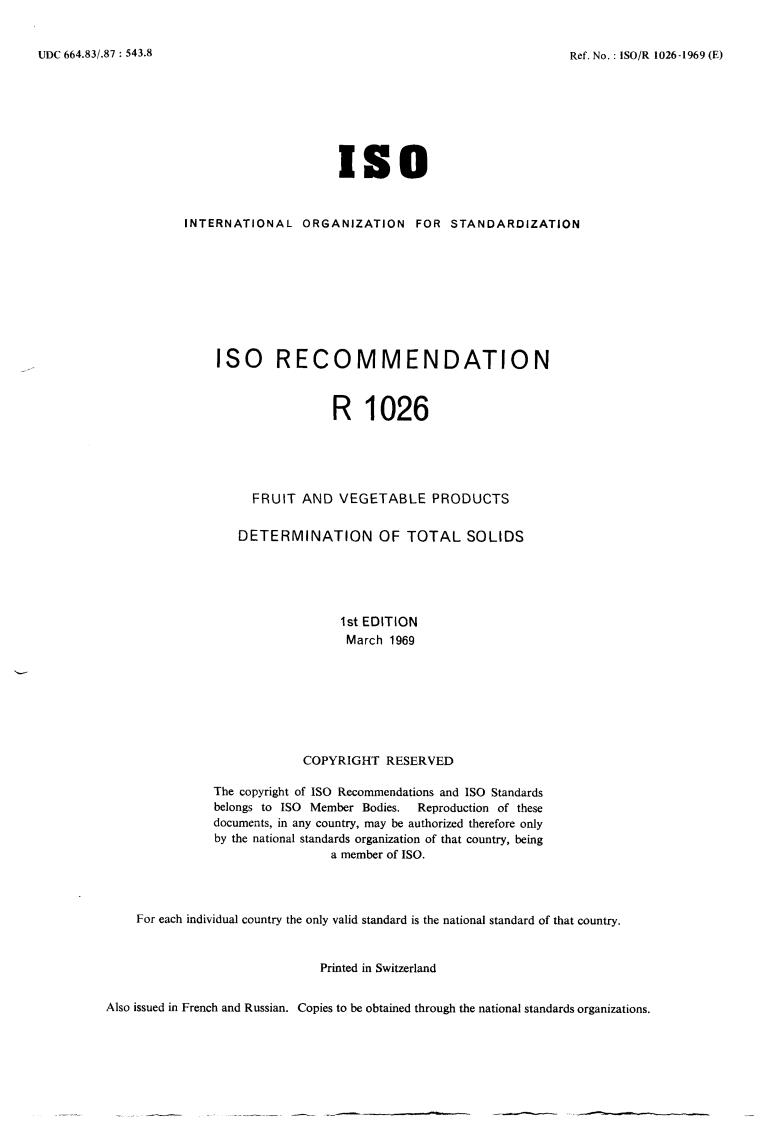
Ref. No. : ISO/R 1026-1969 (E)
UDC 664.831.87 : 543.8
IS0
O R G A N IZATl O N
I N T ERN AT I ON A L FOR STAN DA RD IZATl ON
IS0 RECOMMENDATION
. ,-
R 1026
FRUIT AND VEGETABLE PRODUCTS
DETERMINATION OF TOTAL SOLIDS
1st EDITION
March 1969
COPYRIGHT RESERVED
The copyright of IS0 Recommendations and IS0 Standards
belongs to IS0 Member Bodies. Reproduction of these
documents, in any country, may be authorized therefore only
by the national standards organization of that country, being
a member of ISO.
For each individual country the only valid standard is the national standard of that country.
Printed in Switzerland
Also issued in French and Russian. Copies to be obtained through the national standards organizations.
---------------------- Page: 1 ----------------------
BRIEF HISTORY
The IS0 Recommendation R 1026, Fruit and vegetable products - Determination of total solids, was
drawn up by Technical Committee ISO/TC 34, Agricultural food products, the Secretariat of which is held by
the Magyar Szabvanyügyi Hivatal (MSZH).
-
Work on this question led, in 1966, to the adoption of a Draft IS0 Recommendation.
In April 1967, this Draft IS0 Recommendation (No. 1212) was circulated to all the IS0 Member Bodies
for enquiry. It was approved, subject to a few modifications of an editorial nature, by the following Member
Bodies :
Argentina India Rom ani a
Australia Iran South Africa, Rep. of
Brazil Ireland Thailand
Bulgaria Israel Turkey
Colombia Korea, Rep. of U.A.R.
Czechoslovakia New Zealand
United Kingdom
France Norway U.S.S.R.
Greece Poland Yugoslavia
Hungary Portugal
One Member Body opposed the approval of the Draft :
Netherlands
The Draft IS0 Recommendation was then submitted by correspondence to the IS0 Council, which
decided, in March 1969, to accept it as an IS0 RECOMMENDATION.
-2-
---------------------- Page: 2 ----------------------
ISO/R 1026-1969 (E
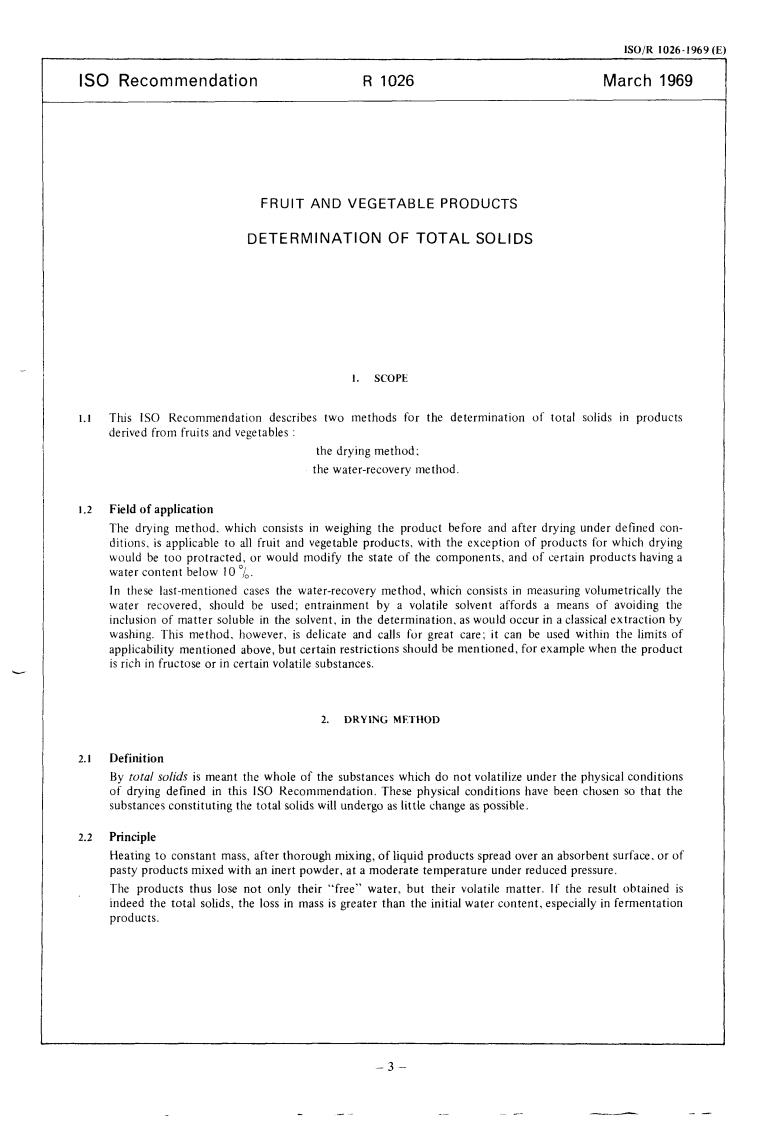
IS0 Recommendation R 1026 March 1969
FRUIT AND VEGETABLE PRODUCTS
DETERMINATION OF TOTAL SOLIDS
1. SCOPE
1. I This IS0 Recommendation describes two methods for the determination of total solids in products
derived from fruits and vegetables :
the drying method;
the water-recovery method.
I .2 Field of application
The drying method. which consists in weighing the product before and after drying under defined con-
ditions. is applicable to all fruit and vegetable products, with the exception of products for which drying
would be too protracted, or would modify the state of the components, and of certain products having a
water content below 1 O
In these last-mentioned cases the water-recovery method, whicn consists in measuring volumetrically the
water recovered, should be used; entrainment by a volatile solvent affords a means of avoiding the
inclusion of matter soluble in the solvent. in the determination, as would occur in a classical extraction by
washing. This method, however, is delicate and calls for great care; it can be used within the limits of
applicability mentioned above, but certain restrictions should be mentioned, for example when the product
is rich in fructose or in certain volatile substances.
2. DRYING METHOD
2. I Definition
rotai solids is meant the whole of the substances which do not volatilize under the physical conditions
By
of drying defined in this IS0 Recornmendation. These physical conditions have been chosen so that the
substances constituting the total solids will undergo as little change as possible.
2.2 Principle
to constant mass, after thorough mixing, of liquid products spread over an absorbent surface, or of
Heating
pasty products mixed with an inert powder, at a moderate temperature under reduced pressure.
The products thus lose not only their “free” water, but their volatile matter. If the result obtained is
indeed the total solids, the loss in mass is greater than the initial water content. especially in fermentation
products.
-3-
---------------------- Page: 3 ----------------------
ISO/R 1026-1969 (E
2.3 Apparatus
2.3.1 Oven, allowing drying to be carried out at 70 “C under a pressure of 26 to 33 mbar (20 to 25 mmHg),
while a slow current of dry air (see clause 2.7.3) enters at the rate of about 40 litres per hour,
measured at atmospheric pressure before entry into the oven; for example, air introduced by means of
a tap is dried by passing it, one bubble at a time, into a wash bottle containing sulphuric acid in front of
the tap, ensuring expansion of the air. The temperature should be uniform at all points in the oven.
2.3.2 Desiccator, provided with an efficient desiccant.
2.3.3 Analytical balance
2.3.4 Dishes, of corrosion-resistant metal (aluminium, nickel, or, preferably, thin stainless steel), cylindrical,
with flat bottom (for example, diameter about 60 mm; height 25 mm), provided with airtight but
easily removable lids.
2.3.5 Glass rod, of length suitable for the size of the dish.
2.4 Support materials
2.4.1 Paper
2.4.1.1 PAPER IN STRIPS, FOR LIQUID PRODUCTS. Use ashless filter paper. Filter paper previously
washed in hydrochloric acid (2 g of HCl per litre) for 8 hours, rinsed five times with distilled water
and dried in air, may also be used. This paper is cut into strips 20 mm wide. It may be crimped or
folded in accordion fashion with close pleats, or more simply by winding round a triangular
mandrel with 1 cm sides. This strip partially uncoils itself, giving a polygonal spiral. From 4 to
4.5 g of paper should be put in each dish, either 3 m of paper strip if the paper weighs 60 to
70 g/m2, or 1 m if a thick paper weighing 180 to 200 g/m2 is used.
2.4.1.2 PAPER IN DISKS, FOR SEMI-LIQUID PRODUCTS. Use disks Of Strong ashless filter paper,
crimped, cut to a diameter slightly less than that of the dishes. if ashless filter paper is not available,
the filter paper used should be treated in the same way as described above.
2.4.2 Sand, pure, washed with 5 ‘lo hydrochloric acid and rinsed until free from hydrochloric acid, sieved so
that the grains are of sizes within the range 100 to 400pm, and calcined.
2.5 Procedure
2.5.1 Preparation of sample
2.5.1.1 LIQUID OR SEMI-LIQUID PRODUCTS (juices, concentrates, thick juices, etc.). Mix the sample
until it is uniform.
2.5.1.2 THICK, PULPY OR HETEROGENEOUS PRODUCTS (fruits in syrup, jams, vegetable conserves,
etc.). After mixing the laboratory sample*, draw from it a quantity sufficient for at least two
determinations and homogenize by means of a blender.
*
Pending the completion of an IS0 Recommendation on the sampling of fruit and vegetable products, the term “laboratory
sample” is used in the English text to denote the sample as delivered to the laboratory.
-4-
---------------------- Page: 4 ----------------------
E
ISO/R 1026-1969 (E
2.5.2 Test portion
2.5.2.1 LIQUID AND SEMI-LIQUID PRODUCTS. Dry in the oven (2.3.1) at 70"C, under the conditions
described in clause 2.3.1, a metal dish (2.3.4) in which have been placed the paper strip or two
disks of crimped paper, as the case may be (see clause 2.4. I), the lid being removed. After drying
for 1 hour in the oven, weigh the dish to the nearest 0.0002 g after cooling in the desiccator
(2.3.2), the lid being placed on the dish before the latter is taken out of the oven.
By means of a pipette, withdraw from the sample, prepared as described in clause 2.5.1, 10 ml (in
the case of liquid products) or a few millilitres (in the case of semi-liquid products), and soak
completely the paper strips or disks, as the case may be (see clause 2.4.1) in the dish (2.3.4),
avoiding the accumulation of an excess of liquid against the metal. Carry out the operations as
quickly as possible in order to avoid the action of atmospheric moisture. Close the dish and weigh
to the nearest 0.0002 g. For semi-liquid products, the soaking can be facilitated by slightly
moistening the paper disks with distilled water after weighing the product added.
2.5.2.2 THICK, PULPY OR HETEROGENEOUS PRODUCTS. Dry in the oven (2.3.1) at 70 OC, under
the conditions described in clause 2.3.1, a metal dish (2.3.4) in which have been put 10 to 20 g of
sand (2.4.2) and the glass rod (2.3.5). After drying for 1 hour in the oven, weigh the dish to the
nearest 0.0002 g after cooling in the desiccator (2.3.2), the lid being placed on the dish before the
latter is taken out of the oven.
Trans
...
I
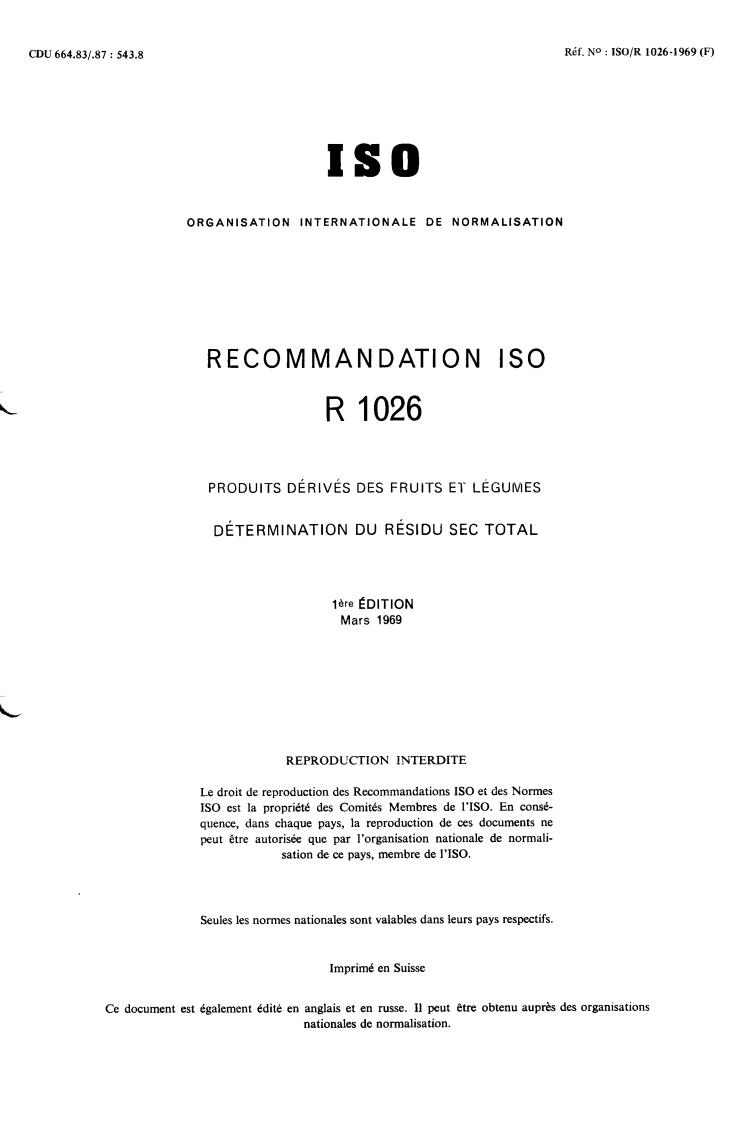
CDU 664.831.87 : 543.8 Réf. No : ISO/R 1026-1969 (F)
IS0
ORGAN I SAT1 ON INTERN AT1 ON A LE DE NORM A LlSATl ON
RECOMMANDATION IS0
R 1026
PRODUITS DÉRIVÉS DES FRUITS El- LEGUNIES
D~TERMINATION DU RÉSIDU SEC TOTAL
ière EDITION
Mars 1969
REPRODUCTION INTERDITE
Le droit de reproduction des Recommandations IS0 et des Normes
IS0 est la propriété des Comités Membres de I’ISO. En consé-
quence, dans chaque pays, la reproduction de ces documents ne
peut être autorisée que par l’organisation nationale de normali-
sation de ce pays, membre de I’ISO.
Seules les normes nationales sont valables dans leurs pays respectifs.
imprimé en Suisse
Ce document est égaiement édité en anglais et en russe. I1 peut être obtenu auprès des organisations
nationales de normalisation.
---------------------- Page: 1 ----------------------
HISTORIQUE
La Recommandation ISO/R 1026, Produits dérivés des fmits et legumes - Determination du résidu sec
total, a été élaborée par le Comité Technique ISO/TC 34, Produits agricoles alimentaires, dont le Secrétariat est
assuré par le Magyar Szabvanyügyi Hivatal (MSZH).
Les travaux relatifs a cette question aboutirent, en 1966, à l’adoption d’un Projet de Recommandation ISO.
En avril 1967, ce Projet de Recommandation IS0 (NO 1212) fut soumis à l’enquête de tous les Comités
Membres de YISO. I1 fut approuvé, sous réserve de quelques modifications d’ordre rédactionnel, par les Comités
Membres suivants :
Hongrie
Afrique du Sud, Rép. d’ R.A.U.
Inde Roumanie
Argentine
Royaume-Uni
Australie Iran
Tchécoslovaquie
Brésil Irlande
Bulgarie Israël Thaïlande
Colombie Nouvelle-Zélande
Turquie
Corée, Rép. de Norvège U.R.S.S.
France Pologne Yougoslavie
Grèce Portugal
Un Comité Membre se déclara opposé a l’approbation du Projet
Pays-Bas
Le Projet de Recommandation IS0 fut alors soumis par correspondance au Conseil de I’ISO qui décida, en
mars 1969, de l’accepter comme RECOMMANDATION 1SO.
-2-
---------------------- Page: 2 ----------------------
I
ISO/R 1026-1969 (F)
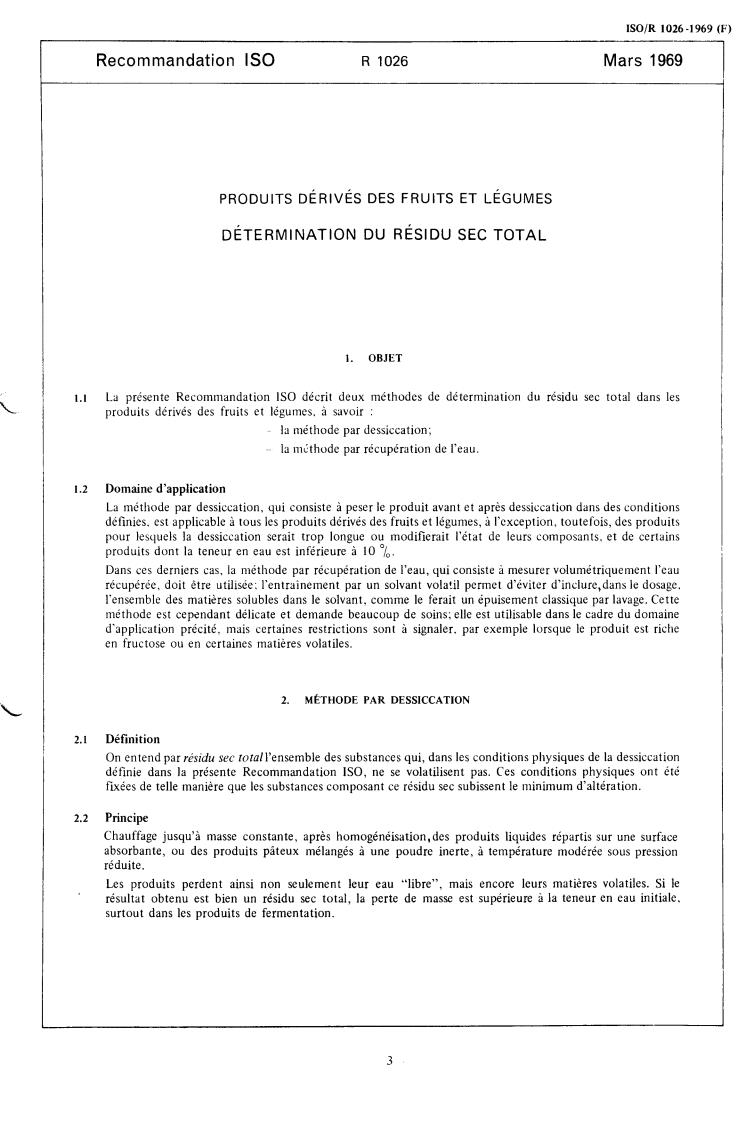
Recommandation IS0 R 1026 Mars 1969
PRODUITS DÉRIVÉS DES FRUITS ET LÉGUMES
D~TERMINATION DU RÉSIDU SEC TOTAL
1. OBJET
1.1 La présente Recommandation IS0 décrit deux méthodes de détermination du résidu sec total dans les
produits dérivés des fruits et légumes. a savoir :
la méthode par dessiccation:
la niGthode par récupération de l’eau.
1.2 Domaine d’application
La méthode par dessiccation, qui consiste à peser le produit avant et après dessiccation dans des conditions
définies. est applicable a tous les produits dérivés des fruits et légumes, a I’cxception, toutefois, des produits
pour lesquels la dessiccation serait trop longue ou modifierait l’état de leurs composants, et de certains
produits dont la teneur en eau est inférieure à 10
Dans ces derniers cas, la méthode par récupération de l’eau, qui consiste a mesurer volumétriquement l’eau
récupérée, doit être utilisée; l’entrainement par un solvant vola!il permet d’éviter d’inciure,dans le dosage,
l’ensemble des matiSres solubles dans le solvant, comme le ferait un épuisement classique par lavage. Cette
méthode est cependant délicate et demande beaucoup de soins; elle est utilisable dans le cadre du domaine
d’application précité, mais certaines restrictions sont à signaler, par exemple lorsque le produit est riche
en fructose ou en certaines matières volatiles.
2. MÉTHODE PAR DESSICCATION
2.1 Définition
On entend par résidu sec total l’ensemble des substances qui, dans les conditions physiques de la dessiccation
définie dans la présente Recommandation EO, ne se volatilisent pas. Ces conditions physiques ont été
fiées de telle manière que les substances composant ce résidu sec subissent le minimum d’altération.
2.2 Principe
Chauffage jusqu’à masse constante, après homogénéisation, des produits liquides répartis sur une surface
absorbante, ou des produits pâteux mélangés à une poudre inerte, à température modérée sous pression
réduite.
Les produits perdent ainsi non seulement leur eau “libre”, mais encore leurs matières volatiles. Si le
résultat obtenu est bien un résidu sec total, la perte de masse est supérieure à la teneur en eau initiale.
surtout dans les produits de fermentation.
3
---------------------- Page: 3 ----------------------
YI
ISO/R 1026-1969 (F)
2.3 Appareillage
2.3.1 Etuue, permettant de sécher à 70 “C sous une pression de 26 à 33 mbar (de 20 à 25 mmHg), en
laissant entrer un faible courant d’air sec (voir paragraphe 2.7.3) à un débit de 40 litres à l’heure
environ, mesuré sous la pression atmosphérique avant l’entrée dans l’étuve; par exemple, l’air introduit
au moyen d’un robinet est séché par passage, bulle à bulle, dans une fiole de lavage contenant de
l’acide sulfurique placé avant le robinet assurant la détente de l’air. La température doit être uniforme
en tous points de l’étuve.
2.3.2 Dessiccateur, garni d’un agent déshydratant efficace
2.3.3 Balance analytique.
2.3.4 Capsules métalliques, résistant à la corrosion (aluminium, nickel ou, de préférence, acier inoxydable
mince), cylindriques, à fond plat (par exemple, diamètre environ 60 mm; hauteur 25 mm), munies de
couvercles étanches mais mobiles.
2.3.5 Baguette en verre, de longueur appropriée à la dimension de la capsule.
2.4 Matières de support
2.4.1 Papier.
2.4.1.1 PAPIER EN BANDES DANS LE CAS DE PRODUITS LIQUIDES. Utiliser du papier filtre sans cendres.
On peut aussi employer du papier filtre préalablement lavé à l’acide Chlorhydrique (2 g de
HCl au litre) pendant 8 heures, rincé cinq fois à l’eau distillée et séché à l’air. Ce papier est
découpé en bandes de 20 millimètres de large. Il peut être gaufré ou plié en accordéon à plis
serrés, ou plus simplement enroulé autour d’un mandrin triangulaire de 1 cm de côté. Cette
bande se déroule partiellement en donnant une spirale polygonale. On doit placer 4 à 4,5 g de
papier par capsule, soit 3 m de bande de papier si le papier pèse 60 à 70 dm’ , ou 1 mètre si l’on
emploie un papier épais pesant 180 à 200 g/m2.
2.4.1.2 PAPIER EN RONDELLES DANS LE CAS DE PRODUITS SEMI-LIQUIDES. Utiliser des rondelles en
papier filtre fort sans cendre, gaufré, découpées à un diamètre un peu inférieur à celui des
capsules. Si l’on ne dispose pas de papier filtre sans cendres, le papier filtre utilisé doit être
traité comme indiqué ci-dessus.
2.4.2 Sable, pur, lavé à l’acide chlorhydrique à 5 et rincé, jusqu’à disparition de l’acide chlorhydrique,
tamisé de manière que les grains soient de grosseur comprise entre 100 et 400 ym, et calciné.
2.5 Mode opératoire
2.5.1 Preparation de l’échantillon
PRoDuiTs LIQUIDES ou SEMI-LIQUIDES (jus, concentrés, jus pulpeux, etc.). Rendre l’échantillon
2.5.1.1
bien homogène.
2.5.1.2 PRODUITS ÉPAIS, PULPEUX ou HÉTÉROGÈNES (fruits au sirop, confitures, conserves de légumes,
etc.). Après avoir mélangé l’échantillon pour laboratoire, en prélever une quantité suffisante
pour deux déterminations, au moins, et rendre homogène à l’aide d‘un broyeur mélangeur.
-4-
---------------------- Page: 4 ----------------------
I
ISO/R 1026 -1 969 (FI
2.5.2 Prise déssai
2.5.2.1 PRODUITS LIQUIDES ET SEMI-LIQUIDES. Sécher préalablement à l’étuve (2.3.1) à 70 OC, dans
les conditions décrites au paragraphe 2.3.1, une capsule métallique (2.3.4) dans laquelle ont été
disposées les bandes de papier ou deux rondelles de papier gaufré, selon le cas (voir paragraphe
2.4.1), le couvercle étant enlevé. Après 1 heure de séjour à l’étuve, peser la capsule à 0,0002 g
près, après refroidissement au dessiccateur (2.3.2), le couvercle étant posé sur la capsule avant
qu’elle ne soit retirée de l’étuve.
Prélever, à la pipette, sur l’échantillon préparé conformément au paragraphe 2.5.1, 10 ml (dans le
cas de produits liquides) ou quelques millilitres (dans le cas de produits semi-liquides), et imbiber
complètement le papier en bandes ou en rondelles, selon le cas (voir paragraphe 2.4.1) dans la
capsule (2.3.4), en évitant qu’un excès de liquide ne s’accumule contre le métal. Opérer le plus
rapidement possible pour éviter l’action de l’humidité atmosphérique. Fermer la capsule et peser
à 0,0002 g près. Pour les produits semi-liquides, on peut faciliter l’imbibition en mouillant
légèrement les rondelles de papier avec de l’eau distillée après avoir pesé le produit ajouté.
PRODUITS ÉPAIS, PULPEUX ou HÉTÉROGÈNES.
2.5.2.2 Sécher préalablement à l’étuve (2.3.1) à 70 OC,
dans les conditions décrites au paragraphe 2.3.1, une capsule métallique (2.3.4) dans laquelle
sont mis de 10 à 20 g de sable (2.4.2) et la baguette en verre (2.3.5). Après 1 heure de séjour
à l’étuve, peser la capsule à 0,0002 g près, après refroidissement au dessiccateur (2.3.2), le couvercle’
étant posé sur la capsule avant qu’elle ne soit retirée de l’étuve.
Introduire de 2 à 5 g de l’échantillon préparé conformément au paragraphe 2.5.1 et peser. Mélanger
intimement avec
...
Questions, Comments and Discussion
Ask us and Technical Secretary will try to provide an answer. You can facilitate discussion about the standard in here.