

ISO 55000:2024
(Main)Asset management — Vocabulary, overview and principles
General Information
- Abstract
This document defines terms and establishes principles and outcomes for asset management. It describes: — the benefits of asset management and an asset management system; — the relationship between asset management, the asset management system and asset portfolio; — asset management improvement and maturity. This document is applicable to all types of assets and all types and sizes of organizations. This document does not provide financial, accounting, human resources nor technical guidance for managing specific asset types. NOTE For the purposes of this document, ISO 55001 and ISO 55002, the term “asset management system” is used to refer to a management system for asset management.
- Status
- Published
- Publication Date
- 02-Jul-2024
- Technical Committee
- ISO/TC 251 - Asset management
- Drafting Committee
- ISO/TC 251 - Asset management
- Current Stage
- 6060 - International Standard published
- Start Date
- 03-Jul-2024
- Due Date
- 21-May-2024
- Completion Date
- 03-Jul-2024
Buy Documents

ISO 55000:2024 - Asset management — Vocabulary, overview and principles Released:7/3/2024
ISO 55000:2024 - Gestion d'actifs — Vocabulaire, aperçu général et principes Released:7/3/2024
ISO 55000:2024 - Asset management — Vocabulary, overview and principles Released:4/25/2025
ISO 55000:2024 - Asset management — Vocabulary, overview and principles Released:1/24/2025
Overview - What ISO 55000:2024 covers
ISO 55000:2024 - titled Asset management - Vocabulary, overview and principles - defines core terminology and establishes the fundamental principles, outcomes and expected benefits of asset management. Applicable to all types of assets and all sizes of organizations, the standard:
- Provides a common vocabulary (assets, asset life, life cycle, asset system, asset portfolio, critical asset, level of service, etc.).
- Describes the relationship between asset management, an asset management system (AMS) and an organization’s asset portfolio.
- Introduces concepts for asset management improvement and maturity.
- Sets the context for the normative requirements in ISO 55001 and the implementation guidance in ISO 55002.
Note: ISO 55000 does not provide financial, accounting, HR or technical instructions for specific asset types - it is a principles and vocabulary document.
Key topics and technical focus
ISO 55000:2024 centers on practical, organizational-level concepts necessary to design and align asset management efforts:
- Principles of asset management - including themes such as value, alignment and leadership that guide decision‑making.
- Terms and definitions - standardized meanings for asset-related concepts (e.g., asset life, life cycle management, asset management plan, capability, level of service).
- Outcomes and benefits - expected results from adopting asset management and an AMS (improved performance, optimized costs and risk balancing).
- Relationship between AMS and assets - clarifies how an AMS supports asset portfolios and organizational objectives.
- Improvement and maturity - indicators and approaches for progressive enhancement of asset management capabilities.
Practical applications and who uses it
ISO 55000:2024 is a foundational reference for organizations that want a consistent approach to managing assets and establishing an asset management system. Typical users:
- Senior executives and boards - to understand strategic value and leadership expectations.
- Asset managers and operations leaders - for consistent terminology and principles when developing strategic asset management plans and asset management plans (AMPs).
- Auditors and consultants - to benchmark maturity and align practices with ISO 55001 requirements.
- Policy makers and public authorities - to design enabling policy and align public asset programs.
- Cross‑functional teams (finance, engineering, IT) - to improve collaboration and align financial and non‑financial objectives.
Practical uses include developing an AMS roadmap, creating asset management plans, aligning life cycle management and level‑of‑service targets, and assessing organizational maturity.
Related standards
ISO 55000 is designed to be used with the ISO 55000 family:
- ISO 55001 (requirements for an AMS)
- ISO 55002 (guidance on application)
- Complementary documents: ISO/TS 55010, ISO 55011, ISO 55012, ISO 55013 for finance alignment, public policy, people competence and data assets.
Keywords: ISO 55000:2024, asset management, asset management system, asset life, life cycle management, asset portfolio, asset management plan, maturity, ISO 55001.
Relations
- Effective Date
- 06-Jun-2022
Buy Documents
ISO 55000:2024 - Asset management — Vocabulary, overview and principles Released:7/3/2024
ISO 55000:2024 - Gestion d'actifs — Vocabulaire, aperçu général et principes Released:7/3/2024
ISO 55000:2024 - Asset management — Vocabulary, overview and principles Released:4/25/2025
ISO 55000:2024 - Asset management — Vocabulary, overview and principles Released:1/24/2025
Get Certified
Connect with accredited certification bodies for this standard

BSI Group
BSI (British Standards Institution) is the business standards company that helps organizations make excellence a habit.

Bureau Veritas
Bureau Veritas is a world leader in laboratory testing, inspection and certification services.

DNV
DNV is an independent assurance and risk management provider.
Sponsored listings
Frequently Asked Questions
ISO 55000:2024 is a standard published by the International Organization for Standardization (ISO). Its full title is "Asset management — Vocabulary, overview and principles". This standard covers: This document defines terms and establishes principles and outcomes for asset management. It describes: — the benefits of asset management and an asset management system; — the relationship between asset management, the asset management system and asset portfolio; — asset management improvement and maturity. This document is applicable to all types of assets and all types and sizes of organizations. This document does not provide financial, accounting, human resources nor technical guidance for managing specific asset types. NOTE For the purposes of this document, ISO 55001 and ISO 55002, the term “asset management system” is used to refer to a management system for asset management.
This document defines terms and establishes principles and outcomes for asset management. It describes: — the benefits of asset management and an asset management system; — the relationship between asset management, the asset management system and asset portfolio; — asset management improvement and maturity. This document is applicable to all types of assets and all types and sizes of organizations. This document does not provide financial, accounting, human resources nor technical guidance for managing specific asset types. NOTE For the purposes of this document, ISO 55001 and ISO 55002, the term “asset management system” is used to refer to a management system for asset management.
ISO 55000:2024 is classified under the following ICS (International Classification for Standards) categories: 01.040.03 - Services. Company organization, management and quality. Administration. Transport. Sociology. (Vocabularies); 03.100.01 - Company organization and management in general. The ICS classification helps identify the subject area and facilitates finding related standards.
ISO 55000:2024 has the following relationships with other standards: It is inter standard links to ISO 55000:2014. Understanding these relationships helps ensure you are using the most current and applicable version of the standard.
ISO 55000:2024 is available in PDF format for immediate download after purchase. The document can be added to your cart and obtained through the secure checkout process. Digital delivery ensures instant access to the complete standard document.
Standards Content (Sample)
SLOVENSKI STANDARD
01-september-2024
Nadomešča:
SIST ISO 55000:2017
Obvladovanje premoženja - Slovar, pregled in načela
Asset management — Vocabulary, overview and principles
Gestion d'actifs — Vocabulaire, aperçu général et principes
Ta slovenski standard je istoveten z: ISO 55000:2024
ICS:
01.040.03 Storitve. Organizacija Services. Company
podjetja, vodenje in kakovost. organization, management
Uprava. Transport. and quality. Administration.
Sociologija. (Slovarji) Transport. Sociology.
(Vocabularies)
03.100.10 Nabava. Dobava. Logistika Purchasing. Procurement.
Logistics
2003-01.Slovenski inštitut za standardizacijo. Razmnoževanje celote ali delov tega standarda ni dovoljeno.
International
Standard
ISO 55000
Second edition
Asset management — Vocabulary,
2024-07
overview and principles
Gestion d'actifs — Vocabulaire, aperçu général et principes
Reference number
© ISO 2024
All rights reserved. Unless otherwise specified, or required in the context of its implementation, no part of this publication may
be reproduced or utilized otherwise in any form or by any means, electronic or mechanical, including photocopying, or posting on
the internet or an intranet, without prior written permission. Permission can be requested from either ISO at the address below
or ISO’s member body in the country of the requester.
ISO copyright office
CP 401 • Ch. de Blandonnet 8
CH-1214 Vernier, Geneva
Phone: +41 22 749 01 11
Email: copyright@iso.org
Website: www.iso.org
Published in Switzerland
ii
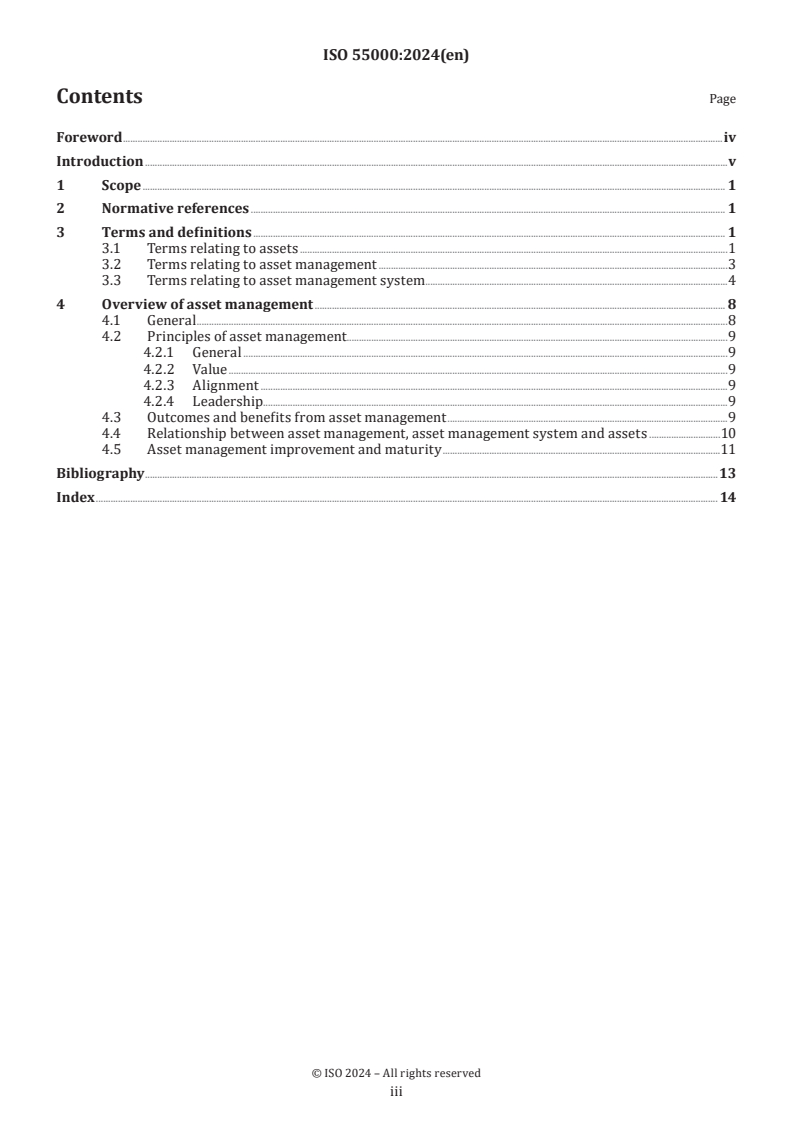
Contents Page
Foreword .iv
Introduction .v
1 Scope . 1
2 Normative references . 1
3 Terms and definitions . 1
3.1 Terms relating to assets .1
3.2 Terms relating to asset management .3
3.3 Terms relating to asset management system .4
4 Overview of asset management . 8
4.1 General .8
4.2 Principles of asset management.9
4.2.1 General .9
4.2.2 Value .9
4.2.3 Alignment .9
4.2.4 Leadership.9
4.3 Outcomes and benefits from asset management .9
4.4 Relationship between asset management, asset management system and assets .10
4.5 Asset management improvement and maturity .11
Bibliography .13
Index . 14
iii
Foreword
ISO (the International Organization for Standardization) is a worldwide federation of national standards
bodies (ISO member bodies). The work of preparing International Standards is normally carried out through
ISO technical committees. Each member body interested in a subject for which a technical committee
has been established has the right to be represented on that committee. International organizations,
governmental and non-governmental, in liaison with ISO, also take part in the work. ISO collaborates closely
with the International Electrotechnical Commission (IEC) on all matters of electrotechnical standardization.
The procedures used to develop this document and those intended for its further maintenance are described
in the ISO/IEC Directives, Part 1. In particular, the different approval criteria needed for the different types
of ISO document should be noted. This document was drafted in accordance with the editorial rules of the
ISO/IEC Directives, Part 2 (see www.iso.org/directives).
ISO draws attention to the possibility that the implementation of this document may involve the use of (a)
patent(s). ISO takes no position concerning the evidence, validity or applicability of any claimed patent
rights in respect thereof. As of the date of publication of this document, ISO had not received notice of (a)
patent(s) which may be required to implement this document. However, implementers are cautioned that
this may not represent the latest information, which may be obtained from the patent database available at
www.iso.org/patents. ISO shall not be held responsible for identifying any or all such patent rights.
Any trade name used in this document is information given for the convenience of users and does not
constitute an endorsement.
For an explanation of the voluntary nature of standards, the meaning of ISO specific terms and expressions
related to conformity assessment, as well as information about ISO’s adherence to the World Trade
Organization (WTO) principles in the Technical Barriers to Trade (TBT), see www.iso.org/iso/foreword.html.
This document was prepared by Technical Committee ISO/TC 251, Asset management.
This second edition cancels and replaces the first edition (ISO 55000:2014), which has been technically
revised.
The main changes are as follows:
— the document has been restructured to provide an insight and understanding of asset management
and its principles, its outcomes and benefits, the relationship between asset management, an asset
management system and the assets of an organization, and indicators of asset management maturity;
— the principles of asset management have been revised;
— the outcomes of asset management have been introduced;
— the benefits have been rephrased and extended;
— the explanation of the elements of an asset management system has been deleted;
— the integration of management systems has been introduced;
— the maturity of an asset management organization has been introduced;
— the annexes have been deleted.
Any feedback or questions on this document should be directed to the user’s national standards body. A
complete listing of these bodies can be found at www.iso.org/members.html.
iv
Introduction
0.1 Purpose
This document provides an overview of asset management, its principles, and the outcomes and expected
benefits from adopting asset management, and introduces the asset management system and relevant
terminology.
This document sets the context for ISO 55001 and ISO 55002, and also later documents in the ISO 55000
family of standards.
0.2 Relationship with other standards in the ISO 55000 family of standards
ISO 55001 specifies requirements for an asset management system. ISO 55002 gives guidance on the design
and application of the asset management system.
This document, ISO 55001 and ISO 55002 can be used in combination with relevant sector-specific or asset-
type-specific standards and technical specifications to achieve the objectives of asset management.
Other standards on asset management developed by ISO/TC 251 can be used in the context established by
this document, ISO 55001 and ISO 55002, including:
— ISO/TS 55010, which provides guidance on aligning financial and non-financial functions in asset
management, and promoting understanding, implementation and improvement of this alignment for
organizational benefits;
— ISO 55011, which offers guidance for developing public policy to promote asset management, focusing
on the external context of organizations responsible for assets, with the aim of creating an enabling
environment through consistent public policy instruments;
— ISO 55012, which focuses on people involvement and competence within an asset management system,
offering guidance to enhance personnel commitment, effectiveness, knowledge and awareness, and
promoting continual improvement;
— ISO 55013, which provides guidance on managing data assets, helping organizations increase and sustain
the usefulness of data assets to meet asset management and organizational objectives.
0.3 Target audience
This document is primarily intended for use by:
— senior executives who wish to adopt asset management and implement an asset management system in
their organization;
— those involved in asset management or intending to become practitioners;
— anyone who would benefit from a short introduction to asset management.
v
International Standard ISO 55000:2024(en)
Asset management — Vocabulary, overview and principles
1 Scope
This document defines terms and establishes principles and outcomes for asset management. It describes:
— the benefits of asset management and an asset management system;
— the relationship between asset management, the asset management system and asset portfolio;
— asset management improvement and maturity.
This document is applicable to all types of assets and all types and sizes of organizations.
This document does not provide financial, accounting, human resources nor technical guidance for managing
specific asset types.
NOTE For the purposes of this document, ISO 55001 and ISO 55002, the term “asset management system” is used
to refer to a management system for asset management.
2 Normative references
There are no normative references in this document.
3 Terms and definitions
ISO and IEC maintain terminology databases for use in standardization at the following addresses:
— ISO Online browsing platform: available at https:// www .iso .org/ obp
— IEC Electropedia: available at https:// www .electropedia .org/
3.1 Terms relating to assets
3.1.1
asset
item, thing or entity that has potential or actual value (3.3.28) to an organization (3.3.1)
Note 1 to entry: Assets can be physical or non-physical.
Note 2 to entry: A grouping of assets referred to as an asset system (3.1.6) can also be considered as an asset.
3.1.2
asset life
period from asset (3.1.1) ideation to asset end of life
Note 1 to entry: “Useful life” is the period over which an asset is capable of fulfilling a purpose to an entity.
Note 2 to entry: Asset life can differ from the period the organization (3.3.1) holds responsibility for the asset.
Note 3 to entry: End-of-life is when the asset can no longer cause any residual obligations.
3.1.3
life cycle
stages of an asset (3.1.1) during its life
Note 1 to entry: Each stage identifies different activities and processes (3.3.10).
Note 2 to entry: The naming of the stages and the activities under each stage can vary in different industry sectors
and is determined by the organization (3.3.1). An example of the naming of the stages is: conception of need, design,
construct, operate and maintain, renew/replace, dispose and extinguishment of liabilities.
Note 3 to entry: The contractual liability of an entity can involve less than one or multiple life cycle stages and may be
shorter than an asset life (3.1.2).
3.1.4
life cycle management
applying asset management (3.2.1) over the life cycle (3.1.3) of assets (3.1.1)
3.1.5
asset type
grouping of assets (3.1.1) having common characteristics that distinguish those assets as a group or class
3.1.6
asset system
set of assets (3.1.1) that interact or are interrelated
3.1.7
asset portfolio
assets (3.1.1) that are within the scope of an asset management system (3.3.5)
Note 1 to entry: A portfolio is typically established and assigned for managerial control purposes.
3.1.8
critical asset
asset (3.1.1) having the potential to significantly impact the achievement of an organization’s (3.3.1)
objectives (3.3.7)
Note 1 to entry: Assets can be safety-critical, environment-critical or performance-critical and can relate to legal,
regulatory or statutory requirements (3.3.16).
Note 2 to entry: Critical assets can refer to those assets necessary to provide services to critical customers.
Note 3 to entry: Asset systems (3.1.6) can be distinguished as being critical in a similar manner to individual assets.
3.1.9
object, noun
anything perceivable or conceivable
Note 1 to entry: An object can be physical (e.g. a pump, a bridge, a building), or non-physical (e.g. a project plan,
copyright, software).
3.1.10
data
facts about an object (3.1.9)
[SOURCE: ISO 9000:2015, 3.8.1]
3.1.11
information
meaningful result of organizing and processing data (3.1.10)
EXAMPLE Make/model/type of a pump in a specific location, span of a bridge, asset (3.1.1) performance (3.3.13)
indicator, an asset’s current total cost of ownership.
3.2 Terms relating to asset management
3.2.1
asset management
coordinated activity of an organization (3.3.1) to realize value (3.3.28) from assets (3.1.1)
Note 1 to entry: Realization of value normally involves a balancing of costs, risks (3.3.8), opportunities (3.3.9) and
performance (3.3.13) benefits.
Note 2 to entry: Activity can also refer to the application of the elements of an asset management system (3.3.5).
Note 3 to entry: The term “activity” has a broad meaning and can include, for example, the approach, planning and
plans, and their implementation.
3.2.2
organizational objective
overarching objective (3.3.7) that sets the context and direction for an organization’s (3.3.1) activities
Note 1 to entry: Organizational objectives are established through the strategic level planning activities of the
organization.
3.2.3
organizational plan
documented information (3.3.12) that specifies the plans to achieve the organizational objectives (3.2.2)
3.2.4
management
coordinated activities to direct and control an organization (3.3.1)
Note 1 to entry: Management can include establishing strategies, policies (3.3.6) and objectives (3.3.7), and processes
(3.3.10) to achieve those objectives.
Note 2 to entry: Management includes the processes of planning, organizing, directing and controlling (e.g. the
outcomes of people, groups or organizations).
Note 3 to entry: Control can include defining roles, appointing authority, assigning tasks, establishing incentives and
rewards, and empowering and engaging people.
Note 4 to entry: The word “management” sometimes refers to people, i.e. a person or group of people with the authority
and responsibility for the conduct and control of an organization. When “management” is used in this sense, it should
always be used with some form of qualifier, e.g. “top management”.
Note 5 to entry: The term “management” can be qualified by a specific domain it addresses. Examples include public
health management, environmental management and risk (3.3.8) management.
[SOURCE: ISO 9000:2015, 3.3.3, modified — “strategies” added to Note 1 to entry. Note 2 to entry shortened
and renumbered as Note 4 to entry. Notes 2, 3 and 5 to entry added.]
3.2.5
asset management plan
AMP
documented information (3.3.12) that specifies the activities, resources, costs and timescales required for an
individual asset (3.1.1), or a grouping of assets, to achieve an organization’s (3.3.1) asset management (3.2.1)
objectives (3.3.7)
Note 1 to entry: The grouping of assets may be by asset type (3.1.5), asset class, asset system (3.1.6) or asset portfolio
(3.1.7).
Note 2 to entry: An asset management plan is derived from the strategic asset management plan (3.3.29).
Note 3 to entry: An asset management plan may be contained in, or may be a subsidiary plan of, the strategic asset
management plan.
3.2.6
capability
measure of capacity and the ability of an entity (system or organization (3.3.1)) to achieve its objectives (3.3.7)
Note 1 to entry: Asset management (3.2.1) capabilities include processes (3.3.10), resources, competences (3.3.11) and
technologies to enable the effective and efficient development and delivery of asset management plans (3.2.5) and asset
life (3.1.2) activities, and their continual improvement (3.3.14).
3.2.7
level of service
parameters, or combination of parameters, which reflect social, political, environmental and economic
outcomes that an organization (3.3.1) delivers
Note 1 to entry: The parameters may include safety, customer satisfaction, quality, quantity, capacity, reliability,
responsiveness, environmental acceptability, cost and availability.
3.3 Terms relating to asset management system
3.3.1
organization
person or group of people that has its own functions with responsibilities, authorities and relationships to
achieve its objectives (3.3.7)
Note 1 to entry: The concept of organization includes, but is not limited to, sole-trader, company, corporation, firm,
enterprise, authority, partnership, charity or institution, or part or combination thereof, whether incorporated or not,
public or private.
Note 2 to entry: If the organization is part of a larger entity, the term “organization” refers only to the part of the larger
entity that is within the scope of the asset management system (3.3.5).
3.3.2
stakeholder
interested party
person or organization (3.3.1) that can affect, be affected by, or perceive itself to be affected by a decision or
activity
3.3.3
top management
person or group of people who directs and controls an organization (3.3.1) at the highest level
Note 1 to entry: Top management has the power to delegate authority and provide resources within the organization.
Note 2 to entry: If the scope of the management system (3.3.4) covers only part of an organization, then top management
refers to those who direct and control that part of the organization.
3.3.4
management system
set of interrelated or interacting elements of an organization (3.3.1) to establish policies (3.3.6) and objectives
(3.3.7), as well as processes (3.3.10) to achieve those objectives
Note 1 to entry: A management system can address a single discipline or several disciplines.
Note 2 to entry: The management system elements include the organization’s structure, roles and responsibilities,
planning and operation.
3.3.5
asset management system
management system (3.3.4) for asset management (3.2.1)
3.3.6
policy
intentions and direction of an organization (3.3.1) as formally expressed by its top management (3.3.3)
3.3.7
objective
result to be achieved
Note 1 to entry: An objective can be strategic, tactical, or operational.
Note 2 to entry: Objectives can relate to different disciplines (such as finance, health and safety, and environment).
They can be, for example, organization-wide or specific to a project, service, product or process (3.3.10).
Note 3 to entry: An objective can be expressed in other ways, e.g. as an intended result, as a purpose, as an operational
criterion, as an asset management objective or by the use of other words with similar meaning (e.g. aim, goal, or
target).
Note 4 to entry: In the context of asset management systems (3.3.5), asset management objectives are set by the
organization (3.3.1), consistent with the asset management policy (3.3.6), to achieve specific results.
3.3.8
risk
effect of uncertai
...
International
Standard
ISO 55000
Second edition
Asset management — Vocabulary,
2024-07
overview and principles
Gestion d'actifs — Vocabulaire, aperçu général et principes
Reference number
© ISO 2024
All rights reserved. Unless otherwise specified, or required in the context of its implementation, no part of this publication may
be reproduced or utilized otherwise in any form or by any means, electronic or mechanical, including photocopying, or posting on
the internet or an intranet, without prior written permission. Permission can be requested from either ISO at the address below
or ISO’s member body in the country of the requester.
ISO copyright office
CP 401 • Ch. de Blandonnet 8
CH-1214 Vernier, Geneva
Phone: +41 22 749 01 11
Email: copyright@iso.org
Website: www.iso.org
Published in Switzerland
ii
Contents Page
Foreword .iv
Introduction .v
1 Scope . 1
2 Normative references . 1
3 Terms and definitions . 1
3.1 Terms relating to assets .1
3.2 Terms relating to asset management .3
3.3 Terms relating to asset management system .4
4 Overview of asset management . 8
4.1 General .8
4.2 Principles of asset management.9
4.2.1 General .9
4.2.2 Value .9
4.2.3 Alignment .9
4.2.4 Leadership.9
4.3 Outcomes and benefits from asset management .9
4.4 Relationship between asset management, asset management system and assets .10
4.5 Asset management improvement and maturity .11
Bibliography .13
Index . 14
iii
Foreword
ISO (the International Organization for Standardization) is a worldwide federation of national standards
bodies (ISO member bodies). The work of preparing International Standards is normally carried out through
ISO technical committees. Each member body interested in a subject for which a technical committee
has been established has the right to be represented on that committee. International organizations,
governmental and non-governmental, in liaison with ISO, also take part in the work. ISO collaborates closely
with the International Electrotechnical Commission (IEC) on all matters of electrotechnical standardization.
The procedures used to develop this document and those intended for its further maintenance are described
in the ISO/IEC Directives, Part 1. In particular, the different approval criteria needed for the different types
of ISO document should be noted. This document was drafted in accordance with the editorial rules of the
ISO/IEC Directives, Part 2 (see www.iso.org/directives).
ISO draws attention to the possibility that the implementation of this document may involve the use of (a)
patent(s). ISO takes no position concerning the evidence, validity or applicability of any claimed patent
rights in respect thereof. As of the date of publication of this document, ISO had not received notice of (a)
patent(s) which may be required to implement this document. However, implementers are cautioned that
this may not represent the latest information, which may be obtained from the patent database available at
www.iso.org/patents. ISO shall not be held responsible for identifying any or all such patent rights.
Any trade name used in this document is information given for the convenience of users and does not
constitute an endorsement.
For an explanation of the voluntary nature of standards, the meaning of ISO specific terms and expressions
related to conformity assessment, as well as information about ISO’s adherence to the World Trade
Organization (WTO) principles in the Technical Barriers to Trade (TBT), see www.iso.org/iso/foreword.html.
This document was prepared by Technical Committee ISO/TC 251, Asset management.
This second edition cancels and replaces the first edition (ISO 55000:2014), which has been technically
revised.
The main changes are as follows:
— the document has been restructured to provide an insight and understanding of asset management
and its principles, its outcomes and benefits, the relationship between asset management, an asset
management system and the assets of an organization, and indicators of asset management maturity;
— the principles of asset management have been revised;
— the outcomes of asset management have been introduced;
— the benefits have been rephrased and extended;
— the explanation of the elements of an asset management system has been deleted;
— the integration of management systems has been introduced;
— the maturity of an asset management organization has been introduced;
— the annexes have been deleted.
Any feedback or questions on this document should be directed to the user’s national standards body. A
complete listing of these bodies can be found at www.iso.org/members.html.
iv
Introduction
0.1 Purpose
This document provides an overview of asset management, its principles, and the outcomes and expected
benefits from adopting asset management, and introduces the asset management system and relevant
terminology.
This document sets the context for ISO 55001 and ISO 55002, and also later documents in the ISO 55000
family of standards.
0.2 Relationship with other standards in the ISO 55000 family of standards
ISO 55001 specifies requirements for an asset management system. ISO 55002 gives guidance on the design
and application of the asset management system.
This document, ISO 55001 and ISO 55002 can be used in combination with relevant sector-specific or asset-
type-specific standards and technical specifications to achieve the objectives of asset management.
Other standards on asset management developed by ISO/TC 251 can be used in the context established by
this document, ISO 55001 and ISO 55002, including:
— ISO/TS 55010, which provides guidance on aligning financial and non-financial functions in asset
management, and promoting understanding, implementation and improvement of this alignment for
organizational benefits;
— ISO 55011, which offers guidance for developing public policy to promote asset management, focusing
on the external context of organizations responsible for assets, with the aim of creating an enabling
environment through consistent public policy instruments;
— ISO 55012, which focuses on people involvement and competence within an asset management system,
offering guidance to enhance personnel commitment, effectiveness, knowledge and awareness, and
promoting continual improvement;
— ISO 55013, which provides guidance on managing data assets, helping organizations increase and sustain
the usefulness of data assets to meet asset management and organizational objectives.
0.3 Target audience
This document is primarily intended for use by:
— senior executives who wish to adopt asset management and implement an asset management system in
their organization;
— those involved in asset management or intending to become practitioners;
— anyone who would benefit from a short introduction to asset management.
v
International Standard ISO 55000:2024(en)
Asset management — Vocabulary, overview and principles
1 Scope
This document defines terms and establishes principles and outcomes for asset management. It describes:
— the benefits of asset management and an asset management system;
— the relationship between asset management, the asset management system and asset portfolio;
— asset management improvement and maturity.
This document is applicable to all types of assets and all types and sizes of organizations.
This document does not provide financial, accounting, human resources nor technical guidance for managing
specific asset types.
NOTE For the purposes of this document, ISO 55001 and ISO 55002, the term “asset management system” is used
to refer to a management system for asset management.
2 Normative references
There are no normative references in this document.
3 Terms and definitions
ISO and IEC maintain terminology databases for use in standardization at the following addresses:
— ISO Online browsing platform: available at https:// www .iso .org/ obp
— IEC Electropedia: available at https:// www .electropedia .org/
3.1 Terms relating to assets
3.1.1
asset
item, thing or entity that has potential or actual value (3.3.28) to an organization (3.3.1)
Note 1 to entry: Assets can be physical or non-physical.
Note 2 to entry: A grouping of assets referred to as an asset system (3.1.6) can also be considered as an asset.
3.1.2
asset life
period from asset (3.1.1) ideation to asset end of life
Note 1 to entry: “Useful life” is the period over which an asset is capable of fulfilling a purpose to an entity.
Note 2 to entry: Asset life can differ from the period the organization (3.3.1) holds responsibility for the asset.
Note 3 to entry: End-of-life is when the asset can no longer cause any residual obligations.
3.1.3
life cycle
stages of an asset (3.1.1) during its life
Note 1 to entry: Each stage identifies different activities and processes (3.3.10).
Note 2 to entry: The naming of the stages and the activities under each stage can vary in different industry sectors
and is determined by the organization (3.3.1). An example of the naming of the stages is: conception of need, design,
construct, operate and maintain, renew/replace, dispose and extinguishment of liabilities.
Note 3 to entry: The contractual liability of an entity can involve less than one or multiple life cycle stages and may be
shorter than an asset life (3.1.2).
3.1.4
life cycle management
applying asset management (3.2.1) over the life cycle (3.1.3) of assets (3.1.1)
3.1.5
asset type
grouping of assets (3.1.1) having common characteristics that distinguish those assets as a group or class
3.1.6
asset system
set of assets (3.1.1) that interact or are interrelated
3.1.7
asset portfolio
assets (3.1.1) that are within the scope of an asset management system (3.3.5)
Note 1 to entry: A portfolio is typically established and assigned for managerial control purposes.
3.1.8
critical asset
asset (3.1.1) having the potential to significantly impact the achievement of an organization’s (3.3.1)
objectives (3.3.7)
Note 1 to entry: Assets can be safety-critical, environment-critical or performance-critical and can relate to legal,
regulatory or statutory requirements (3.3.16).
Note 2 to entry: Critical assets can refer to those assets necessary to provide services to critical customers.
Note 3 to entry: Asset systems (3.1.6) can be distinguished as being critical in a similar manner to individual assets.
3.1.9
object, noun
anything perceivable or conceivable
Note 1 to entry: An object can be physical (e.g. a pump, a bridge, a building), or non-physical (e.g. a project plan,
copyright, software).
3.1.10
data
facts about an object (3.1.9)
[SOURCE: ISO 9000:2015, 3.8.1]
3.1.11
information
meaningful result of organizing and processing data (3.1.10)
EXAMPLE Make/model/type of a pump in a specific location, span of a bridge, asset (3.1.1) performance (3.3.13)
indicator, an asset’s current total cost of ownership.
3.2 Terms relating to asset management
3.2.1
asset management
coordinated activity of an organization (3.3.1) to realize value (3.3.28) from assets (3.1.1)
Note 1 to entry: Realization of value normally involves a balancing of costs, risks (3.3.8), opportunities (3.3.9) and
performance (3.3.13) benefits.
Note 2 to entry: Activity can also refer to the application of the elements of an asset management system (3.3.5).
Note 3 to entry: The term “activity” has a broad meaning and can include, for example, the approach, planning and
plans, and their implementation.
3.2.2
organizational objective
overarching objective (3.3.7) that sets the context and direction for an organization’s (3.3.1) activities
Note 1 to entry: Organizational objectives are established through the strategic level planning activities of the
organization.
3.2.3
organizational plan
documented information (3.3.12) that specifies the plans to achieve the organizational objectives (3.2.2)
3.2.4
management
coordinated activities to direct and control an organization (3.3.1)
Note 1 to entry: Management can include establishing strategies, policies (3.3.6) and objectives (3.3.7), and processes
(3.3.10) to achieve those objectives.
Note 2 to entry: Management includes the processes of planning, organizing, directing and controlling (e.g. the
outcomes of people, groups or organizations).
Note 3 to entry: Control can include defining roles, appointing authority, assigning tasks, establishing incentives and
rewards, and empowering and engaging people.
Note 4 to entry: The word “management” sometimes refers to people, i.e. a person or group of people with the authority
and responsibility for the conduct and control of an organization. When “management” is used in this sense, it should
always be used with some form of qualifier, e.g. “top management”.
Note 5 to entry: The term “management” can be qualified by a specific domain it addresses. Examples include public
health management, environmental management and risk (3.3.8) management.
[SOURCE: ISO 9000:2015, 3.3.3, modified — “strategies” added to Note 1 to entry. Note 2 to entry shortened
and renumbered as Note 4 to entry. Notes 2, 3 and 5 to entry added.]
3.2.5
asset management plan
AMP
documented information (3.3.12) that specifies the activities, resources, costs and timescales required for an
individual asset (3.1.1), or a grouping of assets, to achieve an organization’s (3.3.1) asset management (3.2.1)
objectives (3.3.7)
Note 1 to entry: The grouping of assets may be by asset type (3.1.5), asset class, asset system (3.1.6) or asset portfolio
(3.1.7).
Note 2 to entry: An asset management plan is derived from the strategic asset management plan (3.3.29).
Note 3 to entry: An asset management plan may be contained in, or may be a subsidiary plan of, the strategic asset
management plan.
3.2.6
capability
measure of capacity and the ability of an entity (system or organization (3.3.1)) to achieve its objectives (3.3.7)
Note 1 to entry: Asset management (3.2.1) capabilities include processes (3.3.10), resources, competences (3.3.11) and
technologies to enable the effective and efficient development and delivery of asset management plans (3.2.5) and asset
life (3.1.2) activities, and their continual improvement (3.3.14).
3.2.7
level of service
parameters, or combination of parameters, which reflect social, political, environmental and economic
outcomes that an organization (3.3.1) delivers
Note 1 to entry: The parameters may include safety, customer satisfaction, quality, quantity, capacity, reliability,
responsiveness, environmental acceptability, cost and availability.
3.3 Terms relating to asset management system
3.3.1
organization
person or group of people that has its own functions with responsibilities, authorities and relationships to
achieve its objectives (3.3.7)
Note 1 to entry: The concept of organization includes, but is not limited to, sole-trader, company, corporation, firm,
enterprise, authority, partnership, charity or institution, or part or combination thereof, whether incorporated or not,
public or private.
Note 2 to entry: If the organization is part of a larger entity, the term “organization” refers only to the part of the larger
entity that is within the scope of the asset management system (3.3.5).
3.3.2
stakeholder
interested party
person or organization (3.3.1) that can affect, be affected by, or perceive itself to be affected by a decision or
activity
3.3.3
top management
person or group of people who directs and controls an organization (3.3.1) at the highest level
Note 1 to entry: Top management has the power to delegate authority and provide resources within the organization.
Note 2 to entry: If the scope of the management system (3.3.4) covers only part of an organization, then top management
refers to those who direct and control that part of the organization.
3.3.4
management system
set of interrelated or interacting elements of an organization (3.3.1) to establish policies (3.3.6) and objectives
(3.3.7), as well as processes (3.3.10) to achieve those objectives
Note 1 to entry: A management system can address a single discipline or several disciplines.
Note 2 to entry: The management system elements include the organization’s structure, roles and responsibilities,
planning and operation.
3.3.5
asset management system
management system (3.3.4) for asset management (3.2.1)
3.3.6
policy
intentions and direction of an organization (3.3.1) as formally expressed by its top management (3.3.3)
3.3.7
objective
result to be achieved
Note 1 to entry: An objective can be strategic, tactical, or operational.
Note 2 to entry: Objectives can relate to different disciplines (such as finance, health and safety, and environment).
They can be, for example, organization-wide or specific to a project, service, product or process (3.3.10).
Note 3 to entry: An objective can be expressed in other ways, e.g. as an intended result, as a purpose, as an operational
criterion, as an asset management objective or by the use of other words with similar meaning (e.g. aim, goal, or
target).
Note 4 to entry: In the context of asset management systems (3.3.5), asset management objectives are set by the
organization (3.3.1), consistent with the asset management policy (3.3.6), to achieve specific results.
3.3.8
risk
effect of uncertainty on objectives (3.3.7)
Note 1 to entry: An effect is a deviation from the expected — positive or negative.
Note 2 to entry: Uncertainty is the state, even partial, of deficiency of information (3.1.11) related to, understanding or
knowledge (3.3.26) of, an event, its consequence, or likelihood.
Note 3 to entry: Risk is often characterized by reference to potential events (as defined in ISO 31073) and consequences
(as defined in ISO 31073), or a combination of these.
Note 4 to entry: Risk is often expressed in terms of a combination of the consequences
...
Norme
internationale
ISO 55000
Deuxième édition
Gestion d'actifs — Vocabulaire,
2024-07
aperçu général et principes
Asset management — Vocabulary, overview and principles
Numéro de référence
DOCUMENT PROTÉGÉ PAR COPYRIGHT
© ISO 2024
Tous droits réservés. Sauf prescription différente ou nécessité dans le contexte de sa mise en œuvre, aucune partie de cette
publication ne peut être reproduite ni utilisée sous quelque forme que ce soit et par aucun procédé, électronique ou mécanique,
y compris la photocopie, ou la diffusion sur l’internet ou sur un intranet, sans autorisation écrite préalable. Une autorisation peut
être demandée à l’ISO à l’adresse ci-après ou au comité membre de l’ISO dans le pays du demandeur.
ISO copyright office
Case postale 401 • Ch. de Blandonnet 8
CH-1214 Vernier, Genève
Tél.: +41 22 749 01 11
E-mail: copyright@iso.org
Web: www.iso.org
Publié en Suisse
ii
Sommaire Page
Avant-propos .iv
Introduction .v
1 Domaine d’application . 1
2 Références normatives . 1
3 Termes et définitions . 1
3.1 Termes relatifs aux actifs .1
3.2 Termes relatifs à la gestion d’actifs .3
3.3 Termes relatifs au système de gestion d’actifs .4
4 Aperçu général de la gestion d’actifs . 9
4.1 Généralités .9
4.2 Principes de la gestion d’actifs .9
4.2.1 Généralités .9
4.2.2 Valeur.9
4.2.3 Alignement . .10
4.2.4 Leadership.10
4.3 Résultats et bénéfices d’une gestion d’actifs.10
4.4 Relation entre la gestion d’actifs, le système de gestion d’actifs et les actifs .11
4.5 Amélioration et maturité de la gestion d’actifs . 12
Bibliographie .13
Index . 14
iii
Avant-propos
L’ISO (Organisation internationale de normalisation) est une fédération mondiale d’organismes nationaux
de normalisation (comités membres de l’ISO). L’élaboration des Normes internationales est en général
confiée aux comités techniques de l’ISO. Chaque comité membre intéressé par une étude a le droit de faire
partie du comité technique créé à cet effet. Les organisations internationales, gouvernementales et non
gouvernementales, en liaison avec l’ISO participent également aux travaux. L’ISO collabore étroitement avec
la Commission électrotechnique internationale (IEC) en ce qui concerne la normalisation électrotechnique.
Les procédures utilisées pour élaborer le présent document et celles destinées à sa mise à jour sont
décrites dans les Directives ISO/IEC, Partie 1. Il convient, en particulier, de prendre note des différents
critères d’approbation requis pour les différents types de documents ISO. Le présent document a
été rédigé conformément aux règles de rédaction données dans les Directives ISO/IEC, Partie 2 (voir
www.iso.org/directives).
L’ISO attire l’attention sur le fait que la mise en application du présent document peut entraîner l’utilisation
d’un ou de plusieurs brevets. L’ISO ne prend pas position quant à la preuve, à la validité et à l’applicabilité de
tout droit de brevet revendiqué à cet égard. À la date de publication du présent document, l’ISO n’avait pas
reçu notification qu’un ou plusieurs brevets pouvaient être nécessaires à sa mise en application. Toutefois,
il y a lieu d’avertir les responsables de la mise en application du présent document que des informations
plus récentes sont susceptibles de figurer dans la base de données de brevets, disponible à l’adresse
www.iso.org/brevets. L’ISO ne saurait être tenue pour responsable de ne pas avoir identifié tout ou partie de
tels droits de propriété.
Les appellations commerciales éventuellement mentionnées dans le présent document sont données pour
information, par souci de commodité, à l’intention des utilisateurs et ne sauraient constituer un engagement.
Pour une explication de la nature volontaire des normes, la signification des termes et expressions
spécifiques de l’ISO liés à l’évaluation de la conformité, ou pour toute information au sujet de l’adhésion de
l’ISO aux principes de l’Organisation mondiale du commerce (OMC) concernant les obstacles techniques au
commerce (OTC), voir www.iso.org/avant-propos.
Le présent document a été élaboré par le comité technique ISO/TC 251, Gestion d’actifs.
Cette deuxième édition annule et remplace la première édition (ISO 55000:2014), qui a fait l’objet d’une
révision technique.
Les principales modifications sont les suivantes:
— le présent document a été restructuré pour fournir des informations sur la gestion d’actifs et ses
principes, ses résultats et bénéfices, la relation entre la gestion d’actifs, le système de gestion d’actifs et
les actifs d’un organisme, et les indicateurs de maturité de la gestion d’actifs, ainsi que d’en permettre sa
compréhension;
— les principes de la gestion d’actifs ont été révisés;
— les résultats de la gestion d’actifs ont été introduits;
— les bénéfices ont été reformulés et étendus;
— les explications relatives aux éléments d’un système de gestion d’actifs ont été supprimées;
— l’intégration des systèmes de management a été introduite;
— le thème de la maturité de la gestion d’actifs dans un organisme a été introduit;
— les annexes ont été supprimées.
Il convient que l’utilisateur adresse tout retour d’information ou toute question concernant le présent
document à l’organisme national de normalisation de son pays. Une liste exhaustive desdits organismes se
trouve à l’adresse www.iso.org/fr/members.html.
iv
Introduction
0.1 Objet
Le présent document donne un aperçu général de la gestion d’actifs, de ses principes, des résultats, et des
bénéfices susceptibles d’être obtenus grâce à la mise en œuvre d’une gestion d’actifs, et introduit le système
de gestion d’actifs ainsi que la terminologie pertinente.
Le présent document définit le contexte pour l’ISO 55001 et l’ISO 55002, ainsi que pour les documents
ultérieurs de la famille de normes ISO 55000.
0.2 Relations avec d’autres normes de la famille de normes ISO 55000
L’ISO 55001 spécifie les exigences relatives à un système de gestion d’actifs. L’ISO 55002 donne des
recommandations relatives à la conception et à l’application du système de gestion d’actifs.
Le présent document, l’ISO 55001 et l’ISO 55002 peuvent être utilisés en association avec des normes et
des spécifications techniques pertinentes propres au secteur ou propres à un type d’actif spécifique pour
atteindre les objectifs de gestion d’actifs.
D’autres normes relatives à la gestion d’actifs élaborées par l’ISO/TC 251 peuvent être utilisées dans le
contexte établi par le présent document, l’ISO 55001 et l’ISO 55002, notamment:
— l’ISO/TS 55010, qui fournit des recommandations relatives à l’alignement des fonctions financières et
non financières dans la gestion d’actifs, et à la promotion de la compréhension, de la mise en œuvre et de
l’amélioration de cet alignement pour les bénéfices organisationnels;
— l’ISO 55011, qui propose des recommandations relatives au développement d’une politique publique
visant à promouvoir la gestion d’actifs, en mettant l’accent sur le contexte externe des organismes
responsables des actifs, dans le but de créer un environnement favorable au moyen d’instruments de
politique publique cohérents;
— l’ISO 55012, qui concerne l’implication et les compétences des personnes au sein d’un système de gestion
d’actifs, proposant des recommandations visant à renforcer l’engagement, l’efficacité, les connaissances
et la sensibilisation du personnel, et favorisant l’amélioration continue;
— l’ISO 55013, qui fournit des recommandations relatives à la gestion des données en tant qu’actifs, aidant
les organismes à accroître et maintenir l’utilité des données en tant qu’actifs pour atteindre les objectifs
de gestion d’actifs et les objectifs de l’organisme.
0.3 Public visé
Le présent document est principalement destiné à être utilisé par:
— les cadres supérieures qui souhaitent adopter une gestion d’actifs et mettre en œuvre un système de
gestion d’actifs dans son organisme;
— les personnes impliquées dans la gestion d’actifs ou ayant vocation à devenir praticiens;
— toute personne qui bénéficierait d’une brève introduction à la gestion d’actifs.
v
Norme internationale ISO 55000:2024(fr)
Gestion d'actifs — Vocabulaire, aperçu général et principes
1 Domaine d’application
Le présent document définit les termes et établit les principes et les résultats pour la gestion d’actifs. Il décrit:
— les bénéfices de la gestion d’actifs et d’un système de gestion d’actifs;
— la relation entre la gestion d’actifs, le système de gestion d’actifs et le portefeuille d’actifs;
— l’amélioration et la maturité de la gestion d’actifs.
Le présent document s’applique à tous les types d’actifs ainsi qu’à tous les types et toutes les tailles
d’organismes.
Le présent document ne spécifie pas de recommandations de nature financière, comptable, technique, ou
relatives aux ressources humaines concernant la gestion de types d’actifs spécifiques.
NOTE Pour les besoins du présent document, de l’ISO 55001 et de l’ISO 55002, le terme «système de gestion
d’actifs» est utilisé pour désigner un système de management pour la gestion d’actifs.
2 Références normatives
Le présent document ne contient aucune référence normative.
3 Termes et définitions
L’ISO et l’IEC tiennent à jour des bases de données terminologiques destinées à être utilisées en normalisation,
consultables aux adresses suivantes:
— ISO Online browsing platform: disponible à l’adresse https:// www .iso .org/ obp
— IEC Electropedia: disponible à l’adresse https:// www .electropedia .org/
3.1 Termes relatifs aux actifs
3.1.1
actif
item, chose ou entité qui a une valeur (3.3.28) potentielle ou réelle pour un organisme (3.3.1)
Note 1 à l'article: Les actifs peuvent être physiques ou non physiques.
Note 2 à l'article: Un groupement d’actifs désigné par système d’actifs (3.1.6) peut être également considéré comme un actif.
3.1.2
vie d’un actif
période allant de la conceptualisation d’un actif (3.1.1) à sa fin de vie
Note 1 à l'article: La «vie utile» correspond à la période pendant laquelle un actif est capable de remplir un objectif
pour une entité.
Note 2 à l'article: La vie d’un actif peut différer de la période pendant laquelle l’organisme (3.3.1) assume la
responsabilité de l’actif.
Note 3 à l'article: La fin de vie représente le moment où l’actif ne peut plus entraîner d’obligation résiduelle.
3.1.3
cycle de vie
phases d’un actif (3.1.1) au cours de sa vie
Note 1 à l'article: Chaque phase correspond à différentes activités et différents processus (3.3.10).
Note 2 à l'article: La dénomination des phases et des activités dans le cadre de chaque phase peut varier selon les
différents secteurs industriels et est déterminée par l’organisme (3.3.1). Voici des exemples de dénomination de
phases: définition des besoins, conception, construction, exploitation et maintenance, renouvellement/remplacement,
mise au rebut, et extinction des responsabilités.
Note 3 à l'article: La responsabilité contractuelle d’une entité peut impliquer moins d’une phase ou plusieurs phases du
cycle de vie et peut être plus courte que la vie d’un actif (3.1.2).
3.1.4
gestion du cycle de vie
application de la gestion d’actifs (3.2.1) tout au long du cycle de vie (3.1.3) des actifs (3.1.1)
3.1.5
type d’actif
groupement d’actifs (3.1.1) ayant des caractéristiques communes qui les distinguent en tant que groupe ou classe
3.1.6
système d’actifs
ensemble d’actifs (3.1.1) interactifs ou corrélés
3.1.7
portefeuille d’actifs
actifs (3.1.1) inclus dans le périmètre d’un système de gestion d’actifs (3.3.5)
Note 1 à l'article: Un portefeuille est généralement établi et attribué à des fins de contrôle de gestion.
3.1.8
actif critique
actif (3.1.1) pouvant avoir un impact significatif sur la réalisation des objectifs (3.3.7) de l’organisme (3.3.1)
Note 1 à l'article: Les actifs peuvent être critiques pour la sécurité, critiques pour l’environnement ou critiques pour la
performance et peuvent porter sur des exigences (3.3.16) légales, réglementaires ou statutaires.
Note 2 à l'article: Les actifs critiques peuvent se rapporter à des actifs nécessaires pour la fourniture de services à des
clients critiques.
Note 3 à l'article: Des systèmes d’actifs (3.1.6) peuvent être considérés comme critiques de manière similaire à des
actifs individuels.
3.1.9
objet
tout ce qui est perceptible ou concevable
Note 1 à l'article: Un objet peut être physique (par exemple une pompe, un pont, un bâtiment) ou non physique (par
exemple un plan de projet, des droits d’auteur, un logiciel).
3.1.10
données
éléments factuels concernant un objet (3.1.9)
[SOURCE: ISO 9000:2015, 3.8.1]
3.1.11
information
résultat significatif de l’organisation et du traitement des données (3.1.10)
EXEMPLE Construction/modèle/type d’une pompe dans un lieu spécifique, étendue d’un pont, indicateur de
performance (3.3.14) d’un actif (3.1.1), coût total de possession actuel d’un actif.
3.2 Termes relatifs à la gestion d’actifs
3.2.1
gestion d’actifs
activités coordonnées d’un organisme (3.3.1) dans le but de créer de la valeur (3.3.28) à partir d’actifs (3.1.1)
Note 1 à l'article: La création de la valeur suppose normalement de parvenir à un équilibre entre les bénéfices des
coûts, des risques (3.3.8), des opportunités (3.3.9) et des performances (3.3.14).
Note 2 à l'article: Une activité peut également se rapporter à l’application des éléments d’un système de gestion d’actifs
(3.3.5).
Note 3 à l'article: Le terme «activité» a un sens large et peut inclure, par exemple, l’approche, la planification et les
plans, et leur mise en œuvre.
3.2.2
objectif d’un organisme
objectif (3.3.7) essentiel qui détermine le contexte et l’orientation des activités d’un organisme (3.3.1)
Note 1 à l'article: Les objectifs d’un organisme sont établis par des activités de planification au niveau stratégique de
l’organisme.
3.2.3
plan de l’organisme
information documentée (3.3.13) qui spécifie les plans permettant de réaliser les objectifs de l’organisme (3.2.2)
3.2.4
management
activités coordonnées pour orienter et diriger un organisme (3.3.1)
Note 1 à l'article: Le management peut inclure l’établissement de stratégies, de politiques (3.3.6) et d’objectifs (3.3.7), et
de processus (3.3.10) pour atteindre ces objectifs.
Note 2 à l'article: Le management inclut les processus de planification, d’organisation, d’orientation et de contrôle (par
exemple des résultats des personnes, des groupes ou des organismes).
Note 3 à l'article: Le contrôle peut inclure la définition de rôles, le pouvoir de nomination, l’affectation de tâches,
l’établissement d’incitations et de récompenses, l’habilitation et l’incitation à l’implication des personnes.
Note 4 à l'article: Le terme «management» désigne parfois des personnes, c’est-à-dire une personne ou un groupe
de personnes ayant les responsabilités et les pouvoirs nécessaires pour la conduite et le contrôle d’un organisme.
Lorsque le terme «management» est utilisé dans ce sens, il convient de privilégier une autre expression, par exemple
«la direction générale».
Note 5 à l'article: Le terme «management» peut être qualifié par un domaine spécifique qu’il traite. On peut par
exemple citer le management de la santé, le management environnemental ou le management du risque (3.3.8).
[SOURCE: ISO 9000:2015, 3.3.3, modifié — «stratégies» ajouté à la Note 1 à l’article. La Note 2 à l’article est
raccourcie et renumérotée en Note 4 à l’article. Les Notes 2, 3 et 5 à l’article ont été ajoutées.]
3.2.5
plans de gestion d’actifs
PGA
information documentée (3.3.13) qui spécifie les activités, les ressources, les coûts et les délais nécessaires
pour qu’un actif (3.1.1) individuel, ou un groupement d’actifs, atteigne les objectifs (3.3.7) de gestion d’actifs
(3.2.1) d’un organisme (3.3.1)
Note 1 à l'article: Les actifs peuvent être regroupés par type d’actif (3.1.5), classe d’actifs, système d’actifs (3.1.6) ou
portefeuille d’actifs (3.1.7).
Note 2 à l'article: Un plan de gestion d’actifs est issu du plan stratégique pour la gestion d’actifs (3.3.29).
Note 3 à l'article: Un plan de gestion d’actifs peut être contenu dans le plan stratégique pour la gestion d’actifs ou
constituer un plan subsidiaire de celui-ci.
3.2.6
capabilité
mesure de la capacité et de l’aptitude d’une entité (système ou organisme (3.3.1)) à atteindre ses objectifs (3.3.7)
Note 1 à l'article: Les capabilités de la gestion d’actifs (3.2.1) comprennent les processus (3.3.10), les ressources, les
compétences (3.3.12) et les technologies permettant l’élaboration et la réalisation efficace et efficiente des plans de
gestion d’actifs (3.2.5) et des activités au cours de la vie d’actifs (3.1.2), ainsi que leur amélioration continue (3.3.14).
3.2.7
niveau de service
paramètres ou combinaison de paramètres reflétant les résultats sociaux, politiques, environnementaux et
économiques qu’un organisme (3.3.1) fournit
Note 1 à l'article: Les paramètres peuvent inclure: sécurité, satisfaction client, qualité, quantité, capacité, fiabilité,
réactivité, acceptabilité environnementale, coûts et disponibilité.
3.3 Termes relatifs au système de gestion d’actifs
3.3.1
organisme
personne ou groupe de personnes ayant ses propres fonctions, avec des responsabilités, des autorités et des
relations lui permettant d’atteindre ses objectifs (3.3.7)
Note 1 à l'article: Le concept d’organisme englobe, sans s’y limiter, les travailleurs indépendants, les compagnies,
les sociétés, les firmes, les entreprises, les administrations, les partenariats, les organisations caritatives ou les
institutions, ou bien une partie ou une combinaison des entités précédemment mentionnées, qu’il s’agisse d’une
personne morale ou non, de droit public ou privé.
Note 2 à l'article: Si l’organisme fait partie d’une plus grande entité, le terme «organisme» fait uniquement référence à
la partie de cette entité qui est comprise dans le champ d’application du système de gestion d’actifs (3.3.5).
3.3.2
partie intéressée
partie prenante
personne ou organisme (3.3.1) qui peut soit influer sur une décision ou une activité, soit être influencé(e) ou
se sentir influencé(e) par une décision ou une activité
3.3.3
direction
personne ou groupe de personnes qui oriente et dirige un organisme (3.3.1) au plus haut niveau
Note 1 à l'article: La direction a le pouvoir de déléguer son autorité et de fournir des ressources au sein de l’organisme.
Note 2 à l'article: Si le domaine d’application du système de management (3.3.4) ne couvre qu’une partie de l’organisme,
alors «direction» fait référence à ceux qui orientent et dirigent cette partie de l’organisme.
3.3.4
système de management
ensemble d’éléments corrélés ou en interaction d’un organisme (3.3.1), utilisés pour établir des politiques
(3.3.6) et des objectifs (3.3.7), ainsi que des processus (3.3.10) de façon à atteindre ces objectifs
Note 1 à l'article: Un système de management peut aborder un seul ou plusieurs domaines.
Note 2 à l'article: Les éléments du système de management comprennent la structure, les rôles et les responsabilités, la
planification et le fonctionnement de l’organisme.
3.3.5
système de gestion d’actifs
système de management (3.3.4) pour la gestion d’actifs (3.2.1)
3.3.6
politique
intentions et orientations d’un organisme (3.3.1) telles qu’elles sont officiellement formulées par sa
direction (3.3.3)
3.3.7
objectif
résultat à atteindre
Note 1 à l'article: Un objectif peut être stratégique, tactique ou opérationnel.
Note 2 à l'article: Les objectifs peuvent se rapporter à plusieurs domaines (tels que la finance, la santé et la sécurité, et
l’environnement). Ils peuvent, par exemple, concerner tout l’organisme ou bien un projet, un service, un produit ou un
processus (3.3.10).
Note 3 à l'article: Il est possible qu’un objectif soit exprimé de différentes manières, par exemple par un résultat
attendu, une finalité, un critère opérationnel, un objectif de gestion d’actifs, ou par l’utilisation d’autres termes ayant
la même signification (par exemple ambition, but ou cible).
Note 4 à l'article: Dans le contexte des normes de systèmes de management (3.3.5) pour la gestion d’actifs, les objectifs
encadrés par la norme sont fixés par l’organisme (3.3.1), en cohérence avec sa politique (3.3.6)) de gestion d’actifs et en
vue d’obtenir des résultats précis.
3.3.8
risque
effet de l’incertitude sur les objectifs (3.3.7)
Note 1 à l'article: Un effet est un écart, positif ou négatif, par rapport à une attente.
Note 2 à l'article: L’incertitude est l’état, même partiel, de manque d’information (3.1.11), de compréhension ou de
connaissance (3.3.26) relative à un événement, à ses conséquences ou à sa vraisemblance.
Note 3 à l'article: Un risque est souvent caractérisé par référence à des événements potentiels (tels que définis
dans l’ISO 31073) et à des conséquences potentielles (telles que définies dans l’ISO 31073), ou par référence à une
combinaison des deux.
Note 4 à l'article: Un risque est souvent exprimé en termes de combinaison des conséquences d’un événement
(y compris une variation des circonstances) et de la «vraisemblance» (telle que définie dans l’ISO 31073) de son
occurrence.
3.3.9
opportunité
circonsta
...
Norma internacional
ISO 55000
Segunda edición
Gestión de activos — Vocabulario,
2024-07
aspectos generales y principios
Asset management — Vocabulary, overview and principles
Publicado por la Secretaría Central de ISO en Ginebra, Suiza,
como traducción oficial en español avalada por el Translation
Management Group, que ha certificado la conformidad en
relación con las versiones inglesa y francesa.
Número de referencia
DOCUMENTO PROTEGIDO POR COPYRIGHT
© ISO 2024
Todos los derechos reservados. Salvo que se especifique de otra manera o se requiera en el contexto de su implementación, no
puede reproducirse ni utilizarse ninguna parte de esta publicación bajo ninguna forma y por ningún medio, electrónico o mecánico,
incluidos el fotocopiado, o la publicación en Internet o una Intranet, sin la autorización previa por escrito. La autorización puede
solicitarse a ISO en la siguiente dirección o al organismo miembro de ISO en el país del solicitante.
ISO copyright office
CP 401 • Ch. de Blandonnet 8
CH-1214 Vernier, Geneva
Phone: +41 22 749 01 11
Email: copyright@iso.org
Website: www.iso.org
Publicado en Suiza
Versión en español publicada en 2025
Traducción oficial
ii
Índice Página
Prólogo .iv
Prólogo de la versión en español.v
Introducción .vi
1 Objeto y campo de aplicación . 1
2 Referencias normativas . 1
3 Términos y definiciones . 1
3.1 Términos relacionados con los activos.1
3.2 Términos relacionados con la gestión de activos .3
3.3 Términos relacionados con el sistema de gestión de activos .4
4 Aspectos generales de la gestión de activos . 9
4.1 Generalidades .9
4.2 Principios de la gestión de activos .9
4.2.1 Generalidades .9
4.2.2 Valor .9
4.2.3 Alineación .9
4.2.4 Liderazgo .9
4.3 Resultados y beneficios de la gestión de activos .10
4.4 Relación entre la gestión de activos, el sistema de gestión de activos y los activos .11
4.5 Mejora y madurez de la gestión de activos . 12
Bibliografía.13
Índice . 14
Traducción oficial
iii
Prólogo
ISO (Organización Internacional de Normalización) es una federación mundial de organismos nacionales
de normalización (organismos miembros de ISO). El trabajo de elaboración de las Normas Internacionales
se lleva a cabo normalmente a través de los comités técnicos de ISO. Cada organismo miembro interesado
en una materia para la cual se haya establecido un comité técnico, tiene el derecho de estar representado
en dicho comité. Las organizaciones internacionales, gubernamentales y no gubernamentales, vinculadas
con ISO, también participan en el trabajo. ISO colabora estrechamente con la Comisión Electrotécnica
Internacional (IEC) en todos los temas de normalización electrotécnica.
En la Parte 1 de las Directivas ISO/IEC se describen los procedimientos utilizados para desarrollar este
documento y aquellos previstos para su mantenimiento posterior. En particular debería tomarse nota de los
diferentes criterios de aprobación necesarios para los distintos tipos de documentos ISO. Este documento
ha sido redactado de acuerdo con las reglas editoriales de la Parte 2 de las Directivas ISO/IEC (véase
www.iso.org/directives).
ISO llama la atención sobre la posibilidad de que la implementación de este documento pueda conllevar el uso
de una o varias patentes. ISO no se posiciona respecto a la evidencia, validez o aplicabilidad de los derechos
de patente reivindicados. A la fecha de publicación de este documento, ISO no había recibido notificación
de que una o varias patentes pudieran ser necesarias para su implementación. No obstante, se advierte a
los usuarios que esta puede no ser la información más reciente, la cual puede obtenerse de la base de datos
de patentes disponible en www.iso.org/patents. ISO no será responsable de la identificación de parte o la
totalidad de dichos derechos de patente.
Cualquier nombre comercial utilizado en este documento es información que se proporciona para comodidad
del usuario y no constituye una recomendación.
Para una explicación de la naturaleza voluntaria de las normas, el significado de los términos específicos de
ISO y las expresiones relacionadas con la evaluación de la conformidad, así como la información acerca de la
adhesión de ISO a los principios de la Organización Mundial del Comercio (OMC) respecto a los Obstáculos
Técnicos al Comercio (OTC), véase www.iso.org/iso/foreword.html.
Este documento ha sido elaborado por el Comité Técnico ISO/TC 251, Gestión de activos.
Esta segunda edición anula y sustituye a la primera edición (ISO 55000:2014) que ha sido revisada
técnicamente.
Los principales cambios son los siguientes:
— el documento ha sido reestructurado para proporcionar una visión y comprensión de la gestión de
activos y sus principios, sus resultados y beneficios, la relación entre la gestión de activos, un sistema de
gestión de activos y los activos de una organización, e indicadores de madurez de la gestión de activos;
— se han actualizado los principios de la gestión de activos;
— se han incluido los resultados de la gestión de activos;
— los beneficios han sido reformulados y ampliados;
— se ha eliminado la explicación de los elementos de un sistema de gestión de activos;
— se ha incluido la integración de los sistemas de gestión;
— se ha incluido la madurez de una organización de gestión de activos;
— se han eliminado los anexos.
Cualquier comentario o pregunta sobre este documento deberían dirigirse al organismo nacional de
normalización del usuario. En www.iso.org/members.html se puede encontrar un listado completo de estos
organismos.
Traducción oficial
iv
Prólogo de la versión en español
Este documento ha sido traducido por el Grupo de Trabajo Spanish Translation Task Force (STTF) del Comité
Técnico ISO/TC 251, Gestión de activos, en el que participan representantes de los organismos nacionales de
normalización y otras partes interesadas, para lograr la unificación de la terminología en lengua española
en el ámbito de la gestión de activos.
Este documento ha sido validado por el ISO/TMBG/Spanish Translation Management Group (STMG)
conformado por los siguientes países: Argentina, Bolivia, Chile, Colombia, Costa Rica, Cuba, Ecuador, El
Salvador, España, Guatemala, Honduras, República Dominicana, México, Panamá, Paraguay, Perú y Uruguay.
Traducción oficial
v
Introducción
0.1 Propósito
Este documento proporciona los aspectos generales de la gestión de activos, sus principios y los resultados y
beneficios esperados de la adopción de la gestión de activos, e introduce el sistema de gestión de activos y la
terminología pertinente.
Este documento establece el contexto para las Normas ISO 55001 e ISO 55002, y también para documentos
posteriores de la familia de Normas ISO 55000.
0.2 Relación con otras normas de la familia ISO 55000
La Norma ISO 55001 especifica los requisitos para un sistema de gestión de activos. La Norma ISO 55002
brinda orientación sobre el diseño y aplicación del sistema de gestión de activos.
Este documento, la Norma ISO 55001 y la Norma ISO 55002, se pueden utilizar en combinación con normas
y especificaciones técnicas pertinentes específicas del sector o del tipo de activo para lograr los objetivos de
la gestión de activos.
Otras normas sobre la gestión de activos desarrolladas por el ISO/TC 251 pueden ser utilizadas en el contexto
establecido por este documento, la Norma ISO 55001 y la Norma ISO 55002, incluyendo:
— la Especificación Técnica ISO/TS 55010, que proporciona orientación sobre cómo alinear las funciones
financieras y no financieras en la gestión de activos y como promover la comprensión, implementación y
mejora de esta alineación para obtener beneficios organizacionales;
— la Norma ISO 55011, que proporciona orientación para desarrollar políticas públicas para promover la
gestión de activos, centrándose en el contexto externo de las organizaciones responsables de los activos,
con el objetivo de crear un entorno propicio a través de instrumentos coherentes de políticas públicas;
— la Norma ISO 55012, que se centra en el involucramiento y competencia de las personas dentro de
un sistema de gestión de activos, ofreciendo orientación para mejorar el compromiso, la eficacia, el
conocimiento y la toma de conciencia del personal, y promoviendo la mejora continua;
— la Norma ISO 55013, que proporciona orientación sobre la gestión de los datos sobre los activos, ayudando
a las organizaciones a aumentar y mantener la utilidad de los datos para cumplir con los objetivos
organizacionales y de gestión de activos.
0.3 Público destinatario
Este documento está principalmente destinado a ser usado por:
— altos ejecutivos que deseen adoptar la gestión de activos e implementar un sistema de gestión de activos
en su organización;
— aquellos involucrados en la gestión de activos o que tengan la intención de convertirse en profesionales;
— cualquiera que se beneficiaría de una breve introducción a la gestión de activos.
Traducción oficial
vi
Norma internacional ISO 55000:2024(es)
Gestión de activos — Vocabulario, aspectos generales y
principios
1 Objeto y campo de aplicación
Este documento define términos y establece principios y resultados para la gestión de activos. Describe:
— los beneficios de la gestión de activos y de un sistema de gestión de activos;
— la relación entre la gestión de activos, el sistema de gestión de activos y el portafolio de activos;
— la mejora y madurez de la gestión de activos.
Este documento es aplicable a todos los tipos de activos y todos los tamaños de organizaciones.
Este documento no proporciona orientación financiera, contable, de recursos humanos, ni técnica para
gestionar tipos de activos específicos.
NOTA Para los fines de la Norma ISO 55001, de la Norma ISO 55002 y de este documento, el término “sistema de
gestión de activos” se usa para referirse a un sistema de gestión para la gestión de activos.
2 Referencias normativas
No hay referencias normativas en este documento.
3 Términos y definiciones
ISO e IEC mantienen bases de datos terminológicas para su utilización en normalización en las siguientes
direcciones:
— Plataforma de búsqueda en línea de ISO: disponible en https:// www .iso .org/ obp
— Electropedia de IEC: disponible en https:// www .electropedia .org/
3.1 Términos relacionados con los activos
3.1.1
activo
artículo, cosa o entidad que tiene valor (3.3.28) potencial o real para una organización (3.3.1)
Nota 1 a la entrada: Los activos pueden ser físicos o no físicos.
Nota 2 a la entrada: Un grupo de activos denominado sistema de activos (3.1.6) también puede considerarse como un activo.
3.1.2
vida del activo
período desde la concepción del activo (3.1.1) hasta el final de su vida útil
Nota 1 a la entrada: “Vida útil” es el período durante el cual un activo es capaz de cumplir un propósito para una
entidad.
Nota 2 a la entrada: La vida del activo puede diferir del período en el que la organización (3.3.1) tiene responsabilidad
por el activo.
Nota 3 a la entrada: El final de la vida útil es cuando el activo ya no puede causar obligaciones residuales.
Traducción oficial
3.1.3
ciclo de vida
etapas de un activo (3.1.1) durante su vida
Nota 1 a la entrada: Cada etapa identifica diferentes actividades y procesos (3.3.10).
Nota 2 a la entrada: La denominación de las etapas y las actividades que se incluyen en cada una de ellas puede variar en
los distintos sectores industriales y la determina la organización (3.3.1). Un ejemplo de la denominación de las etapas
es: origen de la necesidad, diseño, construcción, operación y mantenimiento, renovación/reemplazo, disposición y
extinción de responsabilidades.
Nota 3 a la entrada: La responsabilidad contractual de una entidad puede involucrar menos de una o más etapas del
ciclo de vida y puede ser más corta que la vida útil de un activo (3.1.2).
3.1.4
gestión del ciclo de vida
aplicación de la gestión deactivos (3.2.1) durante el ciclo de vida (3.1.3) de los activos (3.1.1)
3.1.5
tipo de activo
grupo de activos (3.1.1) que tienen características comunes que distinguen esos activos como un grupo o clase
3.1.6
sistema de activos
conjunto de activos (3.1.1) que interactúan o están interrelacionados
3.1.7
portafolio de activos
activos (3.1.1) que están dentro del alcance de un sistema de gestión de activos (3.3.5)
Nota 1 a la entrada: Un portafolio generalmente se establece y asigna con fines de control de gestión.
3.1.8
activo crítico
activo (3.1.1) que tiene el potencial de impactar significativamente el logro de los objetivos (3.3.7) de una
organización (3.3.1)
Nota 1 a la entrada: Los activos pueden ser críticos para la seguridad, críticos para el medio ambiente o críticos para el
desempeño y pueden relacionarse con requisitos (3.3.16) legales, regulatorios o estatutarios.
Nota 2 a la entrada: Los activos críticos pueden referirse a aquellos activos necesarios para brindar servicios a clientes
críticos.
Nota 3 a la entrada: Los sistemas de activos (3.1.6) se pueden distinguir como críticos de manera similar a los activos
individuales.
3.1.9
objeto, sustantivo
cualquier cosa perceptible o concebible
Nota 1 a la entrada: Un objeto puede ser físico (por ejemplo, una bomba, un puente, un edificio) o no físico (por ejemplo,
un plan de proyecto, derechos de autor, software).
3.1.10
datos
hechos sobre un objeto (3.1.9)
[FUENTE: ISO 9000:2015, 3.8.1]
Traducción oficial
3.1.11
información
resultado significativo de la organización y procesamiento de datos (3.1.10)
EJEMPLO Marca/modelo/tipo de bomba en una ubicación específica, tramo de un puente, indicador de desempeño
(3.3.13) de un activo (3.1.1) costo total de propiedad actual de un activo.
3.2 Términos relacionados con la gestión de activos
3.2.1
gestión de activos
actividad coordinada de una organización (3.3.1) para obtener valor (3.3.28) a partir de los activos (3.1.1)
Nota 1 a la entrada: La obtención de valor normalmente implica un balance de costos, riesgos (3.3.8), oportunidades
(3.3.9) y beneficios de desempeño (3.3.13).
Nota 2 a la entrada: Actividad también puede referirse a la aplicación de los elementos de un sistema de gestión de
activos (3.3.5).
Nota 3 a la entrada: El término “actividad” tiene un significado amplio y puede incluir, por ejemplo, el enfoque, la
planificación y los planes, y su implementación.
3.2.2
objetivo organizacional
objetivo (3.3.7) general que establece el contexto y la dirección de las actividades de una organización (3.3.1)
Nota 1 a la entrada: Los objetivos organizacionales se establecen a través de las actividades de planificación a nivel
estratégico de la organización.
3.2.3
plan organizacional
información documentada (3.3.12) que especifica los planes para alcanzar los objetivos organizacionales (3.2.2)
3.2.4
gestión
actividades coordinadas para dirigir y controlar una organización (3.3.1)
Nota 1 a la entrada: La gestión puede incluir el establecimiento de estrategias, políticas (3.3.6) y objetivos (3.3.7) y
procesos (3.3.10) para lograr esos objetivos.
Nota 2 a la entrada: La gestión incluye los procesos de planificación, organización, dirección y control (por ejemplo, los
resultados de personas, grupos u organizaciones).
Nota 3 a la entrada: El control puede incluir definir roles, designar autoridades, asignar tareas, establecer incentivos y
recompensas, y empoderar e involucrar a las personas.
Nota 4 a la entrada: La palabra “gestión” a veces se refiere a personas, es decir, una persona o grupo de personas con
la autoridad y responsabilidad de la conducta y el control de una organización. Cuando se utiliza “gestión” en este
sentido, siempre se debería utilizar con algún tipo de calificativo, por ejemplo “alta dirección”.
Nota 5 a la entrada: El término “gestión” puede calificarse por un dominio específico al que se dirige. Los ejemplos
incluyen la gestión de la salud pública, la gestión ambiental y la gestión de riesgos (3.3.8).
[FUENTE: ISO 9000:2015, 3.3.3, modificado — “estrategias” añadidas a la Nota 1 de la entrada. Nota 2 a la
entrada simplificada y renumerada como Nota 4 a la entrada. Se añadieron las Notas 2, 3 y 5 a la entrada.]
Traducción oficial
3.2.5
plan de gestión de activos
PGA
información documentada (3.3.12) que especifica las actividades, recursos, costos y escalas de tiempo
necesarios para que un activo (3.1.1) individual, o un grupo de activos, logre los objetivos (3.3.7) de gestión
de activos (3.2.1) de una organización (3.3.1).
Nota 1 a la entrada: El grupo de activos puede ser por tipo de activo (3.1.5), clase de activo, sistema de activos (3.1.6) o
portafolio de activos (3.1.7).
Nota 2 a la entrada: Un plan de gestión de activos se deriva del plan estratégico de gestión de activos (3.3.29).
Nota 3 a la entrada: Un plan de gestión de activos puede estar contenido en el plan estratégico de gestión de activos o
puede ser un plan subsidiario del mismo.
3.2.6
capacidad
grado de aptitud de una entidad (sistema u organización (3.3.1)) para lograr sus objetivos (3.3.7)
Nota 1 a la entrada: Las capacidades de la gestión de activos (3.2.1) incluyen procesos (3.3.10), recursos, competencias
(3.3.11) y tecnologías para posibilitar el desarrollo y la implementación eficaz y eficiente de los planes de gestión de
activos (3.2.5) y de las actividades en la vida de los activos (3.1.2) y de su mejora continua (3.3.14).
3.2.7
nivel de servicio
parámetros, o combinación de parámetros, que reflejan resultados sociales, políticos, ambientales y
económicos que produce una organización (3.3.1)
Nota 1 a la entrada: Los parámetros pueden incluir seguridad, satisfacción del cliente, calidad, cantidad, capacidad,
confiabilidad, capacidad de respuesta, aceptabilidad ambiental, costos y disponibilidad.
3.3 Términos relacionados con el sistema de gestión de activos
3.3.1
organización
persona o grupo de personas que tienen funciones propias con responsabilidades, autoridades y relaciones
para alcanzar sus objetivos (3.3.7)
Nota 1 a la entrada: El concepto de organización incluye, pero no está limitado a una empresa unipersonal, compañía,
corporación, firma, emprendimiento, autoridad, sociedad, institución de cantidad u otras instituciones, o parte o una
combinación de las mismas, ya sea constituida o no, pública o privada.
Nota 2 a la entrada: Si la organización es parte de una entidad más grande, el término “organización” se refiere sólo a la
parte de la entidad más grande que está dentro del alcance del sistema de gestión de activos (3.3.5).
3.3.2
parte interesada
persona u organización (3.3.1) que puede afectar, ser afectada o percibir que es afectada por una decisión o
actividad.
3.3.3
alta dirección
persona o grupo de personas que dirige y controla una organización (3.3.1) al más alto nivel.
Nota 1 a la entrada: La alta dirección tiene el poder de delegar la autoridad y proporcionar recursos dentro de la
organización.
Nota 2 a la entrada: Si el alcance del sistema de gestión (3.3.4) sólo cubre parte de una organización, entonces la alta
dirección se refiere a los que dirigen y controlan esa parte de la organización.
Traducción oficial
3.3.4
sistema de gestión
conjunto de elementos interrelacionados o que interactúan de una organización (3.3.1) para establecer
políticas (3.3.6) y objetivos (3.3.7), así como procesos (3.3.10) para alcanzar esos objetivos
Nota 1 a la entrada: Un sistema de gestión puede aplicarse a una sola disciplina o a varias disciplinas.
Nota 2 a la entrada: Los elementos del sistema de gestión incluyen la estructura, los roles y las responsabilidades, la
planificación y la operación de la organización.
3.3.5
sistema de gestión de activos
sistema de gestión (3.3.4) para la gestión de activos (3.2.1)
3.3.6
política
intenciones y dirección de una organización (3.3.1) como las expresa formalmente su alta dirección (3.3.3)
3.3.7
objetivo
resultado a alcanzar
Nota 1 a la entrada: Un objetivo puede ser estratégico, táctico u operativo.
Nota 2 a la entrada: Los objetivos pueden relacionarse a diferentes disciplinas (como finanzas, salud y seguridad y
medio ambiente). Pueden ser, por ejemplo, de toda la organización o específicos de un proyecto, servicio, producto o
proceso (3.3.10).
Nota 3 a la entrada: Un objetivo puede expresarse de otras maneras, como por ejemplo, como un resultado previsto,
un propósito, un criterio operacional, un objetivo de gestión de activos o mediante el uso de otras palabras con
significados similares (por ejemplo, objetivos, metas o logros).
Nota 4 a la entrada: En el contexto de los sistemas de gestión de activos (3.3.5), la organización (3.3.1) fija los objetivos
de gestión de activos coherentes con la política de gestión de activos (3.3.6), para alcanzar resultados específicos.
3.3.8
riesgo
efecto de la incertidumbre sobre los objetivos (3.3.7)
Nota 1 a la entrada: Un efecto es una desviación de lo esperado, positiva o negativa.
Nota 2 a la entrada: La incertidumbre es el estado, incluso parcial, de deficiencia de información (3.1.11) relaci
...
Международный
стандарт
ISO 55000
Второе издание
Управление активами.
2024-07
Терминология, общее
представление и принципы
Asset management — Vocabulary, overview and principles
Ссылочный номер
ДОКУМЕНТ ЗАЩИЩЕН АВТОРСКИМ ПРАВОМ
© ISO 2024
Все права сохраняются. Если не указано иное и не требуется в контексте внедрения, никакую часть настоящей
публикации нельзя копировать или использовать в какой-либо форме или каким-либо электронным или механическим
способом, включая фотокопирование, или размещение в сети интернет или интранет, без предварительного
письменного согласия ISO. Запрос о разрешении может быть направлен по адресу, приведенному ниже, или в комитет –
член ISO в стране запрашивающей стороны.
ISO copyright office
CP 401 • Ch. de Blandonnet 8
CH-1214 Vernier, Geneva
Телефон: +41 22 749 01 11
Email: copyright@iso.org
Веб-сайт: www.iso.org
Опубликовано в Швейцарии
ii
Содержание Стр.
Предисловие .iv
Введение .vi
1 Область применения .1
2 Нормативные ссылки .1
3 Термины и определения .1
3.1 Термины, относящиеся к активам .1
3.2 Термины, связанные с управлением активами .3
3.3 Термины, относящиеся к системе управления активами .5
4 Общее представление об управлении активами .10
4.1 Общие положения .10
4.2 Принципы управления активами .11
4.2.1 Общие положения .11
4.2.2 Ценность .11
4.2.3 Согласованность.11
4.2.4 Лидерство .11
4.3 Результаты и выгоды от управления активами .11
4.4 Взаимосвязь между управлением активами, системой управления активами и
активами . 12
4.5 Улучшение управления активами и его зрелости . 13
Библиография .15
Указатель .16
iii
Предисловие
Международная организация по стандартизации (ISO) является всемирной федерацией
национальных организаций по стандартизации (комитетов-членов ISO). Разработка
международных стандартов обычно осуществляется техническими комитетами ISO. Каждый
комитет-член, заинтересованный в деятельности, для которой был создан технический комитет,
имеет право быть представленным в этом комитете. Международные правительственные и
неправительственные организации, имеющие связи с ISO, также принимают участие в работах.
Что касается стандартизации в области электротехники, ISO работает в тесном сотрудничестве с
Международной электротехнической комиссией (IEC).
Процедуры, используемые для разработки данного документа, и процедуры, предусмотренные
для его дальнейшего ведения, описаны в Директивах ISO/IEC Directives, Part 1. В частности, следует
отметить различные критерии утверждения, требуемые для различных типов документов ISO.
Проект данного документа был разработан в соответствии с редакционными правилами Директив
ISO/IEC Directives, Part 2 (см. www.iso.org/directives).
Необходимо обратить внимание на возможность того, что ряд элементов данного документа могут
быть предметом патентных прав. ISO не занимает никакой позиции относительно доказательств,
действительности или применимости любых заявленных патентных прав в отношении них. На
дату публикации этого документа ИСО не получила уведомление о (а) патенте (ах), который может
потребоваться для внедрения этого документа. Однако разработчики предупреждаются, что это
может не отражать последнюю информацию, которая может быть получена из патентной базы
данных, доступной по адресу. см. www.iso.org/patents. Международная организация ISO не должна
нести ответственность за идентификацию таких прав, частично или полностью.
Любое торговое наименование, использованное в данном документе, является информацией,
предоставляемой для удобства пользователей, а не свидетельством в пользу того или иного товара
или той или иной компании.
Для пояснения добровольного характера стандартов, значения конкретных терминов и
выражений ISO, относящихся к оценке соответствия, а также информацию о соблюдении
Международной организацией ISO принципов ВТО по техническим барьерам в торговле (TБT), см.
www.iso.org/iso/foreword.html.
Данный документ был подготовлен Техническим комитетом ISO/TC 251, Управление активами.
Это второе издание отменяет и заменяет первое издание (ISO 55000:2014), которое было технически
пересмотрено.
Основные изменения заключаются в следующем:
— структура документа была изменена таким образом, чтобы дать представление и понимание
управления активами и его принципов, его результатов и преимуществ, взаимосвязи между
управлением активами, системой управления активами и активами организации, а также
показателей зрелости управления активами;
— были пересмотрены принципы управления активами;
— были представлены результаты управления активами;
— преимущества были перефразированы и расширены;
— исключено пояснение элементов системы управления активами;
— была введена интеграция систем управления;
— была представлена зрелость организации по управлению активами;
— приложения были исключены.
iv
Все замечания, вопросы и запросы по данному документу следует направлять в свой
национальный орган по стандартизации. Полный перечень этих органов можно найти на сайте
www.iso.org/members.html.
v
Введение
0.1 Назначение
Настоящий документ содержит общее представление об управлении активами, принципах,
результатах и ожидаемых выгодах от внедрения управления активами, а также знакомит с
системой управления активами и соответствующей терминологией.
Настоящий документ задает смысловой контекст для ISO 55001 и ISO 55002, а также последующих
документов семейства стандартов ISO 55000.
0.2 Взаимосвязь с другими стандартами семейства стандартов ISO 55000
ISO 55001 устанавливает требования к системе управления активами. ISO 55002 содержит
руководство по разработке и применению системы управления активами.
Настоящий документ, ISO 55001 и ISO 55002 может использоваться в сочетании с другими
стандартами и техническими спецификациями, относящимися к определенной отрасли или
определенным активам, для достижения целей управления активами.
Другие стандарты по управлению активами, разработанные ISO/TC 251, могут быть использованы
в контексте, установленном данным документом, ISO 55001 и ISO 55002, в том числе:
— ISO/TS 55010, который содержит руководство по согласованности финансовой и нефинансовой
деятельности при управлении активами, а также способствует пониманию, внедрению и
улучшению этой согласованности для получения организацией своих выгод;
— ISO 55011, который предоставляет руководство по разработке публичной
политики, способствующей управлению активами, уделяя особое внимание внешнему контексту
организаций, ответственных за активы, с целью создания благоприятных условий с помощью
соответствующих положений публичной политики;
— ISO 55012, который сфокусирован на вовлеченности и компетентности персонала в систему
управления активами, предлагая руководство по улучшению приверженности персонала,
эффективности, осведомленности и содействия постоянному улучшению;
— ISO 55013, который содержит руководство по данным для управления активами, помогая
организациям увеличивать и поддерживать полезность данных как актива для достижения
целей управления активами и организационных целей.
0.3 Целевая аудитория
Настоящий документ предназначен в первую очередь для использования:
— руководителями высшего звена, желающими использовать систему управления активами и
внедрить ее в своей организации;
— теми, кто занимается или собирается заняться управлением активами;
— всеми, кто хочет ознакомиться с управлением активами.
vi
Международный стандарт ISO 55000:2024(ru)
Управление активами. Терминология, общее
представление и принципы
1 Область применения
В настоящем документе даются определения терминов, устанавливаются принципы и результаты
управления активами. В нем описываются:
— преимущества управления активами и системы управления активами;
— взаимосвязь между управлением активами, системой управления активами и портфелем
активов;
— улучшение управления активами и его зрелость.
Настоящий документ применим ко всем типам активов и организациям всех типов и размеров.
Настоящий документ не содержит финансовых, бухгалтерских, кадровых или технических
рекомендаций по управлению конкретными видами активов.
ПРИМЕЧАНИЕ Для целей настоящего документа, ISO 55001 и ISO 55002 термин «система управления
активами» используется для обозначения системы менеджмента для управления активами.
2 Нормативные ссылки
В этом документе нет нормативных ссылок.
3 Термины и определения
Организации ISO и IEC ведут терминологические базы данных для применения в стандартизации
по следующим ссылкам:
— просмотровая онлайн-платформа ISO: https:// www .iso .org/ obp
— IEC Electropedia: https:// www .electropedia .org/
3.1 Термины, относящиеся к активам
3.1.1
актив
asset
идентифицируемый предмет, вещь или объект, который имеет потенциальную или действительную
ценность (3.3.28) для организации (3.3.1)
Примечание 1 к статье: Активы могут быть физическими (материальными) и нефизическими
(нематериальными).
Примечание 2 к статье: Совокупность активов, называемая системой активов (3.1.6), также может
рассматриваться как актив.
3.1.2
Жизнь актива
asset life
интервал времени от замысла актива (3.1.1) до прекращения его существования
Примечание 1 к статье: «Полезный срок службы» – это период, в течение которого актив способен выполнять
необходимую функцию для организации.
Примечание 2 к статье: Жизнь актива может отличаться от срока, в течение которого организация (3.3.1)
несет ответственность за актив.
Примечание 3 к статье: Окончание жизни актива означает, что в отношении актива больше нет каких-либо
остаточных обязательств.
3.1.3
жизненный цикл
life cycle
этапы, которые проходит актив (3.1.1) в течение своей жизни
Примечание 1 к статье: Каждый этап определяет различные виды деятельности и процессы (3.3.10).
Примечание 2 к статье: Название этапов и виды деятельности на каждом этапе могут различаться в разных
отраслях промышленности и определяются организацией (3.3.1). Примером наименования этапов является:
замысел, проектирование, строительство, эксплуатация и техническое обслуживание, обновление/замена,
распоряжение активом и прекращение обязательств в отношении актива.
Примечание 3 к статье: Договорное обязательство может включать менее одного или несколько этапов
жизненного цикла и может быть короче жизни актива (3.1.2).
3.1.4
управление жизненным циклом
life cycle management
применение управления активами (3.2.1) на протяжении жизненного цикла (3.1.3) активов (3.1.1)
3.1.5
тип актива
asset type
классификационный признак активов (3.1.1), имеющих общие характеристики, который позволяет
различать их по принадлежности к группам или классам
3.1.6
система активов
asset system
совокупность активов (3.1.1), которые взаимодействуют или взаимосвязаны
3.1.7
портфель активов
asset portfolio
активы (3.1.1), которые включены в область применения системы управления активами (3.3.5)
Примечание 1 к статье: Портфель, как правило, устанавливается и назначается для целей управленческого
контроля.
3.1.8
критичный актив
critical asset
актив (3.1.1), обладающий потенциалом существенно влиять на достижение целей (3.3.7)
организации (3.3.1)
Примечание 1 к статье: Активы могут быть критичными в отношении безопасности, окружающей среды
или производства, и могут быть критичными в связи с законодательными, нормативными или уставными
требованиями (3.3.16).
Примечание 2 к статье: К критичным могут относиться активы, которые необходимы для обслуживания
критичных потребителей.
Примечание 3 к статье: Системы активов (3.1.6) могут быть отнесены к критичным тем же способом, что и
отдельные активы.
3.1.9
объект
object, noun
что-либо воспринимаемое или воображаемое
Примечание 1 к статье: Объект может быть физическим (материальным) (например, насос, мост, здание) или
нефизическим (нематериальным) (например, план проекта, авторские права, программное обеспечение).
3.1.10
данные
data
факты об объекте (3.1.9)
[ИСТОЧНИК: ISO 9000:2015, 3.8.1]
3.1.11
информация
information
значимый результат систематизации и обработки данных (3.1.10)
ПРИМЕР Марка/модель/тип насоса, пролет моста, показатель производительности (3.3.13) актива
(3.1.1), текущая совокупная стоимость владения активом.
3.2 Термины, связанные с управлением активами
3.2.1
управление активами
asset management
скоординированная деятельность организации (3.3.1) по получению ценности (3.3.28) от активов (3.1.1)
Примечание 1 к статье: Получение ценности, как правило, включает балансировку эффектов от затрат, рисков
(3.3.8), возможностей (3.3.9) и производительности (3.3.13).
Примечание 2 к статье: Деятельность может также относиться к применению элементов системы управления
активами (3.3.5).
Примечание 3 к статье: Термин «деятельность» имеет широкое значение и может включать, например,
подход к планированию, планирование и реализацию планов.
3.2.2
цель организации
organizational objective
всеобъемлющая цель (3.3.7), которая определяет контекст и направление видов деятельности
организации (3.3.1)
Примечание 1 к статье: Цели организации устанавливаются посредством деятельности по планированию на
стратегическом уровне организации.
3.2.3
план организации
organizational plan
документированная информация (3.3.12), которая определяет планы по достижению целей
организации (3.2.2)
3.2.4
менеджмент
management
скоординированная деятельность по руководству и управлению организацией (3.3.1)
Примечание 1 к статье: Менеджмент может включать разработку стратегий, установление политик (3.3.6),
целей (3.3.7) и процессов (3.3.10) для достижения этих целей.
Примечание 2 к статье: Менеджмент включает процессы планирования, организации, руководства и
управления (например, результаты деятельности людей, групп или организаций).
Примечание 3 к статье: Управление может включать в себя определение ролей, назначение полномочий,
распределение задач, установление мотивации и вознаграждений, а также расширение возможностей и
вовлечение людей.
Примечание 4 к статье: Термин «менеджмент» иногда относится к людям, т.е. лицу или группе лиц,
наделенных полномочиями и ответственностью для руководства и управления организацией. Когда термин
«менеджмент» используется в этом смысле, его следует всегда применять с квалифицирующим признаком,
например, «высший менеджмент (высшее руководство)».
Примечание 5 к статье: Термин «менеджмент» может быть квалифицирован по конкретной области, к
которой он относится. Примерами являются менеджмент здравоохранения, менеджмент окружающей
среды, менеджмент рисков (3.3.8).
[ИСТОЧНИК: ISO 9000:2015, 3.3.3, изменено - в примечание 1 добавлено слово «стратегий».
Примечание 2 сокращено и перенумеровано в примечание 4. Добавлены примечания 2, 3 и 5]
3.2.5
план управления активами
ПУА
asset management plan
AMP
документированная информация (3.3.12), определяющая виды деятельности, ресурсы, затраты
и временные параметры, применительно к конкретному активу (3.1.1) или группе активов, для
достижения организацией (3.3.1) целей (3.3.7) управления активами(3.2.1)
Примечание 1 к статье: Активы могут группироваться по типу активов (3.1.5), классу активов, системе
активов (3.1.6) или портфелю активов (3.1.7).
Примечание 2 к статье: План управления активами является производным от стратегического плана
управления активами (3.3.29).
Примечание 3 к статье: План управления активами может быть составной частью или дополнением к
стратегическому плану управления активами.
3.2.6
способность (организации или управления активами)
capability
мера возможной и действительной способности организации (3.3.1) достигать своих целей (3.3.7)
Примечание 1 к статье: Способности управлять активами включают наличие процессов (3.3.10), ресурсов,
компетенций (3.3.11) и технологий, обеспечивающих результативную и эффективную разработку и
выполнение планов управления активами (3.2.5) и видов деятельности на протяжении жизни актива (3.1.2), а
также их постоянное улучшение (3.3.14).
3.2.7
уровень обслуживания
level of service
параметры или сочетание параметров, которые отражают социальные, политические,
природоохранные или экономические результаты, достигаемые организацией (3.3.1)
Примечание 1 к статье: Параметры могут включать безопасность, удовлетворенность потребителя, качество,
количество, мощность, безотказность, оперативность, соответствие природоохранным требованиям,
затраты и готовность.
3.3 Термины, относящиеся к системе управления активами
3.3.1
организация
organization
лицо или группа лиц, которые имеют свои собственные функции с распределением ответственности,
полномочий и взаимоотношений для достижения своих целей (3.3.7)
Примечание 1 к статье: Понятие организации включает, не ограничиваясь ими, индивидуального
предпринимателя, компанию, корпорацию, фирму, предприятие, орган власти, партнерство,
благотворительную организацию или учреждение, часть или комбинацию перечисленного, будь то
зарегистрированные или нет, в государственной или частной форме собственности.
Примечание 2 к статье: Если организация является частью более крупной организации, то термин
«организация» относится только к той части более крупной организации, которая находится в области
применения системы управления активами (3.3.5).
3.3.2
заинтересованная сторона
stakeholder
interested party
лицо или организация (3.3.1), которая может влиять, или подвергаться влиянию, или считает, что
подвергается влиянию решений или деятельности
3.3.3
высшее руководство
top management
лицо или группа лиц, осуществляющих руководство и управление организацией (3.3.1) на
высшем уровне
Примечание 1 к статье: Высшее руководство наделяет полномочиями и выделяет ресурсы внутри
организации.
Примечание 2 к статье: Если область применения системы менеджмента (3.3.4) охватывает только часть
организации, то термин «высшее руководство» относится к тем лицам, которые руководят и управляют этой
частью организации.
3.3.4
система менеджмента
management system
совокупность взаимосвязанных или взаимодействующих элементов организации (3.3.1) для
разработки политик (3.3.6), целей (3.3.7) и процессов (3.3.10) для достижения этих целей
Примечание 1 к статье: Система менеджмента может относиться к одной или к нескольким предметным
областям.
Примечание 2 к статье: Элементы системы менеджмента включают структуру организации, роли и
обязанности, планирование, функционирование.
3.3.5
система управления активами
asset management system
система менеджмента (3.3.4) для управления активами (3.2.1)
3.3.6
политика
policy
намерения и курс организации (3.3.1), официально сформулированные ее высшим руководством (3.3.3)
3.3.7
цель
objective
результат, который должен быть достигнут
Примечание 1 к статье: Цель может быть стратегической, тактической или оперативной.
Примечание 2 к статье: Цели могут относиться к различным областям (таким как финансы, здоровье и
безопасность, окружающая среда). Они могут быть, например, общеорганизационными или определены
применительно к проекту, услуге, продукту или процессу (3.3.10).
Примечание 3 к статье: Цель может быть выражена различными способами, например, намеченный
результат, намерение, эксплуатационный показатель, цель управления активами или с использованием
других терминов, имеющих аналогичное значение.
Примечание 4 к статье: Применительно к системе управления активами (3.3.5) цели управления активами
устанавливаются организацией (3.3.1) в соответствии с политикой (3.3.6) управления активами для
достижения определенных измеримых результатов.
3.3.8
риск
risk
влияние неопределенности на цели (3.3.7)
Примечание 1 к статье: Влияние — это отклонение от того, что ожидается (положительное или
отрицательное)
Примечание 2 к статье: Неопределенность — это состояние недостатка, даже частичного, информации (3.1.11),
понимания или знания (3.3.26) относительно события, его последствий или возможности его наступления.
Примечание 3 к статье: Риск часто характеризуется ссылкой на потенциально возможные «события» (как
определено в ISO 31073) и «последствия» (как определено в ISO 31073) или их комбинацию.
Примечание 4 к статье: Риск часто выражают в виде комбинации последствий события (включая изменения
в обстоятельствах) и связанной с ними вероятности или возможности наступления (как определено в
ISO 31073).
3.3.9
возможность (улучшений)
opportunity
обстоятельство или совокупность обстоятельств, которые могут быть использованы для
улучшения показателей деятельности (3.3.13), перевыполнения первоначальных целей (3.3.7) и/
или намеченных результатов, достижения дополнительных целей или постоянного улучшения
(3.3.14)
3.3.10
процесс
process
совокупность взаимосвязанных и взаимодействующих видов деятельности, в которых
используются или преобразуются входные данные для получения результата
Примечание 1 к статье: Называется ли результат процесса выходом, продуктом или услугой, зависит от
особенностей конкретного процесса.
3.3.11
компетенция
competence
способность применять знания (3.3.26) и навыки для дос
...