

ISO 14446:1999
(Main)Binders for paints and varnishes — Determination of the viscosity of industrial cellulose nitrate solutions and classification of such solutions
General Information
- Abstract
This International Standard specifies a method of determining the viscosity of industrial cellulose nitrate, usually referred to as nitrocellulose, the nitrogen content of which can vary between 10,7 % by mass and 12,6 % by mass, depending on the type. It also gives a classification system for industrial cellulose nitrate solutions (see annex A) which is based on viscosity measurements made using the method. The use of a standard procedure results in "standard" types and avoids classification differences which could be caused by the fact that there are many ways of determining viscosity and a wide variety of solvents available.
- Status
- Published
- Publication Date
- 12-May-1999
- Technical Committee
- ISO/TC 35 - Paints and varnishes
- Drafting Committee
- ISO/TC 35 - Paints and varnishes
- Current Stage
- 9093 - International Standard confirmed
- Start Date
- 28-Jun-2022
- Completion Date
- 29-Aug-2026
Buy Documents
ISO 14446:1999 - Binders for paints and varnishes — Determination of the viscosity of industrial cellulose nitrate solutions and classification of such solutions Released:5/13/1999
ISO 14446:1999 - Liants pour peintures et vernis — Détermination de la viscosité des solutions de nitrate de cellulose industrielles et classification de ces solutions Released:5/13/1999
Overview
ISO 14446:1999 specifies a standardized procedure for determining the viscosity of industrial cellulose nitrate (nitrocellulose) solutions and for classifying those solutions. The standard covers cellulose nitrate grades with nitrogen contents typically between 10.7 % and 12.6 % by mass and establishes a repeatable test route that reduces variability caused by differing solvents and test techniques.
Key elements of the method include dissolution in an acetone/water solvent (95 % acetone / 5 % water), density measurement by pyknometer or equivalent, and viscosity measurement using a Höppler falling-ball viscometer (see ISO 12058-1). The method targets a reference dynamic viscosity of (400 ± 25) mPa·s for classification purposes.
Safety note: cellulose nitrate is flammable and hygroscopic. Samples should be kept moistened and handled per the standard’s safety guidance.
Key Topics
- Scope and purpose: Standardized viscosity determination for industrial nitrocellulose used in binders for paints and varnishes.
- Test principle: Dissolve dried nitrocellulose in the specified acetone/water mix, measure density and falling-ball time at controlled temperature (20 ± 0.1 °C), compute dynamic viscosity.
- Apparatus & conditions:
- Höppler falling-ball viscometer (ball No. 4)
- Thermostat for 20 ± 0.1 °C
- Pyknometer or plummet for density
- Oven for drying at about 65 °C
- Classification: Annex A defines a type code combining solution concentration (that yields the reference viscosity) and a solvent/solubility letter: E (ester-soluble), M (medium-soluble), A (alcohol-soluble). Example: 24E denotes a 24 % solution that yields ~400 mPa·s and is ester-soluble.
- Precision: the method references ISO 12058-1 precision data (repeatability and reproducibility figures).
Applications
- Quality control of nitrocellulose raw materials used in paints, varnishes, printing inks and coatings.
- Supplier and purchaser specification: defining "standard types" to avoid classification differences caused by different solvents or viscosity methods.
- Formulation guidance: selecting the appropriate nitrocellulose grade (A, M, E) and concentration to achieve target rheology in coatings and inks.
Related Standards
- ISO 12058-1 - falling-ball viscometer method (referenced for viscometer constant and procedure)
- ISO 760 - Karl Fischer method for water content
- ISO 2811 (parts 1–3) - density determination methods (pyknometer, plummet, oscillator)
- ISO 15528 - sampling of paints and varnishes
By following ISO 14446:1999, laboratories and manufacturers achieve consistent, comparable viscosity data and a harmonized classification scheme for nitrocellulose solutions used in coating and ink industries.
Buy Documents
ISO 14446:1999 - Binders for paints and varnishes — Determination of the viscosity of industrial cellulose nitrate solutions and classification of such solutions Released:5/13/1999
ISO 14446:1999 - Liants pour peintures et vernis — Détermination de la viscosité des solutions de nitrate de cellulose industrielles et classification de ces solutions Released:5/13/1999
Get Certified
Connect with accredited certification bodies for this standard

DIN CERTCO
DIN Group product certification.

Smithers Quality Assessments
US management systems and product certification.
Sponsored listings
Frequently Asked Questions
ISO 14446:1999 is a standard published by the International Organization for Standardization (ISO). Its full title is "Binders for paints and varnishes — Determination of the viscosity of industrial cellulose nitrate solutions and classification of such solutions". This standard covers: This International Standard specifies a method of determining the viscosity of industrial cellulose nitrate, usually referred to as nitrocellulose, the nitrogen content of which can vary between 10,7 % by mass and 12,6 % by mass, depending on the type. It also gives a classification system for industrial cellulose nitrate solutions (see annex A) which is based on viscosity measurements made using the method. The use of a standard procedure results in "standard" types and avoids classification differences which could be caused by the fact that there are many ways of determining viscosity and a wide variety of solvents available.
This International Standard specifies a method of determining the viscosity of industrial cellulose nitrate, usually referred to as nitrocellulose, the nitrogen content of which can vary between 10,7 % by mass and 12,6 % by mass, depending on the type. It also gives a classification system for industrial cellulose nitrate solutions (see annex A) which is based on viscosity measurements made using the method. The use of a standard procedure results in "standard" types and avoids classification differences which could be caused by the fact that there are many ways of determining viscosity and a wide variety of solvents available.
ISO 14446:1999 is classified under the following ICS (International Classification for Standards) categories: 83.080.20 - Thermoplastic materials; 87.060.20 - Binders. The ICS classification helps identify the subject area and facilitates finding related standards.
ISO 14446:1999 is available in PDF format for immediate download after purchase. The document can be added to your cart and obtained through the secure checkout process. Digital delivery ensures instant access to the complete standard document.
Standards Content (Sample)
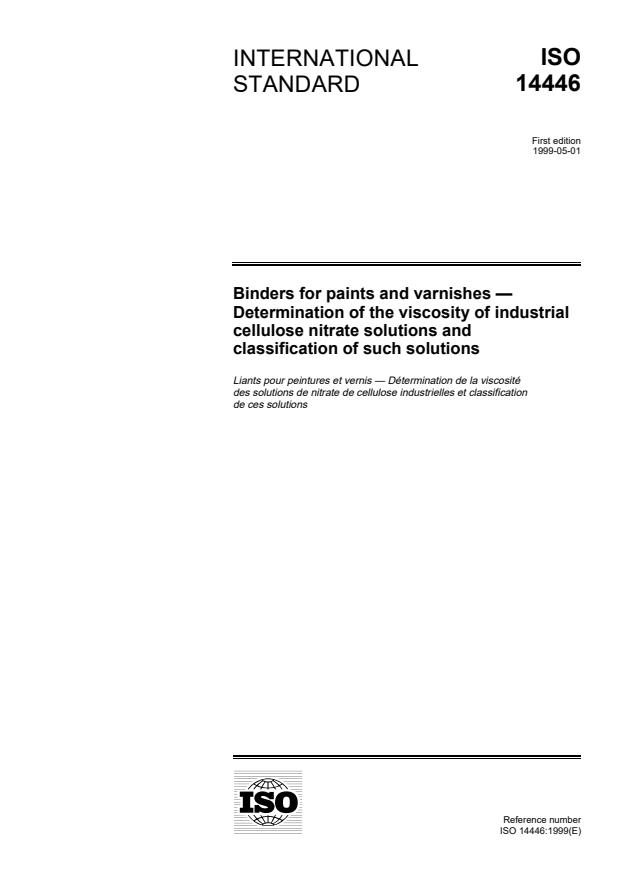
INTERNATIONAL ISO
STANDARD 14446
First edition
1999-05-01
Binders for paints and varnishes —
Determination of the viscosity of industrial
cellulose nitrate solutions and
classification of such solutions
Liants pour peintures et vernis — Détermination de la viscosité
des solutions de nitrate de cellulose industrielles et classification
de ces solutions
A
Reference number
Foreword
ISO (the International Organization for Standardization) is a worldwide federation of national standards bodies (ISO
member bodies). The work of preparing International Standards is normally carried out through ISO technical
committees. Each member body interested in a subject for which a technical committee has been established has
the right to be represented on that committee. International organizations, governmental and non-governmental, in
liaison with ISO, also take part in the work. ISO collaborates closely with the International Electrotechnical
Commission (IEC) on all matters of electrotechnical standardization.
International Standards are drafted in accordance with the rules given in the ISO/IEC Directives, Part 3.
Draft International Standards adopted by the technical committees are circulated to the member bodies for voting.
Publication as an International Standard requires approval by at least 75 % of the member bodies casting a vote.
International Standard ISO 14446 was prepared by Technical Committee ISO/TC 35, Paints and varnishes,
Subcommittee SC 10, Test methods for binders for paints and varnishes.
Annex A forms a normative part of this International Standard.
© ISO 1999
All rights reserved. Unless otherwise specified, no part of this publication may be reproduced or utilized in any form or by any means, electronic
or mechanical, including photocopying and microfilm, without permission in writing from the publisher.
International Organization for Standardization
Case postale 56 • CH-1211 Genève 20 • Switzerland
Internet iso@iso.ch
Printed in Switzerland
ii
INTERNATIONAL STANDARD © ISO ISO 14446:1999(E)
Binders for paints and varnishes — Determination of the viscosity
of industrial cellulose nitrate solutions and classification of such
solutions
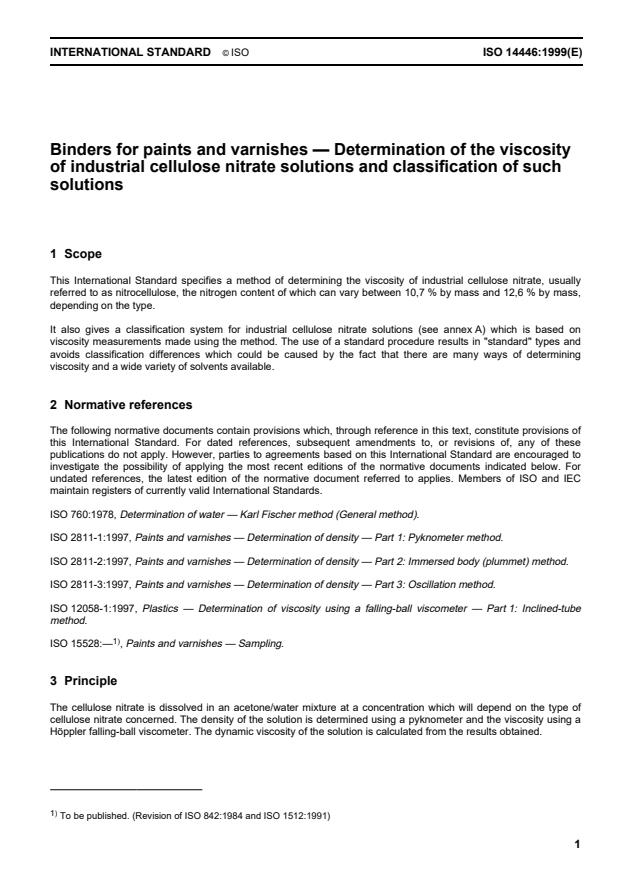
1 Scope
This International Standard specifies a method of determining the viscosity of industrial cellulose nitrate, usually
referred to as nitrocellulose, the nitrogen content of which can vary between 10,7 % by mass and 12,6 % by mass,
depending on the type.
It also gives a classification system for industrial cellulose nitrate solutions (see annex A) which is based on
viscosity measurements made using the method. The use of a standard procedure results in "standard" types and
avoids classification differences which could be caused by the fact that there are many ways of determining
viscosity and a wide variety of solvents available.
2 Normative references
The following normative documents contain provisions which, through reference in this text, constitute provisions of
this International Standard. For dated references, subsequent amendments to, or revisions of, any of these
publications do not apply. However, parties to agreements based on this International Standard are encouraged to
investigate the possibility of applying the most recent editions of the normative documents indicated below. For
undated references, the latest edition of the normative document referred to applies. Members of ISO and IEC
maintain registers of currently valid International Standards.
ISO 760:1978,
Determination of water — Karl Fischer method (General method).
ISO 2811-1:1997, Paints and varnishes — Determination of density — Part 1: Pyknometer method.
ISO 2811-2:1997, Paints and varnishes — Determination of density — Part 2: Immersed body (plummet) method.
ISO 2811-3:1997, Paints and varnishes — Determination of density — Part 3: Oscillation method.
ISO 12058-1:1997, Plastics — Determination of viscosity using a falling-ball viscometer — Part 1: Inclined-tube
method.
1)
ISO 15528:— , Paints and varnishes — Sampling.
3 Principle
The cellulose nitrate is dissolved in an acetone/water mixture at a concentration which will depend on the type of
cellulose nitrate concerned. The density of the solution is determined using a pyknometer and the viscosity using a
Höppler falling-ball viscometer. The dynamic viscosity of the solution is calculated from the results obtained.
1)
To be published. (Revision of ISO 842:1984 and ISO 1512:1991)
© ISO
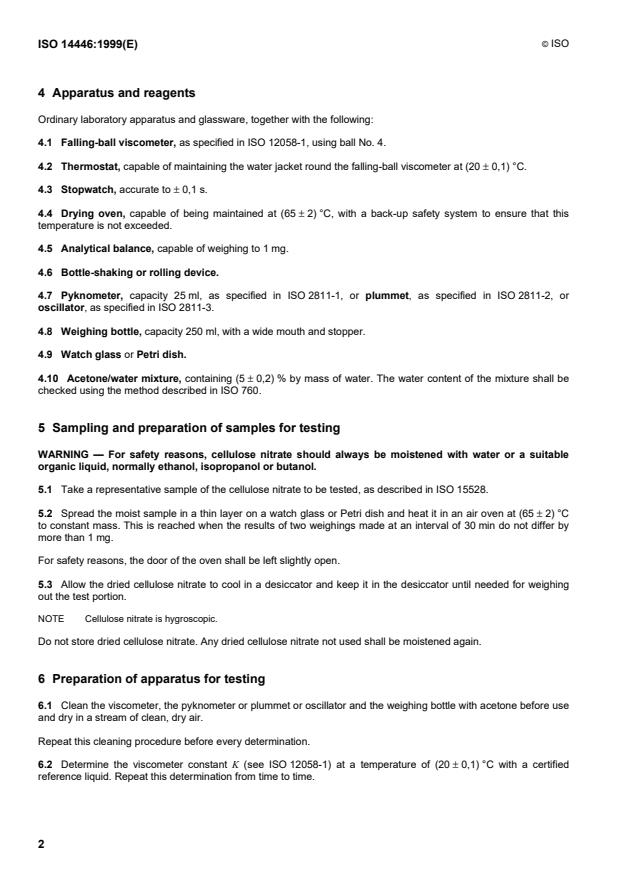
4 Apparatus and reagents
Ordinary laboratory apparatus and glassware, together with the following:
4.1 Falling-ball viscometer, as specified in ISO 12058-1, using ball No. 4.
4.2 Thermostat, capable of maintaining the water jacket round the falling-ball viscometer at (20 ± 0,1) °C.
4.3 Stopwatch, accurate to ± 0,1 s.
4.4 Drying oven, capable of being maintained at (65 ± 2) °C, with a back-up safety system to ensure that this
temperature is not exceeded.
4.5 Analytical balance, capable of weighing to 1 mg.
4.6 Bottle-shaking or rolling device.
4.7 Pyknometer, capacity 25 ml, as specified in ISO 2811-1, or plummet, as specified in ISO 2811-2, or
oscillator, as specified in ISO 2811-3.
4.8 Weighing bottle, capacity 250 ml, with a wide mouth and stopper.
or
4.9 Watch glass Petri dish.
4.10 Acetone/water mixture, containing (5 ± 0,2) % by mass of water. The water content of the mixture shall be
checked using the method described in ISO 760.
5 Sampling and preparation of samples for testing
WARNING — For safety reasons, cellulose nitrate should always be moistened with water or a suitable
organic liquid, normally ethanol, isopropanol or butanol.
5.1 Take a representative sample of the cellulose nitrate to be tested, as described in ISO 15528.
5.2 Spread the moist sample in a thin layer on a watch glass or Petri dish and heat it in an air oven at (65 ± 2) °C
to constant mass. This is reached when the results of two weighings made at an interval of 30 min do not differ by
more than 1 mg.
For safety reasons, the door of the oven shall be left slightly open.
5.3 Allow the dried cellulose nitrate to cool in a desiccator and keep it in the desiccator until needed for weighing
out the test portion.
NOTE Cellulose nitrate is hygroscopic.
Do not store dried cellulose nitrate. Any dried cellulose nitrate not used shall be moistened again.
6 Preparation of apparatus for testing
6.1 Clean the viscometer, the pyknometer or plummet or oscillator and the weighing bottle with a
...
NORME ISO
INTERNATIONALE 14446
Première édition
1999-05-01
Liants pour peintures et vernis —
Détermination de la viscosité des solutions
de nitrate de cellulose industrielles et
classification de ces solutions
Binders for paints and varnishes — Determination of the viscosity of
industrial cellulose nitrate solutions and classification of such solutions
A
Numéro de référence
Avant-propos
L'ISO (Organisation internationale de normalisation) est une fédération mondiale d'organismes nationaux de
normalisation (comités membres de l'ISO). L'élaboration des Normes internationales est en général confiée aux
comités techniques de l'ISO. Chaque comité membre intéressé par une étude a le droit de faire partie du comité
technique créé à cet effet. Les organisations internationales, gouvernementales et non gouvernementales, en
liaison avec l'ISO participent également aux travaux. L'ISO collabore étroitement avec la Commission
électrotechnique internationale (CEI) en ce qui concerne la normalisation électrotechnique.
Les Normes internationales sont rédigées conformément aux règles données dans les Directives ISO/CEI, Partie 3.
Les projets de Normes internationales adoptés par les comités techniques sont soumis aux comités membres pour
vote. Leur publication comme Normes internationales requiert l'approbation de 75 % au moins des comités
membres votants.
La Norme internationale ISO 14446 a été élaborée par le comité technique ISO/TC 35, Peintures et vernis,
sous-comité SC 10, Méthodes d'essai des liants pour peintures et vernis.
L'annexe A constitue un élément normatif de la présente Norme internationale.
© ISO 1999
Droits de reproduction réservés. Sauf prescription différente, aucune partie de cette publication ne peut être reproduite ni utilisée sous quelque
forme que ce soit et par aucun procédé, électronique ou mécanique, y compris la photocopie et les microfilms, sans l'accord écrit de l'éditeur.
Organisation internationale de normalisation
Case postale 56 • CH-1211 Genève 20 • Suisse
Internet iso@iso.ch
Imprimé en Suisse
ii
NORME INTERNATIONALE © ISO ISO 14446:1999(F)
Liants pour peintures et vernis — Détermination de la viscosité
des solutions de nitrate de cellulose industrielles et classification
de ces solutions
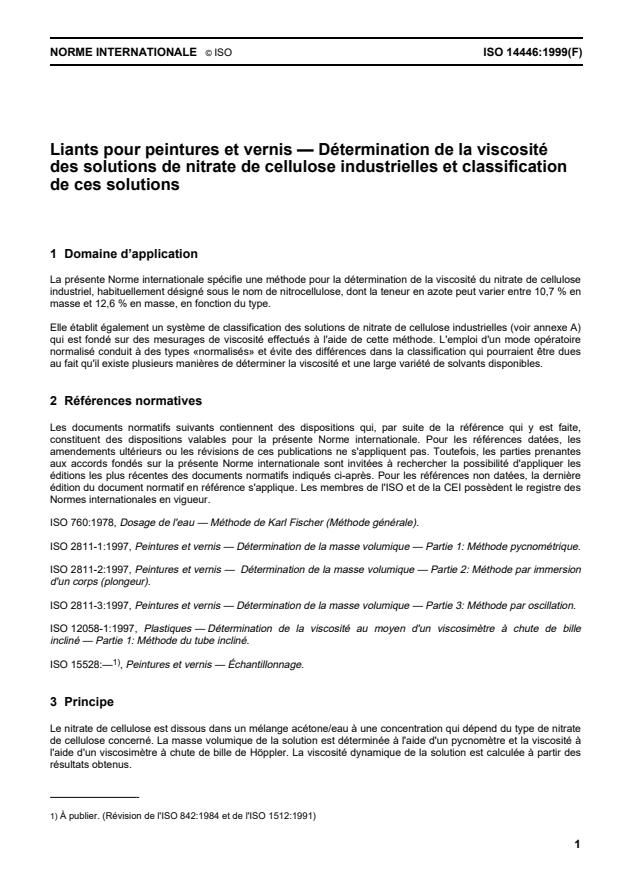
1 Domaine d’application
La présente Norme internationale spécifie une méthode pour la détermination de la viscosité du nitrate de cellulose
industriel, habituellement désigné sous le nom de nitrocellulose, dont la teneur en azote peut varier entre 10,7 % en
masse et 12,6 % en masse, en fonction du type.
Elle établit également un système de classification des solutions de nitrate de cellulose industrielles (voir annexe A)
qui est fondé sur des mesurages de viscosité effectués à l'aide de cette méthode. L'emploi d'un mode opératoire
normalisé conduit à des types «normalisés» et évite des différences dans la classification qui pourraient être dues
au fait qu'il existe plusieurs manières de déterminer la viscosité et une large variété de solvants disponibles.
2 Références normatives
Les documents normatifs suivants contiennent des dispositions qui, par suite de la référence qui y est faite,
constituent des dispositions valables pour la présente Norme internationale. Pour les références datées, les
amendements ultérieurs ou les révisions de ces publications ne s'appliquent pas. Toutefois, les parties prenantes
aux accords fondés sur la présente Norme internationale sont invitées à rechercher la possibilité d'appliquer les
éditions les plus récentes des documents normatifs indiqués ci-après. Pour les références non datées, la dernière
édition du document normatif en référence s'applique. Les membres de l'ISO et de la CEI possèdent le registre des
Normes internationales en vigueur.
ISO 760:1978, Dosage de l'eau — Méthode de Karl Fischer (Méthode générale).
ISO 2811-1:1997, Peintures et vernis — Détermination de la masse volumique — Partie 1: Méthode pycnométrique.
ISO 2811-2:1997, Peintures et vernis — Détermination de la masse volumique — Partie 2: Méthode par immersion
d'un corps (plongeur).
ISO 2811-3:1997, Peintures et vernis — Détermination de la masse volumique — Partie 3: Méthode par oscillation.
ISO 12058-1:1997, Plastiques — Détermination de la viscosité au moyen d'un viscosimètre à chute de bille
incliné — Partie 1: Méthode du tube incliné.
1)
ISO 15528:— ,
Peintures et vernis — Échantillonnage.
3 Principe
Le nitrate de cellulose est dissous dans un mélange acétone/eau à une concentration qui dépend du type de nitrate
de cellulose concerné. La masse volumique de la solution est déterminée à l'aide d'un pycnomètre et la viscosité à
l'aide d'un viscosimètre à chute de bille de Höppler. La viscosité dynamique de la solution est calculée à partir des
résultats obtenus.
1) À publier. (Révision de l'ISO 842:1984 et de l'ISO 1512:1991)
© ISO
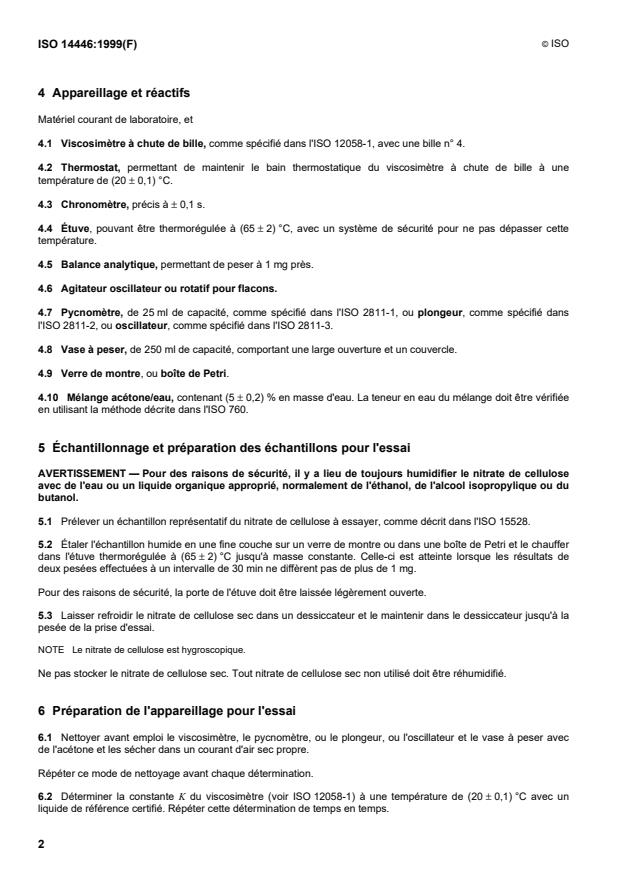
4 Appareillage et réactifs
Matériel courant de laboratoire, et
4.1 Viscosimètre à chute de bille, comme spécifié dans l'ISO 12058-1, avec une bille n° 4.
4.2 Thermostat, permettant de maintenir le bain thermostatique du viscosimètre à chute de bille à une
température de (20 ± 0,1) °C.
4.3 Chronomètre, précis à ± 0,1 s.
4.4 Étuve, pouvant être thermorégulée à (65 ± 2) °C, avec un système de sécurité pour ne pas dépasser cette
température.
4.5 Balance analytique, permettant de peser à 1 mg près.
4.6 Agitateur oscillateur ou rotatif pour flacons.
4.7 Pycnomètre, de 25 ml de capacité, comme spécifié dans l'ISO 2811-1, ou plongeur, comme spécifié dans
l'ISO 2811-2, ou oscillateur, comme spécifié dans l'ISO 2811-3.
4.8 Vase à peser, de 250 ml de capacité, comportant une large ouverture et un couvercle.
4.9 Verre de montre, ou boîte de Petri.
4.10 Mélange acétone/eau, contenant (5 ± 0,2) % en masse d'eau. La teneur en eau du mélange doit être vérifiée
en utilisant la méthode décrite dans l'ISO 760.
5 Échantillonnage et préparation des échantillons pour l'essai
AVERTISSEMENT — Pour des raisons de sécurité, il y a lieu de toujours humidifier le nitrate de cellulose
avec de l'eau ou un liquide organique approprié, normalement de l'éthanol, de l'alcool isopropylique ou du
butanol.
5.1 Prélever un échantillon représentatif du nitrate de cellulose à essayer, comme décrit dans l'ISO 15528.
5.2 Étaler l'échantillon humide en une fine couche sur un verre de montre ou dans une boîte de Petri et le chauffer
dans l'étuve thermorégulée à (65 ± 2) °C jusqu'à masse constante. Celle-ci est atteinte lorsque les résultats de
deux pesées effectuées à un intervalle de 30 min ne diffèrent pas de plus de 1 mg.
Pour des raisons de sécurité, la porte de l'étuve doit être laissée légèrement ouverte.
5.3 Laisser refroidir le nitrate de cellulose sec dans un dessiccateur et le maintenir dans le dessiccateur jusqu'à la
pesée de la prise d'essai.
NOTE Le nitrate de cellulose est hygroscopique.
Ne pas stocker le nitrate de cellulose sec. Tout nitrate de cellulose sec non utilisé doit être réhumidifié.
6 Préparation de l'appareillage pour l'essai
6.1 Nettoyer avant emploi le viscosimètre, le pycnomètre, ou le plongeur, ou l'oscillateur et le vase à peser avec
de l'acétone et les sécher dans un courant d'air sec propre.
Répéter ce mode de nettoyage avant chaque détermination.
6.2 Déterminer la constante K du viscosimètre (voir
...