

ISO 19085-11:2024
(Main)Woodworking machines — Safety — Part 11: Combined machines
General Information
- Abstract
This document specifies the safety requirements and measures for combined woodworking machines (defined in 3.1), capable of continuous production use, with manual loading and unloading of the workpiece and hereinafter referred to also as “machines”. The machines are designed to cut solid wood and material with similar physical characteristics to wood (see ISO 19085-1:2021, 3.2). This document deals with all significant hazards, hazardous situations and events, listed in Annex A, relevant to the machines, when operated, adjusted and maintained as intended and under the conditions foreseen by the manufacturer; reasonably foreseeable misuse has been considered too. Transport, assembly, dismantling, disabling and scrapping phases have also been taken into account. This document applies to machines also equipped with the devices or additional working units listed in the Scopes of ISO 19085-5:2024, ISO 19085-6:2024, ISO 19085-7:2024 and ISO 19085-9:2024. This document does not apply to: a) machines incorporating a planing unit and a mortising device only; NOTE Machines incorporating a planing unit and a mortising device only are dealt with in ISO 19085-7:2024. b) combined machines incorporating a band saw unit; c) machines with a mortising unit with a separate drive other than the planing unit drive; d) machines intended for use in potentially explosive atmosphere; e) machines manufactured before the publication of this document.
- Status
- Published
- Publication Date
- 22-Jul-2024
- Technical Committee
- ISO/TC 39/SC 4 - Woodworking machines
- Drafting Committee
- ISO/TC 39/SC 4 - Woodworking machines
- Current Stage
- 9092 - International Standard to be revised
- Start Date
- 28-Jun-2025
- Completion Date
- 29-Aug-2026
Buy Documents
ISO 19085-11:2024 - Woodworking machines — Safety — Part 11: Combined machines Released:23. 07. 2024
ISO 19085-11:2024 - Machines a bois — Sécurité — Partie 11: Machines combinées Released:23. 07. 2024
Overview
ISO 19085-11:2024 - Woodworking machines - Safety - Part 11: Combined machines defines safety requirements and protective measures for combined woodworking machines used in continuous production with manual loading and unloading. The standard covers machines designed to cut solid wood and materials with similar physical characteristics (see ISO 19085-1:2021) and addresses significant hazards during normal use, reasonably foreseeable misuse, plus transport, assembly, dismantling and scrapping. It applies to machines that include the additional units listed in the scopes of ISO 19085-5, -6, -7 and -9:2024 and excludes specific configurations (e.g., machines with only a planing unit and mortising device, band-saw units, machines for explosive atmospheres, and machines manufactured before publication).
Key Topics
ISO 19085-11:2024 organizes requirements around control systems, mechanical protection, other hazards and user information. Major technical topics include:
- Controls and safety systems: start/stop modes, safe stops, emergency stop, manual reset, standstill detection, braking, mode selection and speed changing.
- Mechanical hazards and safeguards: tool and fixing design, spindle locking, guard types (fixed, interlocking), anti-kickback devices, clamping and ejection prevention, hold-to-run/two-hand controls and ESPE/PSPE.
- Other hazards: fire, noise (design reduction and emission declaration), chips and dust emission, electrical safety, ergonomics, lighting, pneumatics/hydraulics, EMC, static electricity and maintenance.
- Information for use: markings, warning devices and instruction handbook requirements.
- Annexes: list of significant hazards (Annex A), required performance levels (Annex B) and a stability test (Annex C).
Applications and Who Uses It
ISO 19085-11:2024 is practical for:
- Machine manufacturers and designers - to design compliant combined woodworking machines, select safeguards and document safety features.
- Safety and compliance engineers - for risk assessment, CE/market conformity support and verifying control system performance.
- Testing laboratories and certification bodies - to assess machine safety against standardized criteria.
- Maintenance, training and procurement teams - to develop safe operating procedures, maintenance plans and equipment specifications.
- OEM integrators - when combining multiple working units or retrofitting safeguards.
Practical uses include specifying guarding, selecting braking and control solutions, defining labeling and manuals, and reducing noise/dust at the design stage.
Related Standards
- ISO 19085-1:2021 (general terms and scope for woodworking machines)
- ISO 19085-5:2024, ISO 19085-6:2024, ISO 19085-7:2024, ISO 19085-9:2024 (additional units and scopes referenced by this part)
Keywords: ISO 19085-11:2024, woodworking machines safety, combined machines, machine guarding, emergency stop, noise and dust emission, control systems, risk assessment, manufacturer compliance.
Relations
- Consolidates
EN ISO 19085-11:2024 - Woodworking machines - Safety - Part 11: Combined machines (ISO 19085-11:2024) - Effective Date
- 12-Feb-2026
- Effective Date
- 06-Jun-2022
- Effective Date
- 06-Jun-2022
Buy Documents
ISO 19085-11:2024 - Woodworking machines — Safety — Part 11: Combined machines Released:23. 07. 2024
ISO 19085-11:2024 - Machines a bois — Sécurité — Partie 11: Machines combinées Released:23. 07. 2024
Get Certified
Connect with accredited certification bodies for this standard

CIS Institut d.o.o.
Personal Protective Equipment (PPE) certification body. Notified Body NB-2890 for EU Regulation 2016/425 PPE.
Gozdarski inštitut Slovenije
Slovenian Forestry Institute. Forest management certification support, timber testing.

Kiwa BDA Testing
Building and construction product certification.
Sponsored listings
Frequently Asked Questions
ISO 19085-11:2024 is a standard published by the International Organization for Standardization (ISO). Its full title is "Woodworking machines — Safety — Part 11: Combined machines". This standard covers: This document specifies the safety requirements and measures for combined woodworking machines (defined in 3.1), capable of continuous production use, with manual loading and unloading of the workpiece and hereinafter referred to also as “machines”. The machines are designed to cut solid wood and material with similar physical characteristics to wood (see ISO 19085-1:2021, 3.2). This document deals with all significant hazards, hazardous situations and events, listed in Annex A, relevant to the machines, when operated, adjusted and maintained as intended and under the conditions foreseen by the manufacturer; reasonably foreseeable misuse has been considered too. Transport, assembly, dismantling, disabling and scrapping phases have also been taken into account. This document applies to machines also equipped with the devices or additional working units listed in the Scopes of ISO 19085-5:2024, ISO 19085-6:2024, ISO 19085-7:2024 and ISO 19085-9:2024. This document does not apply to: a) machines incorporating a planing unit and a mortising device only; NOTE Machines incorporating a planing unit and a mortising device only are dealt with in ISO 19085-7:2024. b) combined machines incorporating a band saw unit; c) machines with a mortising unit with a separate drive other than the planing unit drive; d) machines intended for use in potentially explosive atmosphere; e) machines manufactured before the publication of this document.
This document specifies the safety requirements and measures for combined woodworking machines (defined in 3.1), capable of continuous production use, with manual loading and unloading of the workpiece and hereinafter referred to also as “machines”. The machines are designed to cut solid wood and material with similar physical characteristics to wood (see ISO 19085-1:2021, 3.2). This document deals with all significant hazards, hazardous situations and events, listed in Annex A, relevant to the machines, when operated, adjusted and maintained as intended and under the conditions foreseen by the manufacturer; reasonably foreseeable misuse has been considered too. Transport, assembly, dismantling, disabling and scrapping phases have also been taken into account. This document applies to machines also equipped with the devices or additional working units listed in the Scopes of ISO 19085-5:2024, ISO 19085-6:2024, ISO 19085-7:2024 and ISO 19085-9:2024. This document does not apply to: a) machines incorporating a planing unit and a mortising device only; NOTE Machines incorporating a planing unit and a mortising device only are dealt with in ISO 19085-7:2024. b) combined machines incorporating a band saw unit; c) machines with a mortising unit with a separate drive other than the planing unit drive; d) machines intended for use in potentially explosive atmosphere; e) machines manufactured before the publication of this document.
ISO 19085-11:2024 is classified under the following ICS (International Classification for Standards) categories: 13.110 - Safety of machinery; 79.120.10 - Woodworking machines. The ICS classification helps identify the subject area and facilitates finding related standards.
ISO 19085-11:2024 has the following relationships with other standards: It is inter standard links to EN ISO 19085-11:2024, ISO/IEC 23008-6:2020, ISO 19085-11:2020. Understanding these relationships helps ensure you are using the most current and applicable version of the standard.
ISO 19085-11:2024 is available in PDF format for immediate download after purchase. The document can be added to your cart and obtained through the secure checkout process. Digital delivery ensures instant access to the complete standard document.
Standards Content (Sample)
International
Standard
ISO 19085-11
Second edition
Woodworking machines — Safety —
2024-07
Part 11:
Combined machines
Machines à bois — Sécurité —
Partie 11: Machines combinées
Reference number
© ISO 2024
All rights reserved. Unless otherwise specified, or required in the context of its implementation, no part of this publication may
be reproduced or utilized otherwise in any form or by any means, electronic or mechanical, including photocopying, or posting on
the internet or an intranet, without prior written permission. Permission can be requested from either ISO at the address below
or ISO’s member body in the country of the requester.
ISO copyright office
CP 401 • Ch. de Blandonnet 8
CH-1214 Vernier, Geneva
Phone: +41 22 749 01 11
Email: copyright@iso.org
Website: www.iso.org
Published in Switzerland
ii
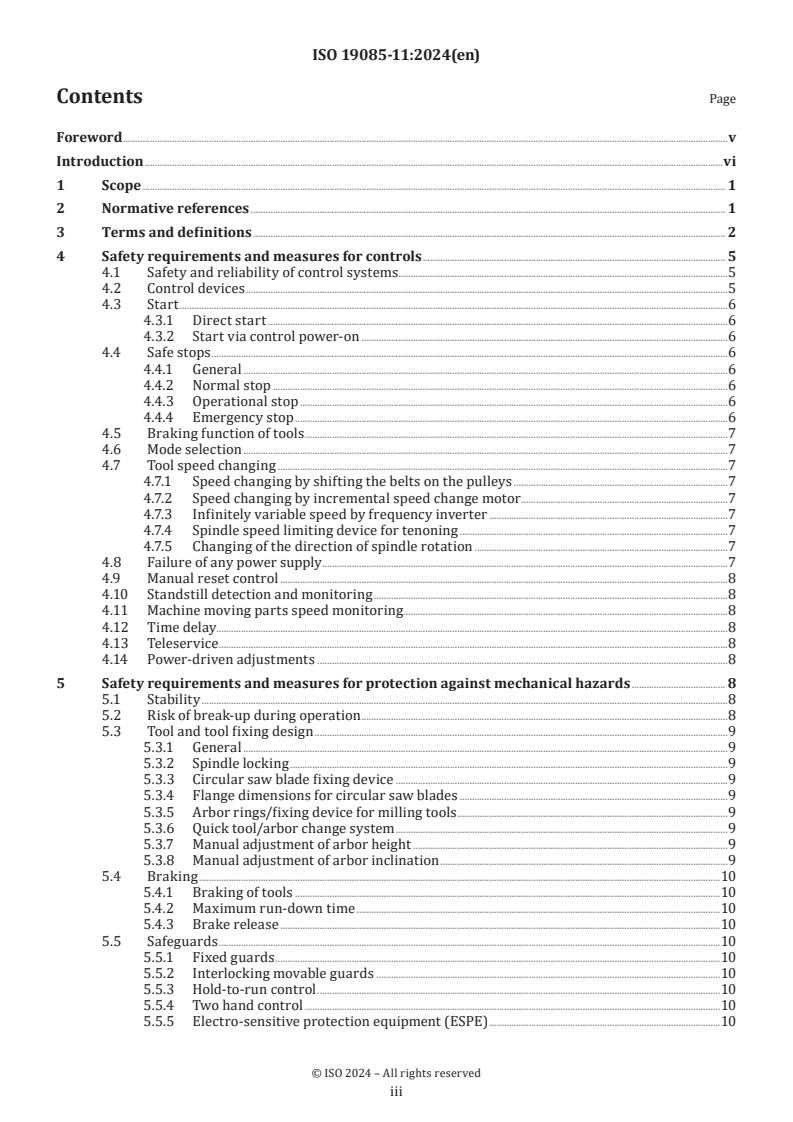
Contents Page
Foreword .v
Introduction .vi
1 Scope . 1
2 Normative references . 1
3 Terms and definitions . 2
4 Safety requirements and measures for controls . 5
4.1 Safety and reliability of control systems.5
4.2 Control devices .5
4.3 Start .6
4.3.1 Direct start .6
4.3.2 Start via control power-on .6
4.4 Safe stops .6
4.4.1 General .6
4.4.2 Normal stop .6
4.4.3 Operational stop .6
4.4.4 Emergency stop .6
4.5 Braking function of tools .7
4.6 Mode selection .7
4.7 Tool speed changing .7
4.7.1 Speed changing by shifting the belts on the pulleys .7
4.7.2 Speed changing by incremental speed change motor .7
4.7.3 Infinitely variable speed by frequency inverter .7
4.7.4 Spindle speed limiting device for tenoning .7
4.7.5 Changing of the direction of spindle rotation .7
4.8 Failure of any power supply .7
4.9 Manual reset control .8
4.10 Standstill detection and monitoring .8
4.11 Machine moving parts speed monitoring.8
4.12 Time delay.8
4.13 Teleservice .8
4.14 Power-driven adjustments .8
5 Safety requirements and measures for protection against mechanical hazards . 8
5.1 Stability .8
5.2 Risk of break-up during operation .8
5.3 Tool and tool fixing design .9
5.3.1 General .9
5.3.2 Spindle locking .9
5.3.3 Circular saw blade fixing device .9
5.3.4 Flange dimensions for circular saw blades .9
5.3.5 Arbor rings/fixing device for milling tools .9
5.3.6 Quick tool/arbor change system .9
5.3.7 Manual adjustment of arbor height .9
5.3.8 Manual adjustment of arbor inclination .9
5.4 Braking .10
5.4.1 Braking of tools .10
5.4.2 Maximum run-down time .10
5.4.3 Brake release .10
5.5 Safeguards .10
5.5.1 Fixed guards .10
5.5.2 Interlocking movable guards .10
5.5.3 Hold-to-run control .10
5.5.4 Two hand control .10
5.5.5 Electro-sensitive protection equipment (ESPE) .10
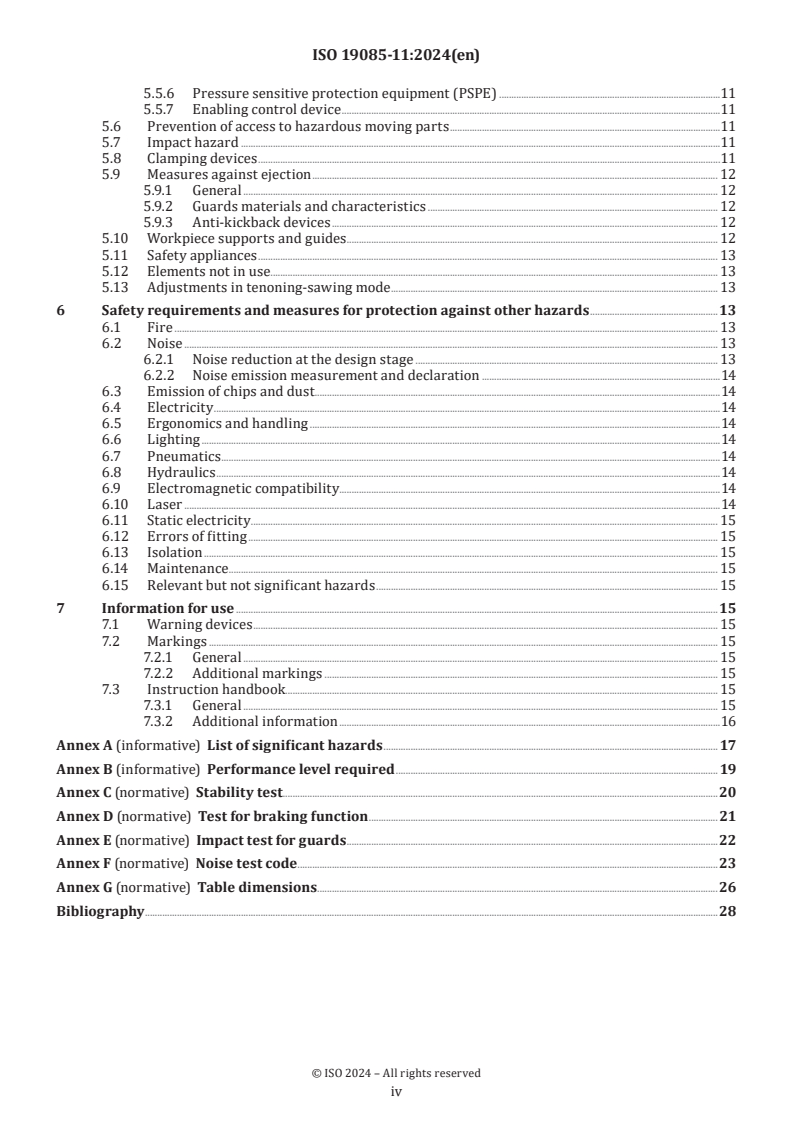
iii
5.5.6 Pressure sensitive protection equipment (PSPE) .11
5.5.7 Enabling control device .11
5.6 Prevention of access to hazardous moving parts .11
5.7 Impact hazard .11
5.8 Clamping devices .11
5.9 Measures against ejection . 12
5.9.1 General . 12
5.9.2 Guards materials and characteristics . 12
5.9.3 Anti-kickback devices . 12
5.10 Workpiece supports and guides . . 12
5.11 Safety appliances . 13
5.12 Elements not in use. 13
5.13 Adjustments in tenoning-sawing mode . 13
6 Safety requirements and measures for protection against other hazards .13
6.1 Fire . 13
6.2 Noise . 13
6.2.1 Noise reduction at the design stage . 13
6.2.2 Noise emission measurement and declaration .14
6.3 Emission of chips and dust .14
6.4 Electricity .14
6.5 Ergonomics and handling .14
6.6 Lighting .14
6.7 Pneumatics .14
6.8 Hydraulics .14
6.9 Electromagnetic compatibility.14
6.10 Laser .14
6.11 Static electricity. 15
6.12 Errors of fitting . 15
6.13 Isolation . 15
6.14 Maintenance . 15
6.15 Relevant but not significant hazards . 15
7 Information for use .15
7.1 Warning devices . 15
7.2 Markings . 15
7.2.1 General . 15
7.2.2 Additional markings . 15
7.3 Instruction handbook. 15
7.3.1 General . 15
7.3.2 Additional information .16
Annex A (informative) List of significant hazards . 17
Annex B (informative) Performance level required . 19
Annex C (normative) Stability test . .20
Annex D (normative) Test for braking function .21
Annex E (normative) Impact test for guards . .22
Annex F (normative) Noise test code . .23
Annex G (normative) Table dimensions .26
Bibliography .28
iv
Foreword
ISO (the International Organization for Standardization) is a worldwide federation of national standards
bodies (ISO member bodies). The work of preparing International Standards is normally carried out through
ISO technical committees. Each member body interested in a subject for which a technical committee
has been established has the right to be represented on that committee. International organizations,
governmental and non-governmental, in liaison with ISO, also take part in the work. ISO collaborates closely
with the International Electrotechnical Commission (IEC) on all matters of electrotechnical standardization.
The procedures used to develop this document and those intended for its further maintenance are described
in the ISO/IEC Directives, Part 1. In particular, the different approval criteria needed for the different types
of ISO document should be noted. This document was drafted in accordance with the editorial rules of the
ISO/IEC Directives, Part 2 (see www.iso.org/directives).
ISO draws attention to the possibility that the implementation of this document may involve the use of (a)
patent(s). ISO takes no position concerning the evidence, validity or applicability of any claimed patent
rights in respect thereof. As of the date of publication of this document, ISO had not received notice of (a)
patent(s) which may be required to implement this document. However, implementers are cautioned that
this may not represent the latest information, which may be obtained from the patent database available at
www.iso.org/patents. ISO shall not be held responsible for identifying any or all such patent rights.
Any trade name used in this document is information given for the convenience of users and does not
constitute an endorsement.
For an explanation of the voluntary nature of standards, the meaning of ISO specific terms and expressions
related to conformity assessment, as well as information about ISO's adherence to the World Trade
Organization (WTO) principles in the Technical Barriers to Trade (TBT), see www.iso.org/iso/foreword.html.
This document was prepared by Technical Committee ISO/TC 39, Machine tools, Subcommittee SC 4
Woodworking machines, in collaboration with the European Committee for Standardization (CEN) Technical
Committee CEN/TC 142, Woodworking machines - Safety, in accordance with the Agreement on technical
cooperation between ISO and CEN (Vienna Agreement).
This second edition cancels and replaces the first edition (ISO 19085-11:2020), which has been technically
revised. The main changes are as follows:
— the scope now specifies that machines are intended for continuous production use;
— the list of significant hazards has been moved to a new Annex A;
— subclause 6.2 has been updated;
— a new noise test code has been specified in Annex F.
A list of all parts in the ISO 19085 series can be found on the ISO website.
Any feedback or questions on this document should be directed to the user’s national standards body. A
complete listing of these bodies can be found at www.iso.org/members.html.
v
Introduction
The ISO 19085 series provides technical safety requirements for the design and construction of
woodworking machinery, as well as for the content of the relevant instruction handbook. It concerns
designers, manufacturers, suppliers and importers of the machines specified in the scope.
This document is a type-C standard as stated in ISO 12100:2010.
This document is of relevance, in particular, for the following stakeholder groups representing the market
players with regard to machinery safety:
— machine manufacturers (small, medium and large enterprises);
— health and safety bodies (e.g. regulators, accident prevention organisations, market surveillance).
Others can be affected by the level of machinery safety achieved with the means of the document by the
above-mentioned stakeholder groups:
— machine users/employers (small, medium and large enterprises);
— machine users/employees (e.g. trade unions, organizations for people with special needs);
— service providers, e.g. for maintenance (small, medium and large enterprises);
— consumers (in case of machinery intended for use by consumers).
The above-mentioned stakeholder groups have been given the possibility to participate in the drafting
process of this document.
The machinery concerned and the extent to which hazards, hazardous situations or hazardous events are
covered are indicated in the Scope of this document.
When requirements of this type-C standard are different from those which are stated in type-A or type-B
standards (as defined in ISO 12100:2010), the requirements of this type-C standard take precedence over
the requirements of the other standards for machines that have been designed and built according to the
requirements of this type-C standard.
The full set of requirements for a particular type of woodworking machine are those given in the part of the
ISO 19085 series applicable to that type, together with the relevant requirements from ISO 19085-1:2021, to
the extent specified in the Scope of the applicable part of the ISO 19085 series.
As far as possible, in this document, safety requirements are referenced to the relevant subclauses of
ISO 19085-1:2021, ISO 19085-5:2024, ISO 19085-6:2024, ISO 19085-7:2024 and ISO 19085-9:2024 to avoid
repetition and reduce their length.
Specific subclauses and annexes in this document without a correspondent in ISO 19085-1:2021,
ISO 19085-5:2024, ISO 19085-6:2024, ISO 19085-7:2024 and ISO 19085-9:2024 are indicated by the
introductory sentence: “Subclause (or annex) specific to this document.”
Clauses 1 to 3 are specific to each part and, therefore are distinct from ISO 19085-1:2021, Clauses 1 to 3.
vi
International Standard ISO 19085-11:2024(en)
Woodworking machines — Safety —
Part 11:
Combined machines
1 Scope
This document specifies the safety requirements and measures for combined woodworking machines
(defined in 3.1), capable of continuous production use, with manual loading and unloading of the workpiece
and hereinafter referred to also as “machines”.
The machines are designed to cut solid wood and material with similar physical characteristics to wood (see
ISO 19085-1:2021, 3.2).
This document deals with all significant hazards, hazardous situations and events, listed in Annex A,
relevant to the machines, when operated, adjusted and maintained as intended and under the conditions
foreseen by the manufacturer; reasonably foreseeable misuse has been considered too. Transport, assembly,
dismantling, disabling and scrapping phases have also been taken into account.
This document applies to machines also equipped with the devices or additional working units listed in the
Scopes of ISO 19085-5:2024, ISO 19085-6:2024, ISO 19085-7:2024 and ISO 19085-9:2024.
This document does not apply to:
a) machines incorporating a planing unit and a mortising device only;
NOTE Machines incorporating a planing unit and a mortising device only are dealt with in ISO 19085-7:2024.
b) combined machines incorporating a band saw unit;
c) machines with a mortising unit with a separate drive other than the planing unit drive;
d) machines intended for use in potentially explosive atmosphere;
e) machines manufactured before the publication of this document.
2 Normative references
The following documents are referred to in the text in such a way that some or all of their content constitutes
requirements of this document. For dated references, only the edition cited applies. For undated references,
the latest edition of the referenced document (including any amendments) applies.
ISO 12100:2010, Safety of machinery — General principles for design — Risk assessment and risk reduction
ISO 19085-1:2021, Woodworking machines — Safety — Part 1: Common requirements
ISO 19085-5:2024, Woodworking machines — Safety — Part 5: Dimension saws
ISO 19085-6:2024, Woodworking machines — Safety — Part 6: Single spindle vertical moulding machines
(toupie)
ISO 19085-7:2024, Woodworking machines — Safety — Part 7: Surface planing, thickness planing, combined
surface/thickness planing machines
ISO 19085-9:2024, Woodworking machines — Safety — Part 9: Circular saw benches (with and without sliding table)
3 Terms and definitions
For the purposes of this document, the terms and definitions given in ISO 12100:2010, ISO 19085-1:2021,
ISO 19085-5:2024, ISO 19085-6:2024, ISO 19085-7:2024, ISO 19085-9:2024 and the following apply.
ISO and IEC maintain terminology databases for use in standardization at the following addresses:
— ISO Online browsing platform: available at https:// www .iso .org/ obp
— IEC Electropedia: available at https:// www .electropedia .org/
3.1
combined machine
machine incorporating two or three separately usable working units, among a sawing unit (3.2), a moulding
unit (3.5) and a planing unit (3.6)
Note 1 to entry: Workpiece feed is primarily by hand, but the machine can also have devices to connect to demountable
power feed units.
Note 2 to entry: The sawing unit and the moulding unit can work simultaneously.
Note 3 to entry: Examples of such machines are given in Figures 2, 3, 4 and 5.
3.2
sawing unit
dimension saw unit (3.3) or table saw unit (3.4), incorporated in a combined machine (3.1)
3.3
dimension saw unit
dimension saw incorporated in a combined machine (3.1)
Note 1 to entry: For the definition of a dimension saw, also called a sliding table circular sawing machine, see
ISO 19085-5:2024, 3.1.
3.4
table saw unit
table saw incorporated in a combined machine (3.1)
Note 1 to entry: For the definition of a table saw, also called a circular saw bench, see ISO 19085-9:2024, 3.1.
3.5
moulding unit
single spindle vertical moulding machine incorporated in a combined machine (3.1)
Note 1 to entry: For the definition of a single spindle vertical moulding machine, see ISO 19085-6:2024, 3.1.
3.6
planing unit
combined surface/thickness planing machine incorporated in a combined machine (3.1)
Note 1 to entry: For the definition of a combined surface/thickness planing machine, see ISO 19085-7:2024, 3.4.
3.7
tenoning-sawing mode
use of the sawing unit (3.2) and moulding unit (3.5) simultaneously to produce tenons
3.8
workstation
position of the operator at the machine to operate a working unit
Note 1 to entry: Combined machines (3.1) have more than one workstation depending on the number of integrated
working units (see Figure 1).
Key
1 workstation during moulding
2 workstation during sawing
3 alternative workstation during sawing
4 workstation during thickness planing
5 workstation during surface planing
Figure 1 — Typical workstations
Figure 2 — Example of a machine with table saw unit and moulding unit, fitted with a sliding table
Figure 3 — Example of a machine with dimension saw unit and moulding unit
Figure 4 — Example of a machine with table saw unit, moulding unit and planing unit, and with a
mortising device fitted with a sliding table
Figure 5 — Example of a machine with dimension saw unit, moulding unit and planing unit, and
with a mortising device
4 Safety requirements and measures for controls
4.1 Safety and reliability of control systems
ISO 19085-1:2021, 4.1, applies with the following additions.
Table B.1 summarizes the performance levels required (PL ) specified in Clauses 4 and 5 for each safety
r
function.
4.2 Control devices
For machines incorporating a dimension saw unit, ISO 19085-5:2024, 4.2 applies.
For machines incorporating a table saw unit, ISO 19085-9:2024, 4.2 applies.
For machines incorporating a moulding unit, ISO 19085-6:2024, 4.2 applies.
For machines incorporating a planing unit, ISO 19085-7:2024, 4.2 applies.
As an exception, the machine may be fitted with a single start control device for all tool drives, which shall
be positioned together with either:
— the unit selector (see 4.3) at a location on the machine body from which the operator has a good view
over the whole machine; or
— the unit selector on a moveable control panel.
Where it is not possible to meet the height requirement of minimum 600 mm, the height for all hand-
operated control devices except start, normal stop and emergency stop, may be reduced to at least 500 mm
from the floor level.
The main power switch may be located at a height of at least 500 mm above the floor level. The plug, fixed to
the machine where supply disconnection is through a plug/socket combination, may be located at a height of
at least 300 mm above the floor level.
Verification is done by checking the relevant drawings and circuit diagrams, inspection of the machine, and
relevant functional testing of the machine.
4.3 Start
4.3.1 Direct start
For machines incorporating a dimension saw unit, ISO 19085-5:2024, 4.3.1 applies.
For machines incorporating a table saw unit, ISO 19085-9:2024, 4.3.1 applies.
For machines incorporating a moulding unit, ISO 19085-6:2024, 4.3.1 applies.
For machines incorporating a planing unit, ISO 19085-7:2024, 4.3.1 applies.
In addition, the following requirements apply.
Operation of more than one working unit at the same time shall be prevented by a unit selector or by
an interlocking in the control system of the working unit start. As an exception, the sawing unit and the
moulding unit may be simultaneously operated in tenoning-sawing mode (see 4.6).
When a unit selector is used, indication of the selected working unit shall be provided, for example, by the
position of the unit selector, the provision of an indicating light or a visual display indication.
The safety related parts of the control system (SRP/CS) for the prevention of simultaneous operation of
more than one working unit shall achieve PL = c.
r
Changing the selected unit by the unit selector shall:
a) initiate a safe stop;
b) not initiate any movement.
Verification is done by checking the relevant drawings and circuit diagrams, inspection of the machine and
relevant functional testing of the machine.
4.3.2 Start via control power-on
ISO 19085-1:2021, 4.3.2 does not apply.
4.4 Safe stops
4.4.1 General
ISO 19085-1:2021, 4.4.1 applies.
4.4.2 Normal stop
ISO 19085-1:2021, 4.4.2 applies with the following additions.
Activation of any normal stop device, regardless of its position, shall stop all machines actuators.
4.4.3 Operational stop
ISO 19085-1:2021, 4.4.3 does not apply.
4.4.4 Emergency stop
ISO 19085-1:2021, 4.4.4 applies with the following additions.
As an exception, emergency stop control is not required on machines without a socket for a demountable
power feed and without tenoning-sawing mode, regardless of the number of machine actuators.
4.5 Braking function of tools
ISO 19085-1:2021, 4.5 applies.
4.6 Mode selection
ISO 19085-1:2021, 4.6 is replaced by the following text.
Machines where the sawing unit and the moulding unit can be operated simultaneously (see also 4.3) shall
be fitted with a tenoning-sawing mode selection switch.
This mode selection shall be in accordance with the following requirements:
a) its control system shall override all other control systems except the emergency stop;
b) changing the mode shall not initiate any movement and the machine shall be brought to a safe stop in
accordance with 4.4;
c) the mode selector shall be lockable in any position, for example, by a key-operated switch.
Indication of the tenoning-sawing mode selection shall be provided, for example, by the position of the mode
selector, by an indicating light or by a visual display indication.
The SRP/CS for the tenoning-sawing mode selection shall achieve PL = c.
r
Verification is done by checking the relevant drawings, inspection of the machine and relevant functional
testing of the machine.
4.7 Tool speed changing
4.7.1 Speed changing by shifting the belts on the pulleys
ISO 19085-1:2021, 4.7.1 applies.
4.7.2 Speed changing by incremental speed change motor
ISO 19085-1:2021, 4.7.2 applies.
4.7.3 Infinitely variable speed by frequency inverter
ISO 19085-1:2021, 4.7.3 applies.
4.7.4 Spindle speed limiting device for tenoning
For machines incorporating a moulding unit, ISO 19085-6:2024, 4.7.4 applies.
4.7.5 Changing of the direction of spindle rotation
For machines incorporating a moulding unit, ISO 19085-6:2024, 4.7.5 applies.
4.8 Failure of any power supply
ISO 19085-1:2021, 4.8 applies.
4.9 Manual reset control
ISO 19085-1:2021, 4.9 does not apply.
4.10 Standstill detection and monitoring
ISO 19085-1:2021, 4.10, does not apply.
4.11 Machine moving parts speed monitoring
ISO 19085-1:2021, 4.11, applies.
4.12 Time delay
ISO 19085-1:2021, 4.12, applies.
4.13 Teleservice
ISO 19085-1:2021, 4.13, applies.
4.14 Power-driven adjustments
For machines incorporating a dimension saw unit and with power-operated adjustment of the saw blade or
of the fences, ISO 19085-5:2024, 4.14, 4.14.1, 4.14.2 and 4.14.3 apply.
For machines incorporating a table saw unit and with power-operated adjustment of the saw blade or of the
fences, ISO 19085-9:2024, 4.14, 4.14.1, 4.14.2 and 4.14.3 apply.
For machines incorporating a moulding unit and with power-operated adjustment of arbor, demountable
power feed unit, fences or table insert, ISO 19085-6:2024, 4.14 applies.
For machines incorporating a planing unit and with power operated adjustment of the tables,
ISO 19085-7:2024, 4.14, applies.
5 Safety requirements and measures for protection against mechanical hazards
5.1 Stability
ISO 19085-1:2021, 5.1 applies with the following additions.
The machines shall pass the stability test required in Annex C.
For machines incorporating a dimension saw unit and a moulding unit only, ISO 19085-5:2024, 5.1, applies.
5.2 Risk of break-up during operation
For machines incorporating a dimension saw unit, ISO 19085-5:2024, 5.2 applies.
For machines incorporating a table saw unit, ISO 19085-9:2024, 5.2 applies.
For machines incorporating a moulding unit, ISO 19085-6:2024, 5.2 applies.
For machines incorporating a planing unit, ISO 19085-7:2024, 5.2 applies.
5.3 Tool and tool fixing design
5.3.1 General
For machines incorporating a dimension saw unit, ISO 19085-5:2024, 5.3.1 applies.
For machines incorporating a table saw unit, ISO 19085-9:2024, 5.3.1 applies.
For machines incorporating a moulding unit, ISO 19085-6:2024, 5.3.1 and Annex G apply.
For machines incorporating a planing unit, ISO 19085-7:2024, 5.3.1 applies.
5.3.2 Spindle locking
For machines incorporating a dimension saw unit, ISO 19085-5:2024, 5.3.2 applies.
For machines incorporating a table saw unit, ISO 19085-9:2024, 5.3.2 applies.
For machines incorporating a moulding unit, ISO 19085-6:2024, 5.3.2 applies.
5.3.3 Circular saw blade fixing device
For machines incorporating a dimension saw unit, ISO 19085-5:2024, 5.3.3 applies.
For machines incorporating a table saw unit, ISO 19085-9:2024, 5.3.3 applies.
For machines incorporating a moulding unit equipped with a glass bead saw unit, ISO 19085-6:2024, 5.3.3
applies.
5.3.4 Flange dimensions for circular saw blades
For machines incorporating a dimension saw unit, ISO 19085-5:2024, 5.3.4 applies.
For machines incorporating a table saw unit, ISO 19085-9:2024, 5.3.4 applies.
For machines incorporating a moulding unit equipped with a glass bead saw unit, ISO 19085-6:2024, 5.3.4
applies.
5.3.5 Arbor rings/fixing device for milling tools
For machines incorporating a dimension saw unit, ISO 19085-5:2024, 5.3.5 applies.
For machines incorporating a table saw unit, ISO 19085-9:2024, 5.3.5 applies.
For machines incorporating a moulding unit, ISO 19085-6:2024, 5.3.5 applies.
5.3.6 Quick tool/arbor change system
For machines incorporating a moulding unit, ISO 19085-6:2024, 5.3.6 applies.
5.3.7 Manual adjustment of arbor height
For machines incorporating a moulding unit, ISO 19085-6:2024, 5.3.7 applies.
5.3.8 Manual adjustment of arbor inclination
For machines incorporating a moulding unit, ISO 19085-6:2024, 5.3.8 applies.
5.4 Braking
5.4.1 Braking of tools
ISO 19085-1:2021, 5.4.1 applies with the following addition.
The braking function shall be tested in accordance with Annex D.
5.4.2 Maximum run-down time
ISO 19085-1:2021, 5.4.2 applies with the following additions.
When conducting the test for braking function on machines incorporating a sawing unit and with the device
for grooving with milling tool, it shall be determined whether the condition with the greatest kinetic energy
will be achieved with a saw blade or a milling tool.
5.4.3 Brake release
ISO 19085-1:2021, 5.4.3 applies.
5.5 Safeguards
5.5.1 Fixed guards
ISO 19085-1:2021, 5.5.1 applies.
5.5.2 Interlocking movable guards
5.5.2.1 General
ISO 19085-1:2021, 5.5.2.1 applies with the following additions.
Additional measures according to ISO 14119:2013, 7.2 are not required.
NOTE The motivation to defeat the interlocking devices in a reasonably foreseeable manner does not exist.
5.5.2.2 Movable guards with interlocking
ISO 19085-1:2021, 5.5.2.2 applies.
5.5.2.3 Movable guards with interlocking and guard locking
ISO 19085-1:2021, 5.5.2.3 does not apply.
5.5.3 Hold-to-run control
ISO 19085-1:2021, 5.5.3 applies.
5.5.4 Two hand control
ISO 19085-1:2021, 5.5.4 applies.
5.5.5 Electro-sensitive protection equipment (ESPE)
ISO 19085-1:2021, 5.5.5 does not apply.
5.5.6 Pressure sensitive protection equipment (PSPE)
ISO 19085-1:2021, 5.5.6 applies.
5.5.7 Enabling control device
ISO 19085-1:2021, 5.5.7 does not apply.
5.6 Prevention of access to hazardous moving parts
For machines incorporating a dimension saw unit, ISO 19085-5:2024, 5.6 applies with the following additions.
For machines incorporating a table saw unit, ISO 19085-9:2024, 5.6 applies with the following additions.
As an exception to ISO 19085-5:2024, 5.6 and to ISO 19085-9:2024, 5.6, machines incorporating a moulding,
a planing and a sawing unit may have a saw blade guard mounted to the riving knife also if:
a) they have a maximum saw blade diameter >315 mm and ≤350 mm; or
b) they are fitted with a device for grooving with milling tools on the saw spindle.
In addition, on machines with the facility to adjust the saw blade height, coverage of the saw blade or the
milling tool during grooving shall be made possible by providing mountings for fixing a protective device
(see 5.11 and 7.3.2).
For machines incorporating a moulding unit, ISO 19085-6:2024, 5.6 applies.
For machines incorporating a planing unit, ISO 19085-7:2024, 5.6 applies with the following additions.
On machines where it is necessary
...
Norme
internationale
ISO 19085-11
Deuxième édition
Machines à bois — Sécurité —
2024-07
Partie 11:
Machines combinées
Woodworking machines — Safety —
Part 11: Combined machines
Numéro de référence
DOCUMENT PROTÉGÉ PAR COPYRIGHT
© ISO 2024
Tous droits réservés. Sauf prescription différente ou nécessité dans le contexte de sa mise en œuvre, aucune partie de cette
publication ne peut être reproduite ni utilisée sous quelque forme que ce soit et par aucun procédé, électronique ou mécanique,
y compris la photocopie, ou la diffusion sur l’internet ou sur un intranet, sans autorisation écrite préalable. Une autorisation peut
être demandée à l’ISO à l’adresse ci-après ou au comité membre de l’ISO dans le pays du demandeur.
ISO copyright office
Case postale 401 • Ch. de Blandonnet 8
CH-1214 Vernier, Genève
Tél.: +41 22 749 01 11
E-mail: copyright@iso.org
Web: www.iso.org
Publié en Suisse
ii
Sommaire Page
Avant-propos .v
Introduction .vi
1 Domaine d'application . 1
2 Références normatives . 1
3 Termes et définitions . 2
4 Exigences et mesures de sécurité pour les commandes . 5
4.1 Sécurité et fiabilité des systèmes de commande .5
4.2 Dispositifs de commande .6
4.3 Démarrage .6
4.3.1 Démarrage direct .6
4.3.2 Démarrage par commande de mise sous tension .7
4.4 Arrêts sûrs .7
4.4.1 Généralités .7
4.4.2 Arrêt normal .7
4.4.3 Arrêt de fonctionnement .7
4.4.4 Arrêt d'urgence .7
4.5 Fonction de freinage des outils .7
4.6 Sélection du mode de fonctionnement .7
4.7 Changement de vitesse d’outil .8
4.7.1 Changement de vitesse par déplacement des courroies sur les poulies .8
4.7.2 Changement de vitesse par moteur à changement incrémental de vitesse .8
4.7.3 Vitesse variable en continu par convertisseur de fréquence .8
4.7.4 Dispositif limiteur de vitesse de l’arbre pour le tenonnage .8
4.7.5 Changement du sens de rotation de l'arbre .8
4.8 Défaillance de toute alimentation en énergie .8
4.9 Commande de réarmement manuel.8
4.10 Détection et surveillance de l’arrêt .8
4.11 Surveillance de la vitesse des parties mobiles de la machine .8
4.12 Temporisation .8
4.13 Téléservice .8
4.14 Réglages mécanisés .8
5 Exigences et mesures de sécurité pour la protection contre les phénomènes dangereux
mécaniques . 9
5.1 Stabilité .9
5.2 Risque de rupture pendant le fonctionnement .9
5.3 Conception de l'outil et de la fixation de l’outil .9
5.3.1 Généralités .9
5.3.2 Blocage de l’arbre .9
5.3.3 Dispositif de fixation de la lame de scie circulaire .9
5.3.4 Dimensions du flasque pour les lames de scie circulaires .9
5.3.5 Bagues de mandrin/dispositif de fixation des outils de fraisage .10
5.3.6 Système de changement rapide d’outil/de mandrin .10
5.3.7 Réglage manuel de la hauteur du mandrin .10
5.3.8 Réglage manuel de l’inclinaison du mandrin .10
5.4 Freinage .10
5.4.1 Freinage des outils .10
5.4.2 Temps d’arrêt maximal .10
5.4.3 Relâchement du frein .10
5.5 Protecteurs .10
5.5.1 Protecteurs fixes .10
5.5.2 Protecteurs mobiles verrouillés .10
5.5.3 Commande nécessitant une action maintenue .11
5.5.4 Commande bimanuelle .11
iii
5.5.5 Équipement de protection électro-sensible (ESPE) .11
5.5.6 Équipement de protection sensible à la pression (PSPE).11
5.5.7 Dispositif de commande de validation.11
5.6 Prévention de l’accès aux parties mobiles dangereuses .11
5.7 Phénomène dangereux de choc . 12
5.8 Dispositifs de bridage . 12
5.9 Mesures contre l’éjection. 12
5.9.1 Généralités . 12
5.9.2 Matériaux et caractéristiques des protecteurs . 12
5.9.3 Dispositifs anti-rejet . 12
5.10 Supports et guide de pièce . 13
5.11 Accessoires de sécurité . 13
5.12 Éléments non utilisés . 13
5.13 Réglages en mode tenonnage-sciage . . 13
6 Exigences et mesures de sécurité pour la protection contre d’autres phénomènes
dangereux . 14
6.1 Incendie .14
6.2 Bruit .14
6.2.1 Réduction du bruit au stade de la conception .14
6.2.2 Mesurage et déclaration de l'émission sonore .14
6.3 Émission des copeaux et poussières .14
6.4 Électricité .14
6.5 Ergonomie et manutention . 15
6.6 Éclairage . 15
6.7 Équipements pneumatiques . 15
6.8 Équipements hydrauliques . 15
6.9 Compatibilité électromagnétique . 15
6.10 Laser . 15
6.11 Électricité statique . . 15
6.12 Erreurs de montage. 15
6.13 Isolation . 15
6.14 Maintenance . 15
6.15 Phénomènes dangereux pertinents mais non significatifs . 15
7 Informations pour l'utilisation . 16
7.1 Dispositifs d’avertissement .16
7.2 Marquages .16
7.2.1 Généralités .16
7.2.2 Marquages supplémentaires . . .16
7.3 Notice d'instructions . .16
7.3.1 Généralités .16
7.3.2 Informations supplémentaires .16
Annexe A (informative) Liste des phénomènes dangereux significatifs.18
Annexe B (informative) Niveaux de performance requis .20
Annexe C (normative) Essai de stabilité .21
Annexe D (normative) Essai de la fonction de freinage .22
Annexe E (normative) Essai de choc pour les protecteurs .23
Annexe F (normative) Code d’essai acoustique .24
Annexe G (normative) Dimensions de la table .27
Bibliographie .29
iv
Avant-propos
L'ISO (Organisation internationale de normalisation) est une fédération mondiale d'organismes nationaux
de normalisation (comités membres de l'ISO). L'élaboration des Normes internationales est en général
confiée aux comités techniques de l'ISO. Chaque comité membre intéressé par une étude a le droit de faire
partie du comité technique créé à cet effet. Les organisations internationales, gouvernementales et non
gouvernementales, en liaison avec l'ISO participent également aux travaux. L'ISO collabore étroitement avec
la Commission électrotechnique internationale (IEC) en ce qui concerne la normalisation électrotechnique.
Les procédures utilisées pour élaborer le présent document et celles destinées à sa mise à jour sont
décrites dans les Directives ISO/IEC, Partie 1. Il convient, en particulier, de prendre note des différents
critères d'approbation requis pour les différents types de documents ISO. Le présent document a
été rédigé conformément aux règles de rédaction données dans les Directives ISO/IEC, Partie 2 (voir
www.iso.org/directives).
L’ISO attire l’attention sur le fait que la mise en application du présent document peut entraîner l’utilisation
d’un ou de plusieurs brevets. L’ISO ne prend pas position quant à la preuve, à la validité et à l’applicabilité
de tout droit de brevet revendiqué à cet égard. À la date de publication du présent document, l’ISO [avait/
n'avait pas] reçu notification qu’un ou plusieurs brevets pouvaient être nécessaires à sa mise en application.
Toutefois, il y a lieu d’avertir les responsables de la mise en application du présent document que des
informations plus récentes sont susceptibles de figurer dans la base de données de brevets, disponible à
l'adresse www.iso.org/brevets. L’ISO ne saurait être tenue pour responsable de ne pas avoir identifié tout ou
partie de tels droits de propriété.
Les appellations commerciales éventuellement mentionnées dans le présent document sont données pour
information, par souci de commodité, à l’intention des utilisateurs et ne sauraient constituer un engagement.
Pour une explication de la nature volontaire des normes, la signification des termes et expressions
spécifiques de l'ISO liés à l'évaluation de la conformité, ou pour toute information au sujet de l'adhésion de
l'ISO aux principes de l’Organisation mondiale du commerce (OMC) concernant les obstacles techniques au
commerce (OTC), voir www.iso.org/avant-propos.
Le présent document a été élaboré par le Comité Technique ISO/TC 39, Machines-outils, sous-comité SC 4,
Machines à bois en collaboration avec le Comité Technique CEN/TC 142, Machines à bois - Sécurité, du Comité
Européen de Normalisation (CEN) conformément à l'accord de coopération technique entre l'ISO et le CEN
(Accord de Vienne).
Cette deuxième édition annule et remplace la première édition (ISO 19085-11:2020), qui a fait l’objet d’une
révision technique. Les principales modifications sont les suivantes:
— le Domaine d'application spécifie désormais que les machines sont destinées à une utilisation en
production continue;
— la liste des phénomènes dangereux significatifs a été déplacée dans une nouvelle Annexe A;
— le paragraphe 6.2 a été mis à jour;
— un nouveau code d'essai acoustique complet a été spécifié à l'Annexe F.
Une liste de toutes les parties de la série ISO 19085 se trouve sur le site Web de l'ISO.
Il convient que l’utilisateur adresse tout retour d’information ou toute question concernant le présent
document à l’organisme national de normalisation de son pays. Une liste exhaustive desdits organismes se
trouve à l’adresse www.iso.org/fr/members.html.
v
Introduction
La série ISO 19085 fournit les exigences techniques de sécurité pour la conception et la fabrication des
machines à bois, ainsi que pour le contenu de la notice d'instructions correspondante. Elle concerne les
concepteurs, les fabricants, les fournisseurs et les importateurs des machines spécifiées dans le Domaine
d’application.
Le présent document est une norme de type C tel que mentionné dans l’ISO 12100:2010.
Le présent document concerne, en particulier, les groupes de parties prenantes suivants représentant les
acteurs du marché dans le domaine de la sécurité des machines:
— fabricants de machines (petites, moyennes et grandes entreprises);
— organismes de santé et de sécurité (par exemple, autorités réglementaires, organismes de prévention
des risques professionnels, surveillance du marché).
D’autres partenaires peuvent être concernés par le niveau de sécurité des machines atteint à l’aide du
document par les groupes de parties prenantes mentionnées ci-dessus:
— utilisateurs de machines/employeurs (petites, moyennes et grandes entreprises);
— utilisateurs de machines/salariés (par exemple syndicats de salariés, organisations représentant des
personnes ayant des besoins particuliers);
— prestataires de services, par exemple sociétés de maintenance (petites, moyennes et grandes entreprises);
— consommateurs (dans le cas de machines destinées à être utilisées par des consommateurs).
Les groupes de parties prenantes mentionnés ci-dessus ont eu la possibilité de participer à l'élaboration du
présent document.
Les machines concernées et l’étendue des phénomènes dangereux, situations dangereuses ou événements
dangereux couverts sont indiquées dans le Domaine d’application du présent document.
Lorsque des exigences de la présente norme de type C sont différentes de celles énoncées dans les normes de
type A ou de type B (tel que défini dans l’ISO 12100:2010), les exigences de la présente norme de type C ont
priorité sur les exigences des autres normes pour les machines ayant été conçues et fabriquées conformément
aux exigences de la présente norme de type C.
L’ensemble des exigences pour un type particulier de machine à bois sont celles données dans la partie de
la série ISO 19085 applicable à ce type, conjointement avec les exigences pertinentes de l’ISO 19085-1:2021,
dans l’étendue spécifiée dans le Domaine d’application de la partie applicable de la série ISO 19085.
Dans la mesure du possible, dans le présent document, les exigences de sécurité font référence aux
sections pertinentes de l'ISO 19085-1:2021, l'ISO 19085-5:2024, l'ISO 19085-6:2024, l'ISO 19085-7:2024 et
l'ISO 19085-9:2024 pour éviter les répétitions et réduire leur longueur.
Les paragraphes et annexes spécifiques du présent document sans correspondance dans l'ISO 19085-1:2021,
l'ISO 19085-5:2024, l'ISO 19085-6:2024, l'ISO 19085-7:2024 et l'ISO 19085-9:2024 sont indiqués par la phrase
introductive: «Paragraphe (ou annexe) spécifique au présent document.»
Les Articles 1 à 3 sont spécifiques à chaque partie et, par conséquent sont distincts de l'ISO 19085-1:2021,
Articles 1 à 3.
vi
Norme internationale ISO 19085-11:2024(fr)
Machines à bois — Sécurité —
Partie 11:
Machines combinées
1 Domaine d'application
Le présent document spécifie les exigences et les mesures de sécurité pour les machines à bois combinées
(définies en 3.1), capables d’une utilisation en production continue, à chargement et déchargement manuels
de la pièce et ci-après désignées également «machines».
Les machines sont conçues pour la coupe de bois massif et de matériaux ayant des caractéristiques physiques
similaires à celles du bois (voir l’ISO 19085-1:2021, 3.2).
Le présent document traite de tous les phénomènes dangereux, situations dangereuses et événements
dangereux significatifs, énumérés à l’Annexe A, applicables aux machines lorsqu'elles sont utilisées, réglées
et entretenues comme prévu et dans les conditions prévues par le fabricant; une mauvaise utilisation
raisonnablement prévisible a été prise en considération également. Les phases de transport, d'assemblage,
de démontage, de mise hors service et de mise au rebut ont également été prises en compte.
Le présent document s’applique aux machines également équipées des dispositifs ou unités de travail
supplémentaires énumérés dans les Domaines d'application de l'ISO 19085-5:2024, l'ISO 19085-6:2024,
l'ISO 19085-7:2024 et l'ISO 19085-9:2024.
Le présent document ne s’applique pas:
a) aux machines comportant uniquement une unité de dégauchissage et un dispositif de mortaisage;
NOTE Les machines comportant uniquement une unité de dégauchissage et un dispositif de mortaisage sont
traitées dans l’ISO 19085-7:2024.
b) aux machines combinées comportant une scie à ruban;
c) aux machines comportant une unité de mortaisage ayant un entraînement séparé autre que
l’entraînement de l’unité de dégauchissage;
d) aux machines prévues pour une utilisation en atmosphère explosible;
e) aux machines fabriquées avant la publication du présent document.
2 Références normatives
Les documents suivants sont cités dans le texte de sorte qu’ils constituent, pour tout ou partie de leur
contenu, des exigences du présent document. Pour les références datées, seule l’édition citée s’applique. Pour
les références non datées, la dernière édition du document de référence s'applique (y compris les éventuels
amendements).
ISO 12100:2010, Sécurité des machines — Principes généraux de conception — Appréciation du risque et
réduction du risque
ISO 19085-1:2021, Machines à bois — Sécurité — Partie 1: Exigences communes
ISO 19085-5:2024, Machines à bois — Sécurité — Partie 5: Scies au format
ISO 19085-6:2024, Machines à bois — Sécurité — Partie 6: Toupies monobroches à arbre vertical
ISO 19085-7:2024, Machines à bois — Sécurité — Partie 7: Machines à dégauchir, à raboter et machines
combinées à dégauchir/raboter
ISO 19085-9, Machines à bois — Sécurité — Partie 9: Scies circulaires à table de menuisier (avec et sans table mobile)
3 Termes et définitions
Pour les besoins du présent document, les termes et les définitions de l'ISO 12100:2010, l'ISO 19085-1:2021,
l'ISO 19085-5:2024, l'ISO 19085-6:2024, l'ISO 19085-7:2024 et l'ISO 19085-9:2024 ainsi que les suivants
s’appliquent.
L’ISO et l’IEC tiennent à jour des bases de données terminologiques destinées à être utilisées en normalisation,
consultables aux adresses suivantes:
— ISO Online browsing platform: disponible à l’adresse https:// www .iso .org/ obp
— IEC Electropedia: disponible à l’adresse https:// www .electropedia .org/
3.1
machine combinée
machine comportant deux ou trois unités de travail pouvant être utilisées séparément parmi une unité de
sciage (3.2), une unité de toupillage (3.5) et une unité de dégauchissage (3.6)
Note 1 à l'article: La pièce est principalement alimentée à la main, mais la machine peut également comporter des
dispositifs qui se connectent avec les unités d’avance mécanisées démontables.
Note 2 à l'article: L’unité de sciage et l’unité de toupillage peuvent fonctionner simultanément.
Note 3 à l'article: Des exemples de telles machines sont montrées aux Figures 2, 3, 4 et 5.
3.2
unité de sciage
unité de sciage au format (3.3), ou unité de sciage à table (3.4), intégrée dans une machine combinée (3.1)
3.3
unité de sciage au format
scie au format intégrée dans une machine combinée (3.1)
Note 1 à l'article: Pour la définition de scie au format, également appelée scie circulaire à table mobile, voir
l’ISO 19085-5:2024, 3.1.
3.4
unité de sciage à table
scie à table intégrée dans une machine combinée (3.1)
Note 1 à l'article: Pour la définition de scie à table, également appelée scie circulaire à table de menuisier, voir
l’ISO 19085-9:2024, 3.1.
3.5
unité de toupillage
toupie monobroche à arbre vertical intégrée dans une machine combinée (3.1)
Note 1 à l'article: Pour la définition de toupie monobroche à arbre vertical, voir l’ISO 19085-6:2024, 3.1.
3.6
unité de dégauchissage
machine combinée à dégauchir/raboter intégrée dans une machine combinée (3.1)
Note 1 à l'article: Pour la définition de machine combinée à dégauchir/raboter, voir l’ISO 19085-7:2024, 3.4.
3.7
mode de marche en tenonnage-sciage
utilisation simultanée de l’unité de sciage (3.2) et de l’unité de toupillage (3.5) pour produire des tenons
3.8
poste de travail
position de l’opérateur de la machine pour actionner une unité de travail
Note 1 à l'article: Les machines combinées (3.1) comportent plus d’un poste de travail selon le nombre d'unités de
travail intégrées (voir la Figure 1).
Légende
1 poste de travail pendant le toupillage
2 poste de travail pendant le sciage
3 poste de travail alternatif pendant le sciage
4 poste de travail pendant le rabotage
5 poste de travail pendant le dégauchissage
Figure 1 — Postes de travail types
Figure 2 — Exemple d'une machine avec unité de sciage à table et unité de toupillage, équipée d'une
table mobile
Figure 3 — Exemple d'une machine avec unité de sciage au format et unité de toupillage
Figure 4 — Exemple d'une machine avec unité de sciage à table, unité de toupillage et unité de
dégauchissage, avec un dispositif de mortaisage, et équipée d'une table mobile
Figure 5 — Exemple d'une machine avec unité de sciage au format, unité de toupillage et unité de
dégauchissage, et avec un dispositif de mortaisage
4 Exigences et mesures de sécurité pour les commandes
4.1 Sécurité et fiabilité des systèmes de commande
L’ISO 19085-1:2021, 4.1, s'applique avec les ajouts suivants.
Le Tableau B.1 récapitule les niveaux de performance requis (PL ) spécifiés dans les Articles 4 et 5 pour
r
chaque fonction de sécurité.
4.2 Dispositifs de commande
Pour les machines comportant une unité de sciage au format, l’ISO 19085-5:2024, 4.2, s’applique.
Pour les machines comportant une unité de sciage à table, l’ISO 19085-9:2024, 4.2, s’applique.
Pour les machines comportant une unité de toupillage, l’ISO 19085-6:2024, 4.2, s’applique.
Pour les machines comportant une unité de dégauchissage, l’ISO 19085-7:2024, 4.2, s’applique.
À titre d'exception, la machine peut être munie d'un seul dispositif de commande de démarrage pour tous les
entraînements d'outils, elle doit être placée avec soit:
— le sélecteur d’unité (voir 4.3) à un emplacement sur le corps de la machine depuis lequel l’opérateur a une
bonne visibilité de l’ensemble de la machine; soit
— le sélecteur d'unité sur un panneau de commande mobile.
Lorsqu’il est impossible de satisfaire à l’exigence de hauteur minimale de 600 mm, la hauteur pour tous les
dispositifs de commande manuelle, à l’exception du démarrage, de l’arrêt normal et de l’arrêt d'urgence, peut
être réduite à au moins 500 mm par rapport au niveau du sol.
L’interrupteur principal peut être placé à une hauteur minimale de 500 mm au-dessus du niveau du sol. La
prise de courant, lorsqu’elle est fixée à une machine pour laquelle la déconnexion de l’alimentation se fait
par une combinaison prise mâle/femelle, peut être située à une hauteur minimale de 300 mm au-dessus du
niveau du sol.
La vérification se fait par contrôle des plans et schémas de circuit correspondants, inspection de la machine
et essais de fonctionnement appropriés de la machine.
4.3 Démarrage
4.3.1 Démarrage direct
Pour les machines comportant une unité de sciage au format, l’ISO 19085-5:2024, 4.3.1, s’applique.
Pour les machines comportant une unité de sciage à table, l’ISO 19085-9:2024, 4.3.1, s’applique.
Pour les machines comportant une unité de toupillage, l’ISO 19085-6:2024, 4.3.1, s’applique.
Pour les machines comportant une unité de dégauchissage, l’ISO 19085-7:2024, 4.3.1, s’applique.
En complément, les exigences suivantes s'appliquent.
Le fonctionnement simultané de plus d’une unité de travail doit être empêché par un sélecteur d’unité ou par
un verrouillage dans le système de commande du démarrage de l’unité de travail. À titre d’exception, l’unité
de sciage et l’unité de toupillage peuvent fonctionner simultanément en mode tenonnage-sciage (voir 4.6).
Lorsqu’un sélecteur d’unité est utilisé, une indication de l’unité de travail sélectionnée doit être fournie, par
exemple, par la position d'un sélecteur d’unité, la fourniture d’un voyant, ou une indication sur un dispositif
d’affichage.
Les parties du système de commande relatives à la sécurité (SRP/CS) pour la prévention du fonctionnement
simultané de plus d’une unité de travail doivent atteindre PL = c.
r
Un changement de l’unité sélectionnée au moyen du sélecteur d'unité doit:
a) déclencher un arrêt sûr;
b) ne déclencher aucun mouvement.
La vérification se fait par contrôle des plans et schémas de circuit correspondants, inspection de la machine,
et essais de fonctionnement appropriés de la machine.
4.3.2 Démarrage par commande de mise sous tension
L’ISO 19085-1:2021, 4.3.2, ne s’applique pas.
4.4 Arrêts sûrs
4.4.1 Généralités
L’ISO 19085-1:2021, 4.4.1, s’applique.
4.4.2 Arrêt normal
L’ISO 19085-1:2021, 4.4.2, s’applique avec les ajouts suivants.
L’activation de tout dispositif d’arrêt normal, quelle que soit sa position, doit arrêter tous les actionneurs de
la machine.
4.4.3 Arrêt de fonctionnement
L’ISO 19085-1:2021, 4.4.3, ne s’applique pas.
4.4.4 Arrêt d'urgence
L’ISO 19085-1:2021, 4.4.4, s’applique avec les ajouts suivants.
À titre d’exception, une commande d’arrêt d’urgence n’est pas requise sur les machines sans une prise
pour une unité d'avance mécanisée démontable et sans mode tenonnage-sciage, quel que soit le nombre
d’actionneurs de la machine.
4.5 Fonction de freinage des outils
L’ISO 19085-1:2021, 4.5, s’applique.
4.6 Sélection du mode de fonctionnement
L’ISO 19085-1:2021, 4.6, est remplacé par le texte suivant.
Les machines dans lesquelles l’unité de sciage et l’unité de toupillage peuvent fonctionner simultanément
(voir aussi 4.3) doivent être équipées d’un sélecteur de mode tenonnage-sciage.
La sélection de ce mode de fonctionnement doit être conforme aux exigences suivantes:
a) son système de commande doit avoir la priorité sur tous les autres systèmes de commande, excepté
l'arrêt d'urgence;
b) un changement du mode de fonctionnement ne doit déclencher aucun mouvement de la machine et celle-
ci doit être amenée à un arrêt sûr conformément à 4.4;
c) le sélecteur de mode de fonctionnement doit être blocable dans toutes les positions, par exemple, par un
interrupteur à clé.
Une indication de la sélection du mode tenonnage-sciage doit être fournie, par exemple, par la position du
sélecteur de mode de fonctionnement, par un voyant, ou par une indication sur un dispositif d’affichage.
Les SRP/CS pour la sélection du mode tenonnage-sciage doivent atteindre PL = c.
r
La vérification se fait par contrôle des plans correspondants, inspection de la machine et essais de
fonctionnement appropriés de la machine.
4.7 Changement de vitesse d’outil
4.7.1 Changement de vitesse par déplacement des courroies sur les poulies
L’ISO 19085-1:2021, 4.7.1, s’applique.
4.7.2 Changement de vitesse par moteur à changement incrémental de vitesse
L’ISO 19085-1:2021, 4.7.2, s’applique.
4.7.3 Vitesse variable en continu par convertisseur de fréquence
L’ISO 19085-1:2021, 4.7.3, s’applique.
4.7.4 Dispositif limiteur de vitesse de l’arbre pour le tenonnage
Pour les machines comportant une unité de toupillage, l’ISO 19085-6:2024, 4.7.4, s’applique.
4.7.5 Changement du sens de rotation de l'arbre
Pour les machines comportant une unité de toupillage, l’ISO 19085-6:2024, 4.7.5, s’applique.
4.8 Défaillance de toute alimentation en énergie
L’ISO 19085-1:2021, 4.8, s’applique.
4.9 Commande de réarmement manuel
L’ISO 19085-1:2021, 4.9, ne s’applique pas.
4.10 Détection et surveillance de l’arrêt
L’ISO 19085-1:2021, 4.10, ne s’applique pas.
4.11 Surveillance de la vitesse des parties mobiles de la machine
L’ISO 19085-1:2021, 4.11, s’applique.
4.12 Temporisation
L’ISO 19085-1:2021, 4.12, s’applique.
4.13 Téléservice
L’ISO 19085-1:2021, 4.13, s’applique.
4.14 Réglages mécanisés
Pour les machines comportant une unité de sciage au format avec réglage mécanisé de la lame de scie ou des
guides, l’ISO 19085-5:2024, 4.14, 4.14.1, 4.14.2 et 4.14.3, s’appliquent.
Pour les machines comportant une unité de sciage à table avec réglage mécanisé de la lame de scie ou des
guides, l’ISO 19085-9:2024, 4.14, 4.14.1, 4.14.2 et 4.14.3, s’appliquent.
Pour les machines comportant une unité de toupillage avec réglage mécanisé du mandrin, de l’unité d’avance
mécanisée démontable, des guides ou de l’insert de table, l’ISO 19085-6:2024, 4.14, s’applique.
Pour les machines comportant une unité de dégauchissage avec réglage mécanisé des tables,
l’ISO 19085-7:2024, 4.14, s’applique.
5 Exigences et mesures de sécurité pour la protection contre les phénomènes
dangereux mécaniques
5.1 Stabilité
L’ISO 19085-1:2021, 5.1, s’applique avec les ajouts suivants.
Les machines doivent satisfaire à l’essai de stabilité requis en Annexe C.
Pour les machines ne comportant qu’une unité de sciage au format et une unité de toupillage,
l’ISO 19085-5:2024, 5.1, s’applique.
5.2 Risque de rupture pendant le fonctionnement
Pour les machines comportant une unité de sciage au format, l’ISO 19085-5:2024, 5.2, s’applique.
Pour les machines comportant une unité de sciage à table, l’ISO 19085-9:2024, 5.2, s’applique.
Pour les machines comportant une unité de toupillage, l’ISO 19085-6:2024, 5.2, s’applique.
Pour les machines comportant une unité de dégauchissage, l’ISO 19085-7:2024, 5.2, s’applique.
5.3 Conception de l'outil et de la fixation de l’outil
5.3.1 Généralités
Pour les machines comportant une unité de sciage au format, l’ISO 19085-5:2024, 5.3.1, s’applique.
Pour les machines comportant une unité de sciage à table, l’ISO 19085-9:2024, 5.3.1, s’applique.
Pour les machines comportant une unité de toupillage, l’ISO 19085-6:2024, 5.3.1 et l'Annexe G, s’appliquent.
Pour les machines comportant une unité de dégauchissage, l’ISO 19085-7:2024, 5.3.1, s’applique.
5.3.2 Blocage de l’arbre
Pour les machines comportant une unité de sciage au format, l’ISO 19085-5:2024, 5.3.2, s’applique.
Pour les machines comportant une unité de sciage à table, l’ISO 19085-9:2024, 5.3.2, s’applique.
Pour les machines comportant une unité de toupillage, l’ISO 19085-6:2024, 5.3.2, s’applique.
5.3.3 Dispositif de fixation de la lame de scie circulaire
Pour les machines comportant une unité de sciage au format, l’ISO 19085-5:2024, 5.3.3, s’applique.
Pour les machines comportant une unité de sciage à table, l’ISO 19085-9:2024, 5.3.3, s’applique.
Pour les machines comportant une unité de toupillage équipée d'une unité de sciage de parclose,
l’ISO 19085-6:2024, 5.3.3, s’applique.
5.3.4 Dimensions du flasque pour les lames de scie circulaires
Pour les machines comportant une unité de sciage au format, l’ISO 19085-5:2024, 5.3.4, s’applique.
Pour les machines comportant une unité de sciage à table, l’ISO 19085-9:2024, 5.3.4, s’applique.
Pour les machines comportant une unité de toupillage équipée d'une unité de sciage de parclose,
l’ISO 19085-6:2024, 5.3.4, s’applique.
5.3.5 Bagues de mandrin/dispositif de fixation des outils de fraisage
Pour les machines comportant une unité de sciage au format, l’ISO 19085-5:2024, 5.3.5, s’applique.
Pour les machines comportant une unité de sciage à table, l’ISO 19085-9:2024, 5.3.5, s’applique.
Pour les machines comportant une unité de toupillage, l’ISO 19085-6:2024, 5.3.5, s’applique.
5.3.6 Système de changement rapide d’outil/de mandrin
Pour les machines comportant une unité de toupillage, l’IS
...