

ISO 3270:1984
(Main)Paints and varnishes and their raw materials — Temperatures and humidities for conditioning and testing
General Information
- Abstract
Specifies conditions of temperature and relative humidity for general use. The test is applicable to coating materials in liquid or powder form, to wet or dry films, and their raw materials. The conditioning atmosphere and the test atmosphere are defined. This third edition cancels and replaces the second edition ISO 3270-1980.
- Status
- Published
- Publication Date
- 29-Feb-1984
- Technical Committee
- ISO/TC 35/SC 9 - General test methods for paints and varnishes
- Drafting Committee
- ISO/TC 35/SC 9 - General test methods for paints and varnishes
- Current Stage
- 9093 - International Standard confirmed
- Start Date
- 08-Aug-2023
- Completion Date
- 29-Aug-2026
Buy Documents

ISO 3270:1984 - Paints and varnishes and their raw materials -- Temperatures and humidities for conditioning and testing
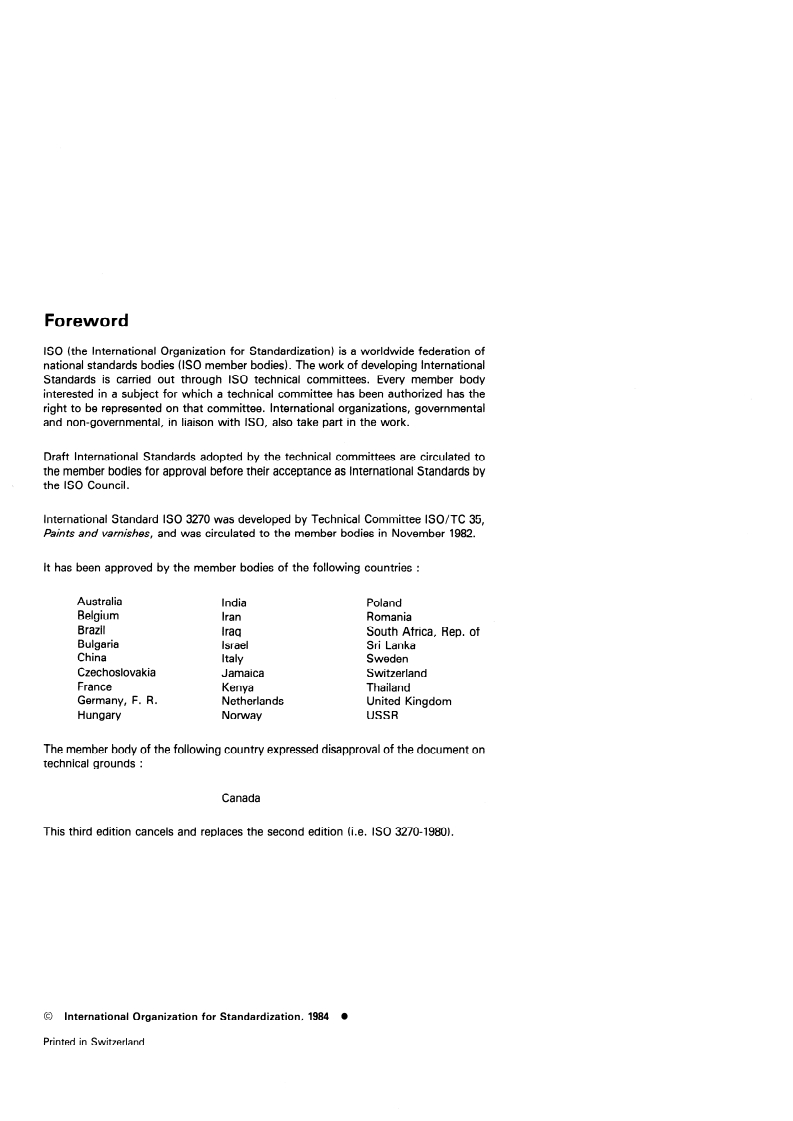
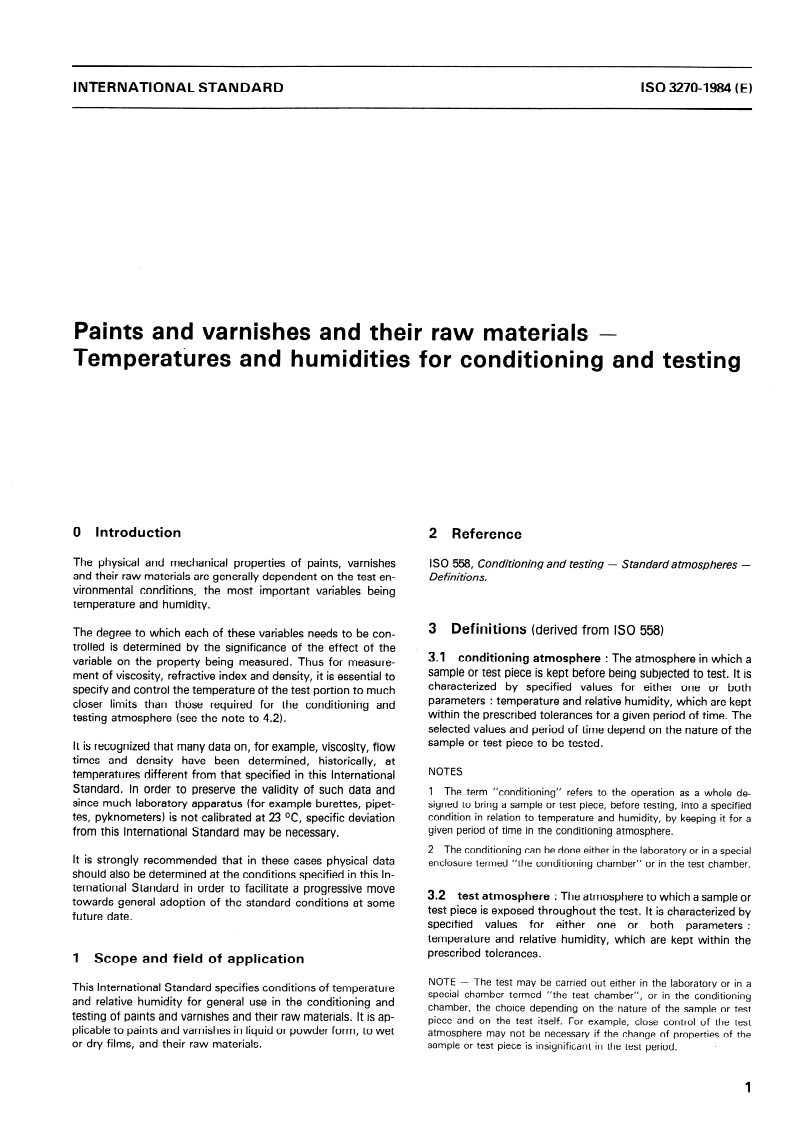
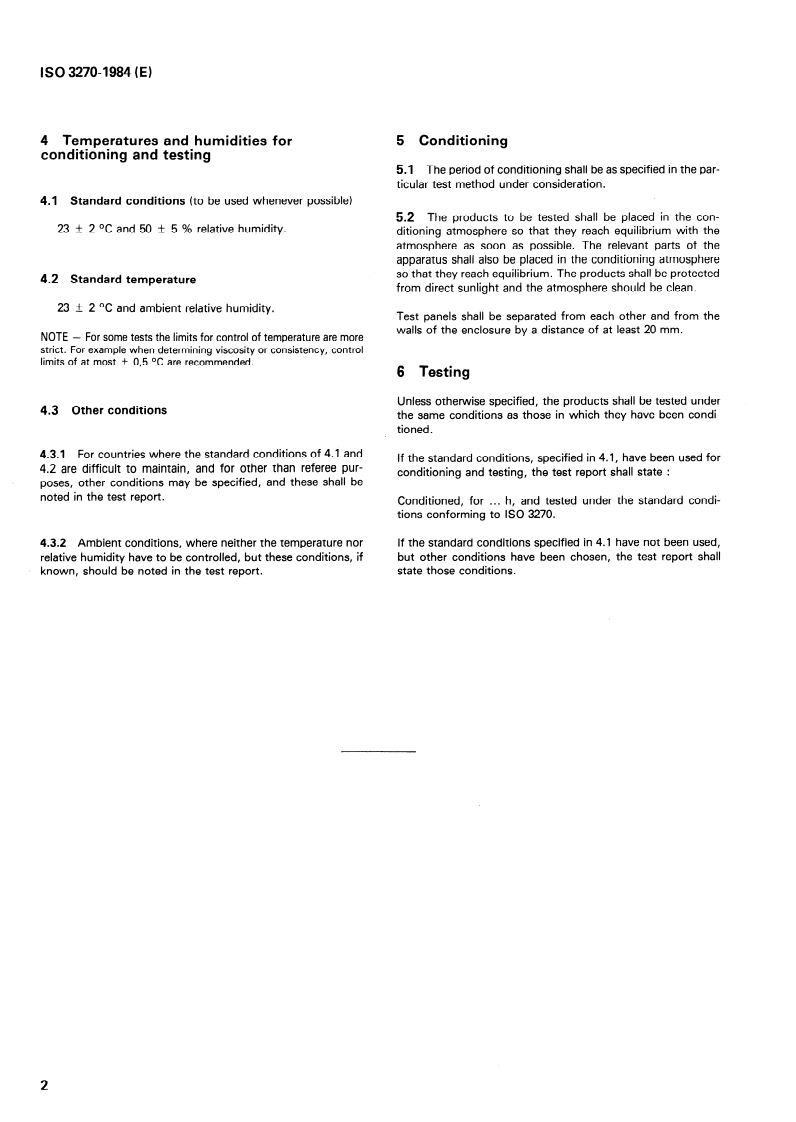
ISO 3270:1984 - Paints and varnishes and their raw materials — Temperatures and humidities for conditioning and testing/1/1984
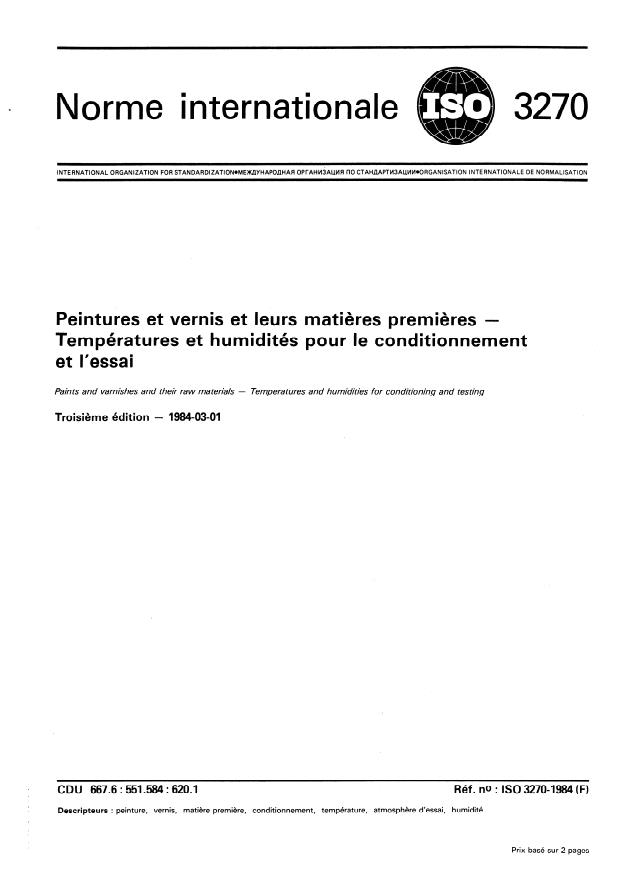

ISO 3270:1984 - Peintures et vernis et leurs matieres premieres -- Températures et humidités pour le conditionnement et l'essai
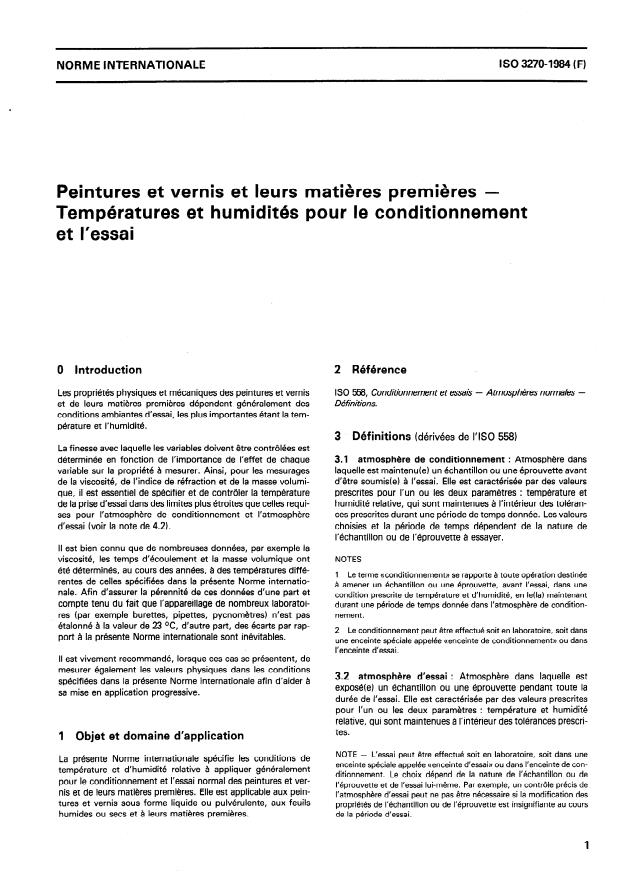

ISO 3270:1984 - Peintures et vernis et leurs matieres premieres -- Températures et humidités pour le conditionnement et l'essai
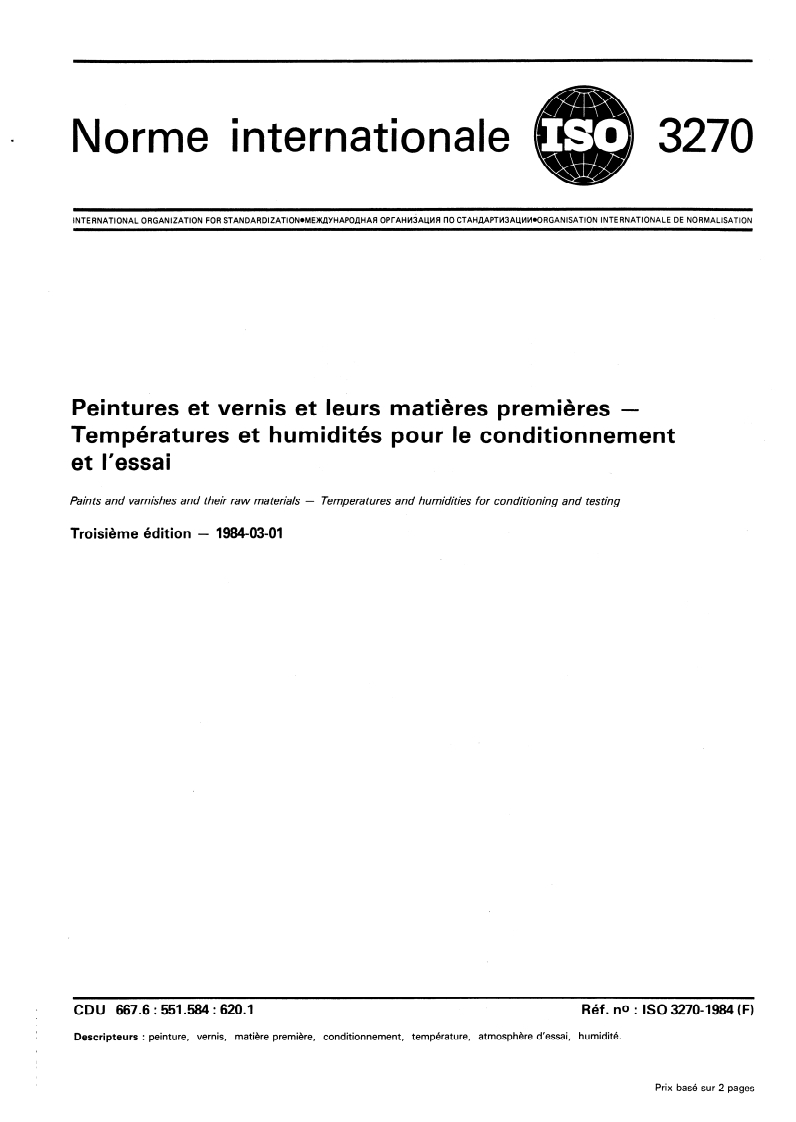
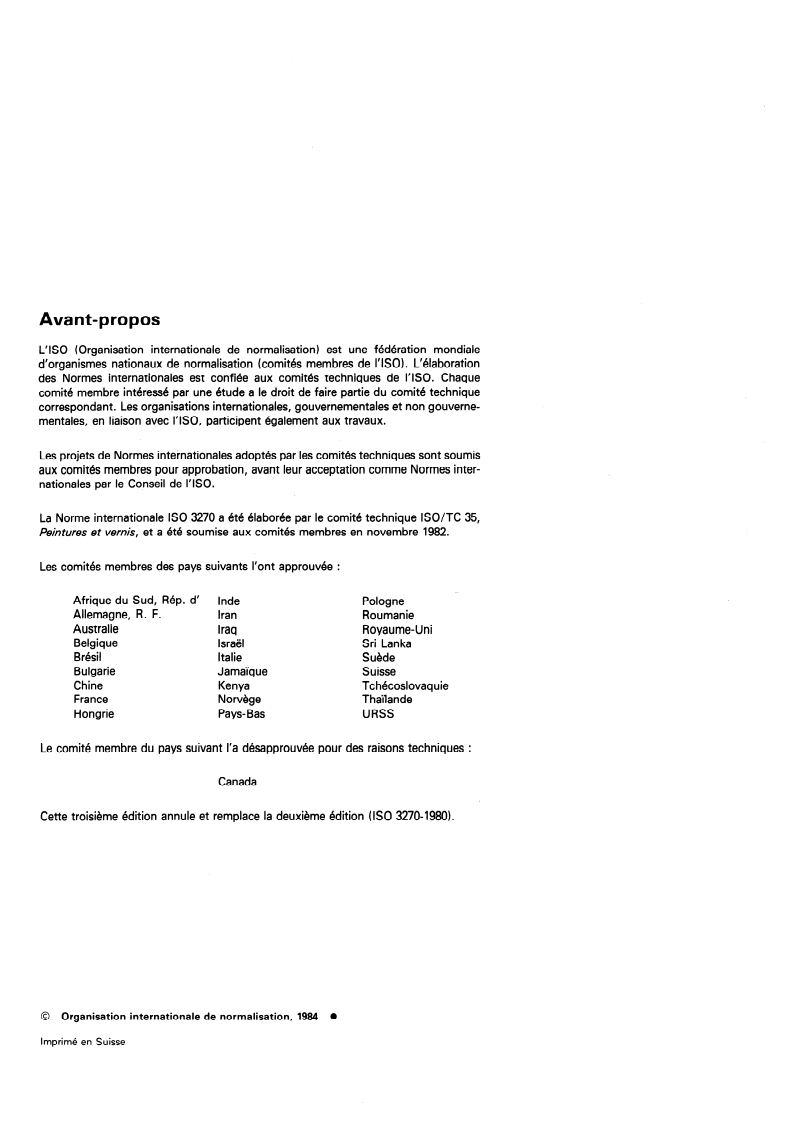
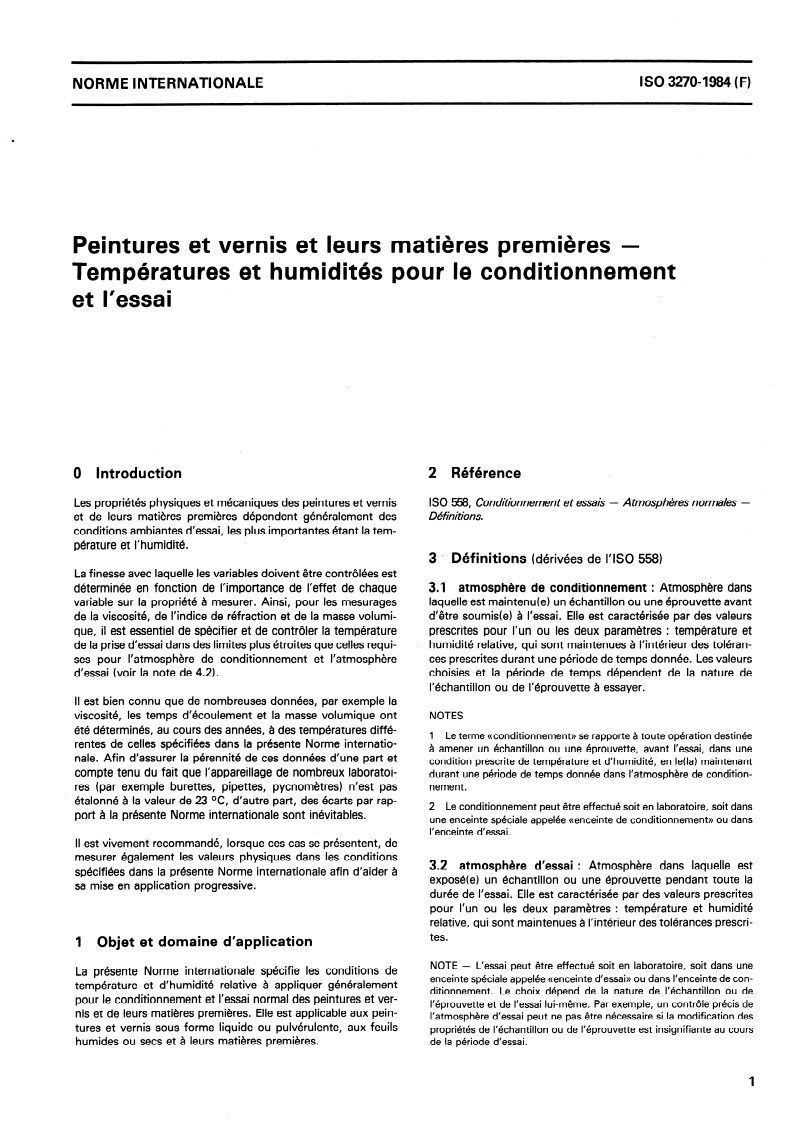
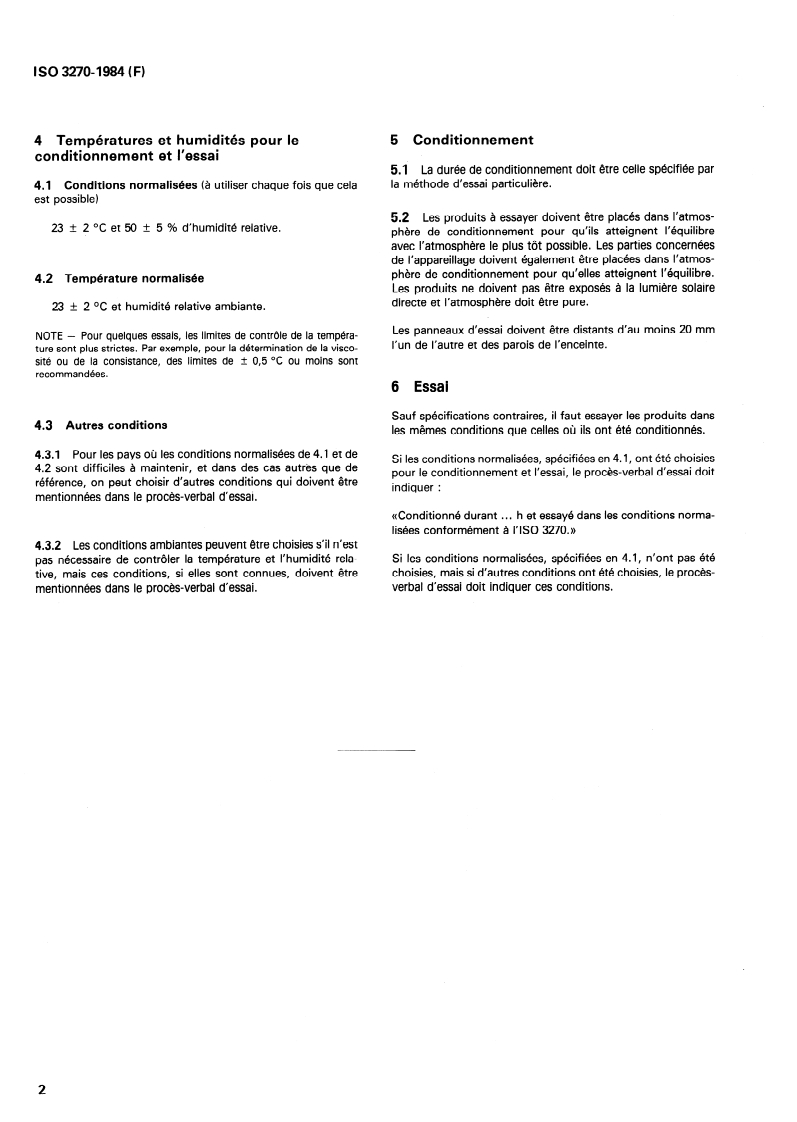
ISO 3270:1984 - Peintures et vernis et leurs matières premières — Températures et humidités pour le conditionnement et l'essai/1/1984
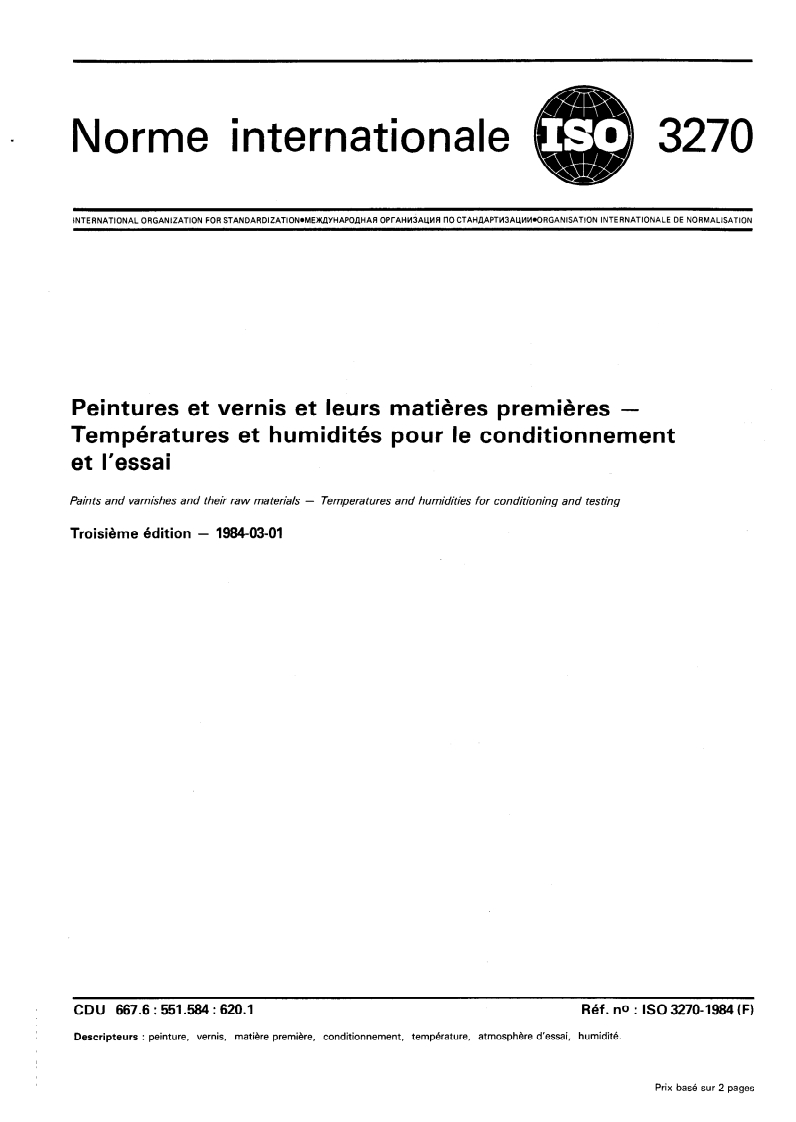
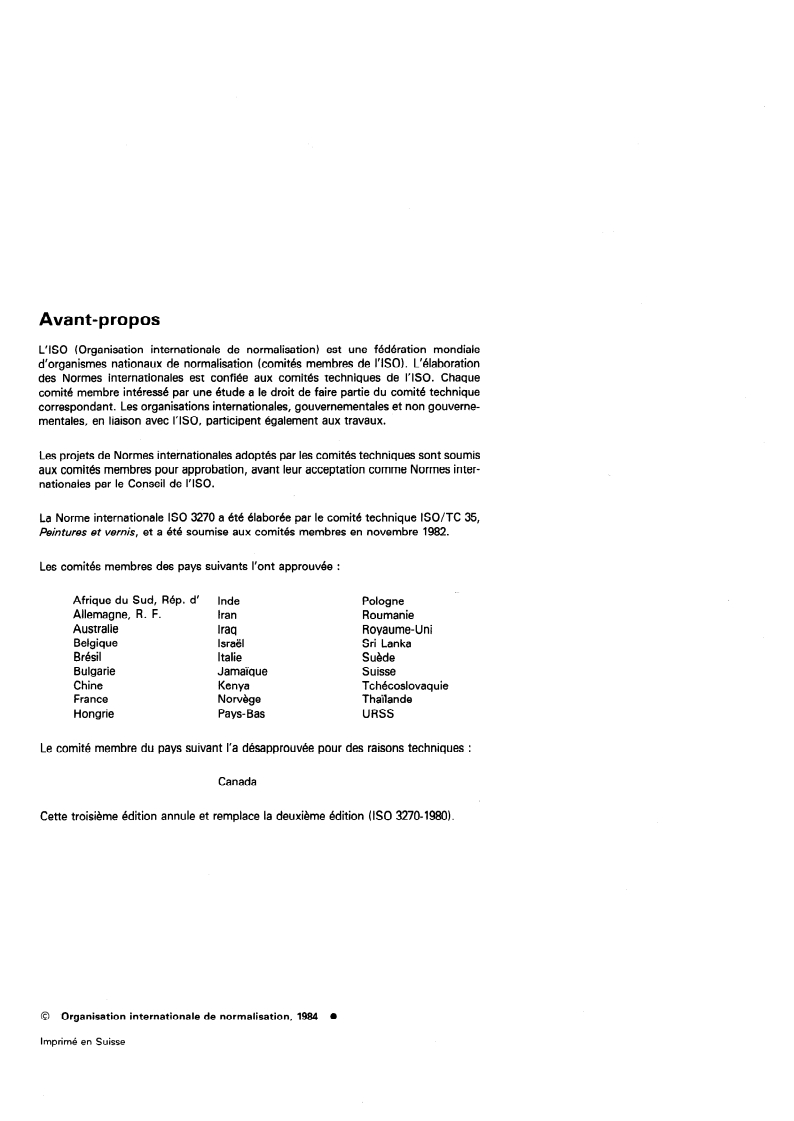
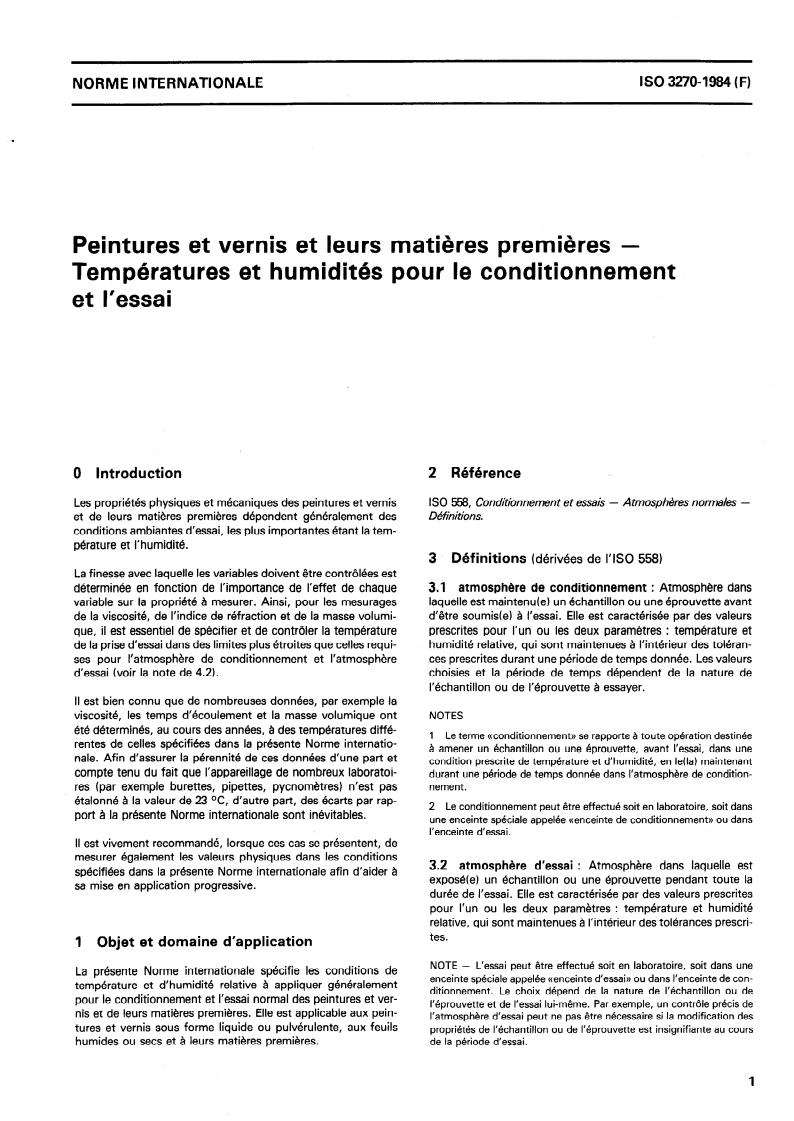
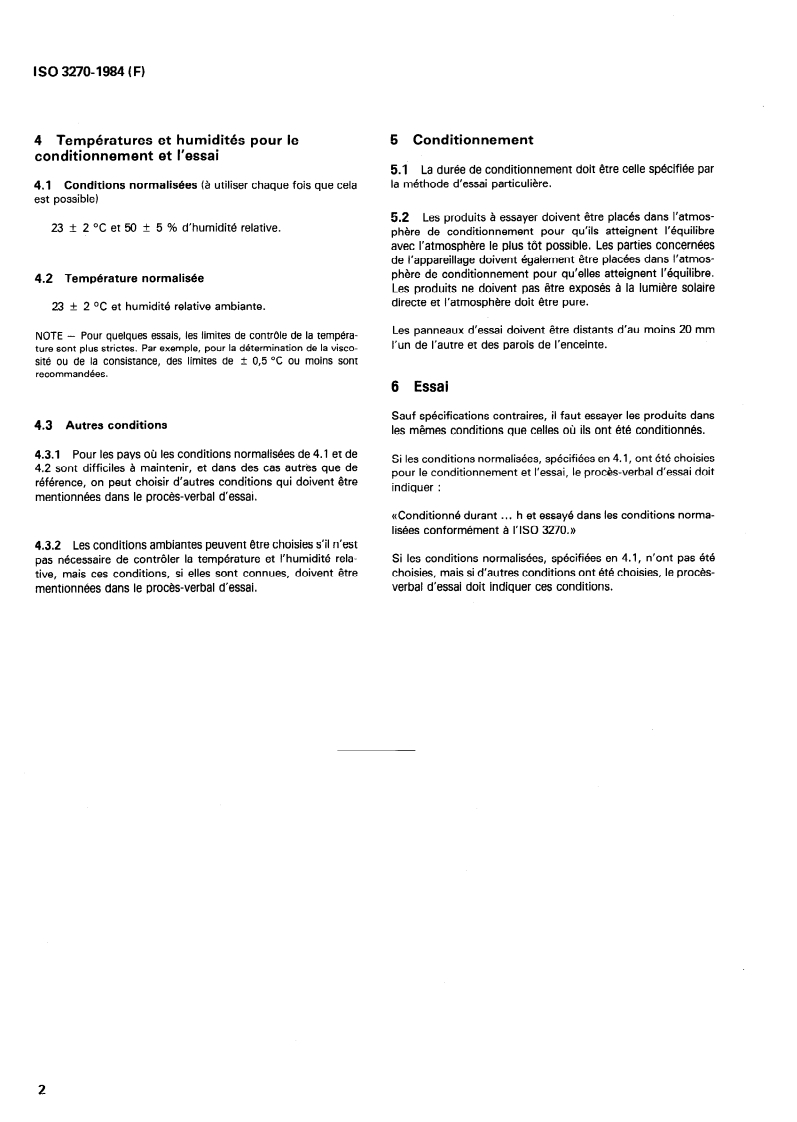
ISO 3270:1984 - Peintures et vernis et leurs matières premières — Températures et humidités pour le conditionnement et l'essai/1/1984
Overview
ISO 3270:1984 sets international requirements for temperatures and humidities used to condition and test paints, varnishes, and their raw materials. Developed by the International Organization for Standardization (ISO), this standard provides a consistent framework to ensure reliable assessment and comparison of coating materials in liquid or powder form, as well as wet or dry films. By defining precise conditioning and test atmospheres, ISO 3270:1984 helps laboratories, manufacturers, and researchers maintain sample integrity and generate dependable results, irrespective of geographic or climatic differences.
Key Topics
- Standard Conditioning Atmosphere: Recommends specific conditions of 23 ± 2°C and 50 ± 5% relative humidity for preparing and equilibrating samples ahead of testing.
- Test Atmosphere: Specifies environmental controls required during the testing process, ensuring consistency with pre-conditioning.
- Applicability: Covers a broad spectrum of coating materials, including paints, varnishes, their raw components, and finished films in both wet and dry states.
- Flexibility in Conditions: Allows for other environmental parameters when standard conditions cannot be maintained or when tests do not require stringent controls.
- Reporting: Mandates documentation of the atmospheric conditions used for both conditioning and testing, especially if there are deviations from the standard prescribed values.
- Sample Handling: Offers guidance on ensuring products and test apparatus reach equilibrium, and recommends protective measures such as exclusion from direct sunlight and clean atmospheres.
Applications
ISO 3270:1984 is widely implemented across industries that produce, test, or apply paints and varnishes. Its guidelines are critical in:
- Quality Control Laboratories: Ensuring that test results are not influenced by variable ambient conditions, improving reliability of paint and varnish performance assessments.
- Product Development: Helping R&D teams standardize testing environments for new paint or coating formulations, enabling meaningful property comparisons.
- Raw Material Evaluation: Guiding suppliers and manufacturers in evaluating properties of resins, pigments, solvents, and additives under controlled conditions.
- Industrial Coating Processes: Assisting in pre-production evaluations, where product consistency, durability, and regulatory compliance require standardized testing.
- Certification and Compliance: Facilitating adherence to international trade and regulatory agreements that demand uniform test atmospheres for coatings.
Related Standards
For comprehensive standardization in the testing of coating materials, consider these related ISO documents:
- ISO 550: Conditioning and Testing - Standard Atmospheres - Definitions. This defines reference atmospheres for lab settings.
- ISO 558: Conditioning and Testing Atmospheres for Standards.
- ISO/TC 35: The technical committee overseeing standards on paints and varnishes, including terminology, testing, and performance criteria.
- Other National and International Standards: Local or regional adaptations may exist, often referencing or aligning with ISO 3270.
Practical Value
Implementing ISO 3270:1984 ensures that paints, varnishes, and their raw materials are evaluated under clearly defined temperature and humidity conditions. The standard minimizes variation due to environmental factors, making test results reproducible and comparable worldwide. This consistency is crucial for manufacturers, researchers, and quality professionals seeking to demonstrate product performance, fulfill certification requirements, and facilitate international trade in coatings and related materials.
Relations
- Effective Date
- 25-Aug-2026
- Effective Date
- 25-Aug-2026
- Effective Date
- 25-Aug-2026
- Effective Date
- 25-Aug-2026
- Effective Date
- 25-Aug-2026
- Effective Date
- 25-Aug-2026
- Effective Date
- 25-Aug-2026
- Effective Date
- 25-Aug-2026
- Effective Date
- 25-Aug-2026
- Effective Date
- 25-Aug-2026
- Effective Date
- 25-Aug-2026
- Effective Date
- 25-Aug-2026
- Effective Date
- 25-Aug-2026
- Effective Date
- 25-Aug-2026
- Effective Date
- 25-Aug-2026
Buy Documents
ISO 3270:1984 - Paints and varnishes and their raw materials -- Temperatures and humidities for conditioning and testing
ISO 3270:1984 - Paints and varnishes and their raw materials — Temperatures and humidities for conditioning and testing/1/1984
ISO 3270:1984 - Peintures et vernis et leurs matieres premieres -- Températures et humidités pour le conditionnement et l'essai
ISO 3270:1984 - Peintures et vernis et leurs matieres premieres -- Températures et humidités pour le conditionnement et l'essai
ISO 3270:1984 - Peintures et vernis et leurs matières premières — Températures et humidités pour le conditionnement et l'essai/1/1984
ISO 3270:1984 - Peintures et vernis et leurs matières premières — Températures et humidités pour le conditionnement et l'essai/1/1984
Frequently Asked Questions
ISO 3270:1984 is a standard published by the International Organization for Standardization (ISO). Its full title is "Paints and varnishes and their raw materials — Temperatures and humidities for conditioning and testing". This standard covers: Specifies conditions of temperature and relative humidity for general use. The test is applicable to coating materials in liquid or powder form, to wet or dry films, and their raw materials. The conditioning atmosphere and the test atmosphere are defined. This third edition cancels and replaces the second edition ISO 3270-1980.
Specifies conditions of temperature and relative humidity for general use. The test is applicable to coating materials in liquid or powder form, to wet or dry films, and their raw materials. The conditioning atmosphere and the test atmosphere are defined. This third edition cancels and replaces the second edition ISO 3270-1980.
ISO 3270:1984 is classified under the following ICS (International Classification for Standards) categories: 87.040 - Paints and varnishes; 87.060.01 - Paint ingredients in general. The ICS classification helps identify the subject area and facilitates finding related standards.
ISO 3270:1984 has the following relationships with other standards: It is inter standard links to EN ISO 11997-2:2025, EN ISO 6270-2:2018, EN 2436-004:2006, EN ISO 7784-1:2023, EN ISO 15710:2006, EN 2435-003:2006, EN 3837:2019, EN ISO 22970:2020, EN ISO 2812-4:2007, EN ISO 11890-1:2007, EN 4688:2012, EN 2435-005:2006, EN ISO 11997-1:2006, EN ISO 15711:2004, EN ISO 6272-1:2011. Understanding these relationships helps ensure you are using the most current and applicable version of the standard.
ISO 3270:1984 is available in PDF format for immediate download after purchase. The document can be added to your cart and obtained through the secure checkout process. Digital delivery ensures instant access to the complete standard document.
Standards Content (Sample)
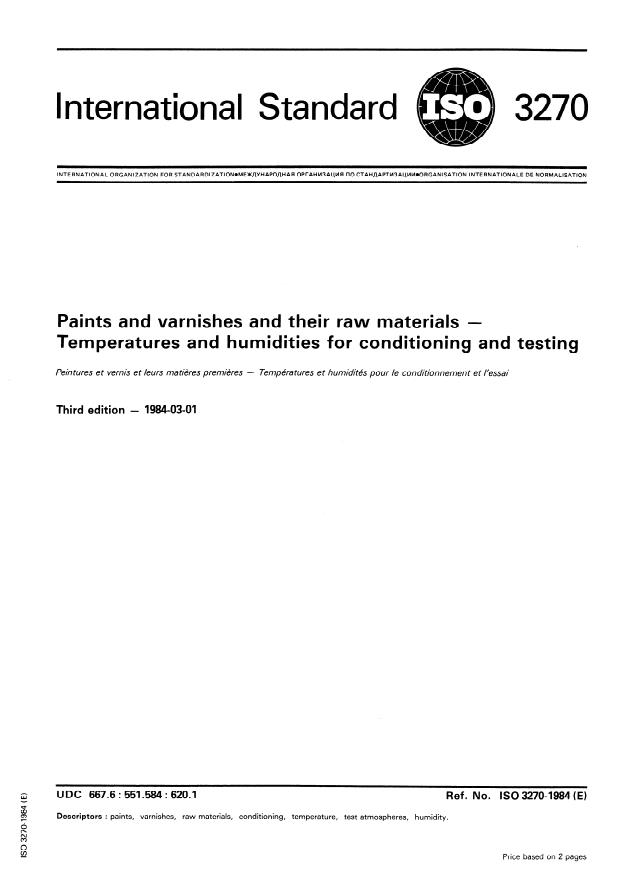
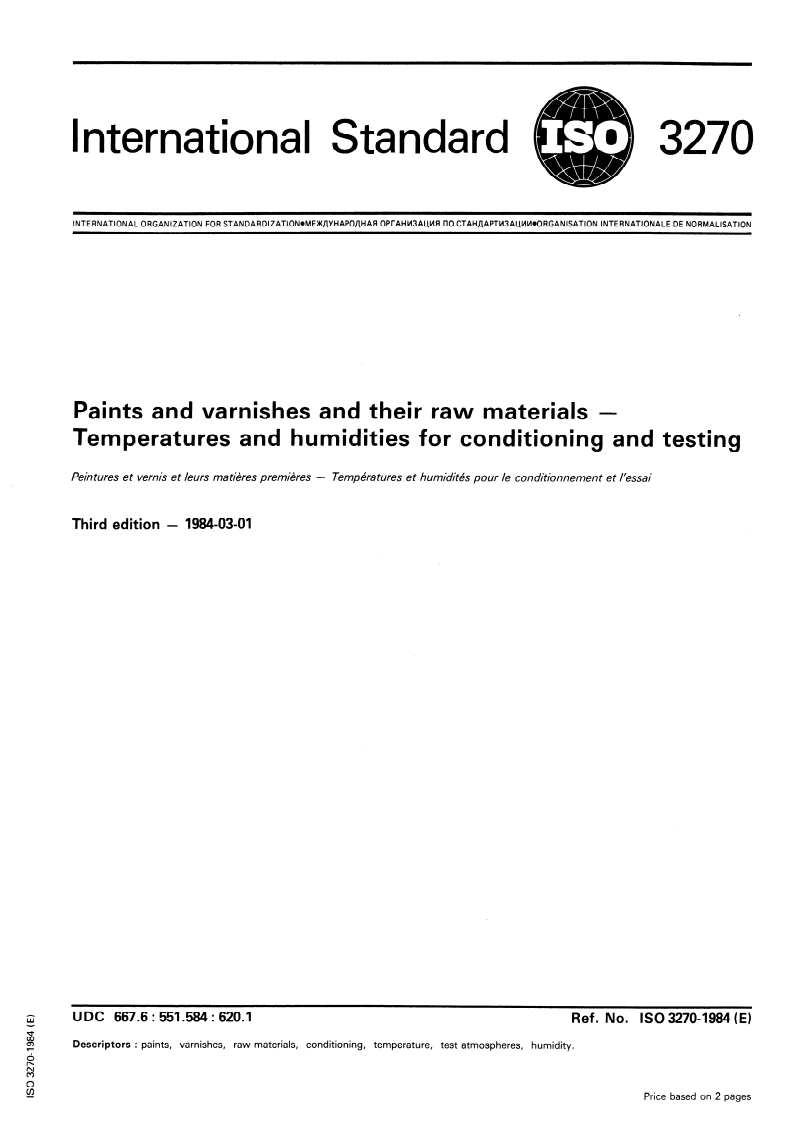
International Standard
INTERNATIONAL ORGANIZATION FOR STANDARDIZATlON.MEXAYHAPOAHAR OPrAHM3Al&lR ilO CTAH~APTM3Al@lM.ORGANlSATlON INTERNATIONALE DE NORMALISATION
Paints and varnishes and their raw materials -
Temperatures and humidities for conditioning and testing
Pein tures et vernis et leurs ma t&es premikres - Temphratures et humidit& pour le conditionnement et l’essai
Third edition - 1984-03-01
UDC 667.6 : 551.584 : 620.1
z Ref. No. IS0 3270-1984 (E)
-
Descriptors : paints, varnishes, raw materials, conditioning, temperature, test atmospheres, humidity.
cn
-
Price based on 2 pages
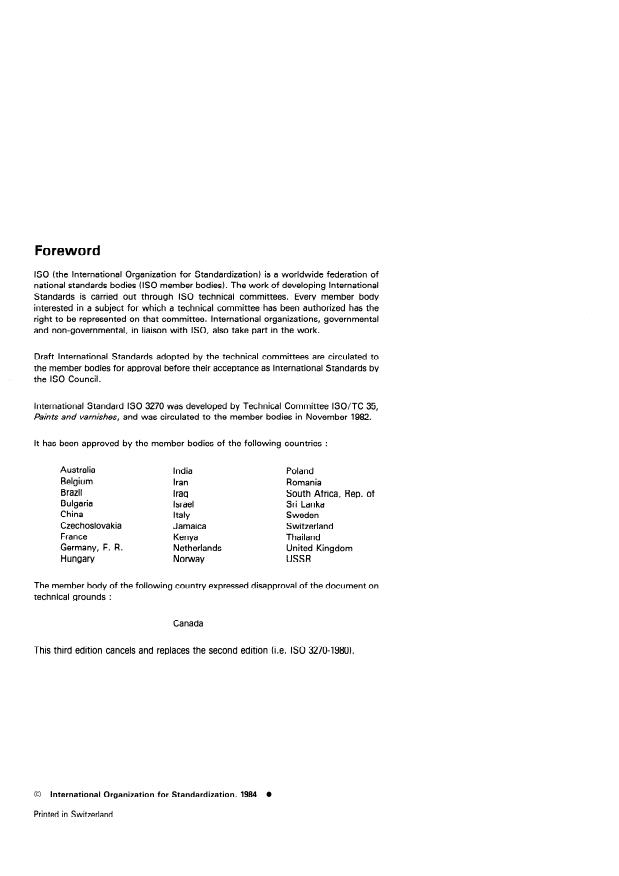
Foreword
IS0 (the International Organization for Standardization) is a worldwide federation of
national standards bodies (IS0 member bodies). The work of developing International
Standards is carried out through IS0 technical committees. Every member body
interested in a subject for which a technical committee has been authorized has the
right to be represented on that committee. International organizations, governmental
and non-governmental, in liaison with ISO, also take part in the work.
Draft International Standards adopted by the technical committees are circulated to
the member bodies for approval before their acceptance as International Standards by
the IS0 Council.
International Standard IS0 3270 was developed by Technical Committee ISO/TC 35,
Paints and varnishes, and was circulated to the member bodies in November 1982.
It has been approved by the member bodies of the following countries :
Australia
India Poland
Belgium
Iran Romania
Brazil
Iraq South Africa, Rep. of
Bulgaria
Israel Sri Lanka
China
Italy Sweden
Czechoslovakia
Jamaica Switzerland
France Kenya Thailand
Germany, F. R.
Netherlands United Kingdom
Hungary Norway USSR
The member body
of the following country expressed disapproval of the document on
technical grounds
Canada
This third edition cancels and replaces the second edition (i.e. IS0 3270-1980).
0 International Organization for Standardization, 1984
Printed in Switzerland
IS0 3270-1984 (E)
INTERNATIONALSTANDARD
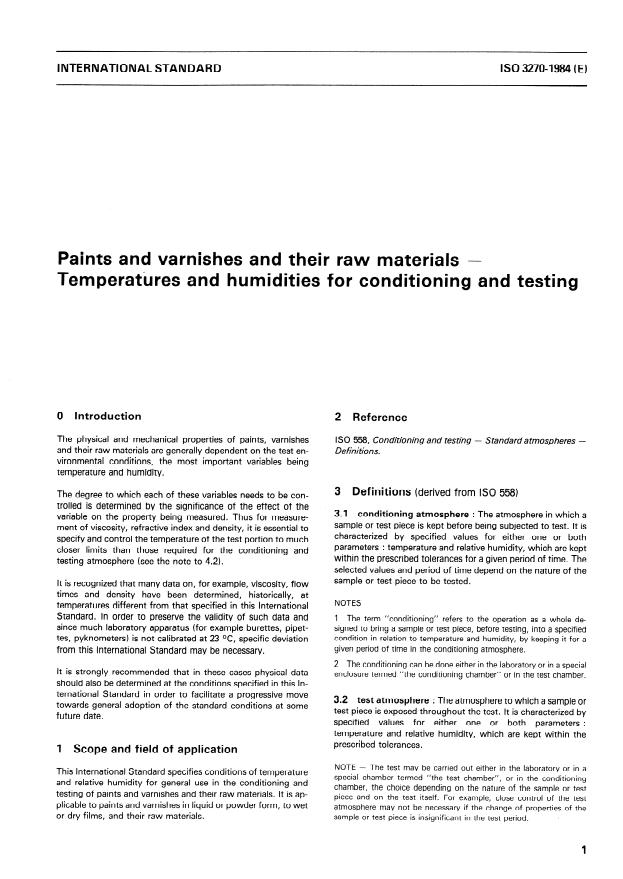
Paints and varnishes and their raw materials -
Temperatures and humidities for conditioning and testing
0 Introduction 2 Reference
The physical and mechanical properties of paints, varnishes IS0 550, Conditioning and testing - Standard atmospheres -
Definitions.
and their raw materials are generally dependent on the test en-
vironmental conditions, the most important variables being
temperature and humidity.
3 Definitions (derived from IS0 558)
The degree to which each of these variables needs to be con-
trolled is determined by the significance of the effect of the
3.1 conditioning atmosphere : The atmosphere in which a
variable on the property being measured. Thus for measure-
sample or test piece is kept before being subjected to test. It is
ment of viscosity, refractive index and density, it is essential to
characterized by specified values for either one or both
specify and control the temperature of the test portion to much
parameters : temperature and relative humidity, which are kept
closer limits than those required for the conditioning and
within the prescribed tolerances for a given period of time. The
testing atmosphere (see the note to 4.2).
selected values and period of time depend on the nature of the
sample or test piece to be tested.
It is recognized that many data on, for example, viscosity, flow
times and density have been determined, historically, at
NOTES
temperatures different from that specified in this International
Standard. In order to preserve the validity of such data and
1 The term “conditioning” refers to the operation as a whole de-
since much lab
...
International Standard
INTERNATIONAL ORGANIZATION FOR STANDARDIZATlON.MEXAYHAPOAHAR OPrAHM3Al&lR ilO CTAH~APTM3Al@lM.ORGANlSATlON INTERNATIONALE DE NORMALISATION
Paints and varnishes and their raw materials -
Temperatures and humidities for conditioning and testing
Pein tures et vernis et leurs ma t&es premikres - Temphratures et humidit& pour le conditionnement et l’essai
Third edition - 1984-03-01
UDC 667.6 : 551.584 : 620.1
z Ref. No. IS0 3270-1984 (E)
-
Descriptors : paints, varnishes, raw materials, conditioning, temperature, test atmospheres, humidity.
cn
-
Price based on 2 pages
Foreword
IS0 (the International Organization for Standardization) is a worldwide federation of
national standards bodies (IS0 member bodies). The work of developing International
Standards is carried out through IS0 technical committees. Every member body
interested in a subject for which a technical committee has been authorized has the
right to be represented on that committee. International organizations, governmental
and non-governmental, in liaison with ISO, also take part in the work.
Draft International Standards adopted by the technical committees are circulated to
the member bodies for approval before their acceptance as International Standards by
the IS0 Council.
International Standard IS0 3270 was developed by Technical Committee ISO/TC 35,
Paints and varnishes, and was circulated to the member bodies in November 1982.
It has been approved by the member bodies of the following countries :
Australia
India Poland
Belgium
Iran Romania
Brazil
Iraq South Africa, Rep. of
Bulgaria
Israel Sri Lanka
China
Italy Sweden
Czechoslovakia
Jamaica Switzerland
France Kenya Thailand
Germany, F. R.
Netherlands United Kingdom
Hungary Norway USSR
The member body
of the following country expressed disapproval of the document on
technical grounds
Canada
This third edition cancels and replaces the second edition (i.e. IS0 3270-1980).
0 International Organization for Standardization, 1984
Printed in Switzerland
IS0 3270-1984 (E)
INTERNATIONALSTANDARD
Paints and varnishes and their raw materials -
Temperatures and humidities for conditioning and testing
0 Introduction 2 Reference
The physical and mechanical properties of paints, varnishes IS0 550, Conditioning and testing - Standard atmospheres -
Definitions.
and their raw materials are generally dependent on the test en-
vironmental conditions, the most important variables being
temperature and humidity.
3 Definitions (derived from IS0 558)
The degree to which each of these variables needs to be con-
trolled is determined by the significance of the effect of the
3.1 conditioning atmosphere : The atmosphere in which a
variable on the property being measured. Thus for measure-
sample or test piece is kept before being subjected to test. It is
ment of viscosity, refractive index and density, it is essential to
characterized by specified values for either one or both
specify and control the temperature of the test portion to much
parameters : temperature and relative humidity, which are kept
closer limits than those required for the conditioning and
within the prescribed tolerances for a given period of time. The
testing atmosphere (see the note to 4.2).
selected values and period of time depend on the nature of the
sample or test piece to be tested.
It is recognized that many data on, for example, viscosity, flow
times and density have been determined, historically, at
NOTES
temperatures different from that specified in this International
Standard. In order to preserve the validity of such data and
1 The term “conditioning” refers to the operation as a whole de-
since much lab
...
Norme internationale
INTERNATIONAL ORGANIZATION FOR STANDARDIZATION.MEIKAYHAPOAHAR OPTAHMiALWlR fl0 CTAH~APTl43ALWWWORGANISATlON INTERNATIONALE DE NORMALISATION
Peintures et vernis et leurs matières premières -
Températures et humidités pour le conditionnement
et l’essai
Paints and vamishes and their raw materials - Tempera turcs and humidities for conditioning and tes ting
Troisième édition - 1984-03-01
Réf. no : ISO 32704984 (F)
CDU 667.6 : 551.584 : 620.1
Descripteurs : peinture, vernis, matiére premiére, conditionnement, température, atmosphère d’essai, humidité.
Prix basé sur 2 pages
Avant-propos
L’ISO (Organisation internationale de normalisation) est une fédération mondiale
d’organismes nationaux de normalisation (comités membres de I’ISO). L’élaboration
des Normes internationales est confiée aux comités techniques de I’ISO. Chaque
comité membre intéresse par une étude a le droit de faire partie du comité technique
correspondant. Les organisations internationales, gouvernementales et non gouverne-
mentales, en liaison avec I’ISO, participent également aux travaux.
Les projets de Normes internationales adoptés par les comités techniques sont soumis
aux comités membres pour approbation, avant leur acceptation comme Normes inter-
nationales par le Conseil de I’ISO.
La Norme internationale ISO 3270 a été élaborée par le comité technique ISO/TC 35,
Peintures et vernis, et a été soumise aux comités membres en novembre 1982.
Les comités membres des pays suivants l’ont approuvée :
Afrique du Sud, Rép. d’
Inde Pologne
Allemagne, R. F.
Iran Roumanie
Australie Iraq Royaume-Uni
Belgique
Israël Sri Lanka
Brésil Italie Suéde
Bulgarie Jamaïque Suisse
Chine Kenya Tchécoslovaquie
France Norvége Thailande
Hongrie Pays- Bas URSS
Le comité membre du pays suivant l’a désapprouvée pour des raisons techniques :
Canada
Cette troisieme édition annule et remplace la deuxiéme édition (ISO 3270-1980).
Organisation internationale de normalisation, 1984
Imprimé en Suisse
ISO 32704984 (F)
NORME INTERNATIONALE
Peintures et vernis et leurs matières premières -
Températures et humidités pour le conditionnement
et l’essai
2 Référence
0 Introduction
Les propriétés physiques et mécaniques des peintures et vernis ISO 558, Conditionnement et essais - Atmosphères normales -
Définitions.
et de leurs matiéres premières dépendent généralement des
conditions ambiantes d’essai, les plus importantes étant la tem-
pérature et l’humidité.
3 Définitions (dérivées de I’ISO 558)
La finesse avec laquelle les variables doivent être contrôlées est
3.1 atmosphère de conditionnement : Atmosphére dans
déterminée en fonction de l’importance de l’effet de chaque
variable sur la propriété à mesurer. Ainsi, pour les mesurages laquelle est maintenu(e) un échantillon ou une éprouvette avant
d’être soumis(e) à l’essai. Elle est caractérisée par des valeurs
de la viscosité, de l’indice de réfraction et de la masse volumi-
que, il est essentiel de spécifier et de contrôler la température prescrites pour l’un ou les deux paramètres : température et
humidité relative, qui sont maintenues à l’intérieur des toléran-
de la prise d’essai dans des limites plus étroites que celles requi-
ses pour l’atmosphère de conditionnement et l’atmosphère ces prescrites durant une période de temps donnée. Les valeurs
d’essai (voir la note de 4.2). choisies et la période de temps dépendent de la nature de
l’échantillon ou de l’éprouvette à essayer.
II est bien connu que de nombreuses données, par exemple la
viscosité, les temps d’écoulement et la masse volumique ont NOTES
été déterminés, au cours des années, à des températures diffé-
1 Le terme «conditionnement)) se rapporte à toute opération destinée
rentes de celles spécifiées dans la présente Norme internatio-
à amener un échantillon ou une éprouvette, avant l’essai, dans une
nale. Afin d’assurer la pérennité de ces données d’une part et
condition prescrite de température et d’humidité, en le(la) maintenant
compte tenu du fait que l’appareil
...
Norme internationale
INTERNATIONAL ORGANIZATION FOR STANDARDIZATION.MEIKAYHAPOAHAR OPTAHMiALWlR fl0 CTAH~APTl43ALWWWORGANISATlON INTERNATIONALE DE NORMALISATION
Peintures et vernis et leurs matières premières -
Températures et humidités pour le conditionnement
et l’essai
Paints and vamishes and their raw materials - Tempera turcs and humidities for conditioning and tes ting
Troisième édition - 1984-03-01
Réf. no : ISO 32704984 (F)
CDU 667.6 : 551.584 : 620.1
Descripteurs : peinture, vernis, matiére premiére, conditionnement, température, atmosphère d’essai, humidité.
Prix basé sur 2 pages
Avant-propos
L’ISO (Organisation internationale de normalisation) est une fédération mondiale
d’organismes nationaux de normalisation (comités membres de I’ISO). L’élaboration
des Normes internationales est confiée aux comités techniques de I’ISO. Chaque
comité membre intéresse par une étude a le droit de faire partie du comité technique
correspondant. Les organisations internationales, gouvernementales et non gouverne-
mentales, en liaison avec I’ISO, participent également aux travaux.
Les projets de Normes internationales adoptés par les comités techniques sont soumis
aux comités membres pour approbation, avant leur acceptation comme Normes inter-
nationales par le Conseil de I’ISO.
La Norme internationale ISO 3270 a été élaborée par le comité technique ISO/TC 35,
Peintures et vernis, et a été soumise aux comités membres en novembre 1982.
Les comités membres des pays suivants l’ont approuvée :
Afrique du Sud, Rép. d’
Inde Pologne
Allemagne, R. F.
Iran Roumanie
Australie Iraq Royaume-Uni
Belgique
Israël Sri Lanka
Brésil Italie Suéde
Bulgarie Jamaïque Suisse
Chine Kenya Tchécoslovaquie
France Norvége Thailande
Hongrie Pays- Bas URSS
Le comité membre du pays suivant l’a désapprouvée pour des raisons techniques :
Canada
Cette troisieme édition annule et remplace la deuxiéme édition (ISO 3270-1980).
Organisation internationale de normalisation, 1984
Imprimé en Suisse
ISO 32704984 (F)
NORME INTERNATIONALE
Peintures et vernis et leurs matières premières -
Températures et humidités pour le conditionnement
et l’essai
2 Référence
0 Introduction
Les propriétés physiques et mécaniques des peintures et vernis ISO 558, Conditionnement et essais - Atmosphères normales -
Définitions.
et de leurs matiéres premières dépendent généralement des
conditions ambiantes d’essai, les plus importantes étant la tem-
pérature et l’humidité.
3 Définitions (dérivées de I’ISO 558)
La finesse avec laquelle les variables doivent être contrôlées est
3.1 atmosphère de conditionnement : Atmosphére dans
déterminée en fonction de l’importance de l’effet de chaque
variable sur la propriété à mesurer. Ainsi, pour les mesurages laquelle est maintenu(e) un échantillon ou une éprouvette avant
d’être soumis(e) à l’essai. Elle est caractérisée par des valeurs
de la viscosité, de l’indice de réfraction et de la masse volumi-
que, il est essentiel de spécifier et de contrôler la température prescrites pour l’un ou les deux paramètres : température et
humidité relative, qui sont maintenues à l’intérieur des toléran-
de la prise d’essai dans des limites plus étroites que celles requi-
ses pour l’atmosphère de conditionnement et l’atmosphère ces prescrites durant une période de temps donnée. Les valeurs
d’essai (voir la note de 4.2). choisies et la période de temps dépendent de la nature de
l’échantillon ou de l’éprouvette à essayer.
II est bien connu que de nombreuses données, par exemple la
viscosité, les temps d’écoulement et la masse volumique ont NOTES
été déterminés, au cours des années, à des températures diffé-
1 Le terme «conditionnement)) se rapporte à toute opération destinée
rentes de celles spécifiées dans la présente Norme internatio-
à amener un échantillon ou une éprouvette, avant l’essai, dans une
nale. Afin d’assurer la pérennité de ces données d’une part et
condition prescrite de température et d’humidité, en le(la) maintenant
compte tenu du fait que l’appareil
...
Norme internationale
INTERNATIONAL ORGANIZATION FOR STANDARDIZATION.MEIKAYHAPOAHAR OPTAHMiALWlR fl0 CTAH~APTl43ALWWWORGANISATlON INTERNATIONALE DE NORMALISATION
Peintures et vernis et leurs matières premières -
Températures et humidités pour le conditionnement
et l’essai
Paints and vamishes and their raw materials - Tempera turcs and humidities for conditioning and tes ting
Troisième édition - 1984-03-01
Réf. no : ISO 32704984 (F)
CDU 667.6 : 551.584 : 620.1
Descripteurs : peinture, vernis, matiére premiére, conditionnement, température, atmosphère d’essai, humidité.
Prix basé sur 2 pages
Avant-propos
L’ISO (Organisation internationale de normalisation) est une fédération mondiale
d’organismes nationaux de normalisation (comités membres de I’ISO). L’élaboration
des Normes internationales est confiée aux comités techniques de I’ISO. Chaque
comité membre intéresse par une étude a le droit de faire partie du comité technique
correspondant. Les organisations internationales, gouvernementales et non gouverne-
mentales, en liaison avec I’ISO, participent également aux travaux.
Les projets de Normes internationales adoptés par les comités techniques sont soumis
aux comités membres pour approbation, avant leur acceptation comme Normes inter-
nationales par le Conseil de I’ISO.
La Norme internationale ISO 3270 a été élaborée par le comité technique ISO/TC 35,
Peintures et vernis, et a été soumise aux comités membres en novembre 1982.
Les comités membres des pays suivants l’ont approuvée :
Afrique du Sud, Rép. d’
Inde Pologne
Allemagne, R. F.
Iran Roumanie
Australie Iraq Royaume-Uni
Belgique
Israël Sri Lanka
Brésil Italie Suéde
Bulgarie Jamaïque Suisse
Chine Kenya Tchécoslovaquie
France Norvége Thailande
Hongrie Pays- Bas URSS
Le comité membre du pays suivant l’a désapprouvée pour des raisons techniques :
Canada
Cette troisieme édition annule et remplace la deuxiéme édition (ISO 3270-1980).
Organisation internationale de normalisation, 1984
Imprimé en Suisse
ISO 32704984 (F)
NORME INTERNATIONALE
Peintures et vernis et leurs matières premières -
Températures et humidités pour le conditionnement
et l’essai
2 Référence
0 Introduction
Les propriétés physiques et mécaniques des peintures et vernis ISO 558, Conditionnement et essais - Atmosphères normales -
Définitions.
et de leurs matiéres premières dépendent généralement des
conditions ambiantes d’essai, les plus importantes étant la tem-
pérature et l’humidité.
3 Définitions (dérivées de I’ISO 558)
La finesse avec laquelle les variables doivent être contrôlées est
3.1 atmosphère de conditionnement : Atmosphére dans
déterminée en fonction de l’importance de l’effet de chaque
variable sur la propriété à mesurer. Ainsi, pour les mesurages laquelle est maintenu(e) un échantillon ou une éprouvette avant
d’être soumis(e) à l’essai. Elle est caractérisée par des valeurs
de la viscosité, de l’indice de réfraction et de la masse volumi-
que, il est essentiel de spécifier et de contrôler la température prescrites pour l’un ou les deux paramètres : température et
humidité relative, qui sont maintenues à l’intérieur des toléran-
de la prise d’essai dans des limites plus étroites que celles requi-
ses pour l’atmosphère de conditionnement et l’atmosphère ces prescrites durant une période de temps donnée. Les valeurs
d’essai (voir la note de 4.2). choisies et la période de temps dépendent de la nature de
l’échantillon ou de l’éprouvette à essayer.
II est bien connu que de nombreuses données, par exemple la
viscosité, les temps d’écoulement et la masse volumique ont NOTES
été déterminés, au cours des années, à des températures diffé-
1 Le terme «conditionnement)) se rapporte à toute opération destinée
rentes de celles spécifiées dans la présente Norme internatio-
à amener un échantillon ou une éprouvette, avant l’essai, dans une
nale. Afin d’assurer la pérennité de ces données d’une part et
condition prescrite de température et d’humidité, en le(la) maintenant
compte tenu du fait que l’appareil
...
Norme internationale
INTERNATIONAL ORGANIZATION FOR STANDARDIZATION.MEIKAYHAPOAHAR OPTAHMiALWlR fl0 CTAH~APTl43ALWWWORGANISATlON INTERNATIONALE DE NORMALISATION
Peintures et vernis et leurs matières premières -
Températures et humidités pour le conditionnement
et l’essai
Paints and vamishes and their raw materials - Tempera turcs and humidities for conditioning and tes ting
Troisième édition - 1984-03-01
Réf. no : ISO 32704984 (F)
CDU 667.6 : 551.584 : 620.1
Descripteurs : peinture, vernis, matiére premiére, conditionnement, température, atmosphère d’essai, humidité.
Prix basé sur 2 pages
Avant-propos
L’ISO (Organisation internationale de normalisation) est une fédération mondiale
d’organismes nationaux de normalisation (comités membres de I’ISO). L’élaboration
des Normes internationales est confiée aux comités techniques de I’ISO. Chaque
comité membre intéresse par une étude a le droit de faire partie du comité technique
correspondant. Les organisations internationales, gouvernementales et non gouverne-
mentales, en liaison avec I’ISO, participent également aux travaux.
Les projets de Normes internationales adoptés par les comités techniques sont soumis
aux comités membres pour approbation, avant leur acceptation comme Normes inter-
nationales par le Conseil de I’ISO.
La Norme internationale ISO 3270 a été élaborée par le comité technique ISO/TC 35,
Peintures et vernis, et a été soumise aux comités membres en novembre 1982.
Les comités membres des pays suivants l’ont approuvée :
Afrique du Sud, Rép. d’
Inde Pologne
Allemagne, R. F.
Iran Roumanie
Australie Iraq Royaume-Uni
Belgique
Israël Sri Lanka
Brésil Italie Suéde
Bulgarie Jamaïque Suisse
Chine Kenya Tchécoslovaquie
France Norvége Thailande
Hongrie Pays- Bas URSS
Le comité membre du pays suivant l’a désapprouvée pour des raisons techniques :
Canada
Cette troisieme édition annule et remplace la deuxiéme édition (ISO 3270-1980).
Organisation internationale de normalisation, 1984
Imprimé en Suisse
ISO 32704984 (F)
NORME INTERNATIONALE
Peintures et vernis et leurs matières premières -
Températures et humidités pour le conditionnement
et l’essai
2 Référence
0 Introduction
Les propriétés physiques et mécaniques des peintures et vernis ISO 558, Conditionnement et essais - Atmosphères normales -
Définitions.
et de leurs matiéres premières dépendent généralement des
conditions ambiantes d’essai, les plus importantes étant la tem-
pérature et l’humidité.
3 Définitions (dérivées de I’ISO 558)
La finesse avec laquelle les variables doivent être contrôlées est
3.1 atmosphère de conditionnement : Atmosphére dans
déterminée en fonction de l’importance de l’effet de chaque
variable sur la propriété à mesurer. Ainsi, pour les mesurages laquelle est maintenu(e) un échantillon ou une éprouvette avant
d’être soumis(e) à l’essai. Elle est caractérisée par des valeurs
de la viscosité, de l’indice de réfraction et de la masse volumi-
que, il est essentiel de spécifier et de contrôler la température prescrites pour l’un ou les deux paramètres : température et
humidité relative, qui sont maintenues à l’intérieur des toléran-
de la prise d’essai dans des limites plus étroites que celles requi-
ses pour l’atmosphère de conditionnement et l’atmosphère ces prescrites durant une période de temps donnée. Les valeurs
d’essai (voir la note de 4.2). choisies et la période de temps dépendent de la nature de
l’échantillon ou de l’éprouvette à essayer.
II est bien connu que de nombreuses données, par exemple la
viscosité, les temps d’écoulement et la masse volumique ont NOTES
été déterminés, au cours des années, à des températures diffé-
1 Le terme «conditionnement)) se rapporte à toute opération destinée
rentes de celles spécifiées dans la présente Norme internatio-
à amener un échantillon ou une éprouvette, avant l’essai, dans une
nale. Afin d’assurer la pérennité de ces données d’une part et
condition prescrite de température et d’humidité, en le(la) maintenant
compte tenu du fait que l’appareil
...