


ISO/FDIS 28399
(Main)Dentistry — External tooth bleaching products
Dentistry — External tooth bleaching products
This document specifies the requirements and test methods for external tooth bleaching products. These products are intended for use in the oral cavity, either by professional application (in-office tooth bleaching products) or consumer application (professional or non-professional home use of tooth bleaching products), or both. It also specifies requirements for their packaging, labelling and manufacturer's instructions for use. This document is not applicable to tooth bleaching products: — specified in ISO 11609; — intended to change colour perception of natural teeth by mechanical methods (e.g. stain removal) or using restorative approaches, such as veneers or crowns; — auxiliary or supplementary materials (e.g. tray materials) and instruments or devices (e.g. lights) that are used in conjunction with the bleaching products. This document does not specify biological safety aspects of tooth bleaching products. NOTE Maximum concentration of a bleaching agent for professional or non-professional use is subject to each country's regulatory body.
Médecine bucco-dentaire — Produits d'éclaircissement dentaire par voie externe
Le présent document spécifie les exigences et les méthodes d'essai relatives aux produits d'éclaircissement dentaire par voie externe destinés à être utilisés dans la cavité buccale, soit pour un usage professionnel (produits d'éclaircissement dentaire prévus pour une utilisation au cabinet dentaire) soit pour une application directe par le consommateur à domicile (produits d'éclaircissement dentaire pour un usage professionnel ou non professionnel à domicile). Il spécifie également les exigences relatives à l'emballage, à l'étiquetage et à la notice d'utilisation du fabricant. Le présent document ne s'applique pas aux produits d'éclaircissement dentaire suivants: — les produits spécifiés dans l'ISO 11609; — les produits destinés à modifier la perception de la teinte des dents naturelles, soit par des moyens mécaniques (par exemple l'élimination des taches), soit à l'aide de techniques de restauration telles que les facettes prothétiques ou les couronnes; — les produits auxiliaires ou complémentaires (par exemple les porte-empreintes) et les instruments ou dispositifs (par exemple les sources de lumière) qui sont utilisés conjointement avec les produits d'éclaircissement. Le présent document ne spécifie pas les aspects relatifs à la sécurité biologique des produits d'éclaircissement dentaire. NOTE La concentration maximale d'agent d'éclaircissement dentaire à usage professionnel ou non professionnel est fixée par l'organisme de réglementation de chaque pays.
General Information
- Status
- Not Published
- Technical Committee
- ISO/TC 106/SC 7 - Oral care products
- Drafting Committee
- ISO/TC 106/SC 7/WG 7 - Dental Bleaching Products
- Current Stage
- 5020 - FDIS ballot initiated: 2 months. Proof sent to secretariat
- Start Date
- 03-Jun-2026
- Completion Date
- 03-Jun-2026
Buy Documents
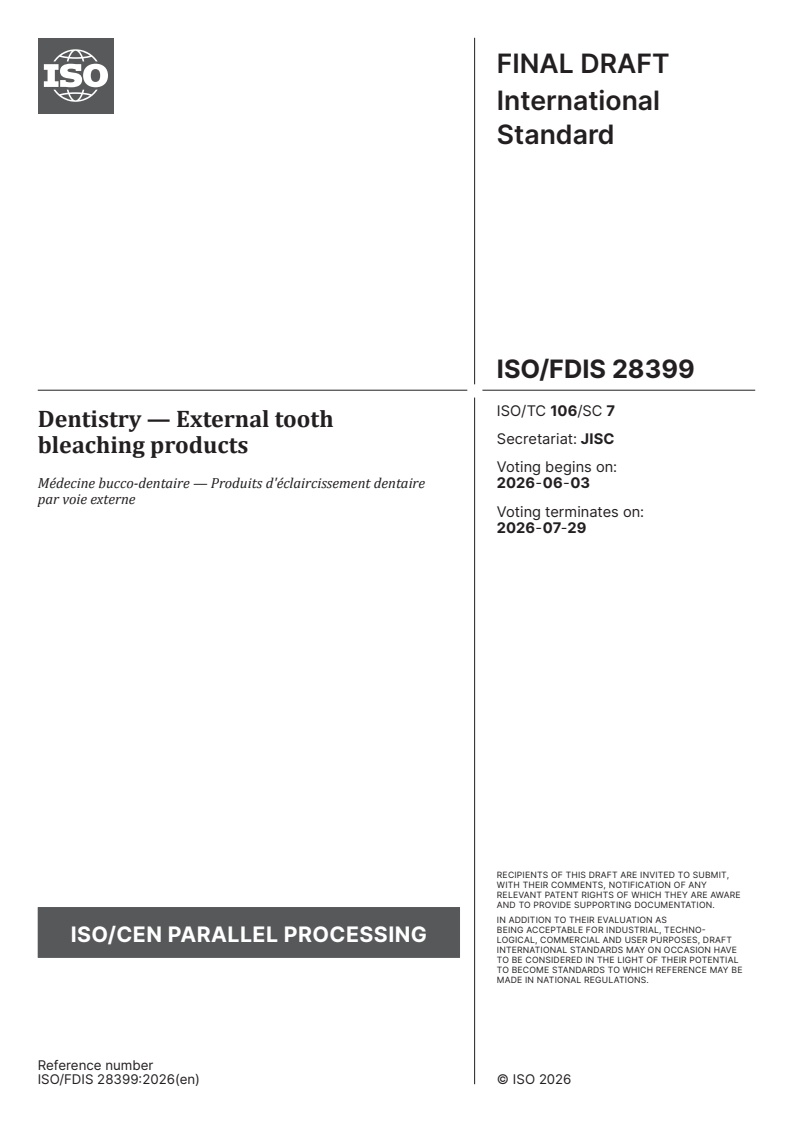
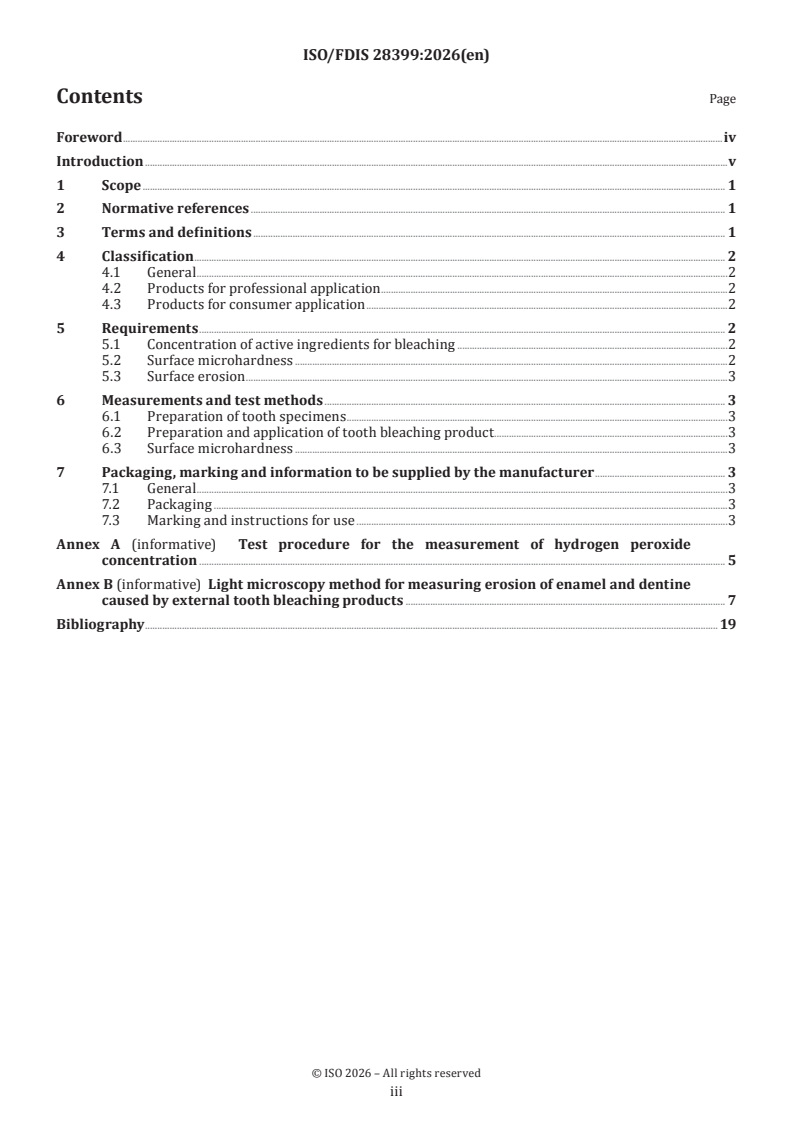
ISO/FDIS 28399 - Dentistry — External tooth bleaching products
REDLINE ISO/FDIS 28399 - Dentistry — External tooth bleaching products
Relations
- Effective Date
- 12-Feb-2026
- Effective Date
- 23-Sep-2023
Overview
ISO/FDIS 28399: Dentistry - External Tooth Bleaching Products is an international standard developed by the International Organization for Standardization (ISO) to ensure the safety and performance of external tooth bleaching products. The standard applies to products designed for application on the external surfaces of natural teeth, either by dental professionals (in-office use) or by consumers at home (professional or non-professional home use). It outlines the requirements for product composition, testing, packaging, labeling, and manufacturer’s instructions to promote consistency and quality in tooth whitening treatments.
This standard does not cover:
- Tooth bleaching products specified in ISO 11609
- Products that alter tooth color via mechanical means (such as stain removal) or through restorative methods (e.g., veneers, crowns)
- Auxiliary materials (like trays) or instruments/devices (lights) that may be used with bleaching agents
- Biological safety aspects, which are addressed in other relevant standards
Key Topics
Product Classification
- Professional application: Designed for use only by dental professionals, such as dentists, in clinical settings.
- Consumer application: Intended for direct use by consumers, either under professional supervision (professional home use) or for non-professional use at home. These products may be prescribed or available over-the-counter.
Performance and Quality Requirements
- Active ingredient concentration: The concentration of bleaching agents (expressed as hydrogen peroxide equivalent) must remain within +10% and -30% of the stated value for unopened products up to their expiry date.
- Surface microhardness: Post-bleaching, the reduction in tooth surface hardness should not exceed 10%, ensuring minimal structural impact.
- Surface erosion: Erosion caused by bleaching products must be less than that caused by a standard reference solution.
Testing and Methods
- Standardized methods are specified for:
- Preparation and storage of tooth specimens for testing
- Application of bleaching agents under conditions that mimic intended real-world use
- Measurement of hydrogen peroxide concentration (using validated titration methods)
- Assessment of tooth surface microhardness and erosion after treatment
Packaging, Labelling, and Information
- Products must be packaged to protect from degradation and contamination.
- Labels and instructions must include:
- Product name and manufacturer information
- Storage recommendations
- Concentration and chemical name of active ingredients
- Expiry date and lot number
- Clear instructions for use, including any warnings or contraindications
- Guidance to consult a dental professional prior to use
Applications
This standard is essential for:
- Dental manufacturers producing in-office or home-use tooth bleaching formulations
- Dental professionals selecting and prescribing bleaching products that meet international safety and efficacy benchmarks
- Regulatory bodies evaluating compliance and setting market authorization criteria for tooth whitening products
- Consumers seeking confidence in the quality and safety of over-the-counter or professionally dispensed teeth whitening solutions
By following ISO/FDIS 28399, stakeholders in dentistry and oral healthcare ensure that bleaching products are consistent, effective, and minimize risk to users.
Related Standards
ISO/FDIS 28399 integrates with several other important standards:
- ISO 11609: Dentistry - Toothpastes - Requirements, test methods, and marking
- ISO 10993-1: Biological evaluation of medical devices - Part 1: Evaluation and testing within a risk management process
- ISO 7405: Dentistry - Evaluation of biocompatibility of medical devices used in dentistry
- ISO 3696: Water for analytical laboratory use - Specification and test methods
- ISO 6344: Coated abrasives - Grain size analysis
Adhering to these related standards ensures a comprehensive approach to product development, patient safety, and regulatory compliance in dental bleaching treatments.
Buy Documents
ISO/FDIS 28399 - Dentistry — External tooth bleaching products
REDLINE ISO/FDIS 28399 - Dentistry — External tooth bleaching products
Get Certified
Connect with accredited certification bodies for this standard

ECOCERT
Organic and sustainability certification.

Eurofins Food Testing Global
Global leader in food, environment, and pharmaceutical product testing.

Intertek Bangladesh
Intertek certification and testing services in Bangladesh.
Sponsored listings
Frequently Asked Questions
ISO/FDIS 28399 is a draft published by the International Organization for Standardization (ISO). Its full title is "Dentistry — External tooth bleaching products". This standard covers: This document specifies the requirements and test methods for external tooth bleaching products. These products are intended for use in the oral cavity, either by professional application (in-office tooth bleaching products) or consumer application (professional or non-professional home use of tooth bleaching products), or both. It also specifies requirements for their packaging, labelling and manufacturer's instructions for use. This document is not applicable to tooth bleaching products: — specified in ISO 11609; — intended to change colour perception of natural teeth by mechanical methods (e.g. stain removal) or using restorative approaches, such as veneers or crowns; — auxiliary or supplementary materials (e.g. tray materials) and instruments or devices (e.g. lights) that are used in conjunction with the bleaching products. This document does not specify biological safety aspects of tooth bleaching products. NOTE Maximum concentration of a bleaching agent for professional or non-professional use is subject to each country's regulatory body.
This document specifies the requirements and test methods for external tooth bleaching products. These products are intended for use in the oral cavity, either by professional application (in-office tooth bleaching products) or consumer application (professional or non-professional home use of tooth bleaching products), or both. It also specifies requirements for their packaging, labelling and manufacturer's instructions for use. This document is not applicable to tooth bleaching products: — specified in ISO 11609; — intended to change colour perception of natural teeth by mechanical methods (e.g. stain removal) or using restorative approaches, such as veneers or crowns; — auxiliary or supplementary materials (e.g. tray materials) and instruments or devices (e.g. lights) that are used in conjunction with the bleaching products. This document does not specify biological safety aspects of tooth bleaching products. NOTE Maximum concentration of a bleaching agent for professional or non-professional use is subject to each country's regulatory body.
ISO/FDIS 28399 is classified under the following ICS (International Classification for Standards) categories: 71.100.70 - Cosmetics. Toiletries; 97.170 - Body care equipment. The ICS classification helps identify the subject area and facilitates finding related standards.
ISO/FDIS 28399 has the following relationships with other standards: It is inter standard links to FprEN ISO 28399, ISO 28399:2021. Understanding these relationships helps ensure you are using the most current and applicable version of the standard.
ISO/FDIS 28399 is available in PDF format for immediate download after purchase. The document can be added to your cart and obtained through the secure checkout process. Digital delivery ensures instant access to the complete standard document.
Standards Content (Sample)
FINAL DRAFT
International
Standard
ISO/TC 106/SC 7
Dentistry — External tooth
Secretariat: JISC
bleaching products
Voting begins on:
Médecine bucco-dentaire — Produits d'éclaircissement dentaire 2026-06-03
par voie externe
Voting terminates on:
2026-07-29
RECIPIENTS OF THIS DRAFT ARE INVITED TO SUBMIT,
WITH THEIR COMMENTS, NOTIFICATION OF ANY
RELEVANT PATENT RIGHTS OF WHICH THEY ARE AWARE
AND TO PROVIDE SUPPOR TING DOCUMENTATION.
IN ADDITION TO THEIR EVALUATION AS
BEING ACCEPTABLE FOR INDUSTRIAL, TECHNO
ISO/CEN PARALLEL PROCESSING LOGICAL, COMMERCIAL AND USER PURPOSES, DRAFT
INTERNATIONAL STANDARDS MAY ON OCCASION HAVE
TO BE CONSIDERED IN THE LIGHT OF THEIR POTENTIAL
TO BECOME STAN DARDS TO WHICH REFERENCE MAY BE
MADE IN NATIONAL REGULATIONS.
Reference number
FINAL DRAFT
International
Standard
ISO/TC 106/SC 7
Dentistry — External tooth
Secretariat: JISC
bleaching products
Voting begins on:
Médecine bucco-dentaire — Produits d'éclaircissement dentaire
par voie externe
Voting terminates on:
RECIPIENTS OF THIS DRAFT ARE INVITED TO SUBMIT,
WITH THEIR COMMENTS, NOTIFICATION OF ANY
RELEVANT PATENT RIGHTS OF WHICH THEY ARE AWARE
AND TO PROVIDE SUPPOR TING DOCUMENTATION.
© ISO 2026
IN ADDITION TO THEIR EVALUATION AS
All rights reserved. Unless otherwise specified, or required in the context of its implementation, no part of this publication may
BEING ACCEPTABLE FOR INDUSTRIAL, TECHNO
ISO/CEN PARALLEL PROCESSING
LOGICAL, COMMERCIAL AND USER PURPOSES, DRAFT
be reproduced or utilized otherwise in any form or by any means, electronic or mechanical, including photocopying, or posting on
INTERNATIONAL STANDARDS MAY ON OCCASION HAVE
the internet or an intranet, without prior written permission. Permission can be requested from either ISO at the address below
TO BE CONSIDERED IN THE LIGHT OF THEIR POTENTIAL
or ISO’s member body in the country of the requester.
TO BECOME STAN DARDS TO WHICH REFERENCE MAY BE
MADE IN NATIONAL REGULATIONS.
ISO copyright office
CP 401 • Ch. de Blandonnet 8
CH-1214 Vernier, Geneva
Phone: +41 22 749 01 11
Email: copyright@iso.org
Website: www.iso.org
Published in Switzerland Reference number
ii
Contents Page
Foreword .iv
Introduction .v
1 Scope . 1
2 Normative references . 1
3 Terms and definitions . 1
4 Classification . 2
4.1 General .2
4.2 Products for professional application .2
4.3 Products for consumer application .2
5 Requirements . 2
5.1 Concentration of active ingredients for bleaching .2
5.2 Surface microhardness .2
5.3 Surface erosion .3
6 Measurements and test methods . 3
6.1 Preparation of tooth specimens .3
6.2 Preparation and application of tooth bleaching product .3
6.3 Surface microhardness .3
7 Packaging, marking and information to be supplied by the manufacturer . 3
7.1 General .3
7.2 Packaging .3
7.3 Marking and instructions for use .3
Annex A (informative) Test procedure for the measurement of hydrogen peroxide
concentration . 5
Annex B (informative) Light microscopy method for measuring erosion of enamel and dentine
caused by external tooth bleaching products . 7
Bibliography . 19
iii
Foreword
ISO (the International Organization for Standardization) is a worldwide federation of national standards
bodies (ISO member bodies). The work of preparing International Standards is normally carried out through
ISO technical committees. Each member body interested in a subject for which a technical committee
has been established has the right to be represented on that committee. International organizations,
governmental and non-governmental, in liaison with ISO, also take part in the work. ISO collaborates closely
with the International Electrotechnical Commission (IEC) on all matters of electrotechnical standardization.
The procedures used to develop this document and those intended for its further maintenance are described
in the ISO/IEC Directives, Part 1. In particular, the different approval criteria needed for the different types
of ISO document should be noted. This document was drafted in accordance with the editorial rules of the
ISO/IEC Directives, Part 2 (see www.iso.org/directives).
ISO draws attention to the possibility that the implementation of this document may involve the use of (a)
patent(s). ISO takes no position concerning the evidence, validity or applicability of any claimed patent
rights in respect thereof. As of the date of publication of this document, ISO had not received notice of (a)
patent(s) which may be required to implement this document. However, implementers are cautioned that
this may not represent the latest information, which may be obtained from the patent database available at
www.iso.org/patents. ISO shall not be held responsible for identifying any or all such patent rights.
Any trade name used in this document is information given for the convenience of users and does not
constitute an endorsement.
For an explanation of the voluntary nature of standards, the meaning of ISO specific terms and expressions
related to conformity assessment, as well as information about ISO's adherence to the World Trade
Organization (WTO) principles in the Technical Barriers to Trade (TBT), see www.iso.org/iso/foreword.html.
This document was prepared by Technical Committee ISO/TC 106, Dentistry, Subcommittee SC 7, Oral care
products, in collaboration with the European Committee for Standardization (CEN) Technical Committee
CEN/TC 55, Dentistry, in accordance with the Agreement on technical cooperation between ISO and CEN
(Vienna Agreement).
This fourth edition cancels and replaces the third edition (ISO 28399:2021), which has been editorially
revised.
The changes are as follows:
— editorial changes were made throughout the document to improve clarity;
— Annex C “Test method for laboratory assessment of tooth bleaching efficacy” has been removed.
Any feedback or questions on this document should be directed to the user’s national standards body. A
complete listing of these bodies can be found at www.iso.org/members.html.
iv
Introduction
External tooth bleaching products are used in dentistry for changing the colour of natural teeth towards a
lighter or whiter shade. They are applied in the oral cavity directly on the outer surfaces of teeth.
Specific qualitative and quantitative requirements for freedom from biological hazard are not included in
this document. Reference should be made to ISO 10993-1 and ISO 7405 when assessing possible biological or
toxicological hazards.
v
FINAL DRAFT International Standard ISO/FDIS 28399:2026(en)
Dentistry — External tooth bleaching products
1 Scope
This document specifies the requirements and test methods for external tooth bleaching products. These
products are intended for use in the oral cavity, either by professional application (in-office tooth bleaching
products) or consumer application (professional or non-professional home use of tooth bleaching products)
or both. It also specifies requirements for their packaging, labelling and manufacturer’s instructions for use.
This document is not applicable to tooth bleaching products:
— specified in ISO 11609;
— intended to change colour perception of natural teeth by mechanical methods (e.g. stain removal) or
using restorative approaches, such as veneers or crowns;
— auxiliary or supplementary materials (e.g. tray materials) and instruments or devices (e.g. lights) that
are used in conjunction with the bleaching products.
This document does not specify biological safety aspects of tooth bleaching products.
NOTE The maximum concentration of a bleaching agent for professional or non-professional use is subject to each
country’s regulatory body.
2 Normative references
The following documents are referred to in the text in such a way that some or all of their content constitutes
requirements of this document. For dated references, only the edition cited applies. For undated references,
the latest edition of the referenced document (including any amendments) applies.
ISO 3696, Water for analytical laboratory use — Specification and test methods
ISO 6344-3, Coated abrasives — Determination and designation of grain size distribution — Part 3: Microgrit
sizes P240 to P5000
ISO 8601-1, Date and time — Representations for information interchange — Part 1: Basic rules
ISO 8601-2, Date and time — Representations for information interchange — Part 2: Extensions
3 Terms and definitions
For the purposes of this document, the following terms and definitions apply.
ISO and IEC maintain terminology databases for use in standardization at the following addresses:
— ISO Online browsing platform: available at https:// www .iso .org/ obp
— IEC Electropedia: available at https:// www .electropedia .org/
3.1
bleaching
removal of intrinsic or acquired discolorations of natural teeth, through the use of chemicals,
sometimes in combination with the application of external energy
Note 1 to entry: Changing the colour of natural teeth towards a lighter or whiter shade is not limited to changing a
discoloration.
Note 2 to entry: Auxiliary means for bleaching other than the application of external energy are also conceivable.
[SOURCE: ISO 1942:2020, 3.6.5, modified — Note 1 to entry and Note 2 to entry have been added.]
3.2
professional home use
use prescribed by a professional and for patient or consumer use at home under the supervision
of the dentist
3.3
erosion
progressive loss of calcified dental tissue by chemical processes that do not involve bacterial
action
[SOURCE: ISO 1942:2020, 3.1.3.6, modified — The term “tooth erosion” has been modified to “erosion”, the
admitted term has been deleted and the domain "" has been added.]
4 Classification
4.1 General
External tooth bleaching products can be classified for either:
a) professional application; or
b) consumer application.
NOTE External tooth bleaching products can be used alone or in conjunction with auxiliary means of application.
4.2 Products for professional application
These products are tooth bleaching products that are intended by the manufacturer to be applied only by
dental professionals (in-office tooth bleaching products).
4.3 Products for consumer application
These products are tooth bleaching products that are intended by the manufacturer to be applied by the
consumer (for professional home use or for non-professional home use).
NOTE Such external bleaching products can be prescribed by a dental professional or be made directly available
to consumers.
5 Requirements
5.1 Concentration of active ingredients for bleaching
The concentration of active ingredients for bleaching (equivalent to that of hydrogen peroxide) delivered
by the unexpired product according to the manufacturer's instructions for use shall be within the range
of +10 % and −30 % of the original concentration stated by the manufacturer for the unopened product.
Annex A or any other validated method that supports the use of the thiosulfate approach to H O titrations,
2 2
or any other validated method of similar sensitivity, accuracy and free of biases can be used.
5.2 Surface microhardness
The reduction in the Knoop hardness (KHN) or Vickers hardness (VHN) after bleaching shall not exceed
10 %, when tested in accordance with 6.3.
5.3 Surface erosion
Surface erosion of the teeth tested shall be less than the level which is caused by the standard reference
solution. The method described in Annex B or other validated methods of similar or better sensitivity,
accuracy and free of biases can be used.
6 Measurements and test methods
6.1 Preparation of tooth specimens
Prepare enamel and dentine specimens taken from a consistent location on extracted human or bovine teeth
that have been stored in a neutralized solution that disinfects but does not alter the physical properties.
Grind the specimen surface under a constant flow of water in accordance with ISO 3696, starting at P400
and sequentially to a minimum of P1200 silicon carbide paper in accordance with ISO 6344-3. Then, polish
the surface using a slurry or paste of 0,3 µm mean particle size aluminium oxide. Ensure a minimum of
1 mm thickness of enamel or dentine tissue for the test specimen. Prevent dehydration of test specimens
during the preparation procedure.
6.2 Preparation and application of tooth bleaching product
The dispensing, processing and application of the tooth bleaching product used in tests (e.g. the test given
in Annex B) shall follow the manufacturer's instructions for use. The method of bleach application shall
simulate the clinical procedure in quantity, frequency and duration of the application. Between bleaching
intervals, and for 24 h after the last bleach application prior to testing, specimens shall be stored at 37 °C
in a solution that is pH 6,8 to 7,2 and saturated with respect to hydroxyapatite with calcium and phosphate
salts (e.g. 4 mmol/l CaCl with 8 mmol/l K 2PO titrated to pH 7 with NaOH or HCl).
2 H 4
6.3 Surface microhardness
Evaluate enamel surface microhardness before and after bleaching treatment.
Determine KHN or VHN surface microhardness by applying a load of 0,49 N (equivalent to a 50 g load)
for 15 s. Evaluate a minimum of 10 specimens for each group, with three indentations for each specimen.
Prevent dehydration of test specimens during the specimen preparation procedure.
7 Packaging, marking and information to be supplied by the manufacturer
7.1 General
Additional information may be included at the discretion of the manufacturer.
7.2 Packaging
The components of the material shall be supplied in properly sealed containers which adequately protect
the contents and do not adversely affect the product quality.
7.3 Marking and instructions for use
For each package, the following applies:
a) Information shall be clearly marked on the outermost package or containers appropriate to the product,
as indicated in Table 1.
b) Instructions shall accompany each package of the product and shall include the information appropriate
to the product, as indicated in Table 1.
Table 1 — Requirements for marking and instructions for use
Manufacturer’s
Outermost
No. Information Container instructions for
package
use
1 Name of the product M M M
2 Identification or name of the manufacturer M M M
3 Address of the manufacturer or the agent responsible for sale M — M
4 Recommended conditions of storage M — M
5 Manufacturer's lot number M M —
Expiry date given in accordance with ISO 8601-1 or —
6 M M
ISO 8601-2
Classification of the external tooth bleaching products
7 M — M
(Clause 4)
Clinical application of the external tooth bleaching products
8 — — M
(Clause 4)
9 Number of containers M — —
10 Net mass of product in each container M M —
11 Chemical name of active ingredient(s) M — M
12 Concentration of active ingredient(s) M — M
13 Concentration equivalent to hydrogen peroxide M — M
14 Instructions for use — — M
15 Recommended auxiliary device(s), exposure times and any special
instructions for use of the equipment
— — M
(for the materials requiring an auxiliary device only)
16 Specific contra-indication(s) or warning(s), such as ”irritation”,
— — M
“avoid contact with eyes”, as necessary
17 Statement equivalent to "It is recommended that you consult with — — M
your dental professional before using this product."
18 Date of issue or latest revision, if applicable — — M
Key
M: mandatory information
—: non-mandatory information
For single use containers, instructions may be labelled on the secondary packaging. The minimum
information on single use containers required are: manufacturer name, trade name, lot number and expiry
date.
Annex A
(informative)
Test procedure for the measurement of hydrogen peroxide
concentration
A.1 Principle
The content of generated hydrogen peroxide (H O ) in tooth bleaching products is determined using a
2 2
modified thiosulfate titration method.
A.2 Test condition
Perform the test at (23 ± 2) °C.
[7]
A.3 Procedure (modified thiosulfate titration method )
A.3.1 General
Use the following materials:
— analytical grade sulfuric acid;
— potassium iodide;
— ammonium molybdate;
— sodium thiosulfate;
— chloroform;
— anhydrous sodium carbonate;
— deionized water, grade 2 in accordance with ISO 3696;
— starch;
— hydrogen peroxide.
Conduct a titration calibration curve using a series of freshly prepared H O solutions at concentrations that
2 2
include the highest possible H O concentration in the test product.
2 2
A.3.2 Method
A.3.2.1 Preparation of the test sample solution
Add approximately 1,0 g (weighing precision to 0,001 g) of test product or an amount appropriate to the test,
with rapid stirring, to 400 ml deionized water that contains 10 ml of sulfuric acid (25 %), 25 ml potassium
iodide (10 %) and 4 drops of ammonium molybdate solution (5 %).
NOTE The reason for "rapid stirring" is that bleaching materials need to be completely dissolved in the solvent
(especially for powder-type materials).
A.3.2.2 Preparation of 0,1 mol/l sodium thiosulfate solution
It is technically very difficult to prepare the standardized solution of 0,1 mol/l sodium thiosulfate for a
technician who is not knowledgeable about applied chemistry; therefore, technicians who prepare the
[5]
standard solution can refer to the literature .
a) Dissolve approximately 25 g sodium thiosulfate into 1 l freshly boiled D-H O. It is recommended to add
approximately 0,15 ml (three drops) of chloroform and 0,1 g anhydrous sodium carbonate to stabilize
[7]
the thiosulfate solution . Keep the solution away from light which will lead to decomposition of the
solution.
b) Standardize the sodium thiosulfate solution following any of the methods in Reference [7].
NOTE Standardized sodium thiosulfate solution is commercially availabl
...
Formatted
...
Style Definition
...
Style Definition
...
Style Definition
...
Style Definition
...
ISO/DISFDIS 28399:2025(en)
Style Definition
...
ISO/TC 106/SC 7
Style Definition
...
Style Definition
...
Secretariat: JISC
Style Definition
...
Date: 2025-06-142026-05-19
Style Definition
...
Style Definition
...
Style Definition
...
Style Definition
...
Style Definition
...
Style Definition
...
Dentistry — External tooth bleaching products
Style Definition
...
Médecine bucco-dentaire — Produits d'éclaircissement dentaire par voie externe
Style Definition
...
Style Definition
...
Style Definition
...
Style Definition
...
Style Definition
...
Style Definition
...
Style Definition
...
Style Definition
...
FDIS stage Style Definition
...
Style Definition
...
Style Definition
...
Style Definition
...
Style Definition
...
Style Definition
...
Style Definition
...
Style Definition
...
Style Definition
...
Style Definition
...
Style Definition
...
Style Definition
...
TThhiiss d drraftaft i iss s suubbmmiitttteded t too a pa pararallel vallel vootte e iinn I ISSOO,, C CEENN.
Style Definition
...
Style Definition
...
Style Definition
...
Style Definition
...
Style Definition
...
Style Definition
...
Style Definition
...
Style Definition
...
Style Definition
...
Style Definition
...
Style Definition
...
Style Definition
...
Style Definition
...
Style Definition
...
Style Definition
...
Style Definition
...
Style Definition
...
Style Definition
...
Style Definition
...
Style Definition
...
Style Definition
...
St l D fi iti
Formatted: Font: 11 pt, Bold
Formatted: HeaderCentered, Line spacing: single
Formatted: Default Paragraph Font
Formatted: Adjust space between Latin and Asian text,
All rights reserved. Unless otherwise specified, or required in the context of its implementation, no part of this publication
Adjust space between Asian text and numbers, Border:
may be reproduced or utilized otherwise in any form or by any means, electronic or mechanical, including photocopying,
Top: (No border), Bottom: (No border), Left: (No
or posting on the internet or an intranet, without prior written permission. Permission can be requested from either ISO
border), Right: (No border)
at the address below or ISO’s member body in the country of the requester.
Formatted: Left: 1.5 cm, Right: 1.5 cm, Top: 1.4 cm,
ISO copyright office
Bottom: 1 cm, Width: 21 cm, Height: 29.7 cm, Header
CP 401 • Ch. de Blandonnet 8
distance from edge: 1.27 cm, Footer distance from
CH-1214 Vernier, Geneva
edge: 0.5 cm
Phone: + 41 22 749 01 11
Formatted: French (Switzerland)
EmailE-mail: copyright@iso.org
Formatted: French (Switzerland)
Website: www.iso.orgwww.iso.org
Formatted: French (Switzerland)
Published in Switzerland
Formatted: Font: 11 pt
Formatted: FooterPageRomanNumber, Line spacing:
single
ii
ISO/DISFDIS 28399:20252026(en) Formatted: Font: 11 pt, Font color: Auto
Formatted: Font: 11 pt, Font color: Auto
Formatted: Font: 11 pt, Font color: Auto
Contents Page
Formatted: Font: Bold
Formatted: HeaderCentered, Left
Foreword . v
Introduction . vi
1 Scope . 1
2 Normative references . 1
3 Terms and definitions . 1
4 Classification. 2
4.1 General. 2
4.2 Products for professional application . 2
4.3 Products for consumer application . 2
5 Requirements . 3
5.1 Concentration of active ingredients for bleaching . 3
5.2 Surface microhardness . 3
5.3 Surface erosion . 3
6 Measurements and test methods . 3
6.1 Preparation of tooth specimens . 3
6.2 Preparation and application of tooth bleaching product . 3
6.3 Surface microhardness . 3
7 Packaging, marking and information to be supplied by the manufacturer. 3
7.1 General. 3
7.2 Packaging . 4
7.3 Marking and instructions for use . 4
Annex A (informative) Test procedure for the measurement of hydrogen peroxide
concentration . 6
Annex B (informative) Light microscopy method for measuring erosion of enamel and dentine
caused by external tooth bleaching products . 8
Bibliography . 26
Foreword . iv
Introduction . v
1 Scope .1
2 Normative references .1
3 Terms and definitions . 1
4 Classification . 2
4.1 General . 2
4.2 Products for professional application . 2
Formatted: Font: 10 pt
4.3 Products for consumer application . 2
Formatted: Font: 10 pt
5 Requirements .3
Formatted: FooterCentered, Left, Space Before: 0 pt,
5.1 Concentration of active ingredients for bleaching. 3
Tab stops: Not at 17.2 cm
Formatted: Font: 11 pt
5.2 Surface microhardness . 3
Formatted: FooterPageRomanNumber, Left, Space
5.3 Surface erosion . 3
After: 0 pt, Tab stops: Not at 17.2 cm
iii
Formatted: Font: 11 pt, Bold
Formatted: HeaderCentered, Line spacing: single
6 Measurements and test methods .3
6.1 Preparation of tooth specimens . 3
6.2 Preparation and application of tooth bleaching product . 3
6.3 Surface microhardness . 3
7 Packaging, marking and information to be supplied by the manufacturer .3
7.1 General . 3
7.2 Packaging . 4
7.3 Marking and instructions for use . 4
Annex A (informative) Test method for the measurement of hydrogen peroxide concentration .5
Annex B (informative) Light microscopy method for measuring erosion of enamel and dentine
caused by external tooth bleaching products .6
Annex C (informative) Test method for laboratory assessment of tooth bleaching efficacy . 19
Bibliography . 22
Formatted: Font: 11 pt
Formatted: FooterPageRomanNumber, Line spacing:
single
iv
ISO/DISFDIS 28399:20252026(en) Formatted: Font: 11 pt, Font color: Auto
Formatted: Font: 11 pt, Font color: Auto
Formatted: Font: 11 pt, Font color: Auto
Foreword
Formatted: Font: Bold
ISO (the International Organization for Standardization) is a worldwide federation of national standards Formatted: HeaderCentered, Left
bodies (ISO member bodies). The work of preparing International Standards is normally carried out through
Formatted: Adjust space between Latin and Asian text,
ISO technical committees. Each member body interested in a subject for which a technical committee has been
Adjust space between Asian text and numbers
established has the right to be represented on that committee. International organizations, governmental and
non-governmental, in liaison with ISO, also take part in the work. ISO collaborates closely with the
International Electrotechnical Commission (IEC) on all matters of electrotechnical standardization.
The procedures used to develop this document and those intended for its further maintenance are described
in the ISO/IEC Directives, Part 1. In particular, the different approval criteria needed for the different types of
ISO documentsdocument should be noted. This document was drafted in accordance with the editorial rules
of the ISO/IEC Directives, Part 2 (see www.iso.org/directiveswww.iso.org/directives).
Attention is drawnISO draws attention to the possibility that some of the elementsimplementation of this
document may beinvolve the subjectuse of (a) patent(s). ISO takes no position concerning the evidence,
validity or applicability of any claimed patent rights. in respect thereof. As of the date of publication of this
document, ISO had not received notice of (a) patent(s) which may be required to implement this document.
However, implementers are cautioned that this may not represent the latest information, which may be
obtained from the patent database available at www.iso.org/patents. ISO shall not be held responsible for
identifying any or all such patent rights. Details of any patent rights identified during the development of the
document will be in the Introduction and/or on the ISO list of patent declarations received (see
www.iso.org/patents).
Any trade name used in this document is information given for the convenience of users and does not
constitute an endorsement.
For an explanation of the voluntary nature of standards, the meaning of ISO specific terms and expressions
related to conformity assessment, as well as information about ISO's adherence to the World Trade
Organization (WTO) principles in the Technical Barriers to Trade (TBT) see www.iso.org/iso/foreword.html),
see www.iso.org/iso/foreword.html.
This document was prepared by Technical Committee ISO/TC 106, Dentistry, Subcommittee SC 7, Oral care
products, in collaboration with the European Committee for Standardization (CEN) Technical Committee
CEN/TC 55, Dentistry, in accordance with the Agreement on technical cooperation between ISO and CEN
(Vienna Agreement).
Formatted: Default Paragraph Font
This fourth edition cancels and replaces the third edition (ISO 28399:2021), which has been editorially
Formatted: Default Paragraph Font
revised. The changes compared to the previous edition are as follows:
Formatted: Default Paragraph Font
— EditorialThe changes to improve clarityare as follows:
Formatted: Adjust space between Latin and Asian text,
Adjust space between Asian text and numbers, Tab
— editorial changes were made throughout the document. to improve clarity;
stops: Not at 0.7 cm + 1.4 cm + 2.1 cm + 2.8 cm +
3.5 cm + 4.2 cm + 4.9 cm + 5.6 cm + 6.3 cm + 7 cm
— — Annex C “Test method for laboratory assessment of tooth bleaching efficacy” has been removed .
Formatted: Adjust space between Latin and Asian text,
Adjust space between Asian text and numbers
Any feedback or questions on this document should be directed to the user’s national standards body. A
complete listing of these bodies can be found at www.iso.org/members.html.
Formatted: Font: 10 pt
Formatted: Font: 10 pt
Formatted: FooterCentered, Left, Space Before: 0 pt,
Tab stops: Not at 17.2 cm
Formatted: Font: 11 pt
Formatted: FooterPageRomanNumber, Left, Space
After: 0 pt, Tab stops: Not at 17.2 cm
v
Formatted: Font: 11 pt, Bold
Formatted: HeaderCentered, Line spacing: single
Introduction
External tooth bleaching products are used in dentistry for changing the colour of natural teeth towards a
lighter or whiter shade. They are applied in the oral cavity directly on the outer surfaces of teeth.
Specific qualitative and quantitative requirements for freedom from biological hazard are not included in this
document. Reference should be made to ISO 10993-1 and ISO 7405 when assessing possible biological or
Formatted: Default Paragraph Font
toxicological hazards.
Formatted: Default Paragraph Font
Formatted: Default Paragraph Font
Formatted: Default Paragraph Font
Formatted: Default Paragraph Font
Formatted: Font: 11 pt
Formatted: FooterPageRomanNumber, Line spacing:
single
vi
DRAFT International Standard ISO/DIS 28399:2025(en)
Formatted: Font: Not Bold
Formatted: Header, Left, Space After: 0 pt, Line
spacing: single
Dentistry — External tooth bleaching products
Formatted: Left: 1.5 cm, Right: 1.5 cm, Top: 1.4 cm,
21 Scope
Bottom: 1 cm, Width: 21 cm, Height: 29.7 cm, Header
distance from edge: 1.27 cm, Footer distance from
This document specifies the requirements and test methods for external tooth bleaching products. These
edge: 0.5 cm
products are intended for use in the oral cavity, either by professional application (in-office tooth bleaching
products) or consumer application (professional or non-professional home use of tooth bleaching products),)
Formatted: Default Paragraph Font
or both. It also specifies requirements for their packaging, labelling and manufacturer’s instructions for use.
Formatted: Default Paragraph Font
This document is not applicable to tooth bleaching products:
Formatted: Adjust space between Latin and Asian text,
Adjust space between Asian text and numbers, Tab
— — specified in ISO 11609;
stops: Not at 0.7 cm + 1.4 cm + 2.1 cm + 2.8 cm +
3.5 cm + 4.2 cm + 4.9 cm + 5.6 cm + 6.3 cm + 7 cm
— — intended to change colour perception of natural teeth by mechanical methods (e.g. stain removal) or
Formatted: Adjust space between Latin and Asian text,
using restorative approaches, such as veneers or crowns;
Adjust space between Asian text and numbers
— — auxiliary or supplementary materials (e.g. tray materials) and instruments or devices (e.g. lights) that Formatted: Adjust space between Latin and Asian text,
are used in conjunction with the bleaching products. Adjust space between Asian text and numbers, Tab
stops: Not at 0.7 cm + 1.4 cm + 2.1 cm + 2.8 cm +
This document does not specify biological safety aspects of tooth bleaching products. 3.5 cm + 4.2 cm + 4.9 cm + 5.6 cm + 6.3 cm + 7 cm
Formatted: Adjust space between Latin and Asian text,
NOTE Maximum The maximum concentration of a bleaching agent for professional or non-professional use is subject to
Adjust space between Asian text and numbers
each country’s regulatory body.
Formatted: Default Paragraph Font
32 Normative references Formatted: Default Paragraph Font
Formatted: Default Paragraph Font
The following documents are referred to in the text in such a way that some or all of their content constitutes
Formatted: Adjust space between Latin and Asian text,
requirements of this document. For dated references, only the edition cited applies. For undated references,
Adjust space between Asian text and numbers, Tab
the latest edition of the referenced document (including any amendments) applies.
stops: Not at 0.7 cm + 1.4 cm + 2.1 cm + 2.8 cm +
3.5 cm + 4.2 cm + 4.9 cm + 5.6 cm + 6.3 cm + 7 cm
ISO 3696, Water for analytical laboratory use — Specification and test methods
Formatted: Default Paragraph Font
ISO 6344-1-3, Coated abrasives — Grain size analysis — Part 1: GrainDetermination and designation of grain
Formatted: Default Paragraph Font
size distribution test— Part 3: Microgrit sizes P240 to P5000
Formatted: Default Paragraph Font
ISO 8601--1, Date and time — Representations for information interchange — Part 1: Basic rules
Formatted: Default Paragraph Font
Formatted: Default Paragraph Font
ISO 8601-2, Date and time — Representations for information interchange — Part 2: Extensions
Formatted: Default Paragraph Font
43 Terms and definitions
Formatted: Default Paragraph Font
Formatted: Default Paragraph Font
For the purposes of this document, the following apply. ISO and IEC maintain terminological databases for use
Formatted: Font: Italic
in standardization at the following addresses:terms and definitions apply.
Formatted: Adjust space between Latin and Asian text,
— ISO and IEC maintain terminology databases for use in standardization at the following
Adjust space between Asian text and numbers
addresses:
Formatted: Adjust space between Latin and Asian text,
Adjust space between Asian text and numbers, Tab
— ISO Online browsing platform: available at https://www.iso.org/obphttps://www.iso.org/obp
stops: Not at 0.7 cm + 1.4 cm + 2.1 cm + 2.8 cm +
3.5 cm + 4.2 cm + 4.9 cm + 5.6 cm + 6.3 cm + 7 cm
— — IEC Electropedia: available at http://www.electropedia.org/https://www.electropedia.org/
Formatted
...
Formatted: Font: 11 pt, Bold
Formatted: HeaderCentered, Line spacing: single
3.1 3.1
Formatted: TermNum2, Adjust space between Latin
bleaching and Asian text, Adjust space between Asian text and
removal of intrinsic or acquired discolorations of natural teeth, through the use of chemicals, numbers
sometimes in combination with the application of external energy
Note 1 to entry: Changing the colour of natural teeth towards a lighter or whiter shade is not limited to changing a
Formatted: Adjust space between Latin and Asian text,
discoloration.
Adjust space between Asian text and numbers, Tab
stops: Not at 0.7 cm + 1.4 cm + 2.1 cm + 2.8 cm +
Note 2 to entry: Auxiliary means for bleaching other than the application of external energy are also conceivable.
3.5 cm + 4.2 cm + 4.9 cm + 5.6 cm + 6.3 cm + 7 cm
[SOURCE: ISO 1942:2020, 3.6.5, modified — “natural teeth through the use of chemicals” has been replaced
Formatted: Default Paragraph Font
with “natural teeth, or changing their colour towards a lighter or whiter shade using chemicals” and Note 1 to
Formatted: Default Paragraph Font
entry and Note 2 to entry have been added.]
Formatted: Default Paragraph Font
3.2 3.2
Formatted: Default Paragraph Font
professional home use
Formatted: Adjust space between Latin and Asian text,
use prescribed by a professional and for patient/ or consumer use at home under the repeated
Adjust space between Asian text and numbers
supervision of the dentist
3.3 3.3
erosion
progressive loss of calcified dental tissue by chemical processes that do not involve bacterial
action
Formatted: Default Paragraph Font
[SOURCE: ISO 1942:2020, 3.1.3.6, modified — theThe term “tooth erosion” has been modified to “erosion”, the
Formatted: Default Paragraph Font
admitted term has been deleted and athe domain "" has been added.]
Formatted: Adjust space between Latin and Asian text,
Adjust space between Asian text and numbers, Tab
54 Classification
stops: Not at 0.71 cm
5.14.1 General Formatted: Adjust space between Latin and Asian text,
Adjust space between Asian text and numbers
External tooth bleaching products can be classified for either:
Formatted: Numbered + Level: 1 + Numbering Style: a,
b, c, … + Start at: 1 + Alignment: Left + Aligned at: 0
a) a) professional application; or
cm + Indent at: 0 cm, Adjust space between Latin and
Asian text, Adjust space between Asian text and
b) b) consumer application.
numbers, Tab stops: Not at 0.7 cm + 1.4 cm + 2.1 cm
+ 2.8 cm + 3.5 cm + 4.2 cm + 4.9 cm + 5.6 cm + 6.3
NOTE External tooth bleaching products can be used alone or in conjunction with auxiliary means of application.
cm + 7 cm
Formatted: Adjust space between Latin and Asian text,
5.24.2 Products for professional application
Adjust space between Asian text and numbers, Tab
stops: Not at 0.71 cm
These products are tooth bleaching products that are intended by the manufacturer to be applied only by
Formatted: Adjust space between Latin and Asian text,
dental professionals (in -office tooth bleaching products).
Adjust space between Asian text and numbers
5.34.3 Products for consumer application
Formatted: Adjust space between Latin and Asian text,
Adjust space between Asian text and numbers, Tab
These products are tooth bleaching products that are intended by the manufacturer to be applied by the
stops: Not at 0.71 cm
consumer (for professional home use or for non-professional home use).
Formatted: Adjust space between Latin and Asian text,
Adjust space between Asian text and numbers
NOTE Such external bleaching products can be prescribed by a dental professional or be made directly available to
consumers. Formatted: Adjust space between Latin and Asian text,
Adjust space between Asian text and numbers, Tab
stops: Not at 0.7 cm + 1.4 cm + 2.1 cm + 2.8 cm +
3.5 cm + 4.2 cm + 4.9 cm + 5.6 cm + 6.3 cm + 7 cm
Formatted: Font: 11 pt
Formatted: FooterPageNumber, Line spacing: single
ISO/DISFDIS 28399:20252026(en) Formatted: Font: 11 pt, Font color: Auto
Formatted: Font: 11 pt, Font color: Auto
Formatted: Font: 11 pt, Font color: Auto
65 Requirements
Formatted: Font: Bold
6.15.1 Concentration of active ingredients for bleaching
Formatted: HeaderCentered, Left
Formatted: Adjust space between Latin and Asian text,
The concentration of active ingredients for bleaching (equivalent to that of hydrogen peroxide) delivered by
Adjust space between Asian text and numbers
the unexpired product according to the manufacturer's instructions for use shall be within the range of +10 %
Formatted: Adjust space between Latin and Asian text,
and −30 % of the original concentration stated by the manufacturer for the unopened product.
Adjust space between Asian text and numbers, Tab
Annex AAnnex A or any other validated method that supports the use of the thiosulfate approach to H O
2 2
stops: Not at 0.71 cm
titrations, or any other validated method of similar sensitivity, accuracy and free of biases can be used.
Formatted: Adjust space between Latin and Asian text,
6.25.2 Surface microhardness
Adjust space between Asian text and numbers
Formatted: Adjust space between Latin and Asian text,
The reduction in the Knoop hardness (KHN) or Vickers hardness (VHN) after bleaching shall not exceed 10 %,
Adjust space between Asian text and numbers, Tab
when tested in accordance with 6.3.6.3.
stops: Not at 0.71 cm
Formatted: Adjust space between Latin and Asian text,
6.35.3 Surface erosion
Adjust space between Asian text and numbers
Surface erosion of the teeth tested shall be less than the level which is caused by the standard reference
Formatted: Adjust space between Latin and Asian text,
solution. The method described in Annex BAnnex B or other validated methods of similar or better sensitivity,
Adjust space between Asian text and numbers, Tab
accuracy, and free of biases can be used. stops: Not at 0.71 cm
Formatted: Adjust space between Latin and Asian text,
76 Measurements and test methods
Adjust space between Asian text and numbers
7.16.1 Preparation of tooth specimens
Formatted: Adjust space between Latin and Asian text,
Adjust space between Asian text and numbers, Tab
Prepare enamel and dentine specimens taken from a consistent location on extracted human or bovine teeth,
stops: Not at 0.71 cm
that have been stored in a neutralized solution that disinfects but does not alter the physical properties. Grind
Formatted: Adjust space between Latin and Asian text,
the specimen surface under a constant flow of water in accordance with ISO 3696, starting at P400 and
Adjust space between Asian text and numbers
sequentially to a minimum of P1200 silicon carbide paper in accordance with ISO 6344-13. Then, polish the
Formatted: Default Paragraph Font
surface using a slurry or paste of 0,3 µm mean particle size aluminium oxide. Ensure a minimum of 1 mm
thickness of enamel or dentine tissue for the test specimen. Prevent dehydration of test specimens during the Formatted: Default Paragraph Font
preparation procedure.
Formatted: Default Paragraph Font
Formatted: Default Paragraph Font
7.26.2 Preparation and application of tooth bleaching product
Formatted: Adjust space between Latin and Asian text,
The dispensing, processing and application of the tooth bleaching product used in tests (e.g. the test given in
Adjust space between Asian text and numbers, Tab
Annex B)Annex B) shall follow the manufacturer's instructions for use. The method of bleach application shall
stops: Not at 0.71 cm
simulate the clinical procedure in quantity, frequency and duration of the application. Between bleaching
Formatted: Adjust space between Latin and Asian text,
intervals, and for 24 h after the last bleach application prior to testing, specimens shall be stored at 37 °C in a
Adjust space between Asian text and numbers
solution. that is pH 6.,8- to 7.,2 and saturated with respect to hydroxyapatite with calcium and phosphate salts
(e.g.,. 4 mmol/l CaCl with 8 mmol/l K 2PO titrated to pH 7 with NaOH or HCl). ).
2 H 4
7.36.3 Surface microhardness
Formatted
...
Evaluate enamel surface microhardness before and after bleaching treatment.
Formatted
...
Determine KHN or VHN surface microhardness by applying a load of 0,49 N (equivalent to a 50 g load) for
Formatted
...
15 s. Evaluate a minimum of 10 specimens for each group, with three indentations for each specimen. Prevent
Formatted
dehydration of test specimens during the specimen preparation procedure.
...
Formatted: Font: 10 pt
87 Packaging, marking and information to be supplied by the manufacturer
Formatted: Font: 10 pt
8.17.1 General Formatted
...
Formatted: Font: 11 pt
Additional information may be included at the discretion of the manufacturer.
Formatted
...
Formatted
...
Formatted
...
Formatted
...
Formatted
...
Formatted
...
8.27.2 Packaging
Formatted
...
The components of the material shall be supplied in properly sealed containers which adequately protect the
Formatted
...
contents and do not adversely affect the product quality.
Formatted
...
8.37.3 Marking and instructions for use
Formatted
...
Formatted
...
For each package, the following applies.:
Formatted
...
a) a) Information shall be clearly marked on the outermost package or containers appropriate to the
Formatted
...
product, as indicated in Table 1.Table 1.
Formatted
...
b) b) Instructions shall accompany each package of the product and shall include the information
Formatted
...
appropriate to the product, as indicated in Table 1.Table 1.
Formatted
...
Formatted
Table 1 — Requirements for marking and instructions for use
...
Formatted
...
Manufacturer’s
Outermost
Formatted
No. Information Container instructions for .
package
use
Formatted
...
1 Name of the product M M M
Formatted
...
Formatted
2 Identification or name of the manufacturer M M M
...
Formatted
3 Address of the manufacturer or the agent responsible for sale M — M .
Formatted
...
4 Recommended conditions of storage M — M
Formatted
...
5 Manufacturer's lot number M M —
Formatted
...
Expiry date given in accordance with ISO 8601-1 or —
6 M M
Formatted
ISO 8601-2 .
Formatted
...
Classification of the external tooth bleaching products
7 M — M
(Clause 4)(Clause 4) Formatted
...
Formatted
Clinical application of the external tooth bleaching products .
8 — — M
(Clause 4)(Clause 4)
Formatted
...
Formatted
9 Number of containers M — —
...
Formatted
10 Net mass of product in each container M M —
...
Formatted
...
11 Chemical name of active ingredient(s) M — M
Formatted
...
12 Concentration of active ingredient(s) M — M
Formatted
...
13 Concentration equivalent to hydrogen peroxide M -— M
Formatted
...
14 Instructions for use — — M
Formatted
...
15 Recommended auxiliary device(s), exposure times and any
Formatted
special instructions for use of the equipment .
— — M
(for the materials requiring an auxiliary device only)
Formatted
...
16 Specific contra-indication(s) or warning(s), such as ”irritation”, Formatted
...
— — M
“avoid contact with eyes”, as necessary
Formatted
...
17 Statement equivalent to 'It"It is recommended that you consult — — M
Formatted
...
with your dental professional before using this product.'."
Formatted
...
18 Date of issue or latest revision, if applicable — — M
Formatted
...
Key
Formatted
...
Formatted
...
Formatted
...
Formatted
...
Formatted
...
Formatted
...
Formatted
...
Formatted
...
Formatted
...
Formatted
...
Formatted
...
Formatted
...
Formatted
...
F tt d
ISO/DISFDIS 28399:20252026(en) Formatted: Font: 11 pt, Font color: Auto
Formatted: Font: 11 pt, Font color: Auto
Formatted: Font: 11 pt, Font color: Auto
Manufacturer’s
Formatted: Font: Bold
Outermost
No. Information Container instructions for
package
Formatted: HeaderCentered, Left
use
M: mandatory information Formatted: Font: Not Bold
—: non-mandatory information
Formatted: Font: Not Bold
Formatted: Font: Not Bold
For single use containers, instructions may be labelled on the secondary packaging. The minimum information
Formatted: Table header (+), Adjust space between
on single use containers required are: manufacturer name, trade name, lot number, and expiry date.
Latin and Asian text, Adjust space between Asian text
and numbers
Formatted: Font: Not Bold
Formatted: Font: Not Bold
Formatted: Space Before: 12 pt, Adjust space between
Latin and Asian text, Adjust space between Asian text
and numbers
Formatted: Font: 10 pt
Formatted: Font: 10 pt
Formatted: FooterCentered, Left, Space Before: 0 pt,
Tab stops: Not at 17.2 cm
Formatted: Font: 11 pt
Formatted: FooterPageNumber, Left, Space After: 0 pt,
Tab stops: Not at 17.2 cm
Formatted: Font: 11 pt, Bold
Formatted: HeaderCentered, Line spacing: single
Annex A Formatted: Adjust space between Latin and Asian text,
Adjust space between Asian text and numbers
(informative)
Formatted: Annex Heading_Line 2, Font: Bold
Test procedure for the measurement of hydrogen peroxide concentration
A.1 Principle
Formatted: Adjust space between Latin and Asian text,
Adjust space between Asian text and numbers, Tab
The content of generated hydrogen peroxide (H2O2) in tooth bleaching products is determined using a stops: Not at 0.63 cm
modified thiosulfate titration method.
Formatted: Adjust space between Latin and Asian text,
Adjust space between Asian text and numbers
A.2 Test condition
Formatted: Adjust space between Latin and Asian text,
Adjust space between Asian text and numbers, Tab
Perform the test at (23 ± 2) °C.
stops: Not at 0.63 cm
Formatted: Adjust space between Latin and Asian text,
[5] [7]
A.3 Procedure (modified thiosulfate titration method, ) )
Adjust space between Asian text and numbers
A.3.1 A.3.1 General
Formatted: Adjust space between Latin and Asian text,
Adjust space between Asian text and numbers, Tab
Use the following materials: stops: Not at 0.63 cm
— analytical grade sulfuric acid, ;
— potassium iodide, ;
— ammonium molybdate, ;
— sodium thiosulfate, ;
— chloroform, ;
— anhydrous sodium carbonate, ;
— deionized water, grade 2 in accordance with ISO 3696, grade 2., ;
Formatted: Default Paragraph Font
Formatted: Default Paragraph Font
— starch and ;
— hydrogen peroxide.
Conduct a titration calibration curve using a series of freshly prepared H O solutions at concentrations that
2 2 Formatted: Adjust space between Latin and Asian text,
include the highest possible H2O2 concentration in the test product. Adjust space between Asian text and numbers
A.3.2 A.3.2 Method
Formatted: a3
A.3.2.1 A.3.2.2 Preparation of the test sample solution
Add approximately 1,0 g (weighing precision to 0,001 g) of test product or an amount appropriate to the test,
with rapid stirring, to 400 ml deionized water that contains 10 ml of sulfuric acid (25 %), 25 ml potassium
iodide (10 %),%) and 4 drops of ammonium molybdate solution (5 %).
Note: NOTE The reason for 'rapid stirring'"rapid stirring" is that bleaching materials need to be completely dissolved
in the solvent (especially for powder-type materials).
Formatted: Font: 11 pt
Formatted: FooterPageNumber, Line spacing: single
ISO/DISFDIS 28399:20252026(en) Formatted: Font: 11 pt, Font color: Auto
Formatted: Font: 11 pt, Font color: Auto
Formatted: Font: 11 pt, Font color: Auto
A.3.2.2 A.3.2.2 Preparation of 0,1 mol/l sodium thiosulfate solution.
Formatted: Font: Bold
It is technically very difficult to prepare the standardized solution of 0,1 mol/l sodium thiosulfate for a
Formatted: HeaderCentered, Left
technician who is not knowledgeable about applied chemistry; therefore, technicians who prepare the
Formatted: a4
[5][5]
standard solution can refer to the literature .
Formatted: Adjust space between Latin and Asian text,
Adjust space between Asian text and numbers
a) . a) Dissolve approximately 25 g sodium thiosulfate into 1 l freshly boiled D-H2O. It is
recommended to add approximately 0,15 ml (3three drops) of chloroform and 0,1 g anhydrous sodium
Formatted: List Number 1, Numbered + Level: 1 +
[[ ]]
carbonate to stabilize the thiosulfate solution. 7 . Keep the solution away from light which will lead to
Numbering Style: a, b, c, … + Start at: 1 + Alignment:
decomposition of the solution.
Left + Aligned at: 0 cm + Indent at: 0 cm
Formatted: Default Paragraph Font, Font: Not Bold,
[7]
b) b) Standardize the sodium thiosulfate solution following any of the methods in . Reference[7].
English (United Kingdom), Not Superscript/ Subscript
Note: NOTE Standardized sodium thiosulfate solution is commercially available. [Sigma-Aldridge]
A.3.2.3 A.3.3 Preparation of the standardized starch solution
[6]
The preparation of the standardized starch solution is described in . Reference[7].
Formatted: Body Text
Note: Standardized starch solution is commercially available [e.g.; Sigma-Aldridge, Inc.]. This trade name is provided for
reasons of public interest or public safety. This information is given for the convenience of users of this document and
does not constitute an endorsement by ISO.
Formatted: Font: English (United Kingdom)
A.3.3 A.3.4 Hydrogen Peroxideperoxide titration assay.
Formatted: Font: English (United Kingdom)
Formatted: English (United Kingdom)
A.3.4.1 Perform the titration of 400 ml of test sample solution (contains 1,0 g test product) using
Formatted: a3
0,1 mol/l sodium thiosulfate. Near the end of the titration, when the colour of the solution is still faint yellow,
add 2 ml of starch solution are added. End. The end of titration is marked by the sudden loss of blue colour of
Formatted: Font: Not Bold, English (United Kingdom)
the indicator. It is recommended to use a conical flask or a conical beaker, and to start titrating immediately
Formatted: Font: Not Bold
[7] [7]
after the sample preparation to avoid oxygen contamination of the test solution . .
Formatted: Font: Not Bold, English (United Kingdom)
A.3.4 A.3.5 Determine the hydrogen peroxide concentration.
Formatted: Font: Not Bold
Formatted: label
A.3.4.1 A.3.5.1 Prepare a calibration curve using a range of known hydrogen peroxide
solutions. Interpolate the H O content using the titration calibration curve. Formatted: where_keep-with-next, Adjust space
2 2
between Latin and Asian text, Adjust space between
A.3.4.2 A.3.5.2 When using standardized titrants (e.g. USP standard grade), it is not necessary Asian text and numbers
to construct a calibration curve. Calculate the mass concentration of H2O2 using Formula (A.1):Formula (A.1):
Formatted: Adjust space between Latin and Asian text,
Adjust space between Asian text and numbers, Tab
C = (1,701× V/m) × Y/0,1 × 100 (A.1)
stops: Not at 0.7 cm + 1.4 cm + 2.8 cm + 3.5 cm +
4.2 cm + 4.9 cm + 5.6 cm + 6.3 cm + 7 cm
where
Formatted: Adjust space between Latin and Asian text,
Adjust space between Asian text and numbers
C is the mass concentration of H O , expressed as a percentage;
2 2
V is the titre of 0,1 N sodium thiosulfate, expressed in millilitres; Formatted: Adjust space between Latin and Asian text,
Adjust space between Asian text and numbers, Tab
m is the mass of the test product dispensed, expressed in milligrams;
stops: Not at 0.7 cm + 1.4 cm + 2.1 cm + 2.8 cm +
Y is the accurate concentration of sodium thiosulfate, expressed in mol/litre.
3.5 cm + 4.2 cm + 4.9 cm + 5.6 cm + 6.3 cm + 7 cm
Repeat the measurement five times (n = 5) and calculate the mean H O concentration.
2 2
Formatted: Font: 10 pt
NOTE Formation of iodine can be indicative of the presence of sodium hypochlorite, phthalimidoperoxycaproic acid
Formatted: Font: 10 pt
(PAP) and other peroxycarboxylic acids which is relevant when the method is used for testing an unknown active
Formatted: FooterCentered, Left, Space Before: 0 pt,
ingredient.
Tab stops: Not at 17.2 cm
Formatted: Font: 11 pt
Formatted: FooterPageNumber, Left, Space After: 0 pt,
Tab stops: Not at 17.2 cm
Formatted: Font: 11 pt, Bold
Formatted: HeaderCentered, Line spacing: single
Annex B Formatted: Adjust space between Latin and Asian text,
Adjust space between Asian text and numbers
(informative)
Formatted: Annex Heading_Line 2, Font: Bold
Light microscopy method for measuring erosion of enamel and dentine caused
by external tooth bleaching products
B.1 Principle
Formatted: Adjust space between Latin and Asian text,
Adjust space between Asian text and numbers, Tab
The depth of erosion of enamel and dentine caused by external tooth bleaching products is determined using stops: Not at 0.63 cm
a light microscope.
Formatted: Adjust space between Latin and Asian text,
Adjust space between Asian text and numbers
Test summary: soundSound enamel and dentine slabs of approximately 4 mm × 4 mm × 1,4 mm are cut from
caries- and erosion -free molars or incisors of human or bovine tooth. These slabs are mounted on a plastic
rod and the. The natural surface of the slab is removed by sanding to expose fresh enamel or dentine. The
surface is protected with fingernail polish, leaving a 1,0 mm unprotected stripe down the centre of the fresh
enamel or dentine surfaces. The specimens are exposed to the potentially erosive solution or gel for 1 h while
stirring, following the manufacturer’s instructions for use or for standard solutions, for 1 h while stirring. The
specimens are rinsed with distilled water (D-H2O), cleansed in mild detergent solution, rinsed with ethanol,
and rinsed again with D-H O and visually inspected to ensure that all product residues have been removed.
The specimens are then sliced perpendicular to the exposed stripe to yield 3three or 4four cross-section slices
from each specimen slab. The cross-section slices are mounted on a glass slide, and a. A digital image is
obtained under microscope. A digital image of a reference scale such as a grid or millimetre ruler is also
obtained at the same magnification. The reference scale and the cross-section can be in the same digital image.
The digital image for each cross-section is evaluated for surface loss using software capable of assessing the
graygrey scale values of pixels . The surface loss for each cross- section from a specimen slab is averaged to
give the erosion loss for each specimen.
NOTE ImageJ software methods are described in Clause B.10 as an example. ImageJ software is freely available and
in the public domain and downloadable from https://imagej.nih.gov/ij/. ImageJ bundled with Java 1.8.0_112 (64-bit Java)
is available for Windows system and ImageJ bundled with Java 1.8.0_172 is available for Mac OS X and follow the
installation instructions. This information is given for the convenience of users of this document and does not constitute
endorsement by ISO of this product.
B.2 Test condition
Formatted: Adjust space between Latin and Asian text,
Adjust spa
...