

ISO 26909:2009
(Main)Springs — Vocabulary
General Information
- Abstract
ISO 26909:2009 specifies terms and definitions commonly used in the metal springs industry. Specifically, these terms appear in technical product documentation. Heat-treatment and surface-treatment terms pertinent to springs are included. Terms in ISO 26909:2009 are grouped into the following seven categories: a) general features of springs; b) application of springs in machinery and engineering; c) layouts and nomenclature of springs; d) specification requirements; e) design and calculation; f) manufacturing and processing; g) testing and inspection.
- Status
- Published
- Publication Date
- 17-Jun-2009
- Technical Committee
- ISO/TC 227 - Springs
- Drafting Committee
- ISO/TC 227 - Springs
- Current Stage
- 9093 - International Standard confirmed
- Start Date
- 18-Jun-2025
- Completion Date
- 29-Aug-2026
Overview
ISO 26909:2009 - Springs - Vocabulary is an International Standard that defines the common terms and definitions used in the metal springs industry. Its primary purpose is to standardize vocabulary that appears in technical product documentation, drawings, specifications and test reports so designers, manufacturers and users share an unambiguous terminology for springs.
The standard covers metal springs only (non‑metallic spring terms and material definitions are excluded) and includes heat‑treatment and surface‑treatment terminology relevant to springs. Annex A provides figures illustrating terms and Annex B gives a hierarchical grouping of the vocabulary.
Key topics
ISO 26909:2009 organizes spring terminology into seven clear categories:
- General features of springs (e.g., compression, extension, torsion, constant‑rate, variable‑rate, constant‑force - as shown in the extract)
- Application of springs in machinery and engineering
- Layout and nomenclature of springs (naming conventions, geometric terms)
- Specification requirements (how terms are used in product specs)
- Design and calculation (vocabulary related to stiffness, deflection, loads)
- Manufacturing and processing (production, heat‑treatment and surface‑treatment terms)
- Testing and inspection (terms used in test procedures and acceptance criteria)
The standard reproduces unchanged terms from earlier ISO work where applicable and was prepared by ISO/TC 227 (Springs). It replaced ISO 2162‑3:1993 and references some terms from ISO 4885.
Practical applications
ISO 26909:2009 is a foundational reference for consistent technical communication in the metal springs value chain:
- Ensures consistent wording in engineering drawings, specifications and bills of materials
- Reduces ambiguity in procurement contracts and supplier technical data
- Standardizes terminology in test reports, inspection records and quality documentation
- Supports clearer requirements for heat treatment and surface treatment steps in production
- Helps technical authors, manuals and training materials use correct, internationally accepted terms
Common uses: spring design reviews, supplier qualification, quality assurance audits, product documentation and R&D collaboration.
Who should use this standard
- Spring designers and mechanical engineers
- Spring manufacturers and production engineers
- Quality assurance and test laboratories
- Procurement specialists and technical buyers
- Technical writers, editors and standards committees
Related standards
- ISO 2162‑3:1993 (superseded by ISO 26909:2009)
- ISO 4885 (contains some reproduced terms)
- Other ISO standards on materials (not repeated in ISO 26909 to avoid duplication)
Keywords: ISO 26909:2009, springs vocabulary, spring terminology, metal springs industry, spring design, spring manufacturing, spring testing, technical documentation.
Relations
- Effective Date
- 09-Feb-2026
- Effective Date
- 12-May-2008
- Effective Date
- 15-Apr-2008
Frequently Asked Questions
ISO 26909:2009 is a standard published by the International Organization for Standardization (ISO). Its full title is "Springs — Vocabulary". This standard covers: ISO 26909:2009 specifies terms and definitions commonly used in the metal springs industry. Specifically, these terms appear in technical product documentation. Heat-treatment and surface-treatment terms pertinent to springs are included. Terms in ISO 26909:2009 are grouped into the following seven categories: a) general features of springs; b) application of springs in machinery and engineering; c) layouts and nomenclature of springs; d) specification requirements; e) design and calculation; f) manufacturing and processing; g) testing and inspection.
ISO 26909:2009 specifies terms and definitions commonly used in the metal springs industry. Specifically, these terms appear in technical product documentation. Heat-treatment and surface-treatment terms pertinent to springs are included. Terms in ISO 26909:2009 are grouped into the following seven categories: a) general features of springs; b) application of springs in machinery and engineering; c) layouts and nomenclature of springs; d) specification requirements; e) design and calculation; f) manufacturing and processing; g) testing and inspection.
ISO 26909:2009 is classified under the following ICS (International Classification for Standards) categories: 01.040.21 - Mechanical systems and components for general use (Vocabularies); 21.160 - Springs. The ICS classification helps identify the subject area and facilitates finding related standards.
ISO 26909:2009 has the following relationships with other standards: It is inter standard links to EN ISO 22705-2:2025, SIST ISO 2162-3:1995, ISO 2162-3:1993. Understanding these relationships helps ensure you are using the most current and applicable version of the standard.
ISO 26909:2009 is available in PDF format for immediate download after purchase. The document can be added to your cart and obtained through the secure checkout process. Digital delivery ensures instant access to the complete standard document.
Standards Content (Sample)
INTERNATIONAL ISO
STANDARD 26909
NORME
First edition
Première édition
INTERNATIONALE
2009-07-01
Springs — Vocabulary
Ressorts — Vocabulaire
Reference number
Numéro de référence
©
ISO 2009
PDF disclaimer
This PDF file may contain embedded typefaces. In accordance with Adobe's licensing policy, this file may be printed or viewed but
shall not be edited unless the typefaces which are embedded are licensed to and installed on the computer performing the editing. In
downloading this file, parties accept therein the responsibility of not infringing Adobe's licensing policy. The ISO Central Secretariat
accepts no liability in this area.
Adobe is a trademark of Adobe Systems Incorporated.
Details of the software products used to create this PDF file can be found in the General Info relative to the file; the PDF-creation
parameters were optimized for printing. Every care has been taken to ensure that the file is suitable for use by ISO member bodies. In
the unlikely event that a problem relating to it is found, please inform the Central Secretariat at the address given below.
PDF – Exonération de responsabilité
Le présent fichier PDF peut contenir des polices de caractères intégrées. Conformément aux conditions de licence d'Adobe, ce fichier
peut être imprimé ou visualisé, mais ne doit pas être modifié à moins que l'ordinateur employé à cet effet ne bénéficie d'une licence
autorisant l'utilisation de ces polices et que celles-ci y soient installées. Lors du téléchargement de ce fichier, les parties concernées
acceptent de fait la responsabilité de ne pas enfreindre les conditions de licence d'Adobe. Le Secrétariat central de l'ISO décline toute
responsabilité en la matière.
Adobe est une marque déposée d'Adobe Systems Incorporated.
Les détails relatifs aux produits logiciels utilisés pour la création du présent fichier PDF sont disponibles dans la rubrique General Info
du fichier; les paramètres de création PDF ont été optimisés pour l'impression. Toutes les mesures ont été prises pour garantir
l'exploitation de ce fichier par les comités membres de l'ISO. Dans le cas peu probable où surviendrait un problème d'utilisation,
veuillez en informer le Secrétariat central à l'adresse donnée ci-dessous.
DOCUMENT PROTÉGÉ PAR COPYRIGHT
© ISO 2009
The reproduction of the terms and definitions contained in this International Standard is permitted in teaching manuals, instruction
booklets, technical publications and journals for strictly educational or implementation purposes. The conditions for such reproduction are:
that no modifications are made to the terms and definitions; that such reproduction is not permitted for dictionaries or similar publications
offered for sale; and that this International Standard is referenced as the source document.
With the sole exceptions noted above, no other part of this publication may be reproduced or utilized in any form or by any means,
electronic or mechanical, including photocopying and microfilm, without permission in writing from either ISO at the address below or
ISO's member body in the country of the requester.
La reproduction des termes et des définitions contenus dans la présente Norme internationale est autorisée dans les manuels
d'enseignement, les modes d'emploi, les publications et revues techniques destinés exclusivement à l'enseignement ou à la mise en
application. Les conditions d'une telle reproduction sont les suivantes: aucune modification n'est apportée aux termes et définitions; la
reproduction n'est pas autorisée dans des dictionnaires ou publications similaires destinés à la vente; la présente Norme internationale
est citée comme document source.
À la seule exception mentionnée ci-dessus, aucune partie de cette publication ne peut être reproduite ni utilisée sous quelque forme que
ce soit et par aucun procédé, électronique ou mécanique, y compris la photocopie et les microfilms, sans l'accord écrit de l'ISO à
l'adresse ci-après ou du comité membre de l'ISO dans le pays du demandeur.
ISO copyright office
Case postale 56 • CH-1211 Geneva 20
Tel. + 41 22 749 01 11
Fax + 41 22 749 09 47
E-mail copyright@iso.org
Web www.iso.org
Published in Switzerland/Publié en Suisse
ii © ISO 2009 – All rights reserved/Tous droits réservés
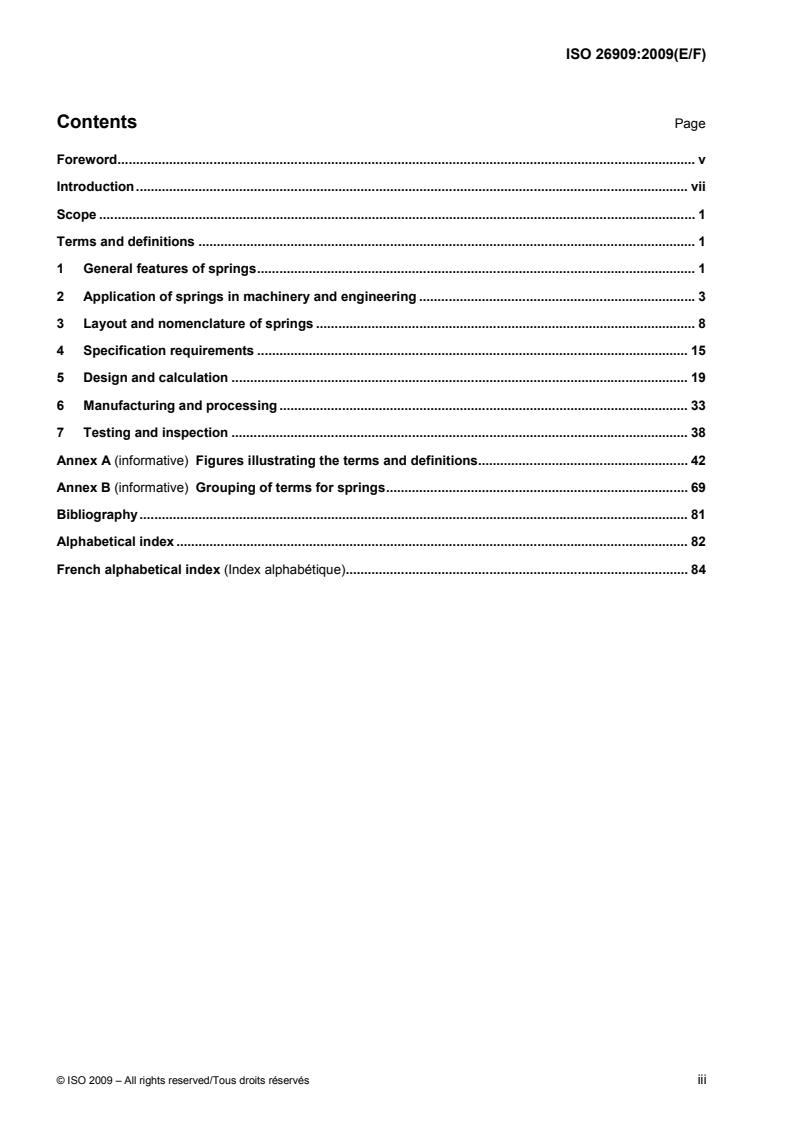
Contents Page
Foreword. v
Introduction. vii
Scope . 1
Terms and definitions . 1
1 General features of springs. 1
2 Application of springs in machinery and engineering .3
3 Layout and nomenclature of springs . 8
4 Specification requirements . 15
5 Design and calculation . 19
6 Manufacturing and processing . 33
7 Testing and inspection . 38
Annex A (informative) Figures illustrating the terms and definitions. 42
Annex B (informative) Grouping of terms for springs. 69
Bibliography. 81
Alphabetical index . 82
French alphabetical index (Index alphabétique). 84
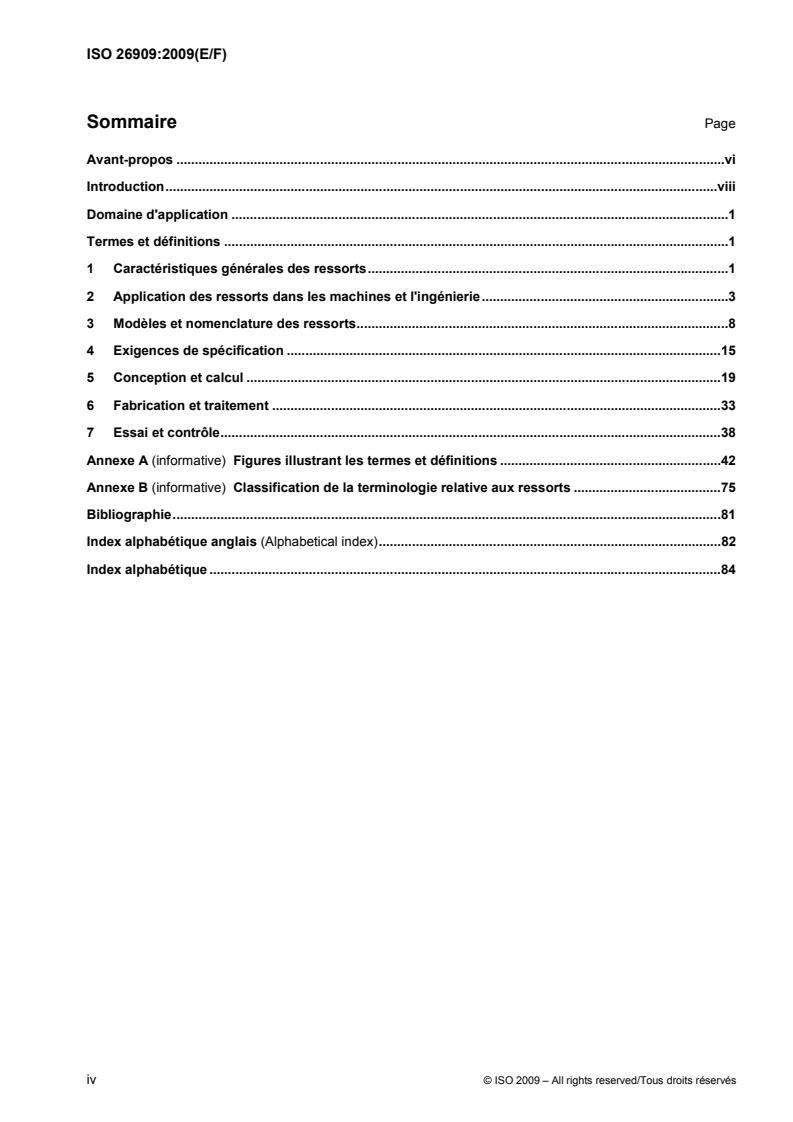
Sommaire Page
Avant-propos .vi
Introduction.viii
Domaine d'application .1
Termes et définitions .1
1 Caractéristiques générales des ressorts.1
2 Application des ressorts dans les machines et l'ingénierie.3
3 Modèles et nomenclature des ressorts.8
4 Exigences de spécification .15
5 Conception et calcul .19
6 Fabrication et traitement .33
7 Essai et contrôle.38
Annexe A (informative) Figures illustrant les termes et définitions .42
Annexe B (informative) Classification de la terminologie relative aux ressorts .75
Bibliographie.81
Index alphabétique anglais (Alphabetical index).82
Index alphabétique .84
iv © ISO 2009 – All rights reserved/Tous droits réservés
Foreword
ISO (the International Organization for Standardization) is a worldwide federation of national standards bodies
(ISO member bodies). The work of preparing International Standards is normally carried out through ISO
technical committees. Each member body interested in a subject for which a technical committee has been
established has the right to be represented on that committee. International organizations, governmental and
non-governmental, in liaison with ISO, also take part in the work. ISO collaborates closely with the
International Electrotechnical Commission (IEC) on all matters of electrotechnical standardization.
International Standards are drafted in accordance with the rules given in the ISO/IEC Directives, Part 2.
The main task of technical committees is to prepare International Standards. Draft International Standards
adopted by the technical committees are circulated to the member bodies for voting. Publication as an
International Standard requires approval by at least 75 % of the member bodies casting a vote.
Attention is drawn to the possibility that some of the elements of this document may be the subject of patent
rights. ISO shall not be held responsible for identifying any or all such patent rights.
ISO 26909 was prepared by Technical Committee ISO/TC 227, Springs.
This first edition of ISO 26909 cancels and replaces ISO 2162-3:1993, which has been technically revised.
Avant-propos
L'ISO (Organisation internationale de normalisation) est une fédération mondiale d'organismes nationaux de
normalisation (comités membres de l'ISO). L'élaboration des Normes internationales est en général confiée
aux comités techniques de l'ISO. Chaque comité membre intéressé par une étude a le droit de faire partie du
comité technique créé à cet effet. Les organisations internationales, gouvernementales et non
gouvernementales, en liaison avec l'ISO participent également aux travaux. L'ISO collabore étroitement avec
la Commission électrotechnique internationale (CEI) en ce qui concerne la normalisation électrotechnique.
Les Normes internationales sont rédigées conformément aux règles données dans les Directives ISO/CEI,
Partie 2.
La tâche principale des comités techniques est d'élaborer les Normes internationales. Les projets de Normes
internationales adoptés par les comités techniques sont soumis aux comités membres pour vote. Leur
publication comme Normes internationales requiert l'approbation de 75 % au moins des comités membres
votants.
L'attention est appelée sur le fait que certains des éléments du présent document peuvent faire l'objet de
droits de propriété intellectuelle ou de droits analogues. L'ISO ne saurait être tenue pour responsable de ne
pas avoir identifié de tels droits de propriété et averti de leur existence.
L'ISO 26909 a été élaborée par le comité technique ISO/TC 227, Ressorts.
Cette première édition de l'ISO 26909 annule et remplace l'ISO 2162-3:1993, qui a fait l'objet d'une révision
technique.
vi © ISO 2009 – All rights reserved/Tous droits réservés
Introduction
This International Standard provides sufficient terms and definitions relevant to springs to facilitate the
discussion of springs among designers, manufacturers and users of springs. The terms identified in this
International Standard are applicable to technical documentation for springs.
Terms and definitions from ISO 2162-3 that have not been modified are reproduced in this International
Standard.
Certain terms and definitions from ISO 4885 are reproduced in this International Standard.
Terms for materials are not defined in this International Standard to avoid duplication and/or conflict with other
International Standards on materials. Terms for non-metallic springs are not within the scope of ISO/TC 227.
Figures relating to the terms are given in Annex A and the grouping of terms is given in Annex B, in order
to heighten the understanding of these terms. In particular, the grouping puts the new terms in systematic
order.
Introduction
La présente Norme internationale fournit une quantité suffisante de termes applicables aux ressorts pour
faciliter la discussion entre utilisateurs, concepteurs et fabricants de ressorts. Les termes identifiés dans la
présente Norme internationale s'appliquent à la documentation technique pour les ressorts.
Les termes et définitions de l'ISO 2162-3 qui n'ont pas été modifiés sont cités tels quel dans la présente
Norme internationale.
Certains termes et définitions de l'ISO 4885 sont cités dans la présente Norme internationale.
Afin d'éviter tout conflit et doublon avec des termes d'autres Normes internationales sur les matériaux, les
termes concernant les matériaux sont exclus de la présente Norme internationale. Les termes s'appliquant
aux ressorts non métalliques ne sont pas couverts par le domaine des travaux de l'ISO/TC 227.
De façon à améliorer la compréhension des termes, des figures correspondant aux termes sont données dans
l'Annexe A et la classification des termes est donnée dans l'Annexe B. En particulier, les nouveaux termes
sont placés de façon systématique.
viii © ISO 2009 – All rights reserved/Tous droits réservés
INTERNATIONAL STANDARD
NORME INTERNATIONALE
Springs — Vocabulary
Ressorts — Vocabulaire
Scope Domaine d'application
This International Standard specifies terms and La présente Norme internationale spécifie les
definitions commonly used in the metal springs termes et définitions les plus couramment utilisés
industry. Specifically, these terms appear in dans le domaine des ressorts métalliques. Ces
technical product documentation. Heat-treatment termes apparaissent spécifiquement dans la
and surface-treatment terms pertinent to springs are documentation technique du produit. Les termes de
included. traitement thermique et de traitement de surface
spécifiques aux ressorts sont inclus.
Terms are grouped into the following seven
categories: Les termes sont classés dans les sept catégories
suivantes:
a) general features of springs;
a) caractéristiques générales des ressorts;
b) application of springs in machinery and
engineering; b) application des ressorts dans les machines et
l'ingénierie;
c) layout and nomenclature of springs;
c) modèles et nomenclature de ressorts;
d) specification requirements;
d) exigences de spécification;
e) design and calculation;
e) conception et calcul;
f) manufacturing and processing;
f) fabrication et traitement;
g) testing and inspection.
g) essai et contrôle.
The hierarchical structure of terminology in each
category is given in Annex B. La structure hiérarchique du vocabulaire dans
chaque catégorie est donnée dans l'Annexe B.
Terms and definitions Termes et définitions
1 General features of springs 1 Caractéristiques générales
des ressorts
1.1 1.1
spring ressort
mechanical device designed to store energy when dispositif mécanique conçu pour emmagasiner de
deflected and to return the equivalent amount of l'énergie lorsqu'il est déformé et en restituer la
energy when released même quantité lorsqu'il est relâché
1.2 1.2
compression spring ressort de compression
spring (1.1) that offers resistance to a compressive ressort (1.1) qui s'oppose à une force de compres-
force applied axially sion axiale
See Figure A.1. Voir Figure A.1.
NOTE In the narrow sense, a compression spring NOTE Au sens étroit, un ressort de compression
indicates a helical compression spring. indique un ressort de compression hélicoïdal.
1.3 1.3
extension spring ressort de traction
spring (1.1) that offers resistance to an axial force ressort (1.1) qui s'oppose à une force axiale
tending to extend its length, with or without initial tendant à allonger la longueur du ressort, avec ou
tension sans tension initiale
See Figures A.2 and A.3. Voir Figures A.2 et A.3.
NOTE In the narrow sense, an extension spring indicates NOTE Au sens étroit, un ressort de traction indique un
a helical extension spring. ressort de traction hélicoïdal.
1.4 1.4
torsion spring ressort de torsion
spring (1.1) that offers resistance to a twisting ressort (1.1) qui s'oppose à un moment de torsion
moment around the longitudinal axis of the spring autour de l'axe longitudinal du ressort
See Figures A.4 to A.6. Voir Figures A.4 à A.6.
NOTE In the narrow sense, a torsion spring indicates a NOTE Au sens étroit, un ressort de torsion indique un
helical torsion spring. ressort de torsion hélicoïdal.
1.5 1.5
constant rate spring ressort à raideur constante
spring (1.1) whose deflection is linear for the load ressort (1.1) dont la déformation est linéaire pour la
applied charge appliquée
1.6 1.6
variable rate spring ressort à raideur variable
spring (1.1) whose deflection is non-linear for the ressort (1.1) dont la déformation n'est pas linéaire
load applied pour la charge appliquée
1.7 1.7
constant force spring ressort à force constante
spring (1.1) that requires a uniformly constant force ressort (1.1) nécessitant qu'une force uniformé-
to be applied regardless of the length of deflection ment constante soit appliquée quelle que soit la
longueur de flèche
See Figures A.47 and A.48.
Voir Figures A.47 et A.48.
NOTE It is normally used as a moving spring and is
made from strip material in a coiled shape. Its inner ends
NOTE Il est normalement utilisé comme ressort de
are free to rotate.
commande et est constitué d'un matériau sous forme de
ruban roulé; ses extrémités intérieures sont libres de
tourner.
2 © ISO 2009 – All rights reserved/Tous droits réservés
1.8 1.8
flat spring ressort plat
spring (1.1) made from flat strip or rectangular- ressort (1.1) constitué de lames plates ou de
shaped bar stock that deflects in the same way as a barres rectangulaires qui se déforme dans le même
cantilever or a simple beam sens comme une potence ou une simple poutre
See Figure A.7. Voir Figure A.7.
1.9 1.9
wire spring ressort en fil
coil spring (3.11) made of wire ressort hélicoïdal (3.11) fabriqué à partir de fil
1.10 1.10
formed wire spring ressort en fil formé
various shapes of spring (1.1) made of wire différentes formes de ressorts (1.1) fabriquées à
partir de fil
See Figure A.8.
Voir Figure A.8.
1.11 1.11
hot formed spring ressort formé à chaud
spring (1.1) formed at high temperature ressort (1.1) formé à haute température
NOTE In the narrow sense, a hot formed spring indi- NOTE Au sens étroit, un ressort formé à chaud indique
cates a hot formed helical compression spring. un ressort de compression hélicoïdal formé à chaud.
1.12 1.12
cold formed spring ressort formé à froid
spring (1.1) formed at ambient temperature ressort (1.1) formé à température ambiante
NOTE In the narrow sense, a cold formed spring indi- NOTE Au sens étroit, un ressort formé à froid indique
cates a cold formed helical compression spring, a cold un ressort de compression hélicoïdal formé à froid, un
formed helical extension spring or a cold formed helical ressort de traction hélicoïdal formé à froid ou un ressort
torsion spring. de torsion hélicoïdal formé à froid.
2 Application of springs in machinery 2 Application des ressorts dans
and engineering les machines et l'ingénierie
2.1 2.1
fastener spring ressort de fixation
various shapes of spring (1.1) for fastening différentes formes de ressorts (1.1) destinés à la
fixation
See Figures A.7 and A.9 to A.19.
Voir Figures A.7 et de A.9 à A.19.
2.2 2.2
snap ring anneau élastique
retaining ring anneau de retenue
circular spring for preventing axial movement by segment d'arrêt
snapping into a groove formed on a shaft or in a ressort circulaire s'insérant dans une rainure sur un
hole arbre ou dans un orifice et destiné à empêcher un
mouvement axial
See Figure A.9.
Voir Figure A.9.
2.3 2.3
circlip circlip
generic term for a circular spring, such as a C-type terme générique désignant les ressorts circulaires
retaining ring (2.4) tels que l'anneau de retenue de type C (2.4)
See Figure A.9. Voir Figure A.9.
2.4 2.4
C-type retaining ring anneau de retenue de type C
eccentric retaining ring (2.2) shaped like the anneau de retenue (2.2) excentrique ayant la
letter “C”, including two types: for on-shaft-use and forme de la lettre «C», de deux types: pour un
for in-bore-use usage sur arbre et pour un usage dans un alésage
See Figure A.9 a). Voir Figure A.9 a).
2.5 2.5
C-type retaining ring with uniform section anneau de retenue de type C à section
concentric retaining ring (2.2) shaped like the constante
letter “C”, including two types: for on-shaft-use and jonc d'arrêt de type C à section constante
for in-bore-use anneau de retenue (2.2) concentrique ayant la
forme de la lettre «C», de deux types: pour un
See Figure A.9 b).
usage sur arbre et pour un usage dans un alésage
Voir Figure A.9 b).
2.6 2.6
E-type retaining ring anneau de retenue de type E
retaining ring (2.2) shaped like the letter “E” for anneau de retenue (2.2) ayant la forme de la
on-shaft-use lettre «E» pour un usage sur arbre
See Figure A.9 c). Voir Figure A.9 c).
2.7 2.7
grip ring anneau de retenue élastique
retaining ring (2.2) used for shafts without grooves anneau de retenue (2.2) utilisé sur des arbres sans
rainure
See Figure A.9 d).
Voir Figure A.9 d).
4 © ISO 2009 – All rights reserved/Tous droits réservés
2.8 2.8
spring washer rondelle élastique
generic term for washer for locking using spring terme générique désignant les rondelles de serrage
action utilisant l'effet ressort
See Figures A.10 to A.14 and A.20. Voir Figures A.10 à A.14 et A.20.
2.9 2.9
waved spring washer rondelle élastique ondulée
spring washer (2.8) made by coiling square or rondelle élastique (2.8) fabriquée à partir de fil de
rectangular section wire and then forming it into a section carrée ou rectangulaire et ayant une forme
waved shape ondulée
See Figure A.11. Voir Figure A.11.
2.10 2.10
waved washer rondelle ondulée
spring washer (2.8) made of thin ring plate on rondelle élastique (2.8) fabriquée à partir d'un
which waves are formed anneau fin sur laquelle sont formées des ondulations
See Figures A.12 and A.13. Voir Figures A.12 et A.13.
2.11 2.11
conical spring washer rondelle élastique conique
spring washer (2.8) shaped like a dish without a rondelle Belleville
bottom rondelle élastique (2.8) ayant la forme d'une
assiette sans fond
See Figure A.20.
Voir Figure A.20.
2.12 2.12
toothed washer rondelle dentée
spring washer (2.8) made of thin ring plate with rondelle élastique (2.8) constituée d'un anneau fin
twisted teeth muni de dents
See Figure A.14. Voir Figure A.14.
2.13 2.13
spring pin goupille élastique
kind of spring pin made by rolling elastic plate goupille élastique constituée de l'enroulement cylin-
cylindrically and used for connecting adjacent parts drique d'un feuillard élastique et servant au raccor-
utilizing its spring action in the radial direction when dement de parties adjacentes en utilisant son effet
inserted into a hole ressort dans la direction radiale lorsqu'elle est
insérée dans un orifice
See Figure A.15.
Voir Figure A.15.
2.14 2.14
slotted spring-type straight pin goupille cylindrique creuse
spring pin (2.13) formed cylindrically so that both goupille élastique (2.13) formée en cylindre dont
sides of the slot do not touch each other when les deux bords de la fente ne se touchent pas
inserted into a hole lorsqu'elle est insérée dans un orifice
See Figures A.15 a) and A.15 b). Voir Figure A.15 a) et A.15 b).
2.15 2.15
coiled spring-type straight pin goupille élastique spiralée
spring pin (2.13) coiled to between 2 turns and goupille élastique (2.13) enroulée entre 2 fois et
2,5 turns 2,5 fois
See Figure A.15 c). Voir Figure A.15 c).
2.16 2.16
spring cotter pin clavette élastique
pin inserted into a shaft in a radial direction for goupille insérée dans un arbre dans une direction
preventing relative displacement of the shaft radiale afin d'empêcher un déplacement relatif de
l'arbre
See Figure A.16.
Voir Figure A.16.
2.17 2.17
hairpin clip épingle d'arrêt
retainer inserted into a groove on a shaft preventing arrêtoir inséré dans une rainure d'arbre empêchant
relative displacement of the shaft un déplacement relatif de l'arbre
See Figure A.17. Voir Figure A.17.
2.18 2.18
spring nut écrou en tôle
thin flat spring (1.8) of either U- or J-section with a ressort plat (1.8) mince en forme de U ou de J,
hole and screw nut shape, which is assembled over pourvu d'un trou et une forme d'écrou de vis se
an edge or slot in a panel, using its spring action to plaçant sur un bord ou dans une fente d'un
maintain its location, so that a second panel or a panneau, utilisant son effet ressort pour son main-
component can be connected to the spring using a tien en place, permettant le raccord d'un second
screw élément au moyen d'une vis
See Figure A.18. Voir Figure A.18.
2.19 2.19
push-on spring nut écrou élastique en tôle
thin flat spring (1.8) for fastening, with a hole and ressort plat (1.8) mince pour la fixation, pourvu
tabs at its centre for inserting a stud d'un trou et d'onglets en son centre pour l'insertion
d'un goujon
See Figure A.19.
Voir Figure A.19.
NOTE This nut securely holds a stud bolt or a fastener
head by a combination of its spring action and locking
NOTE Cet écrou maintient fermement un goujon fileté
action from the tabs.
ou une tête de fixation par la combinaison de son effet
ressort et de l'action de verrouillage de ses onglets.
6 © ISO 2009 – All rights reserved/Tous droits réservés
2.20 2.20
garter spring ressort bracelet
long, close-coiled extension spring (1.3) whose ressort de traction (1.3) long, à spires jointives
ends are joined to form a ring aux extrémités jointes pour former une bague
See Figure A.21. Voir Figure A.21.
NOTE Garter springs are used principally in mechanical NOTE Les ressorts bracelets sont principalement
seals or shafting, to hold round segments together, as a utilisés dans les joints ou fermetures mécaniques afin de
belt or as a holding device. maintenir ensemble des segments ronds, comme une
ceinture et un dispositif de maintien.
2.21 2.21
hose clamp collier de serrage élastique
spring (1.1) made by forming a plate or wire into a ressort (1.1) constitué d'une bande ou d'un fil en
ring and used for tightening the connection of hoses forme d'anneau servant au serrage du raccord des
using the elasticity of the spring material tuyaux flexibles grâce à l'élasticité du matériau du
ressort
See Figure A.22.
Voir Figure A.22.
2.22 2.22
valve spring ressort de soupape
coil spring (3.11) used for intake and exhaust ressort hélicoïdal (3.11) utilisé pour les soupapes
valves of internal combustion engines d'admission et d'échappement des moteurs à com-
bustion interne
2.23 2.23
clutch spring embrayage à ressort enroulé
helical torsion spring (3.14) with a comparatively ressort de torsion hélicoïdal (3.14) avec une lon-
long, solid coil, used for transferring torque only in gueur de spires jointives relativement grande, utilisé
the winding direction, using the winding force of the pour transmettre un couple uniquement dans la
coiling section direction de l'enroulement en utilisant la force
d'enroulement de la section de spires
2.24 2.24
stabilizer bar barre stabilisatrice
generic term for the springs (1.1) mounted on the terme générique pour les ressorts (1.1) montés sur
body of a vehicle for reducing its rolling when a le corps d'un véhicule afin de réduire son roulis
centrifugal force is applied lorsqu'une force centrifuge est appliquée
See Figures A.23 and A.24. Voir Figures A.23 et A.24.
NOTE This is generally made of bars and is U-shaped, NOTE Généralement faits de barres en forme en «U»,
including the solid type (solid stabilizer bar) and the de type massif (barre stabilisatrice pleine) et de type
tubular type (tubular stabilizer bar). tubulaire (barre stabilisatrice tubulaire).
2.25 2.25
seat spring ressort de siège
generic term for springs (1.1) used in cushions on terme générique désignant les ressorts (1.1)
seats, chairs and beds utilisés dans les coussins des sièges, fauteuils et
lits
See Figures A.38, A.39 and A.51.
Voir Figures A.38, A.39 et A.51.
NOTE This includes zigzag springs, helical compres-
sion springs and barrel springs.
NOTE Cela inclut les ressorts en zigzag, les ressorts de
compression hélicoïdaux et les ressorts à barillet.
3 Layout and nomenclature of springs 3 Modèles et nomenclature
des ressorts
3.1 3.1
leaf spring ressort à lames
spring (1.1) made from one or more strips of flat or ressort (1.1) constitué d'une ou de plusieurs bandes
parabolic material having different lengths, arranged d'un matériau plat ou parabolique, de longueurs
one above the other to take account of the varying différentes et disposées les unes au-dessus des
bending moments along the strip autres pour tenir compte de la variation des
différents moments de flexion le long de la lame
See Figures A.25 to A.31.
Voir Figures A.25 à A.31.
3.2 3.2
parabolic leaf spring ressort à lames parabolique
leaf spring (3.1) tapered for approximately its entire ressort à lames (3.1) effilées sur presque la totalité
length except for the clamping area to other com- de sa longueur à l'exception de la zone de fixation
ponents sur d'autres composants
See Figures A.30 and A.31. Voir Figures A.30 et A.31.
NOTE Parabolic tapering is often employed in order to NOTE Un effilage parabolique est souvent employé afin
realize more uniform stress distribution. d'obtenir une répartition plus uniforme de la contrainte.
3.3 3.3
J-leaf spring ressort à lames en J
leaf spring (3.1) in the shape of the letter “J” ressort à lames (3.1) en forme de lettre «J»
See Figure A.32. Voir Figure A.32.
3.4 3.4
Z-leaf spring ressort à lames en Z
leaf spring (3.1) in the shape of the letter “Z” ressort à lames (3.1) en forme de lettre «Z»
See Figure A.33. Voir Figure A.33.
8 © ISO 2009 – All rights reserved/Tous droits réservés
3.5 3.5
trailing leaf for air suspension lame oscillante pour suspension
leaf spring (3.1) used for air suspension, con- pneumatique
nected to the chassis frame before the axle and ressort à lames (3.1) servant à la suspension
used mainly as a linkage mechanism pneumatique, raccordé au cadre du châssis avant
l'essieu et utilisé principalement comme mécanisme
See Figure A.34.
de liaison
Voir Figure A.34.
3.6 3.6
progressive leaf spring ressort à lames progressif
leaf spring (3.1) comprising a main spring which ressort à lames (3.1) composé d'un ressort prin-
always supports the load and an auxiliary spring cipal qui supporte toujours la charge et d'un ressort
which provides supplementary support as the load auxiliaire qui fournit un soutien supplémentaire avec
increases l'augmentation de la charge
See Figure A.29. Voir Figure A.29.
3.7 3.7
main spring ressort principal
leaf spring (3.1) that always supports the load in a ressort à lames (3.1) qui supporte toujours la
progressive leaf spring (3.6) charge dans un ressort à lames progressif (3.6)
See Figure A.29. Voir Figure A.29.
3.8 3.8
auxiliary spring ressort auxiliaire
additional leaf spring (3.1) mounted beneath the ressort à lames (3.1) supplémentaire monté en
main (suspension) leaf spring that becomes active complément du ressort à lames principal (3.7)
when the main spring (3.7) load is reached (suspension) et qui devient actif lorsque la charge
du ressort principal est atteinte
See Figure A.29.
Voir Figure A.29.
NOTE The applied load is carried partly by the main
spring and partly by the auxiliary spring.
NOTE La charge appliquée est supportée partiellement
par le ressort principal et partiellement par le ressort
auxiliaire.
3.9 3.9
two-stage progressive leaf spring ressort à lames progressif à deux phases
leaf spring (3.1) comprising a main spring (3.7), ressort à lames (3.1) composé d'un ressort prin-
which always supports the load, and a helper spring cipal (3.7) qui supporte toujours la charge et d'un
(3.10), which provides supplementary support as ressort d'appoint (3.10) qui fournit un support
the load increases supplémentaire avec l'augmentation de la charge
See Figures A.26 and A.28. Voir Figures A.26 et A.28.
3.10 3.10
helper spring ressort d'appoint
additional leaf spring (3.1) mounted above the ressort à lame (3.1) supplémentaire monté au-
main (suspension) leaf spring that becomes active dessus du ressort à lames principal (suspension) et
when its spring load is reached qui devient actif lorsque la charge de ressort est
atteinte
See Figures A.26 and A.28.
Voir Figures A.26 et A.28.
NOTE The applied load will be carried mostly by the
main spring and only to a small extent by the helper
NOTE La charge appliquée sera en majorité supportée
spring. The helper spring is usually free and load in-
par le ressort principal et seulement dans une faible
creases rapidly after contact.
mesure par le ressort d'appoint. Le ressort d'appoint est
souvent libre et la charge augmente rapidement après
contact.
3.11 3.11
coil spring ressort hélicoïdal
coil-shaped spring (1.1) ressort (1.1) en forme de bobine
NOTE This includes helical compression springs NOTE Cela comprend les ressorts de compression
(see Figures A.1, A.35 to A.42 and A.58 to A.65), helical hélicoïdaux (voir Figures A.1, A.35 à A.42 et A.58 à
extension springs (see Figures A.2 and A.3) and helical A.65), les ressorts de traction hélicoïdaux (voir
torsion springs (see Figures A.4 to A.6). Figures A.2 et A.3) et les ressorts de torsion hélicoïdaux
(voir Figures A.4 à A.6).
3.12 3.12
helical compression spring ressort de compression hélicoïdal
compression spring (1.2) made of wire of circular, ressort de compression (1.2) fait de fil de section
non-circular, square or rectangular cross-section, or circulaire, non circulaire, carrée ou rectangulaire, ou
strip of rectangular cross-section, wound around an de bande de section rectangulaire, enroulé autour
axis with spaces between its coils d'un axe et à spires non jointives
See Figures A.1, A.35 to A.42 and A.58 to A.65. Voir Figures A.1, A.35 à A.42 et A.58 à A.65.
NOTE Helical compression springs are available in NOTE Les ressorts de compression hélicoïdaux exis-
cylindrical or other forms, e.g. conical, double-conical tent sous forme cylindrique ou autre, par exemple coni-
(convex: barrel spring; concave: waisted spring) or que, biconique (convexe: ressort à barillet; concave:
tapered. ressort en diabolo) ou effilée.
3.13 3.13
helical extension spring ressort de traction hélicoïdal
extension spring (1.3) normally made of wire of ressort de traction (1.3) généralement fait de fil de
circular cross-section wound around an axis, with or section circulaire, enroulé autour d'un axe, spires
without spaces between its coils (open- or close- jointives ou non (enroulement ouvert ou fermé)
wound)
Voir Figures A.2 et A.3.
See Figures A.2 and A.3.
3.14 3.14
helical torsion spring ressort de torsion hélicoïdal
torsion spring (1.4) normally made of wire of ressort de torsion (1.4) généralement fait de fil de
circular cross-section wound around an axis and section circulaire, enroulé autour d'un axe et dont
with ends suitable for transmitting a twisting les extrémités peuvent transmettre un moment de
moment torsion
See Figures A.4 to A.6. Voir Figures A.4 à A.6.
10 © ISO 2009 – All rights reserved/Tous droits réservés
3.15 3.15
cylindrical coil spring ressort hélicoïdal cylindrique
cylinder-shaped coil spring (3.11) ressort hélicoïdal (3.11) de forme cylindrique
See Figures A.1 to A.6, A.35, A.36, A.40, A.41, Voir Figures A.1 à A.6, A.35, A.36, A.40, A.41,
A.58, A.59, A.62 and A.64. A.58, A.59, A.62 et A.64.
NOTE A combination of two or three compression NOTE Les combinaisons de deux ou trois ressorts de
springs inside each other is called a double-coil spring or compression à l'intérieur l'un de l'autre, sont appelées
a triple-coil spring, respectively (see Figure A.35). These respectivement un ressort hélicoïdal double ou un ressort
springs are generally called Nests. hélicoïdal triple (voir Figure A.35). Ces ressorts sont
généralement appelés des Nests.
3.16 3.16
conical spring ressort conique
cone-shaped coil spring (3.11) ressort hélicoïdal (3.11) de forme conique
See Figures A.37 and A.42. Voir Figures A.37 et A.42.
3.17 3.17
waisted spring ressort en diabolo
waisted or hourglass-shaped coil spring (3.11) ressort hélicoïdal (3.11) échancré ou en forme de
sablier
See Figure A.38.
Voir Figure A.38.
3.18 3.18
barrel spring ressort à barillet
barrel-shaped coil spring (3.11) made of a material ressort hélicoïdal (3.11) en forme de tonneau
with a constant or variable wire diameter and fabriqué à partir d'un fil de diamètre constant ou
variable pitch variable et d'un pas variable
See Figures A.39 and A.60. Voir Figures A.39 et A.60.
3.19 3.19
coil spring with tapered material ressort hélicoïdal à section ronde
coil spring (3.11) made of tapered round bar variable
ressort hélicoïdal (3.11) fabriqué à partir d'une
See Figure A.36.
barre ou d'un fil à section variable
Voir Figure A.36.
3.20 3.20
beehive compression spring ressort de compression tronconique
helical compression spring (3.12) one end of ressort de compression hélicoïdal (3.12) dont
which is formed into a conical shape une extrémité est de forme conique
See Figure A.61. Voir Figure A.61.
3.21 3.21
arc compression coil spring ressort de compression hélicoïdal courbe
helical compression spring (3.12) with a hyperbolic ressort de compression hélicoïdal (3.12) dont
spring coil axis l'axe d'enroulement est hyperbolique
See Figure A.63. Voir Figure A.63.
3.22 3.22
variable pitch spring ressort à pas variable
helical compression spring (3.12) with changing ressort de compression hélicoïdal (3.12) à pas
pitches changeant
See Figure A.37 and A.59. Voir Figures A.37 et A.59.
3.23 3.23
elliptical coil spring ressort hélicoïdal oblong
coil spring (3.11) which is wound in an elliptical ressort hélicoïdal (3.11) enroulé sous une forme
shape oblongue
See Figure A.65. Voir Figure A.65.
3.24 3.24
circular section wire spring ressort en fil de section circulaire
coil spring (3.11) made of round bar material ressort hélicoïdal (3.11) fabriqué à partir d'un fil de
section ronde
3.25 3.25
non-circular wire coil spring ressort hélicoïdal en fil non circulaire
coil spring (3.11) made of wire which has a non- ressort hélicoïdal (3.11) fabriqué à partir d'un fil
circular cross-section dont la section n'est pas circulaire
See Figures A.40 and A.41. Voir Figures A.40 et A.41.
3.26 3.26
rectangular wire coil spring ressort hélicoïdal en fil rectangulaire
coil spring (3.11) made of wire which has a rectan- ressort hélicoïdal (3.11) fabriqué à partir d'un fil
gular or square cross-section dont la section est rectangulaire ou carrée
See Figures A.6 and A.41. Voir Figures A.6 et A.41.
3.27 3.27
ovate wire coil spring ressort hélicoïdal en fil ovale
egg-shaped wire coil spring ressort hélicoïdal en fil en forme d'œuf
coil spring (3.11) made of wire which has an ovate ressort hélicoïdal (3.11) fabriqué à partir d'un fil
or egg-shaped cross-section dont la section est ovoïde (en forme d'œuf)
See Figure A.40. Voir Figure A.40.
12 © ISO 2009 – All rights reserved/Tous droits réservés
3.28 3.28
stranded wire spring ressort en fil torsadé
coil spring (3.11) made of stranded wire ressort hélicoïdal (3.11) fabriqué à partir de fil tor-
sadé
3.29 3.29
coiled wave spring ressort rondelle ondulé
helical compression spring (3.12) made of flat ressort de compression hélicoïdal (3.12) fabriqué
wire which is coiled in a waved manner à partir d'un fil plat enroulé avec des ondulations
See Figure A.64. Voir Figure A.64.
3.30 3.30
volute spring ressort en volute
compression spring (1.2) (conical) made from ressort de compression (1.2) (conique) constitué
material of rectangular cross-section, shaped so d'une lame de section rectangulaire et dont la forme
that its coils are capable of telescoping est telle que les spires puissent totalement s'emboîter
See Figure A.42. Voir Figure A.42.
3.31 3.31
spiral spring ressort spiral
spring (1.1) usually made by winding flat or ressort (1.1) généralement fait en un matériau plat
rectangular material onto itself in the form of a spiral ou rectangulaire enroulé sur lui-même en forme de
spirale
See Figures A.43 to A.48.
Voir Figures A.43 à A.48.
NOTE It is designed to be wound up and to exert a
return torque around the spring axis, proportional to the
NOTE Il est conçu pour être enroulé et exercer un
angular deflection.
moment de rappel autour de l'axe du ressort, proportion-
nel à l'angle de déviation.
3.32 3.32
motor spring ressort moteur
spiral spring (3.31) the coils of which contact each ressort spiral (3.31) dont les spires sont en contact
other entre elles
See Figures A.44 and A.48. Voir Figures A.44 et A.48.
3.33 3.33
non-contact-type spiral spring ressort spiral sans contact
spiral spring (3.31) the coils of which do not con- ressort spiral (3.31) dont les spires ne
...