


ISO/FDIS 20525
(Main)Tourism and related services — Semantics applied to tourism destinations
Tourism and related services — Semantics applied to tourism destinations
This standard defines a semantics base that allows representing relevant information related to tourist destinations (tourist destination, tourist resources and services within the destination, travel experiences), ensuring -through its use- the interoperability of municipal, territorial and country tourist platforms with third-party developments. This standard provides the tourist activity with semantic data structures that benefit the whole value chain, from content developers to destinations managers and final users (i.e. tourists) facilitating the access to the relevant information in an intuitive and agile way.
Tourisme et services connexes — Sémantique appliquée aux destinations touristiques
General Information
- Status
- Not Published
- Technical Committee
- ISO/TC 228 - Tourism and related services
- Drafting Committee
- ISO/TC 228 - Tourism and related services
- Current Stage
- 5020 - FDIS ballot initiated: 2 months. Proof sent to secretariat
- Start Date
- 13-May-2026
- Completion Date
- 13-May-2026
Overview
ISO/FDIS 20525: Tourism and related services - Semantics applied to tourism destinations is an international standard developed by ISO to define a semantic foundation for representing information related to tourism destinations. The standard addresses the needs of tourism platforms at municipal, territorial, and national levels, enabling them to work seamlessly with third-party systems. By standardizing semantic structures, ISO/FDIS 20525 facilitates interoperability across the tourism value chain, from data providers and destination managers to tourists and end users.
This standard provides a practical framework for structuring and sharing information about tourist destinations, resources, services, and experiences, ensuring that users can access up-to-date and relevant information efficiently and intuitively.
Key Topics
- Semantic Data Structures: Establishes a reference model for describing tourism destinations, resources, experiences, and services in a consistent, machine-readable way.
- Terminology and Hierarchy: Defines standardized terms, relationships, and properties necessary for describing tourism entities, supporting unambiguous communication and data exchange.
- Interoperability: Ensures that tourism IT platforms, from local municipalities to countries, can exchange information with third-party developments and applications.
- Digital Transformation Support: Provides foundational support for the ongoing digitalization of tourism destinations, improving access to information for both tourists and managers.
- Tourist Information Accessibility: Emphasizes intuitive and agile access to information, enhancing visitor experience throughout their journey.
- Value Chain Inclusion: Serves multiple stakeholders, benefiting content creators, data managers, service providers, and tourist users.
- Compliance with Existing Vocabularies: References established standards and vocabularies to support broader compatibility and adoption.
Applications
Implementing ISO/FDIS 20525 delivers several practical benefits across the tourism sector:
- Municipal and Government Tourism Boards: Enable seamless data integration with city, regional, and national tourism platforms, supporting smart destination management and efficient visitor services.
- Travel Technology Developers: Create interoperable solutions (e.g. apps, chatbots, websites) that can easily integrate with official tourism data sources in any compliant destination.
- Tourism Experience Providers: Standardize the way attractions, events, accommodations, and offers are described, making it easier to be discovered by tourists and resellers.
- Destination Managers: Use semantic structures for real-time scenario planning, resource allocation, and performance tracking based on actual tourist flows and interests.
- End-User Experience: Tourists benefit from comprehensive, reliable, and up-to-date information available across channels (web, mobile apps, kiosks), tailored to their preferences and location.
- Content and Data Publishers: Ensure consistent information publishing, enabling better data quality and easier maintenance across platforms.
- Ecosystem Interoperability: Supports integration with smart city initiatives, allowing tourism platforms to collaborate with transportation, event, and civic service systems.
Related Standards
ISO/FDIS 20525 references and aligns with several important international standards for terminology, data structure, and interoperability:
- ISO 639 - Codes for languages
- ISO 3166-1 - Codes for country names and subdivisions
- ISO 4217 - Codes for currencies
- ISO 8601-1 & 8601-2 - Date and time representations for information interchange
- ISO 18513:2021 - Hotels and other types of tourism accommodation vocabulary
- ISO 16520:2025 - Restaurants and catering vocabulary
- ISO 21902:2021 - Accessible tourism for all
- ISO 9000:2015 - Quality management systems
- ISO/IEC/IEEE 24641:2023 - Ontology and semantic standards
By adopting ISO/FDIS 20525, tourism destinations and service providers can ensure that their digital information and offerings are discoverable, interoperable, and useful within the global travel ecosystem, supporting the future of smart, sustainable tourism.
Buy Documents

ISO/FDIS 20525 - Tourism and related services — Semantics applied to tourism destinations
REDLINE ISO/FDIS 20525 - Tourism and related services — Semantics applied to tourism destinations
Get Certified
Connect with accredited certification bodies for this standard

BSI Group
BSI (British Standards Institution) is the business standards company that helps organizations make excellence a habit.

Great Wall Tianjin Quality Assurance Center
Established 1993, first batch to receive national accreditation with IAF recognition.
Hong Kong Quality Assurance Agency (HKQAA)
Hong Kong's leading certification body.
Sponsored listings
Frequently Asked Questions
ISO/FDIS 20525 is a draft published by the International Organization for Standardization (ISO). Its full title is "Tourism and related services — Semantics applied to tourism destinations". This standard covers: This standard defines a semantics base that allows representing relevant information related to tourist destinations (tourist destination, tourist resources and services within the destination, travel experiences), ensuring -through its use- the interoperability of municipal, territorial and country tourist platforms with third-party developments. This standard provides the tourist activity with semantic data structures that benefit the whole value chain, from content developers to destinations managers and final users (i.e. tourists) facilitating the access to the relevant information in an intuitive and agile way.
This standard defines a semantics base that allows representing relevant information related to tourist destinations (tourist destination, tourist resources and services within the destination, travel experiences), ensuring -through its use- the interoperability of municipal, territorial and country tourist platforms with third-party developments. This standard provides the tourist activity with semantic data structures that benefit the whole value chain, from content developers to destinations managers and final users (i.e. tourists) facilitating the access to the relevant information in an intuitive and agile way.
ISO/FDIS 20525 is classified under the following ICS (International Classification for Standards) categories: 03.200.01 - Leisure and tourism in general; 35.240.30 - IT applications in information, documentation and publishing. The ICS classification helps identify the subject area and facilitates finding related standards.
ISO/FDIS 20525 is available in PDF format for immediate download after purchase. The document can be added to your cart and obtained through the secure checkout process. Digital delivery ensures instant access to the complete standard document.
Standards Content (Sample)
FINAL DRAFT
International
Standard
ISO/TC 228
Tourism and related services —
Secretariat: UNE
Semantics applied to tourism
Voting begins on:
destinations
2026-05-13
Tourisme et services connexes — Sémantique appliquée aux
Voting terminates on:
destinations touristiques
2026-07-08
RECIPIENTS OF THIS DRAFT ARE INVITED TO SUBMIT,
WITH THEIR COMMENTS, NOTIFICATION OF ANY
RELEVANT PATENT RIGHTS OF WHICH THEY ARE AWARE
AND TO PROVIDE SUPPOR TING DOCUMENTATION.
IN ADDITION TO THEIR EVALUATION AS
BEING ACCEPTABLE FOR INDUSTRIAL, TECHNO
LOGICAL, COMMERCIAL AND USER PURPOSES, DRAFT
INTERNATIONAL STANDARDS MAY ON OCCASION HAVE
TO BE CONSIDERED IN THE LIGHT OF THEIR POTENTIAL
TO BECOME STAN DARDS TO WHICH REFERENCE MAY BE
MADE IN NATIONAL REGULATIONS.
Reference number
FINAL DRAFT
International
Standard
ISO/TC 228
Tourism and related services —
Secretariat: UNE
Semantics applied to tourism
Voting begins on:
destinations
Tourisme et services connexes — Sémantique appliquée aux
Voting terminates on:
destinations touristiques
RECIPIENTS OF THIS DRAFT ARE INVITED TO SUBMIT,
WITH THEIR COMMENTS, NOTIFICATION OF ANY
RELEVANT PATENT RIGHTS OF WHICH THEY ARE AWARE
AND TO PROVIDE SUPPOR TING DOCUMENTATION.
© ISO 2026
IN ADDITION TO THEIR EVALUATION AS
All rights reserved. Unless otherwise specified, or required in the context of its implementation, no part of this publication may
BEING ACCEPTABLE FOR INDUSTRIAL, TECHNO
LOGICAL, COMMERCIAL AND USER PURPOSES, DRAFT
be reproduced or utilized otherwise in any form or by any means, electronic or mechanical, including photocopying, or posting on
INTERNATIONAL STANDARDS MAY ON OCCASION HAVE
the internet or an intranet, without prior written permission. Permission can be requested from either ISO at the address below
TO BE CONSIDERED IN THE LIGHT OF THEIR POTENTIAL
or ISO’s member body in the country of the requester.
TO BECOME STAN DARDS TO WHICH REFERENCE MAY BE
MADE IN NATIONAL REGULATIONS.
ISO copyright office
CP 401 • Ch. de Blandonnet 8
CH-1214 Vernier, Geneva
Phone: +41 22 749 01 11
Email: copyright@iso.org
Website: www.iso.org
Published in Switzerland Reference number
ii
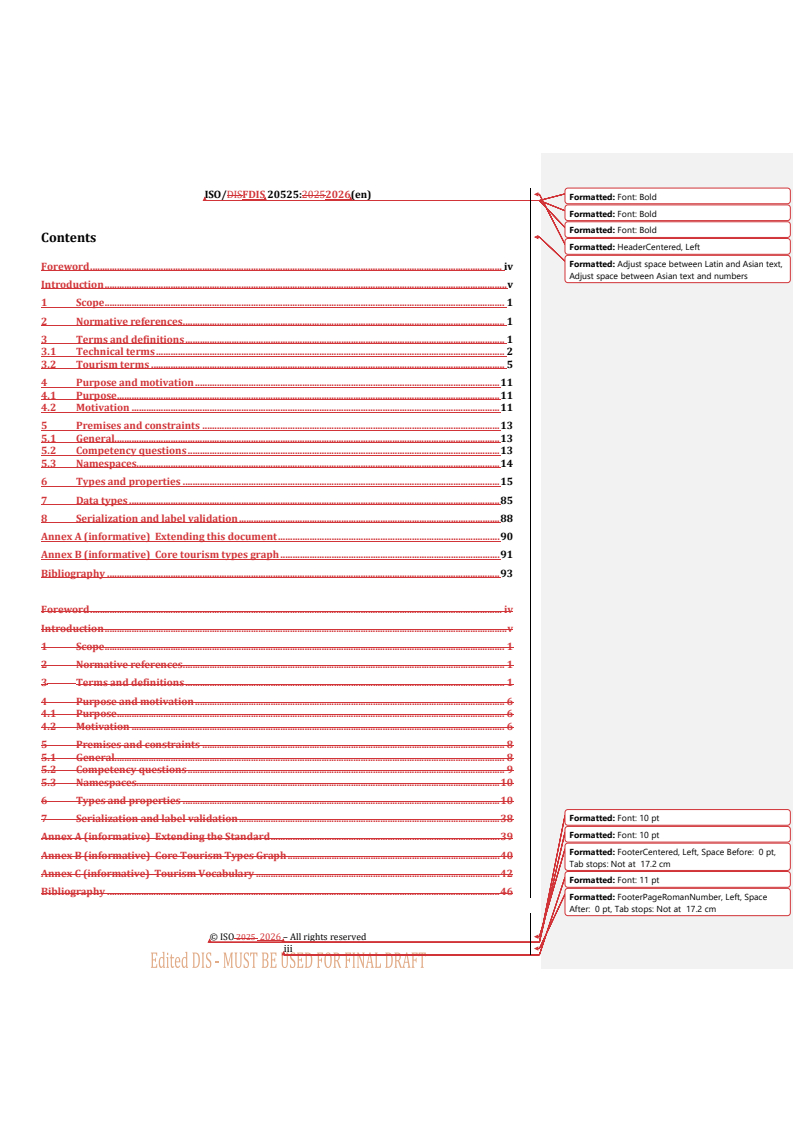
Contents Page
Foreword .iv
Introduction .v
1 Scope . 1
2 Normative references . 1
3 Terms and definitions . 1
3.1 Technical terms .2
3.2 Tourism terms .4
4 Purpose and motivation . 9
4.1 Purpose .9
4.2 Motivation .9
5 Premises and constraints . .11
5.1 General .11
5.2 Competency questions . .11
5.3 Namespaces . 12
6 Types and properties .12
7 Data types .62
8 Serialization and label validation.64
Annex A (informative) Extending this document .65
Annex B (informative) Core tourism types graph .66
Bibliography . 67
iii
Foreword
ISO (the International Organization for Standardization) is a worldwide federation of national standards
bodies (ISO member bodies). The work of preparing International Standards is normally carried out through
ISO technical committees. Each member body interested in a subject for which a technical committee
has been established has the right to be represented on that committee. International organizations,
governmental and non-governmental, in liaison with ISO, also take part in the work. ISO collaborates closely
with the International Electrotechnical Commission (IEC) on all matters of electrotechnical standardization.
The procedures used to develop this document and those intended for its further maintenance are described
in the ISO/IEC Directives, Part 1. In particular, the different approval criteria needed for the different types
of ISO document should be noted. This document was drafted in accordance with the editorial rules of the
ISO/IEC Directives, Part 2 (see www.iso.org/directives).
ISO draws attention to the possibility that the implementation of this document may involve the use of (a)
patent(s). ISO takes no position concerning the evidence, validity or applicability of any claimed patent
rights in respect thereof. As of the date of publication of this document, ISO had not received notice of (a)
patent(s) which may be required to implement this document. However, implementers are cautioned that
this may not represent the latest information, which may be obtained from the patent database available at
www.iso.org/patents. ISO shall not be held responsible for identifying any or all such patent rights.
Any trade name used in this document is information given for the convenience of users and does not
constitute an endorsement.
For an explanation of the voluntary nature of standards, the meaning of ISO specific terms and expressions
related to conformity assessment, as well as information about ISO's adherence to the World Trade
Organization (WTO) principles in the Technical Barriers to Trade (TBT), see www.iso.org/iso/foreword.html.
This document was prepared by the Technical Committee ISO/TC 228, Tourism and related services.
Any feedback or questions on this document should be directed to the user’s national standards body. A
complete listing of these bodies can be found at www.iso.org/members.html.
iv
Introduction
An increasing number of tourism destinations are becoming more digitalized. This digital transition involves
various challenges but is a necessary condition for ensuring the sustainability and competitiveness of this
strategic sector. Through the use of technology, destinations can influence tourists’ behaviour to improve
their experience, enhance their satisfaction and increase tourist expenditure. One of the key elements that
helps to achieve this is providing relevant and customized information to tourists, before, during and after
their stay at the destination.
Tourism involves both intensive generation and use of data. Information plays an important role in the
decision-making process for the tourist, the destination manager and the business sector. With this constant
information flow between digital systems and people, there is a need to standardize a semantic base in the
tourism sector to ensure mutual understanding.
With their high processing capacity, digital systems allow complex operations and can offer information
in real time both to the destination and the tourist. For the destination, digital systems provide the ability
to anticipate and manage different scenarios, for example to adjust public services to the actual volume
of people. For tourists, digital systems act as an interface of the destination and an agile facilitator of
information, aligned with the tourist’s preferences.
Digital systems process information and lines of code with instructions. Semantics endows an object with
a machine-interpretable meaning, providing additional information that can be understood by a computer,
thereby facilitating communication between humans and machines and between machines. Digital systems
are required to acquire a sufficiently high level of comprehension to be able to interact with the tourist
who is connected through different channels (web, app, chatbot, etc.) throughout the trip cycle. Digital
systems deliver updated digital content in a flexible, adapted, precise and agile way. In short, the semantic
base presented in this document aims to provide digital systems with the context they require for human/
machine and machine/machine interaction to be as efficient as possible.
The digital transformation process of a tourism destination shares many aspects with that of smart cities
and territories. However, destinations must cater to tourists and visitors which are not foreseen by the
city, and which have specific needs for information (i.e. content) and services. This document is aimed at
destinations within the tourism ecosystem that aspire towards digital transformations. This document is
intended to lay the foundations for using semantics to structure the tourist information that is transmitted
in different channels and used by tourists and visitors. This document does not intend to define how it
should be generated, stored or processed. Furthermore, this document allows a common data structure to
be shared to ensure interoperability among tourism and city platforms managed by different stakeholders.
v
FINAL DRAFT International Standard ISO/FDIS 20525:2026(en)
Tourism and related services — Semantics applied to tourism
destinations
1 Scope
This document provides a semantic base that allows the representation of relevant information related to
tourism destinations, including resources and services within the destination, travel experiences, and the
destination itself. It establishes the terminology, hierarchy, and the minimum properties and relationships
required for the definition of a reference semantic structure, ensuring the interoperability of local, territorial
and country tourism information technology (IT) platforms with third-party digital systems.
This document provides tourism destinations with semantic data structures that primarily benefit final
users (i.e. tourists and other interested parties), as these structures allow destinations to provide access
to relevant information in an intuitive and agile way, and improve the interaction between tourists and the
systems that manage, publish, carry transactions and accompany tourists during their journey. Furthermore,
destination managers, data managers and data publishers, applying this document can also benefit from
such implementation.
2 Normative references
The following documents are referred to in the text in such a way that some or all of their content constitutes
requirements of this document. For dated references, only the edition cited applies. For undated references,
the latest edition of the referenced document (including any amendments) applies.
ISO 639, Code for individual languages and language groups
ISO 3166-1, Codes for the representation of names of countries and their subdivisions — Part 1: Country code
ISO 4217, Codes for the representation of currencies
ISO 8601-1, Date and time — Representations for information interchange — Part 1: Basic rules
ISO 8601-2, Date and time — Representations for information interchange — Part 2: Extensions
ISO 16520, Tourism and related services — Restaurants and catering — Vocabulary
ISO 18513, Tourism services — Hotels and other types of tourism accommodation — Vocabulary
3 Terms and definitions
For the purposes of this document, the terms and definitions given in ISO 18513, ISO 16520 and the following
apply.
ISO and IEC maintain terminology databases for use in standardization at the following addresses:
— ISO Online browsing platform: available at https:// www .iso .org/ obp
— IEC Electropedia: available at https:// www .electropedia .org/
3.1 Technical terms
3.1.1
semantics
information that defines the meaning rather than the physical representation of data
Note 1 to entry: Semantics potentially cover a very large domain (3.1.2), from the simple domain, such as the units of
one data entity (3.1.5), to a more complex one, such as the relationship (3.1.4) between one data entity and another.
[SOURCE: ISO 21961:2003, 017, modified — part of the original definition was moved to Note 1 to entry.]
3.1.2
domain
subject field, sphere of knowledge or activity having its own specialized culture, social context, and linguistic
characteristics
[SOURCE: ISO 17100:2015, 2.3.10]
3.1.3
ontology
logical structure of the terms used to describe a domain of knowledge, including both the definitions of the
applicable terms and their relationships (3.1.4)
[SOURCE: ISO/IEC/IEEE 24641:2023, 3.1.23]
3.1.4
relationship
perceived association among objects, entities (3.1.5), among attributes (3.1.7)
Note 1 to entry: A relationship itself may be considered an object, entity or property.
[SOURCE: ISO/IEC 20944-1:2013, 3.14.2.6]
3.1.5
entity
semantic/pragmatic unit referenced in discourse, including circumstances, and objects
Note 1 to entry: An entity is represented by a node in a content structure.
3.1.6
instance
specific object (abstract or concrete) that is an element of the set denoted by an atomic type (3.1.8) or
combination of types (i.e. conjunction or disjunction)
3.1.7
property
attribute
inherent property or characteristic of an entity (3.1.5) that can be distinguished quantitatively or
qualitatively by human or automated means
[SOURCE: ISO/IEC 25000:2014, 4.1, modified — notes to entry have been deleted]
3.1.8
type
class
set of instances (3.1.6) that share the same characteristics
Note 1 to entry: The characteristics can be embodied by the use of properties (3.1.7), operations, methods, relationships
(3.1.4), semantics (3.1.1), etc.
3.1.9
subtype
subclass
type (3.1.8) that inherits attributes (3.1.7), operations, methods, relationships (3.1.4) and semantics (3.1.1)
from another type, with some restrictions or extensions
[SOURCE: ISO 28258:2013, 3.32, modified — "subtype" has replaced "subclass" as the preferred term; "class"
has been replaced with "type" in this definition.]
3.1.10
serialization
process of translating data structures or object states into a format that can be stored or transmitted and
reconstructed later
[SOURCE: ISO/TS 23494-1:2023, 3.16]
3.1.11
JavaScript Object Notation
JSON
open and text-based exchange format
Note 1 to entry: Data transmitted in JSON formats make it easy to read and write (for humans), parse and generate (for
computers).
[SOURCE: ISO/TS 23029:2020, 3.3]
3.1.12
JSON-LD
lightweight format for serializing linked data (3.1.13), based on JSON (3.1.11), that inherits its human
readability, and is widely used to transmit encoded data
3.1.13
linked data
data related to other semantically defined data and which are identified and represented on the web
3.1.14
namespace
common uniform resource identifier (URI) prefix or stem used in identifiers for a set of related resources
[SOURCE: ISO 19150-2:2015, 4.1.26]
3.1.15
extensible markup language
XML
schema that defines a set of rules for encoding documents in a format that is both human-readable and
machine-readable
[SOURCE: ISO 29404:2015, 3.28]
3.1.16
RDF
framework for constructing logical languages that can work together in the semantic web (3.1.18) and a way
of using XML (3.1.15) for data rather than just documents
[SOURCE: ISO 5127:2017, 3.1.13.23]
3.1.17
XSD
World Wide Web Consortium (W3C) recommendation that specifies how to formally describe the elements
in an extensible markup language(XML) (3.1.15) document
[SOURCE: ISO/TS 17451-2:2017, 3.6]
3.1.18
semantic web
version of the internet following Web 2.0 which rather than simply connecting internet addresses and data
in their formal form additionally does effect data linking through and in favour of their semantic content or
meaning, thus providing enriched and enlarged information answering requests
[SOURCE: ISO 5127:2017, 3.1.9.06]
3.1.19
microdata
format for encoding structured data within hypertext markup language (HTML) code, embedded in websites
and emails
3.1.20
data type
definition of the structure of a data element
Note 1 to entry: All data types have a name ending with “Type”
[SOURCE: ISO 28005-2:2021, 3.1.2]
3.1.21
range
class of which a value described by the term is an instance (3.1.6)
[SOURCE: ISO 15836-2:2019, 3.1.8]
3.1.22
data manager
person or entity who establishes plans for data quality improvement in an organization, grants data
administrators the authority to trace and correct data over the information systems or organization,
and maintains data consistency in individual information systems through the organization-wide data
architecture
[SOURCE: ISO 8000-2:2022, 3.14.5, modified — "or entity" has been added to the definition.]
3.1.23
interoperability
ability of two or more systems or applications to exchange information and to use the information that has
been exchanged
[SOURCE: ISO/TS 27790:2009, 3.39]
3.1.24
competency question
natural language question that defines the scope and rationale of an ontology (3.1.3)
3.2 Tourism terms
3.2.1
event
experience which takes place at a specific time and location
[SOURCE: ISO 22483:2020, 3.6]
3.2.2
activity
something done for enjoyment
3.2.3
certification
proof of compliance with standards, requirements, characteristics or demands
3.2.4
cultural heritage
legacy of physical objects and intangible attributes of a group or a society that are inherited from past
generations, maintained and protected in the present and preserved for future generations
[SOURCE: ISO 18461:2026, 2.1.3]
3.2.5
local business
company or commercial establishment operating in a specific physical location providing products or
services.
3.2.6
natural heritage
natural features, formations and areas, including ecosystems, biodiversity, geological and geomorphological
elements, and natural landscapes, that have environmental, scientific, cultural or aesthetic value and are
recognized for their importance to present and future generations
3.2.7
place
any point, building, area, town or country
3.2.8
product
output of an organization (3.2.34) that can be produced without any transaction taking place between the
organization and the customer
Note 1 to entry: Production of a product is achieved without any transaction necessarily taking place between provider
and customer, but can often involve this service element upon its delivery to the customer.
Note 2 to entry: The dominant element of a product is that it is generally tangible.
[SOURCE: ISO 9000:2015, 3.7.6]
3.2.9
service
output of an organization, with at least one activity necessarily performed between the organization and
the customer
[SOURCE: ISO 23592:2021, 3.10]
3.2.10
special offer
offer of products (3.2.8) that vary from the regular offer (3.2.21) including, but not limited to, bundles of
like or unlike products and sizes, temporary price reductions, free gifts or extra quantities, and offered and
perishable products close to their use-by date
[SOURCE: ISO 21041:2018, 3.8]
3.2.11
tourism entity
place (3.2.7), site or element often highlighted for their scenic beauty, historical importance, cultural
uniqueness or recreational value, that has significant value and appeal to tourists and is capable of
motivating their travel
3.2.12
tourist guide
person who guides visitors in the language of their choice and interprets the cultural (3.2.4) and natural
heritage of an area, which person normally possesses an area-specific qualification usually issued and/or
recognised by the appropriate authority
[SOURCE: EN 13809:2004]
3.2.13
tourist information office
physical facility where tourist information services are provided either onsite or online with the aim of
meeting and improving the tourists’ expectations once they are at the destination
[SOURCE: ISO 14785:2024, 3.1]
3.2.14
tourism destination
physical space with or without administrative and/or analytical boundaries in which a visitor can spend an
overnight, consisting of a clustering or co-location of products and services and of activities and experiences
along the tourism value chain and a basic unit of analysis of tourism
Note 1 to entry: A destination incorporates various stakeholders and can network to form larger destinations. It is
also intangible with its image and identity, which can influence its market competitiveness.
[SOURCE: ISO 21902:2021, 3.17]
3.2.15
trail
narrow road, track or pathway, usually unpaved, in natural surroundings
[SOURCE: ISO 3021:2023, 3.23]
3.2.16
trip
planned or actual journey undertaken by a person from an origin to a tourism destination (3.2.14), typically
involving one or more stops including transportation, accommodation and activities over a defined time
period
3.2.17
accommodation establishment
establishment providing tourist accommodation
[SOURCE: ISO 21401:2018, 3.2]
3.2.18
accommodation offer
proposal of an accommodation establishment (3.2.17) to sell a specific set of products (3.2.8) (accommodation)
or services (3.2.9) under specific conditions or rates, for a certain price.
3.2.19
civic structure
publicly accessible physical or institutional entity serving a civic function, such as town halls, libraries, post
offices or public squares, that supports community life and governance
3.2.20
holiday rental
private house in which tourist accommodation is provided in a studio, an apartment or the entire house.
3.2.21
offer
statement of terms under which a product or service is made available (e.g. for purchase, rental), including
price, availability, and conditions of use
3.2.22
administrative area
geographically defined region with established governance or administrative boundaries, such as a country,
state, province or municipality, used for official purposes
3.2.23
audio object
digital file or stream containing recorded sound, such as guided tour narration, ambient audio or language
translations, intended for playback in the tourism context
3.2.24
contact point
designated means of communication (e.g. phone number, email, website) through which a person or
organization can be reached for inquiries or support
3.2.25
creative work
an original intellectual or artistic production
EXAMPLE A brochure, documentary film or cultural performance.
3.2.26
day of week
one of the seven named periods (Monday through Sunday) that constitute a standard weekly cycle, used to
define recurring schedules or events
3.2.27
geo coordinates
pair of numerical values (latitude and longitude) that uniquely identify a point on the Earth’s surface,
referenced to a standardized geodetic system that can also include elevation
3.2.28
image object
digital representation of a visual scene or object
EXAMPLE A photograph, map or illustration.
3.2.29
item list
ordered or unordered collection of items
3.2.30
list item
individual member of a list
[SOURCE: ISO 24183:2024, 3.7.3.2]
3.2.31
location feature specification
structured description of a location’s characteristics (e.g. accessibility, amenities) that enables precise
identification and classification within a tourism context
3.2.32
media object
digital file containing audio, video or image content
3.2.33
opening hours specification
structured declaration of the times during which a service or facility is available to visitors, including
regular hours, exceptions, and seasonal variations
3.2.34
organization
provider offering tourism services (3.2.8) and products (3.2.9)
[SOURCE: ISO/PAS 5643:2021, 3.10]
3.2.35
payment method
method used by the customer to pay for the service
[SOURCE: ISO 14452:2012, 2.30]
3.2.36
person
any entity (3.1.5) which is a natural or legal person
[SOURCE: ISO/IEC 23126:2021, 3.15]
3.2.37
physical effort
amount of physical exertion required to complete the route, taking into account extension and unevenness
(uphill and downhill), based on an average participant
3.2.38
postal address
address, possibly inclusive of the explicit identity of an addressee, where the addressable object is an actual
or potential delivery point for a postal item
[SOURCE: ISO 19160-4:2023, 3.11]
3.2.39
practice condition
relevant specific conditions of a trail (3.2.15) including the locomotion mode (walk trail, etc.), as well as any
other condition (weather, seasonality, etc.)
3.2.40
price specification
structured definition of the cost associated with a tourism offer, including amount, currency, validity period,
and applicable taxes or discounts
3.2.41
property value
specific value assigned to an attribute (e.g. “name”), representing its state or characteristic at a given time
3.2.42
quantitative value
measurable quantity expressed as a number with an associated unit (e.g. 5 km), that can be used to describe
dimensions of tourism services or experiences
3.2.43
route navigation orientation
degree of difficulty in orientation, such as the presence of signs, well-marked trails (3.2.15), single-track
trails or the presence of landmarks needed to complete the route
3.2.44
schedule
time based-plan that defines when an activity, service or event occurs repeatedly or at specific intervals (e.g.
seasonal events)
Note 1 to entry: It can be used to represent validity periods of a price specification.
3.2.45
severity of the environment
dangers and other difficulties arising from the natural environment, such as temperature, rainfall, risk of
falls, ease of rescue or self-rescue, which can be encountered along the way
3.2.46
terrain conditions
aspects found on the route in relation to the ground and its conditions, such as types of terrain, sections
with obstacles, sections with loose stones
3.2.47
theme
attribute of a tourism entity that a tourist may find sufficiently attractive to motivate a visit or trip
3.2.48
thing
anything that is or can be thought about or perceived
Note 1 to entry: This definition is taken from ISO 15926-2, in which thing is an entity but not a defined term, including
material and non-material objects, ideas and actions.
[SOURCE: ISO 15926-6:2024, 3.1.22]
3.2.49
video object
digital moving image sequence with synchronized audio
4 Purpose and motivation
4.1 Purpose
Tourism destinations aim to place tourists at the centre of the action, so that tourists can both benefit from
and contribute to some services involving data and information. The tourist’s perception of the destination
is global, made up of a multitude of micro-experiences resulting from their interaction with different service
providers, for which the tourist does not know whether they are public or private. This vision can only be
realized to its full potential if the different technologies used by destinations to respond to the demands of
the connected tourist and their own management incorporate a common semantic core.
The value that destinations offer their tourists is concentrated in flows of information organized and stored
in the content management system (CMS) and distributed through all channels: web portal, applications
(apps), social media campaigns, tourist information offices, etc. Semantics optimizes the delivery of useful
and relevant information for the tourist, as it allows the segmentation of this information — namely,
hierarchized according to their motivations and preferences — in the shortest possible time by means of an
agile and predictive search.
Semantics aims to endow content with machine-interpretable meaning, enabling digital systems to infer
interrelationships among them automatically according to the usage scenarios of that information. This
document contains:
— A vocabulary (see Clause 3) that captures the accurate definition of the meaning of the concepts used by
tourists, destinations and industry. The vocabulary ensures the homogeneous processing of information
and enables interoperability between target and city platforms, as well as data analysis.
— A set of semantic objects (see Clause 6) including hierarchy of types, properties connecting them, and
potential concrete values for some of the properties, to model tourism information.
— Examples of how this document can be used to facilitate the development effort of target platforms.
4.2 Motivation
Tourism is one of the pioneering sectors in technological adoption, responding to the needs of a global
industry and to the demand of a tourist who uses technologies ubiquitously and intensively. Technological
developments in fields such as Artificial Intelligence (AI), the Internet of Things (IoT), 5G, robotics and
blockchain, among others, are increasingly being incorporated into tourism.
Even though the competitive evolution of tourism has a fundamental pillar in its digital transformation, and
the introduction of intelligence in tourism processes will allow its movement to the next level in terms of data
use and management, little development has been achieved in the field of tourism semantics. Nevertheless,
there is a certain consensus on the applicable terminology.
Semantics is the core of the evolution of Web 3.0 or Semantic Web, without which the fast adoption of new
technologies such as AI or Machine Learning would not be feasible.
In this context, next-generation AI will give systems the ability to reason with "common sense". This means
that the AI of the future will be semantically interpreted.
For the tourism sector, this is very relevant, since the aim is for the digital systems themselves to acquire
a sufficiently high level of understanding. For instance, a tourist who just concluded a museum visit seeks
to explore local dining options that accommodate pets. By using a destination app grounded in semantics,
tailored recommendations can be delivered thanks to the machine’s understanding of the user’s preferences
and the contextual information available such as the proximity to the recently visited museum. This
effective human-machine interaction provides up-to-date, flexible and accurate suggestions, exemplifying
the potential of semantics to enhance the travel cycle.
The key to achieving this goal lies in the need for digital systems to understand natural language. In
other words, they understand orders, even if they are full of ambiguities and colloquial structures. This
document compiles a vocabulary (see Clause 3) that is potentially relevant to tourists (e.g. words they use
in their searches), and to tourism destinations, arranged in a specific hierarchy (see Clause 6) for tourism
destinations.
By providing a systematic arrangement of the relevant vocabulary of the tourism domain, the hierarchy
establishes a set of rules and conditions that guide machines in understanding diverse linguistic inputs.
This structured framework offers a common sense dimension to artificial minds, furnishing them with the
contextual awareness and the network of relationships needed for efficient interaction.
In this sense, the use of linked data, a method of structured data publishing that allows machines to combine
information in very complex ways, enriching content with more context, more nuance and improved
comprehension, is nuclear.
Furthermore, establishing common semantics for tourism activity will allow better digital strategies to be
deployed in three main technological areas.
— Building of the digital tourism layer: this area enables a common framework to be created for all players
involved in the generation of content, where all destination tourism resources are interrelated in a
unified and standardized way. This information shall be published following defined data structures so
that it can be understood by all devices that make up the target ecosystem.
— Artificial Intelligence: the implementation of common semantics for all elements of the tourism destination
improves reliability and extends the capabilities of virtual assistants, chatbots and robots. “Training”
machines to interpret and return results to the searches posed by users is one of the most fundamental
and costly aspects of developing these technologies. The purpose of this document is not to work on Deep
Learning techniques or advanced neural networks, but rather, regardless of the technology used by the
destination, enable the creation of standardized content that allows machines to be more efficient in
exchanging and interpreting resources, offering better responses and, hence, a better tourist experience.
— Tourism intelligence: the advanced analytics of Machine Learning systems enables statistical analysis
of pattern recognition to make data-driven predictions. With the enormous amount of information
sources available, Big Data is an essential field because it can analyse data more efficiently to make
decisions when managing destinations, as well as when shaping tourism experiences and ultimately
helping tourism companies to be more competitive. Semantics allows, among other things, dashboards
and indicators with more efficient forecasting systems including real-time simulations. In addition, it
promotes interoperability, which will allow for extended data scenarios for more accurate analysis.
In short, semantics opens up a number of beneficial scenarios for the tourism sector because enabling
technologies will help to create new tourism services and improve existing ones. However, where the
benefits of semantics will be quickly perceived will be in the reduction of technological development costs,
in its integration with destination platforms and in the exchange of information among the different players
that make up the tourism ecosystem.
5 Premises and constraints
5.1 General
Due to the international character of terminology in the tourism domain, and, therefore, the various possible
languages involved, this document defines a common language that has been collaboratively agreed upon.
To this end, English is the language used for all semantic terms. Nonetheless, the document foresees the
usage of multilingual labels and comments, which can incorporate translations of the terms and definitions
used in this document.
Regarding the representation of said terminology at machine level, JSON format can be used as the de
facto standard for structured data transmission on the Internet, as it is considered the most widespread
serialization system in the world. Thus, being exclusively used by some of the most renowned APIs. However,
other representation possibilities with linked data capabilities are RDF/XML, Microdata or JSON-LD, the
latter extending JSON itself. Likewise, such representation ensures the findability of data through Uniform
Resource Identifiers (URIs).
Although this document takes a deep and thoughtful look at unique tourism destinations, it can also be
applied internationally. The uniqueness of tourism destinations makes it harder to define common terms in
tourism, especially those that reflect the specific features of different destinations. As a result, the approach
focuses on a broad, high-level perspective to ensure the terms can apply universally across all types of
tourism destinations worldwide.
To illustrate the aforementioned complexity, consider the culinary landscape of France and Japan. In
France, the term "Brasserie" is locally renowned and represents a specific type of restaurant known for
their atmosphere and classic French dishes. While in the Japanese equally diverse culinary landscape, the
equivalent of a “Brasserie” is not a widespread concept. Instead, various unique dining establishments cater
to the diverse preferences of locals and visitors alike. For example, "Izakayas", "Ryotei".
This example underscores the need for a nuanced and globally adaptable approach to terminology within
the tourism domain. A high-level conceptual approach allows the specificities of individual destinations to
be transcended, acknowledging and respecting the diverse realities faced by each.
Furthermore, the tourism destination is not the only vital component of the global tourism system with a
dynamic nature. The tourist, understood as the main character of the tourism domain, has an even more
radical complexity when compared with other elements of this system. This subject cannot be understood
semantically, since its characterization possibilities in an international scenario are nearly infinite. Thus,
although the tourist will be considered as a relevant domain term, it will not participate nor be affected by
the semantic relationships established in this document. Instead, each user of this document should first
characterize their tourist objectives and then articulate the rest of the proposed entities and properties
around them.
Finally, it is crucial that destination managers update frequently the content they distribute in the digital
channels of their destination. This is because effective recommendations for tourists come along with the
availability of relevant and up-to-date information.
5.2 Competency questions
The following list proposes indicative, non-exhaustive competency questions chosen to represent some use
cases that this document can potentially answer:
a) What are the accommodation establishments offered by a specific tourism destination, classified by
type?
b) Which bed and breakfasts are contained in a specific natural heritage site?
c) What are the different rates offered by a campsite of a tourism destination?
d) Which rural accommodations are next to a particular natural heritage site of a tourism destination?
e) What are the hotels located near a specific tourist point of interest?
f) What are the services offered by a tourist guide?
h) What are the local businesses, classified by type of business?
i) What are the cultural events in a specific tourism destination?
j) Which trails are suitable for families?
k) What are the food establishments classified according to the type of cuisine?
l) Which restaurants are located near a cultural heritage site?
m) What are the trips recommended by a tourism destination?
n) What are the tourism entities of a destination classified by typology?
o) Who are the tourist guides in a specific tourism destination?
p) What trails are there to do in a tourism destination?
5.3 Namespaces
Data is defined using a set of types and properties that encode tourism objects or elements. This document
defines a series of types and properties in order to cover the most relevant objects of a tourism destination
including among others, points of interest, services, destinations, trips, offers, events.
The notion of namespaces is introduced and constitutes the basis of this data exchange document.
The main namespaces used in this document are:
— iso20525: The iso20525 namespace is used to define specific properties and classes.
[36]
— xsd
[37]
— rdf
[38]
— schema
Users can extend this document by providing their own namespaces (see Annex A).
Types and properties will be prefixed with one of these namespaces (e.g. “iso20525”), in order to indicate to
which one of them they belong. Several examples are provided throughout the document to show how this
mechanism works.
Types, properties and enumeration members are defined in Clause 6 and Clause 7.
6 Types and properties
NOTE 1 See 5.3 for an introduction of how this data exchange standard works.
This document is an ontology structured as a list of types. Types are hierarchical and organised in the form
of an oriented graph, the "Thing" type being the root of them all.
The types defined in this document are defined from the point of view of the tourist’s consumption
itinerary, addressing their information needs, with the aim of covering the full range of tourism behaviour
in destinations: accommodation establishments, restaurants, leisure, events, experiences, offerings, travel
arrangements and information on the destination itself.
These types work in the following manner:
— Types can have subtypes, e.g. iso20525: Accomm odationEst ablishment is a supertype of iso20525: Hotel.
— A subtype can have multiple supertypes.
— Subtypes inherit the properties of their parent types, e.g. iso20525: Hotel can be described with all the
properties of iso20525: Accomm odationE
...
Formatted
...
Style Definition
...
Style Definition
...
Style Definition
...
Style Definition
...
ISO/DISFDIS 20525:2025(en)
Style Definition
...
ISO /TC 228/WG 21
Style Definition
...
Style Definition
...
Secretariat: UNE
Style Definition
...
Date: 2025-05-122026-04-28
Style Definition
...
Style Definition
...
Style Definition
...
Style Definition
...
Style Definition
...
Style Definition
...
Tourism and related services — Semantics applied to tourism
Style Definition
...
destinations
Style Definition
...
Tourisme et services connexes — Sémantique appliquée aux destinations touristiques
Style Definition
...
Style Definition
...
Style Definition
...
Style Definition
...
Style Definition
...
Style Definition
...
Style Definition
...
Style Definition
...
Style Definition
FDIS stage
...
Style Definition
...
Style Definition
...
Style Definition
...
Style Definition
...
Style Definition
...
Style Definition
...
Style Definition
...
Style Definition
...
Style Definition
...
Style Definition
...
Style Definition
...
Style Definition
...
Style Definition
...
Style Definition
...
Style Definition
...
Style Definition
...
Style Definition
...
Style Definition
...
Style Definition
...
Style Definition
...
Style Definition
...
Style Definition
...
Style Definition
...
Style Definition
...
Style Definition
...
Style Definition
...
Style Definition
...
Style Definition
...
Style Definition
...
Style Definition
...
Style Definition
...
St l D fi iti
Formatted: Font: Bold
Formatted: HeaderCentered
Formatted: Default Paragraph Font
All rights reserved. Unless otherwise specified, or required in the context of its implementation, no part of this publication
Formatted: Left: 1.5 cm, Right: 1.5 cm, Top: 1.4 cm,
may be reproduced or utilized otherwise in any form or by any means, electronic or mechanical, including photocopying,
Bottom: 1 cm, Header distance from edge: 1.27 cm,
or posting on the internet or an intranet, without prior written permission. Permission can be requested from either ISO
Footer distance from edge: 0.5 cm
at the address below or ISO’s member body in the country of the requester.
ISO copyright office
CP 401 • Ch. de Blandonnet 8
CH-1214 Vernier, Geneva
Phone: + 41 22 749 01 11
Formatted: French (France)
Formatted: French (France)
Fax: +41 22 749 09 47
EmailE-mail: copyright@iso.org
Formatted: French (France)
Website: www.iso.orgwww.iso.org
Formatted: zzCopyright address, Adjust space between
Latin and Asian text, Adjust space between Asian text
Published in Switzerland
and numbers
Formatted: FooterPageRomanNumber
ii
ISO/DISFDIS 20525:20252026(en)
Formatted: Font: Bold
Formatted: Font: Bold
Formatted: Font: Bold
Contents
Formatted: HeaderCentered, Left
Formatted: Adjust space between Latin and Asian text,
Foreword . iv
Adjust space between Asian text and numbers
Introduction . v
1 Scope . 1
2 Normative references . 1
3 Terms and definitions . 1
3.1 Technical terms . 2
3.2 Tourism terms . 5
4 Purpose and motivation . 11
4.1 Purpose . 11
4.2 Motivation . 11
5 Premises and constraints . 13
5.1 General. 13
5.2 Competency questions . 13
5.3 Namespaces. 14
6 Types and properties . 15
7 Data types . 85
8 Serialization and label validation . 88
Annex A (informative) Extending this document . 90
Annex B (informative) Core tourism types graph . 91
Bibliography . 93
Foreword . iv
Introduction . v
1 Scope . 1
2 Normative references . 1
3 Terms and definitions . 1
4 Purpose and motivation . 6
4.1 Purpose . 6
4.2 Motivation . 6
5 Premises and constraints . 8
5.1 General. 8
5.2 Competency questions . 9
5.3 Namespaces. 10
6 Types and properties . 10
Formatted: Font: 10 pt
7 Serialization and label validation . 38
Formatted: Font: 10 pt
Annex A (informative) Extending the Standard . 39
Formatted: FooterCentered, Left, Space Before: 0 pt,
Annex B (informative) Core Tourism Types Graph . 40
Tab stops: Not at 17.2 cm
Annex C (informative) Tourism Vocabulary . 42
Formatted: Font: 11 pt
Bibliography . 46
Formatted: FooterPageRomanNumber, Left, Space
After: 0 pt, Tab stops: Not at 17.2 cm
iii
Formatted: Font: Bold
Formatted: HeaderCentered
Foreword Formatted: Adjust space between Latin and Asian text,
Adjust space between Asian text and numbers
ISO (the International Organization for Standardization) is a worldwide federation of national standards
bodies (ISO member bodies). The work of preparing International Standards is normally carried out through
ISO technical committees. Each member body interested in a subject for which a technical committee has been
established has the right to be represented on that committee. International organizations, governmental and
non-governmental, in liaison with ISO, also take part in the work. ISO collaborates closely with the
International Electrotechnical Commission (IEC) on all matters of electrotechnical standardization.
The procedures used to develop this document and those intended for its further maintenance are described
in the ISO/IEC Directives, Part 1. In particular, the different approval criteria needed for the different types of
ISO document should be noted. This document was drafted in accordance with the editorial rules of the
ISO/IEC Directives, Part 2 (see www.iso.org/directives).
Formatted: English (United Kingdom)
ISO draws attention to the possibility that the implementation of this document may involve the use of (a)
patent(s). ISO takes no position concerning the evidence, validity or applicability of any claimed patent rights
in respect thereof. As of the date of publication of this document, ISO had not received notice of (a) patent(s)
Formatted: Font color: Auto
which may be required to implement this document. However, implementers are cautioned that this may not
represent the latest information, which may be obtained from the patent database available at
www.iso.org/patents.www.iso.org/patents. ISO shall not be held responsible for identifying any or all such
patent rights.
Any trade name used in this document is information given for the convenience of users and does not
constitute an endorsement.
For an explanation of the voluntary nature of standards, the meaning of ISO specific terms and expressions
related to conformity assessment, as well as information about ISO's adherence to the World Trade
Organization (WTO) principles in the Technical Barriers to Trade (TBT), see
www.iso.org/iso/foreword.htmlwww.iso.org/iso/foreword.html.
Formatted: English (United Kingdom)
This document was prepared by the Technical Committee ISO/TC 228, Tourism and related services.
Formatted: Adjust space between Latin and Asian text,
Adjust space between Asian text and numbers
Any feedback or questions on this document should be directed to the user’s national standards body. A
Formatted: English (United Kingdom)
complete listing of these bodies can be found at www.iso.org/members.htmlwww.iso.org/members.html.
Formatted: English (United Kingdom)
Formatted: FooterPageRomanNumber
iv
ISO/DISFDIS 20525:20252026(en)
Formatted: Font: Bold
Formatted: Font: Bold
Formatted: Font: Bold
Introduction
Formatted: HeaderCentered, Left
Formatted: Adjust space between Latin and Asian text,
An increasing number of tourism destinations are becoming more digitalized. This digital transition involves
Adjust space between Asian text and numbers
various challenges but is a necessary condition for ensuring the sustainability and competitiveness of this
strategic sector. Through the use of technology, destinations can influence tourists’ behaviour to improve their
experience, enhance their satisfaction and increase tourist expenditure. One of the key elements that helps to
achieve this is providing relevant and customisedcustomized information to tourists, before, during and after
their stay at the destination.
Tourism involves both intensive generation and use of data. Information plays an important role in the
decision-making process for the tourist, the destination manager and the business sector. With this constant
information flow between digital systems and people, there is a need to standardize a semantic base in the
tourism sector to ensure mutual understanding.
With their high processing capacity, digital systems allow complex operations and can offer information in
real time both to the destination and the tourist. For the destination, digital systems provide the ability to
anticipate and manage different scenarios, for example to adjust public services to the actual volume of people.
For tourists, digital systems act as an interface of the destination and an agile facilitator of information, aligned
with the tourist’s preferences.
Digital systems process information and lines of code with instructions. Semantics endows an object with a
machine-interpretable meaning, providing additional information that can be understood by a computer,
thereby facilitating communication between humans and machines and between machines. Digital systems
are required to acquire a sufficiently high level of comprehension to be able to interact with the tourist who is
connected through different channels (web, app, chatbot, etc.) throughout the trip cycle. Digital systems
deliver updated digital content in a flexible, adapted, precise and agile way. In short, the semantic base
presented in this document aims to provide digital systems with the context they require for human/machine
and machine/machine interaction to be as efficient as possible.
The digital transformation process of a tourism destination shares many aspects with that of smart cities and
territories. However, destinations must cater to tourists and visitors which are not foreseen by the city, and
which have specific needs for information (i.e. content) and services. This document is aimed at destinations
within the tourism ecosystem that aspire towards digital transformations. This document is intended to lay
the foundations for using semantics to structure the tourist information that is transmitted in different
channels and used by tourists and visitors. This document does not intend to define how it should be
generated, stored or processed. Furthermore, this document allows a common data structure to be shared to
ensure interoperability among tourism and city platforms managed by different stakeholders.
Formatted: Font: 10 pt
Formatted: Font: 10 pt
Formatted: FooterCentered, Left, Space Before: 0 pt,
Tab stops: Not at 17.2 cm
Formatted: Font: 11 pt
Formatted: FooterPageRomanNumber, Left, Space
After: 0 pt, Tab stops: Not at 17.2 cm
v
DRAFT International Standard ISO/DIS 20525:2025(en)
Formatted: Left
Tourism and related services — Semantics applied to tourism
Formatted: Left: 1.5 cm, Right: 1.5 cm, Top: 1.4 cm,
destinations
Bottom: 1 cm, Header distance from edge: 1.27 cm,
Footer distance from edge: 0.5 cm
1 Scope
Formatted: Default Paragraph Font
This document provides a semantic base that allows the representation of relevant information related to
Formatted: Default Paragraph Font
tourism destinations, including resources and services within the destination, travel experiences, and the
Formatted: Default Paragraph Font
destination itself. It establishes the terminology, hierarchy, and the minimum properties and relationships
Formatted: Adjust space between Latin and Asian text,
required for the definition of a reference semantic structure, ensuring the interoperability of local, territorial
Adjust space between Asian text and numbers, Tab
and country tourism Information Technologyinformation technology (IT) platforms with third-party digital
stops: Not at 0.7 cm + 1.4 cm + 2.1 cm + 2.8 cm +
systems.
3.5 cm + 4.2 cm + 4.9 cm + 5.6 cm + 6.3 cm + 7 cm
This document provides tourism destinations with semantic data structures that primarily benefit final users Formatted: Default Paragraph Font
(i.e. tourists and other interested parties), as these structures allow destinations to provide access to relevant
Formatted: Default Paragraph Font
information in an intuitive and agile way, and improve the interaction between tourists and the systems that
Formatted: Default Paragraph Font
manage, publish, carry transactions and accompany tourists during their journey. Furthermore, destination
managers, data managers and data publishers, applying this document can also benefit from such Formatted: Default Paragraph Font
implementation.
Formatted: Default Paragraph Font
Formatted: Default Paragraph Font
2 Normative references
Formatted: Default Paragraph Font
The following documents are referred to in the text in such a way that some or all of their content constitutes
Formatted: Default Paragraph Font
requirements of this document. For dated references, only the edition cited applies. For undated references,
Formatted: Default Paragraph Font
the latest edition of the referenced document (including any amendments) applies.
Formatted
...
ISO 639, Code for individual languages and language groups
Formatted: Default Paragraph Font
ISO 3166--1, Codes for the representation of names of countries and their subdivisions — Part 1: Country code Formatted: Default Paragraph Font
Formatted: Default Paragraph Font
ISO 4217, Codes for the representation of currencies
Formatted: Default Paragraph Font
ISO 8601--1, Date and time — Representations for information interchange — Part 1: Basic rules
Formatted
...
Formatted: Default Paragraph Font
ISO 8601-2, Date and time — Representations for information interchange — Part 2: Extensions
Formatted: Default Paragraph Font
ISO 16520:2025, Tourism and related services — Restaurants and catering — Vocabulary
Formatted: Default Paragraph Font
Formatted
...
ISO 18513:2021, Tourism services — Hotels and other types of tourism accommodation — Vocabulary
Formatted
...
3 Terms and definitions
Formatted: Default Paragraph Font
Formatted: Default Paragraph Font
For the purposes of this document, the terms and definitions given in ISO 18513:2021, ISO 16520:2025 and
the following apply. Formatted: English (United Kingdom)
Formatted
...
ISO and IEC maintain terminology databases for use in standardization at the following addresses:
Formatted: English (United Kingdom)
— — ISO Online browsing platform: available at https://www.iso.org/obphttps://www.iso.org/obp
Formatted: English (United Kingdom)
Formatted: Font: Cambria, English (United Kingdom)
— — IEC Electropedia: available at https://www.electropedia.org/https://www.electropedia.org/
Formatted
...
Formatted: Font: Bold
Formatted: HeaderCentered
3.1 Technical terms
3.1.1 3.1.1
Formatted: TermNum3, Adjust space between Latin
semantics
and Asian text, Adjust space between Asian text and
information that defines the meaning rather than the physical representation of data
numbers
Note 1 to entry: Semantics potentially cover a very large domain (3.1.2),(3.1.2), from the simple domain, such as the
units of one data entity (3.1.5),(3.1.5), to a more complex one, such as the relationship (3.1.4)(3.1.4) between one data Formatted: Default Paragraph Font
entity and another.
Formatted: Default Paragraph Font
Formatted: Default Paragraph Font
[SOURCE: ISO 21961:2003, 017, modified — part of the original definition was moved to noteNote 1 to entry.]
Formatted: Default Paragraph Font
3.1.2 3.1.2
Formatted: Default Paragraph Font
domain
subject field, sphere of knowledge or activity having its own specialized culture, social context, and linguistic
Formatted: Default Paragraph Font
characteristics
Formatted: Default Paragraph Font
Formatted: Default Paragraph Font
[SOURCE: ISO 17100:2015, 2.3.10]
Formatted: Default Paragraph Font
3.1.3 3.1.3
Formatted: Default Paragraph Font
ontology
logical structure of the terms used to describe a domain of knowledge, including both the definitions of the
Formatted: Default Paragraph Font
applicable terms and their relationships (3.1.4) (3.1.4)
Formatted: Adjust space between Latin and Asian text,
Adjust space between Asian text and numbers, Tab
[SOURCE: ISO/IEC/IEEE 24641:2023, 3.1.23]
stops: Not at 0.7 cm + 1.4 cm + 2.1 cm + 2.8 cm +
3.5 cm + 4.2 cm + 4.9 cm + 5.6 cm + 6.3 cm + 7 cm
3.1.4 3.1.4
Formatted
relationship .
perceived association among objects, entities (3.1.5),(3.1.5), among attributes (3.1.7)(3.1.7)
Formatted: Default Paragraph Font
Formatted: Default Paragraph Font
Note 1 to entry: A relationship itself may be considered an object, entity, or property.
Formatted: Default Paragraph Font
[SOURCE: ISO/IEC 20944-1:2013, 3.14.2.6]
Formatted: Default Paragraph Font
Formatted: Default Paragraph Font
3.1.5 3.1.5
entity
Formatted
...
semantic/pragmatic unit referenced in discourse, including circumstances, and objects
Formatted
...
Note 1 to entry: An entity is represented by a node in a content structure.
Formatted: Font: Not Bold
Formatted: Font: Not Bold, Not Italic
3.1.6 3.1.6
instance Formatted: Font: Not Bold
specific object (abstract or concrete) that is an element of the set denoted by an atomic type (3.1.8)(3.1.8) or
Formatted: Font: Not Bold, Not Italic
combination of types (i.e. conjunction or disjunction)
Formatted: Font: Not Bold
Formatted: Font: Not Bold
3.1.7 3.1.7
Formatted
...
property
Formatted: Regular, Font: Bold
attribute
inherent property or characteristic of an entity (3.1.5)(3.1.5) that can be distinguished quantitatively or Formatted: Font: Bold
qualitatively by human or automated means
Formatted: Default Paragraph Font
Formatted: Default Paragraph Font
[SOURCE: ISO/IEC 25000:2014, 4.1, modified — notes to entry have been deleted]
Formatted: Default Paragraph Font
Formatted: Default Paragraph Font
Formatted: FooterPageNumber
ISO/DISFDIS 20525:20252026(en) Formatted
...
Formatted: HeaderCentered, Left
3.1.8 3.1.8
type
class
Formatted
...
set of instances (3.1.6)(3.1.6) that share the same characteristics
Note 1 to entry: The characteristics can be embodied by the use of properties (3.1.7),(3.1.7), operations, methods,
Formatted: Font: Not Italic
relationships (3.1.4),(3.1.4), semantics (3.1.1),(3.1.1), etc.
Formatted: Adjust space between Latin and Asian text,
Adjust space between Asian text and numbers, Tab
3.1.9 3.1.9
stops: Not at 0.7 cm + 1.4 cm + 2.1 cm + 2.8 cm +
subtype
3.5 cm + 4.2 cm + 4.9 cm + 5.6 cm + 6.3 cm + 7 cm
subclass
Formatted: TermNum3, Adjust space between Latin
type (3.1.8)(3.1.8) that inherits attributes (3.1.7),(3.1.7), operations, methods, relationships (3.1.4)(3.1.4) and
and Asian text, Adjust space between Asian text and
semantics (3.1.1)(3.1.1) from another type, with some restrictions or extensions
numbers
[SOURCE: ISO 28258:2013, 3.32, modified — "subtype" has replaced "subclass" as the preferred term; "class"
Formatted: Regular, Font: Bold
has been replaced with "type" in this definition.]
Formatted
...
3.1.10 3.1.10
serialization
process of translating data structures or object states into a format that can be stored or transmitted and
reconstructed later
[SOURCE: ISO/TS 23494-1:2023, 3.16]
Formatted
...
3.1.11 3.1.11
Formatted: Dutch (Netherlands)
JavaScript Object Notation
Formatted
...
JSON
open and text-based exchange format
Note 1 to entry: Data transmitted in JSON formats make it easy to read and write (for humans), parse and generate (for
Formatted: Adjust space between Latin and Asian text,
computers).
Adjust space between Asian text and numbers, Tab
stops: Not at 0.7 cm + 1.4 cm + 2.1 cm + 2.8 cm +
[SOURCE: ISO/TS 23029:2020, 3.3]
3.5 cm + 4.2 cm + 4.9 cm + 5.6 cm + 6.3 cm + 7 cm
Formatted
...
3.1.12 3.1.12
JSON-LD Formatted: Adjust space between Latin and Asian text,
Adjust space between Asian text and numbers
lightweight format for serializing linked data (3.1.13),(3.1.13), based on JSON (3.1.11),(3.1.11), that inherits
its human readability, and is widely used to transmit encoded data
3.1.13 3.1.13
linked data
data related to other semantically defined data and which are identified and represented on the web
3.1.14 3.1.14
namespace
common uniform resource identifier (URI) prefix or stem used in identifiers for a set of related resources
Formatted
...
[SOURCE: ISO 19150-2:2015, 4.1.26]
Formatted
...
Formatted: Font: 10 pt
3.1.15 3.1.15
extensible markup language Formatted: Font: 10 pt
XML
Formatted: FooterCentered, Left, Space Before: 0 pt,
schema that defines a set of rules for encoding documents in a format that is both human-readable and
Tab stops: Not at 17.2 cm
machine-readable
Formatted: Font: 11 pt
[SOURCE: ISO 29404:2015, 3.28] Formatted: FooterPageNumber, Left, Space After: 0 pt,
Tab stops: Not at 17.2 cm
Formatted: Font: Bold
Formatted: HeaderCentered
3.1.16 3.1.16
RDF
framework for constructing logical languages that can work together in the semantic web (3.1.18)(3.1.18) and
a way of using XML (3.1.15)(3.1.15) for data rather than just documents
Formatted: Font: Not Italic
[SOURCE: ISO 5127:2017, 3.1.13.23]
Formatted: Default Paragraph Font
Formatted: Default Paragraph Font
3.1.17 3.1.17
XSD Formatted: Default Paragraph Font
World Wide Web Consortium (W3C) recommendation that specifies how to formally describe the elements in
Formatted: Default Paragraph Font
an extensible markup language (XML) (3.1.15)(3.1.15) document
[SOURCE: ISO/TS 17451-2:2017, 3.6]
Formatted: Default Paragraph Font
Formatted: Default Paragraph Font
3.1.18 3.1.18
semantic web Formatted: Default Paragraph Font
version of the internet following Web 2.0 which rather than simply connecting internet addresses and data in
Formatted: Default Paragraph Font
their formal form additionally does effect data linking through and in favour of their semantic content or
Formatted: Default Paragraph Font
meaning, thus providing enriched and enlarged information answering requests
Formatted: Default Paragraph Font
[SOURCE: ISO 5127:2017, 3.1.9.06]
Formatted: Default Paragraph Font
Formatted: Default Paragraph Font
3.1.19 3.1.19
microdata
Formatted: Default Paragraph Font
format for encoding structured data within hypertext markup language (HTML) code, embedded in websites
Formatted: Default Paragraph Font
and emails
3.1.20 3.1.20
data type
definition of the structure of a data element
Formatted: Space After: 12 pt, Adjust space between
Latin and Asian text, Adjust space between Asian text
and numbers
Note 1 to entry: All data types have a name ending with “Type”
Formatted: Note, Adjust space between Latin and
Asian text, Adjust space between Asian text and
[SOURCE: ISO 28005-2:2021, 3.1.2]
3.1.21 3.1.21
range
class of which a value described by the term is an instance (3.1.6)(3.1.6)
[SOURCE: ISO 15836-2:2019, 3.1.8]
Formatted: English (United Kingdom)
3.1.22 3.1.22
data manager
person or entity who establishes plans for data quality improvement in an organization, grants data
administrators the authority to trace and correct data over the information systems or organization, and
maintains data consistency in individual information systems through the organization-wide data
architecture
Formatted: Default Paragraph Font
[SOURCE: ISO 8000-2:2022, 3.14.5, modified — "or entity" has been added to the definition.]
Formatted: Default Paragraph Font
3.1.23 3.1.23
Formatted: Default Paragraph Font
interoperability
ability of two or more systems or applications to exchange information and to use the information that has Formatted: Default Paragraph Font
been exchanged
Formatted: Default Paragraph Font
Formatted: FooterPageNumber
ISO/DISFDIS 20525:20252026(en) Formatted: Font: 11 pt, Bold
Formatted: Font: 11 pt, Bold
Formatted: Font: 11 pt, Bold
[SOURCE: ISO/TS 27790:2009, 3.39]
Formatted: Font: Bold
3.1.24 3.1.24
Formatted: HeaderCentered, Left
competency question
natural language question that defines the scope and rationale of an ontology (3.1.3)(3.1.3)
3.2 Tourism terms
3.2.1 3.2.1
Formatted: TermNum3, Adjust space between Latin
event
and Asian text, Adjust space between Asian text and
experience which takes place at a specific time and location
numbers
[SOURCE: ISO 22483:2020, 3.6]
3.2.2 3.2.2
activity
something done for enjoyment
3.2.3 3.2.3
certification
proof of compliance with standards, requirements, characteristics or demands
3.2.4 3.2.4
Formatted: Dutch (Netherlands)
cultural heritage
Formatted: English (United Kingdom)
legacy of physical objects and intangible attributes of a group or a society that are inherited from past
generations, maintained and protected in the present and preserved for future generations Formatted: English (United Kingdom)
[SOURCE: ISO 18461:2026, 2.1.3]
3.2.5 3.2.5
local business
company or commercial establishment operating in a specific physical location providing products or services.
3.2.6 3.2.6
Formatted: Dutch (Netherlands)
natural heritage
Formatted: English (United Kingdom)
natural features, formations and areas, including ecosystems, biodiversity, geological and geomorphological
elements, and natural landscapes, that have environmental, scientific, cultural or aesthetic value and are
recognized for their importance to present and future generations
3.2.7 3.2.7
place
any point, building, area, town, or country
3.2.8 3.2.8
product
output of an organization (3.2.34)(3.2.34) that can be produced without any transaction taking place between
the organization and the customer
Note 1 to entry: Production of a product is achieved without any transaction necessarily taking place between provider
Formatted: Font: 10 pt
and customer, but can often involve this service element upon its delivery to the customer.
Formatted: Font: 10 pt
Note 2 to entry: The dominant element of a product is that it is generally tangible.
Formatted: FooterCentered, Left, Space Before: 0 pt,
Tab stops: Not at 17.2 cm
[SOURCE: ISO 9000:2015, 3.7.6]
Formatted: Font: 11 pt
Formatted: FooterPageNumber, Left, Space After: 0 pt,
Tab stops: Not at 17.2 cm
Formatted: Font: Bold
Formatted: HeaderCentered
3.2.9 3.2.9
service
output of an organization, with at least one activity necessarily performed between the organization and the
customer
[SOURCE: ISO 23592:2021, 3.10]
Formatted: English (United Kingdom)
3.2.10 3.2.10
special offer
offer of products (3.2.8)(3.2.8) that vary from the regular offer (3.2.21)(3.2.21) including, but not limited to,
Formatted: Font: Italic
bundles of like or unlike products and sizes, temporary price reductions, free gifts or extra quantities, and
offered and perishable products close to their use-by date
[SOURCE: ISO 21041:2018, 3.8]
3.2.11 3.2.11
tourism entity
place (3.2.7),(3.2.7), site, or element often highlighted for their scenic beauty, historical importance, cultural
uniqueness, or recreational value, that has significant value and appeal to tourists and is capable of motivating
their travel
3.2.12 3.2.12
tourist guide
person who guides visitors in the language of their choice and interprets the cultural (3.2.4)(3.2.4) and natural
Formatted: Font: Not Italic
heritage of an area, which person normally possesses an area-specific qualification usually issued and/or
Formatted: Font: Not Italic
recognised by the appropriate authority
[SOURCE: EN 13809:2004]
Formatted: English (United Kingdom)
3.2.13 3.2.13
Formatted: Dutch (Netherlands)
tourist information office
Formatted: English (United Kingdom)
physical facility where tourist information services are provided either onsite or online with the aim of
Formatted: English (United Kingdom)
meeting and improving the tourists’ expectations once they are at the destination
[SOURCE: ISO 14785:2024, 3.1]
Formatted: English (United Kingdom)
3.2.14 3.2.14
tourism destination
Formatted: English (United Kingdom)
physical space with or without administrative and/or analytical boundaries in which a visitor can spend an
overnight, consisting of a clustering or co-location of products and services and of activities and experiences
along the tourism value chain and a basic unit of analysis of tourism
Note 1 to entry: A destination incorporates various stakeholders and can network to form larger destinations. It is also
intangible with its image and identity, which can influence its market competitiveness.
[SOURCE: ISO 21902:2021, 3.17]
3.2.15 3.2.15
trail
narrow road, track or pathway, usually unpaved, in natural surroundings
[SOURCE: ISO 3021:2023, 3.23]
Formatted: FooterPageNumber
ISO/DISFDIS 20525:20252026(en) Formatted: Font: 11 pt, Bold
Formatted: Font: 11 pt, Bold
Formatted: Font: 11 pt, Bold
3.2.16 3.2.16
Formatted: Font: Bold
trip
planned or actual journey undertaken by a person from an origin to a tourism destination (3.2.14),(3.2.14),
Formatted: HeaderCentered, Left
typically involving one or more stops including transportation, accommodation and activities over a defined
time period
3.2.17 3.2.17
accommodation establishment
establishment providing tourist accommodation
[SOURCE: ISO 21401:2018, 3.2]
Formatted: Source, Adjust space between Latin and
Asian text, Adjust space between Asian text and
3.2.18
numbers
3.2.18
Formatted: Font: Bold
accommodation offer
Formatted: Term(s), Adjust space between Latin and
proposal of an accommodation establishment (3.2.17)(3.2.17) to sell a specific set of products (3.2.8)(3.2.8)
Asian text, Adjust space between Asian text and
(accommodation) or services (3.2.9)(3.2.9) under specific conditions or rates, for a certain price.
numbers
Formatted: Font: Not Italic
3.2.19 3.2.19
Formatted: Font: Not Italic
civic structure
Formatted: TermNum3, Adjust space between Latin
publicly accessible physical or institutional entity serving a civic function, such as town halls, libraries, post
and Asian text, Adjust space between Asian text and
offices, or public squares, that supports community life and governance
numbers
3.2.20 3.2.20
Formatted: TermNum3, Adjust space between Latin
holiday rental
and Asian text, Adjust space between Asian text and
private house in which tourist accommodation is provided in a studio, an apartment or the entire house.
numbers
3.2.21
Formatted: Font: Bold
3.2.21
offer
Formatted: Term(s), Adjust space between Latin and
statement of terms under which a product or service is made available (e.g. for purchase, rental), including
Asian text, Adjust space between Asian text and
price, availability, and conditions of use numbers
3.2.22
Formatted: Font: Bold
3.2.22
Formatted: Term(s), Adjust space between Latin and
administrative area
Asian text, Adjust space between Asian text and
geographically defined region with established governance or administrative boundaries, such as a country,
numbers
state, province, or municipality, used for official purposes
Formatted: TermNum3, Adjust space between Latin
and Asian text, Adjust space between Asian text and
numbers
3.2.23 3.2.23
audio object
Formatted: TermNum3, Adjust space between Latin
digital file or stream containing recorded sound, such as guided tour narration, ambient audio, or language and Asian text, Adjust space between Asian text and
translations, intended for playback in the tourism context numbers
Formatted: Font: 10 pt
Formatted: Font: 10 pt
3.2.24 3.2.24
Formatted: FooterCentered, Left, Space Before: 0 pt,
contact point
Tab stops: Not at 17.2 cm
designated means of communication (e.g. phone number, email, website) through which a person or
organization can be reached for inquiries or support
Formatted: Font: 11 pt
Formatted: FooterPageNumber, Left, Space After: 0 pt,
Tab stops: Not at 17.2 cm
Formatted: Font: Bold
Formatted: HeaderCentered
3.2.25
Formatted: Font: Bold
3.2.25
creative work
Formatted: Term(s), Adjust space between Latin and
an original intellectual or artistic production Asian text, Adjust space between Asian text and
numbers
EXAMPLE: A brochure, documentary film or cultural performance.
3.2.26 3.2.26
Formatted: TermNum3, Adjust space between Latin
day of week
and Asian text, Adjust space between Asian text and
one of the seven named periods (Monday through Sunday) that constitute a standard weekly cycle, used to
numbers
define recurring schedules or events
3.2.27
Formatted: Font: Bold
3.2.27
geo coordinates
Formatted: Term(s), Adjust space between Latin and
pair of numerical values (latitude and longitude) that uniquely identify a point on the Earth’s surface,
Asian text, Adjust space between Asian text and
referenced to a standardized geodetic system that can also include elevation
numbers
3.2.28
Formatted: Font: Bold
3.2.28
image object
Formatted: Term(s), Adjust space between Latin and
digital representation of a visual scene or object Asian text, Adjust space between Asian text and
numbers
EXAMPLE A photograph, map or illustration.
Formatted: Example, Adjust space between Latin and
Asian text, Adjust space between Asian text and
numbers
3.2.29 3.2.29
Formatted: TermNum3, Adjust space between Latin
item list
and Asian text, Adjust space between Asian text and
ordered or unordered collection of items
numbers
3.2.30
Formatted: Font: Bold
3.2.30
list item
Formatted: Term(s), Adjust space between Latin and
individual member of a list
Asian text, Adjust space between Asian text and
numbers
[SOURCE: ISO 24183:2024, 3.7.3.2]
Formatted: Source, Adjust space between Latin and
Asian text, Adjust space between Asian text and
3.2.31
numbers
3.2.31
Formatted: Font: Bold
location feature specification
Formatted: Term(s), Adjust space between Latin and
structured description of a location’s characteristics (e.g. accessibility, amenities) that enables precise
Asian text, Adjust space between Asian text and
identification and classification within a tourism context
numbers
3.2.32
Formatted: Font: Bold
3.2.32
media object
Formatted: Term(s), Adjust space between Latin and
digital file containing audio, video, or image content
Asian text, Adjust space between Asian text and
numbers
3.2.33 3.2.33 Formatted: TermNum3, Adjust space between Latin
and Asian text, Adjust space between Asian text and
opening hours specification
numbers
structured declaration of the times during which a service or facility is available to visitors, including regular
hours, exceptions, and seasonal variations
Formatted: FooterPageNumber
ISO/DISFDIS 20525:20252026(en) Formatted: Font: 11 pt, Bold
Formatted: Font: 11 pt, Bold
Formatted: Font: 11 pt, Bold
3.2.34
Formatted: Font: Bold
3.2.34
organization
Formatted: HeaderCentered, Left
provider offering tourism services (3.2.8)(3.2.8) and products (3.2.9)(3.2.9)
Formatted: Font: Bold
Formatted: Term(s), Adjust space between Latin and
[SOURCE: ISO/PAS 5643:2021, 3.10] Asian text, Adjust space between Asian text and
numbers
3.2.35
Formatted: Source, Adjust space between Latin and
3.2.35
Asian text, Adjust space between Asian text and
payment method
numbers
method used by the customer to pay for the service
Formatted: Font: Bold
Formatted: Term(s), Adjust space between Latin and
Asian text, Adjust space between Asian text and
[SOURCE: ISO 14452:2012, 2.30]
numbers
3.2.36
Formatted: Source, Adjust space between Latin and
3.2.36
Asian text, Adjust space between Asian text and
person
numbers
any entity (3.1.5)(3.1.5) which is a natural or legal person
Formatted: Font: Bold
Formatted: Term(s), Adjust space between Latin and
Asian text, Adjust space between Asian text and
[SOURCE: ISO/IEC 23126:2021, 3.15]
numbers
3.2.37
Formatted: Font: Not Italic
3.2.37
Formatted: Source, Adjust space between Latin and
physical effort
Asian text, Adjust space between Asian text and
amount of physical exertion required to complete the route, taking into account extension and unevenness
numbers
(uphill and downhill), based on an average participant
Formatted: Font: Bold
3.2.38
Formatted: Term(s), Adjust space between Latin and
3.2.38
Asian text, Adjust space between Asian text and
postal address
numbers
address, possibly inclusive of the explicit identity of an addressee, where the addressable object is an actual
Formatted: Font: Bold
or potential delivery point for a postal item
Formatted: Term(s), Adjust space between Latin and
Asian text, Adjust space between Asian text and
numbers
[SOURCE: ISO 19160-4:2023, 3.11]
Formatted
...
3.2.39 3.2.39
Formatted
...
practice condition
relevant specific conditions of a trail (3.2.15)(3.2.15) including the locomotion mode (walk trail, etc.), as well
as any other condition (weather, seasonality, etc.)
Formatted
...
3.2.40 3.2.40
Formatted: Font: Bold
price specification
structured definition of the cost associated with a tourism offer, including amount, currency, validity period, Formatted
...
and applicable taxes or discounts
Formatted: Font: 10 pt
Formatted: Font: 10 pt
3.2.41
3.2.41
Formatted
...
property value
Formatted: Font: 11 pt
specific value assigned to an attribute (e.g. “name”), representing its state or characteristic at a given time
Formatted
...
Formatted: Font: Bold
Formatted: HeaderCentered
3.2.42
Formatted: Font: Bold
3.2.42
quantitative value
Formatted: Term(s), Adjust space between Latin and
measurable quantity expressed as a number with an associated unit (e.g. 5 km), that can be used to describe Asian text, Adjust space between Asian text and
dimensions of tourism services or experiences numbers
3.2.43 3.2.43
Formatted: TermNum3, Adjust space between Latin
route navigation orientation
and Asian text, Adjust space between Asian text and
degree of difficulty in orientation, such as the presence of signs, well-marked trails (3.2.15),(3.2.15), single-
numbers
track trails or the presence of landmarks needed to complete the route
3.2.44 3.2.44
Formatted: TermNum3, Adjust space between Latin
schedule
and Asian text, Adjust space between Asian text and
time based-plan that defines when an activity, service, or event occurs repeatedly or at specific intervals (e.g.
numbers
seasonal events)
Note 1 to entry: It can be used to represent validity periods of a price specification.
Formatted: Note, Adjust space between Latin and
Asian text, Adjust space between Asian text and
3.2.45 3.2.45
Form
...