

ISO 13920:1996
(Main)Welding — General tolerances for welded constructions — Dimensions for lengths and angles — Shape and position
General Information
- Abstract
Specifies general tolerances for linear and angular dimensions and for shape and position of welded structures in four classes, these being based on customary workshop accuracy. The main criterion for the selection of a particular class should be the functional requirements.
- Status
- Withdrawn
- Publication Date
- 31-Jul-1996
- Technical Committee
- ISO/TC 44/SC 10 - Quality management in the field of welding
- Drafting Committee
- ISO/TC 44/SC 10 - Quality management in the field of welding
- Current Stage
- 9599 - Withdrawal of International Standard
- Start Date
- 02-Jun-2023
- Completion Date
- 29-Aug-2026
Buy Documents
ISO 13920:1996 - Welding — General tolerances for welded constructions — Dimensions for lengths and angles — Shape and position Released:8/1/1996
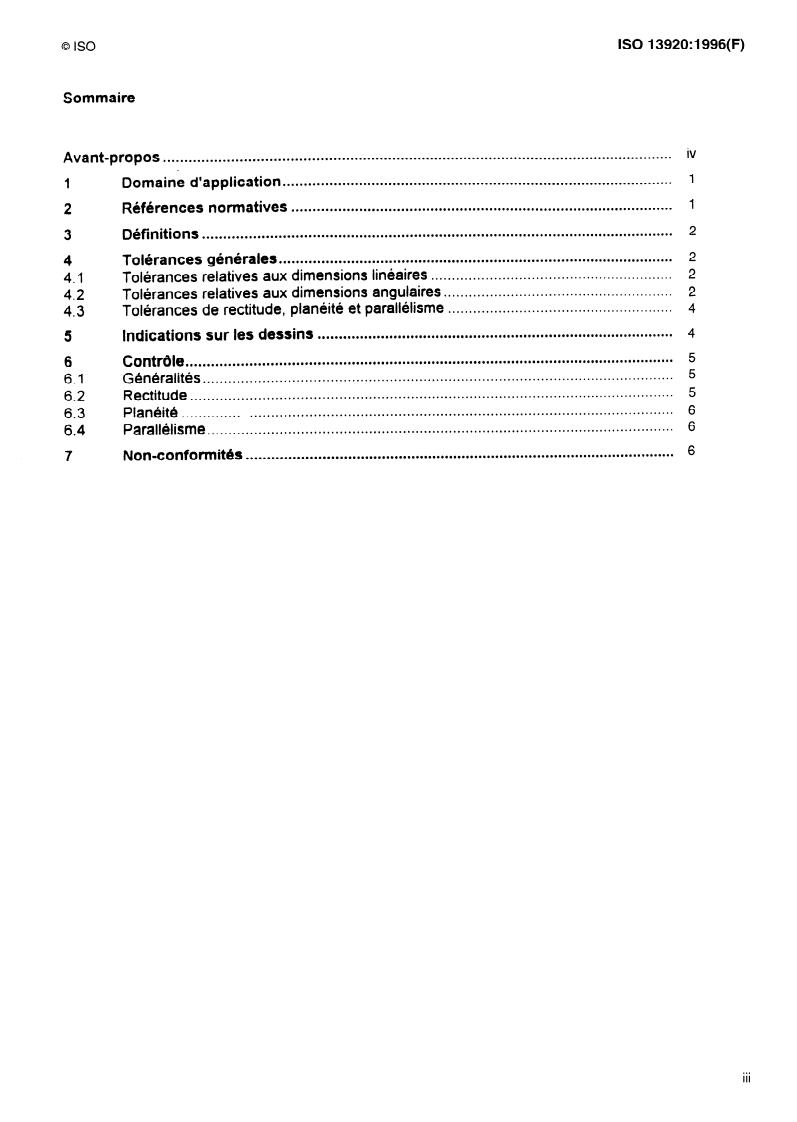
ISO 13920:1996 - Soudage — Tolérances générales relatives aux constructions soudées — Dimensions des longueurs et angles — Formes et positions Released:8/1/1996
Overview
ISO 13920:1996 is an international standard established by the International Organization for Standardization (ISO) that specifies general tolerances for welded constructions. This standard defines acceptable limits for linear and angular dimensions, as well as shape and position tolerances for welded structures, based on customary workshop accuracy. It categorizes tolerances into four classes to suit different functional requirements of welded assemblies, weldments, and complex welding structures.
The standard promotes uniformity in welded construction quality by providing clear guidance on dimensional and geometric tolerances. Its application ensures welds maintain structural integrity and meet design specifications without the need for overly restrictive or loose tolerances, optimizing production efficiency and quality control.
Key Topics
- Tolerance Classes: ISO 13920 specifies four tolerance classes that relate to different levels of workshop accuracy, enabling selection based on the functional requirements of the welded product.
- Linear Dimensions: Detailed tables define permissible deviations for linear measurements, scaling from small to very large dimensions (up to 20,000 mm).
- Angular Dimensions: Angular tolerances depend on the length of the shorter leg of an angle, with allowances explicitly set for different size ranges.
- Shape and Position Tolerances: The standard covers tolerances for straightness, flatness, and parallelism of welded parts, ensuring geometric accuracy and dimensional stability.
- Indications on Drawings: ISO 13920 recommends clear notation of tolerance classes on technical drawings to ensure correct application during manufacturing and inspection.
- Measurement and Testing Methods: Guidance includes using appropriate instruments such as dial gauges, vernier calipers, straightedges, and optical devices to verify compliance with tolerances.
- Non-conformities: The standard permits acceptance decisions based on the suitability of components for their intended purpose, providing practical flexibility in quality control.
Applications
ISO 13920:1996 is widely applicable across industries involving metal fabrication and welding, including:
- Structural Steel Fabrication: Ensuring that beams, columns, and welded frameworks meet dimensional requirements crucial for safety and functionality.
- Mechanical Engineering: Providing weld tolerance guidelines for manufacturing machinery parts and assemblies requiring precise fit and alignment.
- Shipbuilding and Offshore Engineering: Where large welded constructions demand consistent tolerances for reliable strength and structural integrity.
- Automotive and Transportation: Supporting the production of welded chassis, frames, and structural components with controlled dimensional and angular deviations.
- Construction and Heavy Equipment: Enabling the manufacture of welded components for cranes, platforms, and other heavy machinery with assured geometric conformity.
By applying ISO 13920, manufacturers can minimize rework, optimize material usage, and reduce quality inspection times while maintaining compliance with international welding standards.
Related Standards
- ISO 1101 – Geometrical Product Specifications (GPS): Tolerancing of Form, Orientation, Location, and Run-out: Provides foundational principles and methods for geometric dimensioning and tolerancing referenced in ISO 13920.
- ISO 8015 – Fundamentals of Geometrical Product Specifications: Establishes the principle of independence of dimensional and geometrical tolerances adopted by ISO 13920.
- ISO 3599 & ISO 6906 – Vernier Calipers: Specifies design and metrological requirements for measuring instruments used in verifying weld dimensions.
- ISO/DIS 463 – Dial Gauges: Defines design and accuracy requirements of dial gauges applicable in testing straightness, flatness, and parallelism in welding.
- ISO 10042 – Welding – Arc-welded joints in steel: Complements ISO 13920 by addressing quality levels and inspection criteria specific to arc-welded joints.
By incorporating the guidelines of ISO 13920:1996, engineers, fabricators, and inspectors gain a robust framework for managing dimensional and geometric tolerances in welded constructions, promoting functional reliability and international harmonization in welding technology.
Relations
- Effective Date
- 12-Feb-2026
- Effective Date
- 06-Jun-2022
- Effective Date
- 12-Nov-2022
Buy Documents
ISO 13920:1996 - Welding — General tolerances for welded constructions — Dimensions for lengths and angles — Shape and position Released:8/1/1996
ISO 13920:1996 - Soudage — Tolérances générales relatives aux constructions soudées — Dimensions des longueurs et angles — Formes et positions Released:8/1/1996
Get Certified
Connect with accredited certification bodies for this standard

DVS-ZERT GmbH
German welding certification society.
BSMI (Bureau of Standards, Metrology and Inspection)
Taiwan's standards and inspection authority.
CARES (UK Certification Authority for Reinforcing Steels)
UK certification for reinforcing steels and construction.
Sponsored listings
Frequently Asked Questions
ISO 13920:1996 is a standard published by the International Organization for Standardization (ISO). Its full title is "Welding — General tolerances for welded constructions — Dimensions for lengths and angles — Shape and position". This standard covers: Specifies general tolerances for linear and angular dimensions and for shape and position of welded structures in four classes, these being based on customary workshop accuracy. The main criterion for the selection of a particular class should be the functional requirements.
Specifies general tolerances for linear and angular dimensions and for shape and position of welded structures in four classes, these being based on customary workshop accuracy. The main criterion for the selection of a particular class should be the functional requirements.
ISO 13920:1996 is classified under the following ICS (International Classification for Standards) categories: 17.040.10 - Limits and fits; 25.160.10 - Welding processes. The ICS classification helps identify the subject area and facilitates finding related standards.
ISO 13920:1996 has the following relationships with other standards: It is inter standard links to EN ISO 13920:1996, ISO 3743-1:2010, ISO 13920:2023. Understanding these relationships helps ensure you are using the most current and applicable version of the standard.
ISO 13920:1996 is available in PDF format for immediate download after purchase. The document can be added to your cart and obtained through the secure checkout process. Digital delivery ensures instant access to the complete standard document.
Standards Content (Sample)
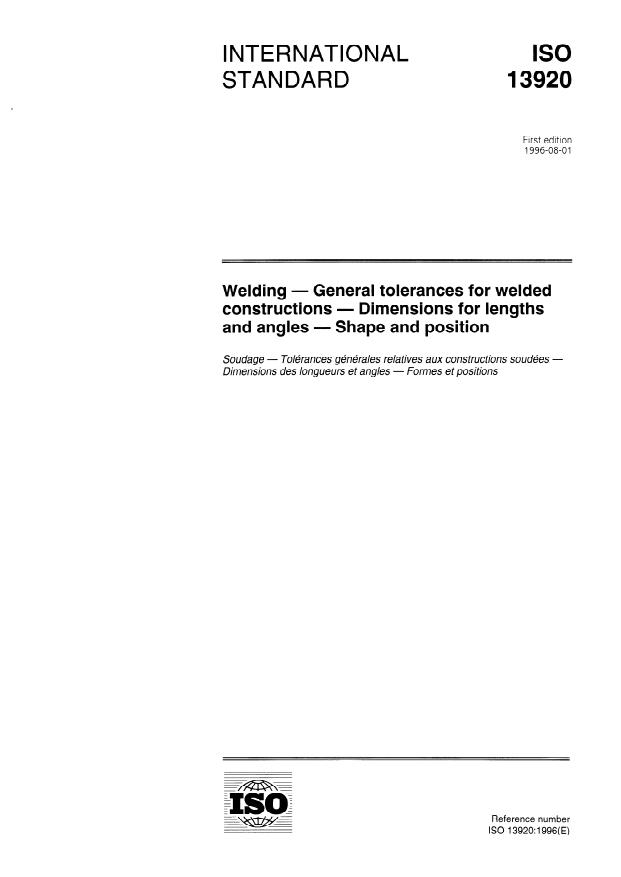
INTERNATIONAL IS0
STANDARD
First edition
1996-08-o 1
Welding - General tolerances for welded
constructions - Dimensions for lengths
and angles - Shape and position
Tolkrances g&Wales relatives aux constructions soudhes -
Soudage -
Dimensions des longueurs et angles - Formes et positions
Reference number
IS0 13920: 1996(E)
IS0 13920: 1996(E)
Foreword
IS0 (the International Organization for Standardization) is a worldwide
federation of national standards bodies (IS0 member bodies). The work of
preparing International Standards is normally carried out through IS0
technical committees. Each member body interested in a subject for which
a technical committee has been established has the right to be represented
on that committee. International organizations, governmental and non-
governmental, in liaison with ISO, also take part in the work. IS0
collaborates closely with the International Electrotechnical Commission
(IEC) on all matters of electrotechnical standardization.
Draft International Standards adopted by the technical committees are
circulated to the member bodies for voting. Publication as an International
Standard requires approval by at least 75 % of the member bodies casting
a vote.
International Standard IS0 13920 was prepared by the European
Committee for Standardization (CEN) in collaboration with IS0 Technical
Committee TC 44, Welding and allied processes, Subcommittee SC IO,
Unification of requirements in the field of metal welding, in accordance with
the Agreement on technical cooperation between IS0 and CEN (Vienna
Agreement).
0 IS0 1996
All rights reserved. Unless otherwise specified, no part of this publication may be reproduced
or utilized in any form or by any means, electronic or mechanical, including photocopying and
microfilm, without permission in writing from the publisher.
International Organization for Standardization
Case postale 56 l CH-1211 Geneve 20 l Switzerland
Internet central @ isocs.iso.ch
c=ch; a=400net; p=iso; o=isocs; s=central
x.400
Printed in Switzerland
0 IS0
IS0 13920:1996(E)
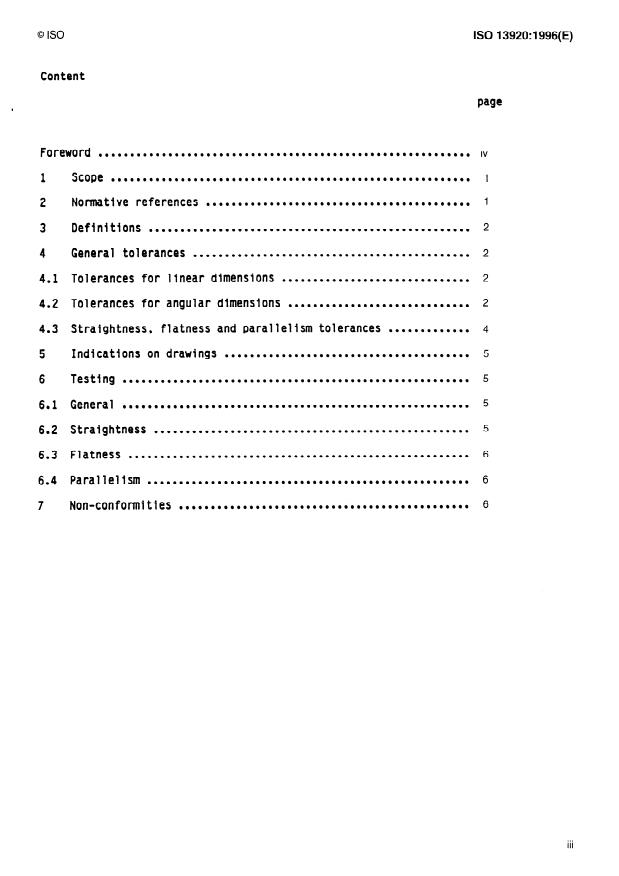
Content
page
*.ooooooo*ooooooomoooooooooooooooooooooo*oOoeoooooooooooooo
Foreword iv
Scope oo*oooooooooooOooooOOOoOoooooOOooOOoeOOoOoOOOooOOOoOO**** 1
OOOOomOOOOOooOoOOoOOoOOOoOOOOOoOoOOOOO****
Normatlve references
Definitions OOOOOOoOOOOoOOoOOOOoOoOOOOOoO~OOOOOOOooOooOOOOoooo*
General tolerances l OOOoOOOOOOOOOOOOOOOOOOOOOOOOOooooOOmOOoooo.
Tolerances for 1 inear dimensions l OoOOOOOOOOOOOOOOooOoOOOOoO.*
4.1
Tolerances for angular dimensions l ~OOOO~OOOOOOOOOOOOOO~OOO~~OO
4.2
4.3 Straightness, flatness and parallelbm tolerances l OO~OOOOOOOOO
Indications on drawings l OOOO~OOOOOOOO~OOOOOOOOO~O~~~OOOOO~OOOO
Testing ~OO~OOOOOO~OOOOOOOO~OOOOOOOOOOOOOOOOOOOOOO~OO~OOOO~O~OO
OOOoOOoOOoOoOoOeOOOOOOoOOOoooOOOOOOOOoOOo~oOOOOOOOoOooO
6 0 1 General
OOO~OOOOOOOOOOOO~~OOOOOOOOOOOOOOOOOOO~~OOOOOOOO~OO
62 0 Straightness
OOOOoOOo*oOOoOOoOOOoOOOoOOOOOOOOOOOoOOOOOOOoOOOOOOOOOO
63 0 Flatness
OOOOOOomOOmooOoooooOOOOOOOOOoOOoOOOoOOoOOOoOOOOoooO
64 0 Parallelism
l 0o~oo~oo~~~*~o~~o~~~~o~o~oo~~~ooo~oo~~o~oo000
7 Non-conformities
. . .
III
IS0 13920:1996(E) @ IS0
Foreword
The text of EN IS0 13920:1996 has been prepared by Technical
Committee CEN/TC 121 “Welding”, the secretariat of which is held
by DS, in collaboration with Technical Committee ISO/TC 44
“Welding and allied processes”.
This European Standard shall be given the status of a national
standard, either by publication of an identical text or by
endorsement, at the latest by February 1997, and conflicting
national standards shall be withdrawn at the latest by
February 1997.
According to the CEN/CENELEC Internal Regulations, the national
standards organizations of the following countries are bound to
implement this European Standard: Austria, Belgium, Denmark,
Finland, France, Germany, Greece, Iceland, Ireland, Italy,
Luxembourg, Netherlands, Norway, Portugal, Spain, Sweden,
Switzerland and the United Kingdom.
@ IS0
3920: 1996(E)
1 scope
This European Standard specifies general tolerances for linear and angl lar di-
mensions and for shape and position of welded structures in four tolerance clas-
ses, these being based on customary workshop accuracy. The main criterion for
the selection of a particular tolerance class should be the functional require-
ments which are to be met.
The applicable tolerances are always those which are stated in the drawing.
Instead of specifying individual tolerances the tolerance classes according to
this standard may be used.
General tolerances for linear and angular dimensions and for shape and position
as specified in this standard apply for weldments, welding assemblies and welded
structures etc.
Special provisions may be necessary for complex structures.
The specifications given in this standard are based on the principle of indepen-
dency as specified in IS0 8015, according to which the dimensional and geometri-
cal tolerances apply independently of each other.
Manufacturing documentation in which linear and angular dimensions or indica-
tions for shape and position are presented without individually indicated tole-
rances shall be deemed incomplete if there is no, or inadequate, reference to
general tolerances. This does not apply to temporary dimensions.
2 Normative references
by dated or undated reference, provisions
This European Standard incorporates
from other publications. These normative references are cited at the appropriate
For dated
place in the text and the publications are listed hereafter.
subsequent amendments to or revisions of any of these publications
references,
apply to this European Standard only when incorporated in it by amendment or
revision. For undated references the last edition of the publication referred to
applies.
Geometrical Product Specifications (GPS) - Dimensional
ISO/DIS 463
measuring instruments; Dial gauges - Design and metrological
requirements
prEN IS0 1101 Technical drawings - Geometrical tolerant ng Tolerances of
form, orientation, location and run-out - Generalities,
definitions, symbols, indications on draw
ngs (ISO/DIS 1101:1995)
Vernier callipers reading to 0,l and 0,05 ml
IS0 3599 -
Vernier callipers reading to 0,02 mn
IS0 6906
Fundamental tolerancin
...
IS0
NORME
INTERNATIONALE 13920
Premiere edition
1996-08-o 1
Soudage - Tolbrances g&Wales relatives
aux constructions soud6es - Dimensions
des longueurs et angles - Formes et
positions
Welding - General tolerances for welded constructions - Dimensions for
lengths and angles - Shape and position
Numb0 de reference
IS0 13920: 1996(F)
IS0 13920: 1996(F)
Avant-propos
L ’ISO (Organisation internationale de normalisation) est une federation
mondiale d ’organismes nationaux de normalisation (comites membres de
I ’ISO). L ’elaboration des Normes internationales est en general confiee aux
comites techniques de I ’ISO. Chaque comite membre interesse par une
etude a le droit de faire partie du comite technique tree a cet effet. Les
organisations internationales, gouvernementales et non gouvernementales,
en liaison avec I ’ISO participent egalement aux travaux. L ’ISO collabore
etroitement avec la Commission electrotechnique internationale (CEI) en
ce qui concerne la normalisation electrotechnique.
Les projets de Normes internationales adopt& par les comites techniques
sont soumis aux comites membres pour vote. Leur publication comme
Normes internationales requiert I ’approbation de 75 % au moins des
comites membres votants.
La Norme internationale IS0 13920 a ete elaboree par le Comite europeen
de normalisation (CEN) en collaboration avec le comite technique
ISO/TC 44, Soudage et techniques connexes, sous-comite SC IO,
Unification des prescriptions dans la technique du soudage des mktaux,
conformement a I ’Accord de cooperation technique entre I ’ISO et le CEN
(Accord de Vienne).
0 IS0 1996
Droits de reproduction reserves. Sauf prescription differente, aucune partie de cette publi-
cation ne peut etre reproduite ni utilisee sous quelque forme que ce soit et par aucun pro-
cede, electronique ou mecanique, y compris la photocopie et les microfilms, sans I ’accord
ecrit de I ’editeur.
Organisation internationale de normalisation
Case postale 56 l CH-1211 Geneve 20 l Suisse
Internet central @I isocs.iso.ch
x.400 c=ch; a=40Onet; p=iso; o=isocs; s=central
lmprime en Suisse
ii
@ IS0 IS0 13920: 1996(F)
Sommaire
iv
Avant-propos .
.............................................................................................
1 Domaine d ’application
...........................................................................................
Rbfbrences normatives
................................................................................................................
3 D6finitions
..............................................................................................
4 Tolbrances g&kales
.......................................................... 2
Tol&ances relatives aux dimensions linbaires
41 .
....................................................... 2
42 . Tolbances relatives aux dimensions angulaires
......................................................
. Tohances de rectitude, plan&it6 et parallhlisme 4
..................................................................................... 4
5 Indications sur ies dessins
Contr6le .
................................................................................................................
G&Walit&s
61 .
62 . Rectitude .
...................................................................................................................
63 . Plan&b
...............................................................................................................
64 . ParalMisme
Non-confomitb .
. . .
III
IS0 13920: 1996(F) @ IS0
Avant-propos
Le texte du EN IS0 13920:1996 a ete Blabore par le Comite
Technique CEN/TC 121 “Soudage” dont le secretariat est tenu par
le DS, en collaboration avec le Comite Technique ISO/TC 44
“Soudage et techniques connexes ”.
Cette norme europeenne devra recevoir le statut de norme
nationale, soit par publication d ’un texte identique, soit par
enterinement, au plus tard en fevrier 1997, et toutes les normes
nationales en contradiction devront etre retirees au plus tard en
fevrier 1997.
Selon le Reglement Interieur du CENKENELEC, les instituts de
normalisation nationaux des pays suivants sont tenus de mettre
cette norme europeenne en application: Allemagne, Autriche,
Belgique, Danemark, Espagne, Finlande, France, G&e, Irlande,
Islande, Italie, Luxembourg, Norvege, Pays-Bas, Portugal, Royaume-
Uni, Suede et Suisse.
@ IS0
IS0 13920: 1996(F)
1 D ’omaine d ’application
La presente norme europeenne spkifie quatre classes de tolkrances gbnbrales relatives aux
dimensions lineaires et angulaires ainsi qu% la forme et a la position des structures soudbes, ces
classes gtant bashes sur la prkcision cotirante des ateliers. II est recommandb que le principal
critere de choix d ’une classe de tolerance particuli&re soit fond4 sur les exigences fonctionnelles
qui doivent 6tre satisfaites.
Les tolerances applicables sont toujours celles qui sont indiqukes sur le dessin. Les classes de
tokrances mentionnees dans la prhente norme europbenne peuvent &re utilisbes a la place de
tolerances specifi&es individuellement.
Les tol&ances g6n&ales relatives aux dimensions lineaires et angulaires ainsi qu% la forme et a
la position spkifides dans la prhente norme europbenne s ’appliquent aux assemblages soudks
et aux structures soudbes, etc.
Des dispositions speciales peuvent Btre nkessaires pour les structures complexes.
Les sphifications pr&sent&es dans la prbsente norme europbenne sont fond&es sur le principe
d ’indbpendance spkcifih dens I ’ISO 8015, d ’aprbs lequel les tol&ances dimensionnelles et
geometriques s ’appliquent inddpendamment les unes des autres.
La documentation de fabrication dans laquelle les dimensions linbaires et angulaires ou des
indications concemant la forme et la position sont present&es sans que les tol&ances soient
indiquites individuellement doit We considerize comme incompl&te s ’il West pas fait rbfkrence (ou
s ’il est fait reference de manibre inadequate) aux tolbrances g&&ales. Ceci ne s ’applique pas
aux dimensions provisoires.
2 R6fhnces ncwmatives
Cette norme europbenne compotie par reference dathe ou non dat&e des dispositions d ’autres
publications. Ces kfhences normatives sont citbes aux endroits appropries dans le texte et les
Pour les r&f&fences dat&es les amendements ou r&visions
publications sont hum&&es ci-aprh.
ult&ieurs de l ’une quelconque de ces publications ne s ’appliquent A cette norme europeenne que
rhision. Pour les r&f&ences non datkes, la
s ’ils y ont et& incorporbs par amendement ou
dern
...