

SIST EN 81-28:2022
(Main)Safety rules for the construction and installation of lifts - Lifts for the transport of persons and goods - Part 28: Remote alarm on passenger and goods passenger lifts
General Information
- Abstract
This document specifies the technical requirements for the alarm systems for passenger and goods passenger lifts, as described in the EN 81 series.
This includes:
- activation of the alarm,
- transmission of the alarm,
- information for use and maintenance,
- site testing to verify the requirements of this document have been met before the lift is used.
Excluded are:
- the failure of the communication network (see Annex A), including mobile network signal strength or similar;
- the failure of the network power supply such that all the lifts in a geographical area create entrapment simultaneously.
This document deals with the following significant hazards, hazardous situations or hazardous events relevant to lift, when it is used as intended and under conditions of misuse which are reasonably foreseeable by the manufacturer:
- risk of entrapment of users in the car and in the well.
This document is not applicable to alarm systems for lifts installed before the date of its publication.
- Status
- Published
- Public Enquiry End Date
- 20-Dec-2020
- Publication Date
- 21-Aug-2022
- Technical Committee
- DTN - Lift and transport appliances
- Current Stage
- 6060 - National Implementation/Publication (Adopted Project)
- Start Date
- 15-Jun-2022
- Due Date
- 20-Aug-2022
- Completion Date
- 22-Aug-2022
- Directive
- 2014/33/EU - Directive 2014/33/EU of the European Parliament and of the Council of 26 February 2014 on the harmonisation of the laws of the Member States relating to lifts and safety components for lifts (recast)OJ Ref: L 206, OJ L 206 OJ Date: 21-Aug-2023

Overview
EN 81-28:2022 (CEN) is the European safety standard that specifies technical requirements for remote alarm systems on passenger and goods passenger lifts. It covers how an alarm is activated and transmitted, what information must be provided for use and maintenance, and site testing to verify compliance before a lift is put into service. The standard addresses the primary hazardous event of user entrapment in the car or well and applies to lift installations from the date of publication (not retroactive to older installations). EN 81-28:2022 is part of the EN 81 series and is intended to be used with EN 81-20:2020.
Key Topics
- Alarm activation: requirements for the alarm initiation device that users press when trapped.
- Alarm transmission & two‑way communication: rules for reliable transmission to a reception (rescue) point and maintaining two‑way voice/data links (see Annex A).
- Acknowledgement and end of alarm: ensuring the alarm identification is emitted until acknowledged and mechanisms to signal that the entrapment has been resolved.
- Alarm filtering and identification: handling false alarms, ensuring full alarm identification is available to the rescue service.
- Emergency electrical power supply: provisions for power continuity to the alarm equipment where applicable.
- Visible/audible signals: in-car indicators for users and rescue personnel.
- Technical characteristics: availability, reliability, electrical interfaces, accessibility to alarm equipment, and control of parameter modification.
- Information & documentation: user information, maintenance instructions, and guidance for rescue services (Annex B).
- Verification & site testing: mandatory tests and examinations to confirm compliance before use.
- Exclusions: failures of the broader communication network (e.g., mobile signal strength) and total network power loss causing simultaneous entrapments across an area are outside the scope.
Applications
EN 81-28:2022 is used by:
- Lift manufacturers and designers to specify compliant alarm systems integrated into new lifts.
- Installers and system integrators to implement and commission remote alarm equipment.
- Maintenance organizations and rescue services for operational procedures, testing, and training.
- Building owners and facility managers to verify lift safety and regulatory conformity.
- Regulators and conformity assessors for demonstrating compliance with EU directives (see Annex ZA).
Practical benefits include improved emergency response, clearer rescue coordination, and reduced risk from user entrapment.
Related Standards
- EN 81-20:2020 - general safety rules for passenger and goods passenger lifts (to be used alongside EN 81-28).
- EN ISO 12100:2010 - risk assessment and reduction principles.
- ISO 4190-5:2006 - control devices and signals for lift installations.
Keywords: EN 81-28:2022, remote alarm, lift alarm systems, passenger lifts, goods passenger lifts, entrapment, two-way communication, rescue service, CEN.
Relations
- Effective Date
- 25-Aug-2026
- Effective Date
- 28-Jan-2026
- Effective Date
- 28-Jan-2026
- Effective Date
- 01-Jul-2026
- Effective Date
- 09-Feb-2026
- Effective Date
- 28-Jan-2026
- Effective Date
- 28-Jan-2026
- Effective Date
- 28-Jan-2026
- Effective Date
- 28-Jan-2026
- Effective Date
- 28-Jan-2026
- Effective Date
- 28-Jan-2026
- Effective Date
- 28-Jan-2026
- Effective Date
- 28-Jan-2026
- Effective Date
- 28-Jan-2026
- Effective Date
- 22-Nov-2023
Get Certified
Connect with accredited certification bodies for this standard

DIBt (Deutsches Institut für Bautechnik)
German Institute for Building Technology.
DIN CERTCO
DIN Group product certification.

Kiwa BDA Testing
Building and construction product certification.
Sponsored listings
Frequently Asked Questions
SIST EN 81-28:2022 is a standard published by the Slovenian Institute for Standardization (SIST). Its full title is "Safety rules for the construction and installation of lifts - Lifts for the transport of persons and goods - Part 28: Remote alarm on passenger and goods passenger lifts". This standard covers: This document specifies the technical requirements for the alarm systems for passenger and goods passenger lifts, as described in the EN 81 series. This includes: - activation of the alarm, - transmission of the alarm, - information for use and maintenance, - site testing to verify the requirements of this document have been met before the lift is used. Excluded are: - the failure of the communication network (see Annex A), including mobile network signal strength or similar; - the failure of the network power supply such that all the lifts in a geographical area create entrapment simultaneously. This document deals with the following significant hazards, hazardous situations or hazardous events relevant to lift, when it is used as intended and under conditions of misuse which are reasonably foreseeable by the manufacturer: - risk of entrapment of users in the car and in the well. This document is not applicable to alarm systems for lifts installed before the date of its publication.
This document specifies the technical requirements for the alarm systems for passenger and goods passenger lifts, as described in the EN 81 series. This includes: - activation of the alarm, - transmission of the alarm, - information for use and maintenance, - site testing to verify the requirements of this document have been met before the lift is used. Excluded are: - the failure of the communication network (see Annex A), including mobile network signal strength or similar; - the failure of the network power supply such that all the lifts in a geographical area create entrapment simultaneously. This document deals with the following significant hazards, hazardous situations or hazardous events relevant to lift, when it is used as intended and under conditions of misuse which are reasonably foreseeable by the manufacturer: - risk of entrapment of users in the car and in the well. This document is not applicable to alarm systems for lifts installed before the date of its publication.
SIST EN 81-28:2022 is classified under the following ICS (International Classification for Standards) categories: 13.320 - Alarm and warning systems; 91.140.90 - Lifts. Escalators. The ICS classification helps identify the subject area and facilitates finding related standards.
SIST EN 81-28:2022 has the following relationships with other standards: It is inter standard links to SIST ISO 4190-5:2012, SIST EN ISO 12100:2011, SIST EN 81-20:2020, SIST EN ISO 8100-1:2026, SIST EN 50600-2-1:2021, SIST EN 12015:2005, SIST EN 81-76:2025, SIST EN 13015:2002+A1:2008, SIST EN 81-20:2014, SIST EN 81-80:2004, SIST EN 81-71:2022, SIST EN 81-80:2019, SIST EN 81-31:2025, SIST EN 81-42:2026, oSIST prEN 81-28:2025. Understanding these relationships helps ensure you are using the most current and applicable version of the standard.
SIST EN 81-28:2022 is associated with the following European legislation: EU Directives/Regulations: 2014/33/EU, EUR-PUB; Standardization Mandates: M/549. When a standard is cited in the Official Journal of the European Union, products manufactured in conformity with it benefit from a presumption of conformity with the essential requirements of the corresponding EU directive or regulation.
SIST EN 81-28:2022 is available in PDF format for immediate download after purchase. The document can be added to your cart and obtained through the secure checkout process. Digital delivery ensures instant access to the complete standard document.
Standards Content (Sample)
SLOVENSKI STANDARD
01-september-2022
Varnostna pravila za konstruiranje in vgradnjo dvigal (liftov) - Dvigala za prevoz
oseb in blaga - 28. del: Alarmi v osebnih in osebno-tovornih dvigalih
Safety rules for the construction and installation of lifts - Lifts for the transport of persons
and goods - Part 28: Remote alarm on passenger and goods passenger lifts
Sicherheitsregeln für die Konstruktion und den Einbau von Aufzügen - Aufzüge für den
Personen- und Gütertransport - Teil 28: Fern-Notruf für Personen- und Lastenaufzüge
Règles de sécurité pour la construction et l'installation des élévateurs - Élévateur pour le
transport de personnes et d'objets - Partie 28 : Téléalarme pour ascenseurs et
ascenseurs de charge
Ta slovenski standard je istoveten z: EN 81-28:2022
ICS:
13.320 Alarmni in opozorilni sistemi Alarm and warning systems
91.140.90 Dvigala. Tekoče stopnice Lifts. Escalators
2003-01.Slovenski inštitut za standardizacijo. Razmnoževanje celote ali delov tega standarda ni dovoljeno.
EN 81-28
EUROPEAN STANDARD
NORME EUROPÉENNE
June 2022
EUROPÄISCHE NORM
ICS 13.320; 91.140.90 Supersedes EN 81-28:2018+AC:2019
English Version
Safety rules for the construction and installation of lifts -
Lifts for the transport of persons and goods - Part 28:
Remote alarm on passenger and goods passenger lifts
Règles de sécurité pour la construction et l'installation Sicherheitsregeln für die Konstruktion und den Einbau
des élévateurs - Élévateur pour le transport de von Aufzügen - Aufzüge für den Personen- und
personnes et d'objets - Partie 28 : Téléalarme pour Gütertransport - Teil 28: Fern-Notruf für Personen-
ascenseurs et ascenseurs de charge und Lastenaufzüge
This European Standard was approved by CEN on 20 April 2022.
CEN members are bound to comply with the CEN/CENELEC Internal Regulations which stipulate the conditions for giving this
European Standard the status of a national standard without any alteration. Up-to-date lists and bibliographical references
concerning such national standards may be obtained on application to the CEN-CENELEC Management Centre or to any CEN
member.
This European Standard exists in three official versions (English, French, German). A version in any other language made by
translation under the responsibility of a CEN member into its own language and notified to the CEN-CENELEC Management
Centre has the same status as the official versions.
CEN members are the national standards bodies of Austria, Belgium, Bulgaria, Croatia, Cyprus, Czech Republic, Denmark, Estonia,
Finland, France, Germany, Greece, Hungary, Iceland, Ireland, Italy, Latvia, Lithuania, Luxembourg, Malta, Netherlands, Norway,
Poland, Portugal, Republic of North Macedonia, Romania, Serbia, Slovakia, Slovenia, Spain, Sweden, Switzerland, Turkey and
United Kingdom.
EUROPEAN COMMITTEE FOR STANDARDIZATION
COMITÉ EUROPÉEN DE NORMALISATION
EUROPÄISCHES KOMITEE FÜR NORMUNG
CEN-CENELEC Management Centre: Rue de la Science 23, B-1040 Brussels
© 2022 CEN All rights of exploitation in any form and by any means reserved Ref. No. EN 81-28:2022 E
worldwide for CEN national Members.
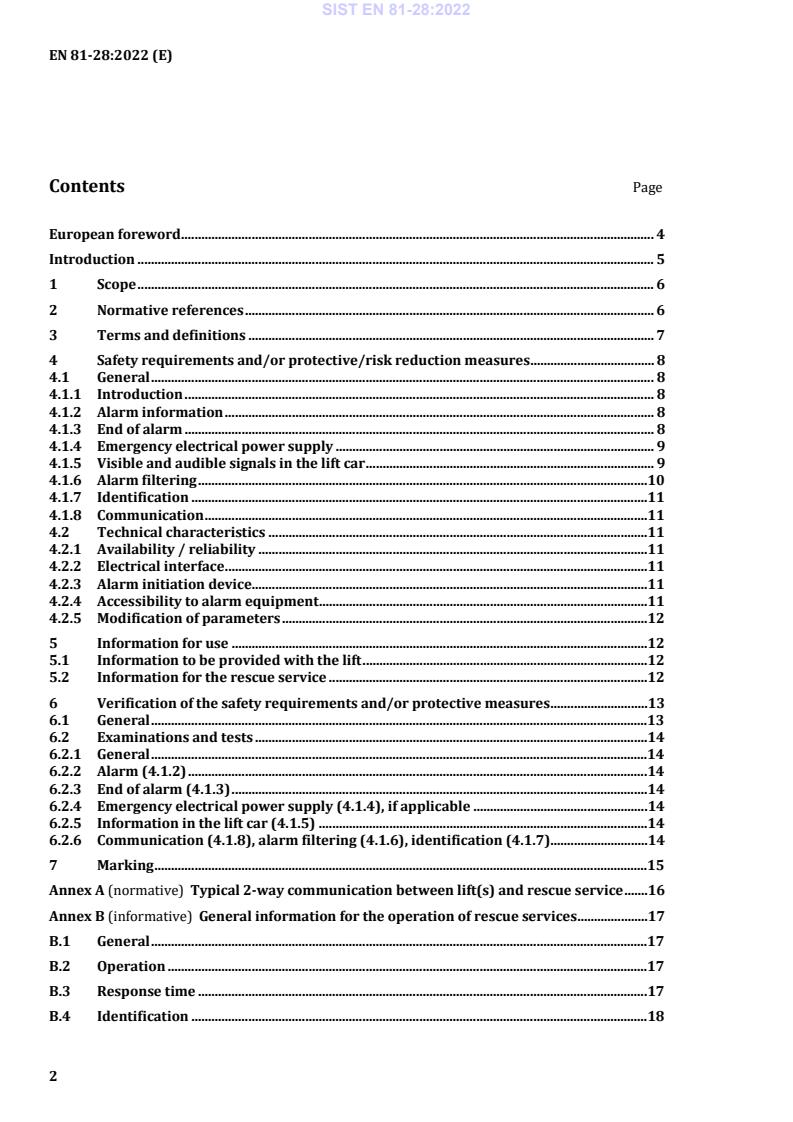
Contents Page
European foreword . 4
Introduction . 5
1 Scope . 6
2 Normative references . 6
3 Terms and definitions . 7
4 Safety requirements and/or protective/risk reduction measures . 8
4.1 General . 8
4.1.1 Introduction . 8
4.1.2 Alarm information . 8
4.1.3 End of alarm . 8
4.1.4 Emergency electrical power supply . 9
4.1.5 Visible and audible signals in the lift car . 9
4.1.6 Alarm filtering .10
4.1.7 Identification .11
4.1.8 Communication .11
4.2 Technical characteristics .11
4.2.1 Availability / reliability .11
4.2.2 Electrical interface .11
4.2.3 Alarm initiation device.11
4.2.4 Accessibility to alarm equipment .11
4.2.5 Modification of parameters .12
5 Information for use .12
5.1 Information to be provided with the lift .12
5.2 Information for the rescue service .12
6 Verification of the safety requirements and/or protective measures .13
6.1 General .13
6.2 Examinations and tests .14
6.2.1 General .14
6.2.2 Alarm (4.1.2) .14
6.2.3 End of alarm (4.1.3) .14
6.2.4 Emergency electrical power supply (4.1.4), if applicable .14
6.2.5 Information in the lift car (4.1.5) .14
6.2.6 Communication (4.1.8), alarm filtering (4.1.6), identification (4.1.7).14
7 Marking .15
Annex A (normative) Typical 2-way communication between lift(s) and rescue service .16
Annex B (informative) General information for the operation of rescue services .17
B.1 General .17
B.2 Operation .17
B.3 Response time .17
B.4 Identification .18
B.5 Communication . 18
B.6 Back-up service . 18
B.7 Testing . 18
B.8 Training . 18
Annex ZA (informative) Relationship between this European Standard and the essential
requirements of Directive 2014/33/EU aimed to be covered . 19
Bibliography . 20
European foreword
This document (EN 81-28:2022) has been prepared by Technical Committee CEN/TC 10 “Lifts, escalators
and moving walks”, the secretariat of which is held by AFNOR.
This European Standard shall be given the status of a national standard, either by publication of an
identical text or by endorsement, at the latest by December 2022, and conflicting national standards shall
be withdrawn at the latest by June 2024.
Attention is drawn to the possibility that some of the elements of this document may be the subject of
patent rights. CEN shall not be held responsible for identifying any or all such patent rights.
This document supersedes EN 81-28:2018+AC:2019.
In comparison with EN 81-28:2018+AC:2019, the following significant changes have been made:
— normative references have been updated;
— Annex ZA has been modified.
No technical changes have been made in Clause 4 during this revision.
This document is intended to be used in conjunction with the EN 81-20:2020, which gives the basic
requirements for passenger and goods passenger lifts.
This document is part of the EN 81 series of standards. The structure of the EN 81 series is described in
CEN/TR 81-10:2008.
This document has been prepared under a Standardization Request given to CEN by the European
Commission and the European Free Trade Association, and supports essential requirements of EU
Directive(s) / Regulation(s).
For relationship with EU Directive(s) / Regulation(s), see informative Annex ZA, which is an integral part
of this document.
Any feedback and questions on this document should be directed to the users’ national standards body.
A complete listing of these bodies can be found on the CEN website.
According to the CEN-CENELEC Internal Regulations, the national standards organisations of the
following countries are bound to implement this European Standard: Austria, Belgium, Bulgaria, Croatia,
Cyprus, Czech Republic, Denmark, Estonia, Finland, France, Germany, Greece, Hungary, Iceland, Ireland,
Italy, Latvia, Lithuania, Luxembourg, Malta, Netherlands, Norway, Poland, Portugal, Republic of North
Macedonia, Romania, Serbia, Slovakia, Slovenia, Spain, Sweden, Switzerland, Turkey and the United
Kingdom.
Introduction
This document is a type-C standard as stated in EN ISO 12100.
This document is of relevance, in particular, for the following stakeholder groups representing the market
players with regard to machinery safety:
— machine manufacturers (small, medium and large enterprises);
— health and safety bodies (regulators, accident prevention organizations, market surveillance etc.).
Others can be affected by the level of machinery safety achieved with the means of the document by the
above-mentioned stakeholder groups:
— machine users/employers (small, medium and large enterprises);
— machine users/employees (e.g. trade unions, organizations for people with special needs);
— service providers, e.g. for maintenance (small, medium and large enterprises);
— consumers (in case of machinery intended for use by consumers).
The above-mentioned stakeholder groups have been given the possibility to participate in the drafting
process of this document.
The machinery concerned and the extent to which hazards, hazardous situations or hazardous events are
covered are indicated in the Scope of this document.
When requirements of this type-C standard are different from those which are stated in type-A or type-B
standards, the requirements of this type-C standard take precedence over the requirements of the other
standards for machines that have been designed and built according to the requirements of this type-C
standard.
1 Scope
This document specifies the technical requirements for the alarm systems for passenger and goods
passenger lifts, as described in the EN 81 series.
This includes:
— activation of the alarm,
— transmission of the alarm,
— information for use and maintenance,
— site testing to verify the requirements of this document have been met before the lift is used.
Excluded are:
— the failure of the communication network (see Annex A), including mobile network signal strength
or similar;
— the failure of the network power supply such that all the lifts in a geographical area create
entrapment simultaneously.
This document deals with the following significant hazards, hazardous situations or hazardous events
relevant to lift, when it is used as intended and under conditions of misuse which are reasonably
foreseeable by the manufacturer:
— risk of entrapment of users in the car and in the well.
This document is not applicable to alarm systems for lifts installed before the date of its publication.
2 Normative references
The following documents are referred to in the text in such a way that some or all of their content
constitutes requirements of this document. For dated references, only the edition cited applies. For
undated references, the latest edition of the referenced document (including any amendments) applies.
EN 81-20:2020, Safety rules for the construction and installation of lifts — Lifts for the transport of persons
and goods — Part 20: Passenger and goods passenger lifts
EN ISO 12100:2010, Safety of machinery — General principles for design — Risk assessment and risk
reduction (ISO 12100:2010)
ISO 4190-5:2006, Lift (Elevator) installation — Part 5: Control devices, signals and additional fittings
3 Terms and definitions
For the purposes of this document, the terms and definitions given in EN ISO 12100:2010, EN 81-20:2020
and the following apply.
ISO and IEC maintain terminological databases for use in standardization at the following addresses:
— ISO Online browsing platform: available at https://www.iso.org/obp
— IEC Electropedia: available at https://www.electropedia.org/
3.1
alarm
status between a person who is entrapped pushing the initiation device until the time all rescue actions
are completed
3.2
acknowledgement
confirmation (answer) by the rescue service to the alarm equipment that the alarm has been received
3.3
alarm equipment
part of the alarm system able to detect, identify, validate as true alarm and initiate 2-way communication
Note 1 to entry: The alarm equipment is part of the lift.
3.4
end of alarm
information issued by the alarm system and destined for the rescue service in order to inform it that the
entrapment situation is ended
3.5
alarm initiation device
device intended for users trapped in the lift installation in order to call for external assistance,
exemplified in Annex A
3.6
alarm system
combination of alarm initiation device(s) and alarm equipment exemplified in Annex A
3.7
human response
response performed directly by a person of the rescue service via the alarm system
3.8
reception equipment
equipment outside of the lift (e.g. at the rescue service) capable of handling alarm identification and 2-
way communication exemplified in Annex A
3.9
rescue service
organization in charge of receiving alarm identification and rescuing users trapped in the lift installation,
exemplified in Annex A
Note 1 to entry: A rescue service can be part of the maintenance organization.
Note 2 to entry: See Annex B.
3.10
transmitter
part of a 2-way communication system which sends voice and data to the reception equipment
exemplified in Annex A
4 Safety requirements and/or protective/risk reduction measures
4.1 General
4.1.1 Introduction
Alarm systems shall comply with the safety requirements and/or protective measures of Clause 4.
In addition, alarm systems shall be designed according to the principles of EN ISO 12100:2010 for
relevant but not significant hazards which are not dealt with by this document.
4.1.2 Alarm information
The alarm equipment shall ensure that subject to 4.1.6 alarm filtering, the full alarm identification
(see 4.1.7) will be emitted until acknowledgement, even during maintenance.
If an emission fails before acknowledgement, the delay between re-emission(s) shall be reduced to the
minimum compatible with the communication network.
If the communication is interrupted any re-emission after acknowledgement shall not be impeded by the
alarm equipment. The alarm system shall be able to accept communication from the rescue service until
the end of the alarm has occurred.
Emission of the alarm identification to the transmitter shall not be delayed, except during alarm filtering.
Between the acknowledgement and the end of alarm, any alarm filtering shall be bypassed.
After acknowledgement, if the communication is interrupted, the alarm equipment shall stop automatic
re-emission.
4.1.3 End of alarm
Means shall be provid
...