

SIST EN 15213-3:2013
(Main)Intelligent transport systems - After-theft systems for the recovery of stolen vehicles - Part 3: Interface and system requirements in terms of short range communication system
General Information
- Abstract
This European Standard focuses on Short Range (SR) Interface/Systems Requirements. SR systems use an interface that allows Detection Equipment to operate some ATSVR functions in the direct line of sight of vehicles.
SR systems enable LEAs in a particular country, to permit LEA personnel to perform actions on vehicles that are within their immediate vicinity. Such actions can include identification of vehicle data or influencing the vehicle from a remote site.
Standards for Automatic Vehicle Identification (AVI) and Automatic Equipment Identification (AEI) are being developed by CEN/TC 278/WG 12 in parallel with ISO/TC 204/WG 4. This ATSVR specification does not prejudice those standards and does not seek to establish parameters for future AVI/AEI standards. DSRC and AVI Standards are seen as basic technology blocks for types of short range ATSVR.
This part of EN 15213 describes the structure, bit arrangements, number representation and coding of message elements that are typically transmitted as data. There is no requirement to make the messages as short or as effective as possible. Emphasis is placed on making them as clear and unambiguous as possible.
For Short Range Communications, where there is very little time available for the transfer of data between passing vehicles and detection equipment, only a subset of the message elements described in this document can be transmitted. Therefore, in these cases, the data lengths are reduced to an absolute minimum.
Data elements such as times, dates, or geographical coordinates need not be transmitted because the ATSVR consists of various equipment elements that communicate and interact through various interfaces in accordance with standard procedures and protocols facilitating the recovery of stolen vehicles. These processes may involve a human operator.
ATSVR elements include the OBE installed in the vehicles, a range of Detecting Equipment and one or more System Operating Centres. One or more supporting Infrastructure Networks provides communications to support the ATSVR. The ATSVR location function may also include one or more supporting Position Reference Sources.
Some Short Range devices may be triggered by or may use long range communications and vice versa.
Some Interfaces are not within the scope of this EN. These comprise interfaces to or from sensors, actuators and human operators; from position reference sources, e.g. GPS, LEAs internal interfaces, etc.
Detection Equipment "knows" the time; in case of stationary equipment, it "knows" its coordinates, etc. The Detection Equipment may concatenate these data elements to the data coming from the vehicle, when sending a complete data set to ATSVR System Operating Centres or to LEA as described in other parts of this EN.
Wherever possible the same specifications, data structures, contents, and definitions have been used throughout this EN. This EN does not seek to define the requirements or actions of the various human elements of the ATSVR, but it does aim to identify the interactions and interfaces that exist amongst the equipment and human elements operating within the system.
- Status
- Published
- Publication Date
- 07-Aug-2013
- Technical Committee
- ITC - Information technology
- Current Stage
- 6060 - National Implementation/Publication (Adopted Project)
- Start Date
- 04-Jul-2013
- Due Date
- 08-Sep-2013
- Completion Date
- 08-Aug-2013



Overview
EN 15213-3:2013 is a CEN European Standard that specifies interface and system requirements for short range communication (SR) within After-Theft Systems for Vehicle Recovery (ATSVR). It defines how On‑Board Equipment (OBE), Detection Equipment (DE) and System Operating Centres (SOC) exchange message elements over short-range links (line‑of‑sight or DSRC/AVI-like technologies). The standard emphasizes clear, unambiguous message structure, bit arrangements and coding for SR telegrams, and addresses practical constraints when only very short contact times are available between passing vehicles and roadside detectors.
Key topics and technical requirements
- Scope and architecture
- SR interface requirements for local, near‑vehicle interactions enabling law enforcement to identify or influence nearby vehicles.
- Defines ATSVR elements: OBE, DE, SOC, supporting infrastructure and optional position sources.
- Message structure & data elements
- Prescribes structure, bit arrangements, number representation and coding for message elements transmitted in SR telegrams.
- Prioritizes clarity and unambiguous encoding over minimizing message length.
- Provides a reduced subset and shortened data lengths for cases with limited contact time.
- Functional operations
- Identification function (vehicle/OBE identification).
- Remote activation, deactivation and optional remote degradation functions.
- Theft indication and interaction sequences for SR detection (consulting and signalling modes).
- Operational constraints
- Acknowledges DE may append contextual data (time, location) so some elements need not be sent by the OBE.
- Notes possible interplay between SR and long range mechanisms (triggering or complementing each other).
- Interoperability focus
- Uses common definitions and data structures across EN 15213 parts to enable national and international interoperability between SOCs and LEAs.
Applications and users
- Who uses it
- ITS product vendors, OBE/DE manufacturers, system integrators, vehicle OEMs, law enforcement agencies (LEAs), SOC operators, test laboratories and standards bodies.
- Typical applications
- Roadside detection of stolen vehicles via DSRC/short‑range links.
- Local identification of vehicle data by police or roadside units.
- Remote commands in the immediate vicinity (identification, activation/deactivation, optional engine performance degradation).
- Integration of SR detection with broader ATSVR workflows managed by SOCs.
Related standards
- EN 15213 series (Parts 1–5) - reference architecture, common status elements, long range and messaging interfaces
- EN 12253, EN 12795, EN 12834, EN 13372 (DSRC physical, data link, application and profiles)
- EN ISO 14906 (EFC application interface)
- CEN/TC 278 deliverables on AVI/AEI and ATSVR interoperability
Keywords: EN 15213-3:2013, after-theft systems, vehicle recovery, short range communication, ATSVR, DSRC, AVI, AEI, On‑Board Equipment, Detection Equipment, System Operating Centre, interface requirements.
Relations
- Effective Date
- 01-Sep-2013
- Effective Date
- 28-Jan-2026
- Effective Date
- 28-Jan-2026
- Effective Date
- 28-Jan-2026
- Effective Date
- 28-Jan-2026
- Effective Date
- 28-Jan-2026
- Effective Date
- 28-Jan-2026
- Effective Date
- 28-Jan-2026
- Effective Date
- 28-Jan-2026
Get Certified
Connect with accredited certification bodies for this standard

BSI Group
BSI (British Standards Institution) is the business standards company that helps organizations make excellence a habit.

TÜV Rheinland
TÜV Rheinland is a leading international provider of technical services.

TÜV SÜD
TÜV SÜD is a trusted partner of choice for safety, security and sustainability solutions.
Sponsored listings
Frequently Asked Questions
SIST EN 15213-3:2013 is a standard published by the Slovenian Institute for Standardization (SIST). Its full title is "Intelligent transport systems - After-theft systems for the recovery of stolen vehicles - Part 3: Interface and system requirements in terms of short range communication system". This standard covers: This European Standard focuses on Short Range (SR) Interface/Systems Requirements. SR systems use an interface that allows Detection Equipment to operate some ATSVR functions in the direct line of sight of vehicles. SR systems enable LEAs in a particular country, to permit LEA personnel to perform actions on vehicles that are within their immediate vicinity. Such actions can include identification of vehicle data or influencing the vehicle from a remote site. Standards for Automatic Vehicle Identification (AVI) and Automatic Equipment Identification (AEI) are being developed by CEN/TC 278/WG 12 in parallel with ISO/TC 204/WG 4. This ATSVR specification does not prejudice those standards and does not seek to establish parameters for future AVI/AEI standards. DSRC and AVI Standards are seen as basic technology blocks for types of short range ATSVR. This part of EN 15213 describes the structure, bit arrangements, number representation and coding of message elements that are typically transmitted as data. There is no requirement to make the messages as short or as effective as possible. Emphasis is placed on making them as clear and unambiguous as possible. For Short Range Communications, where there is very little time available for the transfer of data between passing vehicles and detection equipment, only a subset of the message elements described in this document can be transmitted. Therefore, in these cases, the data lengths are reduced to an absolute minimum. Data elements such as times, dates, or geographical coordinates need not be transmitted because the ATSVR consists of various equipment elements that communicate and interact through various interfaces in accordance with standard procedures and protocols facilitating the recovery of stolen vehicles. These processes may involve a human operator. ATSVR elements include the OBE installed in the vehicles, a range of Detecting Equipment and one or more System Operating Centres. One or more supporting Infrastructure Networks provides communications to support the ATSVR. The ATSVR location function may also include one or more supporting Position Reference Sources. Some Short Range devices may be triggered by or may use long range communications and vice versa. Some Interfaces are not within the scope of this EN. These comprise interfaces to or from sensors, actuators and human operators; from position reference sources, e.g. GPS, LEAs internal interfaces, etc. Detection Equipment "knows" the time; in case of stationary equipment, it "knows" its coordinates, etc. The Detection Equipment may concatenate these data elements to the data coming from the vehicle, when sending a complete data set to ATSVR System Operating Centres or to LEA as described in other parts of this EN. Wherever possible the same specifications, data structures, contents, and definitions have been used throughout this EN. This EN does not seek to define the requirements or actions of the various human elements of the ATSVR, but it does aim to identify the interactions and interfaces that exist amongst the equipment and human elements operating within the system.
This European Standard focuses on Short Range (SR) Interface/Systems Requirements. SR systems use an interface that allows Detection Equipment to operate some ATSVR functions in the direct line of sight of vehicles. SR systems enable LEAs in a particular country, to permit LEA personnel to perform actions on vehicles that are within their immediate vicinity. Such actions can include identification of vehicle data or influencing the vehicle from a remote site. Standards for Automatic Vehicle Identification (AVI) and Automatic Equipment Identification (AEI) are being developed by CEN/TC 278/WG 12 in parallel with ISO/TC 204/WG 4. This ATSVR specification does not prejudice those standards and does not seek to establish parameters for future AVI/AEI standards. DSRC and AVI Standards are seen as basic technology blocks for types of short range ATSVR. This part of EN 15213 describes the structure, bit arrangements, number representation and coding of message elements that are typically transmitted as data. There is no requirement to make the messages as short or as effective as possible. Emphasis is placed on making them as clear and unambiguous as possible. For Short Range Communications, where there is very little time available for the transfer of data between passing vehicles and detection equipment, only a subset of the message elements described in this document can be transmitted. Therefore, in these cases, the data lengths are reduced to an absolute minimum. Data elements such as times, dates, or geographical coordinates need not be transmitted because the ATSVR consists of various equipment elements that communicate and interact through various interfaces in accordance with standard procedures and protocols facilitating the recovery of stolen vehicles. These processes may involve a human operator. ATSVR elements include the OBE installed in the vehicles, a range of Detecting Equipment and one or more System Operating Centres. One or more supporting Infrastructure Networks provides communications to support the ATSVR. The ATSVR location function may also include one or more supporting Position Reference Sources. Some Short Range devices may be triggered by or may use long range communications and vice versa. Some Interfaces are not within the scope of this EN. These comprise interfaces to or from sensors, actuators and human operators; from position reference sources, e.g. GPS, LEAs internal interfaces, etc. Detection Equipment "knows" the time; in case of stationary equipment, it "knows" its coordinates, etc. The Detection Equipment may concatenate these data elements to the data coming from the vehicle, when sending a complete data set to ATSVR System Operating Centres or to LEA as described in other parts of this EN. Wherever possible the same specifications, data structures, contents, and definitions have been used throughout this EN. This EN does not seek to define the requirements or actions of the various human elements of the ATSVR, but it does aim to identify the interactions and interfaces that exist amongst the equipment and human elements operating within the system.
SIST EN 15213-3:2013 is classified under the following ICS (International Classification for Standards) categories: 13.310 - Protection against crime; 35.200 - Interface and interconnection equipment; 43.040.15 - Car informatics. On board computer systems. The ICS classification helps identify the subject area and facilitates finding related standards.
SIST EN 15213-3:2013 has the following relationships with other standards: It is inter standard links to SIST-TS CEN/TS 15213-3:2006, SIST EN 13372:2004, SIST EN 12795:2003, SIST EN 12253:2004, SIST EN 15213-1:2013, SIST EN ISO 14906:2023, SIST EN 15213-2:2013, SIST EN 12834:2004, SIST EN 15213-4:2013. Understanding these relationships helps ensure you are using the most current and applicable version of the standard.
SIST EN 15213-3:2013 is available in PDF format for immediate download after purchase. The document can be added to your cart and obtained through the secure checkout process. Digital delivery ensures instant access to the complete standard document.
Standards Content (Sample)
2003-01.Slovenski inštitut za standardizacijo. Razmnoževanje celote ali delov tega standarda ni dovoljeno.Inteligentni transportni sistemi - Sistemi za odkrivanje ukradenih vozil - 3. del: Vmesnik in zahteve za potrebe sistema za komunikacijo kratkega dosega1DKEHUHLFKVNRPPXQLNDWLRQVV\VWHPHSystèmes de transport intelligents - Systèmes intervenant après un vol pour la récupération des véhicules - Partie 3: Spécifications d'interface et de système pour les communications à courte portéeIntelligent transport systems - After-theft systems for the recovery of stolen vehicles - Part 3: Interface and system requirements in terms of short range communication system43.040.15Car informatics. On board computer systems35.200Vmesniška in povezovalna opremaInterface and interconnection equipment13.310Varstvo pred kriminalomProtection against crimeICS:Ta slovenski standard je istoveten z:EN 15213-3:2013SIST EN 15213-3:2013en,fr,de01-september-2013SIST EN 15213-3:2013SLOVENSKI
STANDARDSIST-TS CEN/TS 15213-3:20061DGRPHãþD
EUROPEAN STANDARD NORME EUROPÉENNE EUROPÄISCHE NORM
EN 15213-3
June 2013 ICS 35.240.60 Supersedes CEN/TS 15213-3:2006English Version
Intelligent transport systems - After-theft systems for the recovery of stolen vehicles - Part 3: Interface and system requirements in terms of short range communication system
Systèmes de transport intelligents - Systèmes intervenant après un vol pour la récupération des véhicules - Partie 3: Spécifications d'interface et de système pour les communications à courte portée
Intelligente Transportsysteme - Systeme für das Wiederfinden gestohlener Fahrzeuge - Teil 3: Schnittstellen- und Systemanforderungen für Nahbereichskommunikationssysteme This European Standard was approved by CEN on 26 April 2013.
CEN members are bound to comply with the CEN/CENELEC Internal Regulations which stipulate the conditions for giving this European Standard the status of a national standard without any alteration. Up-to-date lists and bibliographical references concerning such national standards may be obtained on application to the CEN-CENELEC Management Centre or to any CEN member.
This European Standard exists in three official versions (English, French, German). A version in any other language made by translation under the responsibility of a CEN member into its own language and notified to the CEN-CENELEC Management Centre has the same status as the official versions.
CEN members are the national standards bodies of Austria, Belgium, Bulgaria, Croatia, Cyprus, Czech Republic, Denmark, Estonia, Finland, Former Yugoslav Republic of Macedonia, France, Germany, Greece, Hungary, Iceland, Ireland, Italy, Latvia, Lithuania, Luxembourg, Malta, Netherlands, Norway, Poland, Portugal, Romania, Slovakia, Slovenia, Spain, Sweden, Switzerland, Turkey and United Kingdom.
EUROPEAN COMMITTEE FOR STANDARDIZATION
COMITÉ EUROPÉEN DE NORMALISATION EUROPÄISCHES KOMITEE FÜR NORMUNG
Management Centre:
Avenue Marnix 17,
B-1000 Brussels © 2013 CEN All rights of exploitation in any form and by any means reserved worldwide for CEN national Members. Ref. No. EN 15213-3:2013: ESIST EN 15213-3:2013
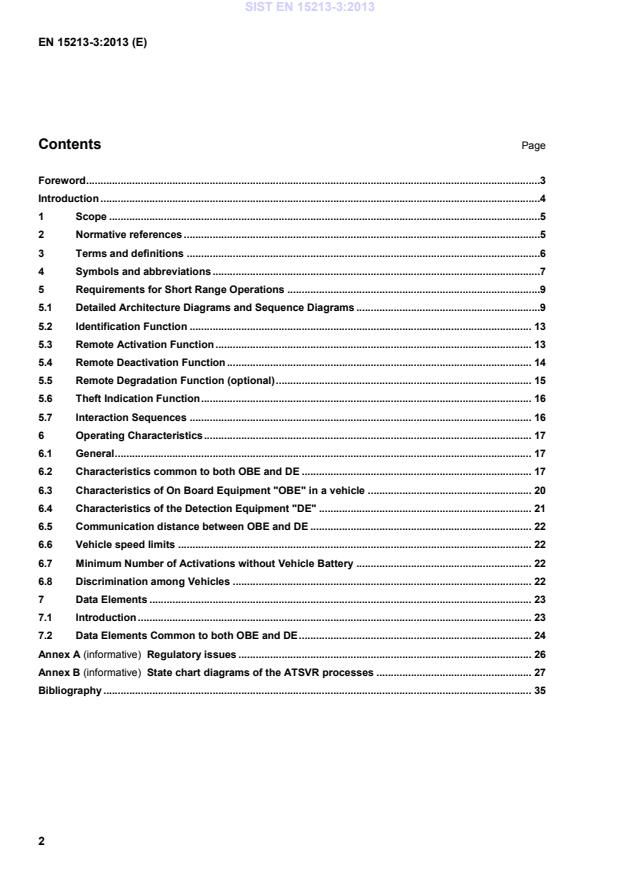
Regulatory issues . 26 Annex B (informative)
State chart diagrams of the ATSVR processes . 27 Bibliography . 35
1) Part 6 awaits final evaluation and ratification as EN and until such time remains a valid part of this EN as CEN/TS 15213-6:2011. SIST EN 15213-3:2013
This document should be read in conjunction with EN 15213-1 which provides the preliminary framework for ATSVR concepts. SIST EN 15213-3:2013
SR systems enable LEAs in a particular country, to permit LEA personnel to perform actions on vehicles that are within their immediate vicinity. Such actions can include identification of vehicle data or influencing the vehicle from a remote site. Standards for Automatic Vehicle Identification (AVI) and Automatic Equipment Identification (AEI) are being developed by CEN/TC 278/WG 12 in parallel with ISO/TC 204/WG 4. This ATSVR specification does not prejudice those standards and does not seek to establish parameters for future AVI/AEI standards. DSRC and AVI Standards are seen as basic technology blocks for types of short range ATSVR. This part of EN 15213 describes the structure, bit arrangements, number representation and coding of message elements that are typically transmitted as data. There is no requirement to make the messages as short or as effective as possible. Emphasis is placed on making them as clear and unambiguous as possible.
For Short Range Communications, where there is very little time available for the transfer of data between passing vehicles and detection equipment, only a subset of the message elements described in this document can be transmitted. Therefore, in these cases, the data lengths are reduced to an absolute minimum.
Data elements such as times, dates, or geographical coordinates need not be transmitted because the ATSVR consists of various equipment elements that communicate and interact through various interfaces in accordance with standard procedures and protocols facilitating the recovery of stolen vehicles. These processes may involve a human operator. ATSVR elements include the OBE installed in the vehicles, a range of Detecting Equipment and one or more System Operating Centres. One or more supporting Infrastructure Networks provides communications to support the ATSVR. The ATSVR location function may also include one or more supporting Position Reference Sources.
Some Short Range devices may be triggered by or may use long range communications and vice versa. Some Interfaces are not within the scope of this EN. These comprise interfaces to or from sensors, actuators and human operators; from position reference sources, e.g. GPS, LEAs internal interfaces, etc. Detection Equipment "knows" the time; in case of stationary equipment, it "knows" its coordinates, etc. The Detection Equipment may concatenate these data elements to the data coming from the vehicle, when sending a complete data set to ATSVR System Operating Centres or to LEA as described in other parts of this EN. Wherever possible the same specifications, data structures, contents, and definitions have been used throughout this EN. This EN does not seek to define the requirements or actions of the various human elements of the ATSVR, but it does aim to identify the interactions and interfaces that exist amongst the equipment and human elements operating within the system. 2 Normative references
The following documents, in whole or in part, are normatively referenced in this document and are indispensable for its application. For dated references, only the edition cited applies. For undated references, the latest edition of the referenced document (including any amendments) applies. EN 12253, Road transport and traffic telematics Dedicated short-range communication Physical layer using microwave at 5,8 GHz SIST EN 15213-3:2013
EN ISO 14906, Electronic fee collection Application interface definition for dedicated short-range communication (ISO 14906) 3 Terms and definitions For the purposes of this document, the terms and definitions given in EN 15213-1:2013 and the following apply. 3.1 AEI automatic equipment identification process of identifying equipment or entities that use surface transportation infrastructures by means of OBE’s combined with the unambiguous data structure defined in these standards 3.2 AIS automatic identification system system for achieving accurate and unambiguous identification of a data bearing OBE, tag, transponder or a natural/prescribed feature, the data or feature being interrogated by means of a system appropriate source 3.3 carrier signal electromagnetic signal that can be modulated to carry lower frequency encoded information across an air interface 3.4 constructed identifier identification which requires a construct of more than one primitive identifier, as defined in ASN.1 3.5 data element structure framework comprising a number of data elements in a prescribed form 3.6 identification function unequivocal identification of vehicles, including those that are not stolen, permitted by the vehicle’s country of origin or registration 3.7 OBE status status of on board equipment (1 byte) SIST EN 15213-3:2013
Note 1 to entry: All construct identifiers will be built from more than one primitive identifier. 3.10 remote activation
electronic communication to the vehicle that is stolen, setting certain bits of information in the vehicle 3.11 remote degradation
potential to degrade from a remote site, the vehicle’s engine performance so as to significantly reduce the speed or cause the thief to park or abandon the vehicle 3.12 session time 4 bytes; coding defined in EN ISO 14906 3.13 short range after theft system for vehicle recovery
ATSVR SR system, within the line of sight or similar short range, that communicates and interacts in accordance with standard procedures and transmission protocols to facilitate the recovery of a Registered Stolen Vehicle 3.14 SR detection by consulting process by which Detection Equipment electronically "consults" passing vehicles for an identity and compares them against a database of stolen vehicles 3.15 SR detection by signalling process by which the stolen vehicle, after a wireless activation process, "signals" to Detection Equipment that it is stolen
3.16 telegram short message data 3.17 vehicle service table
VST information block from the OBE to the RSE during initialisation 4 Symbols and abbreviations A1
EU project ASN.1
Abstract Syntax Notation one ATSVR
After Theft System for Vehicle Recovery AttrID
attribute identifier SIST EN 15213-3:2013
authenticator AVI / AEI Automatic Vehicle Identification/Automatic Equipment Identification CBC
Cipher Block Chaining [CEN_AI] EN ISO 14906: EFC application interface [CEN_L1] EN 12253
DSRC layer1
Physical layer using 5,8 GHz [CEN_L2] EN 12795
DSRC layer2
Data link layer [CEN_L7] EN 12834
DSRC layer7
Application layer [CEN_Pr] EN 13372
DSRC Profiles DE
Detection Equipment DES
Data Encryption Standard (see also TDES) DSRC
Dedicated Short Range Communication EDI
Electronic Data Interchange NOTE Within this context, an EDI message is normally compatible with the form specified in ISO 9897 (CEDEX). EDT
Electronic Data Transfer EFC
Electronic Fee Collection EID
Element ID GSS
Global specifications for short range communication LEA
Law Enforcement Agency (see EN 15213-1) LR
Long Range MAC
Message Authentication Code OBE
On Board Equipment RndOBE
Random number form OBE to RSE RndRSE
Random number from RSE to OBE RSE
Road Side Equipment RTTT
Road Transport and Traffic Telematics SOC
System Operating Centre TDES
Triple DES VST
Vehicle Service Table SIST EN 15213-3:2013
5.1.1 Detection by CONSULTING Architecture Diagram This diagram depicts one subset of the general ATSVR Architectural Diagram. It shows the Operating Centres, Communication Network including the DE, and the vehicle with its OBE together with data streams and interfaces.
Key 1)
Theft shall be reported to the LEA SOC either directly or via an ATSVR SOC. 2) "Reported to be stolen" information is kept by the ATSVR SOC. 3) When the Theft Registration has been reported, the DE is activated (updating the DE data file) either at LEA SOC before being deployed, or remotely via Long Range Infrastructure Network. 4) DE interrogates the OBEs of vehicles in the vicinity ("consulting"). 5) OBE sends back the VIN and theft status of the vehicle (or encrypted information from which VIN and status can be derived). 6) DE compares data from the OBE with its data file of stolen vehicles and determines whether the vehicle is reported as stolen.
7) If the DE has determined that the vehicle status information has to be updated, it sends the appropriate data to the OBE.
8) Acknowledgement that OBE has been updated is reported back and logged in the DE.
9) Data of the detected vehicle together with status information is sent to the LEA SOC.
10) This information is subsequently routed to the ATSVR SOC to update their files.
11) Beyond these technical requirements: LEA SOC or the ATSVR SOC may take appropriate action. Figure 1 — Detection by CONSULTING Architecture Diagram SIST EN 15213-3:2013
This function is especially needed for controls at the roadside, border, harbour, entrance to a parking area, etc. using stationary DEs. In order to support these activities a fast identification-function is provided. The transmission of the VIN and the theft-status is sufficient. All other relevant data about the vehicle can be obtained from the vehicles database. The theft-status in the OBE can be changed via the remote activation function.
Transmission of the theft-status from the OBE to the DE is important because it permits the use of simple DE without connections to a central database of stolen vehicles. It is a pre-requisite that the theft-status of the OBE is up-to-date. Table 1 shows the main events for the case of detection by consulting. Table 1 — Adapted sequence diagram for short range detection by consulting
Main events LEA SOC ATSVR SOC Network DE OBE Theft Registration •
Acknowledgement of the vehicle status • •
Remote DE Notification by updating its file
•
•
Polling of Identification elements by the DE from every surrounding OBE
• • Detection of a vehicle: 1. showing “Theft Status” = ON; OR,
2. if the vehicle is registered as stolen in the DE’s database
•
Report of detection; updating of the theft-status in the OBE •
• •
5.1.3 Detection by SIGNALLING Architecture Diagram
This diagram depicts another subset of the general ATSVR Architectural Diagram. It shows the System Operating Centre(s), the Communication Network(s), including the Detection Equipment, and the Vehicle together with data streams and interfaces. SIST EN 15213-3:2013
Key 1) Theft shall be reported to the LEA SOC either directly or via an ATSVR SOC. 2) "Reported to be stolen" information is kept by the ATSVR SOC. 3) LEA and some specially authorised organisations have access to this file. 4) ATSVR SOC pre-activates the OBE through the Long Range Infrastructure Network. 5) Theft status information is set in the OBE. 6) When in the vicinity of a DE sending interrogation telegrams, the OBE interprets them as a wake up and; 7) OBE starts signalling, i.e. sends periodically the VIN and theft status of the vehicle. 8) Hand held DEs display data from the OBE and mark them as coming from a stolen vehicle.
9) Stationary DEs send the appropriate data to the LEA SOC and/or ATSVR SOC.
10) Beyond these technical requirements: The LEA SOC, the ATSVR SOC or an agent reading the DE information may take appropriate action.
11) In case of vehicle recovery, the OBE's stolen status information shall be reset. Some special equipment using the same DE-OBE-interface may be used. Excellent cryptography shall be used to perform this action. Figure 2 — Detection by SIGNALLING Architecture Diagram The various parts of the system work as follows: a) Theft shall be reported to the LEA SOC either directly or via an ATSVR SOC.
b) Information is put into a file of stolen vehicles, e.g. the stolen vehicle register for the country where the theft takes place and the European central file. The file contains information such as the VIN, make of vehicle, type, colour, license plate number, country of registration of the vehicle, date and time of theft. c) LEA and some specially authorised organisations have access to these files.
EXAMPLE 1 By a point-to-point connection via GSM using e.g. short messages. EXAMPLE 2 By Short Range Communication when the vehicle passes a DE. EXAMPLE 3 By broadcast messages via FM radio using the traffic message channel.
e) This information will "pre-activate" the OBE: The "theft status bit" is set, but transmissions to the outside world ("signalling") will not yet occur. See points f) and g). f) When the "pre-activated" vehicle passes a stationary or mobile detection unit which is sending some short range communication telegrams and if the OBE receives this information, then it interprets it as a wake up command for its signalling device.
g) The OBE energises transmissions for the following vehicle information:
1) "stolen" information; 2) make, type and colour;
3) licence plate number; 4) country of registration;
5) VIN.
h) Hand held readers and/or stationary detection equipment may receive these signals, issue an alarm and may display the signals in an appropriate form in the machine to human interface specifications.
i) Stationary equipment reports the detection of the stolen vehicle to the LEA SOC and/or to the ATSVR SOC. Hand held equipment may also have provisions for sending this information to the LEA and/or ATSVR SOC.
j) After reception, the agent using the DE or the ATSVR SOCs or the LEA may perform appropriate actions to recover the vehicle. These actions are not within the scope of this EN and are given only for clarification.
k) After recovery of the vehicle, the OBE shall be reset to the not-stolen state. If for this purpose the same equipment and interface between the DE and the OBE is used, then very good cryptographic features shall be employed to prevent misuse of this critical resetting.
5.1.4 Detection by SIGNALLING Sequence Diagram A prerequisite to Detection by Signalling is that the OBE has been activated by an external source. This activation may come from a mobile or stationary source, which may be local to the vehicle (short-range) or, in most cases, at a distance from the vehicle (transmission via long-range). Once activated, the OBE will transmit signals (hence "signalling") that can be received by ATSVR Detection Equipment located locally, or at a distance from the vehicle. The transmitted signal may contain other relevant information. Table 2
shows the sequence of events for detection by signalling. SIST EN 15213-3:2013
Acknowledgement of the vehicle status • •
Remote OBE Activation “Theft Status” = on
• •
• Detection of the vehicle signalling " Theft Status = on "
• • Report of detection •
•
In this table the activation of the OBE theft-status is done by long-range communications. The beginning of transmitting the signalling telegrams may be dependent upon prior reception of a short range request from a DE in the vicinity of the vehicle. The short-range activation is described in Annex B.
Discrimination is a very important aspect of detecting a stolen vehicle by signalling in situations where the vehicle is surrounded by several other cars. The officer should be able to determine rapidly which of the vehicles is signalling. This should be achieved through visual observation based on knowledge of the vehicle particulars such as make, model, colour and license-plate. When operating in the Signalling Mode, the OBE shall not interfere with the operation of Detection by Consulting equipment. 5.2 Identification Function
The identification function allows the unequivocal identification of a vehicle as being the Registered Stolen Vehicle. This may be by means of a secure process that allows the unique vehicle data to be read e.g. VIN, registration number, theft status, model, colour.
This function is typically required where an authorised person has to identify a possibly stolen vehicle by using a hand-held scanner.
Table 3 shows the main event for this case. Table 3 — Sequence for Short Range Identification Main events LEA SOC ATSVR SOC Network DE OBE Reading of Identification data stored in OBE
• •
5.3 Remote Activation Function This function is part of Detection by Signalling and Detection by Consulting. The Activation Function switches the OBE Theft Status = ON. Detection by signalling will only be effective if the theft-status in the OBE is set (OBE Theft Status = ON). Reading the theft-status is essential when the DE has no database of Registered Stolen Vehicles.
Acknowledgement of the vehicle status • •
Remote DE Notification by updating its file
• • •
Requesting the OBE Theft Status
• • Read / Compare OBE Theft Status with data file in the DE
•
Remote Short Range Activation of OBE "Theft Status = on"
• •
5.4 Remote Deactivation Function After recovering a stolen vehicle, the OBE Theft Status shall be reset (OBE Theft Status ‘OFF’). This function is complementary to the "Activation" function as it electronically "converts" a stolen vehicle into a "not stolen" vehicle. The design of this function shall be cryptographically secured and only performed by specifically accredited personnel. One possibility of securing the necessary data transfers is to use a very secure algorithm (AES), together with a vehicle specific key that is only stored in the vehicle’s immobiliser and in the manufacturer's data bank. AES has the feature of selectable key length and runs on small micro-controllers. Also, there is no license fee and the algorithm is freely available. Preferably, the deactivation function should employ short range protocols, and the personnel should be in line of sight of the vehicle.
Before deactivation, the vehicle has to be unequivocally identified (see Identification Function). A bi-directional communication with the LEA SOC results in authorising the Deactivation Function. In the Sequence Diagram below it is assumed that the LEA SOC has received the vehicle's unique cryptographic key from a data bank (usually the vehicle manufacturer's data bank
...