

SIST EN 15620:2021
(Main)Steel static storage systems - Tolerances, deformations and clearances
General Information
- Abstract
This document specifies tolerances, deformations and clearances that pertain to the production, assembly and erection and performance under load of pallet racking and cantilever racking. These tolerances, deformations and clearances are important in relation to the functional requirements and ensuring the proper interaction of the handling equipment used by personnel, trained and qualified as competent, in association with the specific type of racking system. The interaction conditions are also important in determining the reliability of the storage system to ensure that the chance of mechanical handling equipment impact, pallet impact or a system breakdown is acceptably low.
This document is limited to:
— single deep adjustable beam pallet racking operated with industrial trucks;
— single and double deep adjustable beam pallet racking operated with stacker cranes;
— drive-in and drive through racking systems operated with industrial trucks;
— cantilever racking systems operated with industrial trucks.
This document does not apply to specialized types of equipment such as automated trucks, miniload, satellite systems, systems involving the use of articulated trucks, trucks using intrusive stacking methods or industrial truck serviced rack-clad buildings.
This document specifically excludes the tolerances and deformation of the industrial trucks, stacker cranes and floors.
It is the responsibility of the specifier in cooperation with the client or user to ensure that the tolerances, deformations and clearances, as quoted in this document are acceptable for safe operation of the overall system considering all factors of influence and the user informed by means such as operation instructions. The specifier can carry out appropriate design/calculations to vary some of the parameters provided that an equivalent safe operation is achieved.
This document gives guidance to be used in conjunction with mechanical handling equipment and floor information.
This document gives guidance to be used in conjunction with mechanical handling equipment and floor information.
- Status
- Published
- Public Enquiry End Date
- 31-Mar-2020
- Publication Date
- 16-Aug-2021
- Technical Committee
- I13 - Imaginarni 13
- Current Stage
- 6060 - National Implementation/Publication (Adopted Project)
- Start Date
- 29-Jul-2021
- Due Date
- 03-Oct-2021
- Completion Date
- 17-Aug-2021

Overview - EN 15620:2021 (Steel static storage systems)
EN 15620:2021 is the CEN European standard that specifies tolerances, deformations and clearances for steel static storage systems, primarily pallet racking and cantilever racking. The standard addresses production, assembly/erection and performance under load to ensure safe, reliable interaction between racking, unit loads and handling equipment (operated by trained, competent personnel). It is limited to common racking types such as single‑deep and double‑deep adjustable pallet racking (including stacker‑crane operation), drive‑in/drive‑through systems and cantilever racking. EN 15620:2021 supersedes EN 15620:2008 and updates scope and tolerancing guidance.
Key topics and technical requirements
- Tolerances and installation accuracy for frame location, beam positioning and verticality during production and erection.
- Deformation limits (beam sag/hog, frame distortions, upright shortening) that affect load handling and safety.
- Clearances required for unit loads, pallets and industrial trucks, including horizontal, vertical and depth (Z‑direction) clearances, aisle widths (wide, narrow, VNA) and clearances for upright protectors.
- Specific guidance for racking types: adjustable pallet racking, cantilever systems and drive‑in/drive‑through applications.
- Interface considerations between racking and mechanical handling equipment and floor conditions - the standard is to be used in conjunction with floor and equipment information.
- Exclusions and responsibilities: EN 15620 does not cover tolerances/deformations of industrial trucks, stacker cranes or floors, nor specialized automated systems (miniload, automated trucks, articulated trucks, satellite systems). It highlights the specifier’s responsibility (in cooperation with the client) to confirm tolerances and to perform additional design/calculations where necessary to achieve equivalent safe operation.
Applications
- Design and specification of warehouse pallet racking and cantilever systems to ensure safe clearances and reliable operation.
- Factory quality control and installation checks to verify compliance with permitted tolerances and deformation limits.
- Risk assessment and layout planning for forklift and VNA (very narrow aisle) operations to minimize impact and breakdown risk.
- Guidance for integration of racking with mechanical handling equipment and sprinkler or building interfaces.
Related standards
- Eurocodes for structural design (notably EN 1993 series) - EN 15620 is intended to be used alongside relevant Eurocode guidance.
- Supersedes EN 15620:2008; refer to national standards bodies for adoption and implementation.
Keywords: EN 15620:2021, steel static storage systems, tolerances, deformations, clearances, pallet racking, cantilever racking, drive‑in racking, industrial trucks, VNA.
Relations
- Effective Date
- 28-Jul-2021
- Effective Date
- 28-Jan-2026
- Referred By
SIST EN 15635:2009 - Steel static storage systems - Application and maintenance of storage equipment - Effective Date
- 28-Jan-2026
- Effective Date
- 28-Jan-2026
- Effective Date
- 28-Jan-2026
- Effective Date
- 28-Jan-2026
- Effective Date
- 28-Jan-2026
- Effective Date
- 28-Jan-2026
- Effective Date
- 27-Mar-2019
Frequently Asked Questions
SIST EN 15620:2021 is a standard published by the Slovenian Institute for Standardization (SIST). Its full title is "Steel static storage systems - Tolerances, deformations and clearances". This standard covers: This document specifies tolerances, deformations and clearances that pertain to the production, assembly and erection and performance under load of pallet racking and cantilever racking. These tolerances, deformations and clearances are important in relation to the functional requirements and ensuring the proper interaction of the handling equipment used by personnel, trained and qualified as competent, in association with the specific type of racking system. The interaction conditions are also important in determining the reliability of the storage system to ensure that the chance of mechanical handling equipment impact, pallet impact or a system breakdown is acceptably low. This document is limited to: — single deep adjustable beam pallet racking operated with industrial trucks; — single and double deep adjustable beam pallet racking operated with stacker cranes; — drive-in and drive through racking systems operated with industrial trucks; — cantilever racking systems operated with industrial trucks. This document does not apply to specialized types of equipment such as automated trucks, miniload, satellite systems, systems involving the use of articulated trucks, trucks using intrusive stacking methods or industrial truck serviced rack-clad buildings. This document specifically excludes the tolerances and deformation of the industrial trucks, stacker cranes and floors. It is the responsibility of the specifier in cooperation with the client or user to ensure that the tolerances, deformations and clearances, as quoted in this document are acceptable for safe operation of the overall system considering all factors of influence and the user informed by means such as operation instructions. The specifier can carry out appropriate design/calculations to vary some of the parameters provided that an equivalent safe operation is achieved. This document gives guidance to be used in conjunction with mechanical handling equipment and floor information. This document gives guidance to be used in conjunction with mechanical handling equipment and floor information.
This document specifies tolerances, deformations and clearances that pertain to the production, assembly and erection and performance under load of pallet racking and cantilever racking. These tolerances, deformations and clearances are important in relation to the functional requirements and ensuring the proper interaction of the handling equipment used by personnel, trained and qualified as competent, in association with the specific type of racking system. The interaction conditions are also important in determining the reliability of the storage system to ensure that the chance of mechanical handling equipment impact, pallet impact or a system breakdown is acceptably low. This document is limited to: — single deep adjustable beam pallet racking operated with industrial trucks; — single and double deep adjustable beam pallet racking operated with stacker cranes; — drive-in and drive through racking systems operated with industrial trucks; — cantilever racking systems operated with industrial trucks. This document does not apply to specialized types of equipment such as automated trucks, miniload, satellite systems, systems involving the use of articulated trucks, trucks using intrusive stacking methods or industrial truck serviced rack-clad buildings. This document specifically excludes the tolerances and deformation of the industrial trucks, stacker cranes and floors. It is the responsibility of the specifier in cooperation with the client or user to ensure that the tolerances, deformations and clearances, as quoted in this document are acceptable for safe operation of the overall system considering all factors of influence and the user informed by means such as operation instructions. The specifier can carry out appropriate design/calculations to vary some of the parameters provided that an equivalent safe operation is achieved. This document gives guidance to be used in conjunction with mechanical handling equipment and floor information. This document gives guidance to be used in conjunction with mechanical handling equipment and floor information.
SIST EN 15620:2021 is classified under the following ICS (International Classification for Standards) categories: 53.080 - Storage equipment. The ICS classification helps identify the subject area and facilitates finding related standards.
SIST EN 15620:2021 has the following relationships with other standards: It is inter standard links to SIST EN 15620:2009, SIST EN 15878:2010, SIST EN 15635:2009, SIST EN 16681:2016, SIST EN 15512:2021+A1:2022, SIST EN 15512:2021, SIST EN 15629:2009, SIST EN 15512:2009, SIST EN 15620:2009. Understanding these relationships helps ensure you are using the most current and applicable version of the standard.
SIST EN 15620:2021 is available in PDF format for immediate download after purchase. The document can be added to your cart and obtained through the secure checkout process. Digital delivery ensures instant access to the complete standard document.
Standards Content (Sample)
SLOVENSKI STANDARD
01-september-2021
Nadomešča:
SIST EN 15620:2009
Stabilni jekleni sistemi za skladiščenje - Tolerance, deformacije in prosti prostori
Steel static storage systems - Tolerances, deformations and clearances
Ortsfeste Regalsysteme aus Stahl - Verstellbare Palettenregale - Grenzabweichungen,
Verformungen und Freiräume
Systèmes de stockage statiques en acier - Rayonnages à palettes réglables -
Tolérances, déformations et jeux
Ta slovenski standard je istoveten z: EN 15620:2021
ICS:
53.080 Skladiščna oprema Storage equipment
2003-01.Slovenski inštitut za standardizacijo. Razmnoževanje celote ali delov tega standarda ni dovoljeno.
EN 15620
EUROPEAN STANDARD
NORME EUROPÉENNE
July 2021
EUROPÄISCHE NORM
ICS 53.080 Supersedes EN 15620:2008
English Version
Steel static storage systems - Tolerances, deformations and
clearances
Système de stockage statique en acier - Tolérance, Ortsfeste Regalsysteme aus Stahl - Verstellbare
déformation et jeux Palettenregale - Grenzabweichungen, Verformungen
und Freiräume
This European Standard was approved by CEN on 16 May 2021.
CEN members are bound to comply with the CEN/CENELEC Internal Regulations which stipulate the conditions for giving this
European Standard the status of a national standard without any alteration. Up-to-date lists and bibliographical references
concerning such national standards may be obtained on application to the CEN-CENELEC Management Centre or to any CEN
member.
This European Standard exists in three official versions (English, French, German). A version in any other language made by
translation under the responsibility of a CEN member into its own language and notified to the CEN-CENELEC Management
Centre has the same status as the official versions.
CEN members are the national standards bodies of Austria, Belgium, Bulgaria, Croatia, Cyprus, Czech Republic, Denmark, Estonia,
Finland, France, Germany, Greece, Hungary, Iceland, Ireland, Italy, Latvia, Lithuania, Luxembourg, Malta, Netherlands, Norway,
Poland, Portugal, Republic of North Macedonia, Romania, Serbia, Slovakia, Slovenia, Spain, Sweden, Switzerland, Turkey and
United Kingdom.
EUROPEAN COMMITTEE FOR STANDARDIZATION
COMITÉ EUROPÉEN DE NORMALISATION
EUROPÄISCHES KOMITEE FÜR NORMUNG
CEN-CENELEC Management Centre: Rue de la Science 23, B-1040 Brussels
© 2021 CEN All rights of exploitation in any form and by any means reserved Ref. No. EN 15620:2021 E
worldwide for CEN national Members.
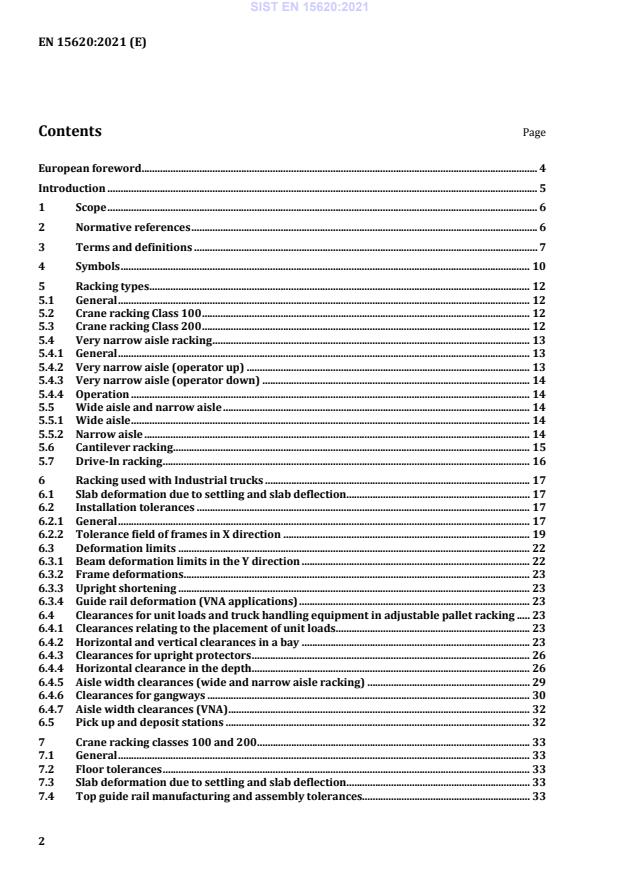
Contents Page
European foreword . 4
Introduction . 5
1 Scope . 6
2 Normative references . 6
3 Terms and definitions . 7
4 Symbols . 10
5 Racking types . 12
5.1 General . 12
5.2 Crane racking Class 100 . 12
5.3 Crane racking Class 200 . 12
5.4 Very narrow aisle racking . 13
5.4.1 General . 13
5.4.2 Very narrow aisle (operator up) . 13
5.4.3 Very narrow aisle (operator down) . 14
5.4.4 Operation . 14
5.5 Wide aisle and narrow aisle . 14
5.5.1 Wide aisle . 14
5.5.2 Narrow aisle . 14
5.6 Cantilever racking . 15
5.7 Drive-In racking . 16
6 Racking used with Industrial trucks . 17
6.1 Slab deformation due to settling and slab deflection. 17
6.2 Installation tolerances . 17
6.2.1 General . 17
6.2.2 Tolerance field of frames in X direction . 19
6.3 Deformation limits . 22
6.3.1 Beam deformation limits in the Y direction . 22
6.3.2 Frame deformations . 23
6.3.3 Upright shortening . 23
6.3.4 Guide rail deformation (VNA applications) . 23
6.4 Clearances for unit loads and truck handling equipment in adjustable pallet racking . 23
6.4.1 Clearances relating to the placement of unit loads . 23
6.4.2 Horizontal and vertical clearances in a bay . 23
6.4.3 Clearances for upright protectors . 26
6.4.4 Horizontal clearance in the depth . 26
6.4.5 Aisle width clearances (wide and narrow aisle racking) . 29
6.4.6 Clearances for gangways . 30
6.4.7 Aisle width clearances (VNA) . 32
6.5 Pick up and deposit stations . 32
7 Crane racking classes 100 and 200 . 33
7.1 General . 33
7.2 Floor tolerances . 33
7.3 Slab deformation due to settling and slab deflection. 33
7.4 Top guide rail manufacturing and assembly tolerances. 33
7.5 Installation tolerances (single deep and double deep) . 33
7.6 Deformation limits . 33
7.6.1 Beam deformation limitations in the Y direction . 33
7.6.2 Frame deformations in the X and Z directions . 33
7.6.3 Frame deformations in the X and Z directions for clad rack buildings and wind loads . 34
7.6.4 Elastic shortening of uprights . 34
7.7 Safety back stop . 35
7.7.1 Deformations. 35
7.7.2 Clearances . 35
8 Cantilever racking . 35
8.1 Installation tolerances . 35
8.2 Verticality tolerances with regard to design and assembly . 39
8.3 Cantilever racking deformation limits. 39
8.3.1 General . 39
8.3.2 Arm deformations . 40
8.4 Cantilever column deformations in the X and Z directions . 40
8.5 Clearances for unit loads and truck handling equipment . 41
8.5.1 Clearances relating to the placement of unit loads . 41
8.5.2 Horizontal and vertical clearances in a bay . 41
9 Drive-In racking . 43
9.1 Installation tolerances . 43
9.2 Deformation limits . 46
9.2.1 Beam rail deformation limits in the Y direction . 46
9.2.2 Frame deformations . 47
9.3 Minimum pallet bearing . 47
9.4 Clearances for unit loads and truck handling equipment . 47
9.4.1 Industrial truck requirement . 47
9.4.2 Clearances relating to the placement of unit loads . 48
9.4.3 Horizontal and vertical clearances . 48
9.4.4 Horizontal clearances in the depth . 49
9.4.5 Horizontal truck clearances . 49
9.4.6 Vertical clearances . 51
10 Racking to warehouse interface . 51
Annex A (informative) General safety philosophy . 52
Annex B (informative) Racking measurement surveys . 56
Annex C (informative) Effects of beam hogging and sagging deformations on clearances . 57
Annex D (informative) Additional information for determining dimensions and clearances
in the depth of the rack (Z direction) in case of palletised loads . 62
Annex E (informative) Additional information for very narrow aisle trucks in adjustable
pallet racking . 65
Annex F (informative) Consideration of tolerances and deformations in determining
clearances . 66
Annex G (informative) Sprinkler systems. 67
Bibliography . 71
European foreword
This document (EN 15620:2021) has been prepared by Technical Committee CEN/TC 344 “Steel static
storage systems”, the secretariat of which is held by UNI.
This European Standard shall be given the status of a national standard, either by publication of an
identical text or by endorsement, at the latest by January 2022, and conflicting national standards shall
be withdrawn at the latest by January 2022.
Attention is drawn to the possibility that some of the elements of this document may be the subject of
patent rights. CEN shall not be held responsible for identifying any or all such patent rights.
This document supersedes EN 15620:2008.
This document includes the following significant technical changes with respect to EN 15620:2008:
— floor tolerances have been removed (reference is made to alternative sources);
— tolerances for Drive-In racking and Cantilever racking have been added;
— tolerances for crane racking have been removed (reference is made to alternative sources);
— the classification system for racking operated by industrial trucks has been removed.
Any feedback and questions on this document should be directed to the users’ national standards body.
A complete listing of these bodies can be found on the CEN website.
According to the CEN-CENELEC Internal Regulations, the national standards organisations of the
following countries are bound to implement this European Standard: Austria, Belgium, Bulgaria,
Croatia, Cyprus, Czech Republic, Denmark, Estonia, Finland, France, Germany, Greece, Hungary, Iceland,
Ireland, Italy, Latvia, Lithuania, Luxembourg, Malta, Netherlands, Norway, Poland, Portugal, Republic of
North Macedonia, Romania, Serbia, Slovakia, Slovenia, Spain, Sweden, Switzerland, Turkey and the
United Kingdom.
Introduction
The determination of the safe load bearing capacity of racking is a structural issue and therefore the
Eurocodes are relevant, especially EN 1993 series. The most relevant parts for racking are EN 1993-1-1
and EN 1993-1-3.
In order to have reliable state of the art guidance for those involved in designing these products and
due to the differences in the shape of the structural components, detailing and connection types,
additional technical information to the Eurocodes is required.
The scope of CEN/TC 344 is to establish European Standards providing guidance for the specification,
design, methods of installation, accuracy of build and also guidance for the user on the safe use of steel
static storage systems.
This, together with the need for harmonized design rules, was the reason that FEM Product Group
Racking and Shelving (FEM R&S) has taken the initiative for the CEN/TC 344. This TC is in the course of
preparing a series of European Standards regarding Steel static storage systems.
1 Scope
This document specifies tolerances, deformations and clearances that pertain to the production,
assembly and erection and performance under load of pallet racking and cantilever racking. These
tolerances, deformations and clearances are important in relation to the functional requirements and
ensuring the proper interaction of the handling equipment used by personnel, trained and qualified as
competent, in association with the specific type of racking system. The interaction conditions are also
important in determining the reliability of the storage system to ensure that the chance of mechanical
handling equipment impact, pallet impact or a system breakdown is acceptably low.
This document is limited to:
— single deep adjustable beam pallet racking operated with industrial trucks;
— single and double deep adjustable beam pallet racking operated with stacker cranes;
— drive-in and drive through racking systems operated with industrial trucks;
— cantilever racking systems operated with industrial trucks.
This document does not apply to specialized types of equipment such as automated trucks, miniload,
satellite systems, systems involving the use of articulated trucks, trucks using intrusive stacking
methods or industrial truck serviced rack-clad buildings.
This document specifically excludes the tolerances and deformation of the industrial trucks, stacker
cranes and floors.
It is the responsibility of the specifier in cooperation with the client or user to ensure that the
tolerances, deformations and clearances, as quoted in this document are acceptable for safe operation
of the overall system considering all factors of influence and the user informed by means such as
operation instructions. The specifier can carry out appropriate design/calculations to vary some of the
parameters provided that an equivalent safe operation is achieved.
This document gives guidance to be used in conjunction with mechanical handling equipment and floor
information.
2 Normative references
The following documents are referred to in the text in such a way that some or all of their content
constitutes requirements of this document. For dated references, only the edition cited applies. For
undated references, the latest edition of the referenced document (including any amendments) applies.
EN 15512, Steel static storage systems - Adjustable pallet racking systems - Principles for structural design
EN 15629, Steel static storage systems - Specification of storage equipment
EN 15878, Steel static storage systems - Terms and definitions
3 Terms and definitions
For the purposes of this document, the terms and definitions given in EN 15878 and the following apply.
ISO and IEC maintain terminological databases for use in standardization at the following addresses:
— IEC Electropedia: available at https://www.electropedia.org/
— ISO Online browsing platform: available at https://www.iso.org/obp
3.1
racking aisle width
minimum dimension measured across the aisle at the floor and at any beam level between the rack
structure
3.2
deformation
displacement due to external actions
3.3
gangway
transfer aisle
space for movement or transport which does not give access to the picking or loading faces of the
storage racking
3.4
fine positioning
local adjustment of the machine with respect to the rack components in the X and/or Y directions using
sensors on the crane and location devices on the rack
3.5
intrusive stacking
placement or retrieval of a unit load where the turning radius or length of an industrial truck is greater
than the operating aisle width and part of the storage location concerned is used by the truck forks and
load when turning to place or retrieve a unit load
3.6
mechanical handling equipment
MHE
mechanical or electro-mechanical equipment used to transport, lift, pick and deposit unit loads
3.7
free-movement truck
industrial truck that is free to move in any direction in the aisle and make 90 ° turns into the rack face
for loading and off loading
3.8
upright protector
component to protect the lower part of uprights against accidental impact from mechanical handling
equipment
Note 1 to entry: Can be either free-standing or connected to the upright.
3.9
pick up and deposit station
P & D station
structure at the end of an operating aisle used as an interface between different types of mechanical
handling equipment
Note 1 to entry: See Figure 1.
Key
1 free movement truck access
2 unit load positions in the racks
3 P & D stations
4 very narrow aisle racking (VNA)
Figure 1 — Example of P & D stations
3.10
racking types
3.10.1
wide aisle racking
pallet racking arranged to leave aisles of sufficient width for use with free-movement trucks
3.10.2
narrow aisle racking
pallet racking arranged in a similar way to wide aisle racking and for use with free-movement trucks,
but having aisles of a reduced width for use with more specialist types of industrial truck
3.10.3
very narrow aisle racking
VNA
pallet racking arranged with aisles of a width to cater only for the truck and the unit load width plus an
operational clearance where the truck cannot make 90° turns into the rack face for loading and off
loading
3.10.4
crane racking class 100 and 200
pallet racking operated by a stacker crane
3.10.5
drive-in racking
DIR
system of racking that provides storage where pallets are stored two or more deep and where access is
gained by driving an industrial truck into a lane with pallets supported along their sides on beam rails
supported from the uprights
Note 1 to entry: In DIR, the industrial truck drives into a lane and reverses out.
3.10.6
drive-through racking
DTR
system of racking similar to DIR but where the industrial truck could drive through the lane if there are
no pallets in the lane
Note 1 to entry: Drive-through racking lanes are not designed as access routes through the racking but allow
full access for pallets to be placed from either end of the aisle, enabling the first-in first-out logistic principle.
3.11
reference directions
directions at 90° to each other related to the orientation of the racking
Note 1 to entry: X is the down aisle direction, Y is the vertical direction and Z is the cross aisle direction.
3.12
specifier
person or company that provides the supplier with a specification based on the user’s requirements
Note 1 to entry: The specifier may be a consultant, other specialist, the user or the equipment supplier acting as
the specifier.
3.13
stacker crane
storage and retrieval machine running on a rail and stabilised at the top of the mast by an upper guide
rail
3.14
tolerances
dimensional variations from the nominal dimension or position arising from manufacture, assembly
and erection
3.15
user
company or person who manages and operates the installation on a daily basis and is responsible for
the continuing safety of the installation
3.16
cantilever arm
load-carrying member connected at one end to the cantilever column in the cross-aisle direction
Note 1 to entry: Arms can either be fixed or adjustable dependent upon the type of racking.
3.17
cantilever base
horizontal structural component fixed to the bottom of the cantilever column and to allow load transfer
and fixing to the floor
3.18
cantilever column
vertical member supporting the cantilever arms that can either be single sided or double sided
3.19
datum
reference point, line or plane
4 Symbols
For the purpose of this document, a number of the following symbols may be used together with
standard subscripts.
Additional symbols and subscripts are defined where they first occur.
A symbol and subscript may have several meanings in this document.
In general, primary symbols are not defined with all the standard subscripts with which they may be
used.
A manoeuvring clearance
A clear entry between two uprights (pallet racking)
A bay width (cantilever racking)
A (n) total length of the rack (comprising ‘n’ bays)
t
A minimum operating aisle width
ST
a horizontal clearance in Drive-In racking
b vertical clearance in Drive-In racking
B misalignment of uprights across an aisle
BF misalignment of rack uprights across a frame
B distance to system datum
C , C out-of-plumb of the member with respect to the relevant axis
x z
D rack depth
D rack frame depth
D 90 ° turning width of truck and load
D depth of unit load and pallet
p
E racking aisle width
F distance from aisle X datum to the rack
F variation between adjacent uprights measured near floor level in the Z direction
G , G , G curvature of the arm or beam with respect to the relevant axis
x y z
h height of compartment
H height from top of base plate to top of upright
H height from top of bottom beam level to top of any other beam level (pallet racking)
H height from the underside of the base to arm 1 (cantilever racking)
H height from top of base plate to top of bottom beam level (pallet racking)
1A
HB height from top of beam level to top of beam level above (pallet racking)
HB dimension between bracing beams (cantilever racking)
J , J curvature of the upright with respect to the relevant axis
x z
L centre to centre distance of uprights
L beam span
L cantilever arm length
L maximum deviation of arm level with respect to the top of the baseplate level
M maximum variation of pallet support level between both sides of the pallet
M distance from front upright to centre of top guide rail
T beam twist at mid span
w
W upright width
WE tolerance field of mutually opposite frames
W width of unit load and pallet
p
X clearance in the X direction (with a subscript)
Y clearance in the Y direction (with a subscript)
Z clearance in the Z direction (with a subscript)
δ hogging deformation
u
δ sagging deformation
d
δ deflection at the tip of a cantilever arm
VB
δ deflection of a cantilever upright in the X or Z direction
5 Racking types
5.1 General
Erection tolerances, deformations and clearances have been divided into groups to cover the general
requirements of the handling equipment. The racking for each group requires a different standard of
installation tolerances, deformations and minimum clearances for safe operation. See Annex F and
Annex A for more information on general safety philosophy.
5.2 Crane racking Class 100
Pallet racking arranged as for a very narrow aisle system but operated by a stacker crane. The aisles are
wide enough only for the stacker crane or load width plus operational clearance as shown in Figure 2.
Figure 2 — Crane racking
The stacker cranes are automatically controlled, do not have a fine positioning system at the unit load
storage positions.
5.3 Crane racking Class 200
Crane operated installations where the stacker cranes are automatically controlled and have fine
positioning system at the unit load storage positions. Also includes installations where the stacker crane
is manually controlled.
5.4 Very narrow aisle racking
5.4.1 General
Very narrow aisle pallet racking is arranged with aisles wide enough only for the truck and the unit load
width plus operational clearance as shown in Figure 3.
The unit loads are handled within the aisles without the need for the truck to turn bodily into the rack
face.
The trucks are usually guided into and along the aisle length and have fixed or rising cabs.
Figure 3 — Very narrow aisle racking
5.4.2 Very narrow aisle (operator up)
Very narrow aisle installations where the truck operator is raised and lowered with the unit load and
has manual height adjustment to position the load. Alternatively, the operator remains at ground level
and has the use of an indirect visibility aid such as closed-circuit television (CCTV) or an equivalent
system to guide the operator.
5.4.3 Very narrow aisle (operator down)
Very narrow aisle installations where the truck operator remains at ground level ‘man-down’ and does
not have the use of an indirect visibility aid.
5.4.4 Operation
In VNA operations the maximum stroke of the forks to pick or deposit the unit load once the truck has
been positioned of the industrial truck is fixed individually for each application. The tolerances,
deformations and clearances given in this document are based on an operational method whereby the
VNA truck driver is trained and instructed to do fine-positioning in placing and retrieving the pallet.
5.5 Wide aisle and narrow aisle
5.5.1 Wide aisle
Wide aisle racking is arranged to leave aisles of sufficient width to allow forklift truck equipment to
traverse the length of the aisle and make 90° turns into the rack face for loading and offloading as
shown in Figure 4.
Figure 4 — Wide aisle racking with counter balanced truck
5.5.2 Narrow aisle
Narrow aisle racking is pallet racking arranged in a similar way to wide aisle racking but having aisles
of a reduced width which can be used with more specialist types of lift truck as shown in Figure 5.
Figure 5 — Narrow aisle racking with reach truck
5.6 Cantilever racking
Cantilever racking is often used to store long or irregular items. Cantilever racking is normally serviced
by powered handling equipment such as side loading or industrial trucks as shown Figure 6.
Figure 6 — Cantilever racking
5.7 Drive-In racking
Drive-In racking is arranged with lanes of a width to cater only for the truck and the unit load width
plus operational clearance as shown in Figure 7.
The trucks are usually reach trucks or counterbalance trucks and are often guided into and along the
aisle length by floor mounted guide rails.
Figure 7 — Drive-In (and drive-through) racking
6 Racking used with Industrial trucks
6.1 Slab deformation due to settling and slab deflection
Deflection of the floor slab results in additional stresses and inclination of the rack structure.
Deflection of the floor slab shall be included at the planning stage by the specifier or client and added to
the clearances and deformations as required for the specific project; reference should be made to
EN 15512.
6.2 Installation tolerances
6.2.1 General
The maximum allowable tolerances after erection, with the racks in the unloaded condition, shall be as
stated in Table 1, Table 2, Figure 8 and Figure 9.
NOTE The installation tolerances are also applicable if racking is dismantled and re-erected.
Table 1 — Tolerances measured horizontally
Horizontal tolerance limitations for X Z plane
mm
Measuring dimension code and description of tolerance Installation Installation
tolerances for tolerances for
wide aisle and VNA racking
narrow aisle
racking
δA Variation from nominal dimension of the clear entry between two ± 3 ± 3
uprights at any beam level
δA (n) Variation from nominal dimension of the total rack length, ± 3 n ± 3 n
t
cumulative with the number of bays ‘n’ measured near floor level
The larger value
of the following
B misalignment of uprights on opposite sides of an aisle, cumulative Not applicable ± 10
with the number of bays 'n' measured near floor level
or
For operator up this applies for the aisle uprights only
± 1,0 n
For operator down this applies for the aisle and rear uprights
± 0,5 n
δB0 Variation from nominal of rack frontage or P&D end with regard ± 10 ± 10
to the installation ’system datum’ concerned, measured near floor
level
BF Misalignment of rack uprights across a frame (over full height) 40 Not applicable
a ± H/350 ± H/500
C Out-of-plumb of each upright in the X direction
x
a ± H/350 ± H/500
C Out-of-plumb of each upright in the Z direction
z
Horizontal tolerance limitations for X Z plane
mm
Measuring dimension code and description of tolerance Installation Installation
tolerances for tolerances for
wide aisle and VNA racking
narrow aisle
racking
δD Variation from nominal dimension of the rack depth For single For single
frame ± 6 frame ± 3
For double
frame ± 6
δE Variation from nominal dimension of the racking aisle width near ± 15 ± 5
floor level
δE Variation from nominal dimension of the width between guide Not applicable See
rails FEM 10.2.14–1
/4.103–1 [1]
δE2 Variation from uprights on one side to guide rail Not applicable ± 5
δF Variation from nominal of the straightness of an aisle measured ± 15 ± 10
near floor level with regard to the ‘aisle system X datum line’ or as
specified by the truck supplier.
F Variation between adjacent uprights measured near floor level in Not applicable ± 5
the Z direction
G Straightness of the beam in the Z direction ± A/400 ± A/400
z
The larger The larger
tolerance of the tolerance of the
following following
Jx Upright straightness in the X direction between beams spaced HB ± 3 or ± HB/400 ± 3 or ± HB/750
apart.
a ± H/500 ± H/500
J Initial curve of an upright frame in the Z direction
z
δM Tolerance of the top guide rail Not applicable Defined by the
Specifier or truck
manufacturer
Tw Beam twist at mid span (per m) 1° 1°
NOTE FEM10.2.14–1/4.103–1 gives guidance on this subject (see [1]).
a
See Figure 8.
Table 2 — Tolerances measured vertically
Vertical tolerance limitations for Y direction
mm
Measuring dimension code and description of tolerance Installation Installation
tolerances, for tolerances, for
wide and VNA racking
narrow aisle
racking
The larger value of the following
Gy Straightness of the beam in the Y direction ± 3 or ± A/500 ± 3 or ± A/500
δH1A Variation of the top of the bottom beam level above the base ± 10 ± 7
plate
δH1 Variation of the top of any beam level H1 above the bottom beam ± 5 or ± H1/500 Operator up ± 5
level or ± H1/500
Operator
down ± 3
or ± H1/1000
δH3 Tolerance of the top guide rail Not applicable Defined by the
Specifier or truck
supplier
Hy Variation of unit load support levels between the front and rear ± 10 ± 10
beams in a compartment
A measurement survey may be used to measure the installation tolerances and clearances before the
racking is loaded. The tolerances stated may not be applicable after the racking has been loaded.
Measurement surveys are conducted when required by individual contracts (see Annex B).
The specifier should determine the overall system clearances using the clearances and tolerances as
stated in this document. If different tolerances are required, they should be specified by the specifier
(see Annex E).
6.2.2 Tolerance field of frames in X direction
This tolerance is only applicable to VNA (operator down) racking.
The tolerance field of mutually opposite frames resulting from offset of the upright, bases out-of-plumb
and curvature of the upright sections shall not exceed WE (see Figure 9).
WE=W++2C +B 2 J
x max x
where
WE is the tolerance field of mutually opposite frames resulting from offset of the upright, bases
out-of-plumb and curvature of the upright sections;
W is the upright width;
C is the out-of-plumb of upright from Table 1;
x
B is 10 mm or 0,5 n from Table 1;
max
J is the upright straightness between beam levels from Table 1.
x
NOTE This tolerance assists the floor level operator in visibly locating the pallets using the mutually opposite
locations.
Key
A clear entry between two uprights
At(n) total length of the rack (comprising ‘n’ bays)
B0 distance to system datum
BF misalignment of rack uprights across a frame
C , C out-of-plumb of upright in the Z and X directions respectively
z x
D rack frame depth
E racking aisle width
F distance from aisle system X datum to front face of upright
Gz, Gy straightness of the beam in the Z and Y directions respectively
H height from top of base plate to top of upright
HB height from top of beam level to top of beam level above
H variation of support levels between the front and rear beams in a compartment
y
H1A height from top of base plate to top of bottom beam level
H1 height from top of bottom beam level to top of any other beam level
J upright straightness in the X direction between adjacent beam levels
x
J initial straightness of an upright in the Z direction
z
L distance from centre to centre of uprights
Figure 8 — Horizontal and vertical tolerances for Wide aisle and Narrow aisle
Key
A clear entry between two uprights
At(n) total length of the rack (comprising ‘n’ bays)
B0 distance to system datum
B , B , B , B misalignment of uprights across an aisle in bays 1, 2, 3 and n respectively
1 2 3 n
C , C out-of-plumb of upright in the Z and X directions respectively
z x
D rack frame depth
E racking aisle width
E distance between guide rails
E distance between guide rail and front of upright
F distance from aisle system X datum and front face of upright
F variation between adjacent uprights measured near floor level in the Z direction
G , G straightness of the beam in the Z and Y directions respectively
z y
H height from top of base plate to top of upright
HB height from top of beam level to top of beam level above
H variation of support levels between the front and rear beams in a compartment
y
H1A height from top of base plate to top of bottom beam level
H height from top of bottom beam level to top of any other beam level
H3 height from top of base plate to underside of top guide rail
Jx upright straightness in the X direction between adjacent beam levels
J initial straightness of an upright in the Z direction
z
L distance from centre to centre of uprights
M distance from front of upright to centre of top guide rail
W upright width
WE is the tolerance field of mutually opposite frames resulting from offset of the upright, bases out-of-
plumb and curvature of the upright sections
Figure 9 — Horizontal and vertical tolerances VNA
6.3 Deformation limits
6.3.1 Beam deformation limits in the Y direction
Limiting deflection values shall be agreed with the specifier on a project by project basis, taking into
account the specific requirements of the installation.
Maximum deformation of supporting beams under load shall not exceed the serviceability criteria.
Where beam spans are effectively continuous over two or three bays, both sagging and hogging beam
deformations should be taken into account (see Annex C).
In the absence of any specific requirements, the limiting deflection values shown in Table 3 should be
used.
Table 3 — Maximum deformation of supporting beams under load (mm)
Beam type Wide aisle and VNA (operator up) racking VNA (operator down) racking
Narrow aisle
Flexural Sagging Hogging Sagging Hogging
deformation
Normal beam a a a a a
L/200 L/200 L/200 L/200 L/200
max. 10 mm for
beam levels above
6 m
c b b b
Cantilever beam L/100 L/100 L/100
max. 15 mm max. 15 mm
max. 10 mm for
beam levels above
6 m
a
L is the beam span (centreline to centreline of upright).
b
L is the cantilever length from centreline of upright.
c
The deflection limit specified here is applicable to pallet racking. Limits for cantilever racking are given in Clause
8.
6.3.2 Frame deformations
Limiting deflection values shall be agreed with the specifier on a project by project basis, taking into
account the specific requirements of the installation.
In the absence of any specific requirements, the following limiting deflection values should be used.
Sway (movement) deformation of rack uprights in the X or Z directions should not exceed 1/200 of the
rack height
NOTE 1 This is to be measured from the unloaded racking upright positions on completion of erection.
NOTE 2 For example, a 15 m high rack could deflect laterally by ± 75 mm.
6.3.3 Upright shortening
The y-axis deformation of any beam level depends upon the accumulation of compression strain in the
individual upright lengths between the beam levels below the level being considered and shall be taken
into account by the specifier when considering the height selection system of a VNA application.
These values shall be provided by the rack supplier.
6.3.4 Gu
...