

SIST EN 50716:2024/oprA1:2026
(Amendment)Railway Applications - Requirements for software development
General Information
- Abstract
The amendment will address misunderstandings on provisions for AI/ML by providing additional guidance and clarifications without changing the fundamental technical requirements and recommendations of the standard. The amendment and its limitation to broadly editorial changes is based on following considerations:
• Limited Standardization for AI: While AI/ML holds promise for various applications, current standardization efforts specific to AI/ML in safety-critical domains like railway are still in their early stages. This lack of mature and widely accepted standards for verifying and validating AI/ML systems in these contexts makes it challenging to reference or directly incorporate such technologies into the scope of EN 50716 (with less restrictive provisions) at this time.
• Promoting Flexibility and Innovation: By clarifying the existing provisions and adding guidance without imposing new requirements, the amendment allows for flexibility and encourages developers to explore the potential of AI/ML (where is safe to do so).
The following areas have already been identified by WG28 for the amendment:
• Explicitly remind the scope of Table A.3: State that the table's techniques and measures are primarily intended for the design of the software architecture for safety-related functions (e.g. does not strictly apply to support tools).
• Provide guidance on AI/ML usage: Explicitly acknowledge the potential of AI/ML in non-safety-critical areas and offer examples of possible applications (complementary to current recommendation for Basic Integrity, “-”, in Table A.3 for 13. Artificial Intelligence and Machine Learning).
• Guidance on Support Tools: Ensure a consistent understanding of the AI/ML provisions related to support tools (& programming languages).
This represent current view on potential changes - other areas may be identified during the amendment drafting, keeping into account the above mentioned limitations to broadly editorial changes.
- Status
- Not Published
- Public Enquiry End Date
- 21-Jun-2026
- Technical Committee
- ŽEN - Electrical applications for railways
- Current Stage
- 4020 - Public enquire (PE) (Adopted Project)
- Start Date
- 14-Apr-2026
- Due Date
- 01-Sep-2026
- Completion Date
- 08-Jul-2026

Overview
SIST EN 50716:2024/oprA1:2026 is a draft amendment to the CENELEC standard covering requirements for software development in railway applications. Developed by CLC/TC 9X, this amendment specifically addresses the increasing relevance of artificial intelligence (AI) and machine learning (ML) within the railway software development lifecycle. The amendment primarily provides clarifications, supplementary guidance, and editorial updates, with a focus on AI/ML integration, without altering the core technical requirements or recommendations of the existing EN 50716 standard.
Given the early stage of AI/ML standardization in safety-critical domains, this amendment aims to remove ambiguities and promote consistent understanding, thereby allowing safe and innovative exploration of AI and ML tools in non-safety-critical railway software applications.
Key Topics
- AI/ML Clarifications: Additional guidance on how AI and ML tools can be applied within railway software development, especially regarding support tools and non-safety-critical functions.
- Scope of Techniques and Measures: Explicit reminders that existing techniques (notably those in Table A.3) are intended for software architecture design-not for support tools or application/data/code generation utilities.
- AI/ML Guidance: New informative content highlighting the potential of AI/ML in requirements engineering, architecture consistency, implementation, testing, and documentation.
- Challenges in AI/ML Adoption: Discussion of verification, validation, model management, and configuration challenges related to emerging AI/ML practices.
- Support Tools with AI/ML: Guidance on the effective and safe use of AI-driven support tools, addressing output validation, independence of roles, competency, and documentation integrity.
- Reproducibility and Configuration Management: Emphasis on tracking tool versions, models, and data-especially for cloud-based or evolving AI-driven tools.
- Safety and Integrity: Sustaining software integrity and safety assurance while leveraging modern AI/ML tools, aligned with existing lifecycle and change management principles.
Applications
The clarifications and guidance in SIST EN 50716:2024/oprA1:2026 are valuable for:
- Railway software developers: Understanding how and where AI/ML can be incorporated within compliance boundaries, particularly in support tools (e.g., code generation, requirements extraction, or test automation).
- Tool vendors and suppliers: Ensuring their AI-based products meet reproducibility, versioning, and integrity expectations for deployment in the railway context.
- System integrators and safety assessors: Interpreting the limitations and approved use cases of AI/ML, especially for non-safety-critical software and lifecycle assistance.
- Project managers: Facilitating innovation in development practices while remaining aligned with sector-specific safety, verification, and documentation requirements.
Use cases include:
- Automating requirements structuring and traceability
- Assisting with code pattern recognition and test case prioritization
- Drafting technical documentation and analytical summaries
- Performing static or automated analysis for error detection and consistency checks
Related Standards
- ISO/IEC TR 5469: Artificial intelligence - Functional safety and AI systems. This technical report provides additional context for integrating AI systems within safety-critical environments, complementing the guidance in EN 50716.
- EN 50128: A related standard addressing railway applications and software for railway control and protection systems.
- IEC 61508: Functional safety of electrical/electronic/programmable electronic safety-related systems.
- EN 50657: Railways - Rolling stock applications - Software on board rolling stock.
SIST EN 50716:2024/oprA1:2026 thus supports the railway industry in both adhering to established principles and embracing new AI/ML-driven technologies, ensuring a balanced approach to innovation, flexibility, compliance, and safety.
Keywords: railway software development, AI in railways, machine learning, EN 50716, software lifecycle, railway standardization, CENELEC, support tool qualification, configuration management, functional safety
Relations
- Effective Date
- 29-Oct-2024
Get Certified
Connect with accredited certification bodies for this standard

BSI Group
BSI (British Standards Institution) is the business standards company that helps organizations make excellence a habit.

IRIS Certification (UNIFE)
International Railway Industry Standard certification.

TÜV SÜD Rail GmbH
TÜV SÜD railway certification services.
Sponsored listings
Frequently Asked Questions
SIST EN 50716:2024/oprA1:2026 is a draft published by the Slovenian Institute for Standardization (SIST). Its full title is "Railway Applications - Requirements for software development". This standard covers: The amendment will address misunderstandings on provisions for AI/ML by providing additional guidance and clarifications without changing the fundamental technical requirements and recommendations of the standard. The amendment and its limitation to broadly editorial changes is based on following considerations: • Limited Standardization for AI: While AI/ML holds promise for various applications, current standardization efforts specific to AI/ML in safety-critical domains like railway are still in their early stages. This lack of mature and widely accepted standards for verifying and validating AI/ML systems in these contexts makes it challenging to reference or directly incorporate such technologies into the scope of EN 50716 (with less restrictive provisions) at this time. • Promoting Flexibility and Innovation: By clarifying the existing provisions and adding guidance without imposing new requirements, the amendment allows for flexibility and encourages developers to explore the potential of AI/ML (where is safe to do so). The following areas have already been identified by WG28 for the amendment: • Explicitly remind the scope of Table A.3: State that the table's techniques and measures are primarily intended for the design of the software architecture for safety-related functions (e.g. does not strictly apply to support tools). • Provide guidance on AI/ML usage: Explicitly acknowledge the potential of AI/ML in non-safety-critical areas and offer examples of possible applications (complementary to current recommendation for Basic Integrity, “-”, in Table A.3 for 13. Artificial Intelligence and Machine Learning). • Guidance on Support Tools: Ensure a consistent understanding of the AI/ML provisions related to support tools (& programming languages). This represent current view on potential changes - other areas may be identified during the amendment drafting, keeping into account the above mentioned limitations to broadly editorial changes.
The amendment will address misunderstandings on provisions for AI/ML by providing additional guidance and clarifications without changing the fundamental technical requirements and recommendations of the standard. The amendment and its limitation to broadly editorial changes is based on following considerations: • Limited Standardization for AI: While AI/ML holds promise for various applications, current standardization efforts specific to AI/ML in safety-critical domains like railway are still in their early stages. This lack of mature and widely accepted standards for verifying and validating AI/ML systems in these contexts makes it challenging to reference or directly incorporate such technologies into the scope of EN 50716 (with less restrictive provisions) at this time. • Promoting Flexibility and Innovation: By clarifying the existing provisions and adding guidance without imposing new requirements, the amendment allows for flexibility and encourages developers to explore the potential of AI/ML (where is safe to do so). The following areas have already been identified by WG28 for the amendment: • Explicitly remind the scope of Table A.3: State that the table's techniques and measures are primarily intended for the design of the software architecture for safety-related functions (e.g. does not strictly apply to support tools). • Provide guidance on AI/ML usage: Explicitly acknowledge the potential of AI/ML in non-safety-critical areas and offer examples of possible applications (complementary to current recommendation for Basic Integrity, “-”, in Table A.3 for 13. Artificial Intelligence and Machine Learning). • Guidance on Support Tools: Ensure a consistent understanding of the AI/ML provisions related to support tools (& programming languages). This represent current view on potential changes - other areas may be identified during the amendment drafting, keeping into account the above mentioned limitations to broadly editorial changes.
SIST EN 50716:2024/oprA1:2026 is classified under the following ICS (International Classification for Standards) categories: 35.080 - Software; 35.240.60 - IT applications in transport; 45.020 - Railway engineering in general. The ICS classification helps identify the subject area and facilitates finding related standards.
SIST EN 50716:2024/oprA1:2026 has the following relationships with other standards: It is inter standard links to SIST EN 50716:2024. Understanding these relationships helps ensure you are using the most current and applicable version of the standard.
SIST EN 50716:2024/oprA1:2026 is associated with the following European legislation: EU Directives/Regulations: 2016/797/EU; Standardization Mandates: M/591. When a standard is cited in the Official Journal of the European Union, products manufactured in conformity with it benefit from a presumption of conformity with the essential requirements of the corresponding EU directive or regulation.
SIST EN 50716:2024/oprA1:2026 is available in PDF format for immediate download after purchase. The document can be added to your cart and obtained through the secure checkout process. Digital delivery ensures instant access to the complete standard document.
Standards Content (Sample)
SLOVENSKI STANDARD
01-junij-2026
Železniške naprave - Zahteve za razvoj programske opreme
Railway Applications - Requirements for software development
Bahnanwendungen - Anforderungen für die Softwareentwicklung
Applications ferroviaires - Exigences pour le développement de logiciels
Ta slovenski standard je istoveten z: EN 50716:2023/prA1:2026
ICS:
35.080 Programska oprema Software
35.240.60 Uporabniške rešitve IT v IT applications in transport
prometu
45.020 Železniška tehnika na Railway engineering in
splošno general
2003-01.Slovenski inštitut za standardizacijo. Razmnoževanje celote ali delov tega standarda ni dovoljeno.
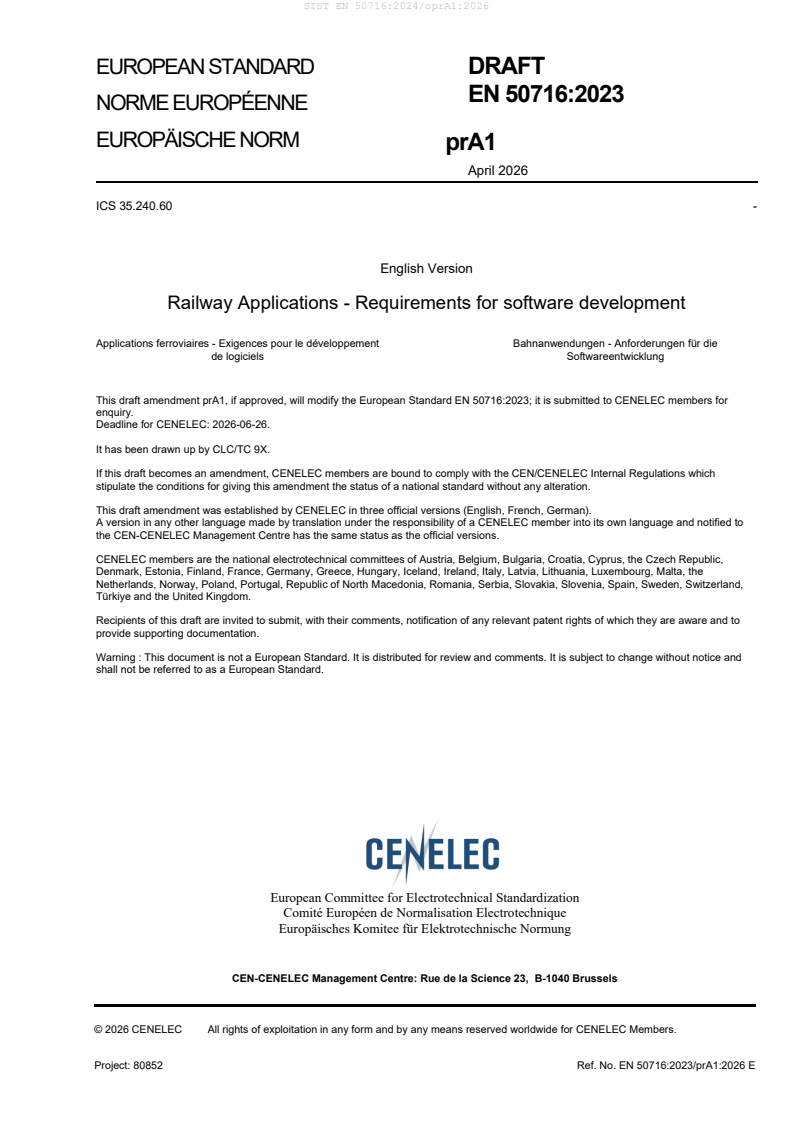
EUROPEAN STANDARD DRAFT
EN 50716:2023
NORME EUROPÉENNE
EUROPÄISCHE NORM
prA1
April 2026
ICS 35.240.60 -
English Version
Railway Applications - Requirements for software development
Applications ferroviaires - Exigences pour le développement Bahnanwendungen - Anforderungen für die
de logiciels Softwareentwicklung
This draft amendment prA1, if approved, will modify the European Standard EN 50716:2023; it is submitted to CENELEC members for
enquiry.
Deadline for CENELEC: 2026-06-26.
It has been drawn up by CLC/TC 9X.
If this draft becomes an amendment, CENELEC members are bound to comply with the CEN/CENELEC Internal Regulations which
stipulate the conditions for giving this amendment the status of a national standard without any alteration.
This draft amendment was established by CENELEC in three official versions (English, French, German).
A version in any other language made by translation under the responsibility of a CENELEC member into its own language and notified to
the CEN-CENELEC Management Centre has the same status as the official versions.
CENELEC members are the national electrotechnical committees of Austria, Belgium, Bulgaria, Croatia, Cyprus, the Czech Republic,
Denmark, Estonia, Finland, France, Germany, Greece, Hungary, Iceland, Ireland, Italy, Latvia, Lithuania, Luxembourg, Malta, the
Netherlands, Norway, Poland, Portugal, Republic of North Macedonia, Romania, Serbia, Slovakia, Slovenia, Spain, Sweden, Switzerland,
Türkiye and the United Kingdom.
Recipients of this draft are invited to submit, with their comments, notification of any relevant patent rights of which they are aware and to
provide supporting documentation.
Warning : This document is not a European Standard. It is distributed for review and comments. It is subject to change without notice and
shall not be referred to as a European Standard.
European Committee for Electrotechnical Standardization
Comité Européen de Normalisation Electrotechnique
Europäisches Komitee für Elektrotechnische Normung
CEN-CENELEC Management Centre: Rue de la Science 23, B-1040 Brussels
© 2026 CENELEC All rights of exploitation in any form and by any means reserved worldwide for CENELEC Members.
Project: 80852 Ref. No. EN 50716:2023/prA1:2026 E
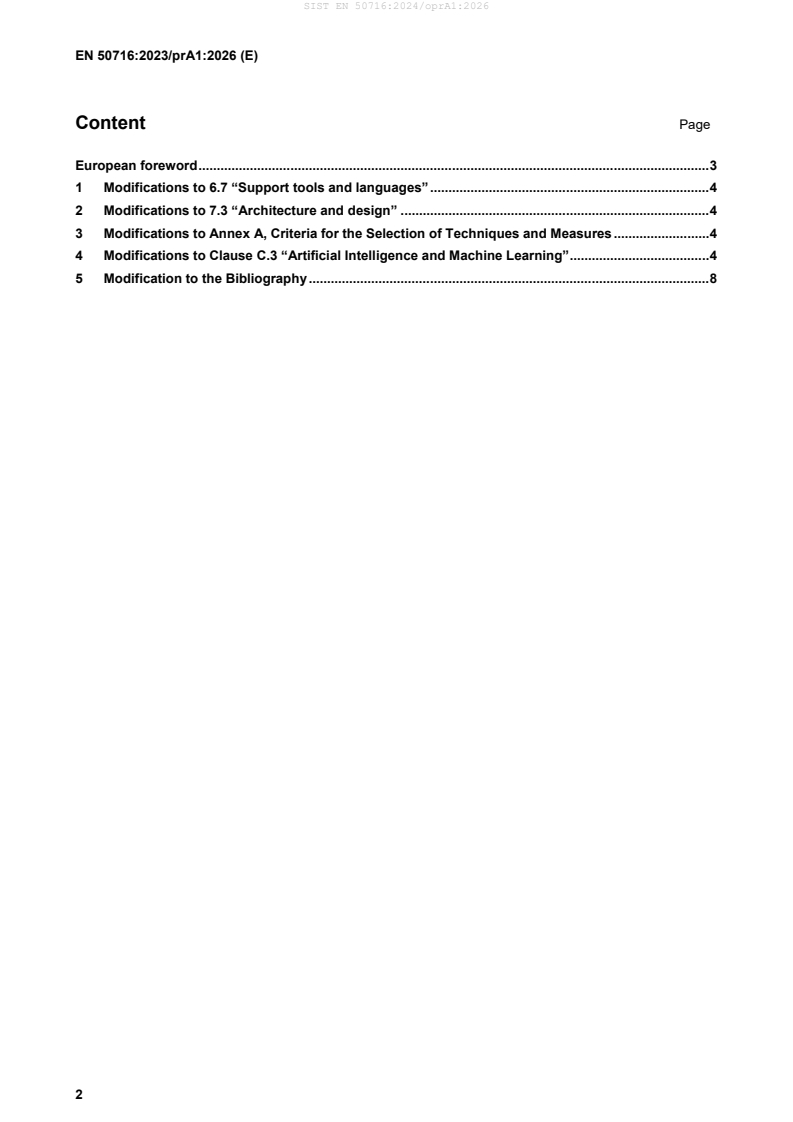
Content Page
European foreword . 3
1 Modifications to 6.7 “Support tools and languages” . 4
2 Modifications to 7.3 “Architecture and design” . 4
3 Modifications to Annex A, Criteria for the Selection of Techniques and Measures . 4
4 Modifications to Clause C.3 “Artificial Intelligence and Machine Learning” . 4
5 Modification to the Bibliography . 8
European foreword
This document (EN 50716:2023/prA1:2026) has been prepared by CENELEC TC 9X, “Electrical and electronic
applications for railways”.
This document is currently submitted to the Enquiry.
The following dates are proposed:
• latest date by which the existence of this (doa) dav + 6 months
document has to be announced at national level
• latest date by which this document has to be (dop) dav + 12 months
implemented at national level by publication of
an identical national standard or by
endorsement
• latest date by which the national standards (dow) dav + 36 months
conflicting with this document have to be (to be confirmed or
withdrawn modified when voting)
The EN 50716:2023 was amended to provide clarifications and additional guidance on the use of AI and ML
technologies, including generative AI.
The amendment A1 does not introduce new technical requirements. Its primary purpose is to provide
informative guidance by:
— adding notes and clarifications to to address usage of AI/ML-based tools;
— re-structuring and adding new informative contents in Annex C.3 on possible usage and challenges
associated with the use of AI and ML tools throughout the software development lifecycle.
The aim of this amendment is to help users of EN 50716 navigate the application of AI and ML tools while
upholding the established requirements for the development of software for railway systems.
This document has been prepared under a standardization request addressed to CENELEC by the European
Commission. The Standing Committee of the EFTA States subsequently approves these requests for its
Member States.
For the relationship with EU Legislation, see informative Annex ZZ, which is an integral part of EN 50716:2023.
1 Modifications to 6.7 “Support tools and languages”
Add the following NOTE after 6.7.4.1. Renumber the following notes.
“NOTE 1 AI/ML techniques can be incorporated into different tool classes (T1, T2, and T3). See Annex C.3.4
and C.3.5 for guidance on potential challenges associated with these technologies.”
Add the following text after 6.7.4.10 (within same numbering):
“Some support tools, particularly those that are cloud-based, utilize evolving models, data sets, or external
services, presenting challenges for version control and reproducibility. The following aspects should be
considered when using such tools:
— solutions to ensure long-term reproducibility (e.g. maintaining local copies), especially if the tool is
discontinued or its interfaces changes significantly;
— if the tool relies on evolving models, data sets, or external services, their versions should also be recorded
and managed to ensure reproducibility - this could require coordinating with the tool vendor or
implementing custom tracking mechanisms.”
2 Modifications to 7.3 “Architecture and design”
Add the following text to 7.3.4.14 (below the NOTE):
“These techniques and measures are intended for the design of the software architecture of run-time functions
within the scope of this document. Table A.3 is not directly applicable to support tools, production of application
data, or production of source code.”
3 Modifications to Annex A, Criteria for the Selection of Techniques and Measures
In Table A.3, line “13. Artificial Intelligence and Machine Learning Reference” in the column “Ref”, replace
“C.3” with “C.3.2 and C.3.3”
4 Modifications to Clause C.3 “Artificial Intelligence and Machine Learning”
Replace Clause C.3 with the following:
“C.3.1 General
The term Artificial Intelligence (AI) covers a wide range of disciplines, research fields, applications, and
techniques. Machine Learning (ML) is the most relevant of these areas for software which is within the scope
of the current standard.
Generative AI is a subset of AI/ML that focuses on creating new content, such as code, text, or other artefacts.
These algorithms, based on architectures like large language models (LLMs) and transformer networks, learn
underlying patterns and structures from input training data and then generate new content that reflects these
patterns. Examples include generating code from natural language specifications, creating test cases from
requirements documents, automatically generating documentation from code comments and structure or
comparing test results with expected results.
C.3.2 Usage of AI and ML within software architecture
The lifecycle processes of EN 50716 take system requirements, decompose them into software requirements
and from them the software architecture is developed and elaborated into components which are then
implemented. Progressive verification activities throughout this process of traceable, hierarchical
decomposition play a major part in ensuring the integrity of the software.
ML implements a software structure which “learns” its behaviour through the application of training data.
System requirements are not decomposed so as to be traceable to software architecture and components,
and the training data are likely to be an incomplete representation of all possible input states. Consequently, it
is not easy to demonstrate the coverage achieved by testing or other verification methods.
ML is still a developing field where techniques for verification and validation are concerned. The main steps in
a machine learning process can be summarized as follows:
— build a training data set;
— build a model to perform the task (usually a program with initially undetermined parameters);
— design an algorithm to train the model to perform the task (i.e. by modifying its parameters to improve its
performance).
Building the model and designing and implementing the algorithm are conventional software engineering
activities. Where ML is used to implement a function that is required to meet a specific SIL, then the software
of the model and the algorithm would need to be developed in accordance with the relevant requirements of
this document.
The trained software produced by ML needs to be executed by an electronic system if it is to perform a function
within the system, and this system will need its own software in order to provide a platform for the trained
software. The platform software is likely to be developed according to relevant requirements of this document
The overall software will need to achieve an integrity level consistent with the requirements of the function to
be performed. It follows that ML will not displace the techniques and measures used to develop high integrity
systems and software, but these techniques and measures will need to be supplemented and enhanced in
order to ensure the integrity of the machine learning process and the trained software which it produces.
C.3.3 Challenges to the use of AI and ML within software architecture
Many of the successful applications of AI andML reported to date are concerned with identifying patterns and
connections within very large data sets, e.g. predicting the 3D shape of proteins.
In the context of applications in the scope of this document, there are four challenges of machine learning
which are hard in the sense that it is not yet possible to be confident that they can be solved either by existing
techniques or by techniques currently under development. These are:
1) Ensuring that the training data are sufficiently complete and accurate: ML is of value in applications where
requirements cannot be fully specified using representations such as truth tables and Boolean logic. The
training data has to include enough cases to make it sufficiently unlikely that a situation not represented
in the training data will actually occur in practice. The effectiveness of the training data depends on the
statistical correlation between the data and reality.
2) Verifying the trained software: because the structure of the trained software is not visible/analysable it is
not possible to know what coverage is achieved by testing, and it is also not possible to supplement testing
by other means such as static analysis.
3) Validation of functionality: the chief advantage of most of the ML methods lies in the generalization of their
intended functions into areas of application not specifically defined beforehand. This advantage turns into
a challenge when it comes to the aspect of validation, namely the check if the final algorithm - which has
been statistically approximated by the Machine Learning algorithm - “has learned the correct function”.
4) Adversarial attacks and missing causality: for example small deviat
...