


oSIST prEN 12882:2024
(Main)Conveyor belts for general purpose use - Electrical and flammability safety requirements
Conveyor belts for general purpose use - Electrical and flammability safety requirements
This document specifies electrical and flammability safety requirements for general purpose conveyor belts not intended for use in underground installations and a means of categorizing conveyor belts in terms of the level of safety sought in their end use application. This document does not provide electrical safety requirements for volume resistance which may be measured by the methods in EN ISO 21178 and which is relevant to some types of light conveyor belts.
This document is not applicable to conveyor belts which are manufactured before the date of publication of this document by CEN.
NOTE 1 Directive 94/9/EC concerning equipment and protective systems intended for use in potentially explosive atmospheres can be applicable to the type of machine or equipment covered by this document. The present standard is not intended to provide means of complying with the essential health and safety requirements of Directive 94/9/EC, this being covered in EN 14973.
NOTE 2 prEN 12882 is not a product standard but is intended to help users of conveyor belts to select the required electrical and flammability safety properties needed following a suitable risk assessment. No requirements are, therefore, included for marking, information to be supplied, etc., these matters being covered in relevant product standards such as EN ISO 14890 and EN ISO 1523-1.
Fördergurte für allgemeine Anwendung - Elektrische und brandtechnische Sicherheitsanforderungen
Dieses Dokument legt elektrische und brandtechnische Anforderungen an Fördergurte für allgemeine Anwendung fest, die nicht für den Einsatz unter Tage vorgesehen sind, sowie die Klassifizierung von Fördergurten hinsichtlich des für den Verwendungszweck angestrebten Sicherheitsgrads. In diesem Dokument sind keine Sicherheitsanforderungen an den elektrischen Durchgangswiderstand festgelegt, der mit den in EN ISO 21178 genannten Verfahren gemessen werden kann und der für einige Typen leichter Fördergurte von Bedeutung ist.
Dieses Dokument gilt nicht für Fördergurte, die vor dem Datum der Veröffentlichung dieses Dokuments durch CEN hergestellt wurden.
ANMERKUNG 1 Richtlinie 94/9/EG, die Einrichtungen und Schutzsysteme für den Einsatz in potentiell explosiven Atmosphären betrifft, kann für den Maschinentyp oder Einrichtungen zutreffen, die durch dieses Dokument abgedeckt sind. Die vorliegende Norm ist nicht zur Erfüllung der wesentlichen Gesundheits- und Sicherheitsanforderungen der Richtlinie 94/9/EG vorgesehen, die durch EN 14973 abgedeckt ist.
ANMERKUNG 2 prEN 12882 ist keine Produktnorm, sondern dazu gedacht, den Anwendern von Fördergurten bei der Auswahl der erforderlichen elektrischen und brandtechnischen sicherheitsrelevanten Eigenschaften zu helfen, die aufgrund einer angemessenen Risikobeurteilung notwendig sind. Deshalb sind keine Anforderungen an Kennzeichnung, bereitzustellende Angaben usw. enthalten, da diese Themen durch die entsprechenden Produktnormen wie beispielsweise EN ISO 14890 und EN ISO 15236 1 abgedeckt sind.
Courroies transporteuses à usage général - Prescriptions de sécurité électrique et protection contre l'inflammabilité
Le présent document spécifie les prescriptions de sécurité électrique et de protection contre l’inflammabilité relatives aux courroies transporteuses à usage général qui ne sont pas destinées à être utilisées dans des installations souterraines, ainsi qu’une méthode de classement des courroies transporteuses en termes de niveau de sécurité recherché dans leur application finale. Le présent document ne fournit pas de prescriptions de sécurité électrique pour la résistance volumique qui peut être mesurée selon les méthodes de l’EN ISO 21178 et qui est pertinente pour certains types de courroies transporteuses légères.
Le présent document ne s’applique pas aux courroies transporteuses fabriquées avant la date de publication du présent document par le CEN.
NOTE 1 La Directive 94/9/CE concernant les appareils et les systèmes de protection destinés à être utilisés en atmosphères explosibles peut être applicable au type de machine ou d’appareil couvert par le présent document. La présente norme n’est pas destinée à fournir un moyen de se conformer aux exigences essentielles en matière de santé et de sécurité de la Directive 94/9/CE, cet aspect étant traité dans l’EN 14973.
NOTE 2 Le prEN 12882 n’est pas une norme de produit, mais est prévue pour aider les utilisateurs de courroies transporteuses à choisir les propriétés de sécurité électrique et de protection contre l’inflammabilité requises après une évaluation appropriée des risques. Aucune prescription n’est donc incluse pour le marquage, les informations à fournir, etc., ces sujets étant couverts par les normes de produits pertinentes telles que l’EN ISO 14890 et l’EN ISO 15236-1.
Naprave za kontinuirni transport - Trakovi tračnih transporterjev za splošne namene - Električne in požarnovarnostne zahteve
General Information
- Status
- Not Published
- Public Enquiry End Date
- 29-Nov-2024
- Technical Committee
- DTN - Lift and transport appliances
- Current Stage
- 4020 - Public enquire (PE) (Adopted Project)
- Start Date
- 03-Oct-2024
- Due Date
- 20-Feb-2025
- Completion Date
- 19-Dec-2024
Relations
- Effective Date
- 26-Feb-2023
Overview
prEN 12882 (draft 2024) - "Conveyor belts for general purpose use - Electrical and flammability safety requirements" is a CEN type-C guidance document that helps users select conveyor belts for aboveground applications based on electrical and fire-safety characteristics. It is intended as a selection tool following a risk assessment (not a product specification) and supersedes EN 12882:2015. It does not cover underground installations, volume resistance requirements for some light belts, or markings/information that are handled by product standards.
Key topics and technical requirements
- Scope: Electrical and flammability safety for general-purpose conveyor belts used above ground; categorization of belts by safety level (Categories 1, 2A, 2B, 3A, 3B, 4A, 4B, 5A, 5B, 5C).
- Electrical conductivity
- All general-purpose belts: electrical surface resistance ≤ 300 MΩ (tested per EN ISO 284:2012).
- Light conveyor belts (EN ISO 21183-1): surface resistance ≤ 300 MΩ per EN ISO 21178:2020, or with internal conductive layer must not generate > 1 000 V surface potential when tested to EN ISO 21179:2013.
- Note: Volume resistance requirements (EN ISO 21178) relevant to some light belts are outside the allocation rules of this standard.
- Flame retardation
- Laboratory flammability tests: EN ISO 340:2022 - for relevant categories aggregate afterflame time for six tests < 45 s, no single test > 15 s (requirements differ by category and whether covers are removed or intact).
- Fire simulation
- Larger-risk categories require propane burner or gallery tests per EN 12881-1:2014; belts must retain a specified length of undamaged material (see standard).
- Light belts cannot be assigned to higher fire-simulation categories.
- Drum friction (stalled-belt heating)
- Tests per EN ISO 20238: categories 3A/3B and 4B require no flame for 60 min under defined conditions; category 5A requires no flame for 150 min. Alternative reduced wrap procedures exist when full test geometry cannot be applied.
- Documentation: Clause 6 (new) addresses test reports for aboveground use; Annex A suggests approval/certification options.
Applications and who uses it
- Intended for belt specifiers, OEMs, safety engineers, procurement teams and integrators who must select conveyor belts based on electrical discharge risk and fire-propagation exposure.
- Typical sectors: bulk handling, logistics, manufacturing, food processing (above ground), and any facility where belt-initiated ignition or static discharge is a hazard.
- Use this standard to inform risk assessments, specify minimum safety categories, and coordinate with product standards (e.g., EN ISO 14890, EN ISO 15236-1) for marking and product details.
Related standards
- EN ISO 284:2012 (electrical conductivity)
- EN ISO 340:2022 (laboratory flammability)
- EN 12881‑1:2014 (fire simulation)
- EN ISO 20238 (drum friction tests)
- EN ISO 21178 / 21179 / 21183 (light conveyor belts)
- EN 14973 and Directive 94/9/EC (ATEX) - compliance with explosive-atmosphere requirements is covered elsewhere.

Frequently Asked Questions
oSIST prEN 12882:2024 is a draft published by the Slovenian Institute for Standardization (SIST). Its full title is "Conveyor belts for general purpose use - Electrical and flammability safety requirements". This standard covers: This document specifies electrical and flammability safety requirements for general purpose conveyor belts not intended for use in underground installations and a means of categorizing conveyor belts in terms of the level of safety sought in their end use application. This document does not provide electrical safety requirements for volume resistance which may be measured by the methods in EN ISO 21178 and which is relevant to some types of light conveyor belts. This document is not applicable to conveyor belts which are manufactured before the date of publication of this document by CEN. NOTE 1 Directive 94/9/EC concerning equipment and protective systems intended for use in potentially explosive atmospheres can be applicable to the type of machine or equipment covered by this document. The present standard is not intended to provide means of complying with the essential health and safety requirements of Directive 94/9/EC, this being covered in EN 14973. NOTE 2 prEN 12882 is not a product standard but is intended to help users of conveyor belts to select the required electrical and flammability safety properties needed following a suitable risk assessment. No requirements are, therefore, included for marking, information to be supplied, etc., these matters being covered in relevant product standards such as EN ISO 14890 and EN ISO 1523-1.
This document specifies electrical and flammability safety requirements for general purpose conveyor belts not intended for use in underground installations and a means of categorizing conveyor belts in terms of the level of safety sought in their end use application. This document does not provide electrical safety requirements for volume resistance which may be measured by the methods in EN ISO 21178 and which is relevant to some types of light conveyor belts. This document is not applicable to conveyor belts which are manufactured before the date of publication of this document by CEN. NOTE 1 Directive 94/9/EC concerning equipment and protective systems intended for use in potentially explosive atmospheres can be applicable to the type of machine or equipment covered by this document. The present standard is not intended to provide means of complying with the essential health and safety requirements of Directive 94/9/EC, this being covered in EN 14973. NOTE 2 prEN 12882 is not a product standard but is intended to help users of conveyor belts to select the required electrical and flammability safety properties needed following a suitable risk assessment. No requirements are, therefore, included for marking, information to be supplied, etc., these matters being covered in relevant product standards such as EN ISO 14890 and EN ISO 1523-1.
oSIST prEN 12882:2024 is classified under the following ICS (International Classification for Standards) categories: 13.220.40 - Ignitability and burning behaviour of materials and products; 53.040.20 - Components for conveyors. The ICS classification helps identify the subject area and facilitates finding related standards.
oSIST prEN 12882:2024 has the following relationships with other standards: It is inter standard links to SIST EN 12882:2015. Understanding these relationships helps ensure you are using the most current and applicable version of the standard.
oSIST prEN 12882:2024 is associated with the following European legislation: EU Directives/Regulations: 2006/42/EC, 2023/1230; Standardization Mandates: M/396, M/605, M/BC/CEN/88/13. When a standard is cited in the Official Journal of the European Union, products manufactured in conformity with it benefit from a presumption of conformity with the essential requirements of the corresponding EU directive or regulation.
oSIST prEN 12882:2024 is available in PDF format for immediate download after purchase. The document can be added to your cart and obtained through the secure checkout process. Digital delivery ensures instant access to the complete standard document.
Standards Content (Sample)
SLOVENSKI STANDARD
01-november-2024
Naprave za kontinuirni transport - Trakovi tračnih transporterjev za splošne
namene - Električne in požarnovarnostne zahteve
Conveyor belts for general purpose use - Electrical and flammability safety requirements
Fördergurte für allgemeine Anwendung - Elektrische und brandtechnische
Sicherheitsanforderungen
Courroies transporteuses à usage général - Prescriptions de sécurité électrique et
protection contre l'inflammabilité
Ta slovenski standard je istoveten z: prEN 12882
ICS:
13.220.40 Sposobnost vžiga in Ignitability and burning
obnašanje materialov in behaviour of materials and
proizvodov pri gorenju products
53.040.20 Deli za transporterje Components for conveyors
2003-01.Slovenski inštitut za standardizacijo. Razmnoževanje celote ali delov tega standarda ni dovoljeno.
DRAFT
EUROPEAN STANDARD
NORME EUROPÉENNE
EUROPÄISCHE NORM
September 2024
ICS 53.040.20 Will supersede EN 12882:2015
English Version
Conveyor belts for general purpose use - Electrical and
flammability safety requirements
Courroies transporteuses à usage général - Fördergurte für allgemeine Anwendung - Elektrische
Prescriptions de sécurité électrique et protection und brandtechnische Sicherheitsanforderungen
contre l'inflammabilité
This draft European Standard is submitted to CEN members for enquiry. It has been drawn up by the Technical Committee
CEN/TC 188.
If this draft becomes a European Standard, CEN members are bound to comply with the CEN/CENELEC Internal Regulations
which stipulate the conditions for giving this European Standard the status of a national standard without any alteration.
This draft European Standard was established by CEN in three official versions (English, French, German). A version in any other
language made by translation under the responsibility of a CEN member into its own language and notified to the CEN-CENELEC
Management Centre has the same status as the official versions.
CEN members are the national standards bodies of Austria, Belgium, Bulgaria, Croatia, Cyprus, Czech Republic, Denmark, Estonia,
Finland, France, Germany, Greece, Hungary, Iceland, Ireland, Italy, Latvia, Lithuania, Luxembourg, Malta, Netherlands, Norway,
Poland, Portugal, Republic of North Macedonia, Romania, Serbia, Slovakia, Slovenia, Spain, Sweden, Switzerland, Türkiye and
United Kingdom.
Recipients of this draft are invited to submit, with their comments, notification of any relevant patent rights of which they are
aware and to provide supporting documentation.
Warning : This document is not a European Standard. It is distributed for review and comments. It is subject to change without
notice and shall not be referred to as a European Standard.
EUROPEAN COMMITTEE FOR STANDARDIZATION
COMITÉ EUROPÉEN DE NORMALISATION
EUROPÄISCHES KOMITEE FÜR NORMUNG
CEN-CENELEC Management Centre: Rue de la Science 23, B-1040 Brussels
© 2024 CEN All rights of exploitation in any form and by any means reserved Ref. No. prEN 12882:2024 E
worldwide for CEN national Members.
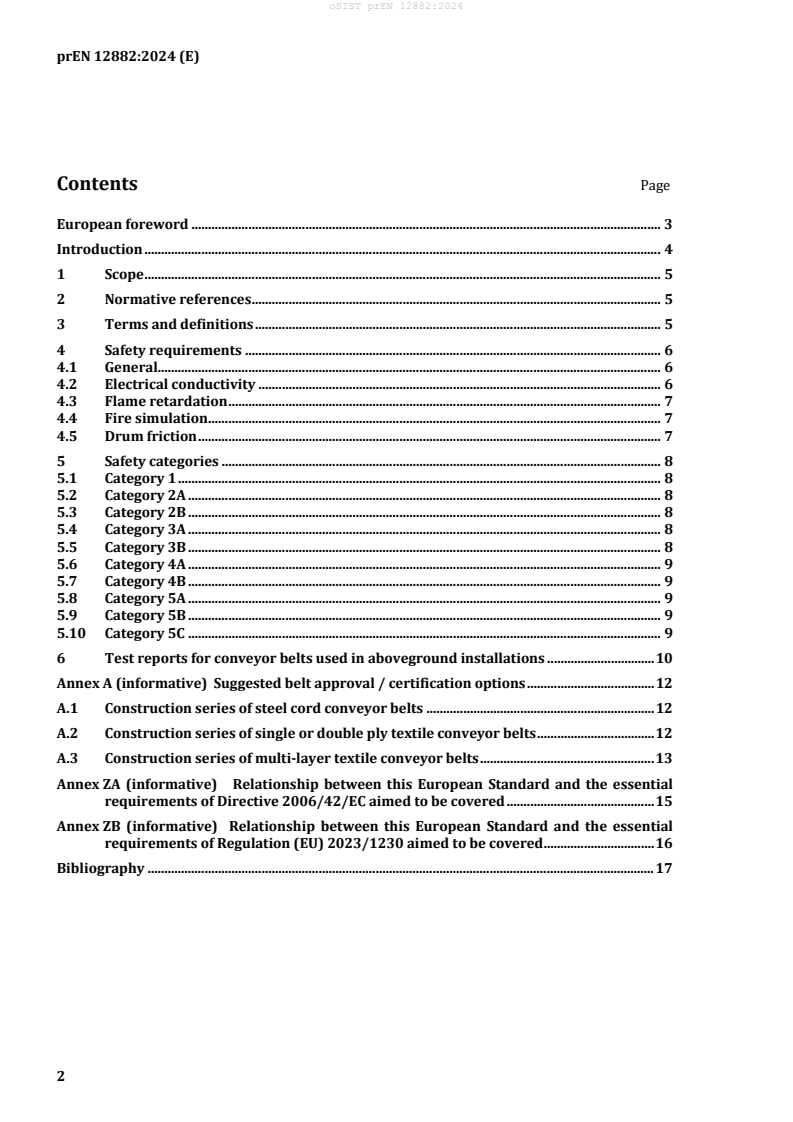
Contents Page
European foreword . 3
Introduction . 4
1 Scope . 5
2 Normative references . 5
3 Terms and definitions . 5
4 Safety requirements . 6
4.1 General. 6
4.2 Electrical conductivity . 6
4.3 Flame retardation . 7
4.4 Fire simulation . 7
4.5 Drum friction . 7
5 Safety categories . 8
5.1 Category 1 . 8
5.2 Category 2A . 8
5.3 Category 2B . 8
5.4 Category 3A . 8
5.5 Category 3B . 8
5.6 Category 4A . 9
5.7 Category 4B . 9
5.8 Category 5A . 9
5.9 Category 5B . 9
5.10 Category 5C . 9
6 Test reports for conveyor belts used in aboveground installations . 10
Annex A (informative) Suggested belt approval / certification options . 12
A.1 Construction series of steel cord conveyor belts . 12
A.2 Construction series of single or double ply textile conveyor belts . 12
A.3 Construction series of multi-layer textile conveyor belts . 13
Annex ZA (informative) Relationship between this European Standard and the essential
requirements of Directive 2006/42/EC aimed to be covered . 15
Annex ZB (informative) Relationship between this European Standard and the essential
requirements of Regulation (EU) 2023/1230 aimed to be covered . 16
Bibliography . 17
European foreword
This document (prEN 12882:2024) has been prepared by Technical Committee CEN/TC 188 “Conveyor
belts”, the secretariat of which is held by SNV.
This document is currently submitted to the CEN Enquiry.
This document will supersede EN 12882:2015.
This document includes the following significant technical changes with respect to EN 12882:2015:
— The EN ISO 20238 procedures have been revised for categories 3A, 3B, 4B, 5A, 5B and 5C;
— A new Clause 6 "Test reports for conveyor belts for use above ground" has been added;
— The definition of the type series has been revised and described in detail.
This document has been prepared under a standardization request addressed to CEN by the European
Commission. The Standing Committee of the EFTA States subsequently approves these requests for its
Member States.
For the relationship with EU Legislation, see informative Annex ZA, which is an integral part of this
document.
Introduction
This document is a type C standard as stated in EN ISO 12100:2010.
The machinery concerned and the extent to which hazards, hazardous situations and events are covered
are indicated in the scope of this document.
When provisions of this type C standard are different from those which are stated in type A or B
standards, the provisions of this type C standard take precedence over the provisions of the other
standards, for machines that have been designed and built according to the provisions of this type C
standard.
During the preparation of this document, the hazards which have been identified as being directly related
to the use of conveyor belts are:
a) hazards associated with the discharge of static electrical energy;
b) hazards associated with the impingement of small naked flames on the cover and/or carcass of a
conveyor belt at rest;
c) hazards caused by the stalling of a conveyor belt and the continued operation of the driving
mechanism causing localized heating of the conveyor belt through contact with the driving drum or
cylinder or some other source of frictional heat;
d) hazards caused by the propagation of a flame along a belt which has been exposed to a relatively high
energy source such as a fire.
The risk, or probable rate of occurrence of these hazards and the degree of harm they can cause will vary
depending upon the particular circumstances of the application or site of application, which are many
and varied. Consequently, the level of safety required will vary from one application to another,
depending upon the risks judged to be pertinent. The hazards listed above should not be taken as the only
properties affecting safety in operation. Other aspects such as health or environmental requirements
should be considered. Depending on the individual end use requirement, these other factors can affect
the category of belt selected and additional safety precautions may need to be employed.
This document is therefore designed to enable the user to select the category of conveyor belt most suited
to the particular circumstances of the application.
1 Scope
This document specifies electrical and flammability safety requirements for general purpose conveyor
belts not intended for use in underground installations and a means of categorizing conveyor belts in
terms of the level of safety sought in their end use application. This document does not provide electrical
safety requirements for volume resistance which may be measured by the methods in EN ISO 21178 and
which is relevant to some types of light conveyor belts.
This document is not applicable to conveyor belts which are manufactured before the date of publication
of this document by CEN.
NOTE 1 Directive 94/9/EC concerning equipment and protective systems intended for use in potentially
explosive atmospheres can be applicable to the type of machine or equipment covered by this document. The
present standard is not intended to provide means of complying with the essential health and safety requirements
of Directive 94/9/EC, this being covered in EN 14973.
NOTE 2 prEN 12882 is not a product standard but is intended to help users of conveyor belts to select the
required electrical and flammability safety properties needed following a suitable risk assessment. No requirements
are, therefore, included for marking, information to be supplied, etc., these matters being covered in relevant
product standards such as EN ISO 14890 and EN ISO 15236-1.
2 Normative references
The following documents are referred to in the text in such a way that some or all of their content
constitutes requirements of this document. For dated references, only the edition cited applies. For
undated references, the latest edition of the referenced document (including any amendments) applies.
EN 12881-1:2014, Conveyor belts - Fire simulation flammability testing - Part 1: Propane burner tests
EN ISO 284:2012, Conveyor belts - Electrical conductivity - Specification and test method (ISO 284:2012)
EN ISO 340:2022, Conveyor belts - Laboratory scale flammability characteristics - Requirements and test
method (ISO 340:2022)
EN ISO 21178:2020, Light conveyor belts - Determination of electrical resistances (ISO 21178)
EN ISO 21179:2013, Light conveyor belts - Determination of the electrostatic field generated by a running
light conveyor belt (ISO 21179:2013)
EN ISO 21183-1:2006, Light conveyor belts - Part 1: Principal characteristics and applications (ISO 21183-
1:2005)
3 Terms and definitions
For the purposes of this document, the following terms and definitions apply.
ISO and IEC maintain terminology databases for use in standardization at the following addresses:
— ISO Online browsing platform: available at https://www.iso.org/obp/
— IEC Electropedia: available at https://www.electropedia.org/
3.1
afterflame
flame which persists after the ignition source has been removed
3.2
afterglow
persistence of glowing, after cessation of flaming or, if no flaming occurs, after the ignition source has
been removed
3.3
flame
zone of combustion in the gaseous phase usually with emission of light
3.4
flame
to undergo combustion in the gaseous phase with emission of light
3.5
glowing
made luminous by heat, (without flame)
3.6
undamaged
part remaining of a conveyor belt after the termination of the propane gallery fire test, described in
accordance with EN 12881-1:2014, and which shows no evidence of embrittlement, cracking, blistering
or other blemishes not originally present
4 Safety requirements
4.1 General
Conveyor belts within each category (1, 2A, 2B, 3A, 3B, 4A, 4B, 5A, 5B and 5C) shall meet the test
requirements as indicated in Table 1 and in the specific subclauses below.
4.2 Electrical conductivity
4.2.1 When tested in accordance with EN ISO 284:2012, all general-purpose conveyor belts shall have
an electrical surface resistance not greater than 300 MΩ.
4.2.2 Light conveyor belts as described in EN ISO 21183-1:2006 shall have an electrical surface
resistance not greater than 300 MΩ when tested in accordance with EN ISO 21178:2020 unless the
conditions described in 4.2.3 are met.
4.2.3 Light conveyor belts with an internal conductive layer shall not generate an electrostatic charge
resulting in a surface potential of more than 1 000 V when tested in accordance with EN ISO 21179:2013.
NOTE Under special service conditions, whereby higher electrostatic charges resulting in surface potentials of
more than 1000 V can be generated due to friction between belt surface and conveyed goods, or due to friction
within the conveyed goods like non-conductive bulk goods such as sugar, flour or plastic granules. The requirements
for safety in this standard do not consider such critical service conditions, but only the run of the empty light
conveyor belt and the electrostatic charges generated thereby.
In certain circumstances (e.g. in the transportation of electronic components), the dissipation of electrical
charges through the belt may be required. This requirement can be specified in terms of volume
resistance as measured by the method described in EN ISO 21178:2020. However, the requirements for
safety in this standard do not consider the volume resistance of light conveyor belts for the allocation to
the different safety categories.
4.3 Flame retardation
4.3.1 Conveyor belts in category 2A, or 3A, (see Clause 5 and Table 1), when tested in accordance with
EN ISO 340:2022 with covers intact, shall have an aggregate of the times for duration of afterflame for all
six tests of less than 45 s and no individual result shall be greater than 15 s.
4.3.2 Conveyor belts in category 2B, 3B, 4A, 4B, 5A, 5B and 5C (see Clause 5 and Table 1), when tested
in accordance with EN ISO 340:2022 with covers intact and also with covers removed, shall have an
aggregate of the times for duration of afterflame for each group of six tests, (i.e. six tests with covers intact
and six tests with covers removed) of less than 45 s and no individual result shall be greater than 15 s.
4.4 Fire simulation
4.4.1 Conveyor belts in categories 4A and 4B, 5A, 5B and 5C (see Clause 5 and Table 1), when tested in
accordance with Method A, C or D of EN 12881-1:2014, shall retain a length of undamaged conveyor belt
as indicated in Table 1.
4.4.2 The test methods in accordance with EN 12881-1:2014 are not applicable for light conveyor belts
as described in EN ISO 21183-1:2006. Therefore, light conveyor belts can only be assigned to the
categories 1, 2A and 2B.
4.5 Drum friction
4.5.1 Conveyor belts in categories 3A and 3B (see Clause 5 and Table 1), when tested in accordance
with Method A1.1 of EN ISO 20238:2019 (constant load of 343 N), shall exhibit no flame whatsoever
throughout the test, which shall continue for 60 min duration, or until the belt breaks, whichever is the
shorter time. If, due to the design of the conveyor belt (for example, textile conveyor belts or steel cord
conveyor belts with a large thickness), the test according to procedure A1.1 cannot be performed, the test
according to procedure A1.2 is performed with a reduced wrap angle.
4.5.2 Conveyor belts in category 4B (see Clause 5 and Table 1), when tested in accordance with Method
B1.1 of EN ISO 20238:2019 (constant load of 343 N), shall exhibit no flame whatsoever throughout the
test, which shall continue for 60 min duration, or until the belt breaks, whichever is the shorter time. If,
due to the design of the conveyor belt (for example, textile conveyor belts or steel cord conveyor belts
with a large thickness), the test according to procedure B1.1 cannot be performed, the test according to
procedure B1.2 is performed with a reduced wrap angle.
4.5.3 Conveyor belts in category 5A (see Clause 5 and Table 1), when tested in accordance with Method
B2.1 of EN ISO 20238:2019, shall exhibit no flame whatsoever throughout the test, which shall continue
for 150 min duration, or until the belt breaks, whichever is the shorter time. If, due to the design of the
conveyor belt (for example, textile conveyor belts or steel cord conveyor belts with a large thickness), the
test according to procedure B2.1 cannot be performed, the test according to procedure B2.2 is performed
with a reduced wrap angle.
4.5.4 Conveyor belts in category 5B (see Clause 5 and Table 1), when tested in accordance with Method
B2.1 of EN ISO 20238:2019, shall exhibit no flame or glowing whatsoever throughout the test, which shall
continue for 150 min duration, or until the belt breaks, whichever is the shorter time. If, due to the design
of the conveyor belt (for example, textile conveyor belts or steel cord conveyor belts with a large
thickness), the test according to procedure B2.1 cannot be performed, the test according to procedure
B2.2 is performed with a reduced wrap angle.
4.5.5 Conveyor belts in category 5C (see Clause 5 and Table 1), when tested in accordance with Method
B2.1 of EN ISO 20238:2019, shall exhibit no flame or glowing whatsoever throughout the test, which shall
continue for 150 min duration, or until the belt breaks, whichever is the shorter time, and at no time
during the test shall the drum temperature exceed 400 °C. If, due to the design of the conveyor belt (for
example, textile conveyor belts or steel cord conveyor belts with a large thickness), the test according to
procedure B2.1 cannot be performed, the test according to procedure B2.2 is performed with a reduced
wrap angle.
4.5.6 The test methods in accordance with the EN ISO 20238:2019 are not applicable for light conveyor
belts as described in EN ISO 21183-1:2006. Therefore, light conveyor belts can only be assigned to the
categories 1, 2A and 2B.
5 Safety categories
5.1 Category 1
A conveyor belt shall be designated only as a category 1 conveyor belt if it complies with the requirements
in 4.2.
NOTE A summarized tabular presentation of the requirements in Clause 4 and Clause 5 is given in Table 1.
5.2 Category 2A
A conveyor belt shall be designated as a category 2A conveyor belt only if it complies with the
requirements of 4.2 and 4.3.1.
5.3 Category 2B
A conveyor belt shall be designated as a category 2B conveyor belt only if it complies with the
requirements of 4.2 and 4.3.2.
5.4 Category 3A
A conveyor belt shall be designated as a category 3A conveyor belt only if it complies with the
requirements of 4.2, 4.3.1 and 4.5.1.
If it is not possible to conduct the test specified in 4.5.1, due to the constructional properties of the type
of belt selected for safety cate
...
Questions, Comments and Discussion
Ask us and Technical Secretary will try to provide an answer. You can facilitate discussion about the standard in here.
Loading comments...