

oSIST prEN 12413:2026
(Main)Safety requirements for bonded abrasive products
- Abstract
This document is applicable to rotating bonded abrasive products. It specifies requirements and/or measures for the removal or reduction of hazards resulting from the design and application of the abrasive products.
This document also contains procedures and tests for verification of compliance with the requirements as well as safety information for use, which is to be made available to the user by the manufacturer.
This document does not apply to superabrasive products and coated abrasive products.
- Status
- Not Published
- Public Enquiry End Date
- 29-Nov-2026
- Technical Committee
- VSN - Safety of machinery
- Current Stage
- 4020 - Public enquire (PE) (Adopted Project)
- Start Date
- 09-Sep-2026
- Due Date
- 27-Jan-2027

prEN 12413:2026 is a draft European Standard from CEN on safety requirements for bonded abrasive products. It applies to rotating bonded abrasive products and specifies design requirements, verification tests, and user information intended for designers, manufacturers, suppliers, and machine builders who select or use these products.
What does prEN 12413:2026 specify?
prEN 12413:2026 covers the safety of rotating bonded abrasive products and the methods used to check that they meet the stated requirements. It excludes superabrasive products and coated abrasive products.
The document is organized into:
- Scope, normative references, terms, and symbols
- A list of significant hazards
- Safety requirements
- Verification of those requirements
- Information for use
- Annexes A to F with marking, calculation, test methods, colour codes, speed conversion, and inspection guidance
| Annex | What it covers |
|---|---|
| A | Marking requirements, restrictions to use, safety symbols, and how marking is applied |
| B | Mounted points and wheels, including a calculation method and example for maximum permissible speed of rotation |
| C | Verification methods for side load capacity |
| D | Colour codes for maximum operating speed |
| E | Speed conversion table |
| F | Recommended scope of the in-process inspection |
What are the key requirements of prEN 12413:2026?
prEN 12413:2026 sets out the main safety expectations for product design, strength, dimensions, marking, verification, and user information. The practical effect is that the product, its label, and the manufacturer’s instructions all have to work together to prevent breakage, kickback, vibration, and misuse.
Product design and operating speed
Clause 5.1 requires abrasive products to be designed and manufactured so they withstand the forces expected in intended use and do not show visible faults. Clause 5.1.2 sets a sequence of maximum operating speeds in m/s, with only limited use of intermediate speeds when the application requires them.
This matters because the declared speed is part of the safety limit for the wheel. The standard also links speed marking to outside diameter through Annex E, so the marked speed has to match the product size.
Strength and stability
Clause 5.2 sets safety factors against bursting due to centrifugal force. For most abrasive products, Table 4 gives the required factor according to product type, machine type, and maximum operating speed. Mounted points and wheels have a separate requirement: the bursting safety factor is 3 and the spindle safety factor against deflection is 1.3.
Clause 5.2.3 adds side load capacity requirements for depressed-centre wheels, straight cutting-off wheels, and depressed-centre cutting-off wheels used on hand-held machines. This is important because these products can be loaded sideways in real use, especially during cutting or when the operator changes angle.
Dimensions, run-out, and unbalance
Clause 5.3 and Table 6 tie together product type, dimensions, and maximum operating speed. The table is the key place to check whether a product form is covered and what speed limit applies for that form and application.
Clause 5.3.2 requires limit deviations and run-out tolerances to comply with ISO 13942 where listed there. Clause 5.4 requires products for hand-held machines to comply with EN ISO 6103 values for permissible unbalance where listed there. In practice, this means geometry and balance are not optional details - they are part of the safety case.
Marking, blotters, and use information
Clause 5.5 requires marking according to Annex A. Annex A covers the manufacturer or supplier identification, dimensions, specification mark, maximum operating speed, declaration of conformity with EN 12413, restrictions to use, traceability code, and safety symbols where applicable.
Clause 5.6 requires blotters where needed for safe mounting and use, and says their material and dimensions have to suit the application. Clause 7 requires user information on general product properties, handling and storage, selection, pre-use conditions, mounting, grinding and cutting operations, marking, and restrictions to use. That is the information the user needs to avoid fitting or using the product incorrectly.
Verification and tests
Clause 6 sets out how compliance is checked. It includes visual inspection, the ring test for certain vitrified products, the safety speed test, centrifugal force testing for safety factors, side-load verification by Annex C, dimensional checks, unbalance verification by EN ISO 6103 methods, marking checks, and blotter checks.
The ring test is specifically clarified for vitrified abrasive products with D > 80 mm, with stated exceptions. The safety speed test and destructive bursting-related tests show that the standard expects type testing and process control, not just label checks.
What terms does prEN 12413:2026 define?
- Bonded abrasive product - A product made of abrasive grains held together by a bond; the standard applies to this product family.
- Stationary machine - A machine fixed in position during operation, including transportable machines that are fixed while used.
- Mobile machine - A machine not fixed in position during operation and guided manually but not hand-held.
- Hand-held machine - A machine held in the hand during operation, including machines with flexible drives.
- Maximum operating speed (v) - The highest permissible peripheral speed of a rotating abrasive product.
- Safety factor (S) - A ratio used to compare bursting speed or spindle deflection speed with the maximum operating speed.
- Blotters - Compressible material used with the abrasive product when required for safe mounting and use.
Who uses prEN 12413:2026?
prEN 12413:2026 is addressed to designers, manufacturers, and suppliers of the abrasive products in its scope. It also helps designers, manufacturers, and suppliers of grinding machines choose compatible abrasive products and reduce risk.
It is used in product development, marking, verification testing, and in-process inspection. The document is also relevant to anyone responsible for safe application of abrasive products on stationary, mobile, and hand-held grinding and cutting-off machines.
What changed in prEN 12413:2026 from the previous edition?
prEN 12413:2026 supersedes EN 12413:2019. The foreword lists these technical changes:
- Clause 3 was supplemented and clarified
- Type 29 was added to Table 5
- Table 6 was revised and aligned with ISO 525
- Maximum operating speeds and dimensional limitations in Table 6 were reviewed and updated
- The dimensional limit for Type 1 at 125 m/s was revised
- The ring test provisions in 6.1.3 were clarified
- Annex A terminology and safety-sign provisions were revised
- Annex D colour-coding provisions were clarified
- Annex E speed-conversion values were corrected
- Annex F in-process inspection recommendations were updated
Which standards are used with prEN 12413:2026?
| Standard | Contribution to prEN 12413:2026 |
|---|---|
| EN ISO 6103 | Gives the static testing method and permissible unbalances for grinding wheels as delivered; used for unbalance verification |
| ISO 525 | Defines shape types, designation, and marking of bonded abrasive products; used in product type descriptions and specification marks |
| ISO 13942 | Covers limit deviations and run-out tolerances; used for dimensional compliance |
The bibliography also points to related standards for stationary and hand-held machine safety, safety signs, and machine-tool or power-tool applications, including EN ISO 16089, EN ISO 7010, ISO 3864-2, and several EN 60745, EN 62841, and EN ISO 11148 parts.
What does the prEN 12413:2026 document contain?
prEN 12413:2026 contains the main safety tables for hazard coverage, strength factors, side-load capacity, and dimensional limits. It also contains the marking table, restrictions-to-use table, and safety-symbol table in Annex A.
The document includes verification methods for visual inspection, ring testing, safety speed testing, centrifugal force testing, and side-load testing. Annex B provides a calculation method and worked example for mounted points and wheels, while Annex C sets out the test methods for side load capacity.
Annex D gives colour codes for operating speed, Annex E gives recommended speed-conversion values, and Annex F gives a recommended scope for in-process inspection. These annexes are the parts most often used in design checks, test planning, and production control.
Relations
- Effective Date
- 22-Oct-2025
Get Certified
Connect with accredited certification bodies for this standard

DVS-ZERT GmbH
German welding certification society.

CARES (UK Certification Authority for Reinforcing Steels)
UK certification for reinforcing steels and construction.

EWF/IIW (European/International Welding Federation)
International welding personnel certification.
Sponsored listings
Frequently Asked Questions
oSIST prEN 12413:2026 is a draft published by the Slovenian Institute for Standardization (SIST). Its full title is "Safety requirements for bonded abrasive products". This standard covers: This document is applicable to rotating bonded abrasive products. It specifies requirements and/or measures for the removal or reduction of hazards resulting from the design and application of the abrasive products. This document also contains procedures and tests for verification of compliance with the requirements as well as safety information for use, which is to be made available to the user by the manufacturer. This document does not apply to superabrasive products and coated abrasive products.
This document is applicable to rotating bonded abrasive products. It specifies requirements and/or measures for the removal or reduction of hazards resulting from the design and application of the abrasive products. This document also contains procedures and tests for verification of compliance with the requirements as well as safety information for use, which is to be made available to the user by the manufacturer. This document does not apply to superabrasive products and coated abrasive products.
oSIST prEN 12413:2026 is classified under the following ICS (International Classification for Standards) categories: 25.100.70 - Abrasives. The ICS classification helps identify the subject area and facilitates finding related standards.
oSIST prEN 12413:2026 has the following relationships with other standards: It is inter standard links to SIST EN 12413:2020. Understanding these relationships helps ensure you are using the most current and applicable version of the standard.
oSIST prEN 12413:2026 is available in PDF format for immediate download after purchase. The document can be added to your cart and obtained through the secure checkout process. Digital delivery ensures instant access to the complete standard document.
Standards Content (Sample)
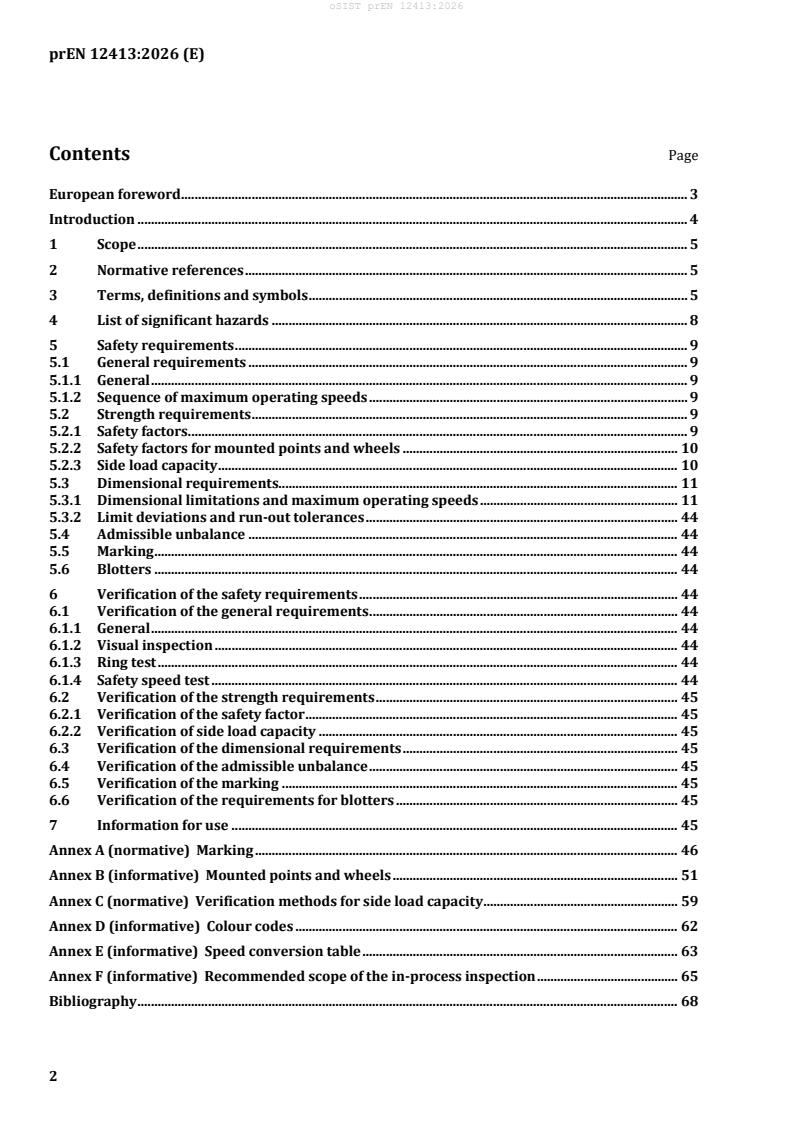
Contents
- Introduction
- 1 Scope
- 2 Normative references
- 3 Terms, definitions and symbols
- 3.1 General
- 3.1.1 bonded abrasive product
- 3.2 Grinding and cutting-off machines
- 3.2.1 stationary machine
- 3.2.2 stationary machine with totally enclosed working area
- 3.2.3 mobile machine
- 3.2.4 hand-held machine
- 3.3 Grinding and cutting-off methods
- 3.3.1 peripheral grinding
- 3.3.2 face grinding
- 3.3.3 cutting-off
- 3.3.4 high pressure grinding
- 3.4 Type of application
- 3.4.1 mechanically guided grinding and cutting-off
- 3.4.2 manually guided grinding and cutting-off
- 3.4.3 hand-held grinding and cutting-off
- 3.5 Symbols
- 4 List of significant hazards
- 5 Safety requirements
- 5.1 General requirements
- 5.2 Strength requirements
- 5.3 Dimensional requirements
- 5.4 Admissible unbalance
- 5.5 Marking
- 5.6 Blotters
- 6 Verification of the safety requirements
- 6.1 Verification of the general requirements
- 6.2 Verification of the strength requirements
- 6.3 Verification of the dimensional requirements
- 6.4 Verification of the admissible unbalance
- 6.5 Verification of the marking
- 6.6 Verification of the requirements for blotters
- 7 Information for use
- Annex A
- Annex B
- 1 Collet
- 1 Collet
- 1 Collet
- 1 Collet
- 1 Collet
- 1 Collet
- 1 Collet
- 1 Collet
- 1 Collet
- Annex C
- 1 Abrasive product
- 2 Feed
- 3 Load cell
- 4 Pressure roll
- 5 Direction of rotation
- Annex D
- 1 × blue
- 1 × yellow
- Annex E
- Annex F
- Bibliography
Introduction
This document has been prepared to provide one means of conforming with essential safety requirements, e.g. of the General Product Safety Directive and associated EFTA regulations. This document is addressed to designers, manufacturers and suppliers of the abrasive products described in the scope. In addition, it helps designers, manufacturers and suppliers of grinding machines in the selection of abrasive products, in order to reduce the risks and achieve conformity of the respective machinery with the essential health and safety requirements of the Machinery Directive. The extent to which hazards are covered is indicated in the scope of this document.
oSIST prEN 12413:2026 prEN 12413:2026 (E)
1 Scope
This document is applicable to rotating bonded abrasive products. It specifies requirements and/or measures for the removal or reduction of hazards resulting from the design and application of the abrasive products.
This document also contains procedures and tests for verification of compliance with the requirements as well as safety information for use, which is to be made available to the user by the manufacturer. This document does not apply to superabrasive products and coated abrasive products.
2 Normative references
The following documents are referred to in the text in such a way that some or all of their content constitutes requirements of this document. For dated references, only the edition cited applies. For undated references, the latest edition of the referenced document (including any amendments) applies. EN ISO 6103, Bonded abrasive products - Permissible unbalances of grinding wheels as delivered - Static testing (ISO 6103) ISO 525, Bonded abrasive products — Shape types, designation and marking ISO 13942, Bonded abrasive products — Limit deviations and run-out tolerances
3 Terms, definitions and symbols
For the purposes of this document, the following terms and definitions apply. ISO and IEC maintain terminological databases for use in standardization at the following addresses:
- IEC Electropedia: available at https://www.electropedia.org/
- ISO Online browsing platform: available at https://www.iso.org/obp
3.1 General
3.1.1 bonded abrasive product
product consisting of abrasive grains held together by a bond EXAMPLE Typical abrasive grains are aluminium oxide or silicon carbide. Note 1 to entry: Types of bonded abrasive products are defined in ISO 525.
3.2 Grinding and cutting-off machines
3.2.1 stationary machine
machine being fixed in position during operation Note 1 to entry: See for example EN ISO 16089.
Note 2 to entry: Included are fixed swing frame machines and mobile machines clamped firmly in position during use.
Note 3 to entry: Transportable machines are fixed in position during operation and therefore considered to be stationary machines.
oSIST prEN 12413:2026 prEN 12413:2026 (E)
3.2.2 stationary machine with totally enclosed working area
stationary machine being protected by separating guards in such a way that machining processes are carried out inside them and persons are protected against hazards
3.2.3 mobile machine
machine not being fixed in position during operation Note 1 to entry: Mobile machines are manually guided (but not hand-held) by the operator during use, e.g. floor grinding machines.
3.2.4 hand-held machine
machine being held in the hand during operation Note 1 to entry: Included are machines with flexible drives.
3.3 Grinding and cutting-off methods
3.3.1 peripheral grinding
grinding with the periphery of the wheel with no or limited side loads
3.3.2 face grinding
grinding with the face of the wheel
3.3.3 cutting-off
cutting or slotting with the periphery of the cutting-off wheel
3.3.4 high pressure grinding
grinding with high contact pressure for steel conditioning
3.4 Type of application
3.4.1 mechanically guided grinding and cutting-off
process with feed movements of the abrasive product and/or the workpiece guided by mechanical means Note 1 to entry: See Table 1.
3.4.2 manually guided grinding and cutting-off
process with feed movements of the abrasive product and/or the workpiece manually guided by the operator Note 1 to entry: See Table 1.
oSIST prEN 12413:2026 prEN 12413:2026 (E)
3.4.3 hand-held grinding and cutting-off
process with the grinding or cutting-off machine entirely guided by the operator Note 1 to entry: See Table 1.
Table 1 — Type of application Type of machine Type of application Abrasive product Workpiece Fixed Mechanically guided Stationary machines Mechanically guided and stationary grinding and cutting- Mechanically guided Fixed machines with totally off enclosed working area Mechanically guided Mechanically guided Manually guided Guided by the operator Fixed Stationary and mobile grinding and cuttingmachines Fixed Guided by the operator off Hand-held grinding Hand-held machines Guided by the operator Fixed and cutting-off
3.5 Symbols
For the purposes of this document, the symbols listed in Table 2 apply. Table 2 — Symbols Symbol Designation Definition Unit A Impact resistance Resistance of a rotating abrasive product Nm to lateral impact f Bursting speed factor Bursting speed divided by maximum — br operating speed:
𝑣𝑣 br 𝑓𝑓 = br 𝑣𝑣 𝑠𝑠 f Test speed factor Safety test speed divided by maximum — pr operating speed:
𝑣𝑣 pr 𝑓𝑓 = pr 𝑣𝑣 𝑠𝑠 F Single point side load Resistance of a rotating abrasive product N S1 to lateral single point load n Deflection speed of mounted Revolutions per minute at which the 1/min ab points spindle of mounted points is deflecting under centrifugal force n Maximum permissible speed Revolutions per minute of a new abrasive 1/min max of rotation product at maximum operating speed S Safety factor against spindle Deflection speed divided by maximum — ab deflection for mounted points permissible speed of rotation:
𝑛𝑛 ab 𝑆𝑆 = ab 𝑛𝑛 max
oSIST prEN 12413:2026 prEN 12413:2026 (E) Symbol Designation Definition Unit S Safety factor against bursting Bursting speed divided by maximum — br due to centrifugal force operating speed, all squared:
𝑣𝑣 br 𝑆𝑆 =� � br 𝑣𝑣 𝑠𝑠 v Maximum operating speed Maximum permissible peripheral speed m/s s of a rotating abrasive product v Safety test speed Peripheral speed at which abrasive m/s pr products are tested by the manufacturer v Bursting speed Peripheral speed at which an abrasive m/s br product breaks due to centrifugal force v Minimum bursting speed Peripheral speed which an abrasive m/s br, min product shall at least reach without bursting due to centrifugal force
4 List of significant hazards
The significant hazards are listed in Table 3.
Table 3 — List of significant hazards Hazard designation Hazardous situation (Examples) Relevant clauses in this standard Ejection of parts 1. Abrasive product breakage — caused by - improper design 5.1, 5.2, 5.3 and Annex C - manufacturing defects 5.1 - wrong selection 5.5, Clause 7 and Annex A - improper handling and storage Clause 7 - improper use (mounting and 5.6, Clause 7 and Annex A grinding process) 2. Grinding debris Clause 7 Vibration Hand arm vibration on hand-held — machines caused by - manufacturing defects 5.3 and 5.4 - improper use Clause 7 - incorrect mounting Clause 7
oSIST prEN 12413:2026 prEN 12413:2026 (E) Hazard designation Hazardous situation (Examples) Relevant clauses in this standard Kickback Kickback effect of cutting-off — wheels on hand-held machines caused by:
- improper use Clause 7
- improper design 5.1, 5.2, 5.3 and Annex C
- manufacturing defects 5.1
- wrong selection 5.5, Clause 7 and Annex A
- improper handling and storage Clause 7
5 Safety requirements
5.1 General requirements
5.1.1 General
Abrasive products shall be designed and manufactured in such a way that they resist the forces and loads that are to be expected when used as intended. They shall not present visible faults and shall comply with the requirements listed in the following clauses.
5.1.2 Sequence of maximum operating speeds
Abrasive products shall be manufactured for maximum operating speeds according to the following sequence:
< 16 — 16 — 20 — 25 — 32 — 35 — 40 — 45 — 50 — 63 — 80 — 100 — 125 in m/s The only exception to this is where the application requirements dictate an intermediate speed. The manufacturer may select any of these speeds up to the maximum values shown in Table 6. NOTE For conversion of peripheral speeds into speeds of rotation for different outside diameters D of the abrasive product, see Annex E.
5.2 Strength requirements
5.2.1 Safety factors
Abrasive products — with the exception of mounted points and wheels — shall have a safety factor against bursting due to centrifugal forces at their maximum operating speed as given in Table 4.
oSIST prEN 12413:2026 prEN 12413:2026 (E) Table 4 — Safety factors Type of Type of abrasive Maximum Safety factor Bursting speed machine product operating factor speed v S f
s br br m/s high pressure grinding ≤ 80 3,50 1,87 wheels cutting-off wheels, manually guided cutting- ≤ 100 3,50 1,87 Stationary off machines cutting-off wheels, only mechanically guided ≤ 100 2,00 1,41 cutting-off all other types all 3,00 1,73 Stationary high pressure grinding ≤ 100 3,00 1,73 machines wheels totally all other types all 1,75 1,32 enclosed Mobile grinding and cutting-off ≤ 100 3,50 1,87 machines wheels ≤ 50 3,00 1,73 grinding wheels D > 125 mm 50 < v ≤ 80 3,50 1,87 s Hand-held cutting-off wheels ≤ 100 3,50 1,87 machines D > 125 mm ≤ 80 3,00 1,73 all types D ≤ 125 mm > 80 3,50 1,87
5.2.2 Safety factors for mounted points and wheels
Mounted points and wheels shall have a safety factor against bursting due to centrifugal forces of S = 3 br at their maximum operating speed. The spindle shall have a safety factor against deflection of S = 1,3. ab For further requirements, see Annex B.
5.2.3 Side load capacity
Depressed-centre wheels, straight cutting-off wheels and depressed-centre cutting-off wheels for the use on hand-held machines shall have a side load capacity according to Table 5.
oSIST prEN 12413:2026 prEN 12413:2026 (E) Table 5 — Side load capacity of abrasive products for use on hand-held machines Abrasive product Maximum Outside Side load capacity operating diameter Single point Impact resistance speed side load v F D A s S1 m/s mm N Nm ≥ 115 290 — Depressed-centre grinding wheels 150 290 4,5 ≤ 80 a,b (type 27 and 180 290 5,4 a,c type 28 ) 230 290 6,9 ≥ 115 40 — 150 50 1,2 Straight and 180 50 1,5 depressed-centre cutting-off wheels ≤ 80 230 50 2,0 a (type 41 and 300 125 5,4 a type 42 ) 350/356 125 5,4 400/406 125 5,4 80 < v ≤ 125 115 < D ≤ 125 40 — s Straight cutting- 300 125 5,4 off wheels 80 < v ≤ 100 a 350/356 125 5,4 s (type 41 ) 400/406 125 5,4 a According to ISO 525.
b With back-up pad where intended for the type of application.
Tested as a type 27.
5.3 Dimensional requirements
5.3.1 Dimensional limitations and maximum operating speeds
Bonded abrasive products shall comply with the dimensional limitations and maximum operating speeds as specified in Table 6.
NOTE The arrow in the figures in Table 6 symbolizes the working face of the bonded abrasive product. NOTE The dash in Table 6 means that these combinations are not covered by this document and therefore cannot be marked with EN 12413.
oSIST prEN 12413:2026 prEN 12413:2026 (E) Table 6 — Dimensional limitations and maximum operating speed Shape, designation, dimensional letters Type of Type of Maximum operating speeds and dimensional limitations a a machine application Standard operating speeds Special operating speeds m/s m/s b b Types of bond Types of bond Dimensional Dimensional limitations limitations V B BF R RF E MG PL V B BF R RF PL Type 1 c H ≤ 0,67 D 63 63 63 63 63 63
Mechanically 40 50 63 50 50 40 50 Straight grinding wheel guided grinding d H ≤ 0,50 D 80 80 80 80 80 63
H ≤ 0,67 D Mechanically c H ≤ 0,67 D 125 80 80 80 80 50
guided 100 80 80 80 80 40 50 grinding, d H ≤ 0,50 D 125 100 100 100 100 63
totally enclosed Stationary Mechanically machines guided high H ≤ 0,50 D — 80 — — — — — — — — — — — — — pressure grinding Mechanically guided high pressure H ≤ 0,50 D — 80 — — — — — — H ≤ 0,33 D — 100 — — — —
grinding, totally enclosed
Stationary H ≤ 0,50 D 35 63 63 63 63 50
Manually and mobile H ≤ 0,67 D 35 50 63 50 50 40 50 guided grinding d machines H ≤ 0,33 D 35 63 80 63 80 50
Hand-held Hand-held H ≤ 0,25 D — 50 80 50 80 — — 50 H ≤ 0,25 D — 63 80 63 80 — b D × T × H machines grinding a Definitions see 3.2 and 3.4.
b Types of bond and designation examples see ISO 525.
D ≤ 1 000 mm d D > 1 000 mm
oSIST prEN 12413:2026 prEN 12413:2026 (E) Shape, designation, dimensional letters Type of Type of Maximum operating speeds and dimensional limitations a a machine application Standard operating speeds Special operating speeds m/s m/s b b Types of bond Types of bond Dimensional Dimensional limitations limitations V B BF R RF E MG PL V B BF R RF PL Type 2 Mechanically guided 32 40 — — — — 25 40 63 63 — — — 50 Cylinder grinding wheel, cemented or clamped to a grinding back-plate Stationary W < 0,17 D W < 0,17 D machines Manually guided 32 40 — — — — — 40 32 50 — — — 50 grinding
Key 1 back-plate b D × T × W a Definitions see 3.2 and 3.4.
b Types of bond and designation examples see ISO 525.
oSIST prEN 12413:2026 prEN 12413:2026 (E) Shape, designation, dimensional letters Type of Type of Maximum operating speeds and dimensional limitations a a machine application Standard operating speeds Special operating speeds m/s m/s b b Types of bond Types of bond Dimensional Dimensional limitations limitations V B BF R RF E MG PL V B BF R RF PL Type 3 Mechanically H ≤ 0,67 D 63 63 — 63 — 63 guided 40 50 — 50 — — — 50 Grinding wheel, tapered on one side H ≤ 0,50 D 80 80 — 80 — 63 grinding Stationary Mechanically H ≤ 0,67 D machines guided grinding, 100 80 — 80 — — — — H ≤ 0,50 D 125 100 — 100 — — totally enclosed
b D/J × T/U × H Type 4 Mechanically H ≤ 0,67 D 63 63 — 63 — 63 guided 40 50 — 50 — — — 50 Grinding wheel, tapered on both sides H ≤ 0,50 D 80 80 — 80 — 63 grinding Stationary Mechanically H ≤ 0,67 D machines guided grinding, 100 80 — 80 — — — — H ≤ 0,50 D 125 100 — 100 — — totally enclosed Hand-held Hand-held D ≤ 200 — 50 80 — — — — — — — — — — — — machines grinding
b D/J × T/U × H a Definitions see 3.2 and 3.4.
b Types of bond and designation examples see ISO 525.
oSIST prEN 12413:2026 prEN 12413:2026 (E)
Shape, designation, dimensional letters Type of Type of Maximum operating speeds and dimensional limitations a a machine application Standard operating speeds Special operating speeds m/s m/s b b Types of bond Types of bond Dimensional Dimensional limitations limitations V B BF R RF E MG PL V B BF R RF PL Type 5 H ≤ 0,67 D 63 63 63 63 63 63 Mechanically Grinding wheel, recessed on one side E ≥ 0,50 T guided 40 50 63 50 50 — — 50 H ≤ 0,50 D grinding 80 80 80 80 80 63 E ≥ 0,50 T Stationary machines Mechanically guided H ≤ 0,67 D H ≤ 0,50 D grinding, 80 80 80 80 80 — — 63 100 100 100 100 100 63 E ≥ 0,50 T E ≥ 0,50 T totally enclosed H ≤ 0,50 D Stationary 35 50 63 50 63 50 Manually E ≥ 0,50 T and guided 35 50 50 50 50 — — 50 b mobile D × T × H − P × F H ≤ 0,33 D grinding 35 50 80 50 80 50 machines E ≥ 0,50 T H ≤ 0,25 D H ≤ 0,25 D Hand-held Hand-held - 50 80 50 80 — — 50 — 63 80 63 80 50 machines grinding E ≥ 0,75 T E ≥ 0,75 T a Definitions see 3.2 and 3.4.
b Types of bond and designation examples see ISO 525.
oSIST prEN 12413:2026 prEN 12413:2026 (E) Shape, designation, dimensional letters Type of Type of Maximum operating speeds and dimensional limitations a a machine application Standard operating speeds Special operating speeds m/s m/s b b Types of bond Types of bond Dimensional Dimensional limitations limitations V B BF R RF E MG PL V B BF R RF PL Type 6 Mechanically guided E ≥ 0,20 T 32 40 — 40 — — — 40 63 63 — 63 — 40 Straight cup grinding wheel grinding Mechanically guided Stationary grinding, E ≥ 0,20 T 32 40 — 40 — — — 40 E ≥ 0,20 T 63 80 — 63 — 50 machines totally enclosed Manually guided E ≥ 0,20 T 32 40 — 40 — — — 40 32 50 — 40 — 40 grinding D ≤ 180 Hand-
Hand-held held — 50 — — — — — — — — — — — — — T ≤ 70 b grinding D × T × H − W × E machines E ≥ 0,25 T Type 7 H ≤ 0,67 D 63 63 — 63 — 63 Mechanically Grinding wheel, recessed on both sides E ≥ 0,50 T guided 40 50 — 50 — — — 50 H ≤ 0,50 D grinding 80 80 — 80 — 63 E ≥ 0,50 T H ≤ 0,67 D Stationary machines E ≥ 0,50 T Mechanically guided H ≤ 0,50 D grinding, 80 80 — 80 — — — 63 100 100 — 100 — 63 E ≥ 0,50 T totally enclosed
b D × T × H − P × F/G
oSIST prEN 12413:2026 prEN 12413:2026 (E) a Definitions see 3.2 and 3.4.
b Types of bond and designation examples see ISO 525.
Shape, designation, dimensional letters Type of Type of Maximum operating speeds and dimensional limitations a a machine application
b b Types of bond Types of bond Dimensional Dimensional limitations limitations V B BF R RF E MG PL V B BF R RF PL Type 9 Double cup grinding wheel Mechanically Stationary guided E ≥ 0,2 T 32 40 — 40 — — — 40 E ≥ 0,2 T 50 50 — 50 — 40 machines grinding
b D × T × H − W × E Mechanically guided 32 40 — 40 — — — 40 50 50 — 50 — 40 grinding E ≥ 0,2 T E ≥ 0,2 T Mechanically
guided Stationary grinding, 32 40 — 40 — — — 40 63 80 — 63 — 50 machines Type 11 totally Taper cup grinding wheel enclosed Manually guided E ≥ 0,2 T 32 40 — 40 — — — 40 — — — — — — — grinding Hand-held Hand-held E ≥ 0,25 T — 50 — — — — — 40 — — — — — — — machines grinding
oSIST prEN 12413:2026 prEN 12413:2026 (E)
b D/J × T × H − W × E a Definitions see 3.2 and 3.4.
b Types of bond and designation examples see ISO 525.
oSIST prEN 12413:2026 prEN 12413:2026 (E) Shape, designation, dimensional letters Type of Type of Maximum operating speeds and dimensional limitations a a machine application Standard operating speeds Special operating speeds m/s m/s b b Types of bond Types of bond Dimensional Dimensional limitations limitations V B BF R RF E MG PL V B BF R RF PL Type 12 Mechanically E ≥ 0,5 T 32 40 — 40 — — — 40 E ≥ 0,5 T 50 50 — 50 — 40 guided grinding Dish grinding wheel Mechanically guided E ≥ 0,5 T 32 40 — 40 — — — 40 E ≥ 0,5 T 63 80 — 63 — 50 grinding, totally enclosed Stationary machines Manually guided grinding E ≥ 0,5 T 32 40 — 40 — — — — — — — — — — — (tool sharpening)
b D/J × T/U × H – W × E Type 13 Mechanically E ≥ 0,5 T 32 40 — 40 — — — 40 E ≥ 0,5 T 50 50 — 50 — 40 guided grinding Saucer grinding wheel Mechanically guided E ≥ 0,5 T 32 40 — 40 — — — 40 E ≥ 0,5 T 63 80 — 63 — 50 grinding, totally enclosed Stationary machines Manually guided grinding E ≥ 0,5 T 32 40 — 40 — — — — — — — — — — — (tool sharpening)
b D/J × T/U × H − K a Definitions see 3.2 and 3.4.
b Types of bond and designation examples see ISO 525.
oSIST prEN 12413:2026 prEN 12413:2026 (E)
Shape, designation, dimensional letters Type of Type of Maximum operating speeds and dimensional limitations a a machine application Standard operating speeds Special operating speeds m/s m/s b b Types of bond Types of bond Dimensional Dimensional limitations limitations V B BF R RF E MG PL V B BF R RF PL Cones and plugs – Examples (Types 16 to 19R):
Type 16 Tapered grinding cone, curved, with threaded insert
b D × T − H × L D ≤ 80 D ≤ 80 Hand-held Hand-held 40 50 — — — — — — 50 50 — — — — machines grinding Type 17 Type 17R T ≤ 100 T ≤ 100 Tapered grinding cone, flat Tapered grinding cone, tip, with threaded insert round tip, with threaded insert
b b D × T − H × L D × T − H × L a Definitions see 3.2 and 3.4.
oSIST prEN 12413:2026 prEN 12413:2026 (E) b Types of bond and designation examples see ISO 525.
...