

oSIST prEN 18444:2026
(Main)Safety requirements for non-woven products
- Abstract
This document is applicable to the following non-woven abrasive products: non-woven flap discs with backing plate, non-woven
unitized discs with backing plate, non-woven general purpose discs with backing plate. These products are manufactured using
abrasive grains and are entirely made of non-woven web.
This document specifies requirements and/or measures for removal or reduction of hazards resulting from the design and application
of the non-woven abrasive products.
This document also contains procedures and tests for verification of compliance with the requirements as well as safety information
for use, which is to be made available to the user by the manufacturer.
Further, this document lists the hazards to be taken into consideration.
- Status
- Not Published
- Public Enquiry End Date
- 30-Oct-2026
- Technical Committee
- VSN - Safety of machinery
- Current Stage
- 4020 - Public enquire (PE) (Adopted Project)
- Start Date
- 19-Aug-2026
- Due Date
- 06-Jan-2027

oSIST prEN 18444:2026 is a CEN draft European Standard for the safety requirements of non-woven abrasive products. It specifies design and application measures, verification tests, marking, and safety information for non-woven flap discs with backing plate, non-woven unitized discs with backing plate, and non-woven general purpose discs with backing plate. The document is intended for manufacturers, suppliers, importers, and the makers of grinding machines who select and use these products.
What does oSIST prEN 18444:2026 specify?
oSIST prEN 18444:2026 applies to the three named non-woven abrasive product families and sets out how their hazards are to be reduced in design, verified in testing, and communicated to users. It also organizes the material into scope, normative references, terms and definitions, hazards, safety requirements, verification, and information for use.
| Annex | What it covers |
|---|---|
| Annex A | Marking, including required product information, restrictions of use, and safety symbols |
| Annex B | Speed conversion table for turning maximum operating speed into speed of rotation for marking |
In practice, this means oSIST prEN 18444:2026 is not only a product description. It links product design, test evidence, label content, and user instructions so the same safety rules can be applied by manufacturers and by people choosing the abrasive product for a machine.
What are the key requirements of oSIST prEN 18444:2026?
oSIST prEN 18444:2026 focuses on a small set of practical safety controls: design strength, speed limits, burst resistance, dimensions, marking, verification, and user information. These are the points that matter most when a product is designed, tested, labeled, or selected for a grinding job.
1. The products must be designed for intended use and free from safety-related visible defects
Clause 5.1 requires non-woven abrasive products to be designed and manufactured so they can withstand the forces and loads expected in intended use. They must not show visible defects that affect safety.
For a buyer or quality manager, this means the product is not just judged on shape or finish. It must be fit for the grinding conditions it is sold for, and obvious defects that could weaken it are not acceptable.
2. Maximum operating speeds are defined and linked to product type
Clause 5.1.2 sets a required sequence of maximum operating speeds, and Clause 5.3 ties those speeds to dimensional limits for each product family. Annex B gives the conversion table used to express the speed as rpm for marking.
This matters because the product must be matched to the correct machine speed. A mismatch can create a burst hazard, so speed marking and machine selection are part of safe use, not just product labeling.
3. Safety factors against bursting are required for the product families
Clauses 5.2.1 to 5.2.3 set burst-related safety factors for non-woven flap discs, non-woven unitized discs, and non-woven general purpose discs. The requirement is expressed through the relationship between bursting speed, maximum operating speed, and the safety factor.
In practice, the manufacturer has to show that the product family can resist centrifugal forces at the stated operating speed. That evidence is central for design validation and for test reports used in conformity assessment.
4. Dimensional limits and machine application are controlled together
Clause 5.3 limits product dimensions and ties each product family to hand-held grinding applications. The tables also distinguish the relevant machine type and product form.
This is important because not every shape or size can be used safely on every grinder. The standard helps the manufacturer define the permitted product range and helps the user avoid fitting an unsuitable disc.
5. Marking is mandatory and must follow Annex A
Clause 5.4 requires marking according to Annex A. Annex A calls for information such as the product designation, the manufacturer or equivalent identification, dimensions, permissible operating speed, declaration of conformity, restrictions of use, and traceability code.
For day-to-day use, this means the product itself or its fixed label must carry the safety-critical details needed for selection, traceability, and correct operation.
6. The document defines how compliance is verified
Clause 6 gives the verification methods. Visible defects are checked by visual inspection, burst resistance is checked by a centrifugal force test, dimensions are checked with suitable measuring equipment, and marking is checked visually.
This is the part that turns the safety requirements into testable checks. It is useful for type testing, incoming inspection, and production control, because it shows how compliance is to be demonstrated.
7. Safety information for use must be supplied to the user
Clause 7 requires safety instructions that cover machine selection, correct speed, product properties, handling and storage, mounting, grinding operations, marking meaning, use restrictions, and personal protective equipment.
This matters because safe performance depends on more than the product alone. The user needs instructions on how to choose, mount, and run the abrasive product without creating avoidable risk.
8. The hazard list drives the safety approach
Clause 4 lists the significant hazards considered by the standard, including ejection of parts, vibration, contact with the rotating abrasive product, and noise.
For manufacturers and machine suppliers, this tells you what hazards the standard expects you to address through design, marking, verification, and user information.
What terms does oSIST prEN 18444:2026 define?
oSIST prEN 18444:2026 defines the terms used to describe the products, machines, and speed-related safety limits.
- Non woven abrasive products - An abrasive product made from non-woven material, abrasive particles, and bond.
- Backing plates - A supporting element, typically glass fiber or plastic, with or without threads to glue the flaps or rings on.
- Non woven flap discs - Abrasive products made of backing plates and non-woven flaps.
- Non woven unitized discs - Abrasive products made of backing plates and a compressed ring of non-woven material.
- Non woven general purpose discs - Abrasive products made of backing plates and a non-compressed ring of non-woven material.
- Hand-held grinding machine - A grinding machine held in the hand during grinding, with fixed or adjustable speed.
- Hand-held grinding - A grinding process in which the machine is entirely guided by the operator’s hands.
- Maximum operating speed (v) - The maximum permissible peripheral speed of a rotating abrasive product.
Who uses oSIST prEN 18444:2026?
oSIST prEN 18444:2026 is aimed at manufacturers, suppliers, and importers of the three covered non-woven abrasive product types. It also helps manufacturers, suppliers, and importers of grinding machines choose compatible products for safer use.
In practice, quality teams use it for product design checks, burst testing, dimensional inspection, and marking review. Purchasing and technical teams use it to confirm that a product family fits the intended hand-held grinding application and speed range. Users and trainers use it to understand mounting, handling, and protective equipment needs.
Which standards are used with oSIST prEN 18444:2026?
oSIST prEN 18444:2026 refers to ISO 554 for the standard atmosphere used when conditioning and testing samples before the burst test. It also points to EN ISO 7010 for safety symbols on marking, and ISO 3864-2 for the color and design principles of product safety labels.
The bibliography connects oSIST prEN 18444:2026 to related machine and abrasive safety standards, including EN ISO 11148-7, EN 60745-2-3, EN 12413, EN 13236, EN 13743, and EN ISO 16089. These references place the document in the wider family of grinder and abrasive safety standards.
What does the oSIST prEN 18444:2026 document contain?
oSIST prEN 18444:2026 contains the structure needed to make the safety rules usable in practice. It includes a scope, a single normative reference, terms and definitions, a list of significant hazards, safety requirements, verification methods, and user information requirements.
The technical core is built around tables and test methods. Table 1 classifies application types, Table 2 lists symbols, Table 3 maps hazards to relevant clauses, and Tables 4 to 7 set product-family requirements for safety factors, dimensions, and operating speed. Annex A contains the detailed marking rules and symbols, while Annex B gives the speed conversion table used for marking in rpm.
It also specifies how compliance is checked. The document uses visual inspection, dimensional measurement, and a centrifugal force burst test on a suitable rig, with sample conditioning before testing. That makes it useful not only for design, but also for verification, inspection, and conformity work.
Get Certified
Connect with accredited certification bodies for this standard

DVS-ZERT GmbH
German welding certification society.

CARES (UK Certification Authority for Reinforcing Steels)
UK certification for reinforcing steels and construction.
CIS Institut d.o.o.
Personal Protective Equipment (PPE) certification body. Notified Body NB-2890 for EU Regulation 2016/425 PPE.
Sponsored listings
Frequently Asked Questions
oSIST prEN 18444:2026 is a draft published by the Slovenian Institute for Standardization (SIST). Its full title is "Safety requirements for non-woven products". This standard covers: This document is applicable to the following non-woven abrasive products: non-woven flap discs with backing plate, non-woven unitized discs with backing plate, non-woven general purpose discs with backing plate. These products are manufactured using abrasive grains and are entirely made of non-woven web. This document specifies requirements and/or measures for removal or reduction of hazards resulting from the design and application of the non-woven abrasive products. This document also contains procedures and tests for verification of compliance with the requirements as well as safety information for use, which is to be made available to the user by the manufacturer. Further, this document lists the hazards to be taken into consideration.
This document is applicable to the following non-woven abrasive products: non-woven flap discs with backing plate, non-woven unitized discs with backing plate, non-woven general purpose discs with backing plate. These products are manufactured using abrasive grains and are entirely made of non-woven web. This document specifies requirements and/or measures for removal or reduction of hazards resulting from the design and application of the non-woven abrasive products. This document also contains procedures and tests for verification of compliance with the requirements as well as safety information for use, which is to be made available to the user by the manufacturer. Further, this document lists the hazards to be taken into consideration.
oSIST prEN 18444:2026 is classified under the following ICS (International Classification for Standards) categories: 13.110 - Safety of machinery; 25.100.70 - Abrasives. The ICS classification helps identify the subject area and facilitates finding related standards.
oSIST prEN 18444:2026 is associated with the following European legislation: EU Directives/Regulations: 2023/1230, 2023/988/EU. When a standard is cited in the Official Journal of the European Union, products manufactured in conformity with it benefit from a presumption of conformity with the essential requirements of the corresponding EU directive or regulation.
oSIST prEN 18444:2026 is available in PDF format for immediate download after purchase. The document can be added to your cart and obtained through the secure checkout process. Digital delivery ensures instant access to the complete standard document.
Standards Content (Sample)
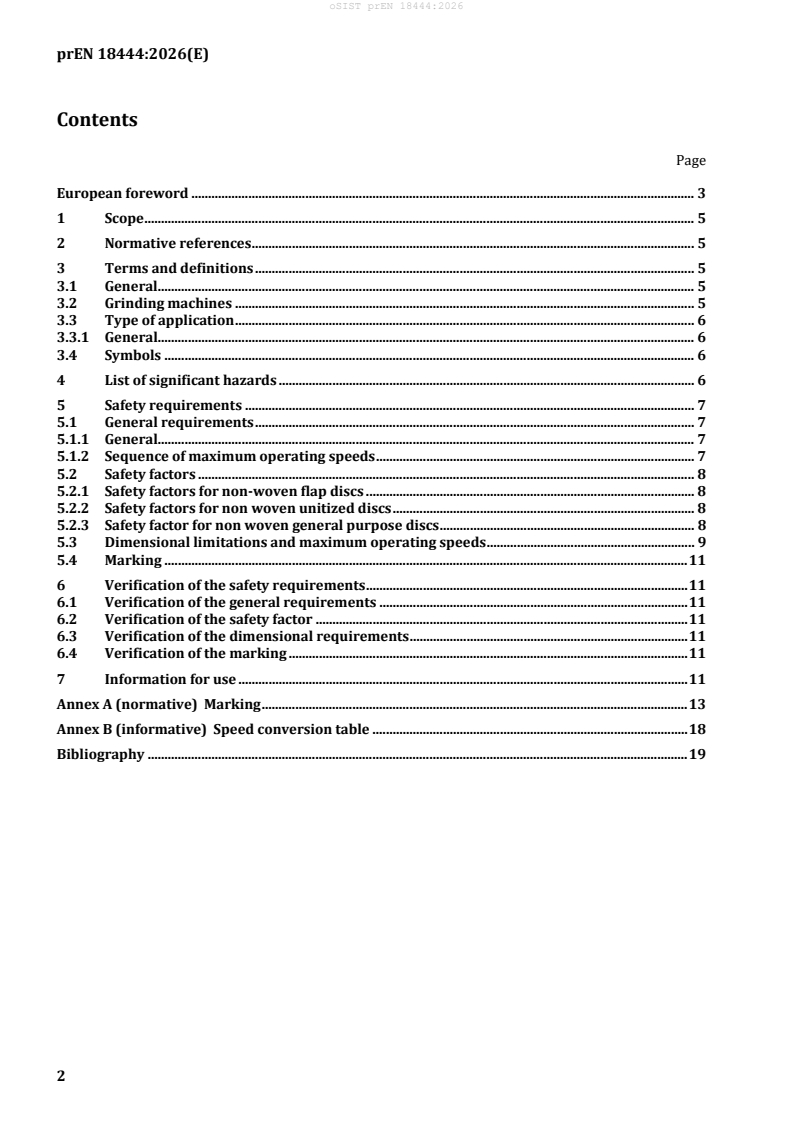
Contents
- Introduction
- 1 Scope
- 2 Normative references
- 3 Terms and definitions
- 3.1 General
- 3.1.1 non woven abrasive products
- 3.1.2 backing plates
- 3.1.3 non woven flap discs
- 3.1.4 non woven unitized discs
- 3.1.5 non woven general purpose discs
- 3.2 Grinding machines
- 3.2.1 hand-held grinding machine
- 3.3 Type of application
- 3.3.2 hand-held grinding
- 3.4 Symbols
- 4 List of significant hazards
- 5 Safety requirements
- 5.1 General requirements
- 5.2 Safety factors
- 5.3 Dimensional limitations and maximum operating speeds
- 5.4 Marking
- 6 Verification of the safety requirements
- 6.1 Verification of the general requirements
- 6.2 Verification of the safety factor
- 6.3 Verification of the dimensional requirements
- 6.4 Verification of the marking
- 7 Information for use
- Annex A
- Annex B
- Bibliography
Introduction
This document has been prepared to provide one means of conforming to essential safety requirements, e.g. of the General Product Safety Regulation and associated EFTA regulations. This document is addressed to manufacturers, suppliers and importers of the non woven abrasive products described in the scope. In addition, it helps manufacturers, suppliers and importers of grinding machines in the selection of non woven abrasive products, in order to reduce the risks and achieve conformity of the respective machinery with the Essential Safety Requirements of the Machinery Directive. The extent to which hazards are covered is indicated in the scope of this document.
oSIST prEN 18444:2026 prEN 18444:2026(E)
1 Scope
This document is applicable to the following non woven abrasive products: non woven flap discs with backing plate, non woven unitized discs with backing plate, non woven general purpose discs with backing plate. These products are manufactured using abrasive grains and are entirely made of non-woven web. This document specifies requirements and/or measures for removal or reduction of hazards resulting from the design and application of the non woven abrasive products. This document also contains procedures and tests for verification of compliance with the requirements as well as safety information for use, which is to be made available to the user by the manufacturer. The hazards taken into consideration are listed in Clause 4 of this document.
2 Normative references
The following documents are referred to in the text in such a way that some or all of their content constitutes requirements of this document. For dated references, only the edition cited applies. For undated references, the latest edition of the referenced document (including any amendments) applies. ISO 554, Standard atmospheres for conditioning and/or testing — Specifications
3 Terms and definitions
For the purposes of this document, the following terms and definitions apply.
3.1 General
3.1.1 non woven abrasive products
abrasive product composed of non-woven material, abrasive particles and bond
3.1.2 backing plates
The backing plate is a supporting element (typically made of glass fiber or plastic) with or without threads to glue the flaps or the rings on
3.1.3 non woven flap discs
abrasive product composed of backing plates and non-woven flaps
3.1.4 non woven unitized discs
abrasive product composed of backing plates and made of a compressed ring of non woven material
3.1.5 non woven general purpose discs
abrasive product composed of backing plates and made of a non-compressed ring of non woven material
3.2 Grinding machines
3.2.1 hand-held grinding machine
grinding machine being held in the hand during the grinding process with fixed (see 5.3 for speed limit) or adjustable speed
oSIST prEN 18444:2026 prEN 18444:2026(E) Note 1 to entry: See for example EN ISO 11148-7 and EN 60745-2-3.
3.3 Type of application
3.3.1 General
See Table 1.
3.3.2 hand-held grinding
grinding process with grinding machine entirely guided by the operator's hands Table 1 — Type of application Type of machine Type of application Abrasive product Workpiece Hand-held grinding machines with Hand-held grinding Guided by hand Fixed adjustable speeds Hand-held grinding machines with fixed Hand-held grinding Guided by hand Fixed speed
3.4 Symbols
The symbols used in this document are listed in Table 2.
Table 2 — Symbols Symbol Designation Definition Unit Maximum permissible peripheral speed of a v Maximum operating speed m/s s rotating abrasive product Peripheral speed at which a rotating abrasive v Bursting speed m/s br product breaks due to centrifugal force Peripheral speed, which a rotating abrasive product v Minimum bursting speed shall at least reach without bursting due to m/s br min centrifugal force Bursting speed divided by maximum operating speed:
f Burst speed factor — br
br f = br
s Bursting speed divided by maximum operating speed, all squared:
Safety factor against S bursting due to centrifugal 2 — br
br force S = br
s
4 List of significant hazards
The significant hazards are given in Table 3.
oSIST prEN 18444:2026 prEN 18444:2026(E) Table 3 — List of significant hazards Hazardous situation Relevant clauses Hazard designation (Examples) in the standard Ejection of parts 1. Abrasive product breakage caused by:
- mounting on the wrong Clause 7 machine (adjustable/not adjustable)
- improper design 5.1, 5.2, 5.3 and 5.4
- manufacturing defects 5.1
- wrong selection (wrong tool for 5.4, Clause 7 and Annex A the application)
- improper handling and storage Clause 7
- improper use (mounting and Clause 7 grinding process) 2. Grinding debris Clause 7
- dust, airborne particles Clause 7
- solid particles Clause 7 Vibration Hand arm vibration on hand-held machines caused by:
- improper use Clause 7
- incorrect mounting Clause 7 Contact with the rotating Improper use Clause 7 abrasive product Noise Insufficient ear protection Clause 7
5 Safety requirements
5.1 General requirements
5.1.1 General
Non woven abrasive products shall be designed and manufactured in such a way that they resist the forces and loads that are to be expected when used as intended. They shall not present visible defects affecting safety and shall comply with the requirements listed in the following clauses.
5.1.2 Sequence of maximum operating speeds
Non woven abrasive products shall be manufactured for maximum operating speeds according to the following sequence:
...