

SIST EN 18152:2026
(Main)Mountaineering equipment - Interfaces between ski mountaineering boots and clip-on binding crampons - Requirements and test methods
- Abstract
This standard specifies the dimensions and characteristics of the interfaces, requirements, test methods and marking of ski mountaineering boots and clip-on binding crampons which are fixed together with attachment at the boot toe and boot heel, the proper fixed function of which depends on the dimensions and design of the interfaces.
- Status
- Published
- Public Enquiry End Date
- 27-Mar-2025
- Publication Date
- 17-Jun-2026
- Technical Committee
- SPO - Sports
- Current Stage
- 6060 - National Implementation/Publication (Adopted Project)
- Start Date
- 10-Jun-2026
- Due Date
- 15-Aug-2026
- Completion Date
- 18-Jun-2026

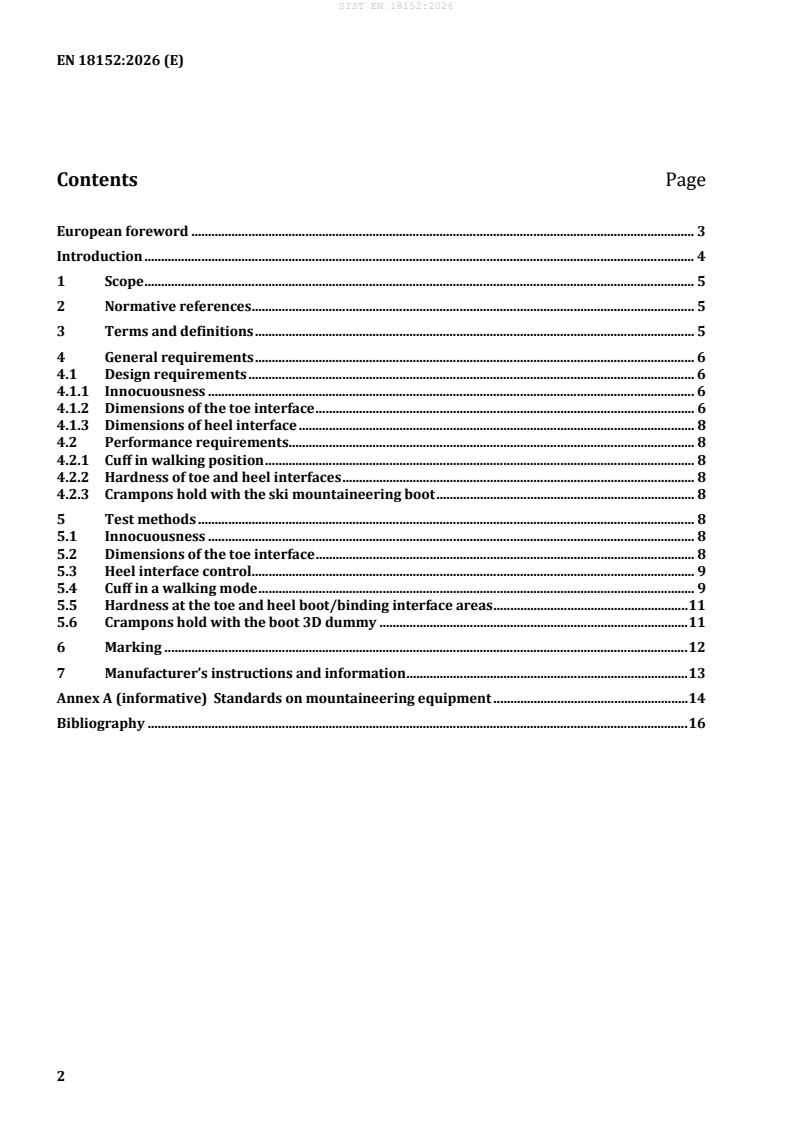
SIST EN 18152:2026 is the Slovenian national adoption of EN 18152:2026 from CEN for mountaineering equipment - Interfaces between ski mountaineering boots and clip-on binding crampons - Requirements and test methods. It specifies the interface dimensions, functional requirements, test methods, marking and user information for ski mountaineering boots and clip-on binding crampons that lock together at the boot toe and heel. Manufacturers, test laboratories, ski shops and buyers use it to check whether a boot and crampon are designed to work as a compatible system.
What does SIST EN 18152:2026 specify?
SIST EN 18152:2026 specifies the dimensions and characteristics of the interfaces between ski mountaineering boots and clip-on binding crampons, plus the related requirements, test methods and marking. It applies to the boot-to-crampon connection at the toe and heel, where proper retention depends on interface shape and size.
The standard is organized into seven clauses and one informative annex:
| Annex | What it covers |
|---|---|
| Annex A | Standards on mountaineering equipment |
Clauses 1 to 3 cover scope, normative references, and terms and definitions. Clause 4 gives the general requirements, Clause 5 gives the test methods, Clause 6 covers marking, and Clause 7 covers manufacturer’s instructions and information.
What are the key requirements of SIST EN 18152:2026?
Interface design and geometry
- Clause 4.1.1 requires the toe interface and heel interface to be free of sharp edges and burrs that could injure the user or cause cutting or abrasion. In practice, this is a basic safety check on the boot’s contact areas.
- Clause 4.1.2 requires the ski mountaineering boot toe dimensions to match Figure 2, and Clause 5.2 verifies this with the toe test body defined in the CAD file
Test bodies.stp. This gives manufacturers and labs a fixed geometry check for the front attachment. - Clause 4.1.3 requires the heel interface dimensions to match Figure 3, and Clause 5.3 checks this with the heel test body from the same CAD file. The heel shape is critical because the rear clip-on binding depends on it.
Performance, fit and material properties
- Clause 4.2.1 requires that, in walking mode, no part of the cuff touches the heel test body. Clause 5.4 sets out the walking-mode setup, including removal of the liner and positioning of the cuff. This matters because the boot must move without unwanted contact at the rear.
- Clause 4.2.2 requires the hardness of the toe and heel interface areas to be at least Shore D 50 at (23 ± 2) °C, tested according to EN ISO 868:2003. In practice, this controls the stiffness of the interface areas so they keep their shape in use.
- Clause 4.2.3 requires the crampon to fit the boot 3D dummy, and Clause 5.6 describes fitting it according to the crampon manufacturer’s instructions. This checks real compatibility, not only nominal dimensions.
Marking and user information
- Clause 6 requires clear, indelible and durable marking with the manufacturer name, model identification if relevant, and the reference to EN 18152 on the ski mountaineering boot. This helps users and inspectors identify compatible products.
- Clause 7 requires an explanatory leaflet with compatibility and inspection information, including the need to check that the boot is marked EN 18152 and to verify boot-crampon size compatibility in a safe place before use. That supports correct selection and safer first use.
What terms does SIST EN 18152:2026 define?
- ski mountaineering boots - Ski boots intended for ski mountaineering and compatible with suitable ski bindings; the definition gives examples such as pin-tech inserts, touring ski-boots ISO 9523:2023, and alpine boots with improved walking soles ISO 23223:2025.
- clip-on binding crampons - Crampons conforming to EN 893:2019 that use both the toe interface and the heel interface to attach to ski mountaineering boots.
- toe interface - The front part of the boot intended to fit with the front clip-on binding.
- heel interface - The rear part of the boot intended to fit with the rear clip-on binding.
- rigid sole - A boot sole that does not flex when walking.
Who uses SIST EN 18152:2026?
Manufacturers of ski mountaineering boots and clip-on binding crampons use this standard when designing the interface shape, choosing materials and writing product instructions. Test laboratories use it when checking geometry, hardness and fit with the specified test bodies and dummy.
Quality managers, buyers and technical reviewers use it to verify compatibility claims and to confirm that markings and user information are present. Ski shops and trained technicians can also use it when checking whether a boot and crampon are the right match before use.
Which standards are used with SIST EN 18152:2026?
- EN ISO 868:2003 - Used in Clause 5.5 for Shore hardness testing of the toe and heel interface areas.
- EN 893:2019 - Named in the definition of clip-on binding crampons as the crampon standard they conform to.
- ISO 9523:2023 - Named in the definition of ski mountaineering boots as an example of a compatible touring ski-boot interface standard.
- ISO 23223:2025 - Named in the definition of ski mountaineering boots as an example of an alpine ski boot with improved walking soles.
Annex A also points readers to the wider mountaineering equipment standards family.
What does the SIST EN 18152:2026 document contain?
SIST EN 18152:2026 includes figures for the toe and heel interface dimensions, the walking-mode cuff clearance check, and the boot 3D dummy fitting check. It also specifies test bodies defined by the CAD files Test bodies.stp and boot 3D dummy.stp, which are used to verify geometry and crampon fit.
The document contains the marking rules and the leaflet content that manufacturers must supply with the boots and crampons. Annex A contains Table A.1, a list of related mountaineering equipment standards. The bibliography names EN 893:2019, ISO 9523:2023 and ISO 23223:2025.
Relations
- Effective Date
- 28-Jan-2026
- Effective Date
- 28-Jan-2026
Frequently Asked Questions
SIST EN 18152:2026 is a standard published by the Slovenian Institute for Standardization (SIST). Its full title is "Mountaineering equipment - Interfaces between ski mountaineering boots and clip-on binding crampons - Requirements and test methods". This standard covers: This standard specifies the dimensions and characteristics of the interfaces, requirements, test methods and marking of ski mountaineering boots and clip-on binding crampons which are fixed together with attachment at the boot toe and boot heel, the proper fixed function of which depends on the dimensions and design of the interfaces.
This standard specifies the dimensions and characteristics of the interfaces, requirements, test methods and marking of ski mountaineering boots and clip-on binding crampons which are fixed together with attachment at the boot toe and boot heel, the proper fixed function of which depends on the dimensions and design of the interfaces.
SIST EN 18152:2026 is classified under the following ICS (International Classification for Standards) categories: 97.220.20 - Winter sports equipment; 97.220.40 - Outdoor and water sports equipment. The ICS classification helps identify the subject area and facilitates finding related standards.
SIST EN 18152:2026 has the following relationships with other standards: It is inter standard links to SIST EN ISO 80601-2-69:2021, SIST EN ISO 18777-2:2026. Understanding these relationships helps ensure you are using the most current and applicable version of the standard.
SIST EN 18152:2026 is available in PDF format for immediate download after purchase. The document can be added to your cart and obtained through the secure checkout process. Digital delivery ensures instant access to the complete standard document.
Standards Content (Sample)
SLOVENSKI STANDARD
01-julij-2026
Gorniška oprema - Vmesniki med smučarskimi gorniškimi čevlji in derezami s
sistemom na klip - Zahteve in preskusne metode
Mountaineering equipment - Interfaces between ski mountaineering boots and clip-on
binding crampons - Requirements and test methods
Bergsteigerausrüstung - Anschlussbereich zwischen Skitourenschuhen für Erwachsene
und Kipphebel-Steigeisen - Sicherheitstechnische Anforderungen und Prüfverfahren
Équipement d'alpinisme et d'escalade - Zones de contact entre les chaussures de ski-
alpinisme et les crampons à attache rapide - Exigences de sécurité et méthodes d'essai
Ta slovenski standard je istoveten z: EN 18152:2026
ICS:
97.220.20 Oprema za zimske športe Winter sports equipment
2003-01.Slovenski inštitut za standardizacijo. Razmnoževanje celote ali delov tega standarda ni dovoljeno.
EN 18152
EUROPEAN STANDARD
NORME EUROPÉENNE
May 2026
EUROPÄISCHE NORM
ICS 97.220.40
English Version
Mountaineering equipment - Interfaces between ski
mountaineering boots and clip-on binding crampons -
Requirements and test methods
Équipement d'alpinisme et d'escalade - Zones de Bergsteigerausrüstung - Anschlussbereich zwischen
contact entre les chaussures de ski-alpinisme et les Skitourenschuhen und Kipphebel-Steigeisen -
crampons à attache rapide - Exigences de sécurité et Sicherheitstechnische Anforderungen und
méthodes d'essai Prüfverfahren
This European Standard was approved by CEN on 20 March 2026.
CEN members are bound to comply with the CEN/CENELEC Internal Regulations which stipulate the conditions for giving this
European Standard the status of a national standard without any alteration. Up-to-date lists and bibliographical references
concerning such national standards may be obtained on application to the CEN-CENELEC Management Centre or to any CEN
member.
This European Standard exists in three official versions (English, French, German). A version in any other language made by
translation under the responsibility of a CEN member into its own language and notified to the CEN-CENELEC Management
Centre has the same status as the official versions.
CEN members are the national standards bodies of Austria, Belgium, Bulgaria, Croatia, Cyprus, Czech Republic, Denmark, Estonia,
Finland, France, Germany, Greece, Hungary, Iceland, Ireland, Italy, Latvia, Lithuania, Luxembourg, Malta, Netherlands, Norway,
Poland, Portugal, Republic of North Macedonia, Romania, Serbia, Slovakia, Slovenia, Spain, Sweden, Switzerland, Türkiye and
United Kingdom.
EUROPEAN COMMITTEE FOR STANDARDIZATION
COMITÉ EUROPÉEN DE NORMALISATION
EUROPÄISCHES KOMITEE FÜR NORMUNG
CEN-CENELEC Management Centre: Rue de la Science 23, B-1040 Brussels
© 2026 CEN All rights of exploitation in any form and by any means reserved Ref. No. EN 18152:2026 E
worldwide for CEN national Members.
Contents Page
European foreword . 3
Introduction . 4
1 Scope . 5
2 Normative references . 5
3 Terms and definitions . 5
4 General requirements . 6
4.1 Design requirements . 6
4.1.1 Innocuousness . 6
4.1.2 Dimensions of the toe interface . 6
4.1.3 Dimensions of heel interface . 8
4.2 Performance requirements . 8
4.2.1 Cuff in walking position . 8
4.2.2 Hardness of toe and heel interfaces . 8
4.2.3 Crampons hold with the ski mountaineering boot . 8
5 Test methods . 8
5.1 Innocuousness . 8
5.2 Dimensions of the toe interface . 8
5.3 Heel interface control . 9
5.4 Cuff in a walking mode . 9
5.5 Hardness at the toe and heel boot/binding interface areas . 11
5.6 Crampons hold with the boot 3D dummy . 11
6 Marking . 12
7 Manufacturer’s instructions and information . 13
Annex A (informative) Standards on mountaineering equipment . 14
Bibliography . 16
European foreword
This document (EN 18152:2026) has been prepared by Technical Committee CEN/TC 136 “Sports,
playground and other recreational facilities and equipment”, the secretariat of which is held by DIN.
This European Standard shall be given the status of a national standard, either by publication of an
identical text or by endorsement, at the latest by November 2026, and conflicting national standards shall
be withdrawn at the latest by November 2026.
Attention is drawn to the possibility that some of the elements of this document may be the subject of
patent rights. CEN shall not be held responsible for identifying any or all such patent rights.
Any feedback and questions on this document should be directed to the users’ national standards body.
A complete listing of these bodies can be found on the CEN website.
According to the CEN-CENELEC Internal Regulations, the national standards organisations of the
following countries are bound to implement this European Standard: Austria, Belgium, Bulgaria, Croatia,
Cyprus, Czech Republic, Denmark, Estonia, Finland, France, Germany, Greece, Hungary, Iceland, Ireland,
Italy, Latvia, Lithuania, Luxembourg, Malta, Netherlands, Norway, Poland, Portugal, Republic of North
Macedonia, Romania, Serbia, Slovakia, Slovenia, Spain, Sweden, Switzerland, Türkiye and the United
Kingdom.
Introduction
The text of this document is based on the former 8th draft standard ISMF 104:2018 (International Ski
Mountaineering Federation), which was developed with international participation.
This document is one of a package of standards for mountaineering equipment, see Annex A.
1 Scope
This document specifies the dimensions and characteristics of the interfaces, requirements, test methods
and marking of ski mountaineering boots and of clip-on binding crampons which are fixed together with
attachment at the boot toe and boot heel, the proper fixed function of which depends on the dimensions
and design of the interfaces.
2 Normative references
The following documents are referred to in the text in such a way that some or all of their content
constitutes requirements of this document. For dated references, only the edition cited applies. For
undated references, the latest edition of the referenced document (including any amendments) applies.
EN ISO 868:2003, Plastics and ebonite — Determination of indentation hardness by means of a durometer
(Shore hardness)
3 Terms and definitions
For the purposes of this document, the following terms and definitions apply.
ISO and IEC maintain terminology databases for use in standardization at the following addresses:
— ISO Online browsing platform: available at https://www.iso.org/obp
— IEC Electropedia: available at https://www.electropedia.org/
3.1
ski mountaineering boots
ski boots compatible with suitable ski bindings intended for ski mountaineering
Note 1 to entry: For ex
...