


SIST EN 10020:2000
(Main)Definition and classification of grades of steel
Definition and classification of grades of steel
This European Standard defines the term "steel" (see clause 2) and classifies steel grades into: - non alloy, stainless steel and other alloy steels by chemical composition (see clause 3); - main quality classes (see clause 4) defined by main property or application characteristics for non alloy, stainless and other alloy steels.
Begriffsbestimmung für die Einteilung der Stähle
Diese Europäische Norm definiert den Begriff "Stahl" (siehe Abschnitt 2) und teilt Stahlsorten ein in: - unlegierte, nichtrostende und andere legierte Stähle nach der chemischen Zusammensetzung (siehe Abschnitt 3); - Hauptgüteklassen (siehe Abschnitt 4) definiert durch Haupteigenschafts- oder -anwendungsmerkmale der unlegierten, nichtrostenden und anderen legierten Stähle.
Définition et classification des nuances d'acier
La présente norme européenne définit le terme "acier" (voir article 2) et établit: - la classification en aciers non alliés, aciers inoxydables et autres alliés suivant la composition chimique (voir article 3); - la classification des aciers non alliés, aciers inoxydables et autres alliés (article 4) en fonction des principales classes de qualité définies selon les principales caractéristiques de propriétés et d'applications.
Definicija in razvrščanje jekel
General Information
Relations
Overview
EN 10020:2000 (CEN) defines the term "steel" and provides a clear, high-level framework for the classification of steel grades. The standard groups steels by chemical composition into non-alloy, stainless, and other alloy steels, and establishes main quality classes based on primary properties or intended applications. Key references in the document include the definition in clause 2, classification by chemical composition in clause 3, and the description of main quality classes in clause 4.
Key Topics
- Definition of steel (clause 2): Establishes the terminology and scope for what is considered steel in the European standards framework.
- Classification by composition (clause 3): Assigns steels to the three broad composition groups: non-alloy, stainless, and other alloy steels.
- Main quality classes (clause 4): Defines quality classes that reflect main properties or application characteristics for each composition group.
- Harmonization objective: Provides a consistent basis for naming, specifying, and selecting steel grades across industry, standards, and supply chains.
Applications
EN 10020:2000 is a foundational reference for organizations involved in metallurgy, manufacturing, design, procurement, testing and quality assurance. Practical uses include:
- Grade selection and specification: Use the classification framework to communicate required material types clearly in purchase orders, technical specifications, and engineering drawings.
- Procurement and vendor communication: Harmonized terminology reduces ambiguity when sourcing steel products across suppliers and borders.
- Product design and engineering: Designers can align material property expectations with the standard’s quality-class approach to ensure fit-for-purpose material choice.
- Quality control and compliance: QA teams can reference the classification to align inspection and documentation practices with European terminology and expectations.
Benefits of applying EN 10020:2000 include improved clarity in material designation, reduced miscommunication in international projects, and a structured approach to mapping material properties to application needs.
Related Standards
- Standards addressing material designation, chemical analysis, mechanical property requirements, and product-specific specifications are typically used together with EN 10020:2000 to create a complete procurement or compliance package.
- For harmonized procurement and testing, pair EN 10020:2000 with applicable product and test standards in your product family to ensure full technical coverage.
EN 10020:2000 serves as a concise, authoritative reference for the definition and high-level classification of steels, supporting consistent material management across industry, standards development and regulatory contexts.

Frequently Asked Questions
SIST EN 10020:2000 is a standard published by the Slovenian Institute for Standardization (SIST). Its full title is "Definition and classification of grades of steel". This standard covers: This European Standard defines the term "steel" (see clause 2) and classifies steel grades into: - non alloy, stainless steel and other alloy steels by chemical composition (see clause 3); - main quality classes (see clause 4) defined by main property or application characteristics for non alloy, stainless and other alloy steels.
This European Standard defines the term "steel" (see clause 2) and classifies steel grades into: - non alloy, stainless steel and other alloy steels by chemical composition (see clause 3); - main quality classes (see clause 4) defined by main property or application characteristics for non alloy, stainless and other alloy steels.
SIST EN 10020:2000 is classified under the following ICS (International Classification for Standards) categories: 01.040.77 - Metallurgy (Vocabularies); 77.080.20 - Steels. The ICS classification helps identify the subject area and facilitates finding related standards.
SIST EN 10020:2000 has the following relationships with other standards: It is inter standard links to SIST EN 10020:1995/AC1:1996, SIST EN 10020:1995. Understanding these relationships helps ensure you are using the most current and applicable version of the standard.
SIST EN 10020:2000 is associated with the following European legislation: EU Directives/Regulations: 305/2011, 89/106/EEC; Standardization Mandates: M/116, M/120, M/BC/CEN/86/1. When a standard is cited in the Official Journal of the European Union, products manufactured in conformity with it benefit from a presumption of conformity with the essential requirements of the corresponding EU directive or regulation.
You can purchase SIST EN 10020:2000 directly from iTeh Standards. The document is available in PDF format and is delivered instantly after payment. Add the standard to your cart and complete the secure checkout process. iTeh Standards is an authorized distributor of SIST standards.
Standards Content (Sample)
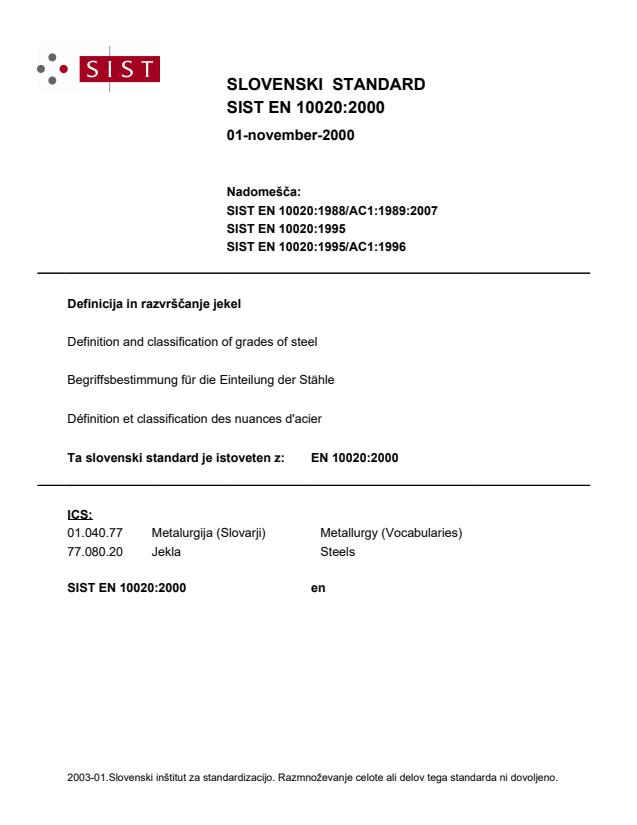
2003-01.Slovenski inštitut za standardizacijo. Razmnoževanje celote ali delov tega standarda ni dovoljeno.Begriffsbestimmung für die Einteilung der StähleDéfinition et classification des nuances d'acierDefinition and classification of grades of steel77.080.20JeklaSteels01.040.77Metalurgija (Slovarji)Metallurgy (Vocabularies)ICS:Ta slovenski standard je istoveten z:
...
SIST EN 10020:2000は、鋼の定義および分類に関する欧州規格であり、その重要性と影響力を持っています。この規格は、鋼の定義を明確にし、化学組成による鋼のグレードを非合金鋼、ステンレス鋼、その他の合金鋼に分けています。この明確な分類は、鋼の特性を理解し、適切な用途に応じた選択を行う上で非常に有用です。 規格の強みは、鋼の主要な品質クラスを定義している点にあります。これにより、鋼の主要な特性や用途によって分類されることが可能となり、ユーザーは求める特性に応じた鋼を容易に識別できます。この標準化により、さまざまな業界において鋼の使用の一貫性が向上し、製品の品質管理が容易になります。 さらに、SIST EN 10020:2000は、鋼材の製造業者や使用者にとって、国際化された共通の文脈でコミュニケーションを行う基盤を提供します。このような標準化は、国際貿易を促進し、鋼の品質に対する信頼を築くために不可欠です。鋼の定義と分類においてこの規格が持つ果たす役割は、鋼材を利用する全てのステークホルダーにとって極めて重要であり、業界全体の発展に寄与しています。 SIST EN 10020:2000は、鋼の理解を深め、品質を確保するための骨子となる文書であり、その影響は今後も続くことが期待されます。そのため、鋼に関連する業務に携わるすべてのプロフェッショナルにとって、必須の参考資料と言えるでしょう。
La norme SIST EN 10020:2000 offre une définition claire et précise du terme "acier", une base essentielle pour comprendre les divers types de matériaux utilisés dans l'industrie. En classifiant les grades d'acier en fonction de la composition chimique, la norme contribue à la standardisation et à l'harmonisation à l’échelle européenne des produits en acier. Le champ d'application de cette norme englobe la classification des aciers non alliés, des aciers inoxydables et d'autres aciers alliés, ce qui permet une identification facile et rapide des matériaux selon leurs caractéristiques chimiques. Grâce à cette approche, la norme facilite les échanges commerciaux et améliore la communication entre les acteurs de l'industrie. Un des points forts de la SIST EN 10020:2000 est la définition des principales classes de qualité selon les propriétés ou les caractéristiques d'application des aciers. Cette classification aide non seulement les fabricants à choisir le bon matériau pour des applications spécifiques, mais elle soutient également les utilisateurs finaux dans l’évaluation de la performance attendue des aciers. La pertinence de cette norme est également soulignée par sa capacité à s'adapter aux évolutions des besoins du marché et des technologies, garantissant ainsi que les standards restent en phase avec les innovations dans le domaine de la métallurgie. En somme, la SIST EN 10020:2000 est un document essentiel pour quiconque travaille avec des matériaux en acier, tant pour la production que pour l'application pratique, en favorisant une meilleure compréhension et un usage optimal des différentes catégories d'acier.
Die SIST EN 10020:2000 ist eine bedeutende europäische Norm, die die Definition und Klassifikation von Stahlgraden festlegt. Diese Norm bietet eine umfassende Grundlage für die Klassifizierung von Stahl, indem sie das Verständnis des Begriffs "Stahl" präzisiert und klarstellt, wie verschiedene Stahlqualitäten einzuordnen sind. Ein zentraler Aspekt der Norm ist die Einteilung der Stahlgrade in nicht legierte Stähle, rostfreie Stähle und andere legierte Stähle basierend auf ihrer chemischen Zusammensetzung. Diese klare Klassifikation (siehe Abschnitt 3) ermöglicht es Industrieakteuren, Stähle effizient zu identifizieren und auszuwählen, was insbesondere für Anwendungen in der Maschinenbau-, Bau- und Automobilindustrie von großer Bedeutung ist. Die Norm definiert auch die Hauptqualitätsklassen (siehe Abschnitt 4), die Stahlgrade nach ihren Hauptmerkmalen oder Anwendungscharakteristika klassifizieren. Diese Kategorisierung ist besonders wertvoll, da sie Ingenieuren und Einkäufern hilft, geeignete Materialeigenschaften je nach spezifischer Anwendung zu bestimmen. Die Differenzierung zwischen verschiedenen Stahlqualitäten fördert außerdem die richtige Handhabung und Anwendung der Materialien, was zur Verbesserung der Produktqualität und Sicherheit beiträgt. Die Relevanz der SIST EN 10020:2000 erstreckt sich über nationale Grenzen hinaus, da die Norm auf europäischer Ebene etabliert ist und damit einheitliche Standards fördert. Dies trägt zu einem höheren Maß an Konsistenz und Vertraulichkeit in der Verwendung von Stahl in verschiedenen Industrien bei, wodurch sie eine unschätzbare Ressource für Hersteller, Lieferanten und Endanwender wird. Insgesamt stellt die SIST EN 10020:2000 eine wesentliche Grundlage für Fachleute dar, die im Bereich der Stahlanwendung tätig sind. Ihre umfassende Klassifikation und Definitionen unterstützen die genaue Kommunikation und das Verständnis von Stahlprodukten, was die Effizienz in der gesamten Lieferkette verbessert.
SIST EN 10020:2000 문서는 철강의 정의와 등급 분류에 대한 유럽 표준을 제시하고 있습니다. 이 표준의 범위는 철강의 개념(2조 참조)을 명확히 하고, 화학 성분에 따른 비합금강, 스테인리스강 및 기타 합금강으로 철강 등급을 분류하는 것입니다(3조 참조). 또한, 비합금강, 스테인리스강 및 기타 합금강의 주요 특성 또는 응용 특성에 따라 주요 품질 등급(4조 참조)을 정의하고 있습니다. SIST EN 10020:2000의 강점은 철강의 다양한 종류와 특성을 체계적으로 분류하여 산업계와 연구 개발에 기초 자료를 제공한다는 점입니다. 이 표준은 특정 용도에 적합한 철강 재료 선택에 도움을 주며, 이를 통해 품질 보증 및 안전성을 보장할 수 있습니다. 특히, 이러한 정의와 분류 체계는 철강 산업과 관련된 다양한 분야에 있어 표준화를 촉진하고, 상호 호환성을 높이는 데 기여합니다. 또한, SIST EN 10020:2000은 유럽 내에서 공통적으로 이해할 수 있는 철강의 정의와 등급 체계를 제시함으로써, 국제 거래 및 협력에 있어서도 중요한 역할을 합니다. 이를 통해 다양한 국가 및 기업 간의 원활한 소통과 거래를 지원하며, 이는 철강 산업의 글로벌화를 촉진하는 데 필수적입니다. 결론적으로, SIST EN 10020:2000은 철강의 Definition과 Classification에 대한 포괄적이고 명확한 지침을 제공하며, 이로써 철강 산업의 표준화를 이끌고 있습니다.
The SIST EN 10020:2000 standard provides a comprehensive framework for the definition and classification of grades of steel, establishing a clear and consistent terminology that is crucial for various industries relying on steel products. The scope of this European Standard encompasses the classification of steel into three primary categories: non-alloy steels, stainless steels, and other alloy steels, based on their chemical composition. This classification is vital for manufacturers, suppliers, and end-users in ensuring that the correct grade of steel is used for specific applications, thereby enhancing the quality and reliability of steel products. One of the strengths of SIST EN 10020:2000 is its meticulous attention to detail, as outlined in clause 3, where the chemical composition of different steel grades is categorized. This thorough classification aids in providing clarity and reducing misunderstandings in the application of steel grades, which is essential for maintaining standards in production and safety. Additionally, clause 4 identifies main quality classes based on significant property or application characteristics, thus facilitating the selection process for appropriate steel grades in various engineering and construction projects. The relevance of this standard extends beyond mere classification; it also serves as a foundational guideline that supports compliance with other related standards in the steel industry. By establishing a standardized method for identifying and classifying steel grades, SIST EN 10020:2000 enhances the overall efficiency of communication throughout the supply chain. Consumers can confidently specify their requirements knowing that the steel grades they are referring to conform to a recognized European Standard. Overall, the SIST EN 10020:2000 standard is instrumental in fostering uniformity and reliability in the classification of steel grades, making it a crucial reference point for industry stakeholders aiming to uphold quality and performance standards in steel production and utilization.
Questions, Comments and Discussion
Ask us and Technical Secretary will try to provide an answer. You can facilitate discussion about the standard in here.
Loading comments...