

SIST EN 10020:2000
(Main)Definition and classification of grades of steel
- Abstract
This European Standard defines the term "steel" (see clause 2) and classifies steel grades into: - non alloy, stainless steel and other alloy steels by chemical composition (see clause 3); - main quality classes (see clause 4) defined by main property or application characteristics for non alloy, stainless and other alloy steels.
- Status
- Published
- Publication Date
- 31-Oct-2000
- Technical Committee
- IFEK - Ferrous metals
- Current Stage
- 6060 - National Implementation/Publication (Adopted Project)
- Start Date
- 01-Nov-2000
- Due Date
- 01-Nov-2000
- Completion Date
- 01-Nov-2000


SIST EN 10020:2000 is the Slovene standard identical to EN 10020:2000. It defines the term steel and classifies steel grades by chemical composition and by main quality classes, so engineers, purchasers, and quality staff can use the same basis when naming and comparing steels.
What does SIST EN 10020:2000 specify?
SIST EN 10020:2000 specifies how steel is defined and how steel grades are grouped. Its scope covers two ways of classifying steels: first by chemical composition, and then by main quality classes based on the main property or application characteristics.
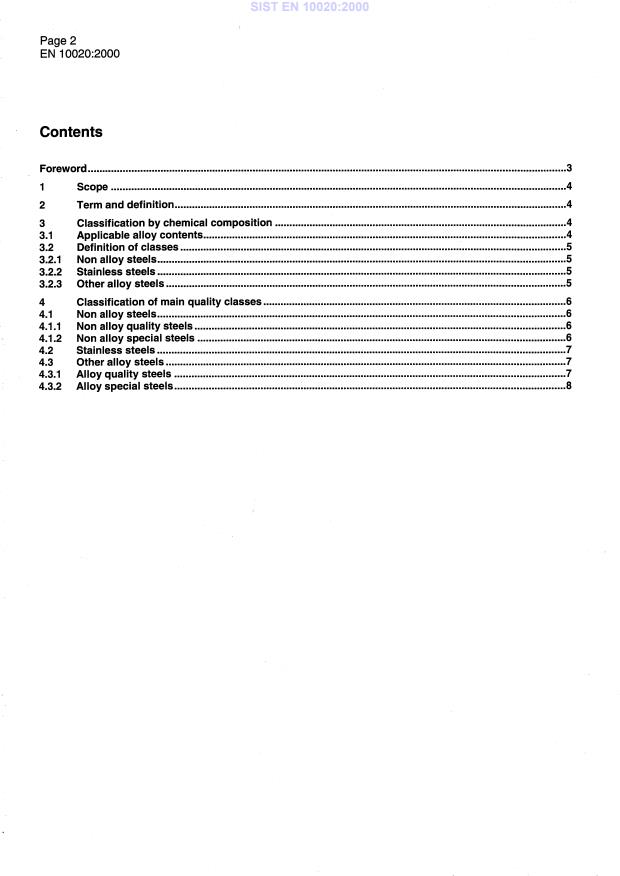
The document is organized around clause 2, clause 3, and clause 4. Clause 2 gives the meaning of steel. Clause 3 sorts steel grades into non alloy, stainless steel, and other alloy steels by chemical composition. Clause 4 groups non alloy, stainless and other alloy steels into main quality classes.
For users, this means the standard gives a common naming framework before a steel grade is selected for a design, bought, or documented in quality records.
What are the key requirements of SIST EN 10020:2000?
Clause 2 defines steel. In practice, this sets the boundary for what the document treats as steel, so users apply the same material concept in specifications and records.
Clause 3 classifies steel grades by chemical composition. The three groups are non alloy, stainless steel, and other alloy steels. This matters when a buyer or engineer needs the correct material family before looking at detailed grade data.
Clause 4 classifies steels by main quality classes. These classes are based on the main property or application characteristics for non alloy, stainless and other alloy steels. That helps users describe what the grade is for, not only what it contains.
The standard uses two different classification views. One view is composition-based, the other is quality-class based. In practice, that lets the same steel grade be discussed both chemically and functionally.
The document is a classification reference, not a product specification. It gives the structure for identifying grades, which is useful when linking a material to a later detailed grade standard, purchase order, or inspection document.
The classification applies to steel grades. That makes it useful when comparing designations across documents, catalogues, and supplier information, where consistent grade naming avoids confusion.
What terms does SIST EN 10020:2000 define?
Steel - the material term defined in clause 2.
Non alloy steel - a steel grade placed in the non alloy category by the chemical-composition classification in clause 3.
Stainless steel - a steel grade placed in the stainless category by the chemical-composition classification in clause 3.
Other alloy steels - steel grades that fall into the alloy-steel grouping other than stainless steel in clause 3.
Main quality classes - classes defined in clause 4 by the main property or application characteristics of the steel.
Steel grades - the grades that the standard organizes into the composition groups and quality classes.
Who uses SIST EN 10020:2000?
Steelmakers, processors, stockists, purchasers, specifiers, and quality managers use SIST EN 10020:2000 when they need a shared way to identify and compare steel grades. It is also relevant in metallurgy documentation, product specifications, and acceptance records, where the grade name must mean the same thing to both supplier and buyer.
In practice, the standard helps when writing technical requirements, checking material descriptions, or deciding whether two steel designations belong to the same broad category.
What does the SIST EN 10020:2000 document contain?
SIST EN 10020:2000 contains a short classification framework built around the definition of steel and two ways of grouping steel grades. Clause 2 sets the meaning of steel, clause 3 classifies grades by chemical composition, and clause 4 classifies them by main quality classes.
The document therefore serves as a reference for terminology and grouping, rather than for test methods or detailed product requirements. It is used to organize steel grades before more specific standards or purchasing documents are applied.
Relations
- Effective Date
- 01-Nov-2001
- Effective Date
- 01-Nov-2001
- Effective Date
- 28-Jan-2026
- Effective Date
- 28-Jan-2026
- Effective Date
- 28-Jan-2026
- Effective Date
- 28-Jan-2026
- Effective Date
- 28-Jan-2026
- Effective Date
- 28-Jan-2026
- Effective Date
- 28-Jan-2026
- Effective Date
- 28-Jan-2026
- Effective Date
- 28-Jan-2026
- Effective Date
- 28-Jan-2026
- Effective Date
- 28-Jan-2026
- Effective Date
- 28-Jan-2026
- Effective Date
- 28-Jan-2026
Get Certified
Connect with accredited certification bodies for this standard

Element Materials Technology
Materials testing and product certification.

Inštitut za kovinske materiale in tehnologije
Institute of Metals and Technology. Materials testing, metallurgical analysis, NDT.
Sponsored listings
Frequently Asked Questions
SIST EN 10020:2000 is a standard published by the Slovenian Institute for Standardization (SIST). Its full title is "Definition and classification of grades of steel". This standard covers: This European Standard defines the term "steel" (see clause 2) and classifies steel grades into: - non alloy, stainless steel and other alloy steels by chemical composition (see clause 3); - main quality classes (see clause 4) defined by main property or application characteristics for non alloy, stainless and other alloy steels.
This European Standard defines the term "steel" (see clause 2) and classifies steel grades into: - non alloy, stainless steel and other alloy steels by chemical composition (see clause 3); - main quality classes (see clause 4) defined by main property or application characteristics for non alloy, stainless and other alloy steels.
SIST EN 10020:2000 is classified under the following ICS (International Classification for Standards) categories: 01.040.77 - Metallurgy (Vocabularies); 77.080.20 - Steels. The ICS classification helps identify the subject area and facilitates finding related standards.
SIST EN 10020:2000 has the following relationships with other standards: It is inter standard links to SIST EN 10020:1995, SIST EN 10020:1995/AC1:1996, SIST EN 10379:2025, SIST EN 10363:2016, SIST EN 10305-1:2010, SIST EN 10025-4:2004, SIST EN 10216-2:2003+A2:2007, SIST EN 10083-1:2006, SIST EN 10225-2:2019, SIST EN 10027-1:2016, SIST EN 10253-1:2000, SIST EN 10263-5:2018, SIST EN 10312:2003, SIST EN 845-3:2013, SIST EN 10085:2002. Understanding these relationships helps ensure you are using the most current and applicable version of the standard.
SIST EN 10020:2000 is associated with the following European legislation: EU Directives/Regulations: 305/2011, 89/106/EEC; Standardization Mandates: M/116, M/120, M/BC/CEN/86/1. When a standard is cited in the Official Journal of the European Union, products manufactured in conformity with it benefit from a presumption of conformity with the essential requirements of the corresponding EU directive or regulation.
SIST EN 10020:2000 is available in PDF format for immediate download after purchase. The document can be added to your cart and obtained through the secure checkout process. Digital delivery ensures instant access to the complete standard document.
Standards Content (Sample)
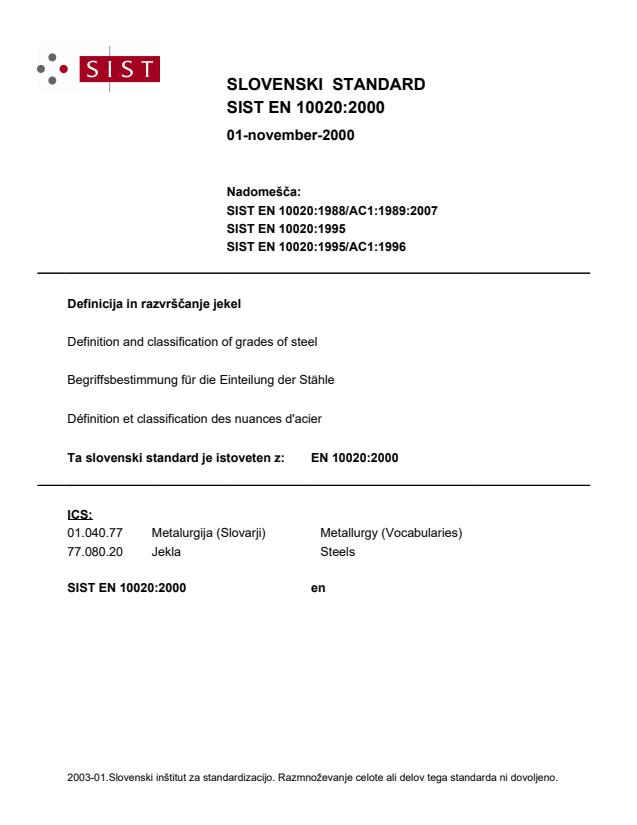
2003-01.Slovenski inštitut za standardizacijo. Razmnoževanje celote ali delov tega standarda ni dovoljeno.Begriffsbestimmung für die Einteilung der StähleDéfinition et classification des nuances d'acierDefinition and classification of grades of steel77.080.20JeklaSteels01.040.77Metalurgija (Slovarji)Metallurgy (Vocabularies)ICS:Ta slovenski standard je istoveten z:
...