

SIST EN 13586:2026
(Main)Cranes - Access
- Abstract
This document specifies design requirements for non-powered means of access installed on cranes.
Slidable, retractable means of access are excluded from the scope, except movable hoop guards.
This document covers means of access to control stations and all access required for maintenance, certain erection and dismantling operations.
For those cranes which are intended to be erected and dismantled frequently to change their places of work, e.g. tower cranes, specific requirements for the access needed during these operations are not covered by this document and can be given in the appropriate European Standards for specific crane types.
Lighting of means of access is not covered by this document and can be given in the appropriate European Standards for specific crane types.
Specification of the required rescue equipment, use of rescue equipment and the adaptation of crane access to the selected rescue equipment, are not covered by this document and can be given in the appropriate European Standards for specific crane types.
NOTE Specific requirements for access on particular types of cranes are given in the appropriate European Standard for the particular crane type.
The requirements given in this document do not take into account the safety distances related to:
- guarding against hazard from moving parts;
- relative movement between crane and adjacent structure or the ground/floor;
- hazardous surface temperature;
- electrical equipment.
The significant hazards covered by this document are identified in Annex A.
This document is not applicable to cranes manufactured before the date of its publication.
- Status
- Not Published
- Public Enquiry End Date
- 29-Jun-2025
- Technical Committee
- DTN - Lift and transport appliances
- Current Stage
- 6060 - National Implementation/Publication (Adopted Project)
- Start Date
- 29-Jul-2026
- Due Date
- 03-Oct-2026
- Ref Project
EN 13586:2026 - Cranes - Access


SIST EN 13586:2026 is the Slovenian standard for crane access, based on the European crane access standard prepared by CEN. It specifies design requirements for non-powered means of access installed on cranes, so designers, manufacturers, inspectors and maintenance teams can provide safe access to control stations, maintenance points and selected erection or dismantling tasks.
What does SIST EN 13586:2026 specify?
SIST EN 13586:2026 covers the design of fixed, non-powered means of access on cranes and the safety measures needed for them. It is aimed at access on cranes themselves, not at general site access or rescue planning.
The scope includes access to control stations and access needed for maintenance, and certain erection and dismantling operations. It excludes slidable or retractable means of access, except movable hoop guards. It also leaves lighting of access ways, rescue equipment and crane-type-specific access solutions to the appropriate European Standards for those crane types.
| Annex | What it covers |
|---|---|
| Annex A | Significant hazards covered by the document |
| Annex B | Selection of a suitable set of crane standards for a given application |
| Annex C | Examples of surfaces considered slip-resistant |
| Annex ZA | Relationship with Regulation (EU) 2023/1230 |
The document is organized into Scope, Normative references, Terms and definitions, Safety requirements and/or protective measures, Verification, and Information for use. The scope also notes that the requirements do not cover certain safety distances related to moving parts, relative movement, hazardous surface temperature or electrical equipment.
What are the key requirements of SIST EN 13586:2026?
Choosing the access method
SIST EN 13586:2026 requires the access method to be selected according to how often it is used, what must be carried, how far the person must travel vertically, and whether the access is for operation, maintenance or inspection. In practice, this means the access design has to fit the real job, not just the available space.
The standard sets a preference order when moving between levels: stairs first, then step ladders, then rung ladders, unless a technical reason prevents this. It also prefers permanent protective equipment over personal protective equipment, and continuous systems over systems that must be connected and disconnected each time.
For cranes with a large vertical distance from the point of access to the operator’s control station, the standard requires provision for powered access. Where powered access is provided, an additional Type 1 access way is also required.
Access classes and general design principles
SIST EN 13586:2026 divides access into Type 1 and Type 2. Type 1 access is used for the main operator route and for maintenance or inspection routes used more frequently; Type 2 access is allowed for less frequent maintenance, emergency exit, and erection or dismantling access.
The general design rules require safe movement with three-point support while ascending or descending, slip-resistant and incombustible surfaces, and attention to the working position of the access way. The document also covers safe openings, hand support edges, and the use of portable ladders where they are intended.
A key practical point is that the access system must be designed as part of the crane, including the number of users and the presence of tools or spare parts. That matters because access ways often fail in practice when they are treated as afterthoughts rather than working platforms.
Stairs, ladders, walkways and protection
SIST EN 13586:2026 gives separate requirements for stairs, step ladders, spiral stairs, rung ladders, footholds, hoop guards, walkways, platforms, handrails, handholds, hatches and manholes. These clauses define the geometry, guarding and clearances needed for each access type.
For stairs and ladders, the document requires regular spacing, hand support on both sides where applicable, rest platforms at defined intervals, and measures to prevent falls from ladders. Spiral stairs are allowed for both access classes, but they must also meet the specified width, headroom, rise and tread rules.
For walkways and platforms, the document requires side protection where there is a falling risk, minimum clear passage, and clear rules for openings in floors. Handrails, intermediate rails, toe boards and closing devices at interruptions are all addressed because users often transition through these points while carrying tools or during inspection.
Strength, verification and instructions
SIST EN 13586:2026 requires access structures and their supports to be proved by calculation and, where needed, by testing or measurement. It also requires the access ways to be verified on the fully assembled crane, although individual components may be checked separately when appropriate.
Clause 5 links each safety requirement to a verification method such as visual inspection, measurement, testing or calculation. In practice, this helps manufacturers and inspectors show that the access system matches the design intent before the crane is delivered.
Clause 6 requires instructions for use, including information on anchorage points for personal fall protection equipment, warning signs at relevant access locations, and guidance for alternative access methods when the fitted access cannot be used. That is important for maintenance planning because safe access is not only a design issue but also a use and documentation issue.
What terms does SIST EN 13586:2026 define?
- rest platform - a standing area between ladder or stair flights where a person can pause and recover.
- platform - a standing area used for work, such as maintenance or inspection.
- handrail - a continuous support that helps a person keep balance with the hand while moving along the access way.
- handhold - a support intended for a single hand placement, usually to help entry or exit.
- foothold - a support for one or two feet used in vertical access.
- manhole - an access opening for persons that may have a fitted cover.
- hatch - an access opening for persons with a cover that can be opened without tools.
- Type 1 access / Type 2 access - the two access classes used by the standard to separate frequent operator or maintenance access from less frequent or special-case access.
Who uses SIST EN 13586:2026?
SIST EN 13586:2026 is used by crane manufacturers, crane designers, safety engineers, quality teams, maintenance providers and inspectors. It also matters to regulators, accident prevention bodies and market surveillance teams because it defines a common technical basis for crane access safety.
It is relevant across crane types where access must be built into the machine, including tower cranes, bridge and gantry cranes, mobile cranes, loader cranes, offshore cranes and other crane systems that use the broader crane standards set. Buyers and project engineers use it when they need to specify access routes, platforms, ladders and guarding as part of a crane order.
What changed in SIST EN 13586:2026 from the previous edition?
SIST EN 13586:2026 supersedes EN 13586:2020. The document states these technical changes compared with the earlier edition:
- updated normative references
- revised grammar and linguistic consistency
- the list of significant hazards moved to Annex A
- renumbered clauses and annexes
- revised and updated Table A.1
- revised Annex ZA
Which standards are used with SIST EN 13586:2026?
The normative references in Clause 2 and the related crane standards named in Annex B provide the framework around this access standard.
| Standard | What it contributes |
|---|---|
| EN 363:2018 | Personal fall protection systems used where access relies on fall protection |
| EN 795:2012 | Anchor devices for fall protection systems |
| EN 13001-3-1:2012+A2:2018 | Proof of competence for steel structure design |
| EN ISO 12100:2010 | General principles of risk assessment and risk reduction |
| EN ISO 13854:2019 | Minimum gaps to avoid crushing in moving sections of protection |
| EN ISO 14122-4:2016 | Fixed ladders and related anti-climb device reference |
| EN ISO 20607:2019 | Instruction handbook drafting principles |
Annex B also points to the wider crane standard set, including the EN 13001 series, EN 13135, EN 13557, EN 12077-2, EN 14502-1 and EN 14502-2. In practice, that tells the reader which other crane standards may need to be used alongside this access document for a specific crane type or application.
What does the SIST EN 13586:2026 document contain?
The document contains design rules, dimensioned layouts, guarding arrangements, strength checks and verification methods for crane access systems. It uses figures and tables to define the working geometry of stairs, step ladders, spiral stairs, rung ladders, footholds, hoop guards, walkways, platforms, handrails, handholds, hatches and manholes.
It also includes a verification table that links each safety clause to visual inspection, measurement, testing or calculation. Annex A lists the significant hazards addressed by the standard, Annex B helps match the standard to specific crane families, and Annex C gives examples of slip-resistant surfaces that can be used when selecting materials for access ways.
Annex ZA connects the document to Regulation (EU) 2023/1230, so the standard is not only a design guide but also part of the route used to show conformity with machinery safety requirements.
Relations
- Effective Date
- 12-Aug-2026
- Effective Date
- 12-Aug-2026
- Effective Date
- 12-Aug-2026
- Effective Date
- 12-Aug-2026
- Effective Date
- 12-Aug-2026
- Effective Date
- 12-Aug-2026
- Effective Date
- 12-Aug-2026
- Effective Date
- 29-Jul-2026
- Effective Date
- 29-Jul-2026
- Referred By
SIST EN 13852-1:2004 - Cranes - Offshore cranes - Part 1: General - purpose offshore cranes - Effective Date
- 29-Jul-2026
- Effective Date
- 29-Jul-2026
- Effective Date
- 29-Jul-2026
- Effective Date
- 31-Jul-2024
Frequently Asked Questions
SIST EN 13586:2026 is a draft published by the Slovenian Institute for Standardization (SIST). Its full title is "Cranes - Access". This standard covers: This document specifies design requirements for non-powered means of access installed on cranes. Slidable, retractable means of access are excluded from the scope, except movable hoop guards. This document covers means of access to control stations and all access required for maintenance, certain erection and dismantling operations. For those cranes which are intended to be erected and dismantled frequently to change their places of work, e.g. tower cranes, specific requirements for the access needed during these operations are not covered by this document and can be given in the appropriate European Standards for specific crane types. Lighting of means of access is not covered by this document and can be given in the appropriate European Standards for specific crane types. Specification of the required rescue equipment, use of rescue equipment and the adaptation of crane access to the selected rescue equipment, are not covered by this document and can be given in the appropriate European Standards for specific crane types. NOTE Specific requirements for access on particular types of cranes are given in the appropriate European Standard for the particular crane type. The requirements given in this document do not take into account the safety distances related to: - guarding against hazard from moving parts; - relative movement between crane and adjacent structure or the ground/floor; - hazardous surface temperature; - electrical equipment. The significant hazards covered by this document are identified in Annex A. This document is not applicable to cranes manufactured before the date of its publication.
This document specifies design requirements for non-powered means of access installed on cranes. Slidable, retractable means of access are excluded from the scope, except movable hoop guards. This document covers means of access to control stations and all access required for maintenance, certain erection and dismantling operations. For those cranes which are intended to be erected and dismantled frequently to change their places of work, e.g. tower cranes, specific requirements for the access needed during these operations are not covered by this document and can be given in the appropriate European Standards for specific crane types. Lighting of means of access is not covered by this document and can be given in the appropriate European Standards for specific crane types. Specification of the required rescue equipment, use of rescue equipment and the adaptation of crane access to the selected rescue equipment, are not covered by this document and can be given in the appropriate European Standards for specific crane types. NOTE Specific requirements for access on particular types of cranes are given in the appropriate European Standard for the particular crane type. The requirements given in this document do not take into account the safety distances related to: - guarding against hazard from moving parts; - relative movement between crane and adjacent structure or the ground/floor; - hazardous surface temperature; - electrical equipment. The significant hazards covered by this document are identified in Annex A. This document is not applicable to cranes manufactured before the date of its publication.
SIST EN 13586:2026 is classified under the following ICS (International Classification for Standards) categories: 53.020.20 - Cranes. The ICS classification helps identify the subject area and facilitates finding related standards.
SIST EN 13586:2026 has the following relationships with other standards: It is inter standard links to SIST EN ISO 13854:2020, SIST EN 363:2019, SIST EN 13001-3-1:2025, SIST EN ISO 12100:2011, SIST ISO 4306-1:2012, SIST EN ISO 14122-4:2016, SIST EN ISO 20607:2020, SIST EN 16851:2017, SIST EN 13852-2:2005, SIST EN 13852-1:2004, SIST EN 15011:2011+A1:2014, SIST EN 14985:2012, SIST EN 13586:2021. Understanding these relationships helps ensure you are using the most current and applicable version of the standard.
SIST EN 13586:2026 is associated with the following European legislation: EU Directives/Regulations: 2023/1230; Standardization Mandates: M/605. When a standard is cited in the Official Journal of the European Union, products manufactured in conformity with it benefit from a presumption of conformity with the essential requirements of the corresponding EU directive or regulation.
SIST EN 13586:2026 is available in PDF format for immediate download after purchase. The document can be added to your cart and obtained through the secure checkout process. Digital delivery ensures instant access to the complete standard document.
Standards Content (Sample)
SLOVENSKI STANDARD
oSIST prEN 13586:2025
01-junij-2025
Dvigala (žerjavi) - Dostop
Cranes - Access
Krane - Zugang
Appareils de levage à charge suspendue - Accès
Ta slovenski standard je istoveten z: prEN 13586
ICS:
53.020.20 Dvigala Cranes
oSIST prEN 13586:2025 en,fr,de
2003-01.Slovenski inštitut za standardizacijo. Razmnoževanje celote ali delov tega standarda ni dovoljeno.
oSIST prEN 13586:2025
oSIST prEN 13586:2025
DRAFT
EUROPEAN STANDARD
prEN 13586
NORME EUROPÉENNE
EUROPÄISCHE NORM
April 2025
ICS 53.020.20 Will supersede EN 13586:2020
English Version
Cranes - Access
Appareils de levage à charge suspendue - Accès Krane - Zugang
This draft European Standard is submitted to CEN members for enquiry. It has been drawn up by the Technical Committee
CEN/TC 147.
If this draft becomes a European Standard, CEN members are bound to comply with the CEN/CENELEC Internal Regulations
which stipulate the conditions for giving this European Standard the status of a national standard without any alteration.
This draft European Standard was established by CEN in three official versions (English, French, German). A version in any other
language made by translation under the responsibility of a CEN member into its own language and notified to the CEN-CENELEC
Management Centre has the same status as the official versions.
CEN members are the national standards bodies of Austria, Belgium, Bulgaria, Croatia, Cyprus, Czech Republic, Denmark, Estonia,
Finland, France, Germany, Greece, Hungary, Iceland, Ireland, Italy, Latvia, Lithuania, Luxembourg, Malta, Netherlands, Norway,
Poland, Portugal, Republic of North Macedonia, Romania, Serbia, Slovakia, Slovenia, Spain, Sweden, Switzerland, Türkiye and
United Kingdom.
Recipients of this draft are invited to submit, with their comments, notification of any relevant patent rights of which they are
aware and to provide supporting documentation.
Warning : This document is not a European Standard. It is distributed for review and comments. It is subject to change without
notice and shall not be referred to as a European Standard.
EUROPEAN COMMITTEE FOR STANDARDIZATION
COMITÉ EUROPÉEN DE NORMALISATION
EUROPÄISCHES KOMITEE FÜR NORMUNG
CEN-CENELEC Management Centre: Rue de la Science 23, B-1040 Brussels
© 2025 CEN All rights of exploitation in any form and by any means reserved Ref. No. prEN 13586:2025 E
worldwide for CEN national Members.
oSIST prEN 13586:2025
prEN 13586:2025 (E)
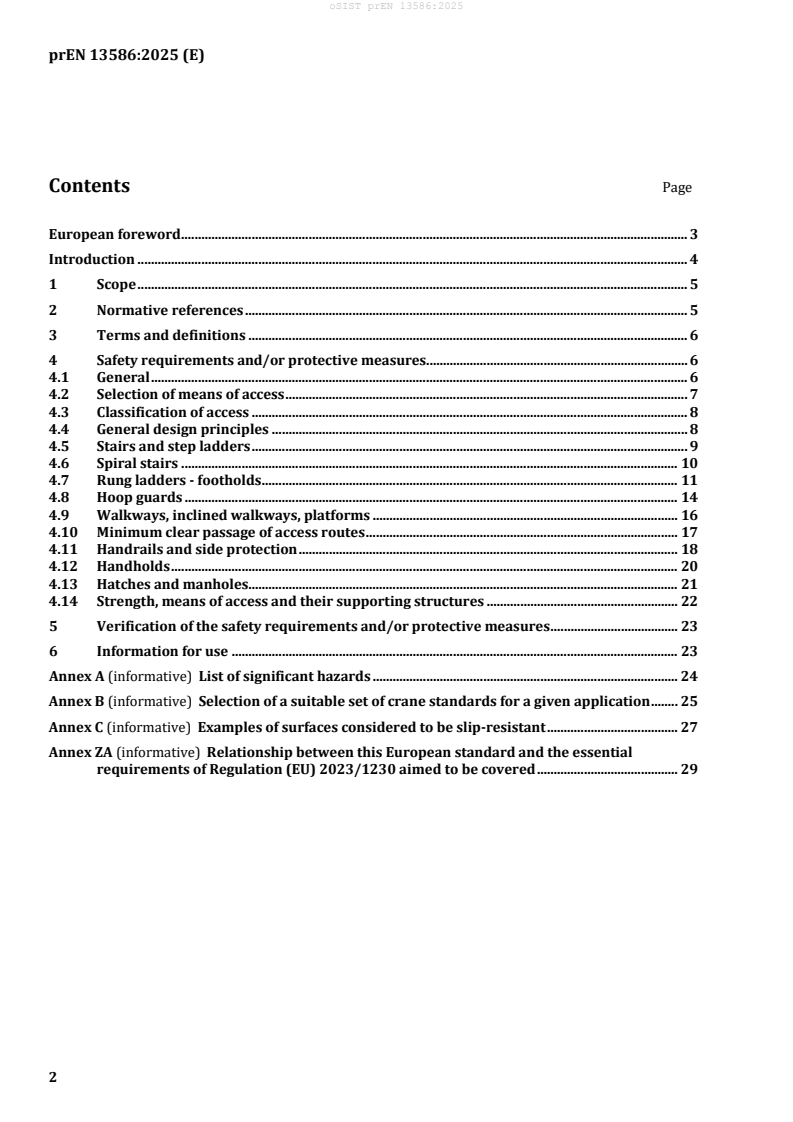
Contents Page
European foreword . 3
Introduction . 4
1 Scope . 5
2 Normative references . 5
3 Terms and definitions . 6
4 Safety requirements and/or protective measures. 6
4.1 General . 6
4.2 Selection of means of access . 7
4.3 Classification of access . 8
4.4 General design principles . 8
4.5 Stairs and step ladders . 9
4.6 Spiral stairs . 10
4.7 Rung ladders - footholds . 11
4.8 Hoop guards . 14
4.9 Walkways, inclined walkways, platforms . 16
4.10 Minimum clear passage of access routes . 17
4.11 Handrails and side protection . 18
4.12 Handholds . 20
4.13 Hatches and manholes. 21
4.14 Strength, means of access and their supporting structures . 22
5 Verification of the safety requirements and/or protective measures . 23
6 Information for use . 23
Annex A (informative) List of significant hazards . 24
Annex B (informative) Selection of a suitable set of crane standards for a given application . 25
Annex C (informative) Examples of surfaces considered to be slip-resistant . 27
Annex ZA (informative) Relationship between this European standard and the essential
requirements of Regulation (EU) 2023/1230 aimed to be covered . 29
oSIST prEN 13586:2025
prEN 13586:2025 (E)
European foreword
This document (prEN 13586:2025) has been prepared by Technical Committee CEN/TC 147 “Cranes -
Safety”, the secretariat of which is held by SFS.
This document is currently submitted to the CEN Enquiry.
This document will supersede EN 13586:2020.
prEN 13586:2025 includes the following significant technical changes with respect to EN 13586:2020:
— updating of normative references;
— revision of grammar and linguistic consistency;
— revision of List of significant hazards and its move to Annex A;
— re-numbering of clauses and Annexes;
— revision and update of Table A.1;
— revision of Annex ZA.
This document has been prepared under a standardization request addressed to CEN by the European
Commission. The Standing Committee of the EFTA States subsequently approves these requests for its
Member States.
For the relationship with EU Legislation, see informative Annex ZA, which is an integral part of this
document.
For the relationship with other European Standards for cranes, see Annex B.
oSIST prEN 13586:2025
prEN 13586:2025 (E)
Introduction
This document has been prepared to be a harmonized standard to provide one means for crane access to
conform with the essential health and safety requirements of the Machinery Regulation, as mentioned in
Annex ZA.
This document is a type-C standard as stated in EN ISO 12100:2010.
This document is of relevance, in particular, for the following stakeholder groups representing the market
players with regard to machinery safety:
— machine manufacturers (small, medium and large enterprises);
— health and safety bodies (regulators, accident prevention organizations, market surveillance, etc.).
Others can be affected by the level of machinery safety achieved with the means of the document by the
above-mentioned stakeholder groups:
— machine users/employers (small, medium and large enterprises);
— machine users/employees (e.g. trade unions, organizations for people with special needs);
— service providers, e.g. for maintenance (small, medium and large enterprises);
— consumers (in case of machinery intended for use by consumers).
The above-mentioned stakeholder groups have been given the possibility to participate at the drafting
process of this document.
The machinery concerned and the extent to which hazards, hazardous situations and hazardous events
are covered, are indicated in the scope of this document.
When requirements of this type-C standard are different from those which are stated in type-A or type B
standard, the requirements of this type-C standard take precedence over the requirements of the other
standards for machines that have been designed and built according to the requirements of this type-C
standard.
oSIST prEN 13586:2025
prEN 13586:2025 (E)
1 Scope
This document specifies design requirements for non-powered access installed on cranes.
NOTE 1 For other type of access, a requirement for information to be supplied is specified.
Slidable, retractable means of access are excluded from the scope, except movable hoop guards.
This document covers means of access to control stations and all access required for maintenance, certain
erection and dismantling operations.
For those cranes which are intended to be erected and dismantled frequently to change their places of
work, specific requirements for the access needed during these operations are not covered by this
document and can be given in the appropriate European Standards for specific crane types.
Lighting of means of access is not covered by this document and can be given in the appropriate European
Standards for specific crane types.
NOTE 2 Specific requirements for access on particular types of cranes are given in the appropriate European
Standard for the particular crane type.
The requirements given in this document do not take into account the safety distances related to:
— guarding against hazard from moving parts;
— relative movement between crane and adjacent structure or the ground/floor;
— hazardous surface temperature;
— electrical equipment.
The significant hazards covered by this document are identified in Annex A.
This document is not applicable to cranes manufactured before the date of its publication.
2 Normative references
The following documents are referred to in the text in such a way that some or all of their content
constitutes requirements of this document. For dated references, only the edition cited applies. For
undated references, the latest edition of the referenced document (including any amendments) applies.
EN 363:2018, Personal fall protection equipment — Personal fall protection systems
EN 795:2012, Personal fall protection equipment — Anchor devices
EN 13001-3-1:2012+A2:2018, Cranes — General Design — Part 3-1: Limit States and proof competence of
steel structure
EN ISO 12100:2010, Safety of machinery — General principles for design — Risk assessment and risk
reduction (ISO 12100:2010)
EN ISO 13854:2019, Safety of machinery — Minimum gaps to avoid crushing of parts of the human body
(ISO 13854:2017)
EN ISO 14122-4:2016, Safety of machinery — Permanent means of access to machinery — Part 4: Fixed
ladders (ISO 14122-4:2016)
oSIST prEN 13586:2025
prEN 13586:2025 (E)
EN ISO 20607:2019, Safety of machinery — Instruction handbook — General drafting principles
(ISO 20607:2019)
3 Terms and definitions
For the purposes of this document, the terms and definitions given in EN ISO 12100:2010 and the
following apply.
ISO and IEC maintain terminology databases for use in standardization at the following addresses:
— ISO Online browsing platform: available at https://www.iso.org/obp
— IEC Electropedia: available at https://www.electropedia.org/.
3.1
rest platform
standing area for persons to rest, situated at intervals between flights of ladders or stairs
3.2
platform
standing area for persons to work from, e.g. for maintenance or inspection
3.3
handrail
device, which provides continuous hand support between two locations
3.4
handhold
means of providing support by a single hand placement
3.5
foothold
means of providing support for one or two feet for vertical access
3.6
manhole
access opening to allow the passage of persons, and which could have a cover fitted
3.7
hatch
access opening to allow the passage of persons, provided with a cover openable without use of tools
4 Safety requirements and/or protective measures
4.1 General
Means of access shall comply with the safety requirements and/or protective/risk reduction measures of
this clause. In addition, the equipment shall be designed according to the principles of EN ISO 12100:2010
for hazards relevant but not significant which are not dealt with by this document.
oSIST prEN 13586:2025
prEN 13586:2025 (E)
4.2 Selection of means of access
The following factors shall be taken into account, when determining means of access for cranes:
— frequency of use;
— equipment and tools to be carried;
— vertical distance to cover;
— nature of use, e.g. regular operator access, maintenance, inspection.
The following hierarchy of access methods shall be applied when moving from one level to another where
no technical reason exists to exclude it:
— stair,
— step ladder,
— rung ladder.
Furthermore, permanent protective equipment (e.g. hoop guard, side protection) is preferred to personal
protection equipment. Where personal protective equipment is required, the use of a continuous system
avoiding the need to connect and disconnect shall be applied where no technical reason exists to exclude
it.
The type of the means of the access depending on its steepness shall be selected in accordance with the
Figure 1.
Key
1 rung ladder 5 inclined walkway
2 step ladder 6 walkway
3 range to be avoided 7 not permitted zone (90 degrees or more)
4 stair D access direction when going upwards
Figure 1 — Ranges of angles for different means of access in their working position
For structural requirements of means of access, the term “ladder” is used to refer both to rung ladders
and step ladders.
Where the vertical height between point of access and operator’s control station is more than 30 m, the
crane shall be designed with provisions to receive a powered access. Where a powered access system is
provided, an additional access way of Type 1, see 4.3, shall also be provided.
oSIST prEN 13586:2025
prEN 13586:2025 (E)
Other means of access than those in the scope of this standard may be utilized, e.g. for inspection locations
with an inspection interval longer than one year, for emergency exit or for access for erection and
dismantling. Access in such cases shall be designed to rely on use of personal fall protection equipment
against falls from a height in accordance with EN 363:2018 and EN 795:2012 or use of mobile elevating
work platforms.
NOTE Specific requirements for particular crane types can be given in the appropriate European Standards,
see Annex B.
4.3 Classification of access
Type 1 access shall be provided in the following cases:
— the main access way of the crane operator to the control station and to starting equipment;
— the access way to maintenance locations, with a maintenance or inspection period shorter than one
month.
Type 2 access may be provided, instead of Type 1 access, in the following cases:
— the access way to maintenance locations, with a maintenance or inspection period one month or
longer;
— emergency exit;
— access for erection and dismantling.
4.4 General design principles
When ascending or descending provisions shall be made to provide simultaneous three-point support;
two hand holds and one foot hold or two feet holds and one hand hold.
Where a lateral body move is necessary from a rung of a ladder to another support surface, the distance
between the step or rung and the nearest edge of the support surface shall be within a spherical radius of
300 mm, see Figure 2.
Key
R spherical radius
S support surface
Figure 2 — Distance between a step or rung and the nearest edge of any support surface
oSIST prEN 13586:2025
prEN 13586:2025 (E)
Means of access, walking and standing areas shall:
— have their working position(s) designated; (for example platform on articulated boom needs defined
position of the boom for the access);
— take into account the number of the persons, and the presence of objects such as tools and spare
parts;
— be constructed of materials specified as being incombustible and with slip resistant surfaces, which
do not retain liquid. See Annex C.
The steps between adjacent, fixed (non-moveable) floor sections shall not exceed 8 mm in height. This
requirement does not apply in cases, where access is directly on a structural surface and the step is due
to welded joint of the structure.
Every operating position and enclosed operating position, e.g. cabin, shall have at least one exit onto a
fixed means of access. An alternative means of egress shall be provided, where a fixed means of access
cannot be reached from all operating positions of the crane.
Where apertures are used in the floor of a walkway, inclined walkway, landing or platform, which are
situated above an area, where persons are expected to be, slots and interstices shall fulfil the following
requirements:
— a ball with a diameter 20 mm or greater cannot pass through;
— a slot has a maximum width of 12 mm, where the length is 200 mm or greater.
Hand supports shall be designed and constructed so as not to have exposed sharp edges and corners or
other hazardous projections. Edges shall have radii (minimum 2 mm) or be chamfered (minimum
2 × 2 mm).
Obstacles to retain the grip of the hands or feet, shall be provided at the ends of handholds and footholds.
Where access is foreseen with portable ladders, permanent means shall be provided to prevent the top
of the ladder from sliding or slipping.
Portable ladders shall meet the requirements of this document for ladders.
4.5 Stairs and step ladders
Type 1 stairs shall be provided with a handrail and an intermediate guard-rail on both sides. Where the
distance between a stair and a continuous surface is less than 200 mm, it is permissible to omit
intermediate guard-rails. For details of handrails and side protections, see 4.11.
The climbing height of a single flight shall not exceed 6 m for Type 1 step ladders.
Where Type 2 stairs are not fitted with a handrail, provision (e.g. an inclined lifeline in accordance with
EN 795:2012) shall be made for the use of personal fall protection equipment. For personal fall protection
equipment, see EN 363:2018.
Step ladders shall be provided with handrails or handholds on both sides.
Steps shall be regularly spaced within a single section of stairs or step ladders. The distance from the floor
to the first step shall be the same as the rise of the stair or ladder; but may vary to accommodate
movement between the floor and the step or for the fitting of standardized components.
Stairs and step ladders shall have the dimensions in accordance with Figure 3, Table 1 and Table 2.
oSIST prEN 13586:2025
prEN 13586:2025 (E)
Figure 3 — Dimensional parameters for stairs and step ladders
Table 1 — Dimensions for stairs
Dimensions in millimetres
Symbols in accordance with Figure 3 Type 1 access Type 2 access
min. max. min. max.
Clear width of the step b 450 - 320 -
Rise h 180 250 180 250
Going g 150 270 150 270
Tread depth
p 200 - 200 -
Tread depth (p) shall not be less
than the going (g).
Height between the floor and the
- 600 - 700
first step
The following formula shall be applied for stairs: 600 mm ≤ 2 × rise + going ≤ 660 mm.
Table 2 — Dimensions for step ladders
Dimensions in millimetres
Symbols in accordance with Figure 3 Type 1 access Type 2 access
min. max. min. max.
Clear width of the step b 450 - 320 -
Rise h 230 300 230 300
Going g 80 - 80 -
Tread depth p 80 - 80 -
Height between the floor
- 600 - 700
and the first step
4.6 Spiral stairs
The general requirements for stairs regarding e.g. steps, handrails and rest platforms apply also for spiral
stairs, where relevant and where not in conflict with the requirements given in this clause.
Spiral stairs as specified here are applicable in Type 1 and Type 2 access ways.
oSIST prEN 13586:2025
prEN 13586:2025 (E)
Spiral stairs shall fulfil the following requirements:
— spiral stairs shall be fitted with side protection;
— the clear width of the access way (R ) shall be 660 mm or wider;
— the clear head room of the access way shall be 2 000 mm or higher;
— the rise height of steps (h) shall be not more than 240 mm;
— the tread depth (p) shall be 190 mm or more, measured at 300 mm (R ) from the narrower edge;
— the going of a step (g) shall be 140 mm or more but not greater than the tread depth (p), measured
at 300 mm (R ) from the narrower edge;
— the size of steps shall be the same through a single spiral stair section, between the lower and upper
walkway or platform.
For illustration of the used symbols, see Figure 4.
Figure 4 — Dimensional parameters for spiral stairs
4.7 Rung ladders - footholds
4.7.1 Rung ladders
The following requirements apply to rung ladders and individual rungs fixed to the crane structure.
Rungs shall be regularly spaced within a single section of ladders, except for the first rung which may
vary to accommodate for movement between the floor and the rung or for the fitting of standardized
component.
Handholds (see 4.12) shall be provided to facilitate access to or from the ladder.
Where a vertical ladder provides an access upwards to a walkway, platform or rest platform, handholds
need not be provided, if one of the following conditions is fulfilled:
a) two handrails (see 4.11) are provided, with opening (u) for the access in accordance with 4.12;
b) the ladder uprights are extended to at least 1 m height from the floor of the walkway, platform or rest
platform;
oSIST prEN 13586:2025
prEN 13586:2025 (E)
c) one handrail and one ladder upright are provided to at least 1 m height from the floor of the walkway,
platform or rest platform.
Type 1 ladders, which present a risk of falling greater than 3 m and type 2 ladders, which present a risk
of falling greater than 5 m, shall be equipped with a hoop guard. For Type 2 ladders, the hoop guard may
be replaced by facilities for use with personal fall protection equipment against falls from a height as
defined in EN 363:2018.
Type 1 and Type 2 ladders shall have rest platforms at least every 6 m.
Flights of ladders shall be positioned, or other means provided, to prevent persons falling more than 6 m.
The cross-section of a rung shall be circular or have rounded corners.
Rungs and rung ladder dimensions shall be in accordance with Figures 5 and 6 and Table 3. Minimum
free space around a ladder shall be as illustrated in Figure 6, with the values for the dimensions d, e and
w taken only the minimum ones from Table 3. The maximum values for e and w are for hoop guards only.
Where provided, the anti-climb devices at ladders shall comply with Annex A of EN ISO 14122-4:2016.
Figure 5 — Dimensional parameters for rung ladders and rungs
Figure 6 — Free space around a ladder and hoop guard dimensions
oSIST prEN 13586:2025
prEN 13586:2025 (E)
Table 3 — Dimensions for rungs and rung ladders
Dimensions in millimetres
Symbols in accordance with Figures 5 and 6 Type 1 access Type 2 access
min. max. min. max.
...