

SIST EN 15534-5:2014
(Main)Composites made from cellulose-based materials and thermoplastics (usually called wood-polymer composites (WPC) or natural fibre composites (NFC)) - Part 5: Specifications for cladding profiles and tiles
General Information
- Abstract
This European Standard specifies the characteristics of cladding profiles and tiles made from cellulose-based materials and thermoplastics, usually called wood-polymer composites (WPC) or natural fibre composites (NFC), for external or internal use.
This part of EN 15534 is applicable to extruded profiles but also to tiles manufactured by other plastics processing techniques, e.g. injection moulding.
It is not applicable to support rail profiles, cover strip profiles and fastener devices which are out of the scope of this part of EN 15534.
EN 15534 1 specifies the test methods relevant to this part of EN 15534.
NOTE For editorial reasons, in EN 15534 the abbreviation "WPC" is used for "composites made from cellulose-based materials and thermoplastics".
- Status
- Published
- Publication Date
- 02-Apr-2014
- Technical Committee
- IPMA - Polimer materials and products
- Current Stage
- 6060 - National Implementation/Publication (Adopted Project)
- Start Date
- 25-Mar-2014
- Due Date
- 30-May-2014
- Completion Date
- 03-Apr-2014

Overview
EN 15534-5:2014 is the CEN European Standard that specifies performance and declaration requirements for cladding profiles and tiles made from cellulose-based materials and thermoplastics - commonly called wood‑polymer composites (WPC) or natural fibre composites (NFC). The standard covers products for external or internal use, applies primarily to extruded profiles and also to tiles produced by other plastics processing techniques (e.g. injection moulding). It does not cover support rails, cover strips or fastener devices. Test methods relevant to EN 15534-5 are given in EN 15534-1.
Key topics and technical requirements
- Material declaration
- Manufacturer must declare base polymer and type/content of cellulose-based material; recycled/reprocessable inputs are permitted if compliant.
- Initial type testing and factory production control
- Initial type testing is required and must be repeated after material, geometry or process changes. Annex A sets minimum testing frequencies for production control.
- Appearance and dimensional control
- Visual matching to a control sample, and dimensional tolerances (thickness, width, length, straightness, cupping) must be declared by the manufacturer.
- Mechanical performance
- Falling mass impact resistance: specified test parameters (H = 1000 mm, Ms = 500 g); no more than 1 failure per 10 specimens.
- Flexural properties: deflection under 250 N ≤ 5.0 mm (mean); bending span declared by manufacturer.
- Durability and weathering
- Biological resistance: use classes defined (internal/covered = Class 2; external above ground = Class 3), with basidiomycetes relevant for external use; test results to be declared.
- Artificial weathering: declared colour/appearance change (tests such as EN ISO 4892-2, EN 927-6, EN 16472 specified).
- Moisture resistance: cyclic moisture tests and swelling/water-absorption limits (mean swelling ≤ 10% thickness; mean water absorption ≤ 8% by weight).
- Thermal
- Linear thermal expansion coefficient limit (use class 3): ≤ 50 × 10−6 K−1; additional thermal tests (heat reversion, heat build-up) when applicable.
- Additional declared characteristics
- Manufacturer must declare any extra properties required by customers, regulators or third parties (e.g. natural ageing results, appearance criteria).
Applications and who uses this standard
- Manufacturers of WPC/NFC cladding profiles and tiles for product specification, design verification and factory production control.
- Specifiers and architects selecting durable, low‑maintenance cladding for façade, soffit or internal wall applications.
- Test laboratories performing EN 15534-1 test methods tied to Part 5 requirements.
- Procurement and compliance teams ensuring product declarations, performance data and marking meet EU/national standards.
Related standards
- EN 15534-1:2014 (test methods for WPC/NFC)
- EN 15534-4 (specifications for decking)
- EN ISO 4892-2, EN 927-6, EN 16472 (artificial weathering/photoageing)
- EN 335 (use classes)
- EN 15347, ISO 15270 (recycling guidance)
Practical takeaway: EN 15534-5:2014 provides the specification framework and mandatory test outcomes manufacturers must declare to demonstrate the performance and durability of WPC/NFC cladding profiles and tiles for internal and external architectural use.
Relations
- Effective Date
- 01-May-2014
- Effective Date
- 28-Jan-2026
- Effective Date
- 28-Jan-2026
- Effective Date
- 28-Jan-2026
- Effective Date
- 28-Jan-2026
- Referred By
SIST EN 15429-4:2015 - Sweepers - Part 4: Symbols for operator controls and other displays - Effective Date
- 28-Jan-2026
- Effective Date
- 18-Jan-2023
- Effective Date
- 04-Apr-2018
Get Certified
Connect with accredited certification bodies for this standard

DIN CERTCO
DIN Group product certification.
Gozdarski inštitut Slovenije
Slovenian Forestry Institute. Forest management certification support, timber testing.

Smithers Quality Assessments
US management systems and product certification.
Sponsored listings
Frequently Asked Questions
SIST EN 15534-5:2014 is a standard published by the Slovenian Institute for Standardization (SIST). Its full title is "Composites made from cellulose-based materials and thermoplastics (usually called wood-polymer composites (WPC) or natural fibre composites (NFC)) - Part 5: Specifications for cladding profiles and tiles". This standard covers: This European Standard specifies the characteristics of cladding profiles and tiles made from cellulose-based materials and thermoplastics, usually called wood-polymer composites (WPC) or natural fibre composites (NFC), for external or internal use. This part of EN 15534 is applicable to extruded profiles but also to tiles manufactured by other plastics processing techniques, e.g. injection moulding. It is not applicable to support rail profiles, cover strip profiles and fastener devices which are out of the scope of this part of EN 15534. EN 15534 1 specifies the test methods relevant to this part of EN 15534. NOTE For editorial reasons, in EN 15534 the abbreviation "WPC" is used for "composites made from cellulose-based materials and thermoplastics".
This European Standard specifies the characteristics of cladding profiles and tiles made from cellulose-based materials and thermoplastics, usually called wood-polymer composites (WPC) or natural fibre composites (NFC), for external or internal use. This part of EN 15534 is applicable to extruded profiles but also to tiles manufactured by other plastics processing techniques, e.g. injection moulding. It is not applicable to support rail profiles, cover strip profiles and fastener devices which are out of the scope of this part of EN 15534. EN 15534 1 specifies the test methods relevant to this part of EN 15534. NOTE For editorial reasons, in EN 15534 the abbreviation "WPC" is used for "composites made from cellulose-based materials and thermoplastics".
SIST EN 15534-5:2014 is classified under the following ICS (International Classification for Standards) categories: 79.080 - Semi-manufactures of timber; 83.140.99 - Other rubber and plastics products. The ICS classification helps identify the subject area and facilitates finding related standards.
SIST EN 15534-5:2014 has the following relationships with other standards: It is inter standard links to SIST-TS CEN/TS 15534-3:2007, SIST EN ISO 4892-2:2013, SIST EN 927-6:2019, SIST EN 16472:2014, SIST EN 15534-1:2014, SIST EN 15429-4:2015, oSIST prEN 15534-5:2019, oSIST prEN 15534-5:2019. Understanding these relationships helps ensure you are using the most current and applicable version of the standard.
SIST EN 15534-5:2014 is available in PDF format for immediate download after purchase. The document can be added to your cart and obtained through the secure checkout process. Digital delivery ensures instant access to the complete standard document.
Standards Content (Sample)
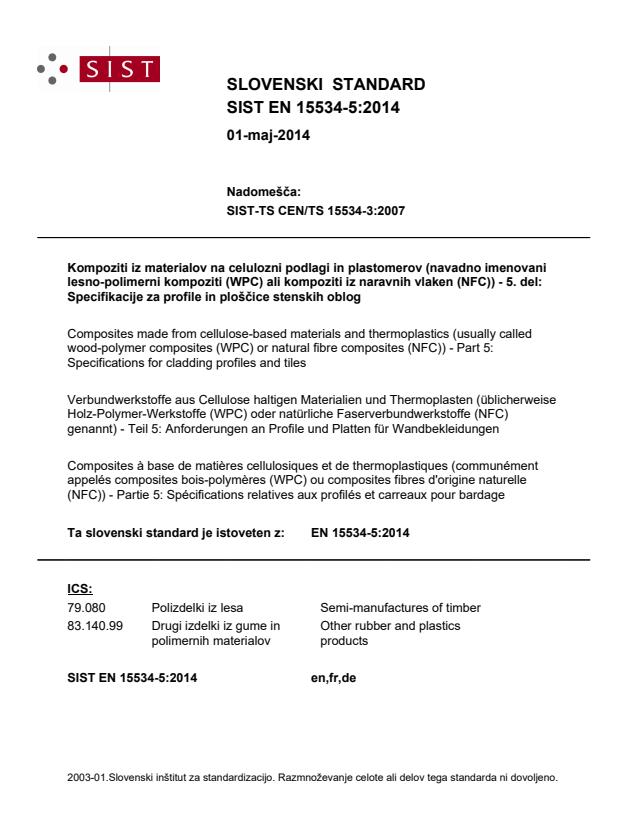
2003-01.Slovenski inštitut za standardizacijo. Razmnoževanje celote ali delov tega standarda ni dovoljeno.Verbundwerkstoffe aus Cellulose haltigen Materialien und Thermoplasten (üblicherweise Holz-Polymer-Werkstoffe (WPC) oder natürliche Faserverbundwerkstoffe (NFC) genannt) - Teil 5: Anforderungen an Profile und Platten für WandbekleidungenComposites à base de matières cellulosiques et de thermoplastiques (communément appelés composites bois-polymères (WPC) ou composites fibres d'origine naturelle (NFC)) - Partie 5: Spécifications relatives aux profilés et carreaux pour bardageComposites made from cellulose-based materials and thermoplastics (usually called wood-polymer composites (WPC) or natural fibre composites (NFC)) - Part 5: Specifications for cladding profiles and tiles83.140.99Drugi izdelki iz gume in polimernih materialovOther rubber and plastics products79.080Polizdelki iz lesaSemi-manufactures of timberICS:Ta slovenski standard je istoveten z:EN 15534-5:2014SIST EN 15534-5:2014en,fr,de01-maj-2014SIST EN 15534-5:2014SLOVENSKI
STANDARDSIST-TS CEN/TS 15534-3:20071DGRPHãþD
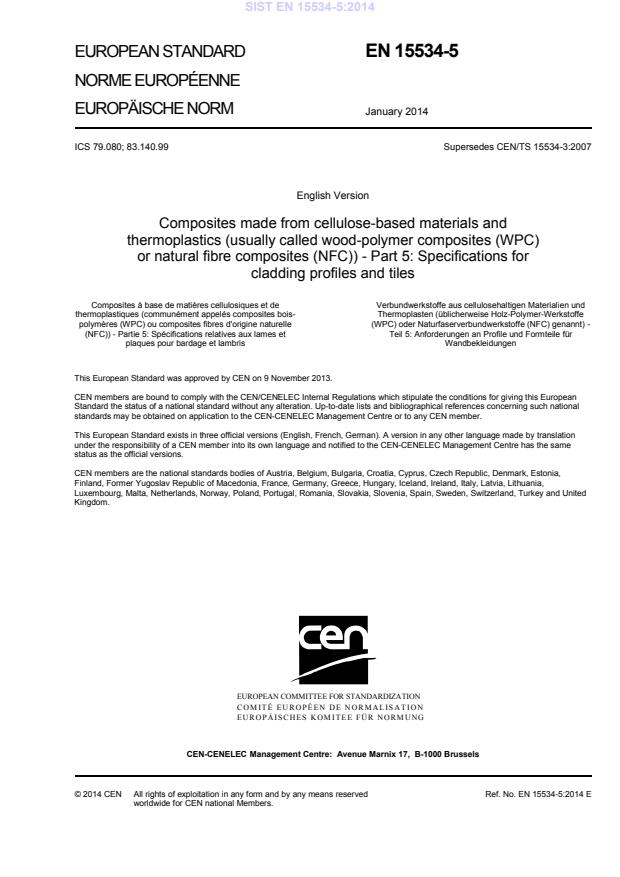
EUROPEAN STANDARD NORME EUROPÉENNE EUROPÄISCHE NORM
EN 15534-5
January 2014 ICS 79.080; 83.140.99 Supersedes CEN/TS 15534-3:2007English Version
Composites made from cellulose-based materials and thermoplastics (usually called wood-polymer composites (WPC) or natural fibre composites (NFC)) - Part 5: Specifications for cladding profiles and tiles
Composites à base de matières cellulosiques et de thermoplastiques (communément appelés composites bois-polymères (WPC) ou composites fibres d'origine naturelle (NFC)) - Partie 5: Spécifications relatives aux lames et plaques pour bardage et lambris
Verbundwerkstoffe aus cellulosehaltigen Materialien und Thermoplasten (üblicherweise Holz-Polymer-Werkstoffe (WPC) oder Naturfaserverbundwerkstoffe (NFC) genannt) -Teil 5: Anforderungen an Profile und Formteile für Wandbekleidungen This European Standard was approved by CEN on 9 November 2013.
CEN members are bound to comply with the CEN/CENELEC Internal Regulations which stipulate the conditions for giving this European Standard the status of a national standard without any alteration. Up-to-date lists and bibliographical references concerning such national standards may be obtained on application to the CEN-CENELEC Management Centre or to any CEN member.
This European Standard exists in three official versions (English, French, German). A version in any other language made by translation under the responsibility of a CEN member into its own language and notified to the CEN-CENELEC Management Centre has the same status as the official versions.
CEN members are the national standards bodies of Austria, Belgium, Bulgaria, Croatia, Cyprus, Czech Republic, Denmark, Estonia, Finland, Former Yugoslav Republic of Macedonia, France, Germany, Greece, Hungary, Iceland, Ireland, Italy, Latvia, Lithuania, Luxembourg, Malta, Netherlands, Norway, Poland, Portugal, Romania, Slovakia, Slovenia, Spain, Sweden, Switzerland, Turkey and United Kingdom.
EUROPEAN COMMITTEE FOR STANDARDIZATION
COMITÉ EUROPÉEN DE NORMALISATION EUROPÄISCHES KOMITEE FÜR NORMUNG
CEN-CENELEC Management Centre:
Avenue Marnix 17,
B-1000 Brussels © 2014 CEN All rights of exploitation in any form and by any means reserved worldwide for CEN national Members. Ref. No. EN 15534-5:2014 ESIST EN 15534-5:2014
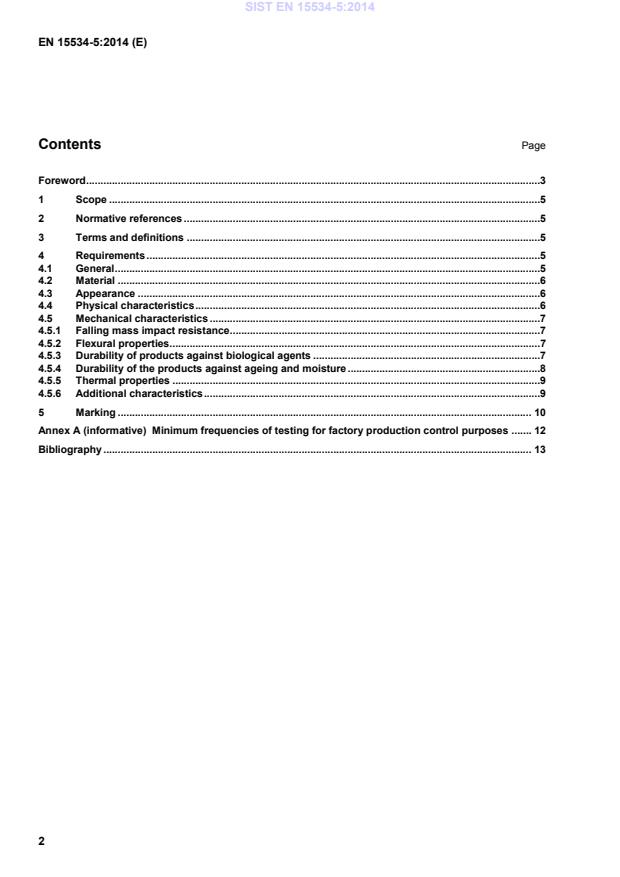
Minimum frequencies of testing for factory production control purposes . 12 Bibliography . 13
— splitting into Parts 4 and 5 of CEN/TS 15534-3:2007; — change of the status from Technical Specification to European Standard; — complete technical review of the document; — change of the scope from characterization to specification of the products. EN 15534 consists of the following parts: — EN 15534-1, Composites made from cellulose-based materials and thermoplastics (usually called wood-polymer composites (WPC) or natural fibre composites (NFC)) — Part 1: Test methods for characterization of compounds and products — prEN 15534-2, Composites made from cellulose-based materials and thermoplastics (usually called wood-polymer composites (WPC) or natural fibre composites (NFC)) — Part 2: Characterization of compounds1) — EN 15534-4, Composites made from cellulose-based materials and thermoplastics (usually called wood-polymer composites (WPC) or natural fibre composites (NFC)) — Part 4: Specifications for decking profiles and tiles — EN 15534-5, Composites made from cellulose-based materials and thermoplastics (usually called wood-polymer composites (WPC) or natural fibre composites (NFC)) — Part 5: Specifications for cladding profiles and tiles — prEN 15534-6, Composites made from cellulose-based materials and thermoplastics (usually called wood-polymer composites (WPC) or natural fibre composites (NFC)) — Part 6: Specifications for fencing profiles and systems1) — prEN 15534-7, Composites made from cellulose-based materials and thermoplastics (usually called wood-polymer composites (WPC) or natural fibre composites (NFC)) — Part 7: Specifications for general purpose profiles in external applications1)
1) In preparation. SIST EN 15534-5:2014
...