


SIST EN 1090-5:2017
(Main)Execution of steel structures and aluminium structures - Part 5: Technical requirements for cold-formed structural aluminium elements and cold-formed structures for roof, ceiling, floor and wall applications
Execution of steel structures and aluminium structures - Part 5: Technical requirements for cold-formed structural aluminium elements and cold-formed structures for roof, ceiling, floor and wall applications
This European Standard specifies requirements for the execution i.e. the manufacture and the installation of cold-formed structural aluminium components made from profiled sheeting for roof, ceiling, floor and wall applications under predominately static loading conditions or seismic loading conditions and their documentation. It does cover products of structural class I and II according to EN 1999-1-4 used in structures.
Structural elements are understood here to mean profiled sheeting, such as trapezoidal, sinusoidal, liner trays or cassette profiles (Figure 1), that are produced by cold forming. Perforated and micro profiled sheeting are also covered by this part.
Welded sections are excluded from this part and are covered by EN 1090-3 except seal welding in low-stress areas.
This standard also covers spacer constructions between the outer and inner or upper and lower skins as well as supporting members for roofs, walls and ceilings made from cold-formed profiled sheeting and the connections and attachments of the afore mentioned elements as long as they are involved in load transfer, it also covers connections and attachments of these elements.
A combination of steel and aluminium structural elements are permitted, e.g. liner trays made of steel, stiffened by profiles made of aluminium. In this case, EN 1090-4 and this document apply.
Composite structural elements where the interaction between dissimilar materials are an integral part of the structural behaviour such as sandwich panels and composite floors are not covered by this standard.
NOTE The structures covered in this standard can be for example
- single- or multi-skin roofs, whereby the load-bearing structure (lower skin) as well as the actual roof covering (upper skin) or both consist of structural elements;
- single- or multi-skin walls whereby the load-bearing structure (inner skin) as well as the actual cladding (outer skin) or both consist of structural elements; or
- suspended ceilings for interior fitting.
Ausführung von Stahltragwerken und Aluminiumtragwerken - Teil 5: Technische Anforderungen an tragende, kaltgeformte Bauelemente aus Aluminium und tragende, kaltgeformte Bauteile für Dach-, Decken-, Boden- und Wandanwendungen
Diese Europäische Norm legt die Anforderungen an die Ausführung, d. h. Herstellung und Montage, von Aluminiumtragwerken aus kaltgeformten Profiltafeln für Dach-, Decken-, Boden- und Wandanwendungen unter vorwiegend ruhenden oder seismischen Lastbedingungen und deren Dokumentation fest. Sie umfasst Produkte der Konstruktionsklassen I und II nach EN 1999-1-4, die in Tragwerken verwendet werden.
Tragende Bauelemente beziehen sich hier auf Profiltafeln, z. B. Trapez-, Well-, Kassettenprofile oder Wandpaneele (siehe Bild 1), die durch Kaltformen hergestellt werden. Perforierte und mikroprofilierte Profiltafeln werden in diesem Teil auch behandelt.
Geschweißte Querschnitte liegen außerhalb des Anwendungsbereiches dieses Normteils und werden bis auf Dichtungsschweißen in wenig beanspruchten Bereichen in EN 1090-3 behandelt.
Diese Norm umfasst außerdem Distanzkonstruktionen zwischen Außen- und Innenschale oder Ober- und Unterschale sowie Unterkonstruktionen für Dächer, Wände und Decken, die aus kaltgeformten Profiltafeln hergestellt wurden sowie die Verbindungen und Befestigungen der zuvor aufgeführten Bauelemente, sofern sie zur Lastübertragung beitragen.
Eine Kombination von tragenden Bauelementen aus Stahl und Aluminium ist erlaubt, z. B. Kassettenprofile (Linerprofile) aus Stahl, die mit Aluminiumprofilen ausgesteift sind. In diesem Fall finden EN 1090 4 und dieses Dokument Anwendung.
Diese Norm befasst sich nicht mit Verbundkonstruktionen, bei denen die Wechselwirkung unterschiedlicher Werkstoffe integraler Bestandteil des Tragwerksverhaltens ist, z. B. Sandwichelemente und Verbunddecken.
ANMERKUNG Konstruktionen, die in dieser Norm behandelt werden, können beispielsweise sein:
- einschalige- oder mehrschalige Dächer, wobei die tragende Konstruktion (Unterschale) sowie die tatsächliche Dachdeckung (Oberschale) oder beide aus tragenden Bauelementen bestehen;
- einschalige- oder mehrschalige Wände, wobei die tragende Konstruktion (Innenschale) sowie die tatsächliche Bekleidung (Außenschale) oder beide aus tragenden Bauelementen bestehen; oder
abgehängte Decken für den Innenausbau.
Exécution des structures en acier et des structures en aluminium - Partie 5 : Exigences techniques pour éléments en aluminium formés à froid et structures formées à froid pour applications en toiture, plafond, paroi verticale et plancher
La présente Norme européenne spécifie les exigences relatives à l'exécution, c’est-à-dire à la fabrication et à la mise en oeuvre d'éléments structuraux en aluminium, réalisés à partir de tôles profilées formées à froid, pour applications en toiture, plafond, mur et plancher, soumis à des charges essentiellement statiques ou sismiques, ainsi qu’à la documentation afférente. Le présent document concerne les produits répondant aux classes de construction I et II selon EN 1999-1-4 utilisés en structures.
Par éléments structuraux, on entend des plaques nervurées, telles que des profils à nervures trapézoïdales, sinusoïdales ou des plateaux (Figure 1), qui sont fabriqués par formage à froid Les plaques perforées et micro-nervurées sont également couvertes par la présente partie.
Les profilés soudés sont exclus de la présente partie et sont traités dans l’EN 1090-3, excepté le soudage des joints dans les zones de faibles contraintes.
La présente Norme européenne s’applique également aux écarteurs entre les peaux extérieure et intérieure ou supérieure et inférieure, aux profilés porteurs des toitures, murs et plafonds constitués de plaques nervurées formées à froid, ainsi qu’aux assemblages et fixations des éléments susmentionnés, dans la mesure où ils participent à la transmission des efforts.
La présente Norme européenne, en combinaison avec l'EN 1090-4, s’applique aux éléments structuraux en acier et en aluminium combinés, par exemple des plateaux en acier, raidis par des profilés en aluminium.
D'autres éléments structuraux mixtes dans lesquels l’interaction entre des matériaux différents fait partie intégrante du comportement structural, tels que les panneaux de type sandwich et les planchers mixtes, ne sont pas couverts par la présente norme.
NOTE Les structures traitées dans la présente norme peuvent être, par exemple :
- des toitures simple peau ou à peaux multiples, dont la structure porteuse (peau inférieure) ou la couverture de toiture (peau supérieure), ou les deux, sont constituées d’éléments structurels à parois minces ;
- des parois simple peau ou à peaux multiples, dont la structure porteuse (peau intérieure) ou le bardage (peau extérieure), ou les deux, sont constitués d’éléments structurels à parois minces ; ou
- des faux plafonds pour aménagement intérieur.
Izvedba jeklenih in aluminijastih konstrukcij - 5. del: Tehnične zahteve za hladno oblikovane konstrukcijske aluminijaste elemente in hladno oblikovane elemente kot del strešnih, stropnih, talnih in stenskih konstrukcij
Ta standard določa zahteve za izdelavo tankih, hladno oblikovanih aluminijastih elementov, in izvedbo konstrukcij, izdelanih iz takšnih elementov (npr. strehe, obloge, stene, tla, stropi in strešne letve) pri pretežno statičnih obremenitvah in ustreznih zahtevah za dokumentacijo.
General Information
- Status
- Published
- Public Enquiry End Date
- 29-Jan-2015
- Publication Date
- 10-Aug-2017
- Technical Committee
- KON - Structures
- Current Stage
- 6060 - National Implementation/Publication (Adopted Project)
- Start Date
- 04-Apr-2017
- Due Date
- 09-Jun-2017
- Completion Date
- 11-Aug-2017
Relations
- Effective Date
- 19-Jan-2023
- Effective Date
- 18-Jan-2023
- Effective Date
- 30-Nov-2022
Overview
SIST EN 1090-5:2017 sets the European requirements for the execution (manufacture and installation) of cold-formed structural aluminium elements used in roofs, ceilings, floors and walls. It covers profiled sheeting produced by cold forming - for example trapezoidal, sinusoidal, liner trays and cassette profiles, including perforated and micro‑profiled sheeting - for structures subjected to predominantly static or seismic loading. The standard applies to products of structural class I and II (EN 1999-1-4) and addresses documentation, traceability and on‑site execution. Welded sections are excluded (see EN 1090-3), though seal welding in low‑stress areas and mixed steel/aluminium assemblies are referenced where applicable.
Key topics and technical requirements
- Scope of components: profiled cold‑formed aluminium sheeting, spacer constructions, supporting members and load‑bearing connections and attachments when involved in load transfer. Composite sandwich panels and floors (dissimilar material interaction) are excluded.
- Specifications & documentation: execution specification, layout drawings, installer’s documentation, quality and traceability records, and execution documentation requirements.
- Constituent products: material identification, thickness tolerances, minimum nominal thicknesses and surface protection.
- Manufacturing controls: cold‑forming, cutting, punching, marking and identification of components.
- Mechanical fastening & connections: use of self‑drilling/self‑tapping screws, blind rivets, edge/field spacing, and attachment rules for different supporting members (metal, timber, concrete).
- Erection & site works: site conditions, storage, lifting, laying, direction of lay, inspection after installation, training/instruction for installation personnel and safety on site.
- Tolerances & performance: geometrical, manufacturing and erection tolerances; functional tolerances; inspection, testing and correction.
- Durability & safety: surface protection, corrosion protection, cleaning/maintenance, lightning protection, reaction and external fire performance provisions.
Practical applications
- Specification and QA for manufacturers of cold‑formed aluminium roofing and cladding profiles.
- Design and installation guidance for structural engineers, fabricators and installers specifying profiled sheeting for roofs, façades, ceilings and floors.
- Compliance and project documentation for contractors, certifiers and building authorities when using cold‑formed aluminium structural elements under static or seismic conditions.
- Reference for procurement and contract clauses covering traceability, tolerances, fastening details and on‑site inspection procedures.
Who should use this standard
- Aluminium profile manufacturers and fabricators
- Structural engineers and detailers working with EN 1999 (Eurocode 9)
- Roofing/cladding installers and contractors
- Quality managers, compliance officers and building inspectors
Related standards
- EN 1090-3 - Execution requirements for welded aluminium structures
- EN 1090-4 - Mixed steel and aluminium assemblies
- EN 1999-1-4 - Structural classes and design rules for aluminium (Eurocode 9)
Keywords: SIST EN 1090-5:2017, cold-formed structural aluminium, profiled sheeting, execution of aluminium structures, roofing cladding, mechanical fastening, traceability documentation.

Frequently Asked Questions
SIST EN 1090-5:2017 is a standard published by the Slovenian Institute for Standardization (SIST). Its full title is "Execution of steel structures and aluminium structures - Part 5: Technical requirements for cold-formed structural aluminium elements and cold-formed structures for roof, ceiling, floor and wall applications". This standard covers: This European Standard specifies requirements for the execution i.e. the manufacture and the installation of cold-formed structural aluminium components made from profiled sheeting for roof, ceiling, floor and wall applications under predominately static loading conditions or seismic loading conditions and their documentation. It does cover products of structural class I and II according to EN 1999-1-4 used in structures. Structural elements are understood here to mean profiled sheeting, such as trapezoidal, sinusoidal, liner trays or cassette profiles (Figure 1), that are produced by cold forming. Perforated and micro profiled sheeting are also covered by this part. Welded sections are excluded from this part and are covered by EN 1090-3 except seal welding in low-stress areas. This standard also covers spacer constructions between the outer and inner or upper and lower skins as well as supporting members for roofs, walls and ceilings made from cold-formed profiled sheeting and the connections and attachments of the afore mentioned elements as long as they are involved in load transfer, it also covers connections and attachments of these elements. A combination of steel and aluminium structural elements are permitted, e.g. liner trays made of steel, stiffened by profiles made of aluminium. In this case, EN 1090-4 and this document apply. Composite structural elements where the interaction between dissimilar materials are an integral part of the structural behaviour such as sandwich panels and composite floors are not covered by this standard. NOTE The structures covered in this standard can be for example - single- or multi-skin roofs, whereby the load-bearing structure (lower skin) as well as the actual roof covering (upper skin) or both consist of structural elements; - single- or multi-skin walls whereby the load-bearing structure (inner skin) as well as the actual cladding (outer skin) or both consist of structural elements; or - suspended ceilings for interior fitting.
This European Standard specifies requirements for the execution i.e. the manufacture and the installation of cold-formed structural aluminium components made from profiled sheeting for roof, ceiling, floor and wall applications under predominately static loading conditions or seismic loading conditions and their documentation. It does cover products of structural class I and II according to EN 1999-1-4 used in structures. Structural elements are understood here to mean profiled sheeting, such as trapezoidal, sinusoidal, liner trays or cassette profiles (Figure 1), that are produced by cold forming. Perforated and micro profiled sheeting are also covered by this part. Welded sections are excluded from this part and are covered by EN 1090-3 except seal welding in low-stress areas. This standard also covers spacer constructions between the outer and inner or upper and lower skins as well as supporting members for roofs, walls and ceilings made from cold-formed profiled sheeting and the connections and attachments of the afore mentioned elements as long as they are involved in load transfer, it also covers connections and attachments of these elements. A combination of steel and aluminium structural elements are permitted, e.g. liner trays made of steel, stiffened by profiles made of aluminium. In this case, EN 1090-4 and this document apply. Composite structural elements where the interaction between dissimilar materials are an integral part of the structural behaviour such as sandwich panels and composite floors are not covered by this standard. NOTE The structures covered in this standard can be for example - single- or multi-skin roofs, whereby the load-bearing structure (lower skin) as well as the actual roof covering (upper skin) or both consist of structural elements; - single- or multi-skin walls whereby the load-bearing structure (inner skin) as well as the actual cladding (outer skin) or both consist of structural elements; or - suspended ceilings for interior fitting.
SIST EN 1090-5:2017 is classified under the following ICS (International Classification for Standards) categories: 91.080.13 - Steel structures; 91.080.17 - Aluminium structures. The ICS classification helps identify the subject area and facilitates finding related standards.
SIST EN 1090-5:2017 has the following relationships with other standards: It is inter standard links to oSIST prEN 1090-5:2025, oSIST prEN 1090-5:2025, oSIST prEN 1090-5:2025. Understanding these relationships helps ensure you are using the most current and applicable version of the standard.
SIST EN 1090-5:2017 is available in PDF format for immediate download after purchase. The document can be added to your cart and obtained through the secure checkout process. Digital delivery ensures instant access to the complete standard document.
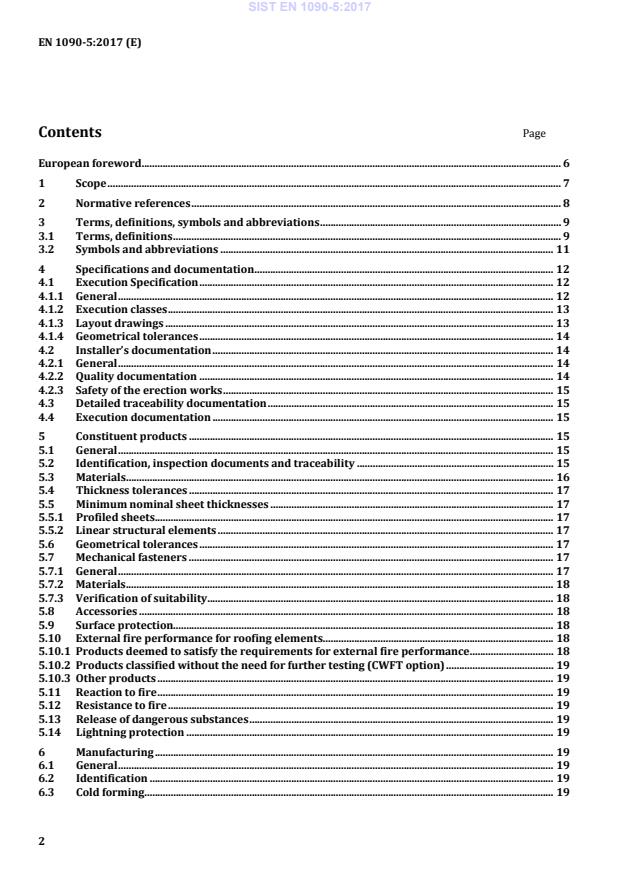
Standards Content (Sample)
2003-01.Slovenski inštitut za standardizacijo. Razmnoževanje celote ali delov tega standarda ni dovoljeno.Ausführung von Stahltragwerken und Aluminiumtragwerken - Teil 5: Technische Anforderungen an tragende, kaltgeformte Bauelemente aus Aluminium und tragende, kaltgeformte Bauteile für Dach-, Decken-, Boden- und WandanwendungenExécution des structures en acier et des structures en aluminium - Partie 5 : Exigences techniques pour éléments en aluminium formés à froid et structures formées à froid pour applications en toiture, plafond, paroi verticale et plancherExecution of steel structures and aluminium structures - Part 5: Technical requirements for cold-formed structural aluminium elements and cold-formed structures for roof, ceiling, floor and wall applications91.080.17Aluminijaste konstrukcijeAluminium structures91.080.13Jeklene konstrukcijeSteel structuresICS:Ta slovenski standard je istoveten z:EN 1090-5:2017SIST EN 1090-5:2017en,fr,de01-september-2017SIST EN 1090-5:2017SLOVENSKI
STANDARD
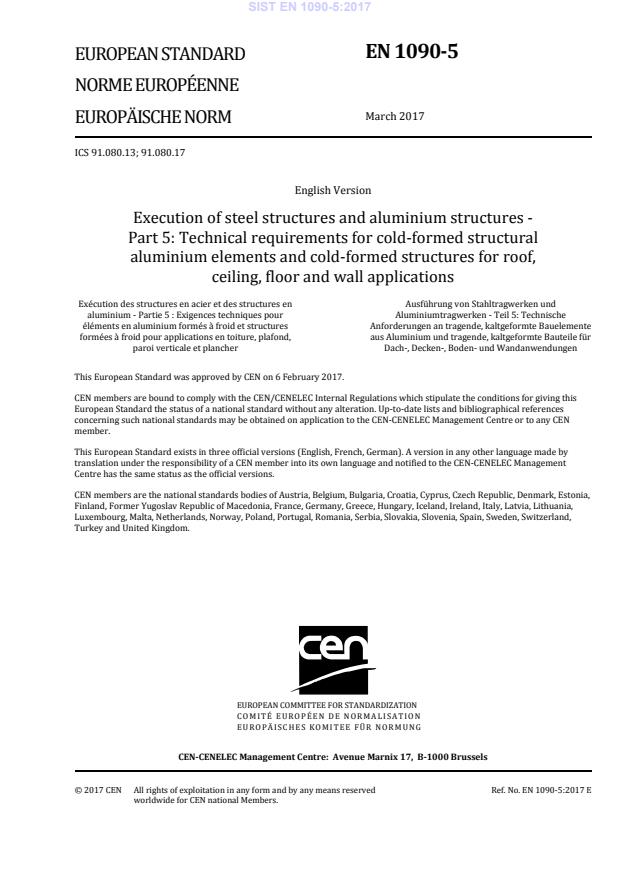
EUROPEAN STANDARD NORME EUROPÉENNE EUROPÄISCHE NORM
EN 1090-5
March
t r s y ICS
{ sä r z rä s uâ
{ sä r z rä s y English Version
Execution of steel structures and aluminium structures æ Part
wã Technical requirements for coldæformed structural aluminium elements and coldæformed structures for roofá ceilingá floor and wall applications Exécution des structures en acier et des structures en aluminium æ Partie
w ã Exigences techniques pour éléments en aluminium formés à froid et structures formées à froid pour applications en toitureá plafondá paroi verticale et plancher
Ausführung von Stahltragwerken und Aluminiumtragwerken æ Teil
wã Technische Anforderungen an tragendeá kaltgeformte Bauelemente aus Aluminium und tragendeá kaltgeformte Bauteile für Dachæá Deckenæá Bodenæ und Wandanwendungen This European Standard was approved by CEN on
x February
t r s yä
egulations which stipulate the conditions for giving this European Standard the status of a national standard without any alterationä Upætoædate lists and bibliographical references concerning such national standards may be obtained on application to the CENæCENELEC Management Centre or to any CEN memberä
translation under the responsibility of a CEN member into its own language and notified to the CENæCENELEC Management Centre has the same status as the official versionsä
CEN members are the national standards bodies of Austriaá Belgiumá Bulgariaá Croatiaá Cyprusá Czech Republicá Denmarká Estoniaá Finlandá Former Yugoslav Republic of Macedoniaá Franceá Germanyá Greeceá Hungaryá Icelandá Irelandá Italyá Latviaá Lithuaniaá Luxembourgá Maltaá Netherlandsá Norwayá Polandá Portugalá Romaniaá Serbiaá Slovakiaá Sloveniaá Spainá Swedená Switzerlandá Turkey and United Kingdomä
EUROPEAN COMMITTEE FOR STANDARDIZATION COMITÉ EUROPÉEN DE NORMALISATION EUROPÄISCHES KOMITEE FÜR NORMUNG
CEN-CENELEC Management Centre:
Avenue Marnix 17,
B-1000 Brussels
t r s y CEN All rights of exploitation in any form and by any means reserved worldwide for CEN national Membersä Refä Noä EN
s r { ræ wã t r s y ESIST EN 1090-5:2017
...
Questions, Comments and Discussion
Ask us and Technical Secretary will try to provide an answer. You can facilitate discussion about the standard in here.
Loading comments...