

oSIST prEN ISO 18119:2026
(Main)Gas cylinders - Seamless steel and seamless aluminium-alloy gas cylinders and tubes - Periodic inspection and testing (ISO/DIS 18119:2026)
General Information
- Abstract
This document specifies the requirements for periodic inspection and testing to verify the integrity of cylinders and tubes to be re-introduced into service for a further period of time.
This document is applicable to seamless steel and seamless aluminium-alloy transportable gas cylinders (single or those that comprise a bundle) intended for compressed and liquefied gases under pressure, of water capacity from 0,5 l up to 150 l and to seamless steel and seamless aluminium-alloy transportable gas tubes (single or those that comprise a bundle) intended for compressed and liquefied gases under pressure, of water capacity greater than 150 l. It also applies, as far as practical, to cylinders of less than 0,5 l water capacity.
This document does not apply to the periodic inspection and maintenance of acetylene cylinders or to the periodic inspection and testing of composite cylinders.
NOTE Unless noted by exception, the use of the word "cylinder" in this document refers to both cylinders and tubes.
- Status
- Not Published
- Public Enquiry End Date
- 19-Jun-2026
- Technical Committee
- TLP - Pressure vessels
- Current Stage
- 4020 - Public enquire (PE) (Adopted Project)
- Start Date
- 16-Apr-2026
- Due Date
- 03-Sep-2026
- Completion Date
- 06-Aug-2026

Overview
oSIST prEN ISO 18119:2026 defines the periodic inspection and testing requirements for seamless steel and seamless aluminium-alloy gas cylinders and tubes intended for the transport of compressed and liquefied gases. Developed by CEN in cooperation with ISO, this standard ensures the ongoing safety, integrity, and fitness for service of gas cylinders and tubes by outlining standardized procedures for their regular examination and testing. Covering both single cylinders and bundles, oSIST prEN ISO 18119:2026 applies to cylinders with water capacities from 0.5 l to 150 l and tubes above 150 l, with recommendations extending, where practicable, to smaller capacities.
The purpose of this standard is to minimize risks associated with the prolonged use of high-pressure gas containers and to facilitate safe reintroduction into service after each inspection cycle.
Key Topics
oSIST prEN ISO 18119:2026 addresses several crucial aspects of periodic inspection and testing for gas cylinders and tubes:
Scope and Applicability
- Focus on seamless steel and seamless aluminium-alloy cylinders and tubes for compressed and liquefied gases.
- Excludes acetylene cylinders and composite cylinders.
Inspection Intervals
- Specifies when cylinders must undergo inspection and testing, typically based on the date of last test, in line with international regulations (such as the UN Model Regulations).
Inspection Procedures
- Identification and documentation of cylinder markings and labelling.
- Safe depressurization and de-valving processes.
- External and internal visual inspection for corrosion, damage, and surface integrity.
- Check of cylinder neck and valve threads.
- Supplementary tests and cylinder repairs if required.
- Pressure testing (including hydraulic tests, proof pressure testing, or ultrasonic testing).
- Final reassembly, marking, and documentation.
Rejection Criteria
- Guidance on when to render cylinders unserviceable if defects exceed acceptable limits.
Safety Considerations
- Emphasis on qualified personnel and proper equipment calibration.
- Attention to hazardous materials and safe handling during inspection and testing.
Applications
This standard provides a consistent framework for organizations involved in the filling, maintenance, and inspection of transportable gas cylinders and tubes. Key applications include:
- Industrial Gas Suppliers: Ensuring cylinders for oxygen, nitrogen, carbon dioxide, argon, and other industrial gases remain safe in long-term service.
- Healthcare and Laboratories: Supporting safe use of medical and specialty gases.
- Fire and Rescue Services: Maintaining cylinders used for breathing apparatus in firefighting and emergency environments.
- Transport and Logistics: Complying with legal requirements for the international shipment of pressurized gases.
- Inspection Bodies and Test Facilities: Providing procedures for accredited cylinder inspection and qualification.
Adhering to oSIST prEN ISO 18119:2026 reduces the likelihood of cylinder failures, ensuring compliance with regulatory requirements and enhancing overall operational safety for users and service providers in various sectors.
Related Standards
oSIST prEN ISO 18119:2026 is closely aligned with numerous related international standards concerning gas cylinder safety and testing, including:
- ISO 7866: Design, construction, and testing of refillable seamless aluminium alloy gas cylinders.
- ISO 9809-1: Design, construction, and testing of refillable seamless steel gas cylinders and tubes.
- ISO 9712: Non-destructive testing - Qualification and certification of NDT personnel.
- ISO 10286: Vocabulary for gas cylinders.
- ISO 11621: Procedures for change of gas service.
- ISO 13769: Gas cylinders - Stamp marking.
- ISO 22434: Inspection and maintenance of valves.
- ISO 25760: Operational procedures for the safe removal of valves from gas cylinders.
Organizations involved with the manufacture, maintenance, or inspection of seamless gas cylinders should reference oSIST prEN ISO 18119:2026 alongside these standards to ensure robust compliance and implementation of best practices in gas cylinder management.
Keywords: gas cylinder inspection, seamless steel cylinders, aluminium-alloy cylinders, periodic testing, gas tube integrity, cylinder safety standards, ISO 18119, compressed gases, liquefied gases, cylinder maintenance, CEN standards, cylinder requalification.
Relations
- Effective Date
- 01-Jun-2028
- Effective Date
- 01-Jun-2026
Get Certified
Connect with accredited certification bodies for this standard

Element Materials Technology
Materials testing and product certification.

Inštitut za kovinske materiale in tehnologije
Institute of Metals and Technology. Materials testing, metallurgical analysis, NDT.
Institut za varilstvo d.o.o. (Welding Institute)
Slovenia's leading welding institute since 1952. ISO 3834, EN 1090, pressure equipment certification, NDT personnel, welder qualification. Only IIW Au
Sponsored listings
Frequently Asked Questions
oSIST prEN ISO 18119:2026 is a draft published by the Slovenian Institute for Standardization (SIST). Its full title is "Gas cylinders - Seamless steel and seamless aluminium-alloy gas cylinders and tubes - Periodic inspection and testing (ISO/DIS 18119:2026)". This standard covers: This document specifies the requirements for periodic inspection and testing to verify the integrity of cylinders and tubes to be re-introduced into service for a further period of time. This document is applicable to seamless steel and seamless aluminium-alloy transportable gas cylinders (single or those that comprise a bundle) intended for compressed and liquefied gases under pressure, of water capacity from 0,5 l up to 150 l and to seamless steel and seamless aluminium-alloy transportable gas tubes (single or those that comprise a bundle) intended for compressed and liquefied gases under pressure, of water capacity greater than 150 l. It also applies, as far as practical, to cylinders of less than 0,5 l water capacity. This document does not apply to the periodic inspection and maintenance of acetylene cylinders or to the periodic inspection and testing of composite cylinders. NOTE Unless noted by exception, the use of the word "cylinder" in this document refers to both cylinders and tubes.
This document specifies the requirements for periodic inspection and testing to verify the integrity of cylinders and tubes to be re-introduced into service for a further period of time. This document is applicable to seamless steel and seamless aluminium-alloy transportable gas cylinders (single or those that comprise a bundle) intended for compressed and liquefied gases under pressure, of water capacity from 0,5 l up to 150 l and to seamless steel and seamless aluminium-alloy transportable gas tubes (single or those that comprise a bundle) intended for compressed and liquefied gases under pressure, of water capacity greater than 150 l. It also applies, as far as practical, to cylinders of less than 0,5 l water capacity. This document does not apply to the periodic inspection and maintenance of acetylene cylinders or to the periodic inspection and testing of composite cylinders. NOTE Unless noted by exception, the use of the word "cylinder" in this document refers to both cylinders and tubes.
oSIST prEN ISO 18119:2026 is classified under the following ICS (International Classification for Standards) categories: 23.020.35 - Gas cylinders; 77.140.01 - Iron and steel products in general; 77.150.10 - Aluminium products. The ICS classification helps identify the subject area and facilitates finding related standards.
oSIST prEN ISO 18119:2026 has the following relationships with other standards: It is inter standard links to SIST EN ISO 18119:2019/A1:2021, SIST EN ISO 18119:2019. Understanding these relationships helps ensure you are using the most current and applicable version of the standard.
oSIST prEN ISO 18119:2026 is associated with the following European legislation: EU Directives/Regulations: 2008/68/EC; Standardization Mandates: M/TDG. When a standard is cited in the Official Journal of the European Union, products manufactured in conformity with it benefit from a presumption of conformity with the essential requirements of the corresponding EU directive or regulation.
oSIST prEN ISO 18119:2026 is available in PDF format for immediate download after purchase. The document can be added to your cart and obtained through the secure checkout process. Digital delivery ensures instant access to the complete standard document.
Standards Content (Sample)
SLOVENSKI STANDARD
01-junij-2026
Plinske jeklenke - Plinske jeklenke in velike jeklenke iz celega iz jekla in
aluminijevih zlitin - Periodični pregled in preskušanje (ISO/DIS 18119:2026)
Gas cylinders - Seamless steel and seamless aluminium-alloy gas cylinders and tubes -
Periodic inspection and testing (ISO/DIS 18119:2026)
Gasflaschen - Nahtlose Gasflaschen und Großflaschen aus Stahl und
Aluminiumlegierungen - Wiederkehrende Inspektion und Prüfung (ISO/DIS 18119:2026)
Bouteilles à gaz - Bouteilles et tubes à gaz en acier et en alliages d'aluminium, sans
soudure - Contrôles et essais périodiques (ISO/DIS 18119:2026)
Ta slovenski standard je istoveten z: prEN ISO 18119
ICS:
23.020.35 Plinske jeklenke Gas cylinders
77.140.01 Železni in jekleni izdelki na Iron and steel products in
splošno general
77.150.10 Aluminijski izdelki Aluminium products
2003-01.Slovenski inštitut za standardizacijo. Razmnoževanje celote ali delov tega standarda ni dovoljeno.
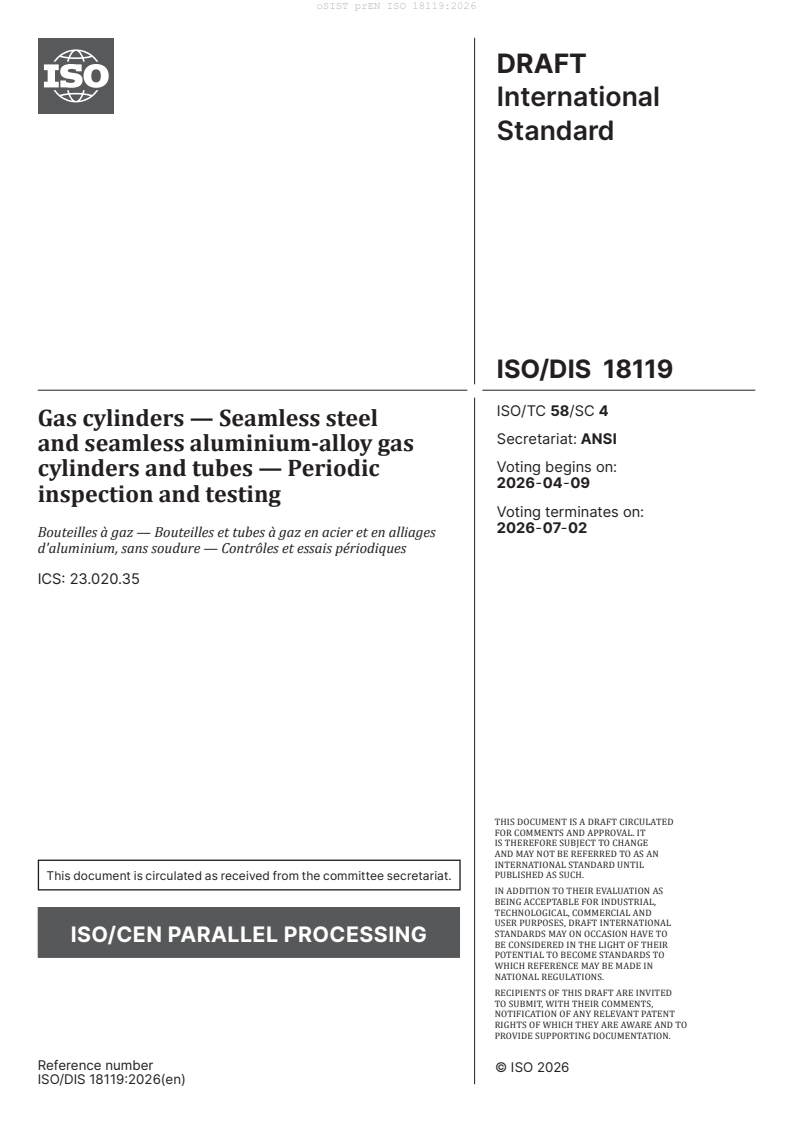
DRAFT
International
Standard
ISO/DIS 18119
ISO/TC 58/SC 4
Gas cylinders — Seamless steel
Secretariat: ANSI
and seamless aluminium-alloy gas
Voting begins on:
cylinders and tubes — Periodic
2026-04-09
inspection and testing
Voting terminates on:
2026-07-02
Bouteilles à gaz — Bouteilles et tubes à gaz en acier et en alliages
d'aluminium, sans soudure — Contrôles et essais périodiques
ICS: 23.020.35
THIS DOCUMENT IS A DRAFT CIRCULATED
FOR COMMENTS AND APPROVAL. IT
IS THEREFORE SUBJECT TO CHANGE
AND MAY NOT BE REFERRED TO AS AN
INTERNATIONAL STANDARD UNTIL
PUBLISHED AS SUCH.
This document is circulated as received from the committee secretariat.
IN ADDITION TO THEIR EVALUATION AS
BEING ACCEPTABLE FOR INDUSTRIAL,
TECHNOLOGICAL, COMMERCIAL AND
USER PURPOSES, DRAFT INTERNATIONAL
STANDARDS MAY ON OCCASION HAVE TO
ISO/CEN PARALLEL PROCESSING
BE CONSIDERED IN THE LIGHT OF THEIR
POTENTIAL TO BECOME STANDARDS TO
WHICH REFERENCE MAY BE MADE IN
NATIONAL REGULATIONS.
RECIPIENTS OF THIS DRAFT ARE INVITED
TO SUBMIT, WITH THEIR COMMENTS,
NOTIFICATION OF ANY RELEVANT PATENT
RIGHTS OF WHICH THEY ARE AWARE AND TO
PROVIDE SUPPORTING DOCUMENTATION.
Reference number
ISO/DIS 18119:2026(en)
DRAFT
ISO/DIS 18119:2026(en)
International
Standard
ISO/DIS 18119
ISO/TC 58/SC 4
Gas cylinders — Seamless steel
Secretariat: ANSI
and seamless aluminium-alloy gas
Voting begins on:
cylinders and tubes — Periodic
inspection and testing
Voting terminates on:
Bouteilles à gaz — Bouteilles et tubes à gaz en acier et en alliages
d'aluminium, sans soudure — Contrôles et essais périodiques
ICS: 23.020.35
THIS DOCUMENT IS A DRAFT CIRCULATED
FOR COMMENTS AND APPROVAL. IT
IS THEREFORE SUBJECT TO CHANGE
AND MAY NOT BE REFERRED TO AS AN
INTERNATIONAL STANDARD UNTIL
PUBLISHED AS SUCH.
This document is circulated as received from the committee secretariat.
IN ADDITION TO THEIR EVALUATION AS
BEING ACCEPTABLE FOR INDUSTRIAL,
© ISO 2026
TECHNOLOGICAL, COMMERCIAL AND
USER PURPOSES, DRAFT INTERNATIONAL
All rights reserved. Unless otherwise specified, or required in the context of its implementation, no part of this publication may
STANDARDS MAY ON OCCASION HAVE TO
ISO/CEN PARALLEL PROCESSING
be reproduced or utilized otherwise in any form or by any means, electronic or mechanical, including photocopying, or posting on
BE CONSIDERED IN THE LIGHT OF THEIR
the internet or an intranet, without prior written permission. Permission can be requested from either ISO at the address below
POTENTIAL TO BECOME STANDARDS TO
WHICH REFERENCE MAY BE MADE IN
or ISO’s member body in the country of the requester.
NATIONAL REGULATIONS.
ISO copyright office
RECIPIENTS OF THIS DRAFT ARE INVITED
CP 401 • Ch. de Blandonnet 8
TO SUBMIT, WITH THEIR COMMENTS,
CH-1214 Vernier, Geneva
NOTIFICATION OF ANY RELEVANT PATENT
Phone: +41 22 749 01 11
RIGHTS OF WHICH THEY ARE AWARE AND TO
PROVIDE SUPPORTING DOCUMENTATION.
Email: copyright@iso.org
Website: www.iso.org
Published in Switzerland Reference number
ISO/DIS 18119:2026(en)
ii
ISO/DIS 18119:2026(en)
Contents Page
Foreword .v
Introduction .vi
1 Scope . 1
2 Normative references . 1
3 Terms and definitions . 1
4 Abbreviated terms and symbols . 2
5 Intervals between periodic inspections and tests . 3
6 List of procedures for periodic inspections and tests. 3
7 Identification of cylinder and preparation for inspection and tests. 4
8 Depressurization and de-valving procedures . 4
8.1 General .4
8.2 Cylinders requiring de-valving .5
8.3 Cylinders not requiring de-valving .5
8.4 Cylinders requiring external shot blasting .5
9 External visual inspection . 5
9.1 Preparation .5
9.2 Inspection procedure .6
10 Inspection of cylinder neck . 6
10.1 Cylinder-to-valve threads .6
10.2 Other neck surfaces .8
10.3 Damaged internal neck threads .9
10.4 Neckring and collar attachment .9
11 Check of internal condition . 9
11.1 General .9
11.2 Internal visual inspection .9
11.2.1 Preparation .9
11.2.2 Inspection requirements .10
11.2.3 Cylinders with footrings . . .10
11.2.4 Cylinders with internal coatings .10
12 Supplementary tests .11
12.1 General .11
12.2 Additional test for seamless aluminium-alloy cylinders possibly subjected to heat
damage .11
12.3 Hammer test on cylinders with footrings .11
13 Cylinder repairs .11
14 Pressure test or UT .11
14.1 General .11
14.2 Proof pressure test . 12
14.2.1 General . 12
14.2.2 Test equipment . 12
14.2.3 Test criteria . 13
14.2.4 Acceptance criteria . 13
14.3 Hydraulic volumetric expansion test . 13
14.4 UT .14
14.4.1 General .14
14.4.2 Requirements .14
14.4.3 Calibration . . .18
14.4.4 Performing the examination . 23
14.4.5 Interpretation of results .24
iii
ISO/DIS 18119:2026(en)
14.4.6 Records . 25
15 Inspection of valve and other accessories .26
16 Replacement of cylinder parts .26
17 Final operations .26
17.1 Drying, cleaning and painting . 26
17.1.1 Drying and cleaning . 26
17.1.2 Painting and coating . 26
17.2 Re-valving of the cylinder .27
17.3 Check of cylinder tare .27
17.4 Retest marking . 28
17.4.1 General . 28
17.4.2 Stamping . 28
17.5 Reference to next periodic inspection and test date . 28
17.6 Identification of contents . 28
17.7 Records . 28
18 Rejection and rendering cylinder unserviceable .29
18.1 General . 29
18.2 Cylinders with a valve attached . 29
18.3 Cylinders with no valves attached . 29
Annex A (informative) Periodic inspection and test periods.30
Annex B (normative) Description, evaluation of defects and conditions for rejection of seamless
steel and seamless aluminium-alloy cylinders at the time of periodic inspection.31
Annex C (informative) List of gases corrosive to steel cylinder material . 41
Annex D (informative) Volumetric expansion testing of cylinders .42
Annex E (informative) Test date rings for cylinders .50
Annex F (informative) Cleaning of seamless aluminium-alloy cylinders .52
Bibliography .53
iv
ISO/DIS 18119:2026(en)
Foreword
ISO (the International Organization for Standardization) is a worldwide federation of national standards
bodies (ISO member bodies). The work of preparing International Standards is normally carried out through
ISO technical committees. Each member body interested in a subject for which a technical committee
has been established has the right to be represented on that committee. International organizations,
governmental and non-governmental, in liaison with ISO, also take part in the work. ISO collaborates closely
with the International Electrotechnical Commission (IEC) on all matters of electrotechnical standardization.
The procedures used to develop this document and those intended for its further maintenance are described
in the ISO/IEC Directives, Part 1. In particular, the different approval criteria needed for the different types
of ISO documents should be noted. This document was drafted in accordance with the editorial rules of the
ISO/IEC Directives, Part 2 (see www.iso.org/directives).
ISO draws attention to the possibility that the implementation of this document may involve the use of (a)
patent(s). ISO takes no position concerning the evidence, validity or applicability of any claimed patent
rights in respect thereof. As of the date of publication of this document, ISO [had/had not] received notice of
(a) patent(s) which may be required to implement this document. However, implementers are cautioned that
this may not represent the latest information, which may be obtained from the patent database available at
www.iso.org/patents. ISO shall not be held responsible for identifying any or all such patent rights.
Any trade name used in this document is information given for the convenience of users and does not
constitute an endorsement.
For an explanation of the voluntary nature of standards, the meaning of ISO specific terms and expressions
related to conformity assessment, as well as information about ISO's adherence to the World Trade
Organization (WTO) principles in the Technical Barriers to Trade (TBT), see www.iso.org/iso/foreword.html.
This document was prepared by ISO/TC 58, Gas cylinders, Subcommittee SC 4, Operational requirements for
gas cylinders.
This second edition cancels and replaces ISO 18119:2018, which have been technically revised. It also
incorporates the ISO 18119:2018/Amd 1:2021 and ISO 18119:2019/Amd 2: 2024.
The main changes are:
— update of definitions;
— technical review of 8.4 and 10.1;
— a review and improvement of 14.4.3.
Any feedback or questions on this document should be directed to the user’s national standards body. A
complete listing of these bodies can be found at www.iso.org/members.html.
v
ISO/DIS 18119:2026(en)
Introduction
This document provides information and procedures for the periodic inspection and testing of seamless
steel and seamless aluminium-alloy cylinders and the condition of the test equipment. The principal aim of
periodic inspection and testing is that at the completion of the test the cylinders have been requalified and
are suitable to be reintroduced into service for a further period of time.
This document requires that well-trained and competent personnel undertake the work as described in this
document, who consult the cylinder’s manufacturer if there are doubts about aspects of the document, so
that the cylinder manufacturer's current recommendations are taken into account.
[23]
This document has been written so that it is suitable to be referenced in the UN Model Regulations .
This document also gives requirements concerning safety of the personnel, preparation, finishing and
maintenance steps of [periodic inspection and testing of gas cylinders]. These requirements can be
mandatory under other regulations (e.g. work permits).
vi
DRAFT International Standard ISO/DIS 18119:2026(en)
Gas cylinders — Seamless steel and seamless aluminium-alloy
gas cylinders and tubes — Periodic inspection and testing
CAUTION — Some of the tests specified in this document involve the use of processes that could lead
to a hazardous situation.
1 Scope
This document specifies the requirements for periodic inspection and testing to verify the integrity of
cylinders and tubes to be re-introduced into service for a further period of time.
This document is applicable to seamless steel and seamless aluminium-alloy transportable gas cylinders
intended for compressed and liquefied gases under pressure, of water capacity from 0,5 l up to 150 l and to
seamless steel and seamless aluminium-alloy transportable gas tubes intended for compressed and liquefied
gases under pressure, of water capacity greater than 150 l. It also applies, as far as practical, to cylinders of
less than 0,5 l water capacity.
This document does not apply to the periodic inspection and maintenance of acetylene cylinders or to the
periodic inspection and testing of composite cylinders.
NOTE Unless noted by exception, the use of the word “cylinder” in this document refers to both cylinders and
tubes.
2 Normative references
The following documents are referred to in the text in such a way that some or all of their content constitutes
requirements of this document. For dated references, only the edition cited applies. For undated references,
the latest edition of the referenced document (including any amendments) applies.
ISO 6506-1, Metallic materials — Brinell hardness test — Part 1: Test method
ISO 7866, Gas cylinders — Refillable seamless aluminium alloy gas cylinders — Design, construction and testing
ISO 9712, Non-destructive testing — Qualification and certification of NDT personnel
ISO 9809-1, Gas cylinders — Design, construction and testing of refillable seamless steel gas cylinders and tubes
— Part 1: Quenched and tempered steel cylinders and tubes with tensile strength less than 1 100 MPa
ISO 10286, Gas cylinders — Vocabulary
ISO 11621, Gas cylinders — Procedures for change of gas service
ISO 13769, Gas cylinders — Stamp marking
ISO 22434, Gas cylinders — Inspection and maintenance of valves
ISO 25760, Gas cylinders — Operational procedures for the safe removal of valves from gas cylinders
ASNT SNT-TC-1A, Personnel qualification and certification in non-destructive testing
3 Terms and definitions
For the purposes of this document, the terms and definitions given in ISO 10286 and the following apply.
ISO and IEC maintain terminological databases for use in standardization at the following addresses:
ISO/DIS 18119:2026(en)
— IEC Electropedia: available at https://www.electropedia.org/
— ISO Online browsing platform: available at https://www.iso.org/obp
3.1
competent authority
any body or authority designated or otherwise recognized as such for any purpose in each country by its
government
Note 1 to entry: The term “competent body” is not to be used. UN Model recommendations only use “competent
authority” and “inspection body”.
[SOURCE: ISO 10286:2025, 3.4.15]
3.2
effective beam width
dimension(s) of the ultrasonic beam in the scan plane
3.3
liquefied gas
gas, which, when packaged for transport, is partially liquid at temperatures above −50 °C
Note 1 to entry: A distinction is made between
a) high pressure liquefied gas: a gas with a critical temperature between −50 °C and 65 °C, and
b) low pressure liquefied gas: a gas with a critical temperature above 65 °C.
[SOURCE: ISO 10286:2025, 3.5.4, 3.5.5 and 3.5.6]
3.4
minimum design wall thickness
minimum wall thickness as specified in the design standard or technical code
3.5
rejected cylinder
cylinder not fit for service
3.6
stove
treat by heating in a stove or an oven in order to apply a desired surface coating
4 Abbreviated terms and symbols
FBH flat bottom hole
PE permanent expansion
SBT sidewall-to-base transition region
UT ultrasonic testing
2 −1
C compressibility (expressed in m /N or Pa )
D depth of notch in ultrasonic test sample (expressed in mm)
K factor for individual temperature (listed in Table C.1)
L length of notch in ultrasonic test sample (expressed in mm)
P pressure (expressed in bar)
ISO/DIS 18119:2026(en)
V cylinder water capacity (expressed in l)
W width of notch in ultrasonic test sample (expressed in mm)
X flaw length (expressed in mm)
Y flaw depth ratio
t minimum measured wall thickness of the calibration specimen (expressed in mm)
mc
t minimum design wall thickness (expressed in mm)
m
a/t flaw depth ratio (in per cent)
5 Intervals between periodic inspections and tests
A cylinder shall be due for periodic inspection and testing on its first receipt by a filler following the expiry
of the established interval or, in the absence of regulations, in accordance with the UN Model Regulations.
[23] th
Annex A lists the intervals for period inspection and testing as outlined in the 19 revised edition of the
UN Model Regulations. The expiry date is based on the last test date shown on the cylinder. Other means of
indicating the expiry date may be used.
Provided the cylinder has not been subjected to abusive and abnormal conditions such as being involved in
an accident, heat exposure or other severe conditions that would render it unsafe, there is no requirement
for the user to return a cylinder before the contents have been used even though the periodic inspection and
testing interval has lapsed. However, cylinders, particularly those containing toxic gases, should be retested
within a period not exceeding twice the time interval.
Seamless steel or seamless aluminium-alloy cylinders used for self-contained breathing apparatus or self-
contained underwater breathing apparatus that are not covered by transport regulations may be submitted
for inspection within the interval shown in Table A.1.
6 List of procedures for periodic inspections and tests
Assessment of conformity to this document shall be carried out in accordance with the applicable regulations
of the countries of use.
Tests and examinations performed to demonstrate compliance shall be conducted using instruments
calibrated before being put into service and thereafter according to an established programme.
Each cylinder shall be submitted to periodic inspections and tests. The following procedures, when
applicable, form the requirements for such inspections and tests and are explained more fully in subsequent
clauses:
a) identification of cylinder and preparation for inspection and tests (see Clause 7);
b) depressurization and de-valving procedures (see Clause 8);
c) external visual inspection (see Clause 9);
d) inspection of cylinder neck (see Clause 10);
e) check of internal condition (see Clause 11);
f) supplementary tests (see Clause 12);
g) cylinder repairs (see Clause 13);
h) pressure test or UT (see Clause 14);
i) inspection of valve and other accessories (see Clause 15);
ISO/DIS 18119:2026(en)
j) replacement of cylinder parts (see Clause 16);
k) final operations (see Clause 17);
l) rejection and rendering cylinder unserviceable (see Clause 18).
These procedures should be performed in the sequence listed in order to improve the safety of the operation
and to detect potential harmful damage. In particular, the external visual inspection (see Clause 9) shall be
carried out before the internal visual inspection (when required) (see Clause 11), the pressure test, or UT
(see Clause 14).
When a cylinder passes the above listed procedures but the condition of the cylinder remains in doubt,
additional, supplementary tests shall be performed to confirm its suitability for continued service (see
Clause 12) or the cylinder shall be rendered unserviceable in accordance with Clause 18.
Depending on the reason for rejection, some cylinders may be recovered in accordance with Annex B.
Mechanical properties of seamless steel and seamless aluminium-alloy cylinders can be affected by heat
exposure. Therefore, the maximum temperature for any operation shall be limited in accordance with the
manufacturer's recommendation (for seamless aluminium-alloy cylinders, see 17.1.2.3).
Cylinders that fail an inspection or test and cannot be recovered shall be rendered unserviceable in
accordance with Clause 18.
The eyesight acuity of operators is critical and should be checked as described in ISO 9712 or ASNT SNT-TC-
1A.
7 Identification of cylinder and preparation for inspection and tests
The labelling and permanent markings on the cylinder shall be checked and the information recorded before
carrying out any further work. When a toxic, flammable or pyrophoric gas is involved, the owner or the
individual presenting the cylinder for retest shall inform the testing facility accordingly. Cylinders with
incorrect or illegible markings or unknown gas contents shall be set aside for special handling.
Cylinders intended for a change of gas service shall be treated in accordance with ISO 11621.
For seamless steel cylinders, the following applies in addition:
If the contents are identified as hydrogen or other embrittling gas, only those cylinders manufactured or
qualified as hydrogen cylinders shall be used for that service. Check that the cylinder is compatible for
hydrogen service, i.e. with respect to the maximum tensile strength and internal surface condition. Seamless
steel cylinders marked in accordance with ISO 13769 are stamped “H”. Seamless steel cylinders that have
not been checked or are not stamped “H” shall not be reintroduced into hydrogen service. Their suitability
for their new, intended service shall be evaluated in accordance with ISO 11621.
8 Depressurization and de-valving procedures
8.1 General
Cylinders that require an internal visual inspection shall be depressurized and emptied in a safe, controlled
manner and de-valved prior to inspection in accordance with ISO 25760.
Particular attention shall be given to cylinders containing flammable, oxidizing, corrosive or toxic gases
to eliminate risks at the internal inspection stage. See Annex C for a list of gases that are corrosive to steel
cylinder material.
Cylinders (other than those with a footring) to be ultrasonically inspected may be examined without being
depressurized or having the valve removed.
ISO/DIS 18119:2026(en)
WARNING — The uncontrolled opening and/or removal of valves from cylinders can lead to injury,
death and/or property damage.
When ultrasonically testing cylinders that are under pressure, care shall be taken to prevent injuries (e.g. by
placing a valve protection device over the valve or by depressurizing the cylinder to 5 bar or less).
8.2 Cylinders requiring de-valving
All cylinders received for testing for which an internal visual inspection is required shall be safely de-valved
in accordance with ISO 25760.
Cylinders with a footring shall be de-valved for internal inspection and may be subsequently evaluated by
UT.
8.3 Cylinders not requiring de-valving
Cylinders without a footring that are to be evaluated by UT do not require the valves to be removed unless
otherwise specified in this document.
8.4 Cylinders requiring external shot blasting
Cylinders containing flammable, corrosive or toxic gases and that require external shot blasting shall be
depressurized to 5 bar or less before processing.
9 External visual inspection
9.1 Preparation
If a cylinder's external condition prevents or hinders a proper visual inspection of the surface, then the
cylinder shall be prepared before the inspection. If any welded or brazed attachment (e.g. to reattach the
neckring) is seen, the cylinder shall be rendered unserviceable in accordance with Clause 18.
The cylinder shall be cleaned and have all loose coatings, labels, corrosion products, tar, oil or other foreign
matter removed from its external surface. The external surface of the cylinder shall not at this stage be
brushed or blasted until after the external visual inspection has been completed in order to not remove
signs of previous damage. .
NOTE Annex F provides information for the safe cleaning of seamless aluminium-alloy cylinders.
For seamless aluminium-alloy cylinders, when using steel media for blasting, the process parameters shall
be carefully selected and controlled to prevent loss of wall thickness. Other media are also acceptable such
as walnut shells, dry ice pellets, etc.
The method used to clean the cylinder shall be a validated, controlled process. Care shall be taken at all
times to avoid damaging the cylinder taking into account the information provided in Annex B.
If fused nylon, polyethylene or a similar coating has been applied and it is damaged or prevents proper
inspection, then this coating shall be removed. If the coating has been removed by the application of heat,
then care shall be taken that the applied temperature has not altered the mechanical properties of the
cylinder material. The temperatures at which damage occurs are as follows:
a) For seamless steel cylinders: in no case shall the temperature of the cylinder have exceeded a value of
typical 300 °C.
b) For seamless aluminium-alloy cylinders: in no case shall the temperature of the cylinder have exceeded
the limits specified in 17.1.2.3.
For both seamless steel and seamless aluminium-alloy cylinders, contact the manufacturer if there is doubt
about heat exposure. If the manufacturer cannot be consulted, the cylinder shall be rendered unserviceable
in accordance with Clause 18.
ISO/DIS 18119:2026(en)
9.2 Inspection procedure
The external surface of each cylinder shall be inspected for the following in accordance with Table B.1,
Table B.2 or Table B.3 as applicable:
a) dents, cuts, gouges, bulges, cracks, laminations or excessive base wear;
b) heat damage, torch damage or electric arc burns;
c) corrosion;
d) other defects such as illegible, incorrect or unauthorized stamp markings, or unauthorized additions or
modifications;
e) integrity of all permanent attachments;
f) vertical stability.
Corrosion is likely to occur in the footring area, especially the transition area cylindrical part/footring, and
the gap-area convex base/footring. When inspecting cylinders with footrings, extra attention shall be given
to these areas.
At this stage, the cylinder shall be visually inspected for signs of corrosion (see Table B.2 for rejection
criteria). Attention shall be given to areas where water can be trapped. These areas include the entire base
area and the neckring. If corrosion is detected, then the corrosion products and paint shall be removed (e.g.
shot blasted), particularly where the corrosion appears on the cylinder shell. If the extent of the corrosion
cannot be determined, including doubt about the remaining wall thickness, then the cylinder shall be
rejected.
Rejection criteria shall be in accordance with Annex B. Cylinders no longer suitable for future service shall
be rendered unserviceable in accordance with Clause 18.
10 Inspection of cylinder neck
10.1 Cylinder-to-valve threads
After the valve is removed, the cylinder-to-valve threads shall be examined to identify the type of thread
(e.g. see ISO 11363-2) and to ensure that they are:
— clean and
— free of damage (e.g. burrs, cracks, cross-threading, corrosion, etc.).
Cylinders in toxic or corrosive gas service shall have their threads gauged for wear and ovality using a
plug gauge (see Figures 1, 2 and 3). The threads of cylinders in other gas services may be verified using
appropriate gauges in cases of doubt.
ISO/DIS 18119:2026(en)
Figure 1 — Example of a calibrated upper thread plug gauge (thread failed)
Key
1 maximum
2 minimum
Figure 2 — Example of a “Go/no-go” plug gauge (thread passed)
Key
1 oval thread in cylinder neck
2 plain taper plug gauge
a
Large movement.
b
Small movement.
Figure 3 — Ovality check
ISO/DIS 18119:2026(en)
Neck cracks manifest themselves as lines that run down the thread across the thread faces (see Figure 4).
Special attention should be paid to look for the presence of cracks in the area at the bottom of the last thread.
They should not be confused with tap marks (tap stop marks). See Figure 5.
Key
1 neck crack
2 propagated crack in the neck
Figure 4 — Neck cracks
Key
1 tap marks
Figure 5 — Tap marks
10.2 Other neck surfaces
Other surfaces of the neck (e.g. face, O-ring seat, external neck surface, etc.) shall also be examined to ensure
they are free from cracks and imperfections in accordance with Annex B.
When a tube is removed from its mounting, external neck threads shall be gauged.
ISO/DIS 18119:2026(en)
10.3 Damaged internal neck threads
Chasing of cylinder threads to clean them is permitted, but removal of metal shall not occur. Neck wall
thickness shall remain unchanged after tapping.
Re-tapping of cylinder threads is not permitted, except by the original manufacturer or authorized by the
competent authority.
10.4 Neckring and collar attachment
When a neckring/collar is attached, an examination shall be carried out to ensure that it is secure and
to inspect for external thread damage. When a neckring needs to be replaced, the old neckring shall be
removed by mechanical means including cutting the neckring if necessary.
Installation on steel cylinders shall be by peening or rolling of the cylinder neck. Other installation methods
shall require approval by the competent authority.
For aluminium alloy cylinders, removal of neckring and installation of a new one shall be approved by the
manufacturer and the competent authority.
WARNING — Precautions shall be taken when using heat for aluminium cylinders for removing and
installation of neckrings.
The new neckring shall be checked to ensure that it is secure by following the minimum requirements for
pull-off force and axial rotation torque in accordance with ISO 9809-1 or ISO 7866, as applicable.
Threads shall be gauged and inspected after this change. If damage to the cylinder material has occurred
by replacement of the neckring/collar, the cylinder shall be evaluated in accordance to Annex B or rendered
unserviceable.
11 Check of internal condition
11.1 General
If the cylinder is not to be evaluated by UT in accordance with 14.4, then it shall be subjected to an internal
visual inspection.
If the cylinder is evaluated by UT and the valve is removed, an internal visual inspection should be performed.
Prior to carrying out an internal visual inspection, the cylinder shall be depressurized and, if necessary,
purged in accordance with ISO 25760.
For seamless aluminium-alloy cylinders susceptible to sustained-load cracking (e.g. those manufactured
from AA 6351 or AA 6082 alloy), the internal side of the shoulder shall be examined visually and the neck
area shall be examined using a non-destructive examination method such as eddy current testing.
11.2 Internal visual inspection
11.2.1 Preparation
11.2.1.1 General
Whenever the internal surface of a cylinder is not adequately visible, a suitable cleaning method shall be
applied.
The method used to clean the cylinder shall be a validated, controlled process. Care shall be taken at all
times to avoid damaging the cylinder taking into account the information provided in Annex B.
ISO/DIS 18119:2026(en)
11.2.1.2 Suitable cleaning methods for seamless steel cylinders
If necessary, suitable cleaning methods such as shot-blasting, water jet abrasive cleaning, flailing, steam jet,
hot water jet, rumbling, chemical cleaning or others may be used on seamless steel cylinders.
If the cylinder has been cleaned by one of the above methods, it shall be inspected after the cleaning
operation.
11.2.1.3 Suitable cleaning methods for seamless aluminium-alloy cylinders
If necessary, suitable cleaning methods such as water jet abrasive cleaning, flailing, steam jet, hot water jet,
chemical cleaning, blasting with glass beads or others may be used on seamless aluminium-alloy cylinders
(see Annex
...