

ASTM E2443-05(2018)e1
(Guide)Standard Guide for Verifying Computer-Generated Test Results Through The Use Of Standard Data Sets
General Information
- Abstract
SCOPE
1.1 This guide establishes a process for the verification of application software used to calculate the mechanical properties of materials.
1.2 This guide has two purposes: (1) it provides guidelines for creating standard data sets for verifying computer-generated test results, and (2) it describes how users can verify whether the calculations in their application software produce accurate, acceptable results. This does not ensure that the software will produce correct results in all cases. The verification is only for those conditions covered by the standard data sets. This guide uses the concept of standard “data sets,” which are made available by the ASTM groups responsible for each of the individual standards.
1.3 This guide defines the terminology, the format, and the process for the use of these data sets and how the data sets are to be used for verification. It does not define the specific data sets required to verify each of the application standards. Rather, such data sets would become a necessary part of the standard and would be classified as an adjunct in accord with the definition in section B29 of the “Form and Style for ASTM Standards.” This classifies an adjunct as any material that is required for use of the standard but is not practicable to publish as an integral part of the standard.
1.4 In Annex A1 there is an example of how such data sets would be made available for one example standard.
1.5 Because the verification data sets are contained in files supplied to the application software in the computer, this procedure only provides verification of post-test calculations performed by the computer system. It does not evaluate the data acquisition system, real-time calculations, or any other part of the software beyond the post-test calculations.
1.6 This international standard was developed in accordance with internationally recognized principles on standardization established in the Decision on Principles for the Development of International Standards, Guides and Recommendations issued by the World Trade Organization Technical Barriers to Trade (TBT) Committee.
- Status
- Published
- Publication Date
- 31-May-2018
- Technical Committee
- E08 - Fatigue and Fracture
- Drafting Committee
- E08.03 - Advanced Apparatus and Techniques
Overview
ASTM E2443-05(2018)e1, titled Standard Guide for Verifying Computer-Generated Test Results Through The Use Of Standard Data Sets, is an international standard developed by ASTM International. The guide establishes a process for verifying application software used to calculate the mechanical properties of materials. By leveraging standard data sets, the document provides comprehensive guidelines for both creating these data sets and verifying software calculations. This approach enhances confidence in results produced by software tools commonly employed in materials testing and engineering analysis.
Key Topics
- Verification of Post-Test Calculations: The standard focuses exclusively on verifying post-test calculations in software applications. It does not address data acquisition systems, real-time calculations, or other pre/post-processing functions.
- Standard Data Sets: Core to this standard is the use of standard data sets, which include raw data, specimen information, and expected results. These data sets are issued as adjuncts to relevant ASTM standards.
- File Format and Data Structure:
- All data sets are provided in ASCII format, ensuring broad compatibility.
- Data sets contain a preamble, specimen information, and basic data sections, each clearly marked.
- Data columns are labeled and units specified, supporting consistent interpretation.
- Expected Results and Tolerances: Each data set is accompanied by expected results and defined tolerance bands. Verification is achieved when calculated results match the expected values within these tolerances.
- Creation and Maintenance of Data Sets: Committees responsible for material test standards create, validate, and maintain these data sets. Updates and storage are handled as per ASTM’s procedures for adjunct materials.
Applications
- Materials Testing Laboratories: Laboratories can use ASTM E2443-05(2018)e1 to confirm that their analysis software accurately calculates mechanical properties, such as modulus, maximum load, and stress intensity factors, from standard test data.
- Software Developers: Developers of materials testing and analysis software can reference this standard to ensure their algorithms deliver results within acceptable tolerances, increasing the credibility of their applications.
- Quality Assurance: Organizations seeking ISO or other quality management certifications can apply these procedures to demonstrate rigorous verification of calculation software.
- Standardization Committees: Technical committees developing or updating testing standards can apply ASTM E2443 procedures to produce robust, shareable verification datasets for their user communities.
Related Standards
- ASTM E1942: Guide for Evaluating Data Acquisition Systems Used in Cyclic Fatigue and Fracture Mechanics Testing - referenced for procedures related to test data collection.
- ASTM General Form and Style for Standards: Defines how adjunct data sets are structured and published alongside primary standards.
- ISO/IEC and WTO TBT Principles: ASTM E2443 is developed in accordance with internationally recognized standardization practices, supporting global harmonization.
Keywords: Verification of computer-generated test results, standard data sets, mechanical properties of materials, software validation, ASTM E2443, ASCII test data, materials testing software, calculation accuracy, result tolerances, adjuncts to ASTM standards.
By integrating these guidelines, organizations can enhance the reliability and traceability of their material property test results, ensuring alignment with international best practices and regulatory expectations.
Relations
- Effective Date
- 01-Jun-2018
- Effective Date
- 01-Jun-2018
- Effective Date
- 01-Nov-2010
- Effective Date
- 01-Nov-2010
- Effective Date
- 01-May-2004
- Effective Date
- 29-Dec-1999
- Effective Date
- 01-Jun-2018
- Effective Date
- 01-Jun-2018
Get Certified
Connect with accredited certification bodies for this standard

BSI Group
BSI (British Standards Institution) is the business standards company that helps organizations make excellence a habit.

BSCIC Certifications Pvt. Ltd.
Established 2006, accredited by NABCB, JAS-ANZ, EIAC, IAS. CDSCO Notified Body.

Intertek India Pvt. Ltd.
Delivers Assurance, Testing, Inspection & Certification since 1993 with 26 labs and 32 offices.
Sponsored listings
Frequently Asked Questions
ASTM E2443-05(2018)e1 is a guide published by ASTM International. Its full title is "Standard Guide for Verifying Computer-Generated Test Results Through The Use Of Standard Data Sets". This standard covers: SCOPE 1.1 This guide establishes a process for the verification of application software used to calculate the mechanical properties of materials. 1.2 This guide has two purposes: (1) it provides guidelines for creating standard data sets for verifying computer-generated test results, and (2) it describes how users can verify whether the calculations in their application software produce accurate, acceptable results. This does not ensure that the software will produce correct results in all cases. The verification is only for those conditions covered by the standard data sets. This guide uses the concept of standard “data sets,” which are made available by the ASTM groups responsible for each of the individual standards. 1.3 This guide defines the terminology, the format, and the process for the use of these data sets and how the data sets are to be used for verification. It does not define the specific data sets required to verify each of the application standards. Rather, such data sets would become a necessary part of the standard and would be classified as an adjunct in accord with the definition in section B29 of the “Form and Style for ASTM Standards.” This classifies an adjunct as any material that is required for use of the standard but is not practicable to publish as an integral part of the standard. 1.4 In Annex A1 there is an example of how such data sets would be made available for one example standard. 1.5 Because the verification data sets are contained in files supplied to the application software in the computer, this procedure only provides verification of post-test calculations performed by the computer system. It does not evaluate the data acquisition system, real-time calculations, or any other part of the software beyond the post-test calculations. 1.6 This international standard was developed in accordance with internationally recognized principles on standardization established in the Decision on Principles for the Development of International Standards, Guides and Recommendations issued by the World Trade Organization Technical Barriers to Trade (TBT) Committee.
SCOPE 1.1 This guide establishes a process for the verification of application software used to calculate the mechanical properties of materials. 1.2 This guide has two purposes: (1) it provides guidelines for creating standard data sets for verifying computer-generated test results, and (2) it describes how users can verify whether the calculations in their application software produce accurate, acceptable results. This does not ensure that the software will produce correct results in all cases. The verification is only for those conditions covered by the standard data sets. This guide uses the concept of standard “data sets,” which are made available by the ASTM groups responsible for each of the individual standards. 1.3 This guide defines the terminology, the format, and the process for the use of these data sets and how the data sets are to be used for verification. It does not define the specific data sets required to verify each of the application standards. Rather, such data sets would become a necessary part of the standard and would be classified as an adjunct in accord with the definition in section B29 of the “Form and Style for ASTM Standards.” This classifies an adjunct as any material that is required for use of the standard but is not practicable to publish as an integral part of the standard. 1.4 In Annex A1 there is an example of how such data sets would be made available for one example standard. 1.5 Because the verification data sets are contained in files supplied to the application software in the computer, this procedure only provides verification of post-test calculations performed by the computer system. It does not evaluate the data acquisition system, real-time calculations, or any other part of the software beyond the post-test calculations. 1.6 This international standard was developed in accordance with internationally recognized principles on standardization established in the Decision on Principles for the Development of International Standards, Guides and Recommendations issued by the World Trade Organization Technical Barriers to Trade (TBT) Committee.
ASTM E2443-05(2018)e1 is classified under the following ICS (International Classification for Standards) categories: 35.080 - Software. The ICS classification helps identify the subject area and facilitates finding related standards.
ASTM E2443-05(2018)e1 has the following relationships with other standards: It is inter standard links to ASTM E2443-05(2010)e1, ASTM E1942-98(2018)e1, ASTM E1942-98(2010), ASTM E1942-98(2010)e1, ASTM E1942-98(2004), ASTM E1942-98e1, ASTM E1823-23, ASTM E3076-18e1. Understanding these relationships helps ensure you are using the most current and applicable version of the standard.
ASTM E2443-05(2018)e1 is available in PDF format for immediate download after purchase. The document can be added to your cart and obtained through the secure checkout process. Digital delivery ensures instant access to the complete standard document.
Standards Content (Sample)
This international standard was developed in accordance with internationally recognized principles on standardization established in the Decision on Principles for the
Development of International Standards, Guides and Recommendations issued by the World Trade Organization Technical Barriers to Trade (TBT) Committee.
ϵ1
Designation: E2443 − 05 (Reapproved 2018)
Standard Guide for
Verifying Computer-Generated Test Results Through The
Use Of Standard Data Sets
This standard is issued under the fixed designation E2443; the number immediately following the designation indicates the year of
original adoption or, in the case of revision, the year of last revision. A number in parentheses indicates the year of last reapproval. A
superscript epsilon (´) indicates an editorial change since the last revision or reapproval.
ε NOTE—Sections 3.1.2, 3.1.4, 4.2, 4.7.3, 4.8.4, and 4.10 were editorially corrected in August 2018.
1. Scope 1.6 This international standard was developed in accor-
dance with internationally recognized principles on standard-
1.1 This guide establishes a process for the verification of
ization established in the Decision on Principles for the
application software used to calculate the mechanical proper-
Development of International Standards, Guides and Recom-
ties of materials.
mendations issued by the World Trade Organization Technical
1.2 This guide has two purposes: (1) it provides guidelines
Barriers to Trade (TBT) Committee.
for creating standard data sets for verifying computer-
generated test results, and (2) it describes how users can verify
2. Referenced Documents
whether the calculations in their application software produce 2
2.1 ASTM Standards:
accurate, acceptable results. This does not ensure that the
E1942 Guide for Evaluating DataAcquisition Systems Used
software will produce correct results in all cases. The verifi-
in Cyclic Fatigue and Fracture Mechanics Testing
cation is only for those conditions covered by the standard data
sets.This guide uses the concept of standard “data sets,” which
3. Terminology
are made available by the ASTM groups responsible for each
3.1 Definitions of Terms Specific to This Standard:
of the individual standards.
3.1.1 ASCII—American National Standard Code for Infor-
1.3 This guide defines the terminology, the format, and the
mation Interchange. Data supplied in this form is readable by
process for the use of these data sets and how the data sets are
any computer system and will be displayed on the screen in
to be used for verification. It does not define the specific data
human readable form.
sets required to verify each of the application standards.
3.1.2 raw data—The sampled values of a sensor output.
Rather, such data sets would become a necessary part of the
3.1.3 data set—A self-contained set of data consisting of a
standard and would be classified as an adjunct in accord with
preamble, specimen information, and basic data.This may take
the definition in section B29 of the “Form and Style forASTM
the form of a printed document or a computer data file.
Standards.” This classifies an adjunct as any material that is
requiredforuseofthestandardbutisnotpracticabletopublish 3.1.4 derived data—Data obtained through the processing
of the raw data.
as an integral part of the standard.
3.1.5 expected results—The results accompanying the data
1.4 In AnnexA1 there is an example of how such data sets
sets that are expected from the computer.
would be made available for one example standard.
3.1.6 item separator—A special character (delimiter) used
1.5 Because the verification data sets are contained in files
to separate items that appear on one line of ASCII characters.
supplied to the application software in the computer, this
procedure only provides verification of post-test calculations 3.1.7 keyword—A text word or combination of characters
performed by the computer system. It does not evaluate the that uniquely identify an item of information in the Specimen
data acquisition system, real-time calculations, or any other Information section. Such keywords are defined in a preamble
part of the software beyond the post-test calculations. to the data set within the standard in which they are to be used.
3.1.8 line terminator—Acharacterorsequenceofcharacters
used to signify the end of a line of ASCII characters.
This guide is under the jurisdiction of ASTM Committee E08 on Fatigue and
Fracture and is the direct responsibility of Subcommittee E08.03 on Advanced
Apparatus and Techniques. For referenced ASTM standards, visit the ASTM website, www.astm.org, or
Current edition approved June 1, 2018. Published August 2018. Originally contact ASTM Customer Service at service@astm.org. For Annual Book of ASTM
approved in 2005. Last previous edition approved in 2010 as E2443-05. DOI: Standards volume information, refer to the standard’s Document Summary page on
10.1520/E2443-05R18E01. the ASTM website.
Copyright © ASTM International, 100 Barr Harbor Drive, PO Box C700, West Conshohocken, PA 19428-2959. United States
ϵ1
E2443 − 05 (2018)
3.1.9 preamble—A text section describing the data set, concerned only with the final section, namely the computer
which standard it applies to, any critical information and processing of data once the basic data is acquired.
restrictions for use of the data sets, and the expected values
4.3 The principle of using data sets is that a standard may
(derived data) to be found as a result of running the algorithm
publish as an adjunct a set of basic data and expected results
using the basic data. This section of the data set would not be
that may be used to verify that software designed to implement
used by the computer, and would normally be stripped off of
thecalculationsisperformingcorrectly.Theuserofthedataset
the data set prior to its use with the computer.
inputs such data into their computer either automatically,
3.1.10 segment marker—A column of data alongside the
manually, or a combination of both.
columns of basic data which indicate different control sections
4.3.1 For example, it may prove most convenient to input
during the test, such as loading versus unloading sections,
thespecimeninformation(describedin4.7)manually,andthen
which might be needed by the algorithm under evaluation.
have the computer read the basic data as a file. The user then
3.1.11 specimen information—Information about a tested starts the computation and compares the actual results with
specimen, other than the basic data, such as specimen
expectedresultssuppliedalongwiththedataset.Ifsuchresults
dimensions, speed of testing, and any other relevant informa-
agree with the expected results within the specified tolerance,
tion that are required in the analysis.
the computer algorithms may be considered verified. If not, the
user must explore the reason for the difference.
3.1.12 status—The status of the standard data set indicates
that it has either been approved by the appropriate ASTM
4.4 When supplied in the form of a computer-readable file,
entity, or that it is unapproved. Unapproved data sets may be
the data set shall be in industry-standard ASCII format.
posted and made available to users for round robin testing or
4.5 Preamble Characteristics—The preamble to the data set
other purposes, but results from the use of an unapproved data
is a section of text containing at least the following:
set would not meet the requirements of this standard guide.
4.5.1 Unique ID of the form: ASTM standard number to
4. Description of the Use of Basic Data For Software which this data set applies, DSxx, where xx is the data set
number (revision year.) For example, E 1234-DS2(2005);
Verification.
4.5.2 Title;
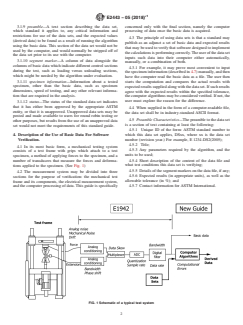
4.1 In its most basic form, a mechanical testing system
4.5.3 Any parameters required by the algorithm, and the
consists of a test frame with grips which attach to a test
units to be used;
specimen, a method of applying forces to the specimen, and a
4.5.4 Short description of the content of the data file and
number of transducers that measure the forces and deforma-
tions applied to the specimen. (See Fig. 1) what test conditions this data set is verifying;
4.5.5 Details of the segment markers on the data file, if any;
4.2 The measurement system may be divided into three
4.5.6 Expected results (in appropriate units), as well as the
sections for the purpose of verification: the mechanical test
allowable tolerance (in %); and
frame and its components, the electrical measurement system,
and the computer processing of data. This guide is specifically 4.5.7 Contact information for ASTM International.
FIG. 1 Schematic of a typical test system
ϵ1
E2443 − 05 (2018)
4.6 The preamble is initiated with the marker , 4.10.1 It is up to the Task Group or Committee responsible
and terminated by the marker . for the Standard to create and recommend data sets that will
adequately test the software for valid or invalid results.That is,
4.7 Specimen Information Characteristics:
if the software must be configured to catch certain things that
4.7.1 The specimen information section consists of a num-
make a test invalid, the data set and expected results must be
ber of rows of information essential for use by the algorithm
configured to test these validity checks.
under evaluation. Such information might, for example, in-
4.11 Expected Results:
clude the gage length of an extensometer, the dimensions of a
specimen, or the test temperature. Each row has this format: 4.11.1 The expected results are supplied along with the
basic data set and provide the correct, calculated (derived)
keyword (text), item separator, value (numeric), units (text).
results that should be produced by the software.Also included
4.7.2 It is required for ease of use that the specimen
with the expected results is a tolerance band (+ or – a certain
information section contain only essential information for the
%oftheresult)withinwhichthederiveddatamustfallinorder
calculations to be performed by the computer. Such informa-
tobeconsideredacce
...