

ASTM E3008/E3008M-16(2023)
(Classification)Standard Classification for Transportation Surface Elements-UNIFORMAT II
General Information
- Abstract
SIGNIFICANCE AND USE
4.1 This standard builds on the concepts and organizational framework established in Classification E1557. This classification describes transportation surface elements that are major components of most vehicular transportation surfaces. The elemental classification is the common thread linking activities and participants in a transportation surface project from initial planning through operations, maintenance, and disposal.
Note 1: As this classification refers solely to permanent, physical parts of any construction, two additional classifications, Classifications E2083 and E2168, need to be included when calculating construction cost. These standards provide for the inclusion of construction enabling, temporary, and risk mitigation cost figures. Procedures for reporting all these figures are described in Practices E1804 and E2514 and Classification E2516. While these three latter standards were primarily written for building construction, they are nonetheless appropriate and readily applied to other forms of construction as well.
4.2 The users of transportation surface UNIFORMAT II include:
4.2.1 Financial and Investment-Typically owners, developers, bankers, lenders, accountants, and financial managers.
4.2.2 Implementation-Primarily project managers; facilities programmers; designers, including engineers; and project controls specialists, including cost planners, estimators, schedulers, specification writers, and risk analysts.
4.2.3 Facilities Management-Comprising property portfolio managers, operating staff, and maintenance staff.
4.2.4 Others-Public officials, manufacturers, educators, students, and other project stakeholders.
4.3 Apply This Classification When Undertaking the Following Work on Transportation Surface Projects:5
4.3.1 Financing and Investing:
4.3.1.1 Structuring costs on an elemental basis for economic evaluations (Guide E1185 and Practices E917, E964, E1057, E1074, E1121, and E1804) early in the design process help...
SCOPE
1.1 This standard establishes a classification of transportation surface elements within the UNIFORMAT II family of elemental classifications. It covers the full breadth of vehicular transportation surfaces, from rural roads to multi-lane interstate highways.
1.2 UNIFORMAT II classifications have an elemental format similar to the original UNIFORMAT2 building elemental classification. However, the title UNIFORMAT II differs from the original in that it now takes into consideration a wide range of constructed entities that collectively form the built environment.
1.3 Elements, as defined here and in Classifications E1557 and E2103/E2103M, are major physical components that are common within constructed entities. Elements perform their given function(s), regardless of the design specification, construction method, or materials used.
1.4 This elemental classification serves as a consistent reference for analysis, evaluation, and monitoring during the feasibility, planning, and design stages when constructing transportation surfaces.
1.5 Using UNIFORMAT II elemental classifications ensures a consistency in the economic evaluation of construction projects over time and from project to project.
1.6 UNIFORMAT II classifications also enhance reporting at all stages of a constructed entity’s life cycle-from feasibility and planning through the preparation of working documents, construction, maintenance, rehabilitation, and disposal.
1.7 This classification is unsuitable for process applications or for preparing trade estimates.
1.8 The values stated in either SI units or inch-pound units are to be regarded separately as standard. The values stated in each system are not necessarily exact equivalents; therefore, to ensure conformance with the standard, each system shall be used independently of the other, and values from the two systems shall not be combined.
1.9 This standard does not purport to address al...
- Status
- Published
- Publication Date
- 30-Apr-2023
- Technical Committee
- E06 - Performance of Buildings
- Drafting Committee
- E06.81 - Building Economics
Overview
ASTM E3008/E3008M-16(2023): Standard Classification for Transportation Surface Elements-UNIFORMAT II provides a comprehensive and systematic method for classifying transportation surface elements. Developed by ASTM International, this standard focuses on the elemental classification of permanent, physical parts of vehicular transportation surfaces such as rural roads and multi-lane interstate highways. Building upon the foundation set by ASTM E1557, it delivers a consistent approach for categorizing elements during planning, design, construction, operation, maintenance, and disposal stages of transportation surface projects.
The UNIFORMAT II elemental classification ensures reliable organization and reporting of cost, scope, and project information throughout the life cycle of transportation infrastructure. This standard is vital for financial analysis, project management, cost estimation, and facilities management within the transportation construction industry.
Key Topics
- Elemental Classification Framework: The standard classifies transportation surfaces into hierarchical levels: Major Group Elements, Group Elements, and Individual Elements. Examples include sub-grade, travelled way, services, protection, and sitework.
- Consistency in Project Evaluation: By using defined elemental categories, stakeholders achieve uniformity in economic evaluations and reporting from project to project.
- Life Cycle Management: The classification aids in monitoring, maintaining, and making decisions through all stages, from feasibility studies to operation and eventual decommissioning.
- Permanent, Physical Components Only: The classification is strictly for permanent transportation surface elements, excluding temporary works or risk mitigation costs, which are addressed by related standards.
- Units of Measure: The standard specifies both SI and inch-pound units for measuring element quantities, supporting international and local applications.
- Stakeholder Collaboration: Financial managers, project managers, engineers, designers, facilities operators, and public officials all use this common language for smoother communication and clearer decision-making.
Applications
ASTM E3008/E3008M-16(2023) has wide-ranging practical applications across the transportation infrastructure sector, including:
- Project Financing and Investment: Enables clear structuring of costs for economic analysis early in the design phase, improving investment decisions and risk management.
- Cost Planning and Estimating: Serves as a basis for preparing budgets, developing elemental cost plans, and establishing targets for design-to-cost during planning, design, and construction.
- Scheduling and Controls: Supports the development of master schedules and project milestones, measured and controlled by elemental progress.
- Value Engineering: Functions as a checklist and reference in value engineering to ensure cost-effective alternatives are considered for every significant element.
- Design and BIM Integration: Facilitates standard coding and referencing within computer-aided design tools and building information modeling (BIM) systems.
- Facilities and Asset Management: Guides the structured recording of condition assessments, maintenance plans, and capital renewal strategies.
- Regulatory and Public Stakeholders: Assists public officials, educators, and other stakeholders in understanding, communicating, and managing transportation asset data.
Related Standards
Several ASTM standards and guides complement ASTM E3008/E3008M-16(2023) to provide a full spectrum of coverage for transportation surface project management:
- ASTM E1557: Classification for Building Elements and Related Sitework-UNIFORMAT II
- ASTM E2083 & ASTM E2168: Classifications for temporary and risk mitigation costs in construction estimating
- ASTM E2514 & ASTM E2516: Practices for cost estimate presentation and cost estimate classification systems
- ASTM E917, E964, E1057, E1074, E1121, E1185, E1804, E1946, and E2691: Standards for economic evaluation, cost analysis, risk assessment, and productivity measurement in construction projects
By integrating UNIFORMAT II classification with these and other related documents, organizations achieve greater accuracy, consistency, and efficiency in the management and delivery of transportation infrastructure projects.
Keywords: transportation surface elements, UNIFORMAT II, ASTM E3008, cost planning, elemental classification, road construction, project management, infrastructure life cycle, transportation cost estimation, value engineering, civil construction standards, infrastructure asset management
Relations
- Effective Date
- 01-Apr-2020
- Effective Date
- 01-Apr-2020
- Effective Date
- 01-Apr-2020
- Effective Date
- 01-Apr-2020
- Effective Date
- 01-Apr-2020
- Effective Date
- 01-Apr-2020
- Effective Date
- 01-Apr-2020
- Effective Date
- 01-Apr-2020
- Effective Date
- 01-Oct-2019
- Effective Date
- 01-Jul-2019
- Refers
ASTM E917-17 - Standard Practice for Measuring Life-Cycle Costs of Buildings and Building Systems - Effective Date
- 01-Sep-2017
- Effective Date
- 01-May-2016
- Effective Date
- 01-Mar-2016
- Effective Date
- 01-Oct-2015
- Effective Date
- 01-Oct-2015
Get Certified
Connect with accredited certification bodies for this standard

Zavod za gradbeništvo Slovenije (ZAG) - Inšpekcija
ZAG inspection body for construction products, structures, and materials.
Sponsored listings
Frequently Asked Questions
ASTM E3008/E3008M-16(2023) is a standard published by ASTM International. Its full title is "Standard Classification for Transportation Surface Elements-UNIFORMAT II". This standard covers: SIGNIFICANCE AND USE 4.1 This standard builds on the concepts and organizational framework established in Classification E1557. This classification describes transportation surface elements that are major components of most vehicular transportation surfaces. The elemental classification is the common thread linking activities and participants in a transportation surface project from initial planning through operations, maintenance, and disposal. Note 1: As this classification refers solely to permanent, physical parts of any construction, two additional classifications, Classifications E2083 and E2168, need to be included when calculating construction cost. These standards provide for the inclusion of construction enabling, temporary, and risk mitigation cost figures. Procedures for reporting all these figures are described in Practices E1804 and E2514 and Classification E2516. While these three latter standards were primarily written for building construction, they are nonetheless appropriate and readily applied to other forms of construction as well. 4.2 The users of transportation surface UNIFORMAT II include: 4.2.1 Financial and Investment-Typically owners, developers, bankers, lenders, accountants, and financial managers. 4.2.2 Implementation-Primarily project managers; facilities programmers; designers, including engineers; and project controls specialists, including cost planners, estimators, schedulers, specification writers, and risk analysts. 4.2.3 Facilities Management-Comprising property portfolio managers, operating staff, and maintenance staff. 4.2.4 Others-Public officials, manufacturers, educators, students, and other project stakeholders. 4.3 Apply This Classification When Undertaking the Following Work on Transportation Surface Projects:5 4.3.1 Financing and Investing: 4.3.1.1 Structuring costs on an elemental basis for economic evaluations (Guide E1185 and Practices E917, E964, E1057, E1074, E1121, and E1804) early in the design process help... SCOPE 1.1 This standard establishes a classification of transportation surface elements within the UNIFORMAT II family of elemental classifications. It covers the full breadth of vehicular transportation surfaces, from rural roads to multi-lane interstate highways. 1.2 UNIFORMAT II classifications have an elemental format similar to the original UNIFORMAT2 building elemental classification. However, the title UNIFORMAT II differs from the original in that it now takes into consideration a wide range of constructed entities that collectively form the built environment. 1.3 Elements, as defined here and in Classifications E1557 and E2103/E2103M, are major physical components that are common within constructed entities. Elements perform their given function(s), regardless of the design specification, construction method, or materials used. 1.4 This elemental classification serves as a consistent reference for analysis, evaluation, and monitoring during the feasibility, planning, and design stages when constructing transportation surfaces. 1.5 Using UNIFORMAT II elemental classifications ensures a consistency in the economic evaluation of construction projects over time and from project to project. 1.6 UNIFORMAT II classifications also enhance reporting at all stages of a constructed entity’s life cycle-from feasibility and planning through the preparation of working documents, construction, maintenance, rehabilitation, and disposal. 1.7 This classification is unsuitable for process applications or for preparing trade estimates. 1.8 The values stated in either SI units or inch-pound units are to be regarded separately as standard. The values stated in each system are not necessarily exact equivalents; therefore, to ensure conformance with the standard, each system shall be used independently of the other, and values from the two systems shall not be combined. 1.9 This standard does not purport to address al...
SIGNIFICANCE AND USE 4.1 This standard builds on the concepts and organizational framework established in Classification E1557. This classification describes transportation surface elements that are major components of most vehicular transportation surfaces. The elemental classification is the common thread linking activities and participants in a transportation surface project from initial planning through operations, maintenance, and disposal. Note 1: As this classification refers solely to permanent, physical parts of any construction, two additional classifications, Classifications E2083 and E2168, need to be included when calculating construction cost. These standards provide for the inclusion of construction enabling, temporary, and risk mitigation cost figures. Procedures for reporting all these figures are described in Practices E1804 and E2514 and Classification E2516. While these three latter standards were primarily written for building construction, they are nonetheless appropriate and readily applied to other forms of construction as well. 4.2 The users of transportation surface UNIFORMAT II include: 4.2.1 Financial and Investment-Typically owners, developers, bankers, lenders, accountants, and financial managers. 4.2.2 Implementation-Primarily project managers; facilities programmers; designers, including engineers; and project controls specialists, including cost planners, estimators, schedulers, specification writers, and risk analysts. 4.2.3 Facilities Management-Comprising property portfolio managers, operating staff, and maintenance staff. 4.2.4 Others-Public officials, manufacturers, educators, students, and other project stakeholders. 4.3 Apply This Classification When Undertaking the Following Work on Transportation Surface Projects:5 4.3.1 Financing and Investing: 4.3.1.1 Structuring costs on an elemental basis for economic evaluations (Guide E1185 and Practices E917, E964, E1057, E1074, E1121, and E1804) early in the design process help... SCOPE 1.1 This standard establishes a classification of transportation surface elements within the UNIFORMAT II family of elemental classifications. It covers the full breadth of vehicular transportation surfaces, from rural roads to multi-lane interstate highways. 1.2 UNIFORMAT II classifications have an elemental format similar to the original UNIFORMAT2 building elemental classification. However, the title UNIFORMAT II differs from the original in that it now takes into consideration a wide range of constructed entities that collectively form the built environment. 1.3 Elements, as defined here and in Classifications E1557 and E2103/E2103M, are major physical components that are common within constructed entities. Elements perform their given function(s), regardless of the design specification, construction method, or materials used. 1.4 This elemental classification serves as a consistent reference for analysis, evaluation, and monitoring during the feasibility, planning, and design stages when constructing transportation surfaces. 1.5 Using UNIFORMAT II elemental classifications ensures a consistency in the economic evaluation of construction projects over time and from project to project. 1.6 UNIFORMAT II classifications also enhance reporting at all stages of a constructed entity’s life cycle-from feasibility and planning through the preparation of working documents, construction, maintenance, rehabilitation, and disposal. 1.7 This classification is unsuitable for process applications or for preparing trade estimates. 1.8 The values stated in either SI units or inch-pound units are to be regarded separately as standard. The values stated in each system are not necessarily exact equivalents; therefore, to ensure conformance with the standard, each system shall be used independently of the other, and values from the two systems shall not be combined. 1.9 This standard does not purport to address al...
ASTM E3008/E3008M-16(2023) is classified under the following ICS (International Classification for Standards) categories: 93.080.01 - Road engineering in general. The ICS classification helps identify the subject area and facilitates finding related standards.
ASTM E3008/E3008M-16(2023) has the following relationships with other standards: It is inter standard links to ASTM E964-15(2020)e1, ASTM E1057-15(2020)e1, ASTM E1074-15(2020)e1, ASTM E1121-15(2020)e1, ASTM E1185-15(2020)e1, ASTM E1369-15(2020)e1, ASTM E2691-20, ASTM E1557-09(2020)e1, ASTM E2516-11(2019), ASTM E2103/E2103M-19, ASTM E917-17, ASTM E2083-05(2016), ASTM E2691-16, ASTM E1185-15, ASTM E1557-09(2015). Understanding these relationships helps ensure you are using the most current and applicable version of the standard.
ASTM E3008/E3008M-16(2023) is available in PDF format for immediate download after purchase. The document can be added to your cart and obtained through the secure checkout process. Digital delivery ensures instant access to the complete standard document.
Standards Content (Sample)
This international standard was developed in accordance with internationally recognized principles on standardization established in the Decision on Principles for the
Development of International Standards, Guides and Recommendations issued by the World Trade Organization Technical Barriers to Trade (TBT) Committee.
Designation: E3008/E3008M − 16 (Reapproved 2023)
Standard Classification for
Transportation Surface Elements—UNIFORMAT II
This standard is issued under the fixed designation E3008/E3008M; the number immediately following the designation indicates the year
of original adoption or, in the case of revision, the year of last revision. A number in parentheses indicates the year of last reapproval.
A superscript epsilon (´) indicates an editorial change since the last revision or reapproval.
1. Scope each system are not necessarily exact equivalents; therefore, to
ensure conformance with the standard, each system shall be
1.1 This standard establishes a classification of transporta-
used independently of the other, and values from the two
tion surface elements within the UNIFORMAT II family of
systems shall not be combined.
elemental classifications. It covers the full breadth of vehicular
1.9 This standard does not purport to address all of the
transportation surfaces, from rural roads to multi-lane interstate
safety concerns, if any, associated with its use. It is the
highways.
responsibility of the user of this standard to establish appro-
1.2 UNIFORMAT II classifications have an elemental for-
priate safety, health, and environmental practices and deter-
mat similar to the original UNIFORMAT building elemental
mine the applicability of regulatory limitations prior to use.
classification. However, the title UNIFORMAT II differs from
1.10 This international standard was developed in accor-
the original in that it now takes into consideration a wide range
dance with internationally recognized principles on standard-
of constructed entities that collectively form the built environ-
ization established in the Decision on Principles for the
ment.
Development of International Standards, Guides and Recom-
1.3 Elements, as defined here and in Classifications E1557
mendations issued by the World Trade Organization Technical
and E2103/E2103M, are major physical components that are
Barriers to Trade (TBT) Committee.
common within constructed entities. Elements perform their
given function(s), regardless of the design specification, con-
2. Referenced Documents
struction method, or materials used.
2.1 ASTM Standards:
1.4 This elemental classification serves as a consistent
E631 Terminology of Building Constructions
reference for analysis, evaluation, and monitoring during the
E833 Terminology of Building Economics
feasibility, planning, and design stages when constructing
E917 Practice for Measuring Life-Cycle Costs of Buildings
transportation surfaces.
and Building Systems
E964 Practice for Measuring Benefit-to-Cost and Savings-
1.5 Using UNIFORMAT II elemental classifications ensures
to-Investment Ratios for Buildings and Building Systems
a consistency in the economic evaluation of construction
E1057 Practice for Measuring Internal Rate of Return and
projects over time and from project to project.
Adjusted Internal Rate of Return for Investments in
1.6 UNIFORMAT II classifications also enhance reporting
Buildings and Building Systems
at all stages of a constructed entity’s life cycle—from feasibil-
E1074 Practice for Measuring Net Benefits and Net Savings
ity and planning through the preparation of working
for Investments in Buildings and Building Systems
documents, construction, maintenance, rehabilitation, and dis-
E1121 Practice for Measuring Payback for Investments in
posal.
Buildings and Building Systems
1.7 This classification is unsuitable for process applications
E1185 Guide for Selecting Economic Methods for Evaluat-
or for preparing trade estimates.
ing Investments in Buildings and Building Systems
E1369 Guide for Selecting Techniques for Treating Uncer-
1.8 The values stated in either SI units or inch-pound units
tainty and Risk in the Economic Evaluation of Buildings
are to be regarded separately as standard. The values stated in
and Building Systems
E1699 Practice for Performing Value Engineering (VE)/
1 Value Analysis (VA) of Projects, Products and Processes
This classification is under the jurisdiction of ASTM Committee E06 on
Performance of Buildings and is the direct responsibility of Subcommittee E06.81
on Building Economics.
Current edition approved May 1, 2023. Published May 2023. Originally
approved in 2016. Last previous edition approved in 2016 as E3008/ For referenced ASTM standards, visit the ASTM website, www.astm.org, or
ɛ1
E3008M – 2016 . DOI: 10.1520/E3008_E3008M-16R23. contact ASTM Customer Service at service@astm.org. For Annual Book of ASTM
The original UNIFORMAT classification was developed jointly by the General Standards volume information, refer to the standard’s Document Summary page on
Services Administration (GSA) and the American Institute of Architects (AIA). the ASTM website.
Copyright © ASTM International, 100 Barr Harbor Drive, PO Box C700, West Conshohocken, PA 19428-2959. United States
E3008/E3008M − 16 (2023)
E1804 Practice for Performing and Reporting Cost Analysis cation describes transportation surface elements that are major
During the Design Phase of a Project components of most vehicular transportation surfaces. The
E1946 Practice for Measuring Cost Risk of Buildings and elemental classification is the common thread linking activities
Building Systems and Other Constructed Projects and participants in a transportation surface project from initial
E2013 Practice for Developing Functions, Constructing planning through operations, maintenance, and disposal.
NOTE 1—As this classification refers solely to permanent, physical parts
FAST Diagrams, and Performing Function Analysis Dur-
of any construction, two additional classifications, Classifications E2083
ing Value Engineering (VE)/Value Analysis (VA) Study
and E2168, need to be included when calculating construction cost. These
E2506 Guide for Developing a Cost-Effective Risk Mitiga-
standards provide for the inclusion of construction enabling, temporary,
tion Plan for New and Existing Constructed Facilities
and risk mitigation cost figures. Procedures for reporting all these figures
E2691 Practice for Job Productivity Measurement are described in Practices E1804 and E2514 and Classification E2516.
While these three latter standards were primarily written for building
2.2 ASTM UNIFORMAT II Classification Standards Fam-
construction, they are nonetheless appropriate and readily applied to other
ily:
forms of construction as well.
E1557 Classification for Building Elements and Related
4.2 The users of transportation surface UNIFORMAT II
Sitework—UNIFORMAT II
include:
E2083 Classification for Building Construction Field
4.2.1 Financial and Investment—Typically owners,
Requirements, and Office Overhead & Profit
developers, bankers, lenders, accountants, and financial man-
E2103/E2103M Classification for Bridge Elements—
agers.
UNIFORMAT II
4.2.2 Implementation—Primarily project managers; facili-
E2168 Classification for Allowance, Contingency, and Re-
ties programmers; designers, including engineers; and project
serve Sums in Building Construction Estimating
controls specialists, including cost planners, estimators,
E2514 Practice for Presentation Format of Elemental Cost
schedulers, specification writers, and risk analysts.
Estimates, Summaries, and Analyses
4.2.3 Facilities Management—Comprising property portfo-
E2516 Classification for Cost Estimate Classification Sys-
lio managers, operating staff, and maintenance staff.
tem
4.2.4 Others—Public officials, manufacturers, educators,
2.3 ASTM Adjunct:
students, and other project stakeholders.
Discount Factor Tables - Adjunct to E917 Practice for
Measuring Life-Cycle Costs of Buildings and Building
4.3 Apply This Classification When Undertaking the Fol-
Systems - Includes Excel and PDF Files
lowing Work on Transportation Surface Projects:
4.3.1 Financing and Investing:
3. Terminology
4.3.1.1 Structuring costs on an elemental basis for economic
3.1 Definitions—For definitions of general terms related to
evaluations (Guide E1185 and Practices E917, E964, E1057,
building construction used in this classification, refer to Ter-
E1074, E1121, and E1804) early in the design process helps
minology E631, and for general terms related to building
reduce the cost of early financial analysis and can contribute to
economics, refer to Terminology E833.
substantial design and operational savings before decisions
3.2 Definitions of Terms Specific to This Standard:
have been made that limit options for potential savings.
3.2.1 element, n—in construction planning, design,
4.3.2 Implementing:
specification, estimating, and cost analysis, is a significant
4.3.2.1 Cost Modeling, Cost Planning, Estimating and Con-
component part of the whole that performs a specific function,
trolling Project Time and Cost During Planning, Design, and
or functions, regardless of design, specification, or construction
Construction—Use the transportation surface UNIFORMAT II
method.
classification to prepare budgets and to establish elemental cost
3.2.2 group element, n—in construction planning, design,
plans before design begins. Project managers and project
specification, estimating, and cost analysis, is a significant controls specialists use these cost plans against which to
component part of the whole that includes relevant elements
measure and control project cost, and quality, and to set
which, as a group, perform major specific function, or design-to-cost targets.
functions, regardless of design, specification, or construction
4.3.2.2 Conducting Value Engineering Workshops—
method. Conducting value engineering workshops (Practices E1699 and
E2013). Use this classification as a checklist to ensure that
3.2.3 major group element, n—in construction planning,
alternatives for all elements of significant cost in the transpor-
design, specification, estimating, and cost analysis, is a very
tation surface project are analyzed in the creativity phase of the
significant component part of the whole that includes relevant
group elements which, as a group, perform major specific
function, or functions, regardless of design, specification, or
For a more comprehensive discussion of the uses of UNIFORMAT II, see
construction method.
Bowen, Charette, and Marshall, UNIFORMAT II—A Recommended Classification
for Building Elements and Related Sitework, National Institute of Standards and
4. Significance and Use
Technology, Special Publication 841, Gaithersburg, MD, 1992; Charette and
Marshall, UNIFORMAT II Elemental Classification for Building Specifications,
4.1 This standard builds on the concepts and organizational
Cost Estimating, and Cost Analysis, National Institute of Standards and Technology,
framework established in Classification E1557. This classifi-
NISTIR 6389, Gaithersburg, MD, 1999; and Kasi and Chapman, Benefits of Using
ASTM Building Economics Standards for the Design, Construction, and Operation
Available from ASTM International Headquarters. Order Adjunct No. of Constructed Facilities, National Institute of Standards and Technology, Special
ADJE091717-EA. Original adjunct produced in 1984. Adjunct last revised in 2017. Publication 1098, Gaithersburg, MD, 2012.
E3008/E3008M − 16 (2023)
job plan. Also, use the elemental cost data to expedite the base of standard details. This is particularly appropriate to
development of cost models for transportation surface systems. design modeling and building information modeling (BIM)
4.3.2.3 Developing Initial Project Master Schedules—Since applications.
projects are essentially built element by element, UNIFOR-
4.3.3 Managing Facilities:
MAT II classifications are an appropriate basis for preparing
4.3.3.1 Recording and writing property condition assess-
construction schedules at the start of the design process.
ment reports in a structured way, using UNIFORMAT II
Project managers and project controls specialists use these time
classifications, provides for a consistent, accessible, and
plans against which to measure and control project time
searchable database of real property inventory.
(Practice E2691), and to set milestone target dates.
4.3.4 Other Activities:
4.3.2.4 Performing Risk Analyses—Simulation (Guides
4.3.4.1 Structuring cost manuals and recording
E1369 and E2506) is one technique for developing probability
construction, operating, and maintenance costs in a computer
distributions of transportation surface costs when evaluating
database. Having a cost manual or computer database in an
the economic risk in undertaking a transportation surface
elemental format assists the preparation of an economic
project. Use individual elements and group elements in this
analysis early in the design stage and at a reasonable cost.
classification for developing probability distributions of el-
emental costs. From these distributions, build up probability
5. Basis of Classification
distributions of total costs to establish project contingencies
5.1 The framework in Fig. 1 shows the various constructed
(Practice E1946 and Classification E2168) or to serve as inputs
entities that collectively are used to create the built environ-
to an economic analysis.
ment. Each entity is treated as a module. Appropriate modules
4.3.2.5 Structuring Preliminary Project Descriptions Dur-
used together will effectively describe any planned or built
ing the Conceptual Design Phase—This classification facili-
development. This standard classification describes exclusively
tates the description of the scope of the project in a clear,
the elements that make up one of those constructed entities,
concise, and logical sequence for presentation to the client; it
transportation surface, shown as the shaded block under the
provides the basis for the preparation of more detailed elemen-
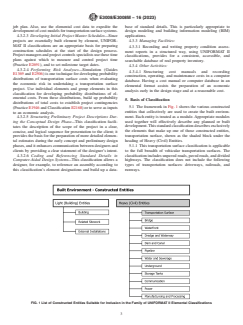
heading of Heavy (Civil) Entities.
tal estimates during the early concept and preliminary design
phases, and it enhances communication between designers and 5.1.1 This transportation surface classification is applicable
clients by providing a clear statement of the designer’s intent. to the full breadth of vehicular transportation surfaces. The
4.3.2.6 Coding and Referencing Standard Details in classification includes unpaved roads, paved roads, and divided
Computer-Aided Design Systems—This classification allows a highways. The classification does not include the following
designer, for example, to reference an assembly according to types of transportation surfaces: driveways, railroads, and
this classification’s element designations and build up a data- runways.
FIG. 1 List of Constructed Entities Suitable for Inclusion in the Family of UNIFORMAT II Elemental Classifications
E3008/E3008M − 16 (2023)
5.2 The classification is consistent with typical costing classification does not include utilities—pipelines (water, natu-
practices used at the conceptual design phase. ral gas, and petroleum) and transmission lines (electrical,
communication, and video)—sharing the same right of way as
5.3 Each element has a significant impact on the cost, and it
the transportation system.
usually occurs frequently.
5.9 Elements, as used and defined in UNIFORMAT II, will
5.4 Each element performs a specific function.
ideally display the following additional attributes:
5.5 Table 1 divides the classification of transportation sur-
5.9.1 Capable of being defined precisely;
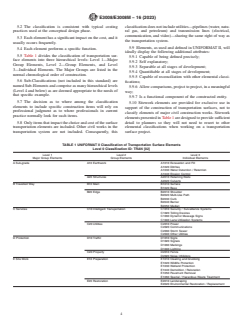
face elements into three hierarchical levels: Level 1—Major
5.9.2 Self explanatory;
Group Elements, Level 2—Group Elements, and Level
5.9.3 Separable at all stages of development;
3—Individual Elements. The Major Groups are listed in the
5.9.4 Quantifiable at all stages of development;
normal chronological order of construction.
5.9.5 Capable of reconciliation with other elemental classi-
5.6 Sub-Classifications (not included in this standard) are
fications;
named Sub-Elements and comprise as many hierarchical levels
5.9.6 Allow comparisons, project to project, in a meaningful
(Level 4 and below) as are deemed appropriate to the needs of
way;
that specific example.
5.9.7 Is a functional component of the constructed entity.
5.7 The decision as to where among the classification
5.10 Sitework elements are provided for exclusive use in
elements to include specific construction items will rely on
support of the construction of transportation surfaces, not to
professional judgment as to where professionals in current
classify elements of major civil construction works. Sitework
practice normally look for such items.
elements presented in Table 1 are designed to provide sufficient
5.8 Only items that impact the choice and cost of the surface detail to planners so they will not need to resort to other
transportation elements are included. Other civil works in the elemental classifications when working on a transportation
transportation system are not included. Consequently, this surface project.
TABLE 1 UNIFORMAT II Classification of Transportation Surface Elements
Level 0 Classification ID: TRAN [02]
Level 1 Level 2 Level 3
Major Group Elements Group Elements Individual Elements
A Sub-grade A10 Earthwork A1010 Excavation and Fill
A1020 Ditches
A1030 Water Detention / Retention
A1040 Erosion Control
A20 Structures A2010 Retaining Walls
A2020 Culverts
B Travelled Way B10 Main B1010 Surface
B1020 Base
B20 Edge B2010 Shoulder
B2020 Multi-Use Path
B2030 Curb
B2040 Barrier
B2050 Median
C Services C10 Intelligent Transportation C1010 Security / Surveillance Systems
C1020 Tolling Devices
C1030 Dynamic Message Signs
C1040 Lane Utilization Systems
C20 Utilities C2010 Power
C2020 Communications
C2030 Storm Sewer
C2040 Other Utilities
D Protection D10 Traffic D1010 Signs
D1020 Signals
D1030 Markings
D1040 Lighting
C20 Property D2010 Fence
D2020 Noise Inhibitors
E Site Work E10 Preparation E1010 Clearing and Grubbing
E1020 Wildlife Protection
E1030 Wetland Protection
E1040 Demolition / Relocation
E1050 Pavement Removal
E1060 Special / Hazardous Waste Treatment
E20 Restoration E2010 Landscaping
E2020 Environmental Restoration / Replacement
E3008/E3008M − 16 (2023)
6. Description of UNIFORMAT II Transportation measure are important to all users of elemental classifications.
Surface Elements and Units of Measure Units of measure are of prime importance in the elemental cost
management process. Both SI and inch-pound units are re-
6.1 Elements and Functions—Table 2 provides, for each
ported. SI units are reported first followed by inch-pound units
Level 3 Individual Ele
...