

ASTM A1095-15(2023)
(Specification)Standard Specification for High-Silicon Molybdenum Ferritic Iron Castings
General Information
- Abstract
ABSTRACT
This specification covers general requirements and corresponding test methods for castings made of high-silicon molybdenum ferritic iron (SiMo). The requirements are prescribed for castings with microstructures of spheroidal graphite (SG) SiMo iron, compacted graphite (CG) SiMo iron, and mixed graphite or medium-nodularity graphite (MG) SiMo iron. MG iron microstructure is comprised of a mixture of spheroidal and compacted graphite shapes.
SCOPE
1.1 This specification covers castings made of high-silicon molybdenum ferritic iron, commonly known as SiMo. This specification includes castings with microstructures of spheroidal graphite (SG) SiMo iron, compacted graphite (CG) SiMo iron, and mixed graphite or medium-nodularity graphite (MG) SiMo iron. MG iron microstructure comprises a mixture of spheroidal and compacted graphite shapes. This standard specifies the condition, chemical composition, microstructure, and other technical requirements of three grades of ferritic cast irons, specified as SG SiMo, MG SiMo, and CG SiMo.
1.2 No precise quantitative relationship can be stated between the properties of iron in the various locations of the same casting or between the properties of castings and those of a test specimen cast from the same iron.
1.3 The values stated in SI units are to be regarded as standard. All chemical compositions are in mass percentage. No other units of measurement are included in this standard.
1.4 This standard does not purport to address all of the safety concerns, if any, associated with its use. It is the responsibility of the user of this standard to establish appropriate safety, health, and environmental practices and determine the applicability of regulatory limitations prior to use.
1.5 This international standard was developed in accordance with internationally recognized principles on standardization established in the Decision on Principles for the Development of International Standards, Guides and Recommendations issued by the World Trade Organization Technical Barriers to Trade (TBT) Committee.
- Status
- Published
- Publication Date
- 30-Sep-2023
- Technical Committee
- A04 - Iron Castings
- Drafting Committee
- A04.02 - Malleable and Ductile Iron Castings
Overview
ASTM A1095-15(2023): Standard Specification for High-Silicon Molybdenum Ferritic Iron Castings sets out the requirements for castings produced from high-silicon molybdenum ferritic iron, commonly known as SiMo iron. Developed by ASTM International, this specification applies to castings featuring microstructures of spheroidal graphite (SG), compacted graphite (CG), and mixed graphite or medium-nodularity graphite (MG) SiMo iron. These microstructures are critical in achieving a balance of mechanical properties, thermal stability, and resistance to oxidation at elevated temperatures, making SiMo iron a preferred material for demanding industrial applications.
Key Topics
Grades and Microstructures: The standard covers three grades:
- SG SiMo (spheroidal graphite)
- MG SiMo (mixed/medium-nodularity graphite)
- CG SiMo (compacted graphite)
The microstructure is predominantly ferritic and must meet strict requirements for graphite distribution and matrix content.
Chemical Composition: Defines precise ranges for elements such as carbon, silicon, and molybdenum, with controlled additions of other elements (e.g., titanium, chromium, magnesium). The control of carbon equivalent is critical for uniform graphite formation and minimization of defects such as shrinkage and graphite flotation.
Mechanical Properties: Specifies minimum values for tensile strength, yield strength, elongation, and Brinell hardness at room temperature, with additional reference values for properties at elevated temperatures. Properties are determined using standardized test methods and specimen types.
Testing and Quality Assurance: Describes requirements for test coupons, inspection, and potential additional tests like radiographic or magnetic particle examination if agreed upon by purchaser and manufacturer.
Workmanship and Marking: Ensures high standards for surface quality, removal of casting artifacts, and appropriate marking for traceability.
Safety and Compliance: The standard emphasizes the importance of appropriate safety, health, and environmental practices in production and use.
Applications
High-silicon molybdenum ferritic iron castings are extensively used in high-temperature, high-stress, and oxidation-prone environments. Key applications include:
- Automotive Industry: Especially for exhaust components and manifolds where performance is required at temperatures up to 800°C.
- Industrial Equipment: Used in the production of components subjected to thermal cycling and corrosive atmospheres.
- Paper Mill Dryer Rolls: Where long-term resistance to high temperatures and moisture is required.
- General Industrial Castings: Suitable for machinery parts that demand a balance of strength, ductility, and oxidation resistance.
The unique properties of SiMo iron - including superior heat resistance, structure stability, and controlled graphite microstructure - make it suitable for products exposed to aggressive service conditions.
Related Standards
ASTM A1095-15(2023) works in conjunction with several key international standards that address aspects of iron casting manufacture, testing, and quality:
- ASTM A247: Test Method for Evaluating the Microstructure of Graphite in Iron Castings
- ASTM A395/A395M: Specification for Ferritic Ductile Iron Pressure-Retaining Castings for Use at Elevated Temperatures
- ASTM A536: Specification for Ductile Iron Castings
- ASTM A842: Specification for Compacted Graphite Iron Castings
- ASTM E8/E8M: Test Methods for Tension Testing of Metallic Materials
- ASTM E10: Test Method for Brinell Hardness of Metallic Materials
- SAE J434: Automotive Ductile (Nodular) Iron Castings
- FED-STD-123 and MIL-STD-129: Marking requirements for shipments
These standards collectively ensure the reliability, performance, and traceability of high-silicon molybdenum ferritic iron castings in critical applications.
Keywords: high-silicon molybdenum ferritic iron, SiMo iron, ASTM A1095-15, spheroidal graphite, compacted graphite, mixed graphite, high-temperature castings, oxidation resistance, automotive exhaust, industrial cast iron, standard specification, microstructure, mechanical properties.
Relations
- Replaces
ASTM A1095-15(2019) - Standard Specification for High-Silicon Molybdenum Ferritic Iron Castings - Effective Date
- 01-Oct-2023
- Effective Date
- 01-Apr-2024
- Effective Date
- 01-Jan-2024
- Effective Date
- 01-May-2022
- Refers
ASTM A247-19 - Standard Test Method for Evaluating the Microstructure of Graphite in Iron Castings - Effective Date
- 01-Mar-2019
Get Certified
Connect with accredited certification bodies for this standard

Element Materials Technology
Materials testing and product certification.

Inštitut za kovinske materiale in tehnologije
Institute of Metals and Technology. Materials testing, metallurgical analysis, NDT.
Sponsored listings
Frequently Asked Questions
ASTM A1095-15(2023) is a technical specification published by ASTM International. Its full title is "Standard Specification for High-Silicon Molybdenum Ferritic Iron Castings". This standard covers: ABSTRACT This specification covers general requirements and corresponding test methods for castings made of high-silicon molybdenum ferritic iron (SiMo). The requirements are prescribed for castings with microstructures of spheroidal graphite (SG) SiMo iron, compacted graphite (CG) SiMo iron, and mixed graphite or medium-nodularity graphite (MG) SiMo iron. MG iron microstructure is comprised of a mixture of spheroidal and compacted graphite shapes. SCOPE 1.1 This specification covers castings made of high-silicon molybdenum ferritic iron, commonly known as SiMo. This specification includes castings with microstructures of spheroidal graphite (SG) SiMo iron, compacted graphite (CG) SiMo iron, and mixed graphite or medium-nodularity graphite (MG) SiMo iron. MG iron microstructure comprises a mixture of spheroidal and compacted graphite shapes. This standard specifies the condition, chemical composition, microstructure, and other technical requirements of three grades of ferritic cast irons, specified as SG SiMo, MG SiMo, and CG SiMo. 1.2 No precise quantitative relationship can be stated between the properties of iron in the various locations of the same casting or between the properties of castings and those of a test specimen cast from the same iron. 1.3 The values stated in SI units are to be regarded as standard. All chemical compositions are in mass percentage. No other units of measurement are included in this standard. 1.4 This standard does not purport to address all of the safety concerns, if any, associated with its use. It is the responsibility of the user of this standard to establish appropriate safety, health, and environmental practices and determine the applicability of regulatory limitations prior to use. 1.5 This international standard was developed in accordance with internationally recognized principles on standardization established in the Decision on Principles for the Development of International Standards, Guides and Recommendations issued by the World Trade Organization Technical Barriers to Trade (TBT) Committee.
ABSTRACT This specification covers general requirements and corresponding test methods for castings made of high-silicon molybdenum ferritic iron (SiMo). The requirements are prescribed for castings with microstructures of spheroidal graphite (SG) SiMo iron, compacted graphite (CG) SiMo iron, and mixed graphite or medium-nodularity graphite (MG) SiMo iron. MG iron microstructure is comprised of a mixture of spheroidal and compacted graphite shapes. SCOPE 1.1 This specification covers castings made of high-silicon molybdenum ferritic iron, commonly known as SiMo. This specification includes castings with microstructures of spheroidal graphite (SG) SiMo iron, compacted graphite (CG) SiMo iron, and mixed graphite or medium-nodularity graphite (MG) SiMo iron. MG iron microstructure comprises a mixture of spheroidal and compacted graphite shapes. This standard specifies the condition, chemical composition, microstructure, and other technical requirements of three grades of ferritic cast irons, specified as SG SiMo, MG SiMo, and CG SiMo. 1.2 No precise quantitative relationship can be stated between the properties of iron in the various locations of the same casting or between the properties of castings and those of a test specimen cast from the same iron. 1.3 The values stated in SI units are to be regarded as standard. All chemical compositions are in mass percentage. No other units of measurement are included in this standard. 1.4 This standard does not purport to address all of the safety concerns, if any, associated with its use. It is the responsibility of the user of this standard to establish appropriate safety, health, and environmental practices and determine the applicability of regulatory limitations prior to use. 1.5 This international standard was developed in accordance with internationally recognized principles on standardization established in the Decision on Principles for the Development of International Standards, Guides and Recommendations issued by the World Trade Organization Technical Barriers to Trade (TBT) Committee.
ASTM A1095-15(2023) is classified under the following ICS (International Classification for Standards) categories: 77.080.10 - Irons. The ICS classification helps identify the subject area and facilitates finding related standards.
ASTM A1095-15(2023) has the following relationships with other standards: It is inter standard links to ASTM A1095-15(2019), ASTM A247-24, ASTM E8/E8M-24, ASTM E8/E8M-22, ASTM A247-19. Understanding these relationships helps ensure you are using the most current and applicable version of the standard.
ASTM A1095-15(2023) is available in PDF format for immediate download after purchase. The document can be added to your cart and obtained through the secure checkout process. Digital delivery ensures instant access to the complete standard document.
Standards Content (Sample)
This international standard was developed in accordance with internationally recognized principles on standardization established in the Decision on Principles for the
Development of International Standards, Guides and Recommendations issued by the World Trade Organization Technical Barriers to Trade (TBT) Committee.
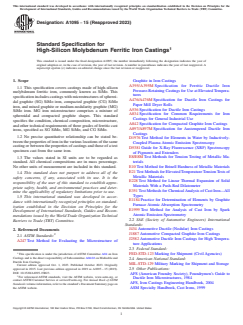
Designation: A1095 − 15 (Reapproved 2023)
Standard Specification for
High-Silicon Molybdenum Ferritic Iron Castings
This standard is issued under the fixed designation A1095; the number immediately following the designation indicates the year of
original adoption or, in the case of revision, the year of last revision. A number in parentheses indicates the year of last reapproval. A
superscript epsilon (´) indicates an editorial change since the last revision or reapproval.
1. Scope Graphite in Iron Castings
A395/A395M Specification for Ferritic Ductile Iron
1.1 This specification covers castings made of high-silicon
Pressure-Retaining Castings for Use at Elevated Tempera-
molybdenum ferritic iron, commonly known as SiMo. This
tures
specification includes castings with microstructures of spheroi-
A476/A476M Specification for Ductile Iron Castings for
dal graphite (SG) SiMo iron, compacted graphite (CG) SiMo
Paper Mill Dryer Rolls
iron, and mixed graphite or medium-nodularity graphite (MG)
A536 Specification for Ductile Iron Castings
SiMo iron. MG iron microstructure comprises a mixture of
A834 Specification for Common Requirements for Iron
spheroidal and compacted graphite shapes. This standard
Castings for General Industrial Use
specifies the condition, chemical composition, microstructure,
A842 Specification for Compacted Graphite Iron Castings
and other technical requirements of three grades of ferritic cast
A897/A897M Specification for Austempered Ductile Iron
irons, specified as SG SiMo, MG SiMo, and CG SiMo.
Castings
1.2 No precise quantitative relationship can be stated be-
D1976 Test Method for Elements in Water by Inductively-
tween the properties of iron in the various locations of the same
Coupled Plasma Atomic Emission Spectroscopy
casting or between the properties of castings and those of a test
D5381 Guide for X-Ray Fluorescence (XRF) Spectroscopy
specimen cast from the same iron.
of Pigments and Extenders
1.3 The values stated in SI units are to be regarded as E8/E8M Test Methods for Tension Testing of Metallic Ma-
terials
standard. All chemical compositions are in mass percentage.
No other units of measurement are included in this standard. E10 Test Method for Brinell Hardness of Metallic Materials
E21 Test Methods for Elevated Temperature Tension Tests of
1.4 This standard does not purport to address all of the
Metallic Materials
safety concerns, if any, associated with its use. It is the
E228 Test Method for Linear Thermal Expansion of Solid
responsibility of the user of this standard to establish appro-
Materials With a Push-Rod Dilatometer
priate safety, health, and environmental practices and deter-
E351 Test Methods for Chemical Analysis of Cast Iron—All
mine the applicability of regulatory limitations prior to use.
Types
1.5 This international standard was developed in accor-
E1184 Practice for Determination of Elements by Graphite
dance with internationally recognized principles on standard-
Furnace Atomic Absorption Spectrometry
ization established in the Decision on Principles for the
E1999 Test Method for Analysis of Cast Iron by Spark
Development of International Standards, Guides and Recom-
Atomic Emission Spectrometry
mendations issued by the World Trade Organization Technical
2.2 SAE (Society of Automotive Engineers) International
Barriers to Trade (TBT) Committee.
Standards:
2. Referenced Documents J434 Automotive Ductile (Nodular) Iron Castings
J1887 Automotive Compacted Graphite Iron Castings
2.1 ASTM Standards:
J2582 Automotive Ductile Iron Castings for High Tempera-
A247 Test Method for Evaluating the Microstructure of
ture Applications
2.3 Federal Standard:
FED-STD-123 Marking for Shipment (Civil Agencies)
This specification is under the jurisdiction of ASTM Committee A04 on Iron
Castings and is the direct responsibility of Subcommittee A04.02 on Malleable and
2.4 American National Standard:
Ductile Iron Castings.
MIL-STD-129 Military Marking for Shipment and Storage
Current edition approved Oct. 1, 2023. Published October 2023. Originally
2.5 Other Publications:
approved in 2015. Last previous edition approved in 2019 as A1095 – 15 (2019).
DOI: 10.1520/A1095-15R23.
AFS (American Foundry Society), Foundrymen’s Guide to
For referenced ASTM standards, visit the ASTM website, www.astm.org, or
Ductile Iron Microstructures, 1984
contact ASTM Customer Service at service@astm.org. For Annual Book of ASTM
AFS, Iron Castings Engineering Handbook, 2004
Standards volume information, refer to the standard’s Document Summary page on
the ASTM website. ASM Specialty Handbook, Cast Irons, 1999
Copyright © ASTM International, 100 Barr Harbor Drive, PO Box C700, West Conshohocken, PA 19428-2959. United States
A1095 − 15 (2023)
ASM Specialty Handbook, Heat-Resistant Materials, 1999 5.3 Controlling the carbon equivalent is important to
ASM Handbook, Casting, Volume 15, 1998 achieve uniform graphite distribution and to minimize solidi-
fication shrinkage and graphite flotation. The carbon equivalent
3. Ordering Information
control range shall be established by the manufacturer to
produce castings that meet the chemical composition ranges in
3.1 Orders for materials to this specification shall include
Table 1, the microstructure requirements in Section 6, and the
the following information:
mechanical properties in Table 2.
3.1.1 ASTM designation and year of issue,
3.1.2 Grade of silicon-molybdenum ferritic iron required,
5.4 Chromium can improve heat resistance of SiMo iron
3.1.3 Chemical composition requirements (see Section 5),
castings. Annealing heat treatments should be utilized if Cr
3.1.4 Microstructure and mechanical requirements (see Sec-
content exceeds 0.10 %.
tions 6 and 7),
5.5 The total concentrations of alloy elements including
3.1.5 Drawing and test coupon criteria (see Section 8),
Mo, Mn, Ni, Cu, W, V, Nb, and Cr shall not exceed 2.5 %.
3.1.6 Special requirements, if desired (see Sections 9 – 11),
5.6 The lower limit of phosphorus for SG SiMo iron is
3.1.7 Certification, if so designated by purchaser (see Sec-
specified to eliminate the brittleness at medium temperature of
tion 12), and
approximately 425 °C.
3.1.8 Special preparation for delivery, if required (see Sec-
tion 14).
6. Microstructure
4. Materials and Manufacture
6.1 The matrix requirements for the three grades of SiMo
irons are the same: predominantly ferritic, a maximum 5 %
4.1 The manufacturer shall produce high-silicon molybde-
primary carbides, and adjacent to the cell boundaries, a
num iron castings with a microstructure consisting of a
maximum 30 % Mo-rich precipitates.
predominantly ferritic matrix in the as-cast condition. Small
amounts of flake graphite in the surface reaction zone are
6.2 All the three grades of SiMo iron castings for which
allowed only when agreed between the manufacturer and
chemical composition is specified in Table 1 shall be substan-
purchaser.
tially free of flake, exploded, chunky, crab, spiky, and floata-
tion graphite. Flake graphite is permitted in the surface reaction
4.2 High-silicon ferritic SiMo iron castings are typically
zone to a maximum depth of 0.30 mm for sections ≤10 mm and
supplied in the as-cast condition. If heat treatment is agreed
to a maximum depth of 0.60 mm for sections >10 mm.
between the manufacturer and purchaser, castings can be either
fully or subcritically annealed. The recommended heat treat-
6.3 For SG SiMo iron, the graphite in the microstructure
ment practice is provided in Appendix X3.
shall consist of a minimum 80 % Type I and Type II graphite
according to Test Method A247.
5. Chemical Composition
6.4 For CG SiMo iron, the graphite in the microstructure
5.1 Chemical requirements for each grade are specified in
shall consist of a minimum 60 % Type IV graphite; the
Table 1. Chemical composition shall be determined from
remaining graphite shall be a combined maximum 40 % Type
chilled disk samples or samples representative of the castings
I, Type II, and Type III graphite according to Test Method
and in accordance with the applicable sections of Test Methods
A247 and Specification A842.
D1976, E351, and E1999, Practice E1184, and Guide D5381.
6.5 For MG SiMo iron, the graphite in the microstructure
5.2 When agreed between the manufacturer and purchaser,
shall consist of a minimum 40 % of Type I and Type II graphite
chemistry control ranges may be tighter than those specified in
according to Test Method A247 and a range of 30 to 60 % Type
Table 1.
IV graphite according to Test Method A247 and Specification
A842.
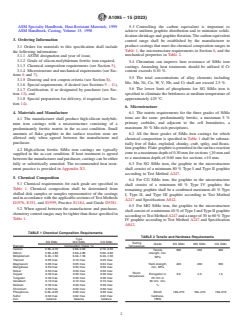
TABLE 1 Chemical Composition Requirements
TABLE 2 Tensile and Hardness Requirements
Type
SG SiMo MG SiMo CG SiMo
Testing
Grade SG SiMo MG SiMo CG SiMo
Element Composition (mass %)
Temperature
Carbon 2.90–3.70 2.80–3.60 2.70–3.50 Tensile 500 450 400
Silicon 3.50–4.80 3.50–4.80 3.50–4.80
strength, min,
Molybdenum 0.40–1.50 0.40–1.50 0.40–1.50 MPa
Titanium 0.05 max 0.10 max 0.25 max
Magnesium 0.06 max 0.05 max 0.04 max Yield strength, 420 400 350
Manganese 0.50 max 0.50 max 0.50 max
min, MPa
Nickel 0.50 max 0.50 max 0.50 max
Room
Copper 0.30 max 0.30 max 0.30 max
Elongation in 6.0 4.0 1.5
temperature
Tungsten 0.30 max 0.30 max 0.30 max 25 mm or
Vanadium 0.10 max 0.10 max 0.10 max 50 mm, min,
Niobium 0.30 max 0.30 max 0.30 max %
Chromium 0.50 max 0.50 max 0.50 max
Phosphorus 0.02–0.05 0.05 max 0.05 max Brinell 190–270 190–270 190–270
Sulfur 0.02 max 0.02 max 0.02 max hardness,
Iron balance balance balance HBW
A1095 − 15 (2023)
6.6 The volume fraction of graphite is typically in the range 8.3 Separately cast test coupons shall be Y-blocks, keel
of 8 to 14 %. Graphite structure evaluations using image blocks, or modified keel blocks in accordance with Specifica-
analysis should only be done by agreement between the tions A395/A395M, A476/A476M, A536, A842, and A897/
manufacturer and purchaser. A897M.
8.3.1 The bottom Y-block thickness shall be 13 mm for
7. Mechanical Properties
casting thickness <13 mm, 25 mm for casting thickness 13 to
38 mm, and 75 mm for casting thickness >38 mm.
7.1 Tensile testing specimens shall be taken from separately
8.3.2 Leg thickness of keel blocks shall be 25 mm for
cast coupons unless otherwise agreed between the manufac-
casting thickness 13 to 38 mm. For other casting thickness, the
turer and purchaser. Brinell hardness testing specimens may be
keel block thickness shall be changed according to 8.3.1.
test coupons or castings, or both (see Section 8).
8.3.3 Modified keel blocks of 25 mm bar diameter can be
7.2 The iron as represented by the test specimens shall
substituted for the 25 mm Y-block or the 25 mm keel block.
conform to the requirements in Table 2 for tensile properties
8.3.4 The coupon molds shall have a thickness equal or
and hardness at room temperature. The tensile testing shall
greater than the coupon thickness. The coupons shall be left in
proceed in accordance with Test Methods E8/E8M for room
the mold until they have cooled to a black color (≤500 °C).
temperature and Test Methods E21 for elevated temperature. If
8.3.5 If the test bars show obvious defects, additional bars
the test results fail to conform to the requirements, two retests
shall be cut from other test blocks representing the same iron.
shall be performed with specimens removed from test coupons
8.4 When castings made in accordance with this specifica-
or castings produced using the same casting conditions. If
tion are produced by spheroidization directly in the mold, the
either retest fails to meet the specification requirements, the
manufacturer may use either separately cast test coupons or test
castings represented by these test specimens shall be subject to
specimens cut from castings. When separately cast test cou-
rejection.
pons are used, selection shall be according to 8.1. If test bars
7.3 Yield strength shall be determined using the 0.2 % offset
are to be cut from castings, test bar location shall be agreed
method in accordance with Test Methods E8/E8M. Brinell
between the manufacturer and purchaser and shall be indicated
hardness shall be determined in accordance with Test Method
on the casting drawing or model.
E10.
9. Additional Tests
7.4 The tensile properties at 425 °C are listed in Table 3 for
reference (nonmandatory) information to monitor the possible
9.1 In addition to the chemical, microstructure, and me-
brittleness at medium temperature. The medium temperature is
chanical requirements in Sections 5 – 7, other special tests such
defined in the range of 350 to 500 °C.
as nondestructive testing (radiographic soundness, liquid pen-
etrant examination, magnetic particle inspection, leakage test-
8. Test Coupons
ing) may be agreed between the manufacturer and purchaser.
8.1 Test coupons fo
...