

ASTM B986-13(2019)
(Test Method)Standard Test Method for Determination of Tensile Strength by Mass Method for Stranded Conductors Intended for use in Electronic Application
General Information
- Abstract
SIGNIFICANCE AND USE
4.1 This test method is designed as an inspection or acceptance test of tensile strength for stranded metallic conductors.
SCOPE
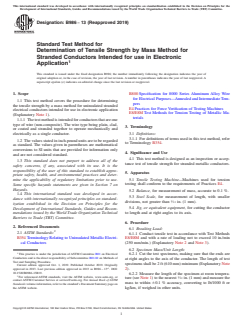
1.1 This test method covers the procedure for determining the tensile strength by a mass method for uninsulated stranded electrical conductors intended for use in electronic application (Explanatory Note 1).
1.1.1 The test method is intended for conductors that are one type of wire (non-composite). The wire type being plain, clad, or coated and stranded together to operate mechanically and electrically as a single conductor.
1.2 The values stated in inch-pound units are to be regarded as standard. The values given in parentheses are mathematical conversions to SI units that are provided for information only and are not considered standard.
1.3 This standard does not purport to address all of the safety concerns, if any, associated with its use. It is the responsibility of the user of this standard to establish appropriate safety, health, and environmental practices and determine the applicability of regulatory limitations prior to use. Some specific hazards statements are given in Section 7 on Hazards.
1.4 This international standard was developed in accordance with internationally recognized principles on standardization established in the Decision on Principles for the Development of International Standards, Guides and Recommendations issued by the World Trade Organization Technical Barriers to Trade (TBT) Committee.
- Status
- Published
- Publication Date
- 30-Sep-2019
- Technical Committee
- B01 - Electrical Conductors
- Drafting Committee
- B01.02 - Methods of Test and Sampling Procedure

Overview
ASTM B986-13(2019), Standard Test Method for Determination of Tensile Strength by Mass Method for Stranded Conductors Intended for use in Electronic Application, establishes a recognized procedure for evaluating the tensile strength of uninsulated stranded metallic conductors. Specifically designed for inspection and acceptance testing, this standard focuses on stranded conductors used in electronic applications that are composed of a single wire type (plain, clad, or coated) to operate as a unified conductor both mechanically and electrically.
This ASTM standard supports international quality and safety assurance in the manufacturing and acceptance of metallic conductors by standardizing the test approach under defined conditions.
Key Topics
Scope and Applicability:
- Applicable to uninsulated, non-composite stranded conductors, including plain, clad, or coated varieties.
- Relevant for conductors intended for electronic applications requiring mechanical and electrical reliability.
- Mandates use of inch-pound units as standard.
Test Methodology:
- Uses a mass method to determine tensile strength, integrating breaking load and specimen mass per unit length.
- Involves precise cutting and measurement of conductor specimens to ensure accuracy.
- Employs a tensile testing machine compliant with ASTM E4 for force verification.
Calculation Principles:
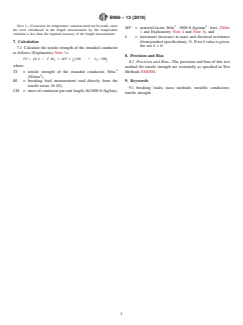
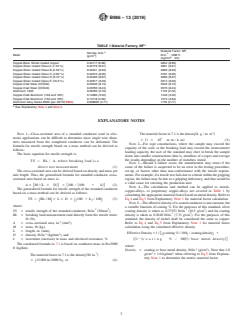
- Tensile strength is calculated using breaking load, mass per unit length, and material factors based on conductor composition.
- Correction for temperature during length measurement is generally unnecessary due to minimal impact on required accuracy.
Safety and Regulatory Considerations:
- Users must assess and address all pertinent safety, health, and environmental practices prior to test execution.
- Section 7 covers specific hazard statements related to the handling and testing of metallic conductors.
Applications
- Electronic Manufacturing: Ensures mechanical reliability and compliance of stranded conductors in circuit assemblies and electronic equipment.
- Quality Control: Used during inspection and acceptance processes for electronic grade conductors, helping to verify conformance with mechanical strength requirements.
- Product Development and R&D: Aids manufacturers in selecting and verifying suitable stranded conductor materials and constructions for new electronic applications.
- Supplier and Procurement Validation: Supports wire suppliers and purchasers in confirming specified tensile strength metrics as part of contract or regulatory requirements.
Related Standards
- ASTM B354: Terminology Relating to Uninsulated Metallic Electrical Conductors – defines key terms for uniform understanding.
- ASTM B800: Specification for 8000 Series Aluminum Alloy Wire for Electrical Purposes – addresses related conductor types for broader application.
- ASTM E4: Practices for Force Verification of Testing Machines – ensures testing equipment is properly calibrated for mechanical testing.
- ASTM E8/E8M: Test Methods for Tension Testing of Metallic Materials – referenced for conducting tensile tests.
Practical Value
ASTM B986-13(2019) enhances consistency and reliability in the assessment of tensile strength for stranded conductors, which are critical for safe and dependable electronic component performance. By providing a clearly defined, mass-based measurement approach appropriate for a wide variety of metallic wires and alloys, this standard supports manufacturers, quality assurance professionals, and engineers in delivering products that meet both customer and global regulatory requirements.
Keywords: ASTM B986, stranded conductor tensile strength, mass method, electronic conductor testing, quality control, metallic wire standards, tensile test methods
Relations
- Effective Date
- 01-Oct-2019
- Effective Date
- 01-Jan-2024
- Effective Date
- 01-Sep-2016
- Effective Date
- 15-Jul-2016
- Effective Date
- 01-Feb-2015
- Effective Date
- 01-Jun-2014
- Effective Date
- 01-Jun-2013
- Effective Date
- 01-Dec-2012
- Effective Date
- 01-Dec-2011
- Effective Date
- 01-Apr-2011
- Effective Date
- 01-Jun-2010
- Effective Date
- 01-Nov-2009
- Effective Date
- 01-Apr-2009
- Effective Date
- 01-Dec-2008
- Effective Date
- 01-Jan-2007
Get Certified
Connect with accredited certification bodies for this standard

ANCE
Mexican certification and testing association.

Intertek Slovenia
Intertek testing, inspection, and certification services in Slovenia.

LNE (Laboratoire National de Métrologie et d'Essais)
French national laboratory for metrology and testing.
Sponsored listings
Frequently Asked Questions
ASTM B986-13(2019) is a standard published by ASTM International. Its full title is "Standard Test Method for Determination of Tensile Strength by Mass Method for Stranded Conductors Intended for use in Electronic Application". This standard covers: SIGNIFICANCE AND USE 4.1 This test method is designed as an inspection or acceptance test of tensile strength for stranded metallic conductors. SCOPE 1.1 This test method covers the procedure for determining the tensile strength by a mass method for uninsulated stranded electrical conductors intended for use in electronic application (Explanatory Note 1). 1.1.1 The test method is intended for conductors that are one type of wire (non-composite). The wire type being plain, clad, or coated and stranded together to operate mechanically and electrically as a single conductor. 1.2 The values stated in inch-pound units are to be regarded as standard. The values given in parentheses are mathematical conversions to SI units that are provided for information only and are not considered standard. 1.3 This standard does not purport to address all of the safety concerns, if any, associated with its use. It is the responsibility of the user of this standard to establish appropriate safety, health, and environmental practices and determine the applicability of regulatory limitations prior to use. Some specific hazards statements are given in Section 7 on Hazards. 1.4 This international standard was developed in accordance with internationally recognized principles on standardization established in the Decision on Principles for the Development of International Standards, Guides and Recommendations issued by the World Trade Organization Technical Barriers to Trade (TBT) Committee.
SIGNIFICANCE AND USE 4.1 This test method is designed as an inspection or acceptance test of tensile strength for stranded metallic conductors. SCOPE 1.1 This test method covers the procedure for determining the tensile strength by a mass method for uninsulated stranded electrical conductors intended for use in electronic application (Explanatory Note 1). 1.1.1 The test method is intended for conductors that are one type of wire (non-composite). The wire type being plain, clad, or coated and stranded together to operate mechanically and electrically as a single conductor. 1.2 The values stated in inch-pound units are to be regarded as standard. The values given in parentheses are mathematical conversions to SI units that are provided for information only and are not considered standard. 1.3 This standard does not purport to address all of the safety concerns, if any, associated with its use. It is the responsibility of the user of this standard to establish appropriate safety, health, and environmental practices and determine the applicability of regulatory limitations prior to use. Some specific hazards statements are given in Section 7 on Hazards. 1.4 This international standard was developed in accordance with internationally recognized principles on standardization established in the Decision on Principles for the Development of International Standards, Guides and Recommendations issued by the World Trade Organization Technical Barriers to Trade (TBT) Committee.
ASTM B986-13(2019) is classified under the following ICS (International Classification for Standards) categories: 33.120.20 - Wires and symmetrical cables. The ICS classification helps identify the subject area and facilitates finding related standards.
ASTM B986-13(2019) has the following relationships with other standards: It is inter standard links to ASTM B986-13e1, ASTM E8/E8M-24, ASTM B354-16, ASTM E8/E8M-16, ASTM E8/E8M-15, ASTM E4-14, ASTM E8/E8M-13, ASTM B354-12, ASTM E8/E8M-11, ASTM B800-05(2011), ASTM E4-10, ASTM E4-09a, ASTM E4-09, ASTM E4-08, ASTM E4-07. Understanding these relationships helps ensure you are using the most current and applicable version of the standard.
ASTM B986-13(2019) is available in PDF format for immediate download after purchase. The document can be added to your cart and obtained through the secure checkout process. Digital delivery ensures instant access to the complete standard document.
Standards Content (Sample)
This international standard was developed in accordance with internationally recognized principles on standardization established in the Decision on Principles for the
Development of International Standards, Guides and Recommendations issued by the World Trade Organization Technical Barriers to Trade (TBT) Committee.
Designation: B986 − 13 (Reapproved 2019)
Standard Test Method for
Determination of Tensile Strength by Mass Method for
Stranded Conductors Intended for use in Electronic
Application
This standard is issued under the fixed designation B986; the number immediately following the designation indicates the year of
original adoption or, in the case of revision, the year of last revision. A number in parentheses indicates the year of last reapproval. A
superscript epsilon (´) indicates an editorial change since the last revision or reapproval.
1. Scope B800 Specification for 8000 Series Aluminum Alloy Wire
for Electrical Purposes—Annealed and Intermediate Tem-
1.1 This test method covers the procedure for determining
pers
the tensile strength by a mass method for uninsulated stranded
E4 Practices for Force Verification of Testing Machines
electrical conductors intended for use in electronic application
E8/E8M Test Methods for Tension Testing of Metallic Ma-
(Explanatory Note 1).
terials
1.1.1 Thetestmethodisintendedforconductorsthatareone
type of wire (non-composite). The wire type being plain, clad,
3. Terminology
or coated and stranded together to operate mechanically and
3.1 Definitions:
electrically as a single conductor.
3.1.1 For definitions of terms used in this test method, refer
1.2 The values stated in inch-pound units are to be regarded
to Terminology B354.
as standard. The values given in parentheses are mathematical
conversions to SI units that are provided for information only
4. Significance and Use
and are not considered standard.
4.1 This test method is designed as an inspection or accep-
1.3 This standard does not purport to address all of the
tance test of tensile strength for stranded metallic conductors.
safety concerns, if any, associated with its use. It is the
responsibility of the user of this standard to establish appro-
5. Apparatus
priate safety, health, and environmental practices and deter-
5.1 Tensile Testing Machine—Machines used for tension
mine the applicability of regulatory limitations prior to use.
testing shall conform to the requirements of Practices E4.
Some specific hazards statements are given in Section 7 on
Hazards.
5.2 Balance, for measurement of mass, accurate to 0.1 %.
1.4 This international standard was developed in accor-
5.3 Steel Scale, for measurement of length, with smaller
dance with internationally recognized principles on standard-
divisions, not greater than ⁄32 in. (1 mm).
ization established in the Decision on Principles for the
5.4 Jig, or equivalent equipment, for cutting the conductor
Development of International Standards, Guides and Recom-
mendations issued by the World Trade Organization Technical to length and at right angles to its axis.
Barriers to Trade (TBT) Committee.
6. Procedure
2. Referenced Documents
6.1 Breaking Load:
2.1 ASTM Standards:
6.1.1 Conduct tensile test in accordance with Test Methods
B354 Terminology Relating to Uninsulated Metallic Electri-
E8/E8M and with a rate of loading not to exceed 10 in./min
cal Conductors
(250 mm/min.) (Explanatory Note 2 and Note 3).
6.2 Specimen Mass/Unit Length:
This practice is under the jurisdiction of ASTM Committee B01 on Electrical
6.2.1 Cut the test specimens, making sure that the ends are
Conductors and is the direct responsibility of Subcommittee B01.02 on Methods of
at right angles to the axis of the conductor. The length of test
Test and Sampling Procedure.
specimens shall be 2 ft (610 mm) minimum (Explanatory Note
Current edition approved Oct. 1, 2019. Published October 2019. Originally
ɛ1
2).
approved in 2013. Last previous edition approved in 2013 as B986 – 13 . DOI:
10.1520/B0986-13R19.
6.2.2 Measure the length of the specimen at room tempera-
For referenced ASTM standards, visit the ASTM website, www.astm.org, or
ture (see Note 1) to the nearest ⁄32 in. (1 mm) and measure the
contact ASTM Customer Service at service@astm.org. For Annual Book of ASTM
mass to within 60.1 % accuracy, converting to lb/1000 ft or
Standards volume information, refer to the standard’s Document Summary page on
the ASTM website. kg/km, if weighed in other units.
Copyright © ASTM International, 100 Barr Harbor Drive, PO Box C700, West Conshohocken, PA 19428-2959. United States
B986 − 13 (2019)
2 2
NOTE 1—Correction for temperature variation need not be made, since
MF = material factor, lb/in · 1000 ft (kg/mm · km), (Table
the error introduced in the length measurement by the temperature
1 and Explanatory Note 4 and Note 5), and
variation is less than the required accuracy of the length measurement.
k = increment (increase) in mass and electrical resistance
(from product specification), %. If no k value is given,
7. Calculation
the use k=0.
7.1 Calculate the tensile strength of the stranded conductor
as follows (Explanatory Note 1):
8. Precision and Bias
TS 5 ~BL ⁄ CM! 3 MF 3 @~100 1 k! ⁄ 100#
8.1 Precision and Bias—The precision and bias of this test
where:
method for tensile strength are essentially as specified in Test
TS = tensile strength of the stranded conductor, lb/in. Methods E8/E8M.
(N/mm ),
BL = breaking load measurement read directly from the 9. Keywords
tensile tester, lb (N),
9.1 breaking loads; mass methods; metallic conductors;
CM = mass of conductor per unit length, lb/1000 ft (kg/km),
tensile strength
---------------------- P
...