

EN 13674-1:2011
(Main)Railway applications - Track - Rail - Part 1: Vignole railway rails 46 kg/m and above
- Abstract
This European Standard specifies Vignole railway rails of 46 kg/m and greater linear mass, for conventional and high speed railway track usage.
Nine pearlitic steel grades are specified covering a hardness range of 200 HBW to 440 HBW and include non heat treated non alloy steels, non heat treated alloy steels, and heat treated non alloy steels and heat treated alloy steels .
There are 23 rail profiles specified in this standard.
Two classes of rail straightness are specified, differing in requirements for straightness, surface flatness and crown profile. Two classes of profile tolerances are specified.
- Status
- Withdrawn
- Publication Date
- 08-Feb-2011
- Withdrawal Date
- 06-Oct-2026
- Technical Committee
- CEN/TC 256 - Railway applications
- Drafting Committee
- CEN/TC 256/SC 1/WG 4 - Rails
- Current Stage
- 9960 - Withdrawal effective - Withdrawal
- Start Date
- 10-May-2017
- Completion Date
- 07-Oct-2026

Relations
- Effective Date
- 22-Dec-2008
- Effective Date
- 18-Jan-2023
- Effective Date
- 25-Aug-2026
- Effective Date
- 25-Aug-2026
- Effective Date
- 25-Aug-2026
- Effective Date
- 28-Jan-2026
- Effective Date
- 28-Jan-2026
- Effective Date
- 28-Jan-2026
- Effective Date
- 28-Jan-2026
- Effective Date
- 28-Jan-2026
- Effective Date
- 28-Jan-2026
- Effective Date
- 28-Jan-2026
- Effective Date
- 28-Jan-2026
- Effective Date
- 28-Jan-2026
- Effective Date
- 28-Jan-2026
Get Certified
Connect with accredited certification bodies for this standard

IRIS Certification (UNIFE)
International Railway Industry Standard certification.

TÜV SÜD Rail GmbH
TÜV SÜD railway certification services.

Bureau Veritas Railway Certification
Railway and transportation certification.
Sponsored listings
Frequently Asked Questions
EN 13674-1:2011 is a standard published by the European Committee for Standardization (CEN). Its full title is "Railway applications - Track - Rail - Part 1: Vignole railway rails 46 kg/m and above". This standard covers: This European Standard specifies Vignole railway rails of 46 kg/m and greater linear mass, for conventional and high speed railway track usage. Nine pearlitic steel grades are specified covering a hardness range of 200 HBW to 440 HBW and include non heat treated non alloy steels, non heat treated alloy steels, and heat treated non alloy steels and heat treated alloy steels . There are 23 rail profiles specified in this standard. Two classes of rail straightness are specified, differing in requirements for straightness, surface flatness and crown profile. Two classes of profile tolerances are specified.
This European Standard specifies Vignole railway rails of 46 kg/m and greater linear mass, for conventional and high speed railway track usage. Nine pearlitic steel grades are specified covering a hardness range of 200 HBW to 440 HBW and include non heat treated non alloy steels, non heat treated alloy steels, and heat treated non alloy steels and heat treated alloy steels . There are 23 rail profiles specified in this standard. Two classes of rail straightness are specified, differing in requirements for straightness, surface flatness and crown profile. Two classes of profile tolerances are specified.
EN 13674-1:2011 is classified under the following ICS (International Classification for Standards) categories: 45.080 - Rails and railway components; 93.100 - Construction of railways. The ICS classification helps identify the subject area and facilitates finding related standards.
EN 13674-1:2011 has the following relationships with other standards: It is inter standard links to EN 13674-1:2003+A1:2007, EN 13674-1:2011+A1:2017, ISO 1099:2006, ISO 4968:1979, ISO 12108:2002, EN ISO 14284:2022, EN 10276-1:2000, EN ISO 6506-1:2014, EN 10247:2017, EN ISO 6892-1:2019, EN ISO 7827:1995, EN 10163-1:2004, EN ISO 12780-1:2011, EN 16644:2014, CEN/TR 10261:2023. Understanding these relationships helps ensure you are using the most current and applicable version of the standard.
EN 13674-1:2011 is associated with the following European legislation: EU Directives/Regulations: 2001/16/EC, 2008/57/EC, 93/38/EEC, 96/48/EC; Standardization Mandates: M/024, M/275, M/334. When a standard is cited in the Official Journal of the European Union, products manufactured in conformity with it benefit from a presumption of conformity with the essential requirements of the corresponding EU directive or regulation.
EN 13674-1:2011 is available in PDF format for immediate download after purchase. The document can be added to your cart and obtained through the secure checkout process. Digital delivery ensures instant access to the complete standard document.
Standards Content (Sample)
2003-01.Slovenski inštitut za standardizacijo. Razmnoževanje celote ali delov tega standarda ni dovoljeno.Bahnanwendungen - Oberbau - Schienen - Teil 1: Vignolschienen ab 46 kg/mApplications ferroviaires - Voie - Rails - Partie 1: Rails Vignole de masse supérieure ou égale à 46 kg/mRailway applications - Track - Rail - Part 1: Vignole railway rails 46 kg/m and above45.080Rails and railway componentsICS:Ta slovenski standard je istoveten z:EN 13674-1:2011SIST EN 13674-1:2011en,fr,de01-oktober-2011SIST EN 13674-1:2011SLOVENSKI
STANDARDSIST EN 13674-1:2004+A1:20081DGRPHãþD
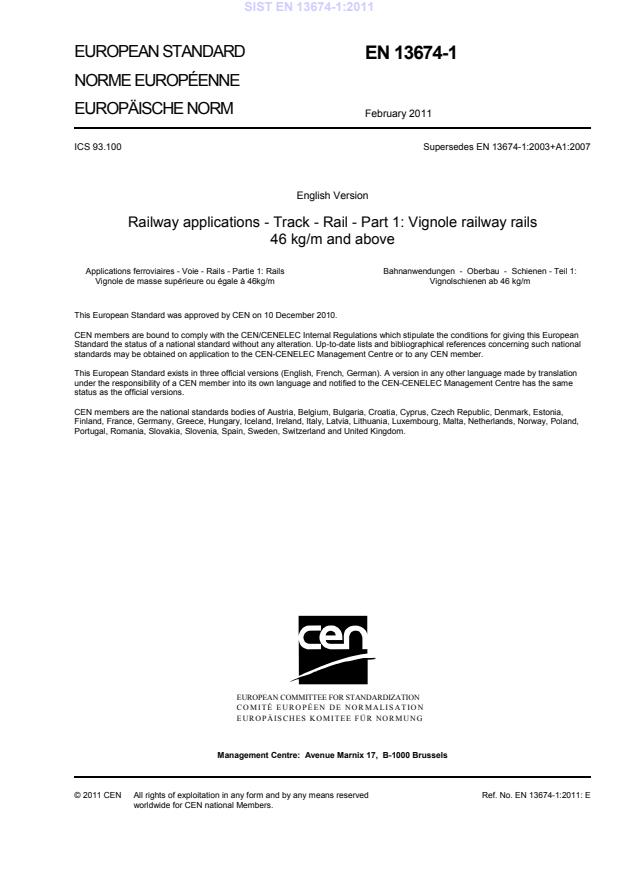
EUROPEAN STANDARD NORME EUROPÉENNE EUROPÄISCHE NORM
EN 13674-1
February 2011 ICS 93.100 Supersedes EN 13674-1:2003+A1:2007English Version
Railway applications - Track - Rail - Part 1: Vignole railway rails 46 kg/m and above
Applications ferroviaires - Voie - Rails - Partie 1: Rails Vignole de masse supérieure ou égale à 46kg/m
Bahnanwendungen
-
Oberbau
-
Schienen - Teil 1: Vignolschienen ab 46 kg/m This European Standard was approved by CEN on 10 December 2010.
CEN members are bound to comply with the CEN/CENELEC Internal Regulations which stipulate the conditions for giving this European Standard the status of a national standard without any alteration. Up-to-date lists and bibliographical references concerning such national standards may be obtained on application to the CEN-CENELEC Management Centre or to any CEN member.
This European Standard exists in three official versions (English, French, German). A version in any other language made by translation under the responsibility of a CEN member into its own language and notified to the CEN-CENELEC Management Centre has the same status as the official versions.
CEN members are the national standards bodies of Austria, Belgium, Bulgaria, Croatia, Cyprus, Czech Republic, Denmark, Estonia, Finland, France, Germany, Greece, Hungary, Iceland, Ireland, Italy, Latvia, Lithuania, Luxembourg, Malta, Netherlands, Norway, Poland, Portugal, Romania, Slovakia, Slovenia, Spain, Sweden, Switzerland and United Kingdom.
EUROPEAN COMMITTEE FOR STANDARDIZATION
COMITÉ EUROPÉEN DE NORMALISATION EUROPÄISCHES KOMITEE FÜR NORMUNG
Management Centre:
Avenue Marnix 17,
B-1000 Brussels © 2011 CEN All rights of exploitation in any form and by any means reserved worldwide for CEN national Members. Ref. No. EN 13674-1:2011: ESIST EN 13674-1:2011
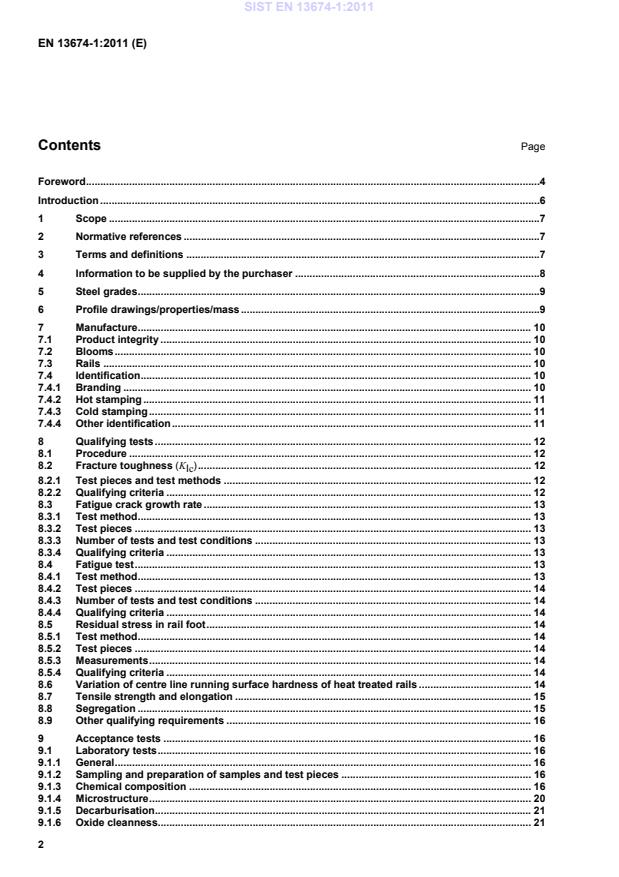
Rail profiles . 41Annex B (normative)
Standard test method for the determination of the plane strain fracture toughness (KIc) of rails . 67B.1 Test methods . 67B.2 Test pieces . 67B.3 Number of tests . 67B.4 Test conditions) . 67B.5 Analysis of test data . 68B.6 Reporting of results . 68Annex C (normative)
Method for the determination of rail foot surface longitudinal residual stresses . 73C.1 Procedure . 73C.2 Strain gauges and their location . 73Annex D (normative)
Limiting sulfur prints . 76Annex E (normative)
Profile and drilling gauges . 90Annex F (informative)
Significant technical changes between this European standard and the previous edition . 103Annex ZA (informative)
Relationship between this European Standard and the Essential Requirements of EU Directive 2008/57/EC . 105Bibliography . 108 SIST EN 13674-1:2011
The standard includes a prerequisite for all manufacturers to prove conformity against a set of qualifying test criteria at the time of tendering. The Qualifying tests include all "normal" acceptance test results plus new "type-casting" features such as fracture toughness, fatigue and residual stress. To provide users with the necessary confidence, acceptance limits have been based on results from rail known to have performed well in demanding track installations. The standard includes a quality assurance and inspection clause as part of product integrity. In order that quality management systems are consistent across all manufacturers and that users have the best assurance for the consistency of required product quality on this safety critical component of the track, this rail standard recommends that the manufacturers' quality assurance systems are at least equivalent to the requirements of EN ISO 9001. The inclusion of this requirement also reduces the need to incorporate detailed method and calibration descriptions on items such as normal chemical composition determination and the need to define more extensive testing. SIST EN 13674-1:2011
Two classes of rail straightness are specified, differing in requirements for straightness, surface flatness and crown profile. Two classes of profile tolerances are specified. 2 Normative references The following referenced documents are indispensable for the application of this document. For dated references, only the edition cited applies. For undated references, the latest edition of the referenced document (including any amendments) applies. EN 10163-1, Delivery requirements for surface condition of hot-rolled steel plates, wide flats and sections — Part 1: General requirements EN 10247, Micrographic examination of the non-metallic inclusion content of steels using standard pictures CEN/TR 10261, Iron and steel — Review of available methods of chemical analysis EN 10276-1, Chemical analysis of ferrous materials — Determination of oxygen in steel and iron — Part 1: Sampling and preparation of steel samples for oxygen determination EN ISO 6506-1, Metallic materials — Brinell hardness test — Part 1: Test method (ISO 6506-1:2005) EN ISO 6892-1, Metallic materials — Tensile testing — Part 1: Method of test at room temperature
(ISO 6892-1:2009) EN ISO 14284, Steel and iron — Sampling and preparation of samples for the determination of chemical composition (ISO 14284:1996) ISO 1099, Metallic materials — Fatigue testing — Axial force-controlled method ISO 4968, Steel — Macrographic examination by sulfur print (Baumann method) ISO 12108, Metallic materials — Fatigue testing — Fatigue crack growth method ASTM E399, Standard test method for linear-elastic plane-strain fracture toughness KIc of metallic materials 3 Terms and definitions For the purposes of this document, the following terms and definitions apply. 3.1 heat liquid steel melt tapped out of a converter or electric arc furnace which includes after continuous casting a given number of blooms relating to the weight of the heat and the extension of the mixing zone. In the case of sequence casting the blooms belonging to the mixing zone should be clearly defined SIST EN 13674-1:2011
process whereby blooms are held for a period of time at an elevated temperature for diminishing the hydrogen content NOTE 1 For maximum efficiency this is as near to (but below) the pearlite to austenite transformation temperature as is practically possible. NOTE 2 This process is sometimes referred to as sub critical diffusion annealing. 3.8 qualifying test special test and criteria which are relevant to some aspects of the service performance of rails. Acceptance tests also form part of the qualifying tests 3.9 acceptance test test carried out as part of the process and product control system, normally on a heat, sequence or tonnage basis 3.10 rail running surface curved surface of the rail head. Area between both gauge corners (transition points of the head inclination and the first head radius) 4 Information to be supplied by the purchaser The purchaser shall provide the supplier with the following information at the time of tender or order: a) rail profile (see Annex A); b) steel grade (see Clause 5); c) profiles class, ‘X’ or ‘Y’ (see 9.2.1); d) straightness class ‘A’ or ‘B’ of rail as specified in 9.2.2; e) length(s) of rail (see Table 9); SIST EN 13674-1:2011
Non-alloy (C-Mn) No branding lines R200 1.0521 200 to 240 Non heat treated
Non-alloy (C-Mn)
R220 1.0524 220 to 260 Non heat treated ————
Non-alloy (C-Mn) ——
R260 1.0623 260 to 300 Non heat treated ————
Non-alloy (C-Mn) ————
R260Mn 1.0624 260 to 300 Non heat treated ————
Alloy (1 %Cr) ————
R320Cr 1.0915 320 to 360 Non heat treated ————
————
Non-alloy (C-Mn) ——
R350HT 1.0631 350 to 390 b Heat treated ———— ————
Non-alloy (C-Mn) ——
R350LHT 1.0632 350 to 390 b Heat treated ———— ————
——
Alloy (C-Mn) ——
R370CrHT 1.0992 370 to 410 Heat treated ———— ————
————
Non-alloy (C-Mn) ————
R400HT 1.1254 400 to 440 Heat treated ———— ————
a See Table 5 a) and Table 5 b) for chemical composition/mechanical properties. b See Table 6 for hardness requirements.
6 Profile drawings/properties/mass Rail profiles, dimensions, properties and linear masses shall be in accordance with Annex A. The tolerances of certain dimensions shall be as given in Table 7. All other quantities are informative only. NOTE Linear masses have been calculated based on the density of steel of 7,85 kg/dm3. SIST EN 13674-1:2011
___
ROLLING MILL _______ 07 60 E1
___
ROLLING MILL _______ _______ 07 60 E1
(60 E1 profile rail rolled 2007, non-alloy heat treated rail steel grade R350HT). NOTE The sequence of the branding marks is at the discretion of the manufacturer. 7.4.2 Hot stamping In addition to the branding requirements of 7.4.1 each rail shall be identified by a numerical and/or alphabetical code system, hot stamped on the non-branded side of the rail web by machine and each rail shall be hot stamped at least once every 10 m. NOTE Subsequent cutting could result in more than one rail length having the same identity. The figures and letters used shall be clearly legible and shall be 16 mm high. The stamped characters shall have a flat or radius face (1 mm to 1,5 mm wide) with bevels on each side. The letters and numbers shall be on a 10° angle from vertical and shall have rounded corners. The stamping shall be between 0,5 mm and 1,5 mm in depth along the centre of the web. The design shall be as shown in Figure 1.
Figure 1 — Design of letters and numbers on a 10° angle for rail stamps The identification system employed shall be such as to enable the hot stamped marking to be collated with the: a) number of the heat from which the rail has been rolled; b) number of the strand and position of bloom within the strand; c) position of the rail in the bloom (A, B . Y). In the event of identification marks having been removed, omitted or requiring alteration, re-identification of such marks shall be made by rotary burr. 7.4.3 Cold stamping Cold stamping shall only be used on the cut face of the rail within the central portion of the head, at the request of the purchaser. 7.4.4 Other identification The purchaser shall specify their requirements for any colour coding or special marking instructions and their position on the rail at the time of enquiry or order. SIST EN 13674-1:2011
The manufacturer shall only carry out testing on the 60E1 profile or the heaviest section produced. All rail grades and profiles supplied shall conform to the qualifying criteria in accordance with 8.2 to 8.9. The results for the grades to be supplied shall be provided at the time of tendering. In the event of a manufacturer not having produced the rail grade prior to the tender enquiry he shall have the option of carrying out such tests on the first available sequence. When the qualifying criteria have been complied with, compliance with the standard is demonstrated and consequently the manufacturer is qualified. 8.1.3 The samples in accordance with 8.1.4 and 8.1.5 shall be removed from finished roller straightened rails. These samples shall not be subject to any further mechanical or thermal treatment (other than the treatment of ageing of the tensile test pieces as described in 9.1.9.2). 8.1.4 Test pieces for fracture toughness, fatigue crack growth rate and fatigue tests (see 8.2, 8.3 and 8.4 respectively) shall be taken from 3 sample rails at least 3 m from the cut ends of the rail. Sample rails shall be from different heats and different strands. 8.1.5 For residual stress tests (see 8.5), there shall be 6 sample rails and the test pieces shall be taken at least 3 m from each rail end. 8.1.6 All tests should be carried out by a laboratory that operates an approved and audited quality assurance system conforming to requirements at least equivalent to EN ISO 9001. 8.1.7 The purchaser shall have access to all test records, calibrations and calculations that contribute to the final results. 8.1.8 All test results shall be reported to the purchaser. 8.2 Fracture toughness (KIc) 8.2.1 Test pieces and test methods Tests shall be performed in accordance with Annex B.
8.2.2 Qualifying criteria The value of KIc shall comply with Table 2. SIST EN 13674-1:2011
NOTE In some circumstances*QK values can be used for the purpose of qualification, see B.6. 8.3 Fatigue crack growth rate 8.3.1 Test method Tests shall be carried out in accordance with the general requirements of ISO 12108. 8.3.2 Test pieces A three point bend, single edge notch test piece, of the dimensions and location within the rail shown in Figure 2 shall be used. 8.3.3 Number of tests and test conditions A minimum of 3 tests from each sample rail shall be performed under the following conditions: test temperature shall be within the range +15 °C to +25 °C; R = 0,5 (R = minimum cyclic load/maximum cyclic load); 3 point bend test piece loading span shall be 4 W (see Figure 2); cyclic loading frequency shall be within the range 15 Hz to 40 Hz; environment: laboratory air. 8.3.4 Qualifying criteria Fatigue crack growth rates (m/Gc) shall not exceed the values given in Table 3. Table 3 — Fatigue crack growth rates Steel grades ∆ K = 10 MPa m½ ∆ K = 13,5 MPa m½ All grades except R200 and R320Cr 17 m/Gc 55 m/Gc 8.4 Fatigue test 8.4.1 Test method Constant amplitude fatigue tests shall be carried out in accordance with ISO 1099. SIST EN 13674-1:2011
1,0 % (1 standard deviation). 8.7.3 The results of the predictive equations shall be compared with experimentally determined tensile strength and elongation results as described in 9.1.9. This comparison will be achieved by carrying out one valid tensile test every 2 000 tonnes or at least every tenth heat. The experimental results shall be within plus or minus 25 MPa tensile strength and plus or minus 2 % elongation of those obtained from the predictive equations. 8.7.4 The results of the experimental tensile strength and elongation tests obtained from 8.7.3 shall be used to update the predictive equations. These results shall be accumulated and the equations updated annually. The updated equations shall be based on a minimum of the last 100 results. 8.7.5 If results from the predictive equations or the experimental results are outside the limits set in 8.7.2 and 8.7.3 then actions a), b) and c) and when necessary action d) shall be taken: a) manufacturer shall carry out an investigation; b) problem will be resolved by the manufacturer taking appropriate corrective action; c) manufacturer shall report the findings of a) and b) to the purchaser; d) if the problem cannot be resolved to the satisfaction of the purchaser, the manufacturer or potential manufacturer shall have failed the approval requirements as specified in 8.7.1. If the physical tests themselves are within the requirements of Table 5 a) the product is satisfactory. 8.8 Segregation Full section transverse test pieces shall be sulfur printed in accordance with ISO 4968. For this purpose rail sulfur prints shall be taken from each strand from the beginning of every heat, excluding the mixing zone, for five heats. The samples shall be assessed and classified according to the limiting figures of Annex D. For the process to be accepted, all samples shall be classified as acceptable. SIST EN 13674-1:2011
9.1.3 Chemical composition 9.1.3.1 General The chemical composition of the liquid steel shall be determined for each heat. When the solid chemical composition is checked, this shall be carried out at the position of the tensile test piece. Liquid and solid chemical composition shall conform to the requirements of Table 5 a) and Table 5 b). The choice of the suitable physical or chemical analytical method for the product analysis shall be at the discretion of the manufacturer. In cases of dispute, the analysis method shall be agreed taking into account the relevant existing European Standards. The available European Standards are given in CEN/TR 10261. 9.1.3.2 Hydrogen The hydrogen content of the liquid steel shall be measured by determining pressure of hydrogen in the steel using an on-line immersion probe system. At least two liquid samples shall be taken from the first heat of any sequence using a new tundish and one from each of the remaining heats and analysed for hydrogen content (see Table 4). The first sample from the first heat in a sequence shall be taken from the tundish at the time of the maximum hydrogen concentration. The heats shall be assessed for hydrogen content in accordance with Table 5 a). SIST EN 13674-1:2011
One per 500 tonnes of re-heated and mill heat treated a,c Oxide cleanness 9.1.6 One per sequence b
One per sequence b or c Sulfur print 9.1.7 One per 500 tonnes or part thereof a,b One per 500 tonnes or part thereof a,b or c Hardness 9.1.8 One per heat a,b One per 100 tonnes of heat treated rail a,c Tensile 8.7 and 9.1.9 One calculation per heat/one test per 2 000 tonnesa,b One test per 1 000 tonnes a,c
a Samples shall be taken at random but only rails from blooms outside the mixing zone between heats when continuously cast in sequence. b Samples shall be cut after rolling. c Samples shall be cut from heat treated rails. SIST EN 13674-1:2011
Table 5 a)
— Chemical composition and mechanical properties Steel grade % by mass 10-4 % (ppm) by massmax. Tensile strength Rm min. Elonga-tion A min. Hardness of the rail running surface, centre linec
Steel name Sample C Si Mn P max. S max. Cr Al max V max N max Oa Hb MPa % HBW R200 Liquid 0,40 to 0,60 0,15 to 0,58 0,70 to 1,20 0,035 0,035 ≤ 0,15
0,004 0,030 0,009 20 3,0
Solid 0,38 to 0,62 0,13 to 0,60 0,65 to 1,25 0,040 0,040 ≤ 0,15
0,004 0,030 0,010 20 3,0 680 14 200 to 240 R220 Liquid 0,50 to 0,60 0,20 to 0,60 1,00 to 1,25 0,025 0,025 ≤ 0,15
0,004 0,030 0,009 20 3,0
Solid 0,48 to 0,62 0,18 to 0,62 0,95 to 1,30 0,030 0,030 ≤ 0,15 0,004 0,030 0,010 20 3,0 770 12 220 to 260 R260 Liquid 0,62 to 0,80 0,15 to 0,58 0,70 to 1,20 0,025 0,025 ≤ 0,15 0,004 0,030 0,009 20 2,5
Solid 0,60 to 0,82 0,13 to 0,60 0,65 to 1,25 0,030 0,030 ≤ 0,15 0,004 0,030 0,010 20 2,5 880 10 260 to 300 R260Mn Liquid 0,55 to 0,75 0,15 to 0,60 1,30 to 1,70 0,025 0,025 ≤ 0,15 0,004 0,030 0,009 20 2,5
Solid 0,53 to 0,77 0,13 to 0,62 1,25 to 1,75 0,030 0,030 ≤ 0,15 0,004 0,030 0,010 20 2,5 880 10 260 to 300 R320Cr
Liquid 0,60 to 0,80 0,50 to 1,10 0,80 to 1,20 0,020 0,025 0,80 to 1,20 0,004 0,18 0,009 20 2,5
Solid 0,58 to 0,82 0,48 to 1,12 0,75 to 1,25 0,025 0,030 0,75 to 1,25 0,004 0,20 0,010 20 2,5 1 080 9 320 to 360 R350HT Liquid 0,72 to 0,80 0,15 to 0,58 0,70 to 1,20 0,020 0,025 ≤ 0,15 0,004 0,030 0,009 20 2,5
Solid 0,70 to 0,82 0,13 to 0,60 0,65 to 1,25 0,025 0,030 ≤ 0,15 0,004 0,030 0,
...