

EN 1998-2:2025/prA1
(Amendment)Eurocode 8 - Design of structures for earthquake resistance - Part 2: Bridges
- Abstract
EN 1998-2 is intended to be applied to the design of new bridges in seismic regions. It covers the design of reinforced concrete, steel and composite steel-concrete bridges and provides guidance for the design of timber bridges.
EN 1998-2 is applicable to the seismic design of bridges exploiting ductility in structural members or through the use of antiseismic devices. When ductility is exploited, this part primarily covers bridges in which the horizontal seismic actions are mainly resisted through bending of the piers or at the abutments; i.e. of bridges composed of vertical or nearly vertical pier systems supporting the traffic deck superstructure. It is also applicable to the seismic design of arched bridges, although its provisions should not be considered as fully covering these cases.
Suspension bridges and masonry bridges, moveable bridges and floating bridges are not included in the scope of EN 1998-2.
- Status
- Not Published
- Publication Date
- 27-Jun-2027
- Technical Committee
- CEN/TC 250 - Structural Eurocodes
- Drafting Committee
- CEN/TC 250/SC 8/WG 7 - Evolution of Eurocode 8
- Current Stage
- 4060 - Closure of enquiry - Enquiry
- Start Date
- 18-Jun-2026
- Due Date
- 25-May-2026
- Completion Date
- 18-Jun-2026

Overview
EN 1998-2:2025/prA1, developed by CEN, is a key section of Eurocode 8 focusing on the seismic design of bridges. This standard addresses the requirements for making bridges resistant to earthquake actions. It guides engineers in the seismic design and detailing of reinforced concrete, steel, and composite steel-concrete bridges, and provides advisory content for timber bridges. The document is part of the second generation of Eurocodes, aligning with the latest advancements in seismic and structural engineering.
EN 1998-2 is specifically tailored for new bridge structures located in regions with notable seismic activity. It ensures that bridges are designed to withstand earthquake forces, with an emphasis on safety, structural integrity, and resilience. By applying the concepts within this standard, designers can incorporate ductility into structural members or utilize antiseismic devices to absorb and dissipate seismic energy.
Key Topics
EN 1998-2:2025/prA1 covers a wide range of technical criteria necessary for effective earthquake-resistant bridge design:
Scope and Application
- Applies to new bridges in seismic zones, focusing primarily on reinforced concrete, steel, and composite structures
- Provides guidance for timber bridges
- Not applicable to suspension, masonry, moveable, or floating bridges
Design Principles
- Addresses ductile behavior of bridge piers and abutments, especially for bridges with vertical or near-vertical pier systems
- Covers requirements for arched bridges, noting some limitations in full coverage
Antiseismic Devices
- Specifies rules for the incorporation and verification of antiseismic devices such as isolators and seismic links
Structural Analysis and Modelling
- Details modelling methods, including considerations for pier behavior, mass distribution, and damping corrections when soil-structure interaction is significant
Verification and Detailing
- Outlines verification of limit states for structural members impacted by seismic forces
- Provides detailed guidance on ductile detailing and reinforcement practices for different materials
National Adaptation
- Allows for National Annexes to define specific safety values and practical adaptations, ensuring local conditions and regulatory requirements are respected
Applications
The practical implementation of EN 1998-2 is vital for organizations and professionals involved in bridge design and construction in seismic regions. Key applications include:
New Construction Projects
- Ensuring all new bridges are designed to national and European standards for seismic resistance
- Applying ductile design methods and antiseismic devices to safeguard bridge performance during and after earthquakes
Infrastructure Modernization
- As a reference document for updating bridge design methodologies in line with the latest Eurocode requirements
Quality Assurance and Compliance
- Providing a framework for verifying that bridge designs meet the essential performance and safety criteria under seismic actions
- Serving as a benchmark for risk assessment, inspection, and maintenance procedures
Material and Structural Innovation
- Supporting the use of innovative construction materials or design techniques while maintaining seismic safety standards
Related Standards
To ensure a comprehensive approach to earthquake-resistant design, EN 1998-2 references and should be used alongside other relevant standards, including:
- EN 1998-1-1:2024 - General rules, seismic actions, and rules for buildings
- EN 1998-1-2 - Provisions related to shear verification for concrete elements
- EN 1998-5:2024 - Foundation and soil-structure interaction in seismic design
- EN 1990-1:2023+A1:2026 - Basis of structural design for all Eurocodes
National Annexes and additional execution, material, product, and test standards also play a role in the effective implementation of EN 1998-2.
By applying EN 1998-2:2025/prA1, bridge designers and civil engineers can ensure that new structures in seismic regions meet high standards for earthquake resistance, safety, and durability, supporting resilient and sustainable infrastructure.
Relations
- Amends
EN 1998-2:2025 - Eurocode 8 - Design of structures for earthquake resistance - Part 2: Bridges - Effective Date
- 30-Jul-2025
Get Certified
Connect with accredited certification bodies for this standard

DIBt (Deutsches Institut für Bautechnik)
German Institute for Building Technology.
DIN CERTCO
DIN Group product certification.
Zavod za gradbeništvo Slovenije (ZAG) - Inšpekcija
ZAG inspection body for construction products, structures, and materials.
Sponsored listings
Frequently Asked Questions
EN 1998-2:2025/prA1 is a draft published by the European Committee for Standardization (CEN). Its full title is "Eurocode 8 - Design of structures for earthquake resistance - Part 2: Bridges". This standard covers: EN 1998-2 is intended to be applied to the design of new bridges in seismic regions. It covers the design of reinforced concrete, steel and composite steel-concrete bridges and provides guidance for the design of timber bridges. EN 1998-2 is applicable to the seismic design of bridges exploiting ductility in structural members or through the use of antiseismic devices. When ductility is exploited, this part primarily covers bridges in which the horizontal seismic actions are mainly resisted through bending of the piers or at the abutments; i.e. of bridges composed of vertical or nearly vertical pier systems supporting the traffic deck superstructure. It is also applicable to the seismic design of arched bridges, although its provisions should not be considered as fully covering these cases. Suspension bridges and masonry bridges, moveable bridges and floating bridges are not included in the scope of EN 1998-2.
EN 1998-2 is intended to be applied to the design of new bridges in seismic regions. It covers the design of reinforced concrete, steel and composite steel-concrete bridges and provides guidance for the design of timber bridges. EN 1998-2 is applicable to the seismic design of bridges exploiting ductility in structural members or through the use of antiseismic devices. When ductility is exploited, this part primarily covers bridges in which the horizontal seismic actions are mainly resisted through bending of the piers or at the abutments; i.e. of bridges composed of vertical or nearly vertical pier systems supporting the traffic deck superstructure. It is also applicable to the seismic design of arched bridges, although its provisions should not be considered as fully covering these cases. Suspension bridges and masonry bridges, moveable bridges and floating bridges are not included in the scope of EN 1998-2.
EN 1998-2:2025/prA1 is classified under the following ICS (International Classification for Standards) categories: 91.120.25 - Seismic and vibration protection; 93.040 - Bridge construction. The ICS classification helps identify the subject area and facilitates finding related standards.
EN 1998-2:2025/prA1 has the following relationships with other standards: It is inter standard links to EN 1998-2:2025. Understanding these relationships helps ensure you are using the most current and applicable version of the standard.
EN 1998-2:2025/prA1 is available in PDF format for immediate download after purchase. The document can be added to your cart and obtained through the secure checkout process. Digital delivery ensures instant access to the complete standard document.
Standards Content (Sample)
SLOVENSKI STANDARD
01-maj-2026
Evrokod 8 - Projektiranje potresnoodpornih konstrukcij - 2. del: Mostovi
Eurocode 8 - Design of structures for earthquake resistance - Part 2: Bridges
Eurocode 8 - Auslegung von Bauwerken gegen Erdbeben - Teil 2: Brücken
Eurocode 8 - Calcul des structures pour leur résistance au séisme - Partie 2 : Ponts
Ta slovenski standard je istoveten z: EN 1998-2:2025/prA1
ICS:
91.120.25 Zaščita pred potresi in Seismic and vibration
vibracijami protection
93.040 Gradnja mostov Bridge construction
2003-01.Slovenski inštitut za standardizacijo. Razmnoževanje celote ali delov tega standarda ni dovoljeno.
DRAFT
EUROPEAN STANDARD
EN 1998-2:2025
NORME EUROPÉENNE
EUROPÄISCHE NORM
prA1
March 2026
ICS 91.120.25; 93.040
English Version
Eurocode 8 - Design of structures for earthquake
resistance - Part 2: Bridges
Eurocode 8 - Calcul des structures pour leur résistance Eurocode 8 - Auslegung von Bauwerken gegen
au séisme - Partie 2 : Ponts Erdbeben - Teil 2: Brücken
This draft amendment is submitted to CEN members for enquiry. It has been drawn up by the Technical Committee CEN/TC 250.
This draft amendment A1, if approved, will modify the European Standard EN 1998-2:2025. If this draft becomes an amendment,
CEN members are bound to comply with the CEN/CENELEC Internal Regulations which stipulate the conditions for inclusion of
this amendment into the relevant national standard without any alteration.
This draft amendment was established by CEN in three official versions (English, French, German). A version in any other
language made by translation under the responsibility of a CEN member into its own language and notified to the CEN-CENELEC
Management Centre has the same status as the official versions.
CEN members are the national standards bodies of Austria, Belgium, Bulgaria, Croatia, Cyprus, Czech Republic, Denmark, Estonia,
Finland, France, Germany, Greece, Hungary, Iceland, Ireland, Italy, Latvia, Lithuania, Luxembourg, Malta, Netherlands, Norway,
Poland, Portugal, Republic of North Macedonia, Romania, Serbia, Slovakia, Slovenia, Spain, Sweden, Switzerland, Türkiye and
United Kingdom.
Recipients of this draft are invited to submit, with their comments, notification of any relevant patent rights of which they are
aware and to provide supporting documentation.
Warning : This document is not a European Standard. It is distributed for review and comments. It is subject to change without
notice and shall not be referred to as a European Standard.
EUROPEAN COMMITTEE FOR STANDARDIZATION
COMITÉ EUROPÉEN DE NORMALISATION
EUROPÄISCHES KOMITEE FÜR NORMUNG
CEN-CENELEC Management Centre: Rue de la Science 23, B-1040 Brussels
© 2026 CEN All rights of exploitation in any form and by any means reserved Ref. No. EN 1998-2:2025/prA1:2026 E
worldwide for CEN national Members.
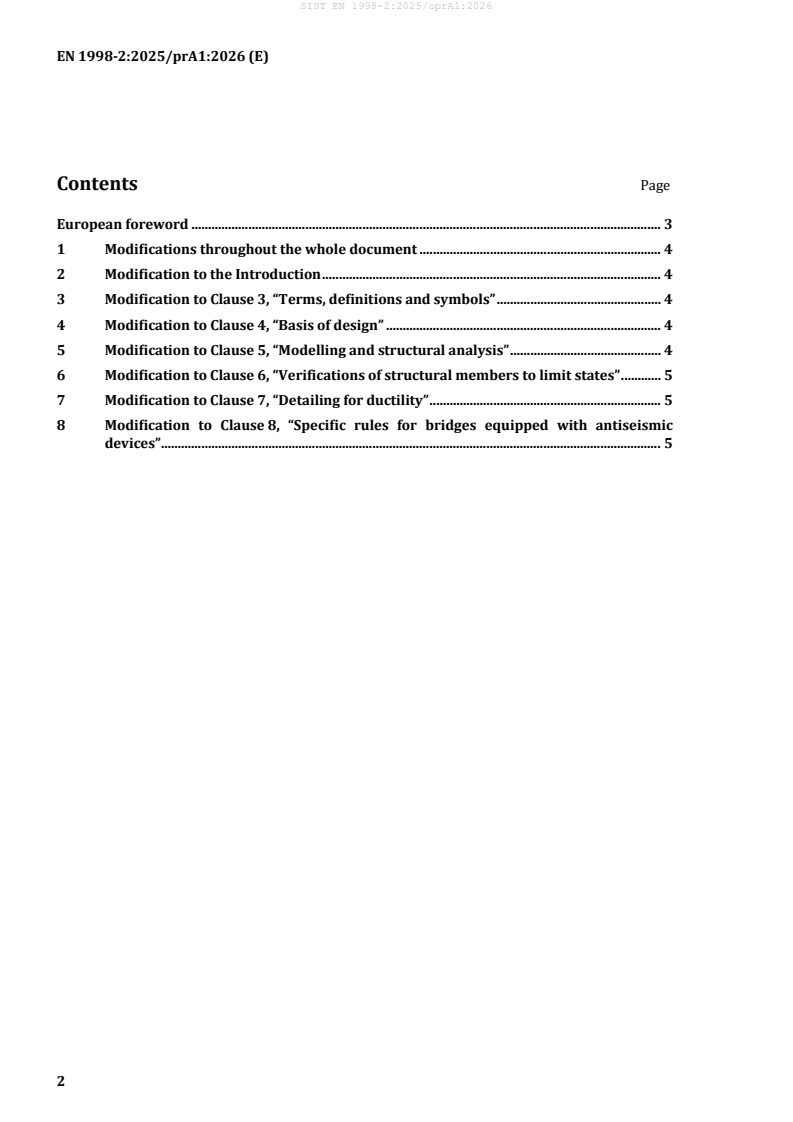
Contents Page
European foreword . 3
1 Modifications throughout the whole document . 4
2 Modification to the Introduction . 4
3 Modification to Clause 3, “Terms, definitions and symbols” . 4
4 Modification to Clause 4, “Basis of design” . 4
5 Modification to Clause 5, “Modelling and structural analysis” . 4
6 Modification to Clause 6, “Verifications of structural members to limit states” . 5
7 Modification to Clause 7, “Detailing for ductility” . 5
8 Modification to Clause 8, “Specific rules for bridges equipped with antiseismic
devices” . 5
European foreword
This document (EN 1998-2:2025/prA1:2026) has been prepared by Technical Committee CEN/TC 250
“Structural Eurocodes”, the secretariat of which is held by BSI. CEN/TC 250 is responsible for all
Structural Eurocodes and has been assigned responsibility for structural and geotechnical design matters
by CEN.
This document is an amendment to EN 1998-2:2025 and is currently submitted to the CEN Enquiry.
The following main changes to EN 1998-2:2025 are included in the amendment:
— introduction of γ for consistency with EN 1998-1-1:2024, on what concerns antiseismic devices and
x
related issues;
— consistency with EN 1998-1-2 in relation to shear verification of concrete members.
The first generation of EN Eurocodes was published between 2002 and 2007. This document forms part
of the second generation of the Eurocodes, which have been prepared under Mandate M/515 issued to
CEN by the European Commission and the European Free Trade Association.
The Eurocodes have been drafted to be used in conjunction with relevant execution, material, product
and test standards, and to identify requirements for execution, materials, products and testing that are
relied upon by the Eurocodes.
The Eurocodes recognize the responsibility of each Member State and have safeguarded their right to
determine values related to regulatory safety matters at national level through the use of National
Annexes.
1 Modifications throughout the whole document
Replace “EN 1990:2023” with “EN 1990-1:2023+A1:2026”.
Replace “EN 1990” with “EN 1990-1”.
2 Modification to the Introduction
In 0.5, in the list of clauses for which a national choice is allowed, add “4.1(3)”.
In 0.5, in the list of clauses for which a national choice is allowed, replace “10.4.2.1(1)” with “10.4.2(1)”.
3 Modification to Clause 3, “Terms, definitions and symbols”
In 3.1.4, add “Seismic links can consist, for example, of shear key arrangements, buffers, and/or linkage
bolts or cables.” at the end of Note 1 to entry.
In 3.1.10, replace the definition of “curved bridge” with “bridge with a maximum angle between tangents
to the in-plan curved longitudinal axis larger than 25°”.
4 Modification to Clause 4, “Basis of design”
In 4.1, add
...