


EN 13411-4:2011
(Main)Terminations for steel wire ropes - Safety - Part 4: Metal and resin socketing
Terminations for steel wire ropes - Safety - Part 4: Metal and resin socketing
This European Standard specifies the minimum requirements for the molten metal and resin socketing of steel wire ropes within the scopes of EN 12385-4:2002+A1:2008; EN 12385-5:2002; EN 12385-6:2004;
EN 12385-7:2002; EN 12385-8:2002; EN 12385-9:2002 and EN 12385-10:2003+A1:2008.
The European Standard is applicable only to those requirements that ensure that the socketing is strong enough to withstand a force of at least 100 % of the minimum breaking force of the rope (i.e. socket termination efficiency factor KT = 1,0).
NOTE Rope terminations made by socketing in accordance with this European Standard can be used for determining the breaking force of wire ropes in accordance with EN 12385-1:2002+A1:2008, Annex A.
Socketing by the methods and materials described in this standard are for use within the temperature limits given in normative Annex E.
This European Standard deals with all significant hazards, hazardous situations and events relevant to metal and resin socket terminations, when they are used as intended and under conditions of misuse which are reasonably foreseeable (see Clause 4).
Endverbindungen für Drahtseile aus Stahldraht - Sicherheit - Teil 4: Vergießen mit Metall und Kunstharz
Diese Europäische Norm legt die Mindestanforderungen für das Vergießen von Drahtseilen aus Stahldraht mit geschmolzenem Metall und Kunstharz, nach EN 12385–4:2002+A1:2008; EN 12385–5:2002; EN 12385–6: 2004; EN 12385–7:2002; EN 12385–8:2002; EN 12385–9:2002 und EN 12385–10:2003 +A1:2008, fest.
Diese Europäische Norm ist nur für solche Anforderungen anwendbar, die sicherstellen, dass der Verguss fest genug ist, um einer Kraft von mindestens 100 % der Mindestbruchkraft des Seiles zu widerstehen (d.h. Wirkungsgradfaktor der Endverbindung der Seilhülse KT = 1,0).
ANMERKUNG Seilendverbindungen durch Vergüsse nach dieser Europäischen Norm können verwendet werden, um die Bruchkraft von Drahtseilen nach EN 12385-1:2002+A1:2008, Anhang A, zu bestimmen.
Vergüsse, die nach und mit den in dieser Norm beschriebenen Verfahren und Werkstoffen hergestellt sind, sind für Anwendungen innerhalb der im normativen Anhang E angegebenen Temperaturgrenzen geeignet.
Diese Europäische Norm befasst sich mit allen signifikanten Gefährdungen, gefährlichen Situationen und relevanten Ereignissen für das Vergießen von Metall- und Kunstharz-Endverbindungen, wie sie bei vorgesehenem Gebrauch entstehen oder durch Fehlanwendungen und die vernünftig absehbar waren. (siehe Abschnitt 4).
Terminaisons pour câbles en acier - Sécurité - Partie 4: Manchonnage à l'aide de métal et de résine
La présente Norme européenne spécifie les prescriptions minimales pour le manchonnage à l'aide de métal
fondu et de résine des câbles en acier conformément aux EN 12385-4:2002+A1:2008 ; EN 12385-5:2002 ;
EN 12385-6:2004 ; EN 12385-7:2002 ; EN 12385-8:2002 ; EN 12385-9:2002 et EN 12385-10:2003+A1:2008.
La présente Norme européenne couvre uniquement les prescriptions assurant que le manchonnage est
suffisamment résistant pour supporter une charge au moins égale à 100 % de la charge minimale de rupture
du câble (c'est-à-dire un facteur d'efficacité de la terminaison manchonnée KT = 1,0).
NOTE Les terminaisons de câbles réalisées par manchonnage conformément à la présente Norme européenne
peuvent être utilisées pour déterminer la charge de rupture des câbles en acier conformément à l'Annexe A de
l'EN 12385-1:2002+A1:2008.
Le manchonnage effectué selon les méthodes et à l'aide des matériaux décrits dans la présente norme est
destiné à être utilisé dans les limites de température données dans l'Annexe informative E.
La présente Norme européenne traite de tous les phénomènes dangereux, situations et évènements
dangereux, dangereux significatifs relatifs aux terminaisons manchonnées à l’aide de métal et de résine,
lorsqu'elles sont utilisées pour l’usage prévu et dans des conditions de mauvais usage raisonnablement
prévisible (voir Article 4).
Zaključki jeklenih žičnih vrvi - Varnost - 4. del: Zalivke iz kovin in umetnih smol
Ta evropski standard določa minimalne zahteve za taljene zalivke iz kovin in umetnih smol za jeklene žične vrvi v okviru EN 12385-4:2002+A1:2008; EN 12385-5:2002; EN 12385-6:2004; EN 12385-7:2002; EN 12385-8:2002; EN 12385-9:2002 in EN 12385-10:2003+A1:2008. Ta evropski standard se uporablja le za zahteve, ki zagotavljajo, da so zalivke dovolj močne, da prenesejo silo, ki ustreza najmanj 100 % minimalne pretržne sile vrvi (tj. faktor učinkovitosti zaključka zalivke KT = 1,0). Zalivke po metodah in materialih, opisanih v tem standardu, so za uporabo v temperaturnih omejitvah, podanih v normativnem dodatku E. Ta evropski standard obravnava velike nevarnosti, nevarne situacije in primere, ki se nanašajo na zaključke zalivk iz kovin in umetnih smol, kadar se uporabljajo, kot je predvideno in v okoliščinah napačne uporabe, ki se lahko razumno predvidijo (glej točko 4). Ta druga izdaja zajema tehnična in redakcijska dopolnila z naslednjimi glavnimi spremembami glede na prejšnjo izdajo: – poudarja odobrena merila za dimenzije zalivk, ki preklicujejo potrebo po tipskem preskušanju, in premik podatkov v informativni dodatek F; – dodana definicija za »proizvajalca zalivk«; – na novo oblikovana točka o nevarnostih; – na novo oblikovan standard v skladu s pravili direktiv ISO/IEC, 2. del, in Vodilom CEN 414.
General Information
- Status
- Withdrawn
- Publication Date
- 29-Mar-2011
- Withdrawal Date
- 13-Apr-2025
- Technical Committee
- CEN/TC 168 - Chains, ropes, webbing, slings and accessories - safaty
- Drafting Committee
- CEN/TC 168 - Chains, ropes, webbing, slings and accessories - safaty
- Current Stage
- 9960 - Withdrawal effective - Withdrawal
- Start Date
- 22-Dec-2021
- Completion Date
- 14-Apr-2025
- Directive
- 98/37/EC - Machinery
Relations
- Effective Date
- 08-Jun-2022
- Replaced By
EN 13411-4:2021 - Terminations for steel wire ropes - Safety - Part 4: Metal and resin socketing - Effective Date
- 01-Aug-2018
- Revised
EN 13411-4:2002 - Terminations for steel wire ropes - Safety - Part 4: Metal and resin socketing - Effective Date
- 22-Dec-2008


Frequently Asked Questions
EN 13411-4:2011 is a standard published by the European Committee for Standardization (CEN). Its full title is "Terminations for steel wire ropes - Safety - Part 4: Metal and resin socketing". This standard covers: This European Standard specifies the minimum requirements for the molten metal and resin socketing of steel wire ropes within the scopes of EN 12385-4:2002+A1:2008; EN 12385-5:2002; EN 12385-6:2004; EN 12385-7:2002; EN 12385-8:2002; EN 12385-9:2002 and EN 12385-10:2003+A1:2008. The European Standard is applicable only to those requirements that ensure that the socketing is strong enough to withstand a force of at least 100 % of the minimum breaking force of the rope (i.e. socket termination efficiency factor KT = 1,0). NOTE Rope terminations made by socketing in accordance with this European Standard can be used for determining the breaking force of wire ropes in accordance with EN 12385-1:2002+A1:2008, Annex A. Socketing by the methods and materials described in this standard are for use within the temperature limits given in normative Annex E. This European Standard deals with all significant hazards, hazardous situations and events relevant to metal and resin socket terminations, when they are used as intended and under conditions of misuse which are reasonably foreseeable (see Clause 4).
This European Standard specifies the minimum requirements for the molten metal and resin socketing of steel wire ropes within the scopes of EN 12385-4:2002+A1:2008; EN 12385-5:2002; EN 12385-6:2004; EN 12385-7:2002; EN 12385-8:2002; EN 12385-9:2002 and EN 12385-10:2003+A1:2008. The European Standard is applicable only to those requirements that ensure that the socketing is strong enough to withstand a force of at least 100 % of the minimum breaking force of the rope (i.e. socket termination efficiency factor KT = 1,0). NOTE Rope terminations made by socketing in accordance with this European Standard can be used for determining the breaking force of wire ropes in accordance with EN 12385-1:2002+A1:2008, Annex A. Socketing by the methods and materials described in this standard are for use within the temperature limits given in normative Annex E. This European Standard deals with all significant hazards, hazardous situations and events relevant to metal and resin socket terminations, when they are used as intended and under conditions of misuse which are reasonably foreseeable (see Clause 4).
EN 13411-4:2011 is classified under the following ICS (International Classification for Standards) categories: 53.020.30 - Accessories for lifting equipment; 77.140.99 - Other iron and steel products. The ICS classification helps identify the subject area and facilitates finding related standards.
EN 13411-4:2011 has the following relationships with other standards: It is inter standard links to EN 13411-4:2002+A1:2008, EN 13411-4:2021, EN 13411-4:2002. Understanding these relationships helps ensure you are using the most current and applicable version of the standard.
EN 13411-4:2011 is associated with the following European legislation: EU Directives/Regulations: 2006/42/EC, 98/37/EC; Standardization Mandates: M/079, M/396. When a standard is cited in the Official Journal of the European Union, products manufactured in conformity with it benefit from a presumption of conformity with the essential requirements of the corresponding EU directive or regulation.
You can purchase EN 13411-4:2011 directly from iTeh Standards. The document is available in PDF format and is delivered instantly after payment. Add the standard to your cart and complete the secure checkout process. iTeh Standards is an authorized distributor of CEN standards.
Standards Content (Sample)
2003-01.Slovenski inštitut za standardizacijo. Razmnoževanje celote ali delov tega standarda ni dovoljeno.Endverbindungen für Drahtseile aus Stahldraht - Sicherheit - Teil 4: Vergießen mit Metall und KunstharzTerminaisons pour câbles en acier - Sécurité - Partie 4: Manchonnage à l'aide de métal ou résineTerminations for steel wire ropes - Safety - Part 4: Metal resin socketing77.140.99Drugi železni in jekleni izdelkiOther iron and steel products53.020.30Pribor za dvigalno opremoAccessories for lifting equipmentICS:Ta slovenski standard je istoveten z:EN 13411-4:2011SIST EN 13411-4:2011en,fr,de01-julij-2011SIST EN 13411-4:2011SLOVENSKI
STANDARDSIST EN 13411-4:2002+A1:20081DGRPHãþD
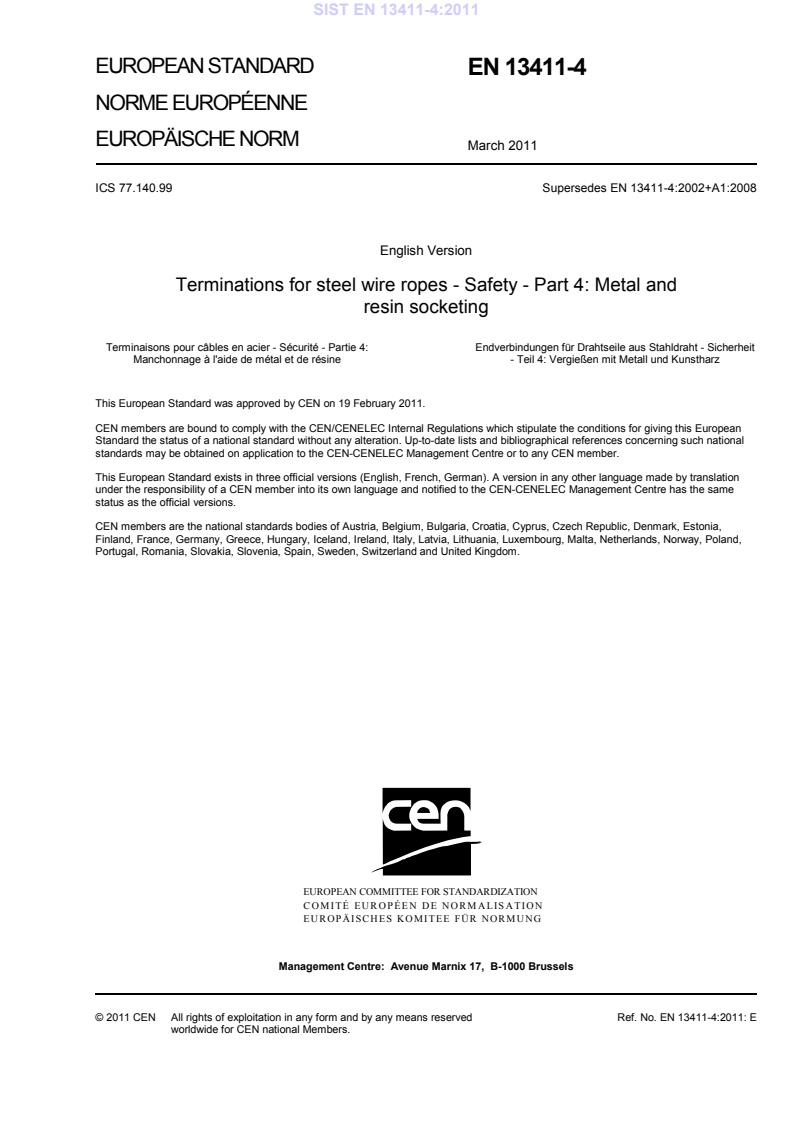
EUROPEAN STANDARD NORME EUROPÉENNE EUROPÄISCHE NORM
EN 13411-4
March 2011 ICS 77.140.99 Supersedes EN 13411-4:2002+A1:2008English Version
Terminations for steel wire ropes - Safety - Part 4: Metal and resin socketing
Terminaisons pour câbles en acier - Sécurité - Partie 4: Manchonnage à l'aide de métal et de résine
Endverbindungen für Drahtseile aus Stahldraht -Sicherheit - Teil 4: Vergießen mit Metall und Kunstharz This European Standard was approved by CEN on 19 February 2011.
CEN members are bound to comply with the CEN/CENELEC Internal Regulations which stipulate the conditions for giving this European Standard the status of a national standard without any alteration. Up-to-date lists and bibliographical references concerning such national standards may be obtained on application to the CEN-CENELEC Management Centre or to any CEN member.
This European Standard exists in three official versions (English, French, German). A version in any other language made by translation under the responsibility of a CEN member into its own language and notified to the CEN-CENELEC Management Centre has the same status as the official versions.
CEN members are the national standards bodies of Austria, Belgium, Bulgaria, Croatia, Cyprus, Czech Republic, Denmark, Estonia, Finland, France, Germany, Greece, Hungary, Iceland, Ireland, Italy, Latvia, Lithuania, Luxembourg, Malta, Netherlands, Norway, Poland, Portugal, Romania, Slovakia, Slovenia, Spain, Sweden, Switzerland and United Kingdom.
EUROPEAN COMMITTEE FOR STANDARDIZATION
COMITÉ EUROPÉEN DE NORMALISATION EUROPÄISCHES KOMITEE FÜR NORMUNG
Management Centre:
Avenue Marnix 17,
B-1000 Brussels © 2011 CEN All rights of exploitation in any form and by any means reserved worldwide for CEN national Members. Ref. No. EN 13411-4:2011: ESIST EN 13411-4:2011
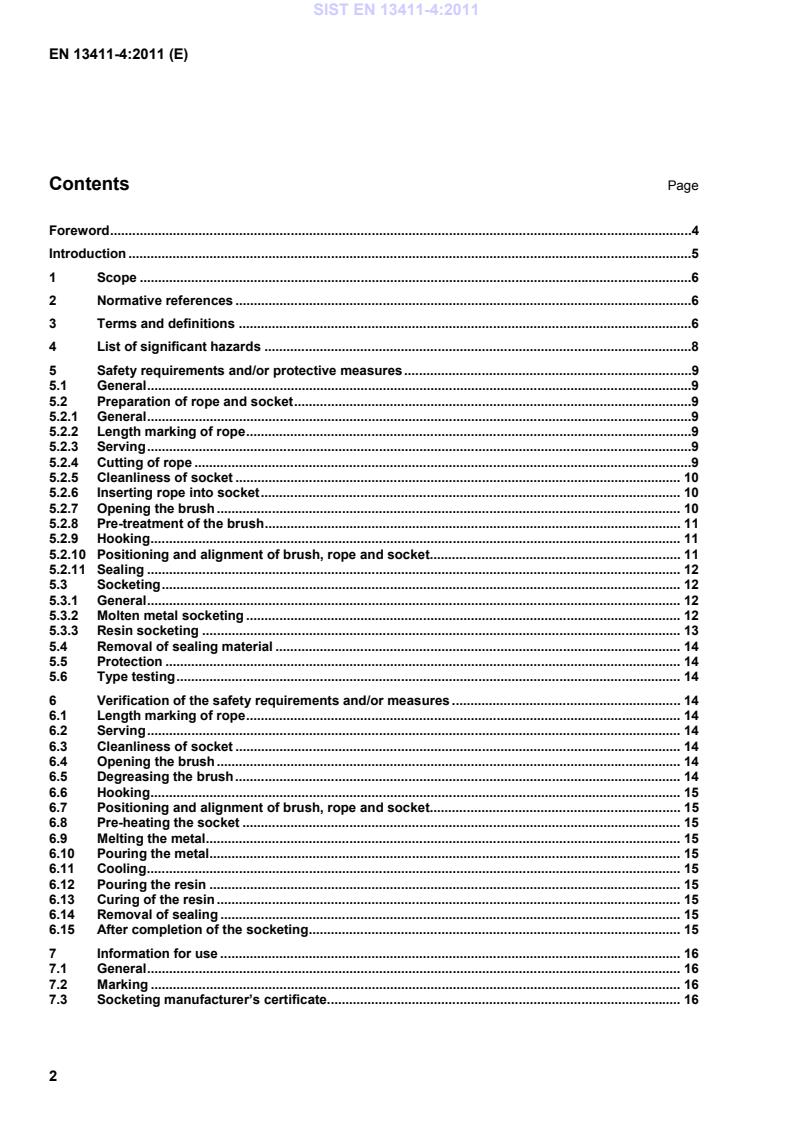
Molten metal socketing media . 17A.1Lead-based alloys . 17A.2Zinc . 17A.3Zinc-based alloy . 17Annex B (normative)
Resin socketing media . 18B.1General . 18B.2Physical properties . 18Annex C (normative)
Type testing for assessment of molten metal or resin socketed termination . 19C.1General . 19C.2Method of test . 19C.3Acceptance criteria . 19C.4Test report . 19Annex D (informative)
Procedure for pre-treatment of bright rope for improved adhesion when socketing with lead-based alloys . 20D.1General . 20D.2Fluxing . 20D.3Coating . 20Annex E (normative)
Operating temperature limits . 21Annex F (informative)
Approved socket design parameters . 22Annex ZA (informative)
Relationship between this European Standard And the Essential Requirements of EU Directive 2006/42/EC . 23Bibliography . 24 SIST EN 13411-4:2011
EN 12385-7:2002; EN 12385-8:2002; EN 12385-9:2002 and EN 12385-10:2003+A1:2008.
The European Standard is applicable only to those requirements that ensure that the socketing is strong enough to withstand a force of at least 100 % of the minimum breaking force of the rope (i.e. socket termination efficiency factor KT = 1,0). NOTE Rope terminations made by socketing in accordance with this European Standard can be used for determining the breaking force of wire ropes in accordance with EN 12385-1:2002+A1:2008, Annex A. Socketing by the methods and materials described in this standard are for use within the temperature limits given in normative Annex E. This European Standard deals with all significant hazards, hazardous situations and events relevant to metal and resin socket terminations, when they are used as intended and under conditions of misuse which are reasonably foreseeable (see Clause 4). 2 Normative references The following referenced documents are indispensable for the application of this document. For dated references, only the edition cited applies. For undated references, the latest edition of the referenced document (including any amendments) applies. EN 59, Glass reinforced plastics Measurement of hardness by means of a Barcol impressor EN 1774:1997, Zinc and zinc alloys Alloys for foundry purposes Ingot and liquid EN 12385-1:2002+A1:2008, Steel wire ropes Safety Part 1: General requirements EN 12385-2:2002+A1:2008, Steel wire ropes Safety Part 2: Definitions, designation and classification EN ISO 75-2:2004, Plastics Determination of temperature of deflection under load Part 2: Plastics, ebonite and long-fibre-reinforced composites (ISO 75-2:2004) EN ISO 604, Plastics Determination of compressive properties (ISO 604:2002) EN ISO 3838, Crude petroleum and liquid or solid petroleum products Determination of density or relative density Capillary-stoppered pyknometer and graduated bicapillary pyknometer methods (ISO 3838:2004) EN ISO 12100:2010 Safety of machinery General principles for design Risk assessment and risk reduction (ISO 12100:2010) 3 Terms and definitions For the purpose of this document, the terms and definitions given in EN ISO 12100,
EN 12385-2:2002+A1:2008 and the following apply.
3.1 socket type of wire rope termination incorporating a socket basket SIST EN 13411-4:2011
Descriptions of further elements of the socket geometry are shown in Figure 1.
Key 1 length of tapered basket plus any parallel portion(s) including any radius at rope entry 2 small end of tapered basket 3 large end of tapered basket 4 included angle of tapered basket 5 bore (internal diameter at rope entry) 6 pin hole centre line 7 length of tapered basket 8 length of parallel portion including any radius at rope entry 9 protruding wires 10 length of brush 11 root of brush
NOTE Some sockets can have baskets with an extended parallel portion at the large end of the tapered basket. Figure 1 — Nomenclature of typical parts of socket and brush 3.3 serving wrapping, usually of wire or strand, for the purpose of securing a rope end to prevent its unlaying 3.4 permanent serving serving applied prior to socketing and remaining in place at least until the socketing operation has been completed 3.5 temporary serving serving applied and subsequently removed at various stages of the socketing operation 3.6 gelling change in condition of resin from liquid to a semi-solid, jelly-like composition 3.7 hooking procedure whereby the end of a wire forming part of a brush is bent backwards to form a hook SIST EN 13411-4:2011
3.11 socketing system designer person or organization that designs the socketing system and assumes responsibility for type testing 3.12 socketing manufacturer person or organization that manufactures socketed terminations in accordance with the socketing system designer’s instructions 4 List of significant hazards This clause contains all the significant hazards, hazardous situations and events for the molten metal and resin socketing of steel wire ropes within the scopes of EN 12385-4:2002+A1:2008; EN 12385-5:2002;
EN 12385-6:2004; EN 12385-7:2002; EN 12385-8:2002; EN 12385-9:2002 and EN 12385-10:2003+A1:2008, as far as these hazards are dealt with in this European Standard, identified by risk assessment as significant for socket terminations that require action to eliminate or reduce risk. In particular, the hazard caused by accidental release of a load due to failure of the socketed portion of a socketed rope termination puts at risk, either directly or indirectly, the safety or health of those persons within the danger zone. In order to provide the necessary strength of the socketed portion of a socketed termination, this European Standard gives requirements for the method of socketing to ensure specified levels of performance are met.
Table 1 contains those hazards that require action to reduce risk identified by risk assessment as being specific and significant for socketed termination assemblies.
Table 1 Hazards identified EN ISO 14121-1:2007, A.1 and A.4 Type or group OriginPotential consequences Mechanical hazards
- Acceleration, deceleration (kinetic energy) - Falling objects - Moving elements - Impact - Crushing
Hazardous events - Stability of the machine and/or parts of the machine - Mechanical strength of parts of - Loss of stability - Break-up during SIST EN 13411-4:2011
5 Safety requirements and/or protective measures 5.1 General Machinery shall comply with the safety requirements and/or protective measures of this clause. In addition, the machine (rope assembly terminated in accordance with this European Standard and which is designated for lifting purposes) shall be designed in accordance with the principles of EN ISO 12100 for relevant but not significant hazards which are not dealt with by this document. Socketing shall be carried out by a person trained in socketing. 5.2 Preparation of rope and socket 5.2.1 General The position of the wires and strands of the non-socketed portion of rope shall remain undisturbed during the socketing operation. Temporary servin
...
EN 13411-4:2011 표준은 철선 로프의 금속 및 수지 소켓에 대한 안전 요구사항을 규명하는 중요한 문서입니다. 이 표준의 범위는 EN 12385 시리즈와 관련된 직접적인 요구 사항을 포괄하고 있으며, 철선 로프의 최소 파괴 하중의 100 %를 견딜 수 있도록 소켓이 충분히 강할 것임을 보장합니다. 즉, 소켓 종료 효율성 계수 KT가 1.0이라는 구조적 요구 조건을 충족해야 합니다. 이 표준은 기존 EN 12385-1의 파괴 하중 결정 시에도 적용될 수 있으며, 이는 사용자가 철선 로프의 성능을 정확하게 평가할 수 있도록 도와줍니다. 표준에 명시된 방법과 재료를 사용한 소켓화는 규범적 부록 E에서 제시된 온도 한계 내에서 진행해야 하며, 이러한 제한은 안전성과 장기적 내구성을 보장합니다. EN 13411-4:2011은 금속 및 수지 소켓 종료와 관련된 모든 중요한 위험 요소 및 상황을 다루고 있으며, 정상적인 사용 및 합리적으로 예견 가능한 오용 조건 하에서의 위험 요소를 사전에 분석하고 있습니다. 이러한 점에서 이 표준은 안전성을 극대화하고 현장 적용성을 높이는 데 기여하는 강력한 근거가 됩니다. 결론적으로 EN 13411-4:2011 표준은 철선 로프의 소켓화 과정에서 필수적으로 고려해야 할 구성 요소로, 강도 및 안전성을 보장하며, 사용자에게 신뢰할 수 있는 가이드라인을 제공합니다.
The standard EN 13411-4:2011 addresses the crucial aspects of terminations for steel wire ropes, specifically focusing on metal and resin socketing methods. Its scope is comprehensive, clearly specifying the minimum requirements necessary for ensuring the safety and reliability of socketing procedures in various applications within the steel wire rope sector. One of the primary strengths of this standard is its focus on the structural integrity of the termination, mandating that socketing must withstand forces of at least 100% of the minimum breaking force of the rope, reflected in the socket termination efficiency factor KT = 1.0. This provision underscores the emphasis on safety, making it a pivotal reference for manufacturers and users who prioritize secure applications involving steel wire ropes. Moreover, the standard is tightly linked to other critical European standards, such as EN 12385 series, ensuring a cohesive framework that enhances its applicability across different contexts and materials in the industry. With clear guidance on the conditions under which socketing methods may be employed, the standard supports both operational effectiveness and risk management by addressing significant hazards associated with metal and resin socket terminations. The inclusion of specific temperature limits as stipulated in normative Annex E further elevates the relevance of EN 13411-4:2011 by ensuring that socketing methods are permissible within defined operational parameters, thus bolstering their reliability and performance consistency. By covering foreseeable misuse scenarios, the standard equips users with a comprehensive understanding of the boundaries within which safe application can be assured. In summary, EN 13411-4:2011 stands out as a critical document that outlines the essential guidelines for the molten metal and resin socketing of steel wire ropes, reinforcing safety and efficiency in the field. Its detailed approach towards regulatory compliance and risk mitigation positions it as an indispensable resource for professionals involved in the design, manufacture, and application of steel wire rope systems.
La norme EN 13411-4:2011 spécifie les exigences minimales relatives à la réalisation de terminaisons pour câbles en acier par socketage en métal et en résine. Cette norme européenne s'inscrit dans un cadre normatif plus large en lien avec d'autres normes sur les câbles, assurant ainsi une cohérence et une interopérabilité au sein de l'industrie. L'un des points forts de la norme est qu'elle garantit que le socketage doit être suffisamment solide pour résister à une force d'au moins 100 % de la force de rupture minimale du câble, en établissant un facteur d'efficacité de terminaison au niveau de KT = 1,0. Cela permet de certifier que les terminaisons réalisées selon cette norme sont non seulement fiables, mais aussi sûres pour des applications nécessitant une résistance à des forces importantes. De plus, la norme EN 13411-4:2011 traite de toutes les dangers significatifs associés aux terminaisons par socketage en métal et en résine et identifie les situations à risque lors d'une utilisation prévue. Cela inclut des considérations sur les conditions d'utilisation abusives qui peuvent être raisonnablement anticipées. Ce niveau de détail contribue à la sécurité globale des opérations impliquant des câbles en acier, ce qui est crucial pour de nombreux secteurs tels que la construction, la manutention et les transports. Enfin, cette norme est particulièrement pertinente dans le contexte de l'innovation des matériaux et des méthodes de socketage, car elle établit des températures limites précises pour les matériaux utilisés, comme indiqué dans l'annexe normative E. Cela garantit la performance des terminaisons dans des conditions de températures variables, rendant cette norme applicable dans une multitude d'environnements de travail. En somme, la norme EN 13411-4:2011 fait preuve d'une approche exhaustive et rigoureuse pour les terminaisons de câbles en acier, assurant ainsi une utilisation sécurisée et efficace dans le cadre des applications industrielles.
Die Norm EN 13411-4:2011 ist ein wichtiger Bestandteil der europäischen Vorschriften für die Beendigung von Stahldrahtseilen. Sie legt die Mindestanforderungen für das Schmelzmetall- und Harzverpressen von Stahldrahtseilen fest und erweitert somit das Konzept der Sicherheitsstandards in der Anwendung und Verarbeitung von Seilenden. Ein herausragendes Merkmal dieser Norm ist die Festlegung des socket termination efficiency factors KT, der mindestens 1,0 betragen muss. Dies gewährleistet, dass die Verpressung stark genug ist, um einer Kraft von mindestens 100 % der minimalen Bruchkraft des Seils standzuhalten, was die Sicherheit in der praktischen Anwendung erheblich erhöht. Der Anwendungsbereich der Norm ist klar definiert und bezieht sich auf zahlreiche ergänzende Normen, wie EN 12385-4 bis EN 12385-10, die in verschiedenen Aspekten der Drahtseiltechnik relevant sind. Damit wird sichergestellt, dass Nutzer beim Verarbeiten von Drahtseilen mit unterschiedlichen Anforderungen auf eine konsistente und umfassende Richtlinie zurückgreifen können. Ein weiterer Vorteil der Norm ist, dass sie nicht nur die Herstellung, sondern auch die Verwendung von Seilbeendigungen in verschiedenen Temperaturbereichen reguliert. Die Vorgaben in dem normativen Anhang E bieten wichtige Hinweise zur Materialauswahl und -verarbeitung, was die Qualität und Zuverlässigkeit der Produkte zusätzlich verbessert. Die Norm behandelt zudem alle wesentlichen Gefahren und gefährlichen Situationen, die mit metallischen und harzbasierenden Seilanschlüssen verbunden sind. Das bedeutet, dass sie nicht nur den sicheren Betrieb unter vorgesehenen Bedingungen berücksichtigt, sondern auch potenzielle Fehlanwendungen, die vorhersehbar sind. Diese umfassende Betrachtung der Sicherheitsaspekte macht die EN 13411-4:2011 zu einer relevanten und wertvollen Grundlage für alle, die in der Branche tätig sind. Zusammengefasst bietet die EN 13411-4:2011 eine klare, strukturierte und praxisnahe Richtlinie für die Sicherheit von Stahldrahtseilanschlüssen durch metallische und harzbasierten Verpressungen. Ihre Relevanz erstreckt sich über eine Vielzahl von Anwendungen und bietet ein hohes Maß an Sicherheit und Qualität, was sie zu einer unverzichtbaren Norm in der Branche macht.
SIST EN 13411-4:2011は、鋼製ワイヤーロープの端末処理に関する重要な欧州標準であり、金属及び樹脂によるソケット接続の安全性を確保するために必要な最低要件を明確に定めています。この標準は、EN 12385シリーズに関連する複数の基準と直結しており、特に鋼製ワイヤーロープの最小破断荷重の少なくとも100%に耐えるソケット接続を保証するための要件を含んでいます。この点において、ソケット端末の効率係数KTは1.0とされており、安全性の高い端末処理方法としての信頼性が高いです。 また、SIST EN 13411-4:2011は、金属及び樹脂ソケット端末の使用時におけるすべての重要な危険、危険な状況、及びイベントに対処しており、標準に示された方法及び材料は、規範的附属書Eに示された温度制限内での使用に適しています。この規格は、意図された通りに使用されるとともに、合理的に予見可能な誤使用の条件下でも適用されるため、非常に包括的です。 さらに、この標準に従って作成されたロープ端末は、EN 12385-1:2002+A1:2008の附属書Aに従ってワイヤーロープの破断荷重を決定するためにも使用することができ、その有用性が広範囲にわたることを示しています。全体として、SIST EN 13411-4:2011は、鋼製ワイヤーロープのソケット接続における安全性と信頼性を高めるための不可欠なフレームワークを提供するものであり、その関連性は実務での活用においても極めて高いと言えます。
Questions, Comments and Discussion
Ask us and Technical Secretary will try to provide an answer. You can facilitate discussion about the standard in here.
Loading comments...